How is the titular theme of disgrace applied to J.M.
Coetzee’s vision of post-apartheid South Africa? Is
there any hope for South Africa?

Disgrace

J.M. Coetzee : A presentation
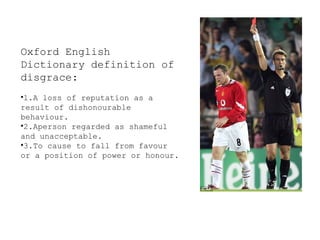
Oxford English
Dictionary definition of
disgrace:
•1.A loss of reputation as a
result of dishonourable
behaviour.
•2.Aperson regarded as shameful
and unacceptable.
•3.To cause to fall from favour
or a position of power or honour.
Disgrace and Coetzee’s
vision of post-apartheid
South Africa:
• The death of Western languages

and intellectualism:
P95 “He

speaks Italian, he speaks French but
[neither]...will not save him here in darkest
Africa. He is helpless, an Aunt Sally, a figure
from a cartoon.

•P117

More and more he is convinced that
English is an unfit medium for the truth of
South Africa. Stretches of English code whole
sentences have thickened, lost their
articulations,...Like a dinosaur expiring in
the mud, the language has stiffened.
•
•The end of the Plaatsronan, Farm novel
subgenre of South African literature.
The disgrace of the AIDS
epidemic in South Africa:
•Over 10% of South Africa’s population is believed to be
infected with the virus and this explains why David’s
first fear was not of pregnancy but of HIV (105)
•A fear that is aggravated when Lucy tells him that she
thinks of the three as frequent rapists (158), and he
continually questions whether she has taken care of all
eventualities and she lies to him numerous times (125),
as the reader discovers towards the novels conclusion
(198), although a HIV test seems to have been taken.
•Indeed the treatment and state of the dogs present in
Disgrace can be argued to be a metaphysical allegory for
the under resourced way that AIDS is being treated in
South Africa, where those who have contracted the
disease have limited access to medication in much the
same way that Bev lacks even the most basic pain killers
for the dogs who ‘visit’ her clinic.
The disgrace of policing in South
Africa:
•By turning Lucy into a victim of a rape, Coetzee
clearly points the finger at the result of bad policing
in South Africa, where rapists can be almost certain of
escaping without conviction
•In light of this Lucy may be right when she assumes
that her perpetrators are “rapists first and foremost”
(158), who use their victims like “dogs in a pack” (159)
•When David re-enters Cape Town after his first visit to
Lucy, his house has been “visited” (176)
•David describes the break-in as “another incident in
the great campaign of redistribution” (176)
•Then there is also Ettinger, Lucy’s neighbour who has
turned his farm into a small fortress, for whom David
predicts a future with a “bullet in his back”, which
further illustrates what a dangerous country South
Africa is (204)
The disgrace of policing in South
Africa:
•When the police comes to Lucy’s farm, they miss important evidence (109)
•When the police informs David that his stolen car has been retrieved (153), they
have not only left the suspects out of custody before David has a chance to
identify them, but have also mixed up his case with another, as the retrieved car is
not his.
•Lucy knows that there is no hope that the police would catch the intruders in its
current state and by this gives a first hint why she might not have reported the
crime in the first place. Earlier in the plot she stated, concerning her rape, that “in
another time, in another place it might be held to be a public matter. But in this
place, at this time, it is not”, which might illustrate her resignation (112).
The failure of the Rainbow Nation?:

•In his most open criticism Coetzee attributes the
crimes in Disgrace to the failure of the Rainbow
Nation as all crimes involve Blacks as criminals
and Whites as victims. The burglary of his house is
part of the redistribution (176)
•There are other hints of a failure of the rainbow
ideology. When David spies on Pollux, one of the
three intruders, at Petrus’ party, he “lifts a hand
to his white skullcap. For the first time he is
glad to have it, to wear it as his own” (135) and
clearly sets himself apart by these thoughts.
•Not only David thinks in terms such as “we” and
“them”, as Petrus justifies his taking care of
Pollux by stating that Pollux is part of his
family, his people (201).
The incompatibility of cultures in South
Africa:
•The sheep are kept on a bare patch of ground next to
Petrus’ stable, even though they could have been
placed on a patch of grass as well (123)
•David, who feels sorry for the animals, moves them to a nearby dam
where they can graze, but Petrus moves them back to the miserable
patch of land where he had put them before (125)
•In this context, a passage from J.M. Coetzee’s “Elizabeth Costello” can
be used to underline the cultural conflict at hand. During a debate in
“Elizabeth Costello”, the protagonist discusses the issue of the animalrights movement, a movement that also stands in line with the Animal
Welfare League, run by Bev Shaw (80). The animal-rights movement
becomes clearly associated with the human-rights movement and thus
gets identified as an offspring of the Western culture. Blind to other
traditions, the Western societies try to impose their ideology on other
cultures and force justified resistance, the reader gets to know during
the debate taking place in “Elizabeth Costello”. Coetzee, J.M., 2003,
Elizabeth Costello: Eight Lessons, Secker & Warburg, London, pp 105106
Petrus the future of the South
African countryside?
•If Lucy is to remain on the land it is on his terms (203)
•Colonialism and its disruption have created the opportunities that Petrus
exploits. Petrus uses his concept of family, especially the simple and violent
Pollux to wreak violence against the Luries, and invokes the same concept to
protect the perpetrators (201)
•“in this place, at this time” (112)
•Coetzee’s portrayal of Petrus’s motives and success aims directly at a
fundamental prejudice of white South Africans. Whites want to believe that
where they cannot take possession of the land, no-one can. The prejudice
regarding colonialism is that the colonial presence is temporary, a fact that
David acknowledges with his constant questioning of Lucy’s presence there.
Petrus is aware of this and wants Lucy’s land for his own. Petrus brings about
an inversion of the norms of apartheid to register his land claim.
Melanie Isaacs the future of urban
South Africa?:

•“close cropped black hair, wide almost Chinese
cheekbones, large, dark eyes” (11)
•“Ms M Isaacs has withdrawn from COM
312 with immediate effect.” (36)
•“a fashionable entertainment spot”, “positively
gifted” (191)
•That Melanie’s talent shines in a formulaic
comedy set in a hairdressing salon in the now
racially integrated Jo’burg (23) reinforces the point
made by Coetzee’s writing of Disgrace, that there
is room for art, which reflects our way of life to
ourselves and with such an opportunity there is
hope even in a disgraced nation. David may be
unable to find salvation in his failed operetta, but
perhaps Melanie, and more importantly South
Africa will. This is the hope that Melanie and by
extension Disgrace instantiates.
In conclusion:

I believe it is justifiable to believe that Coetzee’s main aim in
Disgrace was to show the disgraceful state of South Africa in
1999. Although in apartheid itself, measured by the same
standards it would be seen to be in disgrace. A state in which it
remains, even though it will soon stage the World Cup. However
there are signs within the novel that there is hope that South
Africa will return to a state of grace and fulfil Mandela’s dream
of a rainbow nation, in the form of Melanie, Petrus and to a
lesser extent Lucy, except that it will not be on Western
landliche terms and there will be no losung or simple solutions.

Disgrace presentation

  • 1.
    How is thetitular theme of disgrace applied to J.M. Coetzee’s vision of post-apartheid South Africa? Is there any hope for South Africa? Disgrace J.M. Coetzee : A presentation
  • 2.
    Oxford English Dictionary definitionof disgrace: •1.A loss of reputation as a result of dishonourable behaviour. •2.Aperson regarded as shameful and unacceptable. •3.To cause to fall from favour or a position of power or honour.
  • 3.
    Disgrace and Coetzee’s visionof post-apartheid South Africa: • The death of Western languages and intellectualism: P95 “He speaks Italian, he speaks French but [neither]...will not save him here in darkest Africa. He is helpless, an Aunt Sally, a figure from a cartoon. •P117 More and more he is convinced that English is an unfit medium for the truth of South Africa. Stretches of English code whole sentences have thickened, lost their articulations,...Like a dinosaur expiring in the mud, the language has stiffened. • •The end of the Plaatsronan, Farm novel subgenre of South African literature.
  • 4.
    The disgrace ofthe AIDS epidemic in South Africa: •Over 10% of South Africa’s population is believed to be infected with the virus and this explains why David’s first fear was not of pregnancy but of HIV (105) •A fear that is aggravated when Lucy tells him that she thinks of the three as frequent rapists (158), and he continually questions whether she has taken care of all eventualities and she lies to him numerous times (125), as the reader discovers towards the novels conclusion (198), although a HIV test seems to have been taken. •Indeed the treatment and state of the dogs present in Disgrace can be argued to be a metaphysical allegory for the under resourced way that AIDS is being treated in South Africa, where those who have contracted the disease have limited access to medication in much the same way that Bev lacks even the most basic pain killers for the dogs who ‘visit’ her clinic.
  • 5.
    The disgrace ofpolicing in South Africa: •By turning Lucy into a victim of a rape, Coetzee clearly points the finger at the result of bad policing in South Africa, where rapists can be almost certain of escaping without conviction •In light of this Lucy may be right when she assumes that her perpetrators are “rapists first and foremost” (158), who use their victims like “dogs in a pack” (159) •When David re-enters Cape Town after his first visit to Lucy, his house has been “visited” (176) •David describes the break-in as “another incident in the great campaign of redistribution” (176) •Then there is also Ettinger, Lucy’s neighbour who has turned his farm into a small fortress, for whom David predicts a future with a “bullet in his back”, which further illustrates what a dangerous country South Africa is (204)
  • 6.
    The disgrace ofpolicing in South Africa: •When the police comes to Lucy’s farm, they miss important evidence (109) •When the police informs David that his stolen car has been retrieved (153), they have not only left the suspects out of custody before David has a chance to identify them, but have also mixed up his case with another, as the retrieved car is not his. •Lucy knows that there is no hope that the police would catch the intruders in its current state and by this gives a first hint why she might not have reported the crime in the first place. Earlier in the plot she stated, concerning her rape, that “in another time, in another place it might be held to be a public matter. But in this place, at this time, it is not”, which might illustrate her resignation (112).
  • 7.
    The failure ofthe Rainbow Nation?: •In his most open criticism Coetzee attributes the crimes in Disgrace to the failure of the Rainbow Nation as all crimes involve Blacks as criminals and Whites as victims. The burglary of his house is part of the redistribution (176) •There are other hints of a failure of the rainbow ideology. When David spies on Pollux, one of the three intruders, at Petrus’ party, he “lifts a hand to his white skullcap. For the first time he is glad to have it, to wear it as his own” (135) and clearly sets himself apart by these thoughts. •Not only David thinks in terms such as “we” and “them”, as Petrus justifies his taking care of Pollux by stating that Pollux is part of his family, his people (201).
  • 8.
    The incompatibility ofcultures in South Africa: •The sheep are kept on a bare patch of ground next to Petrus’ stable, even though they could have been placed on a patch of grass as well (123) •David, who feels sorry for the animals, moves them to a nearby dam where they can graze, but Petrus moves them back to the miserable patch of land where he had put them before (125) •In this context, a passage from J.M. Coetzee’s “Elizabeth Costello” can be used to underline the cultural conflict at hand. During a debate in “Elizabeth Costello”, the protagonist discusses the issue of the animalrights movement, a movement that also stands in line with the Animal Welfare League, run by Bev Shaw (80). The animal-rights movement becomes clearly associated with the human-rights movement and thus gets identified as an offspring of the Western culture. Blind to other traditions, the Western societies try to impose their ideology on other cultures and force justified resistance, the reader gets to know during the debate taking place in “Elizabeth Costello”. Coetzee, J.M., 2003, Elizabeth Costello: Eight Lessons, Secker & Warburg, London, pp 105106
  • 9.
    Petrus the futureof the South African countryside? •If Lucy is to remain on the land it is on his terms (203) •Colonialism and its disruption have created the opportunities that Petrus exploits. Petrus uses his concept of family, especially the simple and violent Pollux to wreak violence against the Luries, and invokes the same concept to protect the perpetrators (201) •“in this place, at this time” (112) •Coetzee’s portrayal of Petrus’s motives and success aims directly at a fundamental prejudice of white South Africans. Whites want to believe that where they cannot take possession of the land, no-one can. The prejudice regarding colonialism is that the colonial presence is temporary, a fact that David acknowledges with his constant questioning of Lucy’s presence there. Petrus is aware of this and wants Lucy’s land for his own. Petrus brings about an inversion of the norms of apartheid to register his land claim.
  • 10.
    Melanie Isaacs thefuture of urban South Africa?: •“close cropped black hair, wide almost Chinese cheekbones, large, dark eyes” (11) •“Ms M Isaacs has withdrawn from COM 312 with immediate effect.” (36) •“a fashionable entertainment spot”, “positively gifted” (191) •That Melanie’s talent shines in a formulaic comedy set in a hairdressing salon in the now racially integrated Jo’burg (23) reinforces the point made by Coetzee’s writing of Disgrace, that there is room for art, which reflects our way of life to ourselves and with such an opportunity there is hope even in a disgraced nation. David may be unable to find salvation in his failed operetta, but perhaps Melanie, and more importantly South Africa will. This is the hope that Melanie and by extension Disgrace instantiates.
  • 11.
    In conclusion: I believeit is justifiable to believe that Coetzee’s main aim in Disgrace was to show the disgraceful state of South Africa in 1999. Although in apartheid itself, measured by the same standards it would be seen to be in disgrace. A state in which it remains, even though it will soon stage the World Cup. However there are signs within the novel that there is hope that South Africa will return to a state of grace and fulfil Mandela’s dream of a rainbow nation, in the form of Melanie, Petrus and to a lesser extent Lucy, except that it will not be on Western landliche terms and there will be no losung or simple solutions.