Location
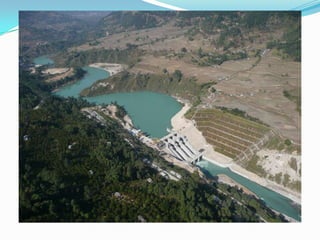
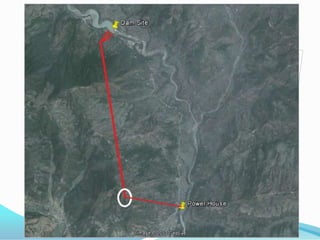
 Powerhouse and headworks is located at Suindibar (14
  km before Besisahar).
 Dam Site: Besisahar (4 km before Besisahar).
 Elevation: 760m (2,490 ft)
 40 km upstream of the existing Lower Marsyangdi
  Hydropower Plant.
Construction
 Project Initiation: 2001
 Project Completed: 2007
 Project was financially and technically supported by
  Germany.
General Info
 Run-of-river type with daily pondage of 5 hours
    peaking.
   Second largest hydro-electric project.
   Max. gross head: 110m
   Net head: 98m
   Installed Capacity: 70MW(two 35MW turbines)
   Annual average energy: 398 GWh
Dam, Spillway and Intake
             Structures
 Type of dam: combined concrete gravity and rockfill
  dam.
 34.5m height above foundation.
 Power tunnel length
   Low pressure: 5,230m(between desander outlet and
    surge tank)
   High pressure: 225m (between surge tank and discharge
    measurement chamber)
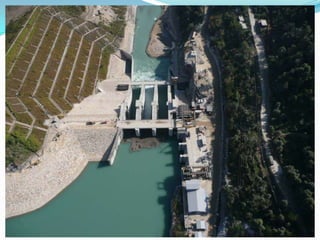
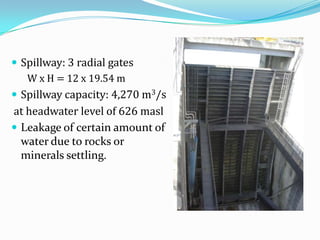
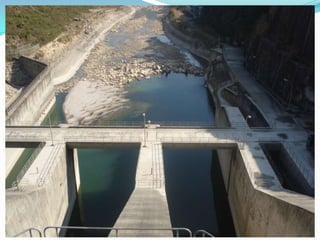
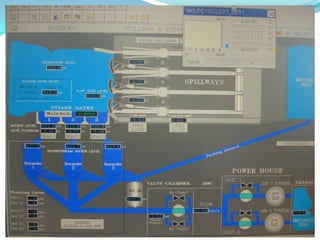
 Spillway: 3 radial gates
   W x H = 12 x 19.54 m
 Spillway capacity: 4,270 m3/s
at headwater level of 626 masl
 Leakage of certain amount of
  water due to rocks or
  minerals settling.
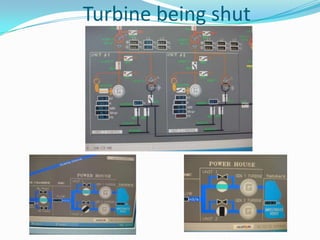
Turbine being shut
Surge Tank & Penstock
 Vertical, circular surge tank with net diameter 20m.
 Height 45 m


 1 concrete cased steel pipe Penstock.
 Length: 212-218m (between discharge
  measurement chamber
  and turbine inlet valve)
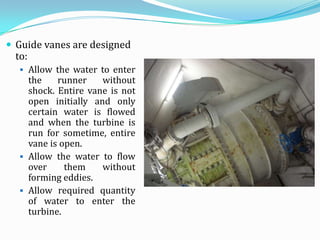
 Guide vanes are designed
 to:
   Allow the water to enter
    the    runner    without
    shock. Entire vane is not
    open initially and only
    certain water is flowed
    and when the turbine is
    run for sometime, entire
    vane is open.
   Allow the water to flow
    over     them    without
    forming eddies.
   Allow required quantity
    of water to enter the
    turbine.
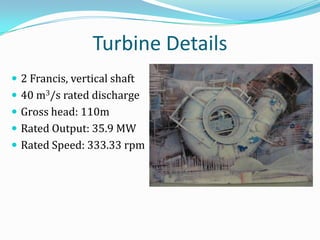
Turbine Details
 2 Francis, vertical shaft
 40 m3/s rated discharge
 Gross head: 110m
 Rated Output: 35.9 MW
 Rated Speed: 333.33 rpm
 Erosion in turbines are many due to cavitation.
 Cavitation is the formation of bubbles filled with
 vapours within the body of moving liquid. It causes:
   Noise and vibration of various parts.
   Causes pitting (erosion of material) making the surface
    rough.
   Reduction in discharge which causes suddent drop in
    power output and efficiency.
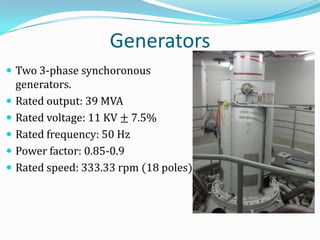
Generators
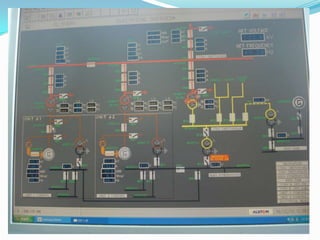
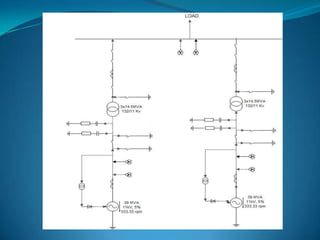
 Two 3-phase synchoronous
    generators.
   Rated output: 39 MVA
   Rated voltage: 11 KV ± 7.5%
   Rated frequency: 50 Hz
   Power factor: 0.85-0.9
   Rated speed: 333.33 rpm (18 poles)
Excitation System
 Consists of autonomic voltage regulator (AVR), exciter,
    measuring elements, power system stabilizer (PSS) and
    limitation and protection unit.
   Exciter is required to provide necessary field current to the
    rotor winding of a sync. machine.
   Exciter has its field winding in the stator, and armature
    winding in the rotor.
   Exciter is controlled by the AVR, which is very effective
    during steady-state operation, but, in case of sudden
    disturbances it may have negative influence on the damping
    of power swings, because then it forces field current changes
    in the generator.
   This may be eliminated by introducing the power system
    stabilizer (PSS).
 Here, STATIC excitation (self-excited) DC system is
    used.
   It consists of thyristor or transistor bridge and
    transformer.
   Energy needed for excitation is brought to generator
    field winding via slip-rings with carbon brushes.
   The main disadvantage is that excitation supply
    voltage, and thereby excitation current, depends
    directly on generator output voltage.
   Another problem: large time constant (about 3 sec)
    and commutation difficulties.
Transformers
 Ratio : 132 ∕ √3 : 11 KV
 Total of 5 tr. used: four 3-phase and one 1-phase.
 Rated Power: 14.5 MVA
 Forced oil type transformers. Oil is circulated by pump
  from the top of the transformer tank to a cooling plant.
 For regulating the voltage, load tap changers are
  provided.
 Oil/air heat exchanger used.
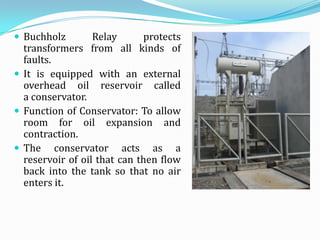
 Buchholz        Relay      protects
  transformers from all kinds of
  faults.
 It is equipped with an external
  overhead oil reservoir called
  a conservator.
 Function of Conservator: To allow
  room for oil expansion and
  contraction.
 The conservator acts as a
  reservoir of oil that can then flow
  back into the tank so that no air
  enters it.
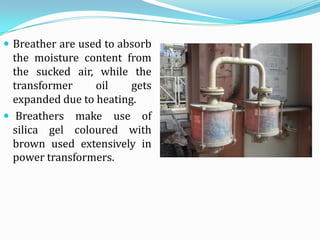
 Breather are used to absorb
  the moisture content from
  the sucked air, while the
  transformer     oil    gets
  expanded due to heating.
 Breathers make use of
  silica gel coloured with
  brown used extensively in
  power transformers.
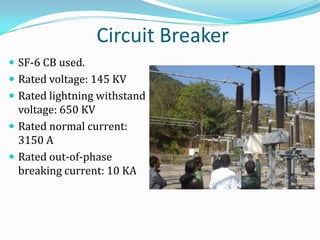
Circuit Breaker
 SF-6 CB used.
 Rated voltage: 145 KV
 Rated lightning withstand
  voltage: 650 KV
 Rated normal current:
  3150 A
 Rated out-of-phase
  breaking current: 10 KA
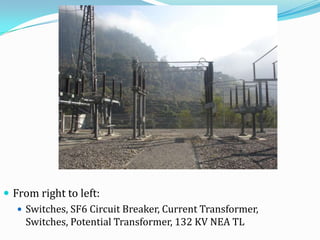
 From right to left:
    Switches, SF6 Circuit Breaker, Current Transformer,
     Switches, Potential Transformer, 132 KV NEA TL
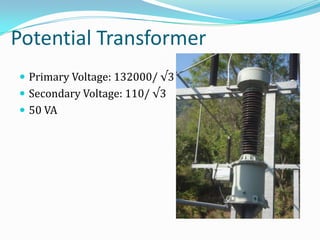
Potential Transformer
 Primary Voltage: 132000/ √3
 Secondary Voltage: 110/ √3
 50 VA
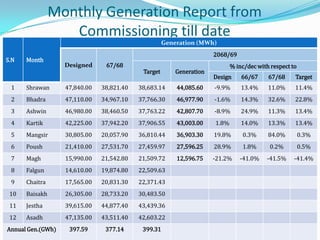
Monthly Generation Report from
                   Commissioning till date
                                                     Generation (MWh)
                                                                      2068/69
S.N   Month
                   Designed     67/68                                        % inc/dec with respect to
                                            Target       Generation
                                                                      Design     66/67     67/68     Target
 1    Shrawan      47,840.00   38,821.40   38,683.14     44,085.60    -9.9%      13.4%     11.0%     11.4%
 2    Bhadra       47,110.00   34,967.10   37,766.30     46,977.90    -1.6%      14.3%     32.6%     22.8%
 3    Ashwin       46,980.00   38,460.50   37,763.22     42,807.70    -8.9%      24.9%     11.3%     13.4%
 4    Kartik       42,225.00   37,942.20   37,906.55     43,003.00    1.8%       14.0%     13.3%     13.4%
 5    Mangsir      30,805.00   20,057.90   36,810.44     36,903.30    19.8%      0.3%      84.0%         0.3%
 6    Poush        21,410.00   27,531.70   27,459.97     27,596.25    28.9%      1.8%      0.2%          0.5%
 7    Magh         15,990.00   21,542.80   21,509.72     12,596.75    -21.2%    -41.0%    -41.5%     -41.4%
 8    Falgun       14,610.00   19,874.80   22,509.63
 9    Chaitra      17,565.00   20,831.30   22,371.43
 10   Baisakh      26,305.00   28,733.20   30,483.50
 11   Jestha       39,615.00   44,877.40   43,439.36
 12   Asadh        47,135.00   43,511.40   42,603.22
Annual Gen.(GWh)    397.59      377.14      399.31
Fault Sheet and Log
Presented by:
       Bhavin Pradhan
       Bishnu Dawadi
       Kalyan Shrestha
        Kishwor Karki
       Umesh Gurung
       Roshan Gurung

DEPARTMENT OF ELECTRICAL
       ENGINEERING
Kathmandu Engineering College

Middle marshyangdi hydro power plant

  • 3.
    Location  Powerhouse andheadworks is located at Suindibar (14 km before Besisahar).  Dam Site: Besisahar (4 km before Besisahar).  Elevation: 760m (2,490 ft)  40 km upstream of the existing Lower Marsyangdi Hydropower Plant.
  • 4.
    Construction  Project Initiation:2001  Project Completed: 2007  Project was financially and technically supported by Germany.
  • 5.
    General Info  Run-of-rivertype with daily pondage of 5 hours peaking.  Second largest hydro-electric project.  Max. gross head: 110m  Net head: 98m  Installed Capacity: 70MW(two 35MW turbines)  Annual average energy: 398 GWh
  • 7.
    Dam, Spillway andIntake Structures  Type of dam: combined concrete gravity and rockfill dam.  34.5m height above foundation.  Power tunnel length  Low pressure: 5,230m(between desander outlet and surge tank)  High pressure: 225m (between surge tank and discharge measurement chamber)
  • 9.
     Spillway: 3radial gates W x H = 12 x 19.54 m  Spillway capacity: 4,270 m3/s at headwater level of 626 masl  Leakage of certain amount of water due to rocks or minerals settling.
  • 13.
  • 14.
    Surge Tank &Penstock  Vertical, circular surge tank with net diameter 20m.  Height 45 m  1 concrete cased steel pipe Penstock.  Length: 212-218m (between discharge measurement chamber and turbine inlet valve)
  • 15.
     Guide vanesare designed to:  Allow the water to enter the runner without shock. Entire vane is not open initially and only certain water is flowed and when the turbine is run for sometime, entire vane is open.  Allow the water to flow over them without forming eddies.  Allow required quantity of water to enter the turbine.
  • 16.
    Turbine Details  2Francis, vertical shaft  40 m3/s rated discharge  Gross head: 110m  Rated Output: 35.9 MW  Rated Speed: 333.33 rpm
  • 17.
     Erosion inturbines are many due to cavitation.  Cavitation is the formation of bubbles filled with vapours within the body of moving liquid. It causes:  Noise and vibration of various parts.  Causes pitting (erosion of material) making the surface rough.  Reduction in discharge which causes suddent drop in power output and efficiency.
  • 18.
    Generators  Two 3-phasesynchoronous generators.  Rated output: 39 MVA  Rated voltage: 11 KV ± 7.5%  Rated frequency: 50 Hz  Power factor: 0.85-0.9  Rated speed: 333.33 rpm (18 poles)
  • 19.
    Excitation System  Consistsof autonomic voltage regulator (AVR), exciter, measuring elements, power system stabilizer (PSS) and limitation and protection unit.  Exciter is required to provide necessary field current to the rotor winding of a sync. machine.  Exciter has its field winding in the stator, and armature winding in the rotor.  Exciter is controlled by the AVR, which is very effective during steady-state operation, but, in case of sudden disturbances it may have negative influence on the damping of power swings, because then it forces field current changes in the generator.  This may be eliminated by introducing the power system stabilizer (PSS).
  • 20.
     Here, STATICexcitation (self-excited) DC system is used.  It consists of thyristor or transistor bridge and transformer.  Energy needed for excitation is brought to generator field winding via slip-rings with carbon brushes.  The main disadvantage is that excitation supply voltage, and thereby excitation current, depends directly on generator output voltage.  Another problem: large time constant (about 3 sec) and commutation difficulties.
  • 22.
    Transformers  Ratio :132 ∕ √3 : 11 KV  Total of 5 tr. used: four 3-phase and one 1-phase.  Rated Power: 14.5 MVA  Forced oil type transformers. Oil is circulated by pump from the top of the transformer tank to a cooling plant.  For regulating the voltage, load tap changers are provided.  Oil/air heat exchanger used.
  • 23.
     Buchholz Relay protects transformers from all kinds of faults.  It is equipped with an external overhead oil reservoir called a conservator.  Function of Conservator: To allow room for oil expansion and contraction.  The conservator acts as a reservoir of oil that can then flow back into the tank so that no air enters it.
  • 24.
     Breather areused to absorb the moisture content from the sucked air, while the transformer oil gets expanded due to heating.  Breathers make use of silica gel coloured with brown used extensively in power transformers.
  • 25.
    Circuit Breaker  SF-6CB used.  Rated voltage: 145 KV  Rated lightning withstand voltage: 650 KV  Rated normal current: 3150 A  Rated out-of-phase breaking current: 10 KA
  • 26.
     From rightto left:  Switches, SF6 Circuit Breaker, Current Transformer, Switches, Potential Transformer, 132 KV NEA TL
  • 28.
    Potential Transformer  PrimaryVoltage: 132000/ √3  Secondary Voltage: 110/ √3  50 VA
  • 29.
    Monthly Generation Reportfrom Commissioning till date Generation (MWh) 2068/69 S.N Month Designed 67/68 % inc/dec with respect to Target Generation Design 66/67 67/68 Target 1 Shrawan 47,840.00 38,821.40 38,683.14 44,085.60 -9.9% 13.4% 11.0% 11.4% 2 Bhadra 47,110.00 34,967.10 37,766.30 46,977.90 -1.6% 14.3% 32.6% 22.8% 3 Ashwin 46,980.00 38,460.50 37,763.22 42,807.70 -8.9% 24.9% 11.3% 13.4% 4 Kartik 42,225.00 37,942.20 37,906.55 43,003.00 1.8% 14.0% 13.3% 13.4% 5 Mangsir 30,805.00 20,057.90 36,810.44 36,903.30 19.8% 0.3% 84.0% 0.3% 6 Poush 21,410.00 27,531.70 27,459.97 27,596.25 28.9% 1.8% 0.2% 0.5% 7 Magh 15,990.00 21,542.80 21,509.72 12,596.75 -21.2% -41.0% -41.5% -41.4% 8 Falgun 14,610.00 19,874.80 22,509.63 9 Chaitra 17,565.00 20,831.30 22,371.43 10 Baisakh 26,305.00 28,733.20 30,483.50 11 Jestha 39,615.00 44,877.40 43,439.36 12 Asadh 47,135.00 43,511.40 42,603.22 Annual Gen.(GWh) 397.59 377.14 399.31
  • 30.
  • 31.
    Presented by: Bhavin Pradhan Bishnu Dawadi Kalyan Shrestha Kishwor Karki Umesh Gurung Roshan Gurung DEPARTMENT OF ELECTRICAL ENGINEERING Kathmandu Engineering College