B.P MANDAL COLLEGE OF ENGINEERING, MADHEPURA
( DEPT. OF SCIENCE & TECHNOLOGY, GOVT. OF BIHAR )
A PRESENTATION OF SUMMER INTERNSHIP TRAINING IN
“NTPC Barh Super Thermal Power Station”
SUBMITTED BY- RAHUL
RAJ
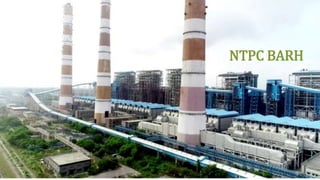
NTPC BARH
 NTPC Limited – Largest power generation company in India.
 Founded by Government of India on November 7 1975.
 Contributing about 26% of country’s entire power generation.
 NTPC currently operates 55 power stations out of which 24 Coal, 7 combined cycle
gas/liquid fuel, 2 Hydro, 1 Wind, and 11 solar projects.
 It is the largest power company in India with an electric power generating capacity of
67,907 MW.
 NTPC currently produces 25 billion units of electricity per month.
 NTPC has been ranked as No. 1 buyer by GeM under CPSE category. NTPC has
been adjudged 14th in Fortune's 2020 rankings for Top 500 Corporations in India.
BSTPP : BARH SUPER THERMAL POWER PLANT
Capacity : 1980MW (3x 660) in Stage-1 is being built by Russian firm
Technopromexport.
1320MW (2x660) in Stage 2 built by BHEL.
Generators: Supplied by SIEMENS.
Coal Supply: Hazaribagh Coal Mine requirement is around 15 million tons per annum.
Water Requirement : From river Ganga.
Beneficiary States: Majorly Bihar and some states of Northern and western regions of
india.
Land Requirement : Approx 1200 acres of Lands.
Location : NTPC Barh is located barely four kilometres (2.5 mi) east of the Barh sub-
division on National Highway-31 in Patna district.
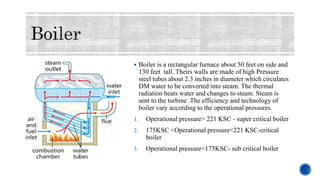
 Boiler is a rectangular furnace about 50 feet on side and
130 feet tall. Theirs walls are made of high Pressure
steel tubes about 2.3 inches in diameter which circulates
DM water to be converted into steam. The thermal
radiation heats water and changes to steam. Steam is
sent to the turbine .The efficiency and technology of
boiler vary according to the operational pressures.
1. Operational pressure> 221 KSC - super critical boiler
2. 175KSC <Operational pressure<221 KSC-critical
boiler
3. Operational pressure<175KSC- sub critical boiler
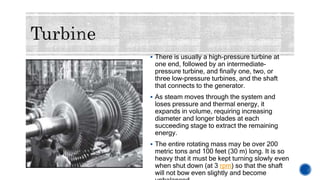
 There is usually a high-pressure turbine at
one end, followed by an intermediate-
pressure turbine, and finally one, two, or
three low-pressure turbines, and the shaft
that connects to the generator.
 As steam moves through the system and
loses pressure and thermal energy, it
expands in volume, requiring increasing
diameter and longer blades at each
succeeding stage to extract the remaining
energy.
 The entire rotating mass may be over 200
metric tons and 100 feet (30 m) long. It is so
heavy that it must be kept turning slowly even
when shut down (at 3 rpm) so that the shaft
will not bow even slightly and become
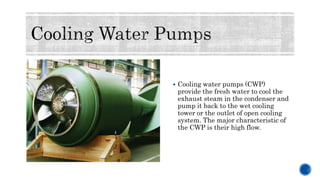
 Cooling water pumps (CWP)
provide the fresh water to cool the
exhaust steam in the condenser and
pump it back to the wet cooling
tower or the outlet of open cooling
system. The major characteristic of
the CWP is their high flow.
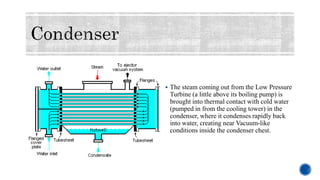
 The steam coming out from the Low Pressure
Turbine (a little above its boiling pump) is
brought into thermal contact with cold water
(pumped in from the cooling tower) in the
condenser, where it condenses rapidly back
into water, creating near Vacuum-like
conditions inside the condenser chest.
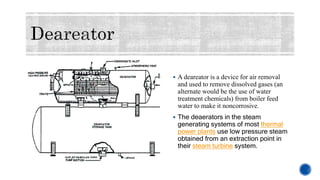
 A deareator is a device for air removal
and used to remove dissolved gases (an
alternate would be the use of water
treatment chemicals) from boiler feed
water to make it noncorrosive.
 The deaerators in the steam
generating systems of most thermal
power plants use low pressure steam
obtained from an extraction point in
their steam turbine system.
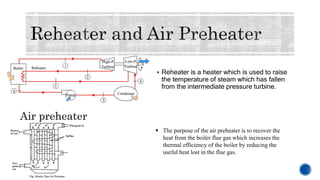
 Reheater is a heater which is used to raise
the temperature of steam which has fallen
from the intermediate pressure turbine.
Air preheater
 The purpose of the air preheater is to recover the
heat from the boiler flue gas which increases the
thermal efficiency of the boiler by reducing the
useful heat lost in the flue gas.
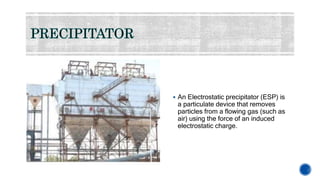
 An Electrostatic precipitator (ESP) is
a particulate device that removes
particles from a flowing gas (such as
air) using the force of an induced
electrostatic charge.
 General Voltage Level
 LT – 415 V
 HT – 11KV & 3.3 KV
 EHT – 400KV
 Voltage generation level (NTPC Barh)
 stage 1 – 24.5kv
 stage 2 – 21.5kv
 voltage level ( power plant)
 5.5kv, 11kv, 132kv,400kv
 Switchyard is considered as the HEART of the Power Plant. Power generated can be
worthy only if it is successfully transmitted and received by its consumers. Switchyard
plays a very important role as a junction between the generation and transmission. It is
a junction, which carries the generated power to its destination (i.e. consumers).
Outdoor Equipment
1. Bus bar
2. Lightening Arrester
3. Wavetrap
4. Breaker
5. Capacitive voltage transformer
6. Earthingrod
7. Current transformer
8. Potential transformer
9. Lightening Mask
Indoor Equipment
1. Relays
2. Control panels’
3. Circuit breakers
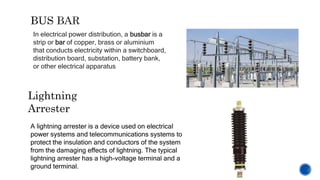
In electrical power distribution, a busbar is a
strip or bar of copper, brass or aluminium
that conducts electricity within a switchboard,
distribution board, substation, battery bank,
or other electrical apparatus
Lightning
Arrester
A lightning arrester is a device used on electrical
power systems and telecommunications systems to
protect the insulation and conductors of the system
from the damaging effects of lightning. The typical
lightning arrester has a high-voltage terminal and a
ground terminal.
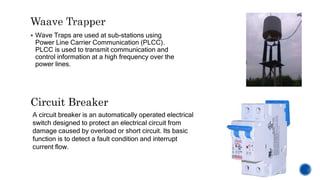
 Wave Traps are used at sub-stations using
Power Line Carrier Communication (PLCC).
PLCC is used to transmit communication and
control information at a high frequency over the
power lines.
Circuit Breaker
A circuit breaker is an automatically operated electrical
switch designed to protect an electrical circuit from
damage caused by overload or short circuit. Its basic
function is to detect a fault condition and interrupt
current flow.
ACB (Air break circuit breaker):-
operated as well asarc quenched through air.
BOCB (Bulk oil circuit breaker):-
arc quenching done through oil(Aerosol fluid oil).
MOCB (Minimum oil circuit breaker):-
arc quenching done through oil(Aerosol fluid oil).
ABCB (Air Blast Circuit Breaker):-
arc quenching done by blast of air
SF6 circuit breaker:-
arc quenching done through SF6 gas.
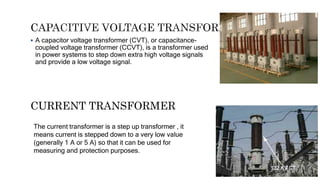
 A capacitor voltage transformer (CVT), or capacitance-
coupled voltage transformer (CCVT), is a transformer used
in power systems to step down extra high voltage signals
and provide a low voltage signal.
CURRENT TRANSFORMER
The current transformer is a step up transformer , it
means current is stepped down to a very low value
(generally 1 A or 5 A) so that it can be used for
measuring and protection purposes.
ISOLATOR
An isolator is one, which can break an electrical circuit when the circuit is to beswitched on no
load. These are normally used in various circuits for the purposes of isolating a certain portion
when required for maintenance etc.
NTPC Barh Training Report .pptx

NTPC Barh Training Report .pptx

  • 1.
    B.P MANDAL COLLEGEOF ENGINEERING, MADHEPURA ( DEPT. OF SCIENCE & TECHNOLOGY, GOVT. OF BIHAR ) A PRESENTATION OF SUMMER INTERNSHIP TRAINING IN “NTPC Barh Super Thermal Power Station” SUBMITTED BY- RAHUL RAJ
  • 2.
  • 3.
     NTPC Limited– Largest power generation company in India.  Founded by Government of India on November 7 1975.  Contributing about 26% of country’s entire power generation.  NTPC currently operates 55 power stations out of which 24 Coal, 7 combined cycle gas/liquid fuel, 2 Hydro, 1 Wind, and 11 solar projects.  It is the largest power company in India with an electric power generating capacity of 67,907 MW.  NTPC currently produces 25 billion units of electricity per month.  NTPC has been ranked as No. 1 buyer by GeM under CPSE category. NTPC has been adjudged 14th in Fortune's 2020 rankings for Top 500 Corporations in India.
  • 4.
    BSTPP : BARHSUPER THERMAL POWER PLANT Capacity : 1980MW (3x 660) in Stage-1 is being built by Russian firm Technopromexport. 1320MW (2x660) in Stage 2 built by BHEL. Generators: Supplied by SIEMENS. Coal Supply: Hazaribagh Coal Mine requirement is around 15 million tons per annum. Water Requirement : From river Ganga. Beneficiary States: Majorly Bihar and some states of Northern and western regions of india. Land Requirement : Approx 1200 acres of Lands. Location : NTPC Barh is located barely four kilometres (2.5 mi) east of the Barh sub- division on National Highway-31 in Patna district.
  • 6.
     Boiler isa rectangular furnace about 50 feet on side and 130 feet tall. Theirs walls are made of high Pressure steel tubes about 2.3 inches in diameter which circulates DM water to be converted into steam. The thermal radiation heats water and changes to steam. Steam is sent to the turbine .The efficiency and technology of boiler vary according to the operational pressures. 1. Operational pressure> 221 KSC - super critical boiler 2. 175KSC <Operational pressure<221 KSC-critical boiler 3. Operational pressure<175KSC- sub critical boiler
  • 7.
     There isusually a high-pressure turbine at one end, followed by an intermediate- pressure turbine, and finally one, two, or three low-pressure turbines, and the shaft that connects to the generator.  As steam moves through the system and loses pressure and thermal energy, it expands in volume, requiring increasing diameter and longer blades at each succeeding stage to extract the remaining energy.  The entire rotating mass may be over 200 metric tons and 100 feet (30 m) long. It is so heavy that it must be kept turning slowly even when shut down (at 3 rpm) so that the shaft will not bow even slightly and become
  • 8.
     Cooling waterpumps (CWP) provide the fresh water to cool the exhaust steam in the condenser and pump it back to the wet cooling tower or the outlet of open cooling system. The major characteristic of the CWP is their high flow.
  • 9.
     The steamcoming out from the Low Pressure Turbine (a little above its boiling pump) is brought into thermal contact with cold water (pumped in from the cooling tower) in the condenser, where it condenses rapidly back into water, creating near Vacuum-like conditions inside the condenser chest.
  • 10.
     A deareatoris a device for air removal and used to remove dissolved gases (an alternate would be the use of water treatment chemicals) from boiler feed water to make it noncorrosive.  The deaerators in the steam generating systems of most thermal power plants use low pressure steam obtained from an extraction point in their steam turbine system.
  • 11.
     Reheater isa heater which is used to raise the temperature of steam which has fallen from the intermediate pressure turbine. Air preheater  The purpose of the air preheater is to recover the heat from the boiler flue gas which increases the thermal efficiency of the boiler by reducing the useful heat lost in the flue gas.
  • 12.
     An Electrostaticprecipitator (ESP) is a particulate device that removes particles from a flowing gas (such as air) using the force of an induced electrostatic charge.
  • 13.
     General VoltageLevel  LT – 415 V  HT – 11KV & 3.3 KV  EHT – 400KV  Voltage generation level (NTPC Barh)  stage 1 – 24.5kv  stage 2 – 21.5kv  voltage level ( power plant)  5.5kv, 11kv, 132kv,400kv
  • 14.
     Switchyard isconsidered as the HEART of the Power Plant. Power generated can be worthy only if it is successfully transmitted and received by its consumers. Switchyard plays a very important role as a junction between the generation and transmission. It is a junction, which carries the generated power to its destination (i.e. consumers). Outdoor Equipment 1. Bus bar 2. Lightening Arrester 3. Wavetrap 4. Breaker 5. Capacitive voltage transformer 6. Earthingrod 7. Current transformer 8. Potential transformer 9. Lightening Mask Indoor Equipment 1. Relays 2. Control panels’ 3. Circuit breakers
  • 15.
    In electrical powerdistribution, a busbar is a strip or bar of copper, brass or aluminium that conducts electricity within a switchboard, distribution board, substation, battery bank, or other electrical apparatus Lightning Arrester A lightning arrester is a device used on electrical power systems and telecommunications systems to protect the insulation and conductors of the system from the damaging effects of lightning. The typical lightning arrester has a high-voltage terminal and a ground terminal.
  • 16.
     Wave Trapsare used at sub-stations using Power Line Carrier Communication (PLCC). PLCC is used to transmit communication and control information at a high frequency over the power lines. Circuit Breaker A circuit breaker is an automatically operated electrical switch designed to protect an electrical circuit from damage caused by overload or short circuit. Its basic function is to detect a fault condition and interrupt current flow.
  • 17.
    ACB (Air breakcircuit breaker):- operated as well asarc quenched through air. BOCB (Bulk oil circuit breaker):- arc quenching done through oil(Aerosol fluid oil). MOCB (Minimum oil circuit breaker):- arc quenching done through oil(Aerosol fluid oil). ABCB (Air Blast Circuit Breaker):- arc quenching done by blast of air SF6 circuit breaker:- arc quenching done through SF6 gas.
  • 18.
     A capacitorvoltage transformer (CVT), or capacitance- coupled voltage transformer (CCVT), is a transformer used in power systems to step down extra high voltage signals and provide a low voltage signal. CURRENT TRANSFORMER The current transformer is a step up transformer , it means current is stepped down to a very low value (generally 1 A or 5 A) so that it can be used for measuring and protection purposes.
  • 19.
    ISOLATOR An isolator isone, which can break an electrical circuit when the circuit is to beswitched on no load. These are normally used in various circuits for the purposes of isolating a certain portion when required for maintenance etc.