hist
ory
of
archit
ect
ure
History of Architecture
Part I- Ancient Architecture
Lecture - VI
hist
ory
of
archit
ect
ure
Early Christian
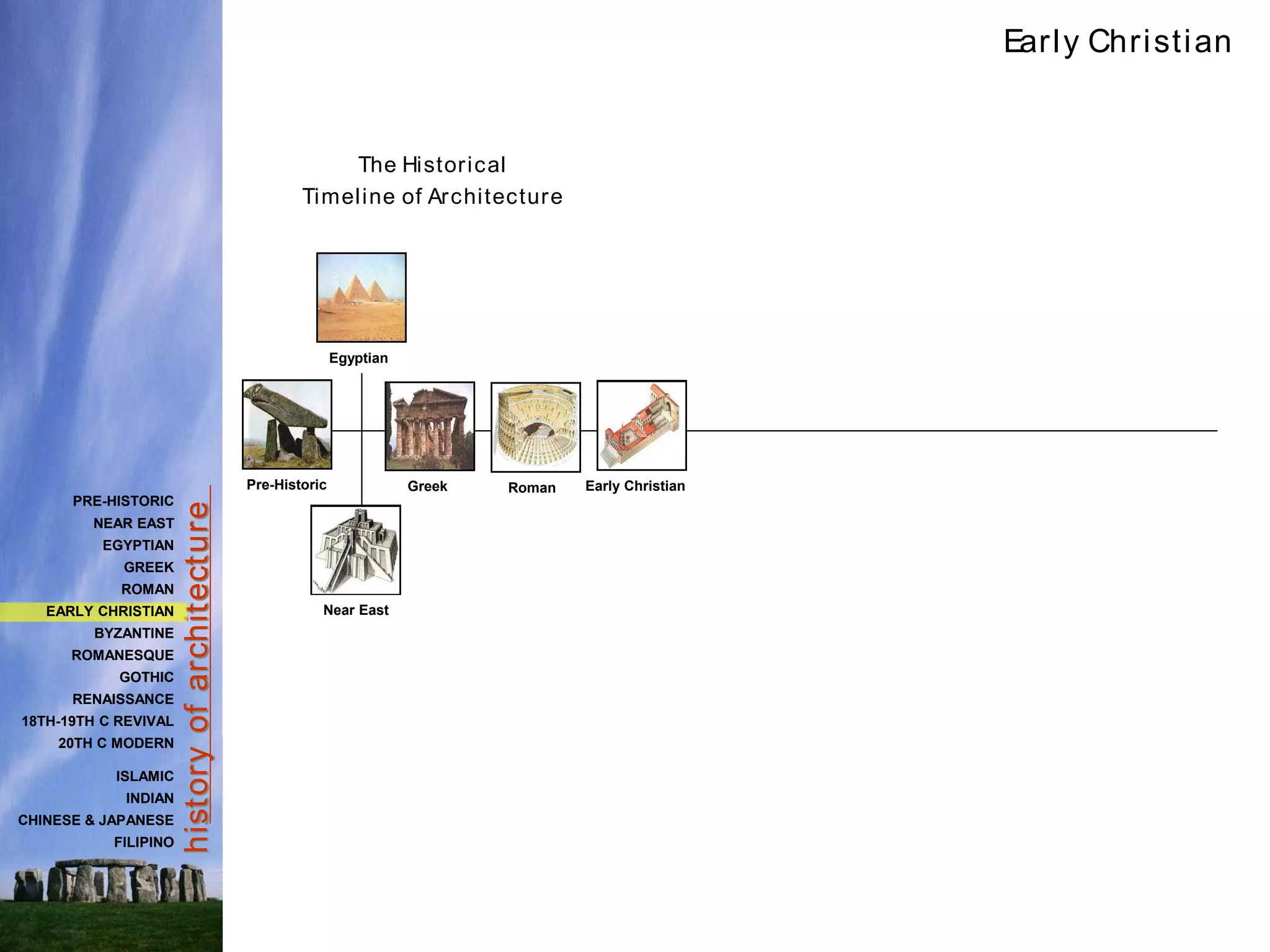
The Historical
Timeline of Architecture
PRE-HISTORIC
NEAR EAST
EGYPTIAN
GREEK
ROMAN
EARLY CHRISTIAN
BYZANTINE
ROMANESQUE
GOTHIC
RENAISSANCE
18TH-19TH C REVIVAL
20TH C MODERN
ISLAMIC
INDIAN
CHINESE & JAPANESE
FILIPINO
Pre-Historic
Egyptian
Near East
Roman Early Christian
Greek
hist
ory
of
archit
ect
ure
INFLUENCES
HISTORY
• In 63 BC, the Romans conquered Judea in the Eastern
Mediterranean
• Main inhabitants were the Jews
• Jews believed that one day the “Messiah” or “Christ”
would free them from the Romans
• In 27 AD, Jesus began preaching to people in Galilee,
north of Judea
• After three years, he was arrested by the Jews and found
guilty of offending their god
• He was nailed to a cross and died a painful death
• He appeared to his disciples after his resurrection from
the dead
• Belief that Jesus was the Christ and the Son of God -
Christianity was born
• Disciples spread stories of Jesus’ life and teaching by
word of mouth and by written account in the new
testament
• Moved from Judea to Antioch in Syria and into the
Northern Mediterranean
• Founded new communities along the way
• Carried by St. Peter, St. Paul and other missionaries to
Rome, the center of the Empire and fountainhead of power
and influence
• Emperor Nero ordered Christians to be fed to wild beasts
or burned to death
• Despite this, in 4th century Rome, Christianity grew
• In 312 AD, Constantine, a converted Christian, named it
the official religion of the Roman empire
• By 600 AD, most roman villages had their own churches,
governed by a bishop
• Patriarchs based in Jerusalem, Alexandria, Antioch,
Constantinople and Rome
GEOGRAPHY & GEOLOGY
• Ruins of Roman buildings served as quarries from which
materials were obtained
Early Christian
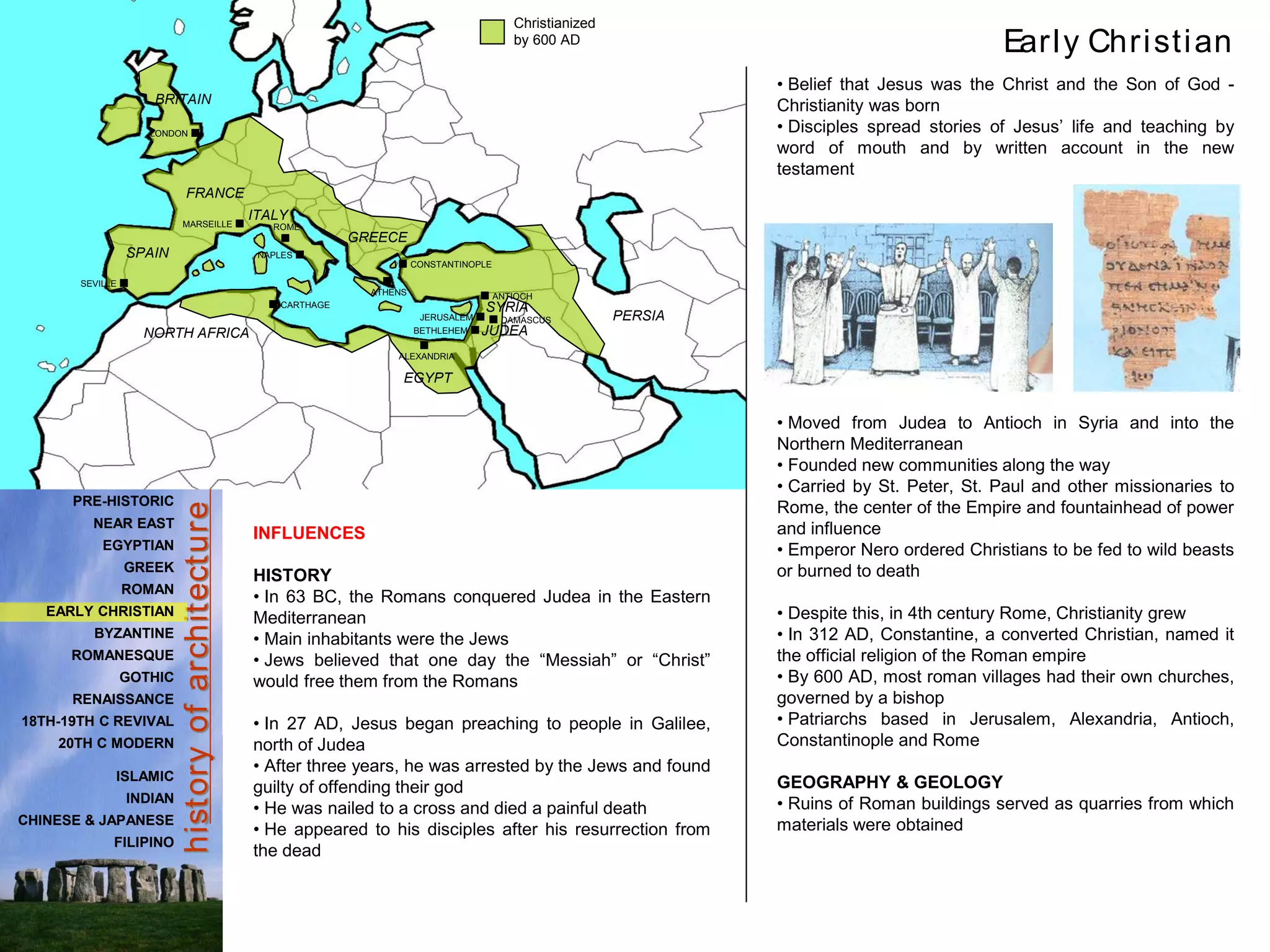
Christianized
by 600 AD
PERSIA
EGYPT
GREECE
FRANCE
SPAIN
NORTH AFRICA
BRITAIN
ITALY
MARSEILLE ROME
CARTHAGE
CONSTANTINOPLE
ANTIOCH
NAPLES
ATHENS
LONDON
SEVILLE
SYRIA
JUDEA
JERUSALEM DAMASCUS
BETHLEHEM
ALEXANDRIA
PRE-HISTORIC
NEAR EAST
EGYPTIAN
GREEK
ROMAN
EARLY CHRISTIAN
BYZANTINE
ROMANESQUE
GOTHIC
RENAISSANCE
18TH-19TH C REVIVAL
20TH C MODERN
ISLAMIC
INDIAN
CHINESE & JAPANESE
FILIPINO
hist
ory
of
archit
ect
ure
ARCHITECTURAL CHARACTER
DESCRIPTION
• Highly-influenced by Roman art and architecture
• This architecture hardly has the architectural value of a
style, simply because it was never really produced by the
solution of constructive problems
ROOF and CEILING
• Further development of trusses - king and queen post
trusses
EXAMPLES
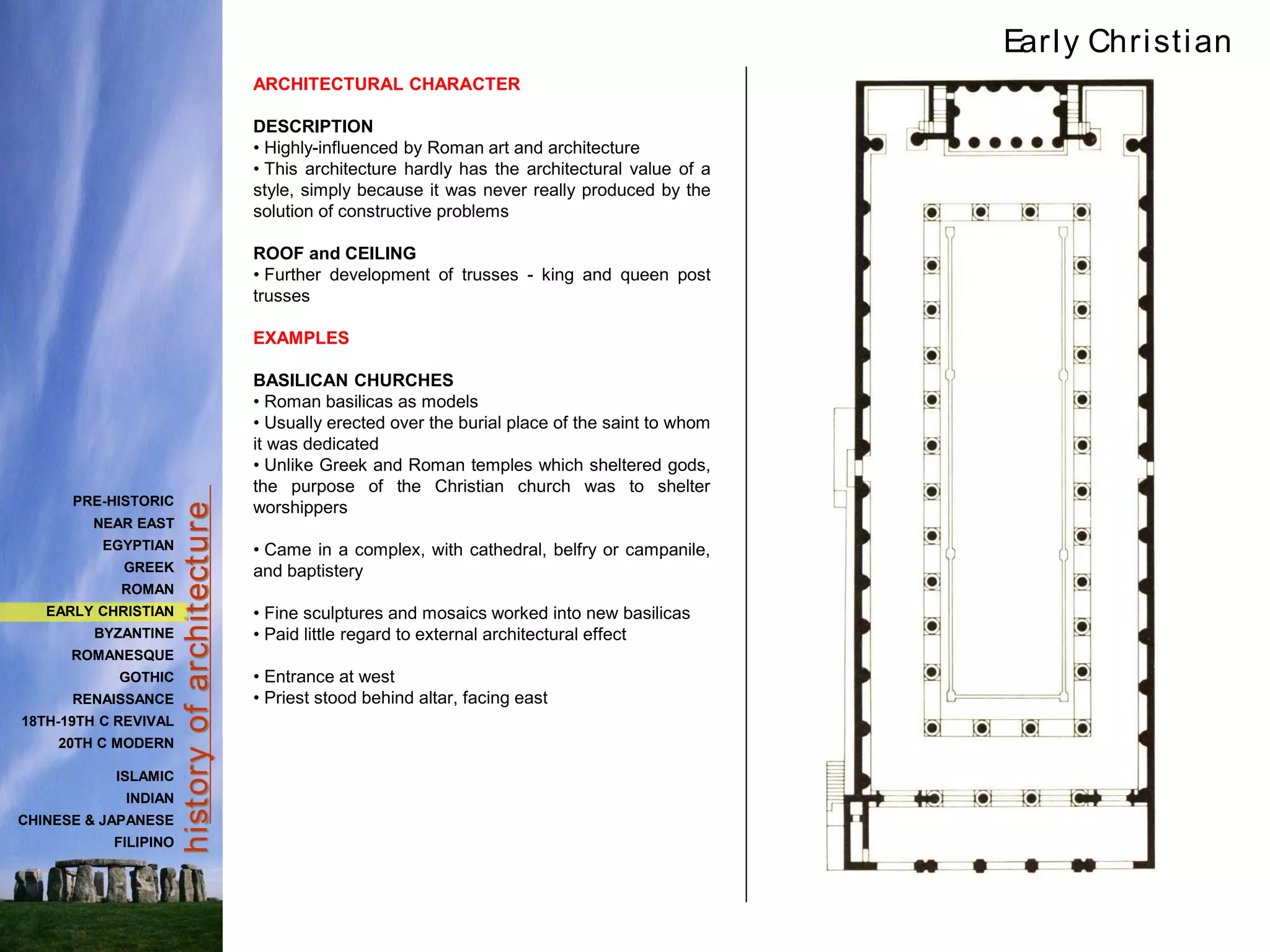
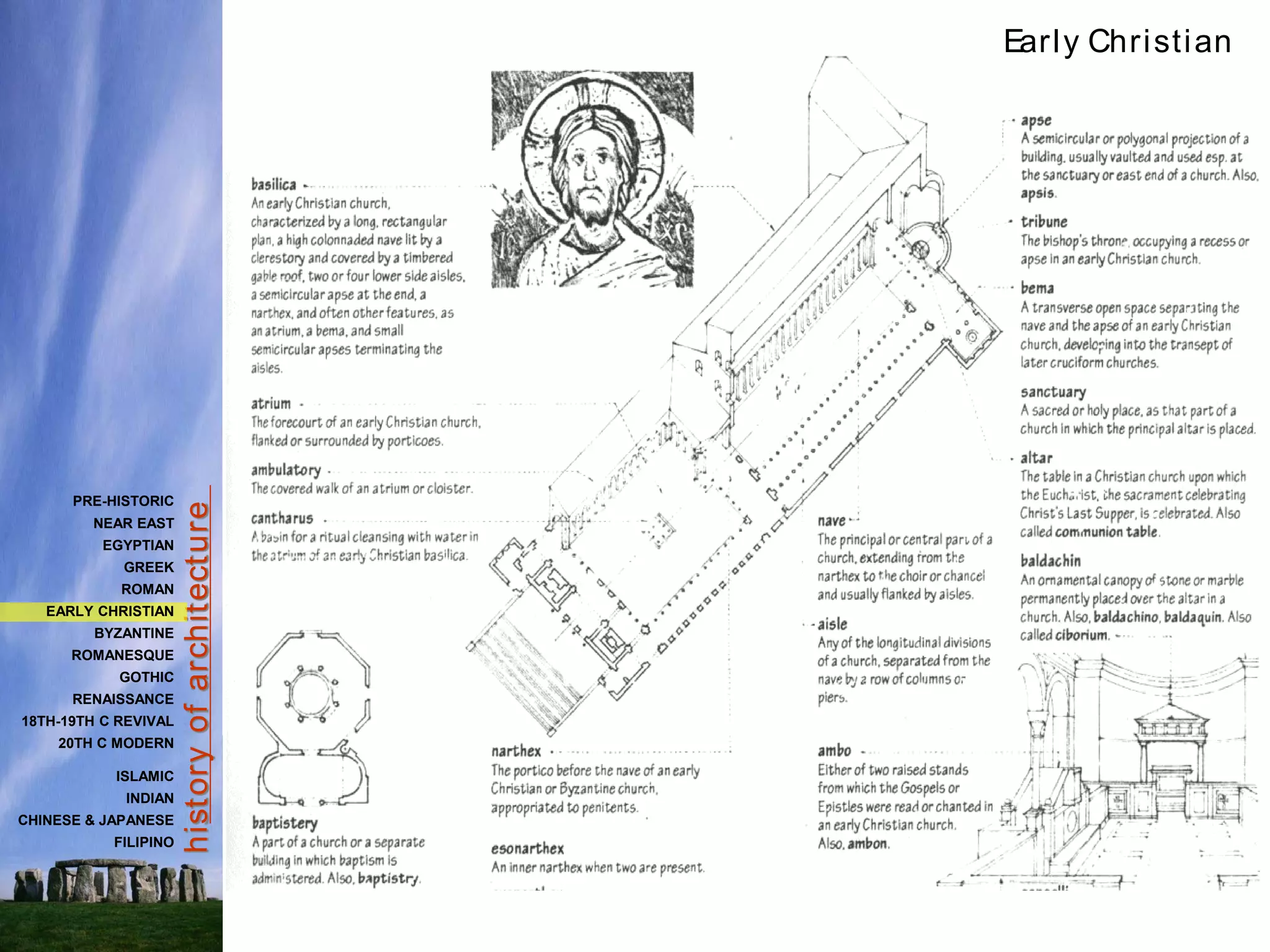
BASILICAN CHURCHES
• Roman basilicas as models
• Usually erected over the burial place of the saint to whom
it was dedicated
• Unlike Greek and Roman temples which sheltered gods,
the purpose of the Christian church was to shelter
worshippers
• Came in a complex, with cathedral, belfry or campanile,
and baptistery
• Fine sculptures and mosaics worked into new basilicas
• Paid little regard to external architectural effect
• Entrance at west
• Priest stood behind altar, facing east
Early Christian
PRE-HISTORIC
NEAR EAST
EGYPTIAN
GREEK
ROMAN
EARLY CHRISTIAN
BYZANTINE
ROMANESQUE
GOTHIC
RENAISSANCE
18TH-19TH C REVIVAL
20TH C MODERN
ISLAMIC
INDIAN
CHINESE & JAPANESE
FILIPINO
hist
ory
of
archit
ect
ure
Early Christian
PRE-HISTORIC
NEAR EAST
EGYPTIAN
GREEK
ROMAN
EARLY CHRISTIAN
BYZANTINE
ROMANESQUE
GOTHIC
RENAISSANCE
18TH-19TH C REVIVAL
20TH C MODERN
ISLAMIC
INDIAN
CHINESE & JAPANESE
FILIPINO
hist
ory
of
archit
ect
ure
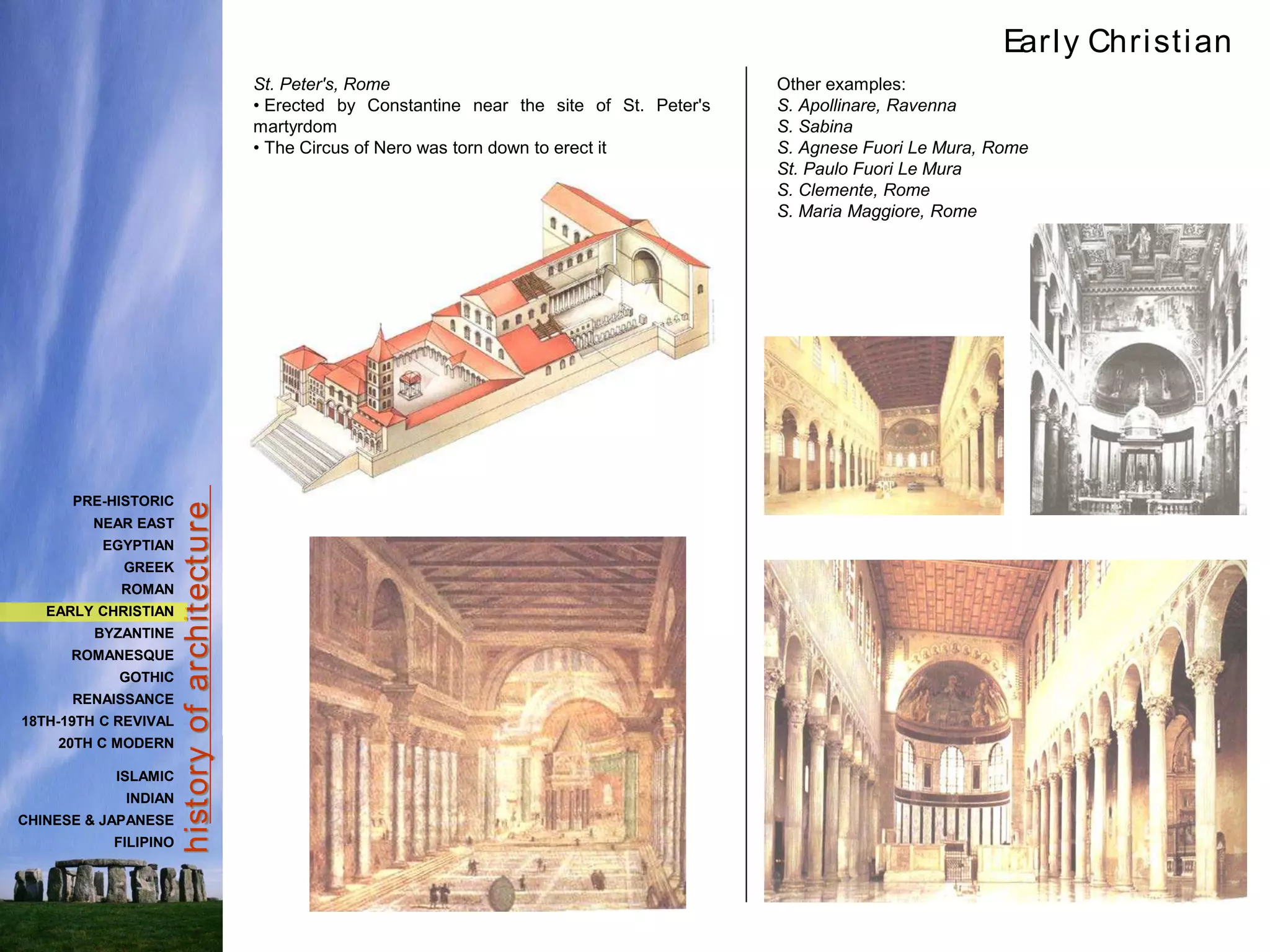
St. Peter's, Rome
• Erected by Constantine near the site of St. Peter's
martyrdom
• The Circus of Nero was torn down to erect it
Early Christian
Other examples:
S. Apollinare, Ravenna
S. Sabina
S. Agnese Fuori Le Mura, Rome
St. Paulo Fuori Le Mura
S. Clemente, Rome
S. Maria Maggiore, Rome
PRE-HISTORIC
NEAR EAST
EGYPTIAN
GREEK
ROMAN
EARLY CHRISTIAN
BYZANTINE
ROMANESQUE
GOTHIC
RENAISSANCE
18TH-19TH C REVIVAL
20TH C MODERN
ISLAMIC
INDIAN
CHINESE & JAPANESE
FILIPINO
hist
ory
of
archit
ect
ure
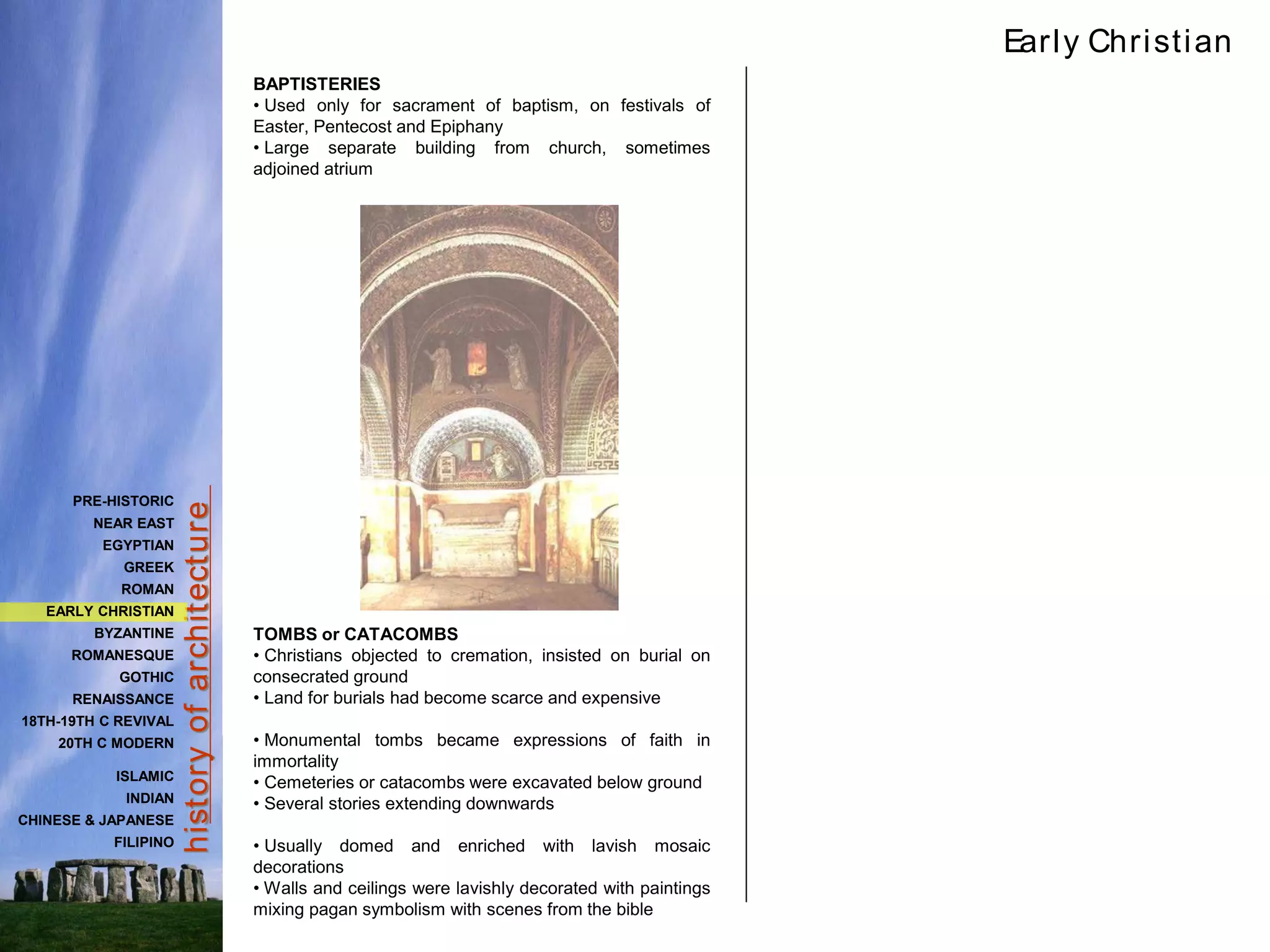
BAPTISTERIES
• Used only for sacrament of baptism, on festivals of
Easter, Pentecost and Epiphany
• Large separate building from church, sometimes
adjoined atrium
TOMBS or CATACOMBS
• Christians objected to cremation, insisted on burial on
consecrated ground
• Land for burials had become scarce and expensive
• Monumental tombs became expressions of faith in
immortality
• Cemeteries or catacombs were excavated below ground
• Several stories extending downwards
• Usually domed and enriched with lavish mosaic
decorations
• Walls and ceilings were lavishly decorated with paintings
mixing pagan symbolism with scenes from the bible
Early Christian
PRE-HISTORIC
NEAR EAST
EGYPTIAN
GREEK
ROMAN
EARLY CHRISTIAN
BYZANTINE
ROMANESQUE
GOTHIC
RENAISSANCE
18TH-19TH C REVIVAL
20TH C MODERN
ISLAMIC
INDIAN
CHINESE & JAPANESE
FILIPINO
hist
ory
of
archit
ect
ure
Early Christian
PRE-HISTORIC
NEAR EAST
EGYPTIAN
GREEK
ROMAN
EARLY CHRISTIAN
BYZANTINE
ROMANESQUE
GOTHIC
RENAISSANCE
18TH-19TH C REVIVAL
20TH C MODERN
ISLAMIC
INDIAN
CHINESE & JAPANESE
FILIPINO

Lec-VI_Early Christian Architecture.pdf

  • 1.
    hist ory of archit ect ure History of Architecture PartI- Ancient Architecture Lecture - VI
  • 2.
    hist ory of archit ect ure Early Christian The Historical Timelineof Architecture PRE-HISTORIC NEAR EAST EGYPTIAN GREEK ROMAN EARLY CHRISTIAN BYZANTINE ROMANESQUE GOTHIC RENAISSANCE 18TH-19TH C REVIVAL 20TH C MODERN ISLAMIC INDIAN CHINESE & JAPANESE FILIPINO Pre-Historic Egyptian Near East Roman Early Christian Greek
  • 3.
    hist ory of archit ect ure INFLUENCES HISTORY • In 63BC, the Romans conquered Judea in the Eastern Mediterranean • Main inhabitants were the Jews • Jews believed that one day the “Messiah” or “Christ” would free them from the Romans • In 27 AD, Jesus began preaching to people in Galilee, north of Judea • After three years, he was arrested by the Jews and found guilty of offending their god • He was nailed to a cross and died a painful death • He appeared to his disciples after his resurrection from the dead • Belief that Jesus was the Christ and the Son of God - Christianity was born • Disciples spread stories of Jesus’ life and teaching by word of mouth and by written account in the new testament • Moved from Judea to Antioch in Syria and into the Northern Mediterranean • Founded new communities along the way • Carried by St. Peter, St. Paul and other missionaries to Rome, the center of the Empire and fountainhead of power and influence • Emperor Nero ordered Christians to be fed to wild beasts or burned to death • Despite this, in 4th century Rome, Christianity grew • In 312 AD, Constantine, a converted Christian, named it the official religion of the Roman empire • By 600 AD, most roman villages had their own churches, governed by a bishop • Patriarchs based in Jerusalem, Alexandria, Antioch, Constantinople and Rome GEOGRAPHY & GEOLOGY • Ruins of Roman buildings served as quarries from which materials were obtained Early Christian Christianized by 600 AD PERSIA EGYPT GREECE FRANCE SPAIN NORTH AFRICA BRITAIN ITALY MARSEILLE ROME CARTHAGE CONSTANTINOPLE ANTIOCH NAPLES ATHENS LONDON SEVILLE SYRIA JUDEA JERUSALEM DAMASCUS BETHLEHEM ALEXANDRIA PRE-HISTORIC NEAR EAST EGYPTIAN GREEK ROMAN EARLY CHRISTIAN BYZANTINE ROMANESQUE GOTHIC RENAISSANCE 18TH-19TH C REVIVAL 20TH C MODERN ISLAMIC INDIAN CHINESE & JAPANESE FILIPINO
  • 4.
    hist ory of archit ect ure ARCHITECTURAL CHARACTER DESCRIPTION • Highly-influencedby Roman art and architecture • This architecture hardly has the architectural value of a style, simply because it was never really produced by the solution of constructive problems ROOF and CEILING • Further development of trusses - king and queen post trusses EXAMPLES BASILICAN CHURCHES • Roman basilicas as models • Usually erected over the burial place of the saint to whom it was dedicated • Unlike Greek and Roman temples which sheltered gods, the purpose of the Christian church was to shelter worshippers • Came in a complex, with cathedral, belfry or campanile, and baptistery • Fine sculptures and mosaics worked into new basilicas • Paid little regard to external architectural effect • Entrance at west • Priest stood behind altar, facing east Early Christian PRE-HISTORIC NEAR EAST EGYPTIAN GREEK ROMAN EARLY CHRISTIAN BYZANTINE ROMANESQUE GOTHIC RENAISSANCE 18TH-19TH C REVIVAL 20TH C MODERN ISLAMIC INDIAN CHINESE & JAPANESE FILIPINO
  • 5.
    hist ory of archit ect ure Early Christian PRE-HISTORIC NEAR EAST EGYPTIAN GREEK ROMAN EARLYCHRISTIAN BYZANTINE ROMANESQUE GOTHIC RENAISSANCE 18TH-19TH C REVIVAL 20TH C MODERN ISLAMIC INDIAN CHINESE & JAPANESE FILIPINO
  • 6.
    hist ory of archit ect ure St. Peter's, Rome •Erected by Constantine near the site of St. Peter's martyrdom • The Circus of Nero was torn down to erect it Early Christian Other examples: S. Apollinare, Ravenna S. Sabina S. Agnese Fuori Le Mura, Rome St. Paulo Fuori Le Mura S. Clemente, Rome S. Maria Maggiore, Rome PRE-HISTORIC NEAR EAST EGYPTIAN GREEK ROMAN EARLY CHRISTIAN BYZANTINE ROMANESQUE GOTHIC RENAISSANCE 18TH-19TH C REVIVAL 20TH C MODERN ISLAMIC INDIAN CHINESE & JAPANESE FILIPINO
  • 7.
    hist ory of archit ect ure BAPTISTERIES • Used onlyfor sacrament of baptism, on festivals of Easter, Pentecost and Epiphany • Large separate building from church, sometimes adjoined atrium TOMBS or CATACOMBS • Christians objected to cremation, insisted on burial on consecrated ground • Land for burials had become scarce and expensive • Monumental tombs became expressions of faith in immortality • Cemeteries or catacombs were excavated below ground • Several stories extending downwards • Usually domed and enriched with lavish mosaic decorations • Walls and ceilings were lavishly decorated with paintings mixing pagan symbolism with scenes from the bible Early Christian PRE-HISTORIC NEAR EAST EGYPTIAN GREEK ROMAN EARLY CHRISTIAN BYZANTINE ROMANESQUE GOTHIC RENAISSANCE 18TH-19TH C REVIVAL 20TH C MODERN ISLAMIC INDIAN CHINESE & JAPANESE FILIPINO
  • 8.
    hist ory of archit ect ure Early Christian PRE-HISTORIC NEAR EAST EGYPTIAN GREEK ROMAN EARLYCHRISTIAN BYZANTINE ROMANESQUE GOTHIC RENAISSANCE 18TH-19TH C REVIVAL 20TH C MODERN ISLAMIC INDIAN CHINESE & JAPANESE FILIPINO