Design of Micro-strip slot
Antenna with polarization
PRESENTED BY :-
V. Prabhu kiran (13003306)
K. Sri Charan reddy(13003350)
Under the kind guidance of ,
Dr T. V. RAMAKRISHNA
Introduction
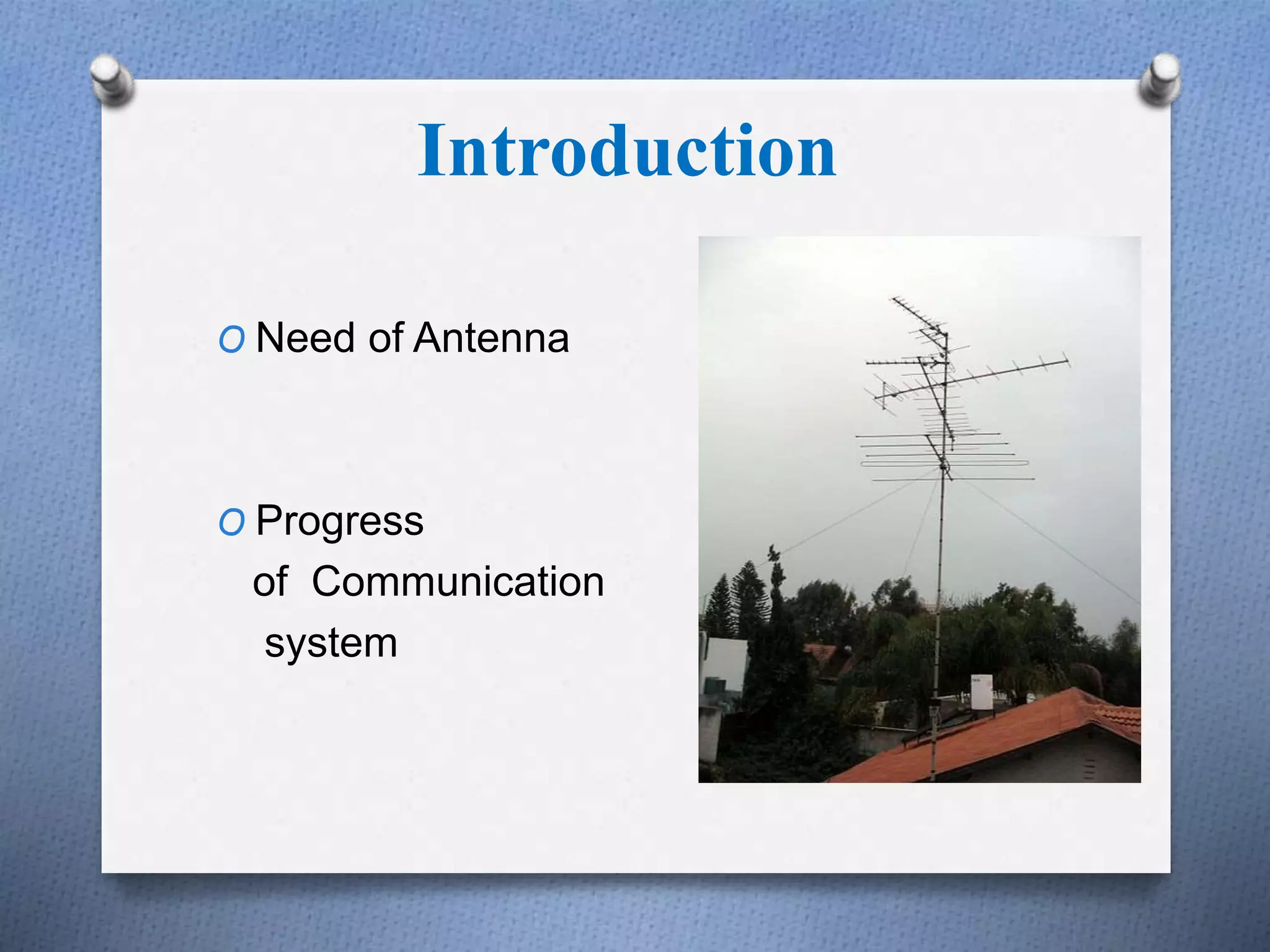
O Need of Antenna
O Progress
of Communication
system
AIM & OBJECTIVES
O To study Micro-strip Patch Antenna.
O To design and implement this antenna
using the software HFSS, v 13.0 .
How does an antenna work ?
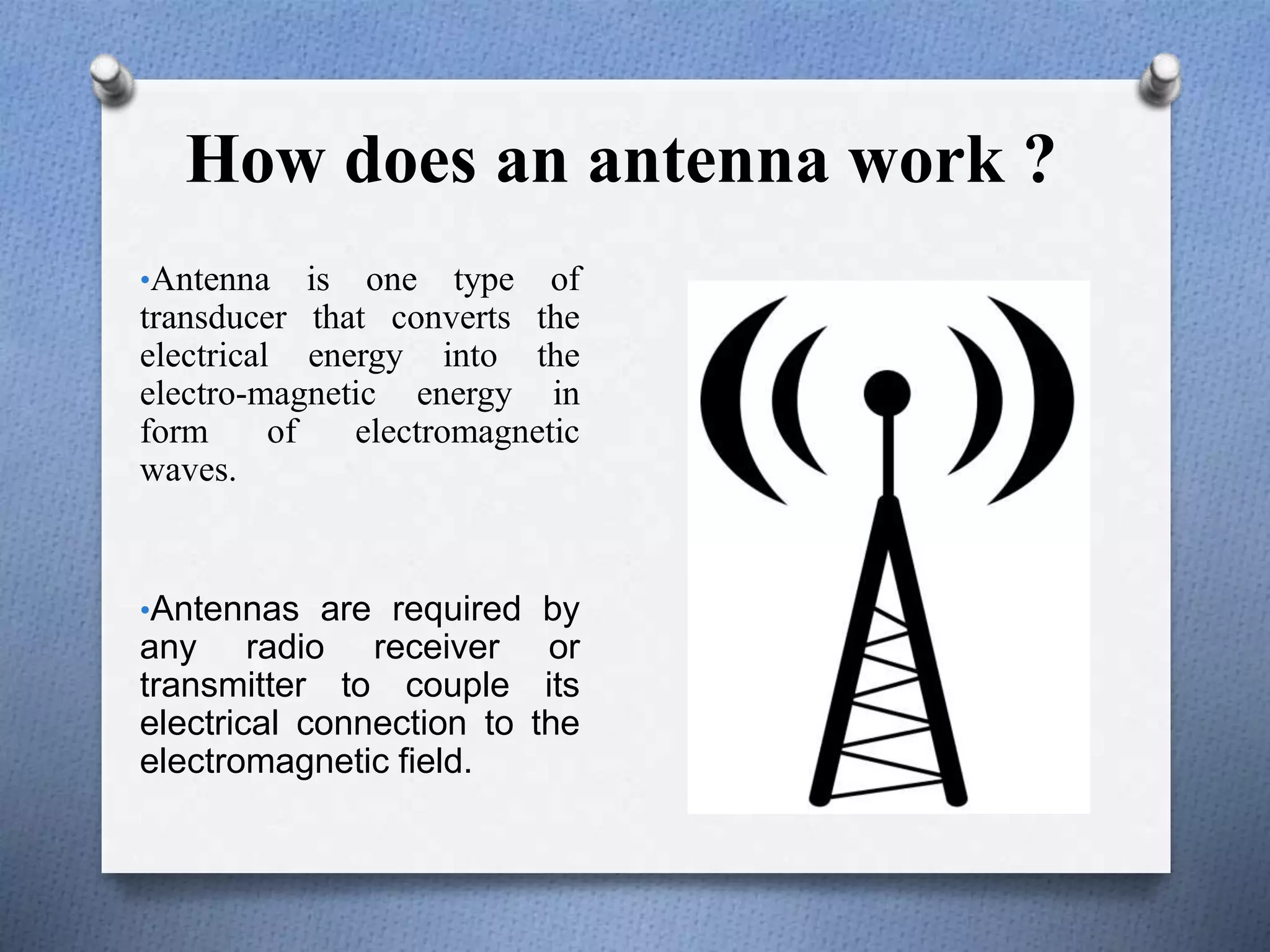
•Antenna is one type of
transducer that converts the
electrical energy into the
electro-magnetic energy in
form of electromagnetic
waves.
•Antennas are required by
any radio receiver or
transmitter to couple its
electrical connection to the
electromagnetic field.
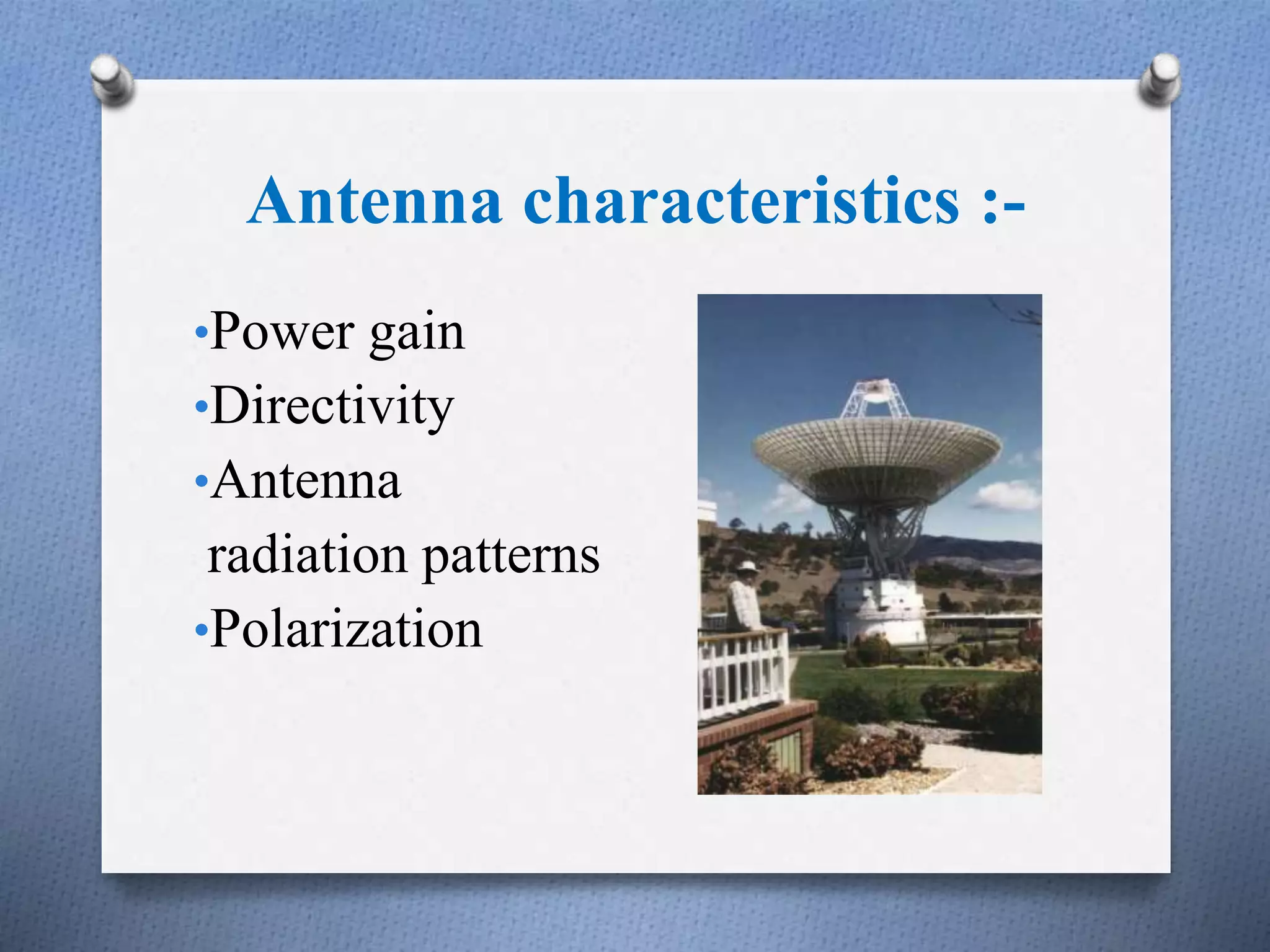
Antenna characteristics :-
•Power gain
•Directivity
•Antenna
radiation patterns
•Polarization
Overview of micro-strip
Antenna
O Developed after revolution in Electronic
Circuit Miniaturization & LSI in 1970.
O Used on rockets & missiles previously.
O Designer’s choice.
Micro-strip Patch Antenna
What is Micro-strip Antenna ?
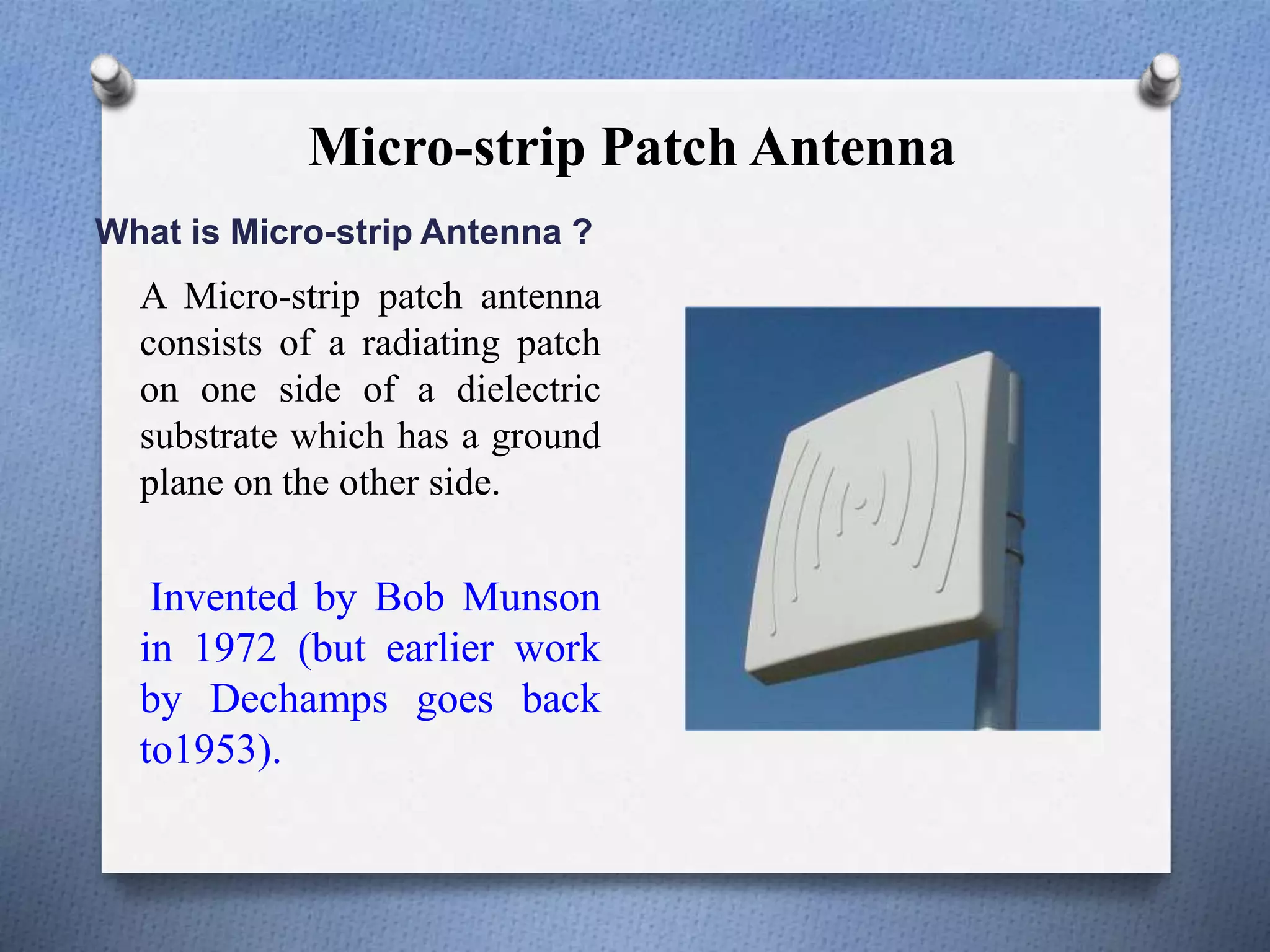
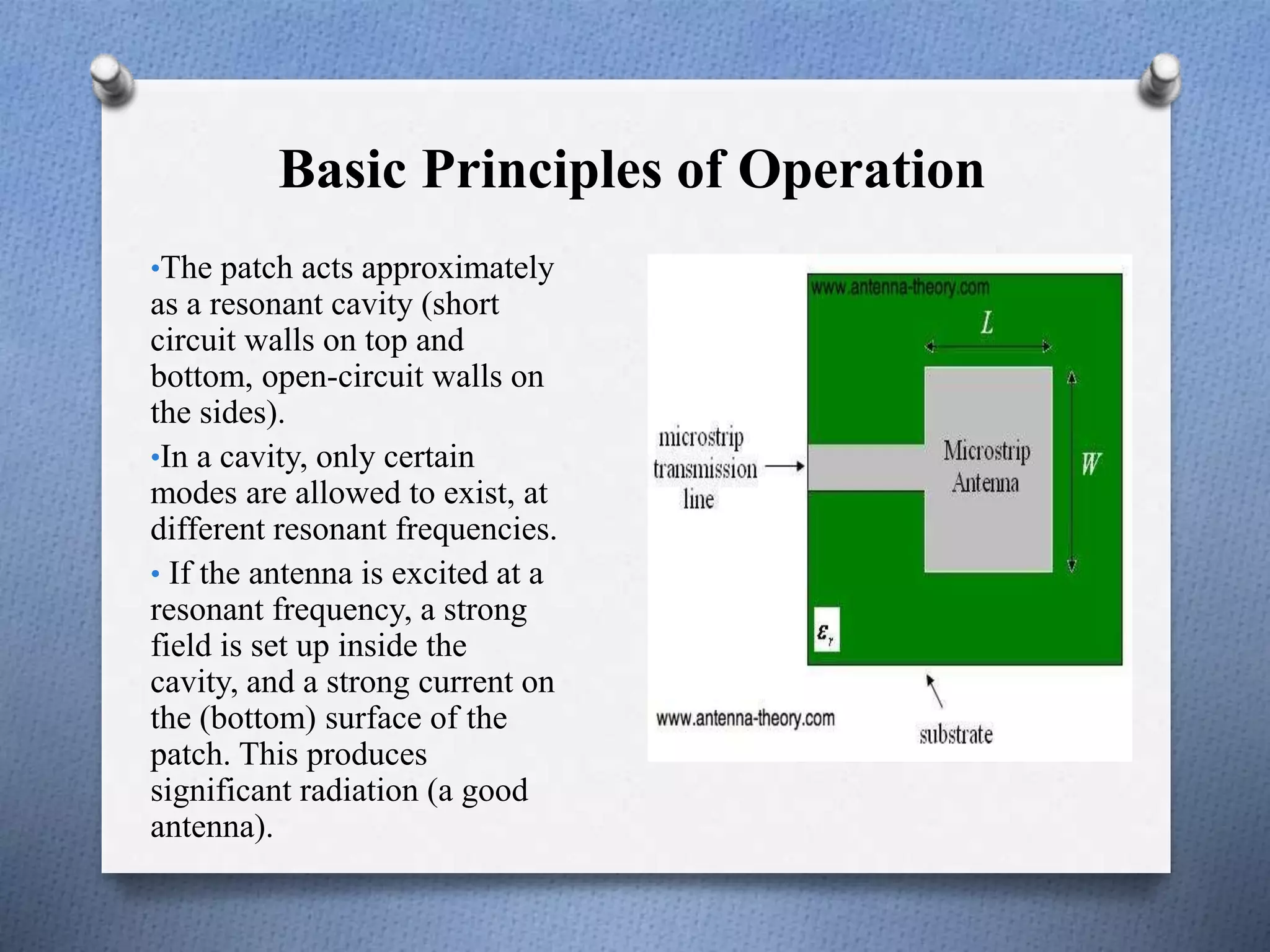
A Micro-strip patch antenna
consists of a radiating patch
on one side of a dielectric
substrate which has a ground
plane on the other side.
Invented by Bob Munson
in 1972 (but earlier work
by Dechamps goes back
to1953).
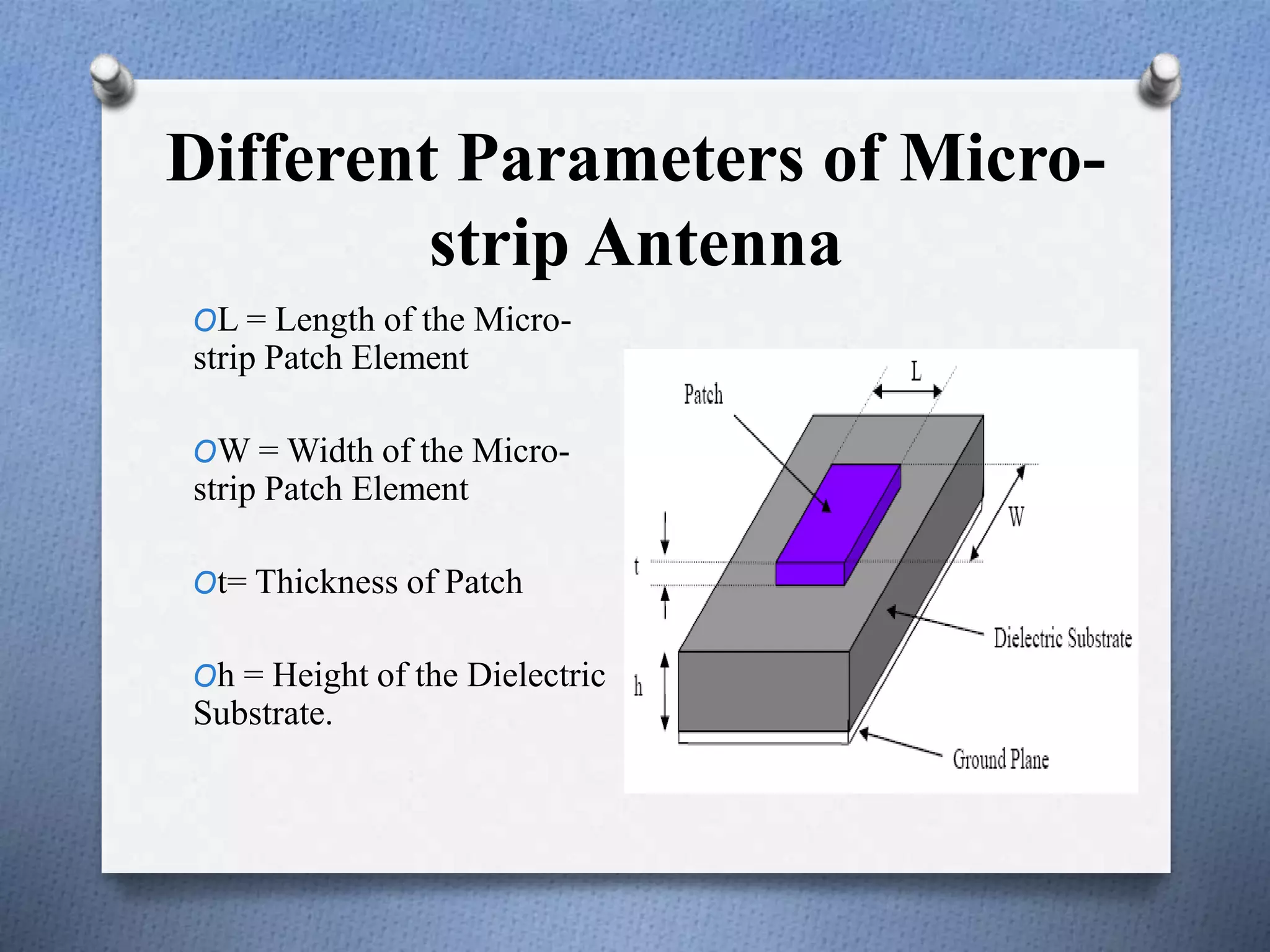
Different Parameters of Micro-
strip Antenna
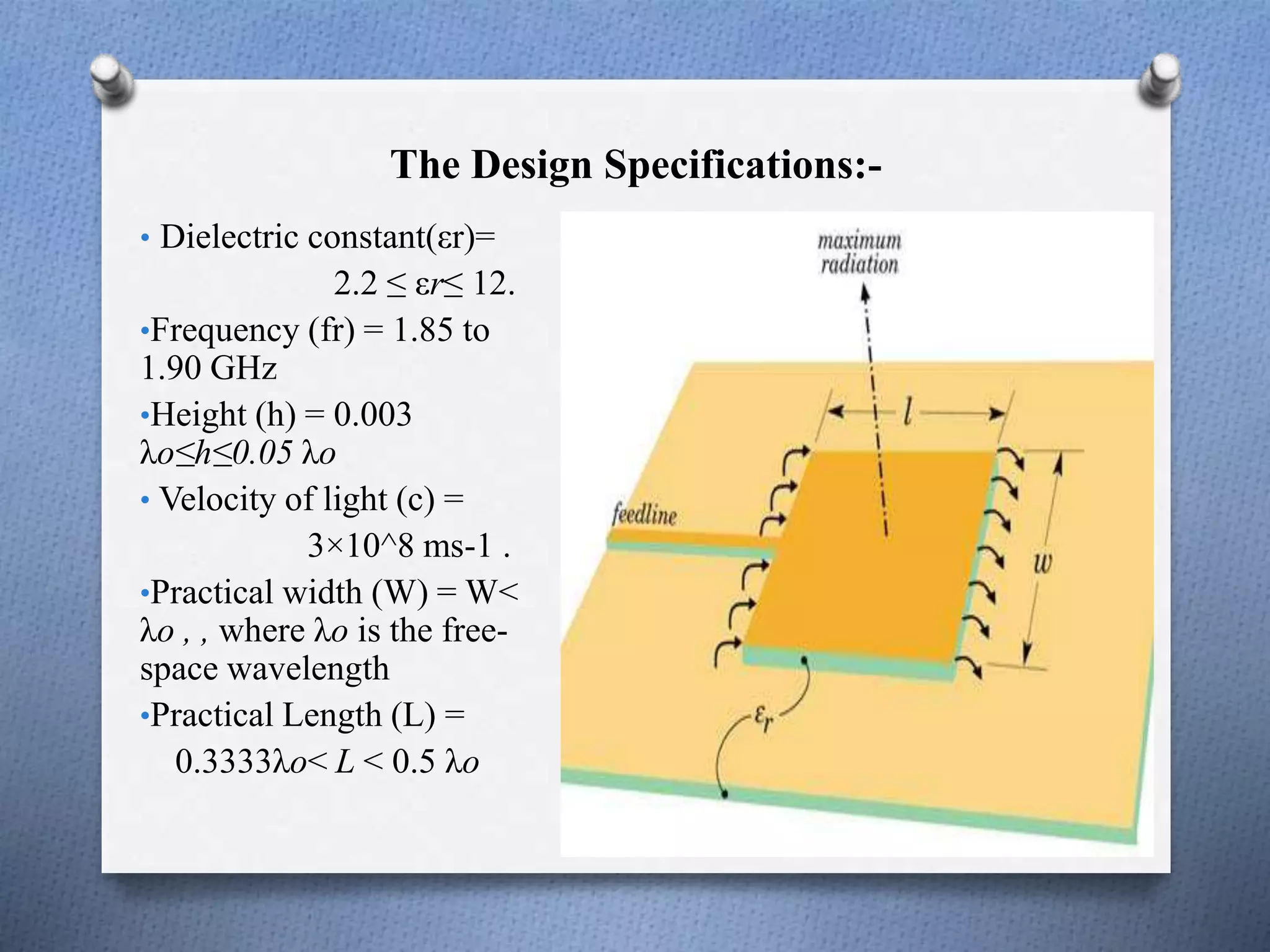
OL = Length of the Micro-
strip Patch Element
OW = Width of the Micro-
strip Patch Element
Ot= Thickness of Patch
Oh = Height of the Dielectric
Substrate.
Basic Principles of Operation
•The patch acts approximately
as a resonant cavity (short
circuit walls on top and
bottom, open-circuit walls on
the sides).
•In a cavity, only certain
modes are allowed to exist, at
different resonant frequencies.
• If the antenna is excited at a
resonant frequency, a strong
field is set up inside the
cavity, and a strong current on
the (bottom) surface of the
patch. This produces
significant radiation (a good
antenna).
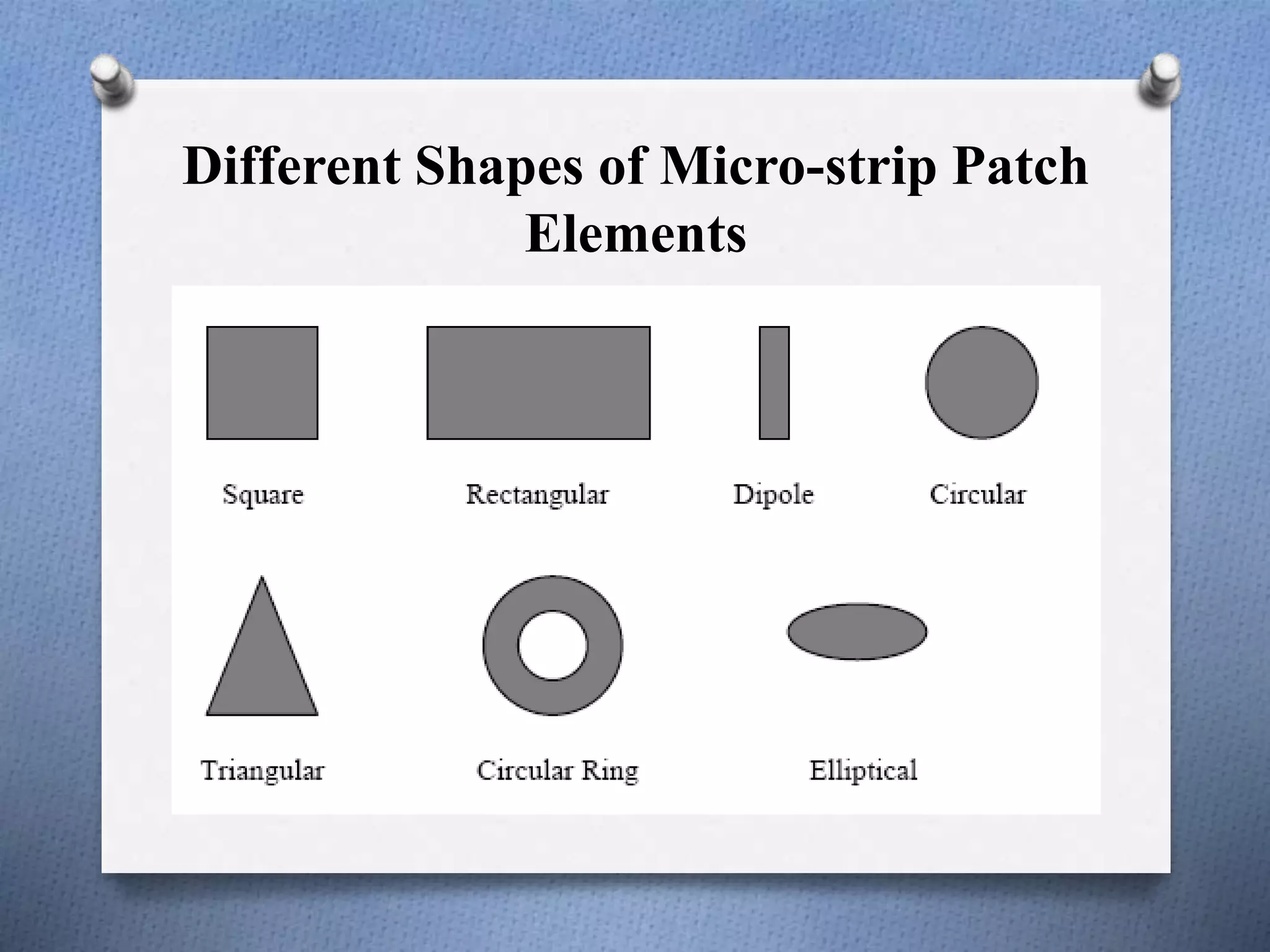
Different Shapes of Micro-strip Patch
Elements
Advantages of Micro-strip Patch
Antenna
•Light weight and low volume.
• Low profile planar configuration which can be easily made
conformal to host surface.
• Low fabrication cost, hence can be manufactured in large
quantities.
• Supports both, linear as well as circular polarization.
• Can be easily integrated with microwave integrated circuits
(MICs).
•Capable of dual and triple frequency operations.
• Mechanically robust when mounted on rigid surfaces.
Disadvantages:-
•Narrow bandwidth
•Low efficiency
•Low Gain
•Extraneous radiation from feeds and junctions
•Poor end fire radiator except tapered slot antennas
• Low power handling capacity.
• Surface wave excitation.
Feed Techniques:-
Micro-strip antenna can be feed by variety of methods.
This methods can be classified into two categories-
contacting and non-contacting. The foremost popular
feed techniques used are :-
O Micro-strip line.
O Co-axial probe
O Aperture coupling
O Proximity coupling
Software used to design Micro-strip
Patch Antenna
OHFSS is commercial finite
element
Omethod solver for electromagnetic
OStructures.from Anasys Corp.
OHFSS stands for High Frequency
OStructural Simulator. It is one of
the
OSeveral commercial tools used for
Oantenna design . It was developed
Oby Prof. Zontal Cendes and his
Ostudents at Carnegie Mellon
Univ.
Oin the year 1989.
The Design Specifications:-
• Dielectric constant(εr)=
2.2 ≤ εr≤ 12.
•Frequency (fr) = 1.85 to
1.90 GHz
•Height (h) = 0.003
λo≤h≤0.05 λo
• Velocity of light (c) =
3×10^8 ms-1 .
•Practical width (W) = W<
λo , , where λo is the free-
space wavelength
•Practical Length (L) =
0.3333λo< L < 0.5 λo
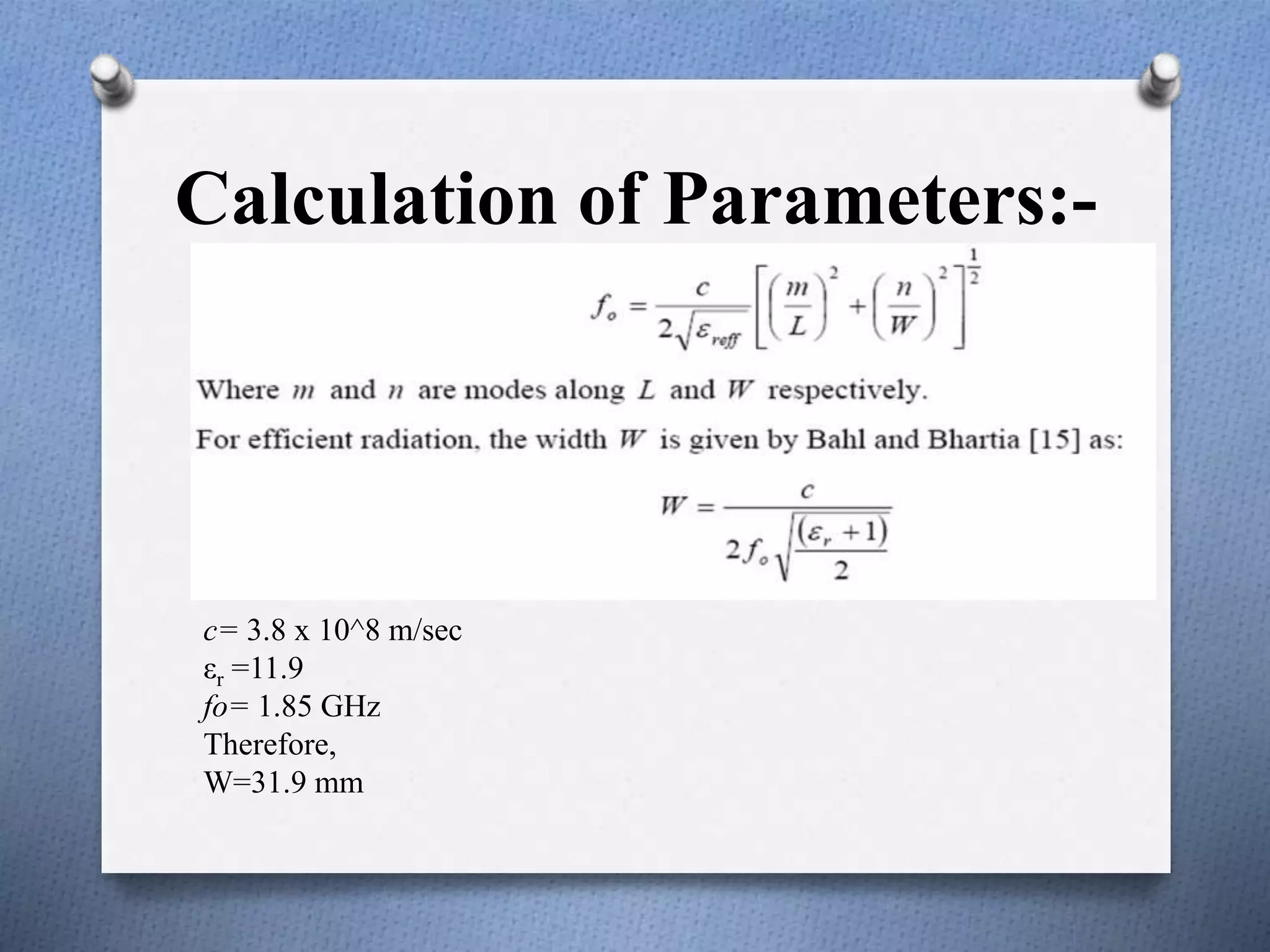
Calculation of Parameters:-
c= 3.8 x 10^8 m/sec
εr =11.9
fo= 1.85 GHz
Therefore,
W=31.9 mm
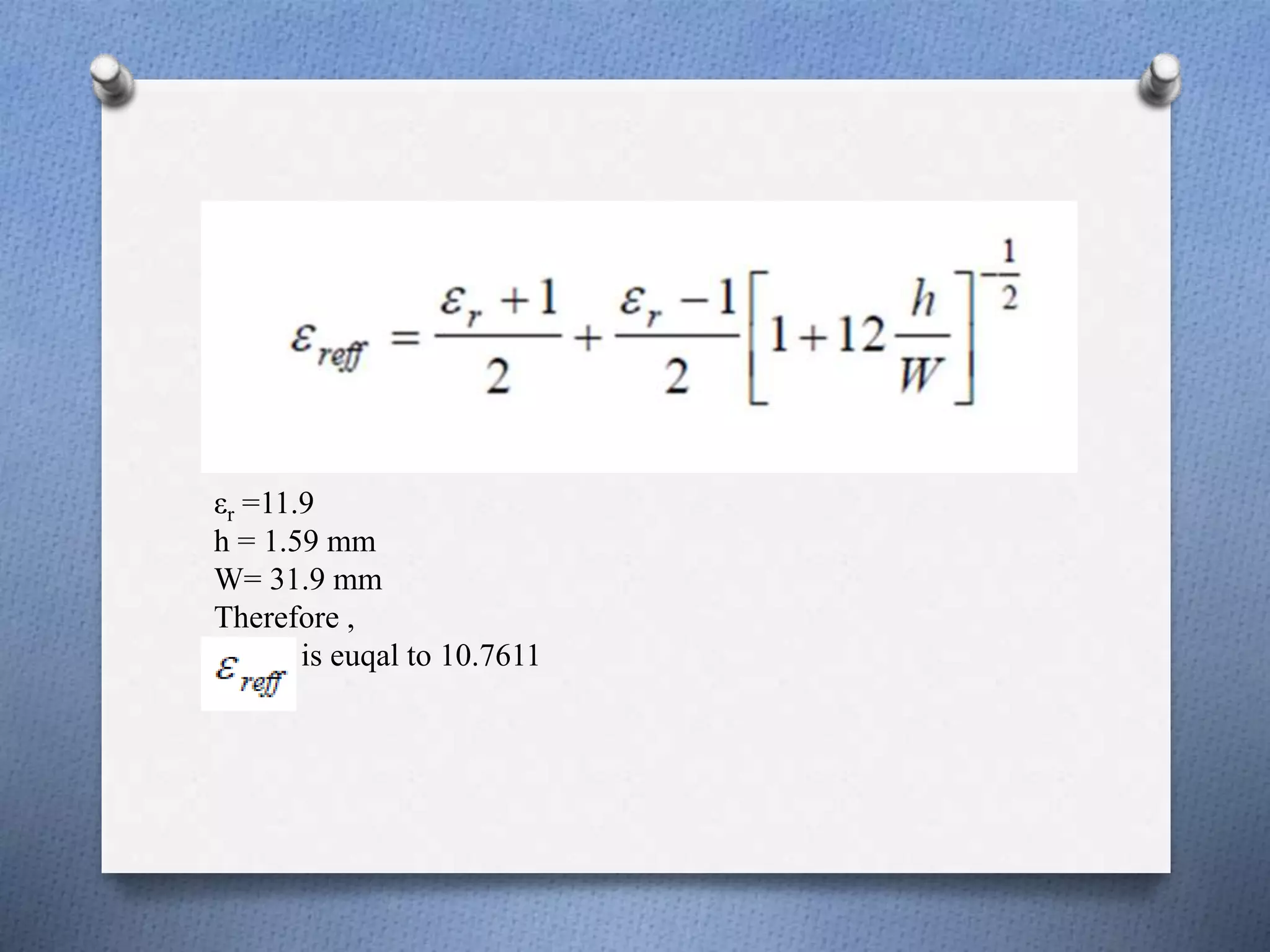
εr =11.9
h = 1.59 mm
W= 31.9 mm
Therefore ,
is euqal to 10.7611
εr =11.9
h=1.59 mm
W = 31.9 mm
Therefore ,
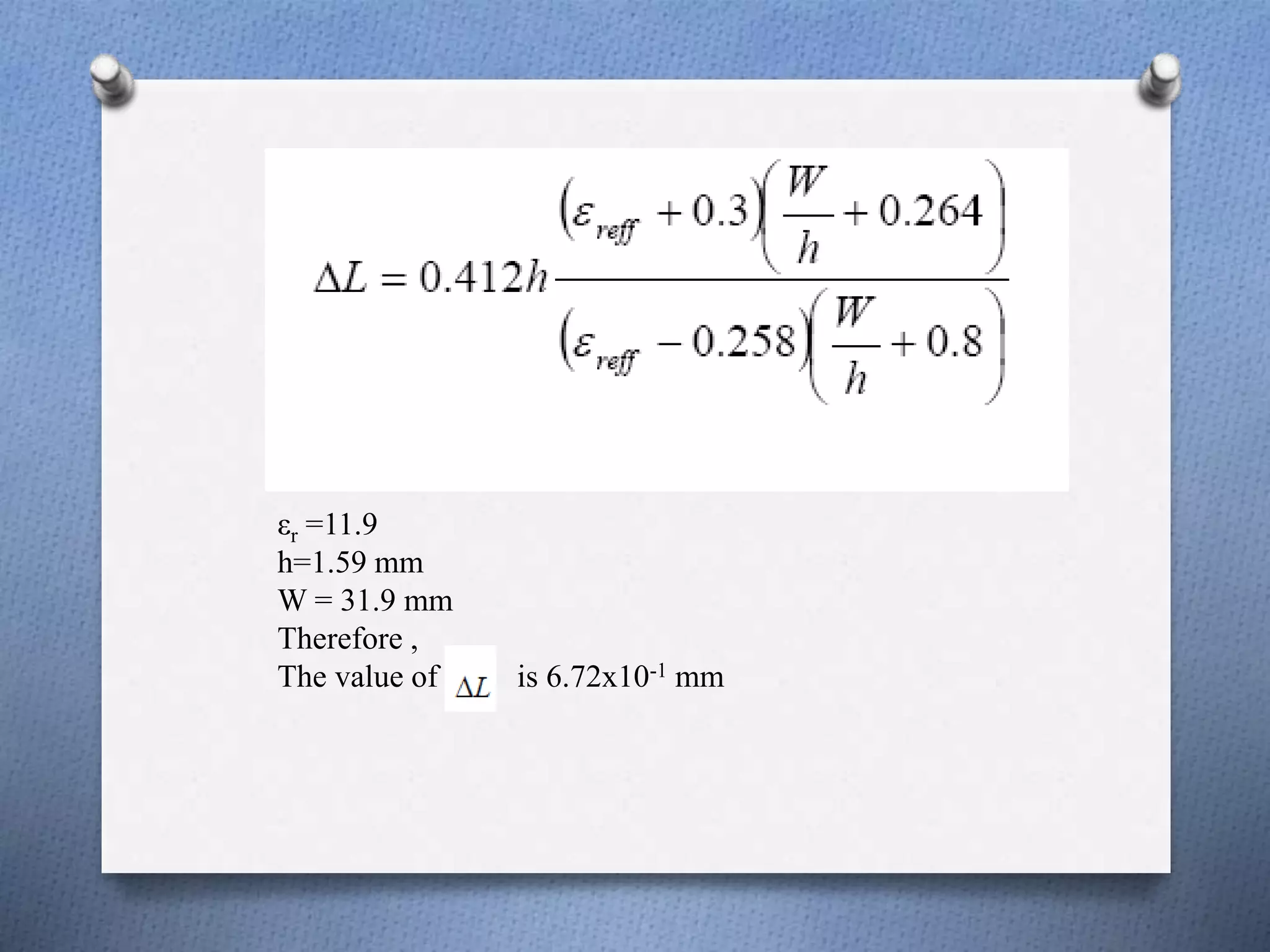
The value of is 6.72x10⁻¹ mm
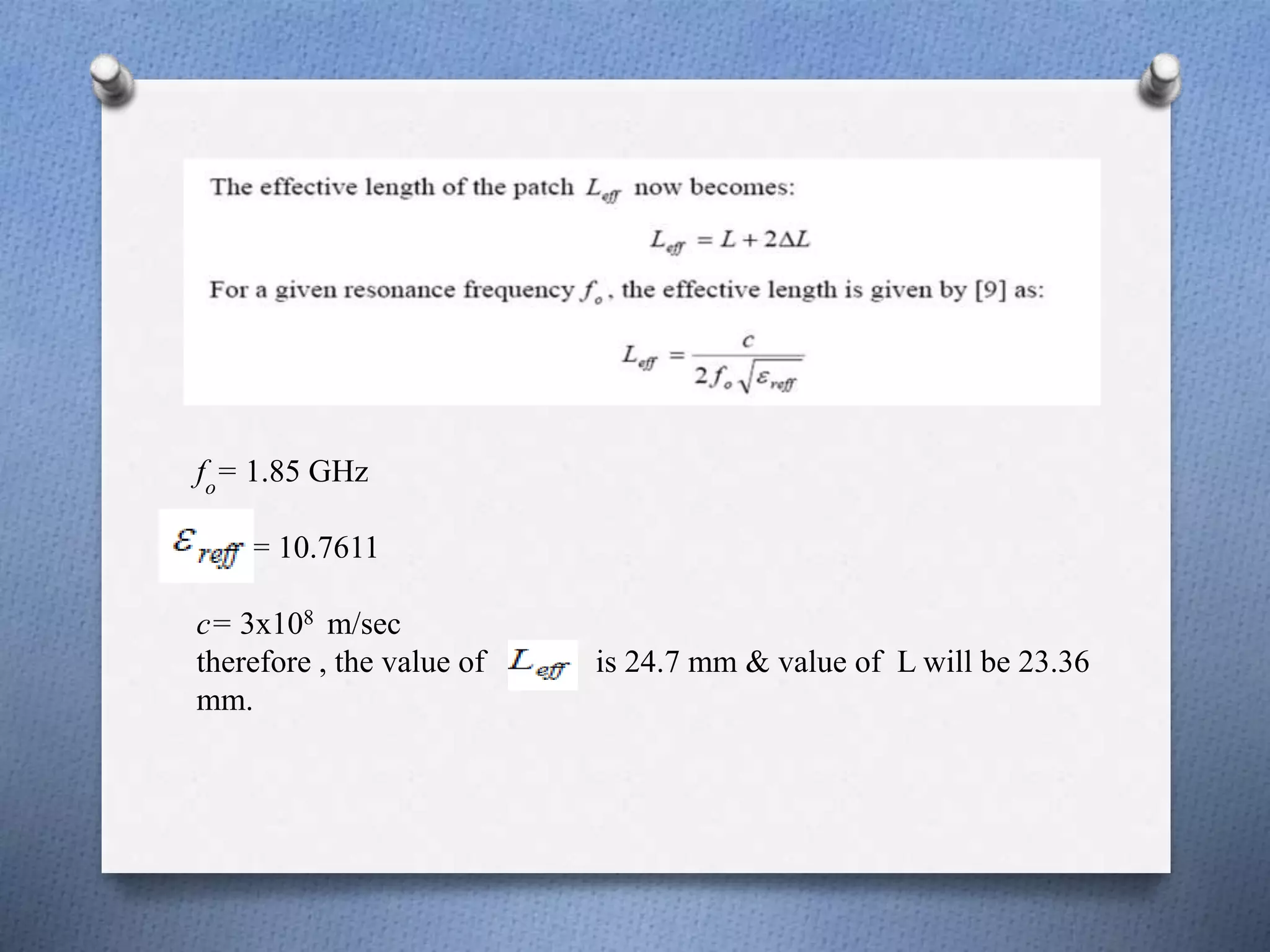
fo
= 1.85 GHz
= 10.7611
c= 3x10⁸ m/sec
therefore , the value of is 24.7 mm & value of L will be 23.36
mm.
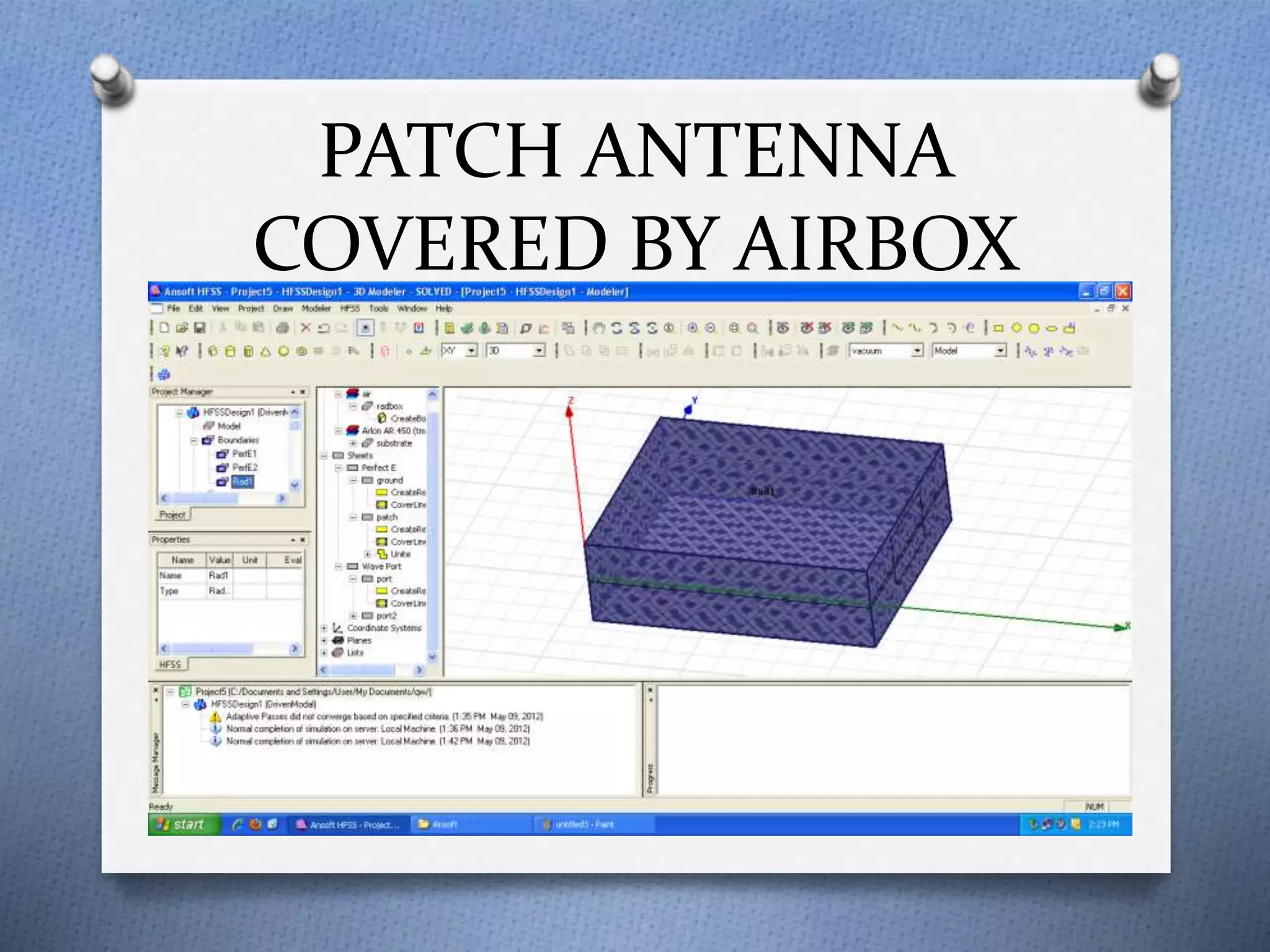
PATCH ANTENNA
COVERED BY AIRBOX
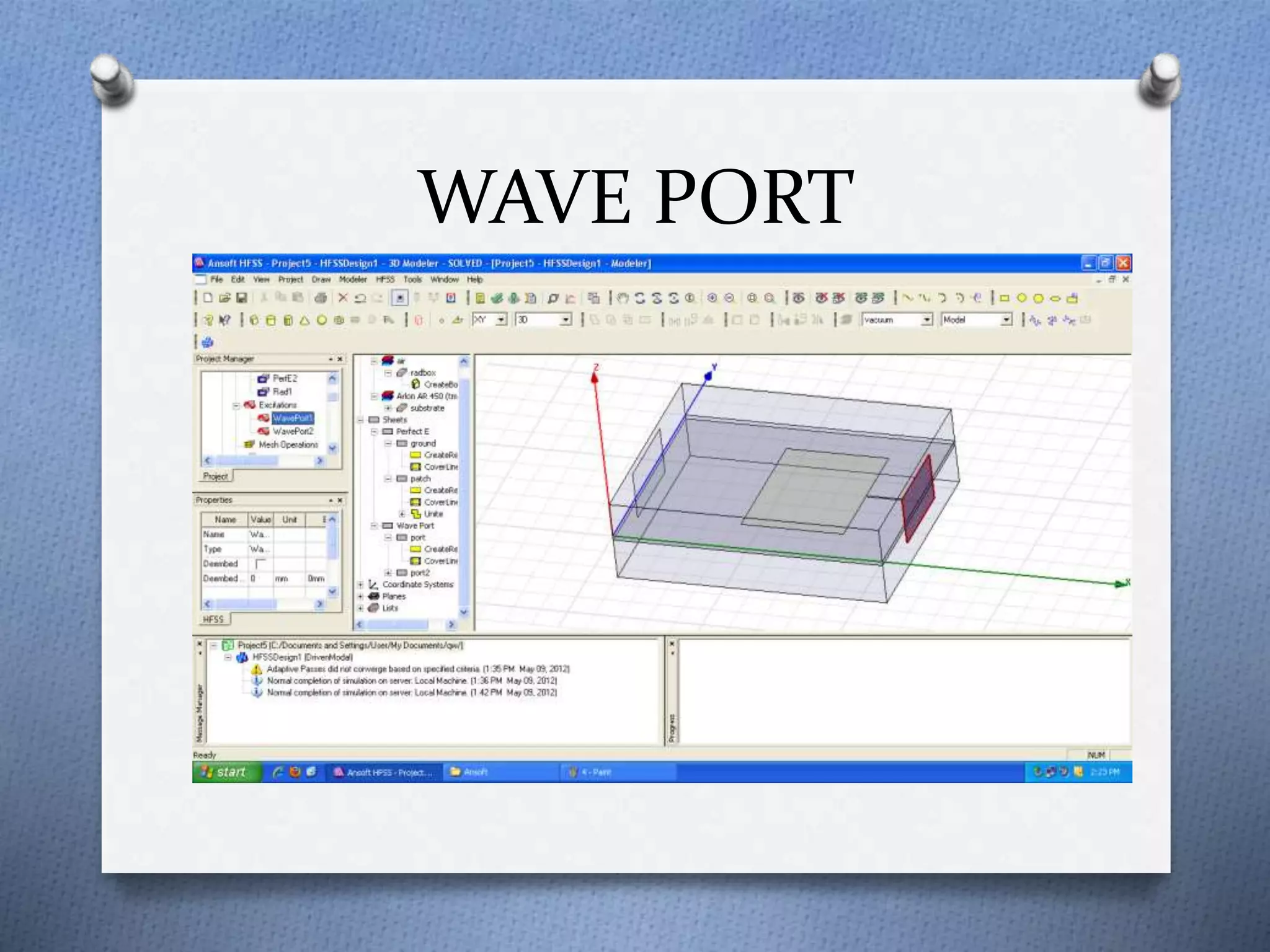
WAVE PORT
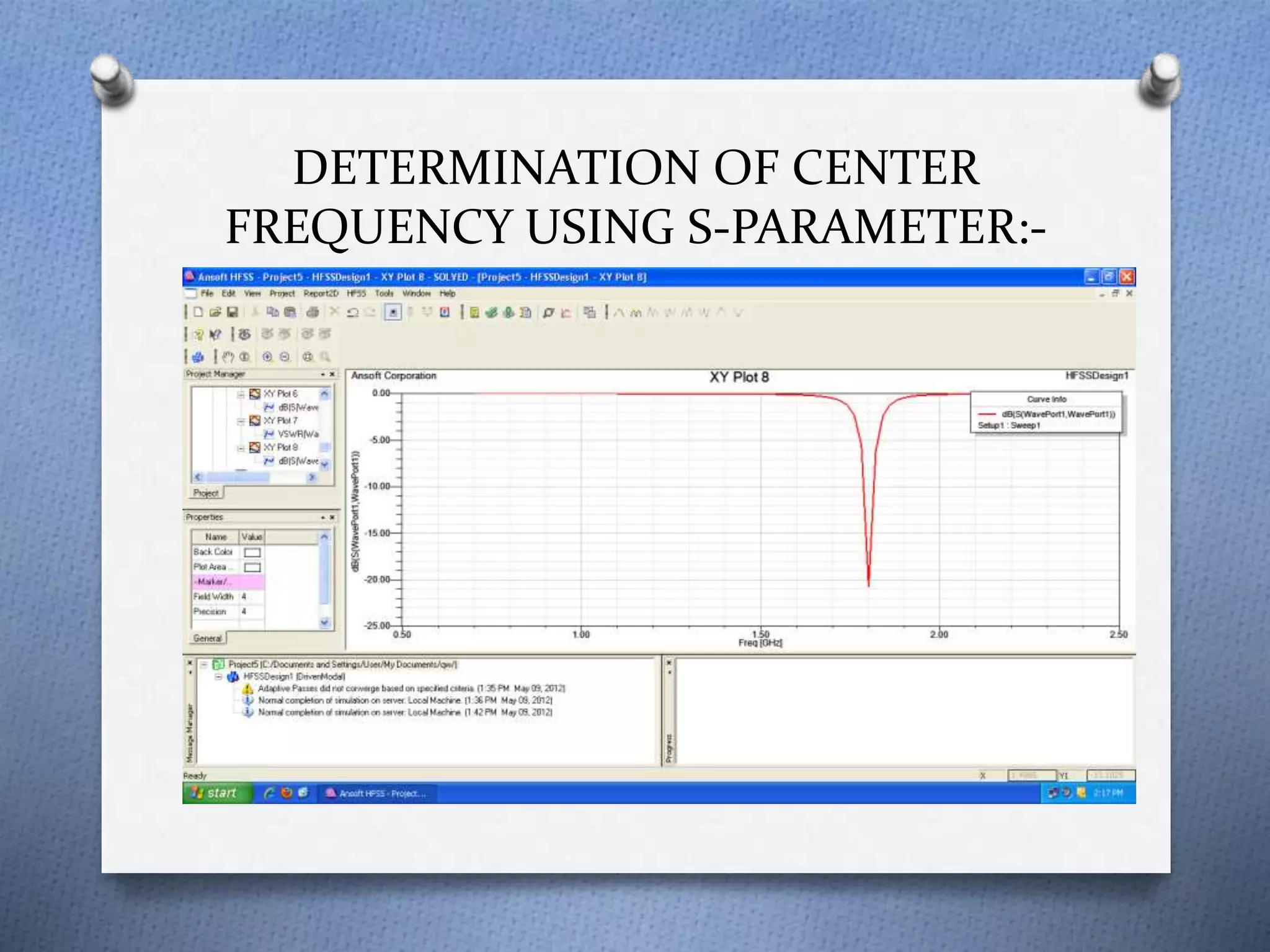
DETERMINATION OF CENTER
FREQUENCY USING S-PARAMETER:-
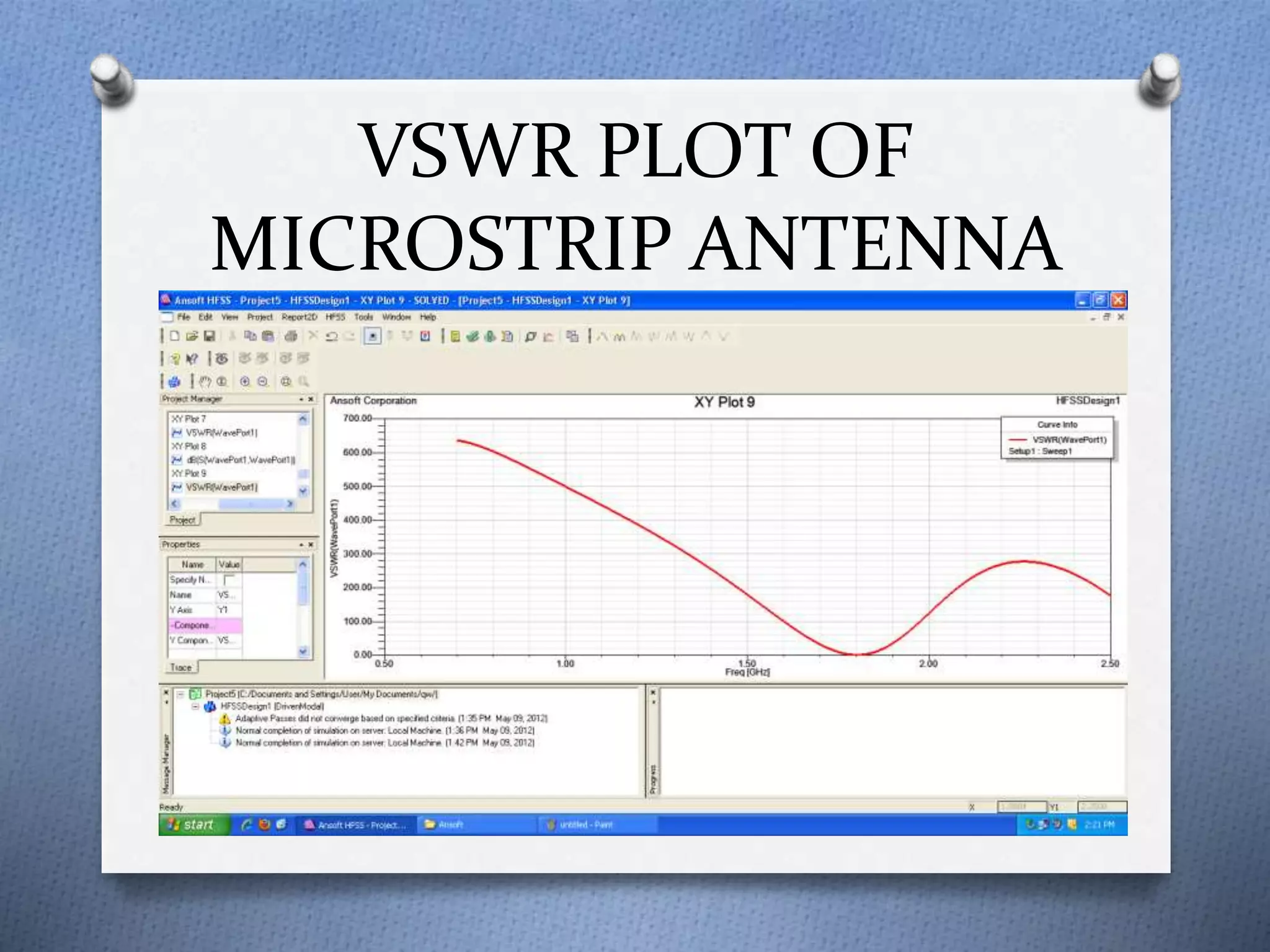
VSWR PLOT OF
MICROSTRIP ANTENNA
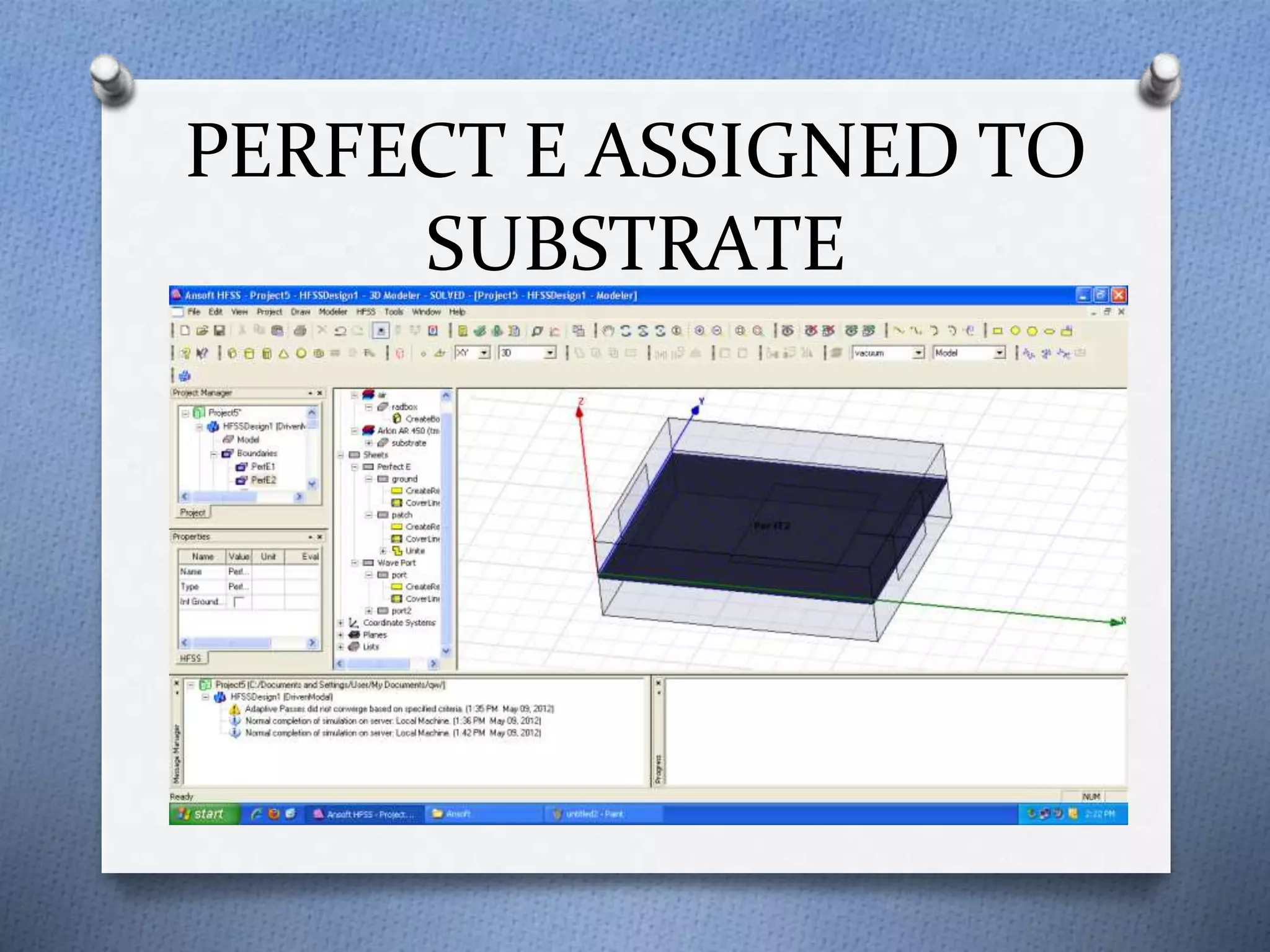
PERFECT E ASSIGNED TO
SUBSTRATE
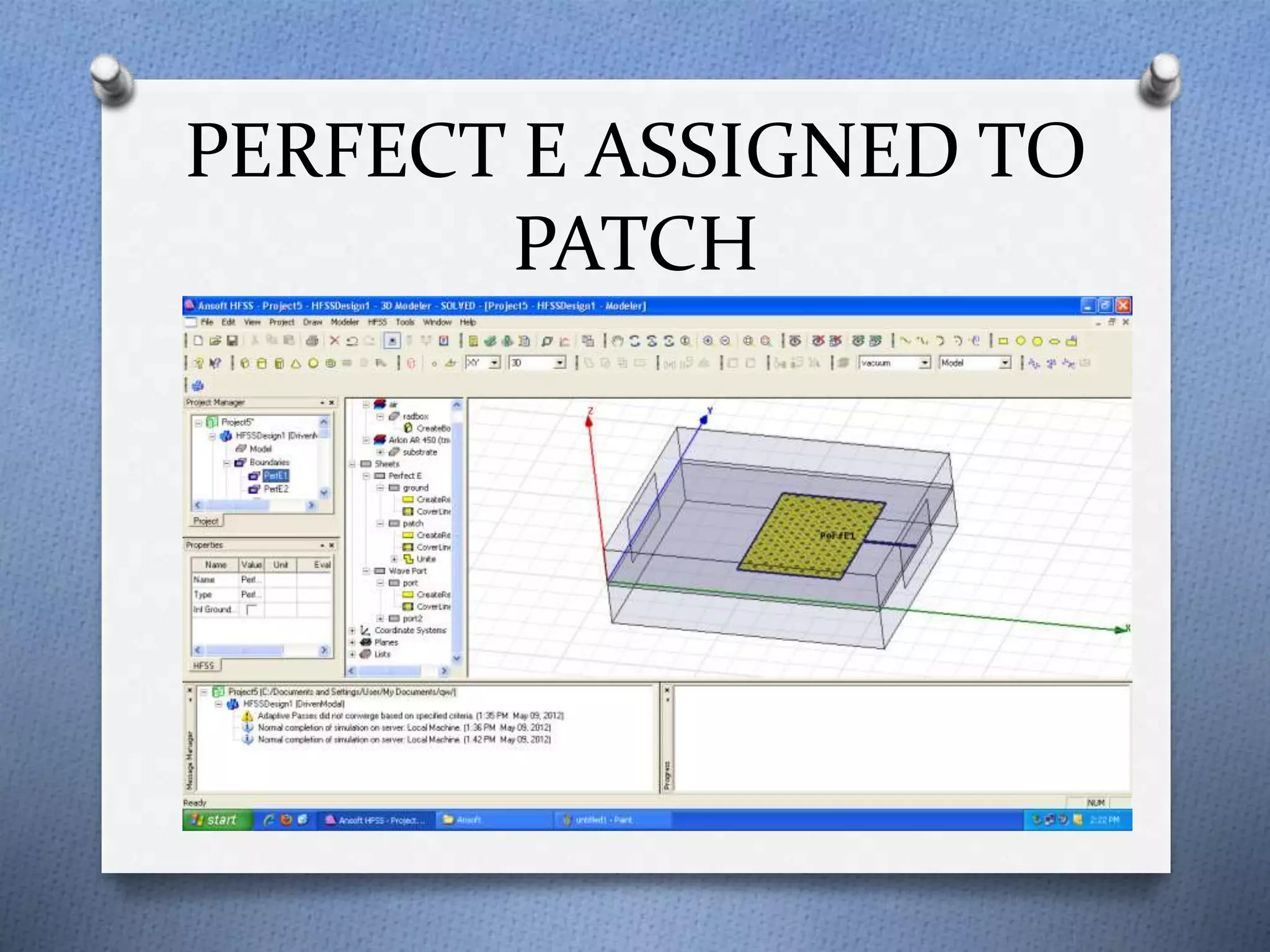
PERFECT E ASSIGNED TO
PATCH
APPLICATIONS
• The use of micro-strip
antennas for integrated
phased array systems.
• Used in GPS (Sat.
Navigational System)
technology.
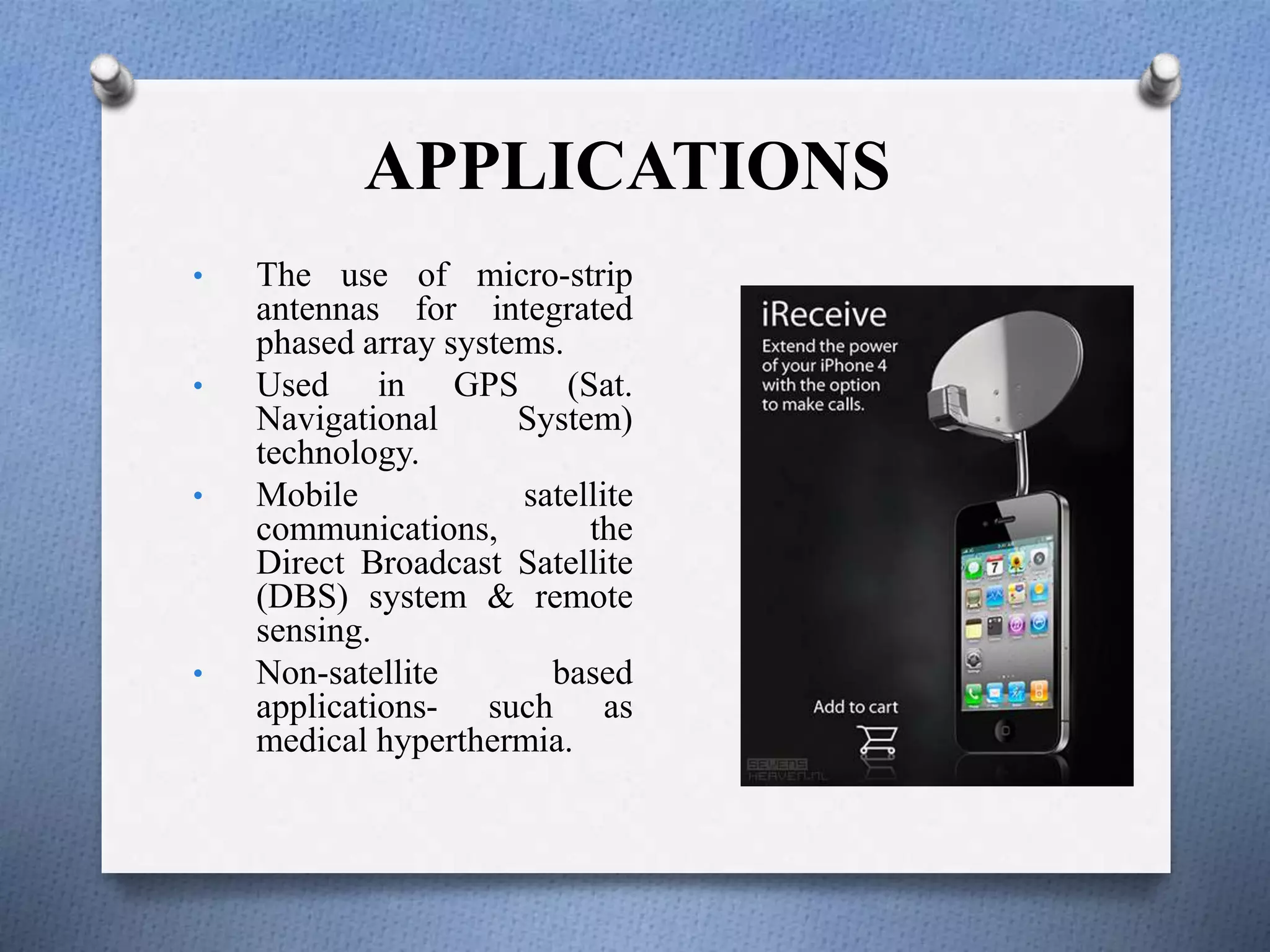
• Mobile satellite
communications, the
Direct Broadcast Satellite
(DBS) system & remote
sensing.
• Non-satellite based
applications- such as
medical hyperthermia.
CONCLUSION
OThe design of patch
antenna using ANSOFT
HFSS Software has been
shown here. Our project
on Design of Microstrip
Antenna which is based
on Microstrip Feed Line
Technique.
OMany more design
options and impletation
techniques are available.
REFERENCES:-
• http://en.wikipedia.org/wiki/Microstrip_antenna
• http://www.microwaves101.com/encyclopedia/anten
na_ustrip.cfm
• C. A. Balanis, “ Antenna Theory, Analysis and
Design”, JOHN WILEY & SONS,INC, New York
1997.
Microstrip_patch_antenna_design.ppt

Microstrip_patch_antenna_design.ppt

  • 1.
    Design of Micro-stripslot Antenna with polarization PRESENTED BY :- V. Prabhu kiran (13003306) K. Sri Charan reddy(13003350) Under the kind guidance of , Dr T. V. RAMAKRISHNA
  • 2.
    Introduction O Need ofAntenna O Progress of Communication system
  • 3.
    AIM & OBJECTIVES OTo study Micro-strip Patch Antenna. O To design and implement this antenna using the software HFSS, v 13.0 .
  • 4.
    How does anantenna work ? •Antenna is one type of transducer that converts the electrical energy into the electro-magnetic energy in form of electromagnetic waves. •Antennas are required by any radio receiver or transmitter to couple its electrical connection to the electromagnetic field.
  • 5.
    Antenna characteristics :- •Powergain •Directivity •Antenna radiation patterns •Polarization
  • 6.
    Overview of micro-strip Antenna ODeveloped after revolution in Electronic Circuit Miniaturization & LSI in 1970. O Used on rockets & missiles previously. O Designer’s choice.
  • 7.
    Micro-strip Patch Antenna Whatis Micro-strip Antenna ? A Micro-strip patch antenna consists of a radiating patch on one side of a dielectric substrate which has a ground plane on the other side. Invented by Bob Munson in 1972 (but earlier work by Dechamps goes back to1953).
  • 8.
    Different Parameters ofMicro- strip Antenna OL = Length of the Micro- strip Patch Element OW = Width of the Micro- strip Patch Element Ot= Thickness of Patch Oh = Height of the Dielectric Substrate.
  • 9.
    Basic Principles ofOperation •The patch acts approximately as a resonant cavity (short circuit walls on top and bottom, open-circuit walls on the sides). •In a cavity, only certain modes are allowed to exist, at different resonant frequencies. • If the antenna is excited at a resonant frequency, a strong field is set up inside the cavity, and a strong current on the (bottom) surface of the patch. This produces significant radiation (a good antenna).
  • 10.
    Different Shapes ofMicro-strip Patch Elements
  • 11.
    Advantages of Micro-stripPatch Antenna •Light weight and low volume. • Low profile planar configuration which can be easily made conformal to host surface. • Low fabrication cost, hence can be manufactured in large quantities. • Supports both, linear as well as circular polarization. • Can be easily integrated with microwave integrated circuits (MICs). •Capable of dual and triple frequency operations. • Mechanically robust when mounted on rigid surfaces.
  • 12.
    Disadvantages:- •Narrow bandwidth •Low efficiency •LowGain •Extraneous radiation from feeds and junctions •Poor end fire radiator except tapered slot antennas • Low power handling capacity. • Surface wave excitation.
  • 13.
    Feed Techniques:- Micro-strip antennacan be feed by variety of methods. This methods can be classified into two categories- contacting and non-contacting. The foremost popular feed techniques used are :- O Micro-strip line. O Co-axial probe O Aperture coupling O Proximity coupling
  • 14.
    Software used todesign Micro-strip Patch Antenna OHFSS is commercial finite element Omethod solver for electromagnetic OStructures.from Anasys Corp. OHFSS stands for High Frequency OStructural Simulator. It is one of the OSeveral commercial tools used for Oantenna design . It was developed Oby Prof. Zontal Cendes and his Ostudents at Carnegie Mellon Univ. Oin the year 1989.
  • 15.
    The Design Specifications:- •Dielectric constant(εr)= 2.2 ≤ εr≤ 12. •Frequency (fr) = 1.85 to 1.90 GHz •Height (h) = 0.003 λo≤h≤0.05 λo • Velocity of light (c) = 3×10^8 ms-1 . •Practical width (W) = W< λo , , where λo is the free- space wavelength •Practical Length (L) = 0.3333λo< L < 0.5 λo
  • 16.
    Calculation of Parameters:- c=3.8 x 10^8 m/sec εr =11.9 fo= 1.85 GHz Therefore, W=31.9 mm
  • 17.
    εr =11.9 h =1.59 mm W= 31.9 mm Therefore , is euqal to 10.7611
  • 18.
    εr =11.9 h=1.59 mm W= 31.9 mm Therefore , The value of is 6.72x10⁻¹ mm
  • 19.
    fo = 1.85 GHz =10.7611 c= 3x10⁸ m/sec therefore , the value of is 24.7 mm & value of L will be 23.36 mm.
  • 20.
  • 21.
  • 22.
  • 23.
  • 24.
    PERFECT E ASSIGNEDTO SUBSTRATE
  • 25.
  • 26.
    APPLICATIONS • The useof micro-strip antennas for integrated phased array systems. • Used in GPS (Sat. Navigational System) technology. • Mobile satellite communications, the Direct Broadcast Satellite (DBS) system & remote sensing. • Non-satellite based applications- such as medical hyperthermia.
  • 27.
    CONCLUSION OThe design ofpatch antenna using ANSOFT HFSS Software has been shown here. Our project on Design of Microstrip Antenna which is based on Microstrip Feed Line Technique. OMany more design options and impletation techniques are available.
  • 28.
    REFERENCES:- • http://en.wikipedia.org/wiki/Microstrip_antenna • http://www.microwaves101.com/encyclopedia/anten na_ustrip.cfm •C. A. Balanis, “ Antenna Theory, Analysis and Design”, JOHN WILEY & SONS,INC, New York 1997.