



Insight in an organization is like a brain surgery, critical,
inspiring and mysterious.
(Dimitri De Meester, 2013)

email:dimitri_de_meester@yahoo.com
Mobile: +32(0)479 29 67 54
Presentation in 8 blocks

1.Introduction
2.Value creation in 5 dimensions
3.Planning & control VS. Organizational culture
4.Strategic analysis, guru about planning and control
5.Ratio analysis
6.Working capital
7.Automation in DWH, guru about BI
8.Define your own BI/PM/EIM2 success road
BLOCK 1: INTRODUCTION
What is BI/Performance Management?

●

●

●

●

Ask ten people to explain you what BI exactly is, and there is a big chance they will
tell you ten different stories depending on there background
Gartner says: Leverage technology and best practices to deliver management
insight from enterprise applications and data. Combine business intelligence tools
and applications with effective structure, quality improvement and information
governance and learn to maximize payback while minimizing risk.
Gartner describes Business Intelligence (BI) also as the usage of information to
enable organizations to best decide, measure, manage and optimize performance to
achieve efficiency and financial benefit. In short, BI aims to support better business
decision-making by providing operational insight.
Gartner defines Performance Management as the combination of management
methodologies, metrics and information technology that enables users to define,
monitor and optimize results and outcomes to achieve personal or departmental
objectives while enabling alignment with strategic objectives across multiple
organizational levels. Successful performance management is achieved when used,
accepted and applied at all levels in an organization. Alignment with strategic
objectives is of ultimate importance
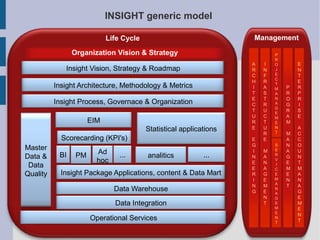
INSIGHT generic model
Management

Life Cycle
Organization Vision & Strategy
Insight Vision, Strategy & Roadmap
Insight Architecture, Methodology & Metrics
Insight Process, Governace & Organization
EIM
Statistical applications
Scorecarding (KPI's)
Master
Data &
Data
Quality

BI

PM

Ad
hoc

...

analytics

...

Insight Package Applications, content & Data Mart
Data Warehouse
Data Integration
Operational Services

A
R
C
H
I
T
E
C
T
U
R
E
E
G
I
N
E
E
R
I
N
G

I
N
F
R
A
S
T
R
U
C
T
U
R
E
M
A
N
A
G
E
M
E
N
T

P
R
O
J
E
C
T
M
A
N
A
G
E
M
E
N
T
S
E
R
V
I
C
E
M
A
N
A
G
E
M
E
N
T

P
R
O
G
R
A
M
M
A
N
A
G
E
M
E
N
T

E
N
T
E
R
P
R
I
S
E
A
C
C
O
U
N
T
M
A
N
A
G
E
M
E
N
T
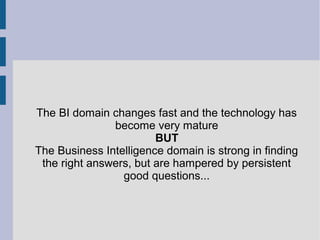
The BI domain changes fast and the technology has
become very mature
BUT
The Business Intelligence domain is strong in finding
the right answers, but are hampered by persistent
good questions...
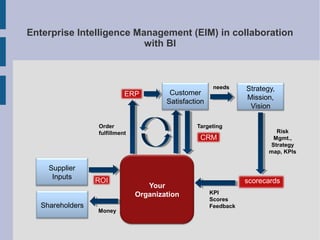
Enterprise Intelligence Management (EIM) in collaboration
with BI

ERP

Customer
Satisfaction

Order
fulfillment

Supplier
Inputs

Shareholders

ROI

Money

needs

Targeting

CRM

Your
Organization

Strategy,
Mission,
Vision

Risk
Mgmt.,
Strategy
map, KPIs

scorecards
KPI
Scores
Feedback
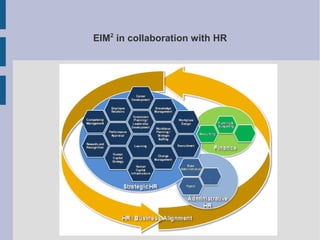
EIM2 in collaboration with HR
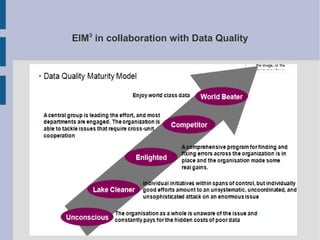
EIM3 in collaboration with Data Quality
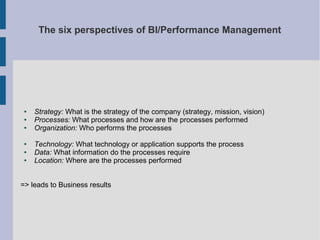
The six perspectives of BI/Performance Management

●
●
●

●
●
●

Strategy: What is the strategy of the company (strategy, mission, vision)
Processes: What processes and how are the processes performed
Organization: Who performs the processes
Technology: What technology or application supports the process
Data: What information do the processes require
Location: Where are the processes performed

=> leads to Business results
Key attention points for BI/Performance Management

●

●
●
●

●

●

Focus on the intention of BI: create insights to take the best decisions and perform
the best actions to accomplish the ambition of your organization
BI is not a one time implementation but a structural additive to your organization
Foresee organization wide unambiguous expectations and goals about BI
Proactive management of inevitable changes in goals and resources (my
philosophy is to train the people, not to dismiss)
BI interfaces every aspect of an organization, the weakest chain determines the
success
The effective success of BI will be determined by the organization itself, on basis of
the contribution to the organizational performance
BLOCK 2: VALUE CREATION
IN 5 DIMENSIONS
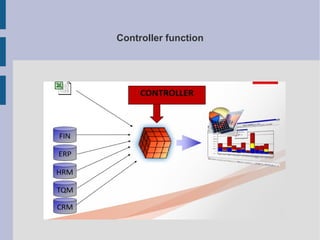
Controller function
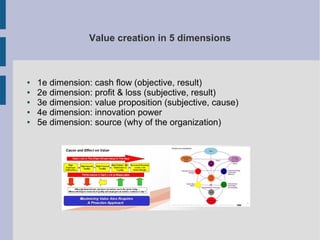
Value creation in 5 dimensions

●
●
●
●
●

1e dimension: cash flow (objective, result)
2e dimension: profit & loss (subjective, result)
3e dimension: value proposition (subjective, cause)
4e dimension: innovation power
5e dimension: source (why of the organization)
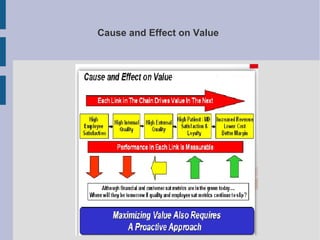
Cause and Effect on Value
BLOCK 3: Planning & control VS. Organizational culture
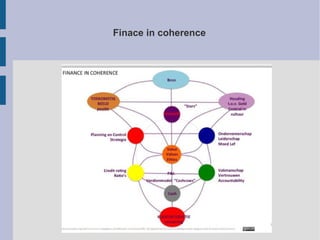
Finace in coherence
BLOCK 4: Strategic analysis
gurus about planning and control
Gurus about strategy, planning and control

●
●
●
●
●
●
●
●
●

Tom Peters
Larry E. Greiner
Stephen Covey
Deepak Chopra
Joghn Kotter
Henry Mintzberg
William Schiemann
Robert Kaplan
Vineer Nayar
Tom Peters about successful entrepreneurship

●
●
●
●
●
●
●
●

Preference for action
Customer intimacy
Autonomy and entrepreneurship
Productivity trough people
Passion for practical value
Simple organization, small staff
First strong control and then release
We should stick to what we are good at
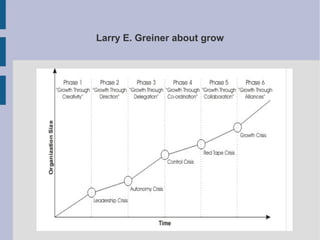
Larry E. Greiner about grow
Stephen Covey: 8 characteristics of effective leaders

●
●
●
●
●
●
●
●

Be pro-active
Start with a well defined goal in mind
Start with the end, create first a to-be overview
Think in terms of win-win situations
First understand then be understood
Work synergistically
Be alert
Find your own voice and help other to find their voice too
Chopra: 7 components of leadership

●
●
●
●
●
●
●

Listen
Empathic ability
Awareness
Action oriented
Give responsibility
Take responsibility
Do the right thing on the right moment
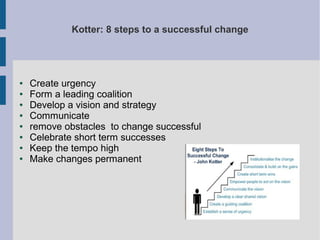
Kotter: 8 steps to a successful change

●
●
●
●
●
●
●
●

Create urgency
Form a leading coalition
Develop a vision and strategy
Communicate
remove obstacles to change successful
Celebrate short term successes
Keep the tempo high
Make changes permanent
Henry Mintzberg

●
●

●
●

●

Leadership gives sense to employees
Strategy comes from below because people solve day by
day operational problems and discover the effective
direction
Involved employees oppose against thoughtless big plans
Effective leaders are not in the top but simply move in the
network
Learn to manage is learn to think
William Schiemann: 7 biggest myths about measure

●

●
●
●
●
●
●

Measure hard results and soft goals will be reached
automatically
Measuring is like counting beens
Measuring is all about the past, history
Measuring creates 'the real'
Measuring blocks creativity
Measuring is anti-people
The more you measure the better
Robert Kaplan: What you don't measure, you can't manage

●
●
●
●
●

●
●

First strategy
Then critical success factors
After this KPI's, divided over four perspectives
The balanced scorecard is never finished
Evaluate constantly if KPI's are reliable indicators of the road to
success
The CEO is owner of the problems
The simpler, the better the strategic card
Vineer Nayar: Employees First, Customers Second

●
●
●
●

Internal transparency
Employee engagement
Technology needs intelligence more than money to invest
Front-line employees have to become the key drivers of
change
Effective planning and control

●
●

●
●
●

Stimulate thinking based on value creation
P&L is less important, more important are the KPI's that
accomplish the strategy
Make control available at every level in the organization
More interest in a business model compared to an agenda
Use financial and non financial KPI's that create value for the
company
BLOCK 5: Ratio analysis
Ratio analyse, different perspectives

●
●

●

Shareholders perspective: shareholders value
Bank perspective, the first way out and the second way out
and other bank aspects
Social responsibility and entrepreneurship
Shareholders value

●
●
●
●
●

EVA and MVA
Dividend
Gross/net profit margin
CAPM
Dupon-chart and ROI
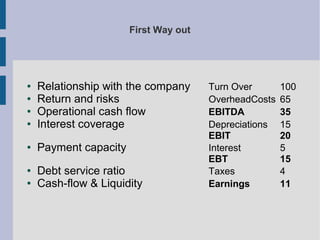
First Way out

●
●
●
●

●

●
●

Relationship with the company
Return and risks
Operational cash flow
Interest coverage
Payment capacity
Debt service ratio
Cash-flow & Liquidity

Turn Over
OverheadCosts
EBITDA
Depreciations
EBIT
Interest
EBT
Taxes
Earnings

100
65
35
15
20
5
15
4
11
Second Way out

●
●
●
●
●
●

Capacity to cover unforeseen costs
Solvability
Warranty capability
Resilience ability
Warrant and warrant credits
Security
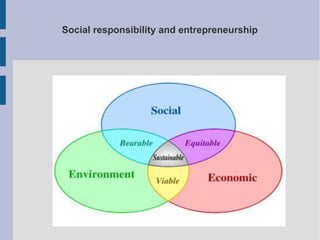
Social responsibility and entrepreneurship
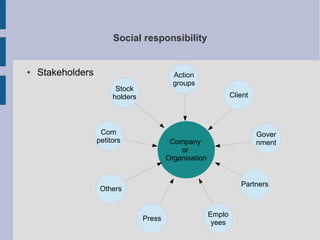
Social responsibility

●

Stakeholders

Action
groups

Stock
holders

Client

Com
petitors

Gover
nment

Partners

Others

Press

Emplo
yees
BLOCK 6: work capital analysis
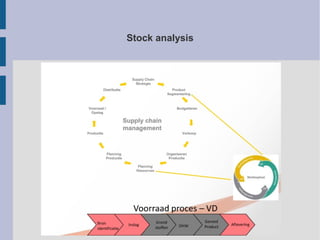
Attention points for stock analysis

●

Understand the production process
–

●

Stock value
–

●

Categorized per product and cost allocation

Current stock VS budgeted
–

●

Production flows, raw materials, import restrictions,
inspections

Identify differences

Theory of constraints
–

Evaluate if the organization optimizes or suboptimizes
Stock analysis
Debtors

●
●
●

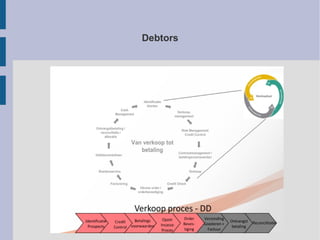
Debtors calculated from the moment the bill is created or sent
Should have a natural term
Other elements of debtors cycle not on the balance, but
possibly add costs in the process
–
–
–

Conditions
Bill process
Efficiency of the process
Debtors
Think out of the box

●
●
●
●
●
●
●
●

Credit control VS automatic incasso
Don't forget overhead cost administration
Time to market VS circulation rate stock
Benchmark to get a better insight
Physical money flows are expensive
Natural hedging is cost and time saving
Good cash management to save time
Don't lose time to focus only on making profits
Think out of the box

●
●

●
●
●
●
●

Fits the administration to the physical company
Fixed overhead costs and optimum Material
Management
Theory of constraints in logistics part of the company
Reduce work capital days to reduce costs
Difference between buy to order and buy to stock
Debtors management by commercial people
Blame culture, leads to nontransparent organization
BLOCK 7: Automation in DWH
gurus about BI
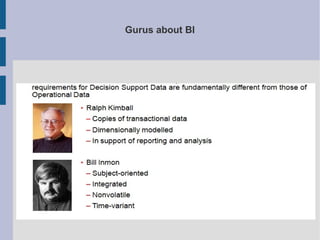
Gurus about BI
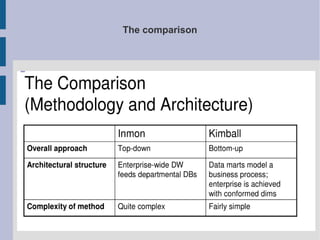
The comparison
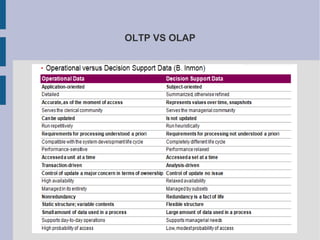
OLTP VS OLAP
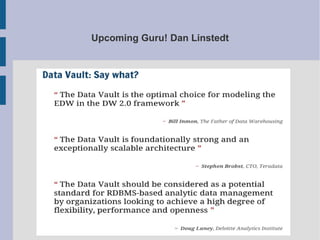
Upcoming Guru! Dan Linstedt
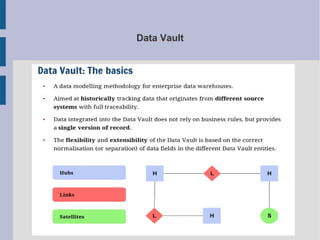
Data Vault
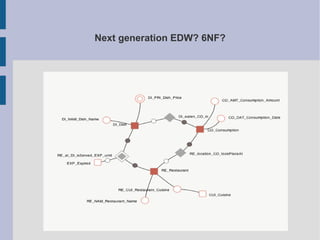
Next generation EDW? 6NF?
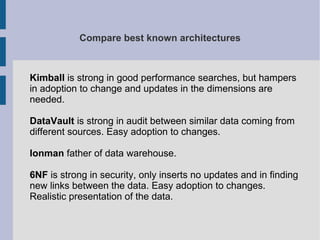
Compare best known architectures

Kimball is strong in good performance searches, but hampers
in adoption to change and updates in the dimensions are
needed.
DataVault is strong in audit between similar data coming from
different sources. Easy adoption to changes.
Ionman father of data warehouse.
6NF is strong in security, only inserts no updates and in finding
new links between the data. Easy adoption to changes.
Realistic presentation of the data.
Software partners

The BIG five
●
●
●
●
●

www.sas.com
www.ibm.com
www.sap.com
www.microsoft/bi.com
www.oracle.com
BLOCK 8: DEFINE YOUR OWN BI/PM/EIM3 SUCCESS
ROAD
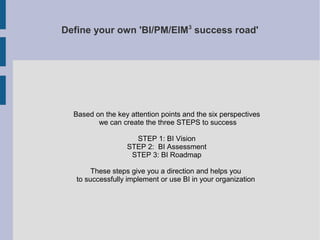
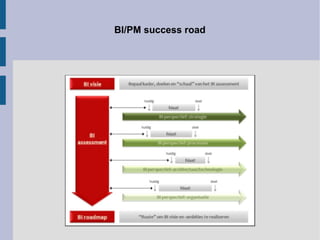
Define your own 'BI/PM/EIM3 success road'

Based on the key attention points and the six perspectives
we can create the three STEPS to success
STEP 1: BI Vision
STEP 2: BI Assessment
STEP 3: BI Roadmap
These steps give you a direction and helps you
to successfully implement or use BI in your organization
BI/PM success road
BI/PM Brainstorm sessions

●
●

●
●
●
●

A Brain storm takes at least 60 minutes and maximum a day
You decide the content of the agenda depending on the BI ambitions of your
organization
You decide the participants of your organization to the brainstorm session
A BI brainstorm session is guided by one or two very experienced BI experts
After the brainstorm session you receive a brief overview of the session
Every thing discussed during this session is strictly confidential
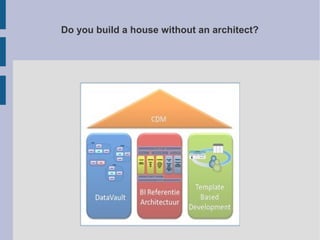
Do you build a house without an architect?
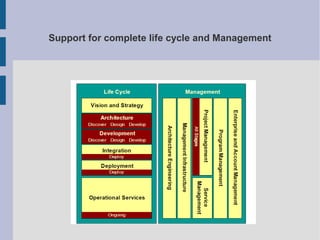
Support for complete life cycle and Management
Some example BI/PM project types

●
●
●
●
●
●
●
●
●
●

Implementation of a BI/PM strategy
Process optimization in the context of BI project
New and reverse engineering of BI project
Migration of BI platform or tools
Set up of BI competence center (Bicc)
BI assessment
BI training and documentation
BI tool selection
Change management and training
...
Thank you for your attention...
Questions?
Email: dimitri_de_meester@yahoo.com
Mobile: +32 (0)479 29 67 54
Linkedin: be.linkedin.compubdimitri-de-meester1811321
Twitter: @ddemeester1

InsightSolutions

  • 2.
    Insight in anorganization is like a brain surgery, critical, inspiring and mysterious. (Dimitri De Meester, 2013) email:dimitri_de_meester@yahoo.com Mobile: +32(0)479 29 67 54
  • 3.
    Presentation in 8blocks 1.Introduction 2.Value creation in 5 dimensions 3.Planning & control VS. Organizational culture 4.Strategic analysis, guru about planning and control 5.Ratio analysis 6.Working capital 7.Automation in DWH, guru about BI 8.Define your own BI/PM/EIM2 success road
  • 4.
  • 5.
    What is BI/PerformanceManagement? ● ● ● ● Ask ten people to explain you what BI exactly is, and there is a big chance they will tell you ten different stories depending on there background Gartner says: Leverage technology and best practices to deliver management insight from enterprise applications and data. Combine business intelligence tools and applications with effective structure, quality improvement and information governance and learn to maximize payback while minimizing risk. Gartner describes Business Intelligence (BI) also as the usage of information to enable organizations to best decide, measure, manage and optimize performance to achieve efficiency and financial benefit. In short, BI aims to support better business decision-making by providing operational insight. Gartner defines Performance Management as the combination of management methodologies, metrics and information technology that enables users to define, monitor and optimize results and outcomes to achieve personal or departmental objectives while enabling alignment with strategic objectives across multiple organizational levels. Successful performance management is achieved when used, accepted and applied at all levels in an organization. Alignment with strategic objectives is of ultimate importance
  • 6.
    INSIGHT generic model Management LifeCycle Organization Vision & Strategy Insight Vision, Strategy & Roadmap Insight Architecture, Methodology & Metrics Insight Process, Governace & Organization EIM Statistical applications Scorecarding (KPI's) Master Data & Data Quality BI PM Ad hoc ... analytics ... Insight Package Applications, content & Data Mart Data Warehouse Data Integration Operational Services A R C H I T E C T U R E E G I N E E R I N G I N F R A S T R U C T U R E M A N A G E M E N T P R O J E C T M A N A G E M E N T S E R V I C E M A N A G E M E N T P R O G R A M M A N A G E M E N T E N T E R P R I S E A C C O U N T M A N A G E M E N T
  • 7.
    The BI domainchanges fast and the technology has become very mature BUT The Business Intelligence domain is strong in finding the right answers, but are hampered by persistent good questions...
  • 8.
    Enterprise Intelligence Management(EIM) in collaboration with BI ERP Customer Satisfaction Order fulfillment Supplier Inputs Shareholders ROI Money needs Targeting CRM Your Organization Strategy, Mission, Vision Risk Mgmt., Strategy map, KPIs scorecards KPI Scores Feedback
  • 9.
  • 10.
    EIM3 in collaborationwith Data Quality
  • 11.
    The six perspectivesof BI/Performance Management ● ● ● ● ● ● Strategy: What is the strategy of the company (strategy, mission, vision) Processes: What processes and how are the processes performed Organization: Who performs the processes Technology: What technology or application supports the process Data: What information do the processes require Location: Where are the processes performed => leads to Business results
  • 12.
    Key attention pointsfor BI/Performance Management ● ● ● ● ● ● Focus on the intention of BI: create insights to take the best decisions and perform the best actions to accomplish the ambition of your organization BI is not a one time implementation but a structural additive to your organization Foresee organization wide unambiguous expectations and goals about BI Proactive management of inevitable changes in goals and resources (my philosophy is to train the people, not to dismiss) BI interfaces every aspect of an organization, the weakest chain determines the success The effective success of BI will be determined by the organization itself, on basis of the contribution to the organizational performance
  • 13.
    BLOCK 2: VALUECREATION IN 5 DIMENSIONS
  • 14.
  • 15.
    Value creation in5 dimensions ● ● ● ● ● 1e dimension: cash flow (objective, result) 2e dimension: profit & loss (subjective, result) 3e dimension: value proposition (subjective, cause) 4e dimension: innovation power 5e dimension: source (why of the organization)
  • 16.
  • 17.
    BLOCK 3: Planning& control VS. Organizational culture
  • 18.
  • 19.
    BLOCK 4: Strategicanalysis gurus about planning and control
  • 20.
    Gurus about strategy,planning and control ● ● ● ● ● ● ● ● ● Tom Peters Larry E. Greiner Stephen Covey Deepak Chopra Joghn Kotter Henry Mintzberg William Schiemann Robert Kaplan Vineer Nayar
  • 21.
    Tom Peters aboutsuccessful entrepreneurship ● ● ● ● ● ● ● ● Preference for action Customer intimacy Autonomy and entrepreneurship Productivity trough people Passion for practical value Simple organization, small staff First strong control and then release We should stick to what we are good at
  • 22.
    Larry E. Greinerabout grow
  • 23.
    Stephen Covey: 8characteristics of effective leaders ● ● ● ● ● ● ● ● Be pro-active Start with a well defined goal in mind Start with the end, create first a to-be overview Think in terms of win-win situations First understand then be understood Work synergistically Be alert Find your own voice and help other to find their voice too
  • 24.
    Chopra: 7 componentsof leadership ● ● ● ● ● ● ● Listen Empathic ability Awareness Action oriented Give responsibility Take responsibility Do the right thing on the right moment
  • 25.
    Kotter: 8 stepsto a successful change ● ● ● ● ● ● ● ● Create urgency Form a leading coalition Develop a vision and strategy Communicate remove obstacles to change successful Celebrate short term successes Keep the tempo high Make changes permanent
  • 26.
    Henry Mintzberg ● ● ● ● ● Leadership givessense to employees Strategy comes from below because people solve day by day operational problems and discover the effective direction Involved employees oppose against thoughtless big plans Effective leaders are not in the top but simply move in the network Learn to manage is learn to think
  • 27.
    William Schiemann: 7biggest myths about measure ● ● ● ● ● ● ● Measure hard results and soft goals will be reached automatically Measuring is like counting beens Measuring is all about the past, history Measuring creates 'the real' Measuring blocks creativity Measuring is anti-people The more you measure the better
  • 28.
    Robert Kaplan: Whatyou don't measure, you can't manage ● ● ● ● ● ● ● First strategy Then critical success factors After this KPI's, divided over four perspectives The balanced scorecard is never finished Evaluate constantly if KPI's are reliable indicators of the road to success The CEO is owner of the problems The simpler, the better the strategic card
  • 29.
    Vineer Nayar: EmployeesFirst, Customers Second ● ● ● ● Internal transparency Employee engagement Technology needs intelligence more than money to invest Front-line employees have to become the key drivers of change
  • 30.
    Effective planning andcontrol ● ● ● ● ● Stimulate thinking based on value creation P&L is less important, more important are the KPI's that accomplish the strategy Make control available at every level in the organization More interest in a business model compared to an agenda Use financial and non financial KPI's that create value for the company
  • 31.
  • 32.
    Ratio analyse, differentperspectives ● ● ● Shareholders perspective: shareholders value Bank perspective, the first way out and the second way out and other bank aspects Social responsibility and entrepreneurship
  • 33.
    Shareholders value ● ● ● ● ● EVA andMVA Dividend Gross/net profit margin CAPM Dupon-chart and ROI
  • 34.
    First Way out ● ● ● ● ● ● ● Relationshipwith the company Return and risks Operational cash flow Interest coverage Payment capacity Debt service ratio Cash-flow & Liquidity Turn Over OverheadCosts EBITDA Depreciations EBIT Interest EBT Taxes Earnings 100 65 35 15 20 5 15 4 11
  • 35.
    Second Way out ● ● ● ● ● ● Capacityto cover unforeseen costs Solvability Warranty capability Resilience ability Warrant and warrant credits Security
  • 36.
    Social responsibility andentrepreneurship
  • 37.
  • 38.
    BLOCK 6: workcapital analysis
  • 39.
    Attention points forstock analysis ● Understand the production process – ● Stock value – ● Categorized per product and cost allocation Current stock VS budgeted – ● Production flows, raw materials, import restrictions, inspections Identify differences Theory of constraints – Evaluate if the organization optimizes or suboptimizes
  • 40.
  • 41.
    Debtors ● ● ● Debtors calculated fromthe moment the bill is created or sent Should have a natural term Other elements of debtors cycle not on the balance, but possibly add costs in the process – – – Conditions Bill process Efficiency of the process
  • 42.
  • 43.
    Think out ofthe box ● ● ● ● ● ● ● ● Credit control VS automatic incasso Don't forget overhead cost administration Time to market VS circulation rate stock Benchmark to get a better insight Physical money flows are expensive Natural hedging is cost and time saving Good cash management to save time Don't lose time to focus only on making profits
  • 44.
    Think out ofthe box ● ● ● ● ● ● ● Fits the administration to the physical company Fixed overhead costs and optimum Material Management Theory of constraints in logistics part of the company Reduce work capital days to reduce costs Difference between buy to order and buy to stock Debtors management by commercial people Blame culture, leads to nontransparent organization
  • 45.
    BLOCK 7: Automationin DWH gurus about BI
  • 46.
  • 47.
  • 48.
  • 49.
  • 50.
  • 51.
  • 52.
    Compare best knownarchitectures Kimball is strong in good performance searches, but hampers in adoption to change and updates in the dimensions are needed. DataVault is strong in audit between similar data coming from different sources. Easy adoption to changes. Ionman father of data warehouse. 6NF is strong in security, only inserts no updates and in finding new links between the data. Easy adoption to changes. Realistic presentation of the data.
  • 53.
    Software partners The BIGfive ● ● ● ● ● www.sas.com www.ibm.com www.sap.com www.microsoft/bi.com www.oracle.com
  • 54.
    BLOCK 8: DEFINEYOUR OWN BI/PM/EIM3 SUCCESS ROAD
  • 55.
    Define your own'BI/PM/EIM3 success road' Based on the key attention points and the six perspectives we can create the three STEPS to success STEP 1: BI Vision STEP 2: BI Assessment STEP 3: BI Roadmap These steps give you a direction and helps you to successfully implement or use BI in your organization
  • 56.
  • 57.
    BI/PM Brainstorm sessions ● ● ● ● ● ● ABrain storm takes at least 60 minutes and maximum a day You decide the content of the agenda depending on the BI ambitions of your organization You decide the participants of your organization to the brainstorm session A BI brainstorm session is guided by one or two very experienced BI experts After the brainstorm session you receive a brief overview of the session Every thing discussed during this session is strictly confidential
  • 58.
    Do you builda house without an architect?
  • 59.
    Support for completelife cycle and Management
  • 60.
    Some example BI/PMproject types ● ● ● ● ● ● ● ● ● ● Implementation of a BI/PM strategy Process optimization in the context of BI project New and reverse engineering of BI project Migration of BI platform or tools Set up of BI competence center (Bicc) BI assessment BI training and documentation BI tool selection Change management and training ...
  • 61.
    Thank you foryour attention...
  • 62.
    Questions? Email: dimitri_de_meester@yahoo.com Mobile: +32(0)479 29 67 54 Linkedin: be.linkedin.compubdimitri-de-meester1811321 Twitter: @ddemeester1