Design Patterns For
Micro Service
Architecture
By - LambdaTest
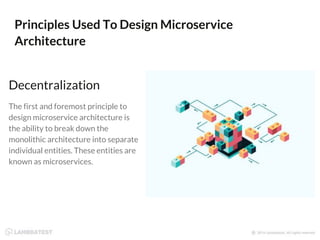
The first and foremost principle to
design microservice architecture is
the ability to break down the
monolithic architecture into separate
individual entities. These entities are
known as microservices.
Decentralization
Principles Used To Design Microservice
Architecture
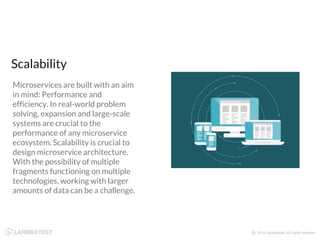
Microservices are built with an aim
in mind: Performance and
efficiency. In real-world problem
solving, expansion and large-scale
systems are crucial to the
performance of any microservice
ecosystem. Scalability is crucial to
design microservice architecture.
With the possibility of multiple
fragments functioning on multiple
technologies, working with larger
amounts of data can be a challenge.
Scalability
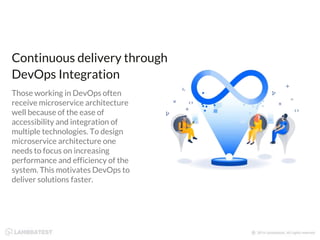
Continuous delivery through
DevOps Integration
Those working in DevOps often
receive microservice architecture
well because of the ease of
accessibility and integration of
multiple technologies. To design
microservice architecture one
needs to focus on increasing
performance and efficiency of the
system. This motivates DevOps to
deliver solutions faster.
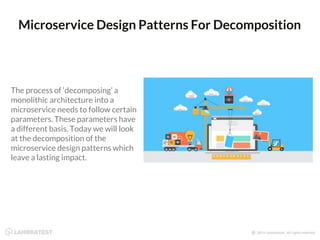
The process of ‘decomposing’ a
monolithic architecture into a
microservice needs to follow certain
parameters. These parameters have
a different basis. Today we will look
at the decomposition of the
microservice design patterns which
leave a lasting impact.
Microservice Design Patterns For Decomposition
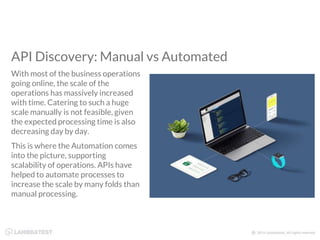
With most of the business operations
going online, the scale of the
operations has massively increased
with time. Catering to such a huge
scale manually is not feasible, given
the expected processing time is also
decreasing day by day.
This is where the Automation comes
into the picture, supporting
scalability of operations. APIs have
helped to automate processes to
increase the scale by many folds than
manual processing.
API Discovery: Manual vs Automated
Decompose by a
Business Capability
A microservice is as successful as its
combination of high cohesion and loose
coupling. Services need to be loosely
coupled while keeping the function of
similar interests together.
To maintain efficiency and foresee
growth, the best solution is to
decompose the systems using business
capability. This includes classification
into various business domains which are
responsible to generate value in their
own capabilities.
Domain Driven Design
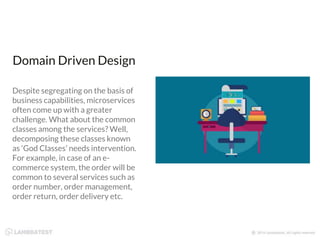
Despite segregating on the basis of
business capabilities, microservices
often come up with a greater
challenge. What about the common
classes among the services? Well,
decomposing these classes known
as ‘God Classes’ needs intervention.
For example, in case of an e-
commerce system, the order will be
common to several services such as
order number, order management,
order return, order delivery etc.
Strangler Pattern
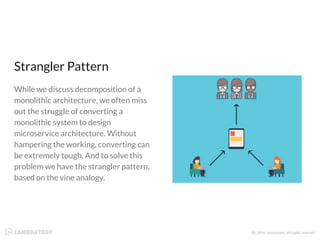
While we discuss decomposition of a
monolithic architecture, we often miss
out the struggle of converting a
monolithic system to design
microservice architecture. Without
hampering the working, converting can
be extremely tough. And to solve this
problem we have the strangler pattern,
based on the vine analogy.
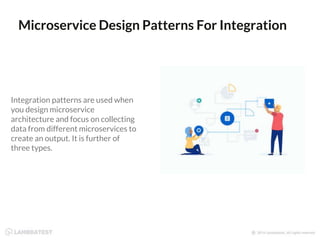
Integration patterns are used when
you design microservice
architecture and focus on collecting
data from different microservices to
create an output. It is further of
three types.
Microservice Design Patterns For Integration
Aggregator Pattern
With multiple services involved, fetching
the output and combining it for the end-
user is necessary. For a user to combine
the data, will require immense internal
knowledge of the system. As we design
microservice architecture, breaking
down the monolith means the division of
the sources of output. Hence, to
aggregate this data we make use of the
aggregator pattern.
API Gateway Pattern
With the microservice architecture, it is
very important to extract the data from
individual services. But, these may or
may not run on common technology.
What do we do now? The solution is an
Application Programming Interface (API)
which acts as the controller between the
system and client calls.
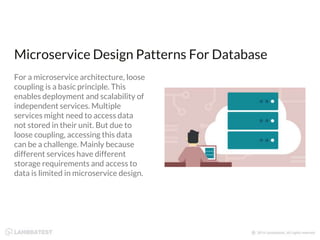
Microservice Design Patterns For Database
For a microservice architecture, loose
coupling is a basic principle. This
enables deployment and scalability of
independent services. Multiple
services might need to access data
not stored in their unit. But due to
loose coupling, accessing this data
can be a challenge. Mainly because
different services have different
storage requirements and access to
data is limited in microservice design.
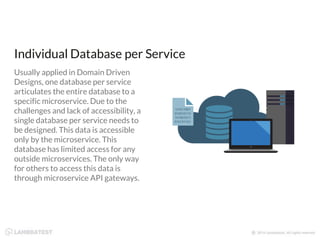
Individual Database per Service
Usually applied in Domain Driven
Designs, one database per service
articulates the entire database to a
specific microservice. Due to the
challenges and lack of accessibility, a
single database per service needs to
be designed. This data is accessible
only by the microservice. This
database has limited access for any
outside microservices. The only way
for others to access this data is
through microservice API gateways.
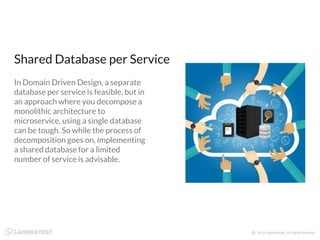
Shared Database per Service
In Domain Driven Design, a separate
database per service is feasible, but in
an approach where you decompose a
monolithic architecture to
microservice, using a single database
can be tough. So while the process of
decomposition goes on, implementing
a shared database for a limited
number of service is advisable.
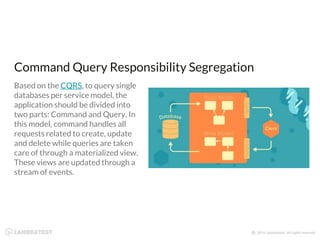
Command Query Responsibility Segregation
Based on the CQRS, to query single
databases per service model, the
application should be divided into
two parts: Command and Query. In
this model, command handles all
requests related to create, update
and delete while queries are taken
care of through a materialized view.
These views are updated through a
stream of events.
The bottom line
Though not all the design patterns might apply to a given microservice, you can
rest assured that most of them will be used everywhere. These design patterns
help developers to bring in a standard that is consistent and brings in reliability to
the application as a whole.
The evaluation, auditing, and implementation and testing microservices of these
design patterns are an ongoing process of microservice architecture. Right from
the designing phase of the application to the maintenance phase in production,
these patterns will help throughout.
www.lambdatest.com
HAPPY TESTING!!

Design Patterns for Micro Service Architecture

  • 2.
    Design Patterns For MicroService Architecture By - LambdaTest
  • 3.
    The first andforemost principle to design microservice architecture is the ability to break down the monolithic architecture into separate individual entities. These entities are known as microservices. Decentralization Principles Used To Design Microservice Architecture
  • 4.
    Microservices are builtwith an aim in mind: Performance and efficiency. In real-world problem solving, expansion and large-scale systems are crucial to the performance of any microservice ecosystem. Scalability is crucial to design microservice architecture. With the possibility of multiple fragments functioning on multiple technologies, working with larger amounts of data can be a challenge. Scalability
  • 5.
    Continuous delivery through DevOpsIntegration Those working in DevOps often receive microservice architecture well because of the ease of accessibility and integration of multiple technologies. To design microservice architecture one needs to focus on increasing performance and efficiency of the system. This motivates DevOps to deliver solutions faster.
  • 6.
    The process of‘decomposing’ a monolithic architecture into a microservice needs to follow certain parameters. These parameters have a different basis. Today we will look at the decomposition of the microservice design patterns which leave a lasting impact. Microservice Design Patterns For Decomposition
  • 7.
    With most ofthe business operations going online, the scale of the operations has massively increased with time. Catering to such a huge scale manually is not feasible, given the expected processing time is also decreasing day by day. This is where the Automation comes into the picture, supporting scalability of operations. APIs have helped to automate processes to increase the scale by many folds than manual processing. API Discovery: Manual vs Automated
  • 8.
    Decompose by a BusinessCapability A microservice is as successful as its combination of high cohesion and loose coupling. Services need to be loosely coupled while keeping the function of similar interests together. To maintain efficiency and foresee growth, the best solution is to decompose the systems using business capability. This includes classification into various business domains which are responsible to generate value in their own capabilities.
  • 9.
    Domain Driven Design Despitesegregating on the basis of business capabilities, microservices often come up with a greater challenge. What about the common classes among the services? Well, decomposing these classes known as ‘God Classes’ needs intervention. For example, in case of an e- commerce system, the order will be common to several services such as order number, order management, order return, order delivery etc.
  • 10.
    Strangler Pattern While wediscuss decomposition of a monolithic architecture, we often miss out the struggle of converting a monolithic system to design microservice architecture. Without hampering the working, converting can be extremely tough. And to solve this problem we have the strangler pattern, based on the vine analogy.
  • 11.
    Integration patterns areused when you design microservice architecture and focus on collecting data from different microservices to create an output. It is further of three types. Microservice Design Patterns For Integration
  • 12.
    Aggregator Pattern With multipleservices involved, fetching the output and combining it for the end- user is necessary. For a user to combine the data, will require immense internal knowledge of the system. As we design microservice architecture, breaking down the monolith means the division of the sources of output. Hence, to aggregate this data we make use of the aggregator pattern.
  • 13.
    API Gateway Pattern Withthe microservice architecture, it is very important to extract the data from individual services. But, these may or may not run on common technology. What do we do now? The solution is an Application Programming Interface (API) which acts as the controller between the system and client calls.
  • 14.
    Microservice Design PatternsFor Database For a microservice architecture, loose coupling is a basic principle. This enables deployment and scalability of independent services. Multiple services might need to access data not stored in their unit. But due to loose coupling, accessing this data can be a challenge. Mainly because different services have different storage requirements and access to data is limited in microservice design.
  • 15.
    Individual Database perService Usually applied in Domain Driven Designs, one database per service articulates the entire database to a specific microservice. Due to the challenges and lack of accessibility, a single database per service needs to be designed. This data is accessible only by the microservice. This database has limited access for any outside microservices. The only way for others to access this data is through microservice API gateways.
  • 16.
    Shared Database perService In Domain Driven Design, a separate database per service is feasible, but in an approach where you decompose a monolithic architecture to microservice, using a single database can be tough. So while the process of decomposition goes on, implementing a shared database for a limited number of service is advisable.
  • 17.
    Command Query ResponsibilitySegregation Based on the CQRS, to query single databases per service model, the application should be divided into two parts: Command and Query. In this model, command handles all requests related to create, update and delete while queries are taken care of through a materialized view. These views are updated through a stream of events.
  • 18.
    The bottom line Thoughnot all the design patterns might apply to a given microservice, you can rest assured that most of them will be used everywhere. These design patterns help developers to bring in a standard that is consistent and brings in reliability to the application as a whole. The evaluation, auditing, and implementation and testing microservices of these design patterns are an ongoing process of microservice architecture. Right from the designing phase of the application to the maintenance phase in production, these patterns will help throughout. www.lambdatest.com
  • 19.