For Microservices Online Training : +91-999 123 502
Introduction to Microservices
Shailendra Chauhan
Microsoft MVP, Technical Consultant and Corporate Trainer
For Microservices Online Training : +91-999 123 502
• Introduction to Microservices
• Microservices Principles
• Monolithic vs. N-Layer vs. SOA vs. Microservices
• Microservices Architecture
• When to use Microservices Architecture
• Challenges of Microservices
• Tools/Platform For Building Microservices
• Microservices API Gateways
• Design Patterns for Microservices
Agenda
For Microservices Online Training : +91-999 123 502
• Microservice is a small unit that has only one responsibility or single logic
which solve a specific problem.
• Microservices are the evolution of service-oriented architecture.
• Microservices are small and independent services that work together.
• A style of engineering to build highly automated, independent and evolving
software.
• Each Microservice can be deployed independently.
• A Microservice itself persist its own data or external state.
• All services don't need to share the same technology stack, libraries, or
frameworks.
Introduction to Microservices
For Microservices Online Training : +91-999 123 502
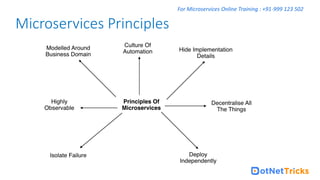
Microservices Principles
For Microservices Online Training : +91-999 123 502
• Modelled around business domain : Separate system capability into
different domains and each domain will focus on one thing and its
associated logic.
• Culture of Automation : Follow the culture of automation by designing it for
continues integration and continuous delivery.
• Hide implementation details : Hiding the internal details reduce the
coupling and helps to do changes and improvement without affecting the
overall architecture.
• Decentralization : There is no centralized database, usually each service is
designed to manage its own database.
Microservices Principles Contd..
For Microservices Online Training : +91-999 123 502
• Deploy Independently : Each service can be deployed independently.
• Failure Isolation : The impact of a failure is less in microservice architecture
compares to monolithic type as it will only affect that particular service and
its associates. Other services can keep running.
• Highly Observable : The services should collect as much information to
analyze what is happening within each of them like log events and stats.
Microservices Principles Contd..
For Microservices Online Training : +91-999 123 502
Monolithic vs. N-Layer vs. SOA vs. Microservices
Monolithic: Single Unit Multi Units: N-Layer/SOA Smaller Units: Microservices
For Microservices Online Training : +91-999 123 502
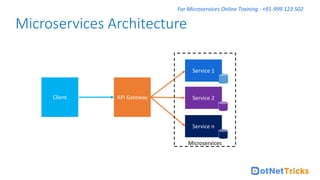
Microservices Architecture
Client API Gateway
Service 1
Service 2
Service n
Microservices
For Microservices Online Training : +91-999 123 502
• Large applications that require a high release velocity.
• Complex applications that need to be highly scalable.
• Applications with rich domains or many subdomains.
• An organization that consists of small development teams.
When to use Microservices Architecture
For Microservices Online Training : +91-999 123 502
• Language independent and framework independent.
• Independently develop, deploy, redeploy, version and scale component
services in seconds without compromising the integrity of an application
• Better fault isolation keeps other services to work even on failure.
• Zero downtime upgrades.
• Services can be of from different servers or even from different datacenters.
• Reliable and self-healing.
• Supports continuous integration and delivery.
• Easy to integrate with third parties.
Advantages of Microservices
For Microservices Online Training : +91-999 123 502
• Complexity - A microservices application is more complex as compared to
the equivalent monolithic application.
• Development and testing - Building and testing a service that relies on other
services need domains understanding and refactoring them can be difficult.
• Lack of governance - The decentralized approach to building microservices
has advantages, but it also lead to so many problems like maintenance
because of many different languages and frameworks.
• Network congestion and latency - The use of many small, services can result
into additional latency because of interservice communication and a long
chain of service dependencies. So design APIs carefully and use
asynchronous communication patterns.
Challenges of Microservices
For Microservices Online Training : +91-999 123 502
• Data Integrity - Each microservice is responsible for its own data
persistence. As a result, data consistency can be a challenge.
• Management - To be successful with microservices requires a mature
DevOps culture. Correlated logging across services can be challenging for a
single user operation.
• Versioning - Be careful while updating a service. It must not break services
that depend on it. So without careful design, you might have problems
with backward or forward compatibility.
• Skillset - Microservices are highly distributed systems. So need a skilled and
experience team to implement it.
Challenges of Microservices Contd..
For Microservices Online Training : +91-999 123 502
Tools/IDE:
Getting started with Microservices
For Microservices Online Training : +91-999 123 502
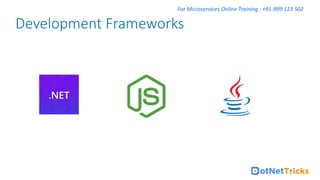
Development Frameworks
For Microservices Online Training : +91-999 123 502
Development Tools
www.visualstudio.microsoft.com/
Visual Studio VS Code
www.code.visualstudio.com/
Docker
www.code.docker.com/
For Microservices Online Training : +91-999 123 502
Microservices API Gateways
Azure API Management Ocelot API Gateway Traefik (traffic)
For Microservices Online Training : +91-999 123 502
Design Patterns for Microservices
Decomposition Patterns
• Decompose by Business Capability
• Decompose by Subdomain
• Strangler Pattern
Integration Patterns
• API Gateway Pattern
• Aggregator Pattern
• Client-Side UI Composition Pattern
Database Patterns
• Database per Service
• Shared Database per Service
• CQRS Pattern
• Saga Pattern
Communication Patterns
• Request/Response Pattern
• Messaging Pattern
• Event Driven Pattern
Deployment Patterns
• Multiple Service Instances per Host
• Service Instance per Host
• Serverless Deployment
• Service Deployment Platform
For Microservices Online Training : +91-999 123 502
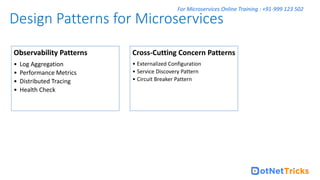
Design Patterns for Microservices
Observability Patterns
• Log Aggregation
• Performance Metrics
• Distributed Tracing
• Health Check
Cross-Cutting Concern Patterns
• Externalized Configuration
• Service Discovery Pattern
• Circuit Breaker Pattern

Microservices Tutorial for Beginners | All You Need to Get Started

  • 1.
    For Microservices OnlineTraining : +91-999 123 502 Introduction to Microservices Shailendra Chauhan Microsoft MVP, Technical Consultant and Corporate Trainer
  • 2.
    For Microservices OnlineTraining : +91-999 123 502 • Introduction to Microservices • Microservices Principles • Monolithic vs. N-Layer vs. SOA vs. Microservices • Microservices Architecture • When to use Microservices Architecture • Challenges of Microservices • Tools/Platform For Building Microservices • Microservices API Gateways • Design Patterns for Microservices Agenda
  • 3.
    For Microservices OnlineTraining : +91-999 123 502 • Microservice is a small unit that has only one responsibility or single logic which solve a specific problem. • Microservices are the evolution of service-oriented architecture. • Microservices are small and independent services that work together. • A style of engineering to build highly automated, independent and evolving software. • Each Microservice can be deployed independently. • A Microservice itself persist its own data or external state. • All services don't need to share the same technology stack, libraries, or frameworks. Introduction to Microservices
  • 4.
    For Microservices OnlineTraining : +91-999 123 502 Microservices Principles
  • 5.
    For Microservices OnlineTraining : +91-999 123 502 • Modelled around business domain : Separate system capability into different domains and each domain will focus on one thing and its associated logic. • Culture of Automation : Follow the culture of automation by designing it for continues integration and continuous delivery. • Hide implementation details : Hiding the internal details reduce the coupling and helps to do changes and improvement without affecting the overall architecture. • Decentralization : There is no centralized database, usually each service is designed to manage its own database. Microservices Principles Contd..
  • 6.
    For Microservices OnlineTraining : +91-999 123 502 • Deploy Independently : Each service can be deployed independently. • Failure Isolation : The impact of a failure is less in microservice architecture compares to monolithic type as it will only affect that particular service and its associates. Other services can keep running. • Highly Observable : The services should collect as much information to analyze what is happening within each of them like log events and stats. Microservices Principles Contd..
  • 7.
    For Microservices OnlineTraining : +91-999 123 502 Monolithic vs. N-Layer vs. SOA vs. Microservices Monolithic: Single Unit Multi Units: N-Layer/SOA Smaller Units: Microservices
  • 8.
    For Microservices OnlineTraining : +91-999 123 502 Microservices Architecture Client API Gateway Service 1 Service 2 Service n Microservices
  • 9.
    For Microservices OnlineTraining : +91-999 123 502 • Large applications that require a high release velocity. • Complex applications that need to be highly scalable. • Applications with rich domains or many subdomains. • An organization that consists of small development teams. When to use Microservices Architecture
  • 10.
    For Microservices OnlineTraining : +91-999 123 502 • Language independent and framework independent. • Independently develop, deploy, redeploy, version and scale component services in seconds without compromising the integrity of an application • Better fault isolation keeps other services to work even on failure. • Zero downtime upgrades. • Services can be of from different servers or even from different datacenters. • Reliable and self-healing. • Supports continuous integration and delivery. • Easy to integrate with third parties. Advantages of Microservices
  • 11.
    For Microservices OnlineTraining : +91-999 123 502 • Complexity - A microservices application is more complex as compared to the equivalent monolithic application. • Development and testing - Building and testing a service that relies on other services need domains understanding and refactoring them can be difficult. • Lack of governance - The decentralized approach to building microservices has advantages, but it also lead to so many problems like maintenance because of many different languages and frameworks. • Network congestion and latency - The use of many small, services can result into additional latency because of interservice communication and a long chain of service dependencies. So design APIs carefully and use asynchronous communication patterns. Challenges of Microservices
  • 12.
    For Microservices OnlineTraining : +91-999 123 502 • Data Integrity - Each microservice is responsible for its own data persistence. As a result, data consistency can be a challenge. • Management - To be successful with microservices requires a mature DevOps culture. Correlated logging across services can be challenging for a single user operation. • Versioning - Be careful while updating a service. It must not break services that depend on it. So without careful design, you might have problems with backward or forward compatibility. • Skillset - Microservices are highly distributed systems. So need a skilled and experience team to implement it. Challenges of Microservices Contd..
  • 13.
    For Microservices OnlineTraining : +91-999 123 502 Tools/IDE: Getting started with Microservices
  • 14.
    For Microservices OnlineTraining : +91-999 123 502 Development Frameworks
  • 15.
    For Microservices OnlineTraining : +91-999 123 502 Development Tools www.visualstudio.microsoft.com/ Visual Studio VS Code www.code.visualstudio.com/ Docker www.code.docker.com/
  • 16.
    For Microservices OnlineTraining : +91-999 123 502 Microservices API Gateways Azure API Management Ocelot API Gateway Traefik (traffic)
  • 17.
    For Microservices OnlineTraining : +91-999 123 502 Design Patterns for Microservices Decomposition Patterns • Decompose by Business Capability • Decompose by Subdomain • Strangler Pattern Integration Patterns • API Gateway Pattern • Aggregator Pattern • Client-Side UI Composition Pattern Database Patterns • Database per Service • Shared Database per Service • CQRS Pattern • Saga Pattern Communication Patterns • Request/Response Pattern • Messaging Pattern • Event Driven Pattern Deployment Patterns • Multiple Service Instances per Host • Service Instance per Host • Serverless Deployment • Service Deployment Platform
  • 18.
    For Microservices OnlineTraining : +91-999 123 502 Design Patterns for Microservices Observability Patterns • Log Aggregation • Performance Metrics • Distributed Tracing • Health Check Cross-Cutting Concern Patterns • Externalized Configuration • Service Discovery Pattern • Circuit Breaker Pattern