Web Applications Development
with MEAN Stack - Webinar
Learn Node.js Development with Project – Dot Net Tricks Training Program
“Full-Stack JavaScript Solution”
About Me
Hi, I’m Shailendra Chauhan
Author, Consultant, Speaker and Technology Evangelist
Founder and CEO of Dot Net Tricks (www.dotnettricks.com)
Author of most popular e-books for Technical Interview on
ASP.NET MVC, LINQ, AngularJS and Node.js
@proshailendrachauhan
@proshailendra
• Introduction to MEAN
• Introduction to Node.js
• Why Server-side JavaScript?
• Node.js vs. other Server Side Frameworks
• Node.js Application Area
• Introduction to ExpressJS
• Introduction to AngularJS
Agenda
• Why MEAN?
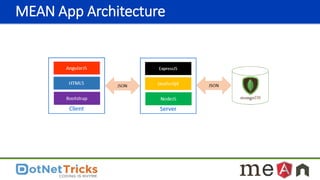
• MEAN App Architecture
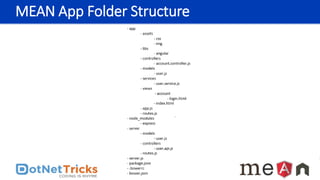
• MEAN App Folder Structure
• Demonstration
• Jobs Trends
• Learn Node.js Development with Project
• Q&A
Agenda (Contd.)
Introduction to MEAN
• MEAN is a most popular full-stack JavaScript solution for
developing fast, robust and scalable web applications.
• Uses MongoDB to store data in JSON/BSON formats
which makes it well suited to use with JavaScript.
• Uses ExpressJS as Node.js web application framework.
• Uses AngularJS as front-end SPA development.
• Uses Node.js as Server Side JavaScript environment.
Introduction to MEAN
Introduction to MongoDB
• Introduced in 2009 by 10gen, known as MongoDB Inc.
• NoSQL database written in C++
• Document-oriented database
• Supports dynamic schema – No DDL
• Stores data in JSON/BSON format
• Supports multiple platform like Windows, Linux, Mac etc.
• Open-source
Introduction to MongoDB
Why MongoDB?
• MongoDB stores data in objects (JSON, BSON).
• Now-a-days, programmers write code in object oriented
fashion using languages like C#, Python, Php, Java etc.
• Hence, programmers need a database which can store
the data in objects.
• Since, querying and manipulating data objects is easy
and it reduces the time of database operations.
• Embedded documents and arrays reduce need of joins.
Why MongoDB?
Introduction to Node.js
• Server side JavaScript environment for developing
web app like as ASP.NET, JSP, Php etc.
• Open-source and cross-platform framework.
• Based on Google's V8 JavaScript Engine.
• Used to build fast & scalable network applications
as well as data-intensive real-time web applications.
Introduction to Node.js
Why Server-side JavaScript?
• Unified language for both front-end and back-end .
• Increase programmer productivity.
• Code reusability.
• Exchange of data using JSON.
• JavaScript with V8 engine performs faster than Php,
Ruby, Python, JSP and ASP.NET.
Why Server-side JavaScript?
Node.js vs. others Server Side Frameworks
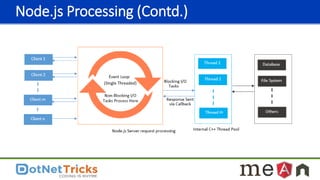
• Node.js is different from existing server-side frameworks
because it is based on asynchronous events via JavaScript
callback functionality.
• Uses the JavaScript as a programming language.
• Everything inside Node.js runs in single thread.
Node.js Processing
Node.js Processing (Contd.)
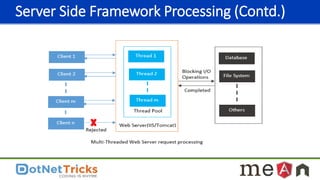
• Server-side framework like ASP.NET, JSP and Php etc. are
based on multiple threads web server (IIS/Tomcat).
• In multiple threads system, there is a limit of maximum
number of threads, beyond which the throughput
decreases.
Server Side Framework Processing
Server Side Framework Processing (Contd.)
Node.js Application Area
• E-Commerce Web Applications
• Social Media Applications
• Proxy Server
• Real-time Services
• Real-time data Applications like Multiplayer Games,
Stock Trading, Chat App etc.
• Data Streaming Applications
• Network Applications
Node.js Application Area
• High Concurrency Applications
• File Uploading Tools
• Process Monitoring Tools
• HTTP Web Server
Node.js Application Area (Contd.)
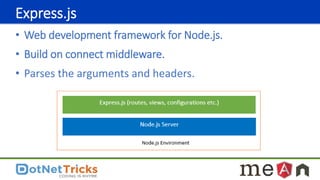
Express.js
• Web development framework for Node.js.
• Build on connect middleware.
• Parses the arguments and headers.
Express.js
• Supports Routing
• Supports multiple view engines like Jade, EJS, JSHtml etc.
• Handle Configurations
• Supports Sessions
• Supports Content Negotiation
• Supports Error Handling
• Supports Multiple Databases – RDBMS & NoSQL
Express.js (Contd.)
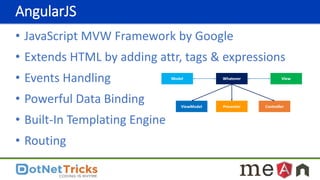
AngularJS
• JavaScript MVW Framework by Google
• Extends HTML by adding attr, tags & expressions
• Events Handling
• Powerful Data Binding
• Built-In Templating Engine
• Routing
AngularJS
• Form Validations
• REST API support using $http, $resource services
• Web Storage - Local Storage, Session Storage
• Cookies
• Animations
• Dependency Injection
• Testing
AngularJS (Contd.)
Why MEAN?
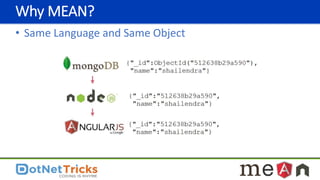
• Same Language and Same Object
Why MEAN?
MEAN App Architecture
MEAN App Folder Structure
Demonstration
Jobs Trends
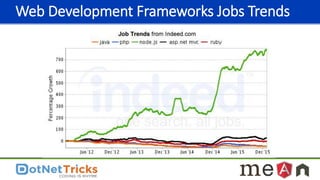
Web Development Frameworks Jobs Trends
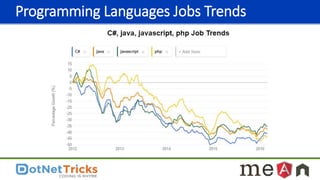
Programming Languages Jobs Trends
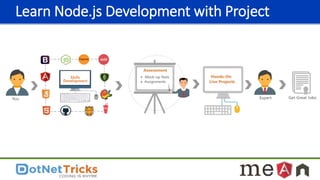
Learn Node.js Development with Project
Q&A
It’s the beginning…It’s the beginning…