W14	
  
Test	
  Techniques	
  
5/10/17	
  15:00	


Microservices	
  Testing	
  Strategies:	
  The	
  
Good,	
  the	
  Bad,	
  and	
  the	
  Reality	


Presented	
  by:	


   Tariq	
  King	


Ultimate	
  Software	


Brought	
  to	
  you	
  by:	


350	
  Corporate	
  Way,	
  Suite	
  400,	
  Orange	
  Park,	
  FL	
  32073	
  	
  
888-­‐-­‐-­‐268-­‐-­‐-­‐8770	
  ·∙·∙	
  904-­‐-­‐-­‐278-­‐-­‐-­‐0524	
  -­‐	
  info@techwell.com	
  -­‐	
  http://www.starwest.techwell.com/	


Tariq	
  King	


Tariq	
  King	
  is	
  the	
  director	
  of	
  quality	
  engineering	
  at	
  Ultimate	
  Software.	
  With	
  more	
  
than	
  fifteen	
  years	
  of	
  experience	
  in	
  software	
  testing	
  research	
  and	
  practice,	
  Tariq	
  
provides	
  technical	
  leadership,	
  people	
  leadership,	
  strategic	
  direction,	
  and	
  staff	
  
training	
  in	
  software	
  quality	
  and	
  test	
  engineering.	
  He	
  has	
  previously	
  held	
  positions	
  of	
  
test	
  manager,	
  test	
  architect,	
  test	
  lead,	
  researcher,	
  and	
  college	
  professor.	
  Tariq	
  is	
  a	
  
frequent	
  presenter	
  at	
  conferences	
  and	
  workshops,	
  has	
  published	
  more	
  than	
  thirty	
  
research	
  articles	
  in	
  IEEE	
  and	
  ACM	
  sponsored	
  journals,	
  and	
  has	
  developed	
  and	
  
taught	
  software	
  testing	
  courses	
  in	
  both	
  industry	
  and	
  academia.	
  Contact	
  him	
  via	
  
LinkedIn.	


MICROSERVICES TESTINGA hero will emerge on 5.10.2017 at the Rosen Center Hotel, Orlando FL.
BADTHE
THE
GOOD
REALITY
AND THE
Tariq King
and
ARCHITECT
DEVELOPER
ANALYST
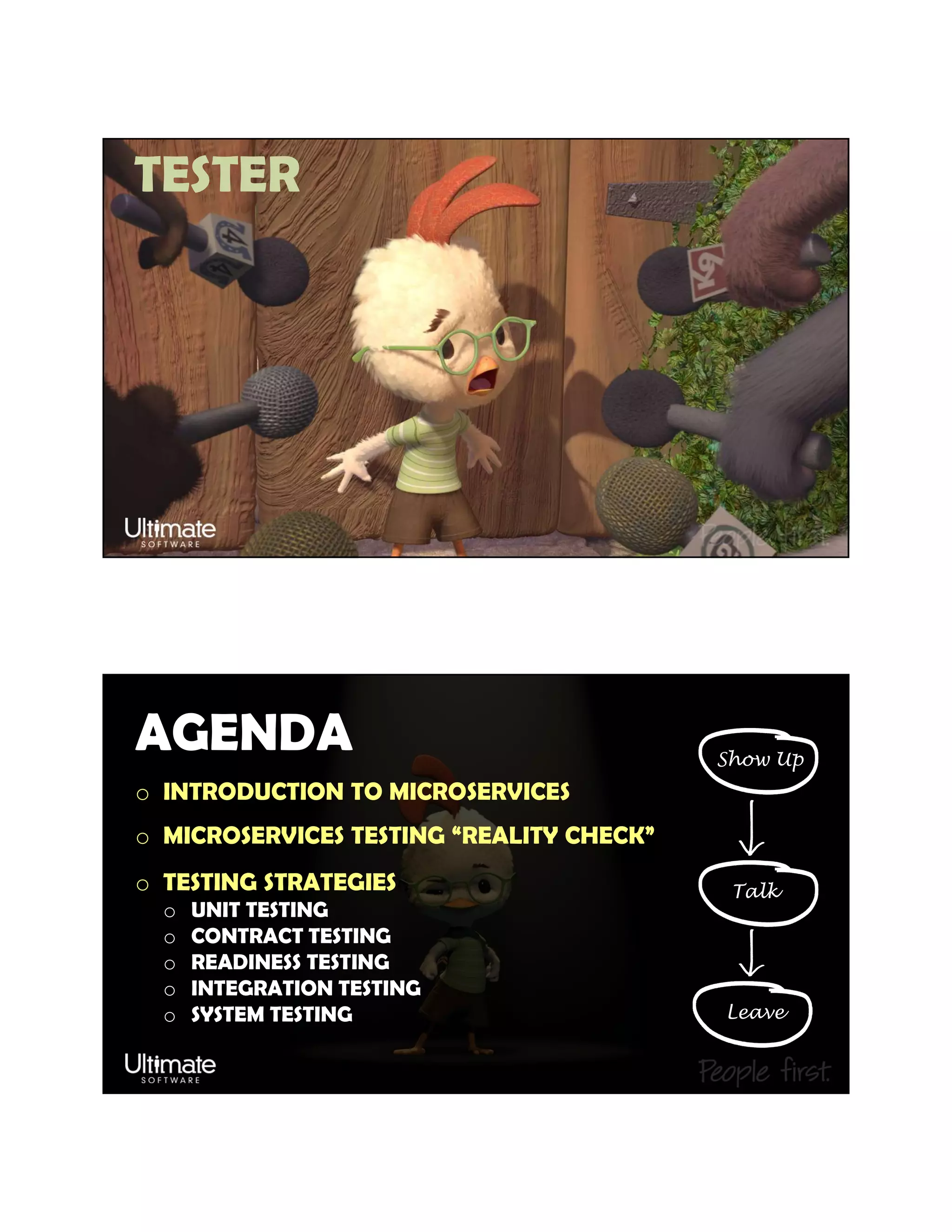
TESTER
AGENDA
o INTRODUCTION TO MICROSERVICES
o MICROSERVICES TESTING “REALITY CHECK”
o TESTING STRATEGIES
o UNIT TESTING
o CONTRACT TESTING
o READINESS TESTING
o INTEGRATION TESTING
o SYSTEM TESTING
Show Up
Talk
Leave
MICROSERVICES
MICROSERVICES
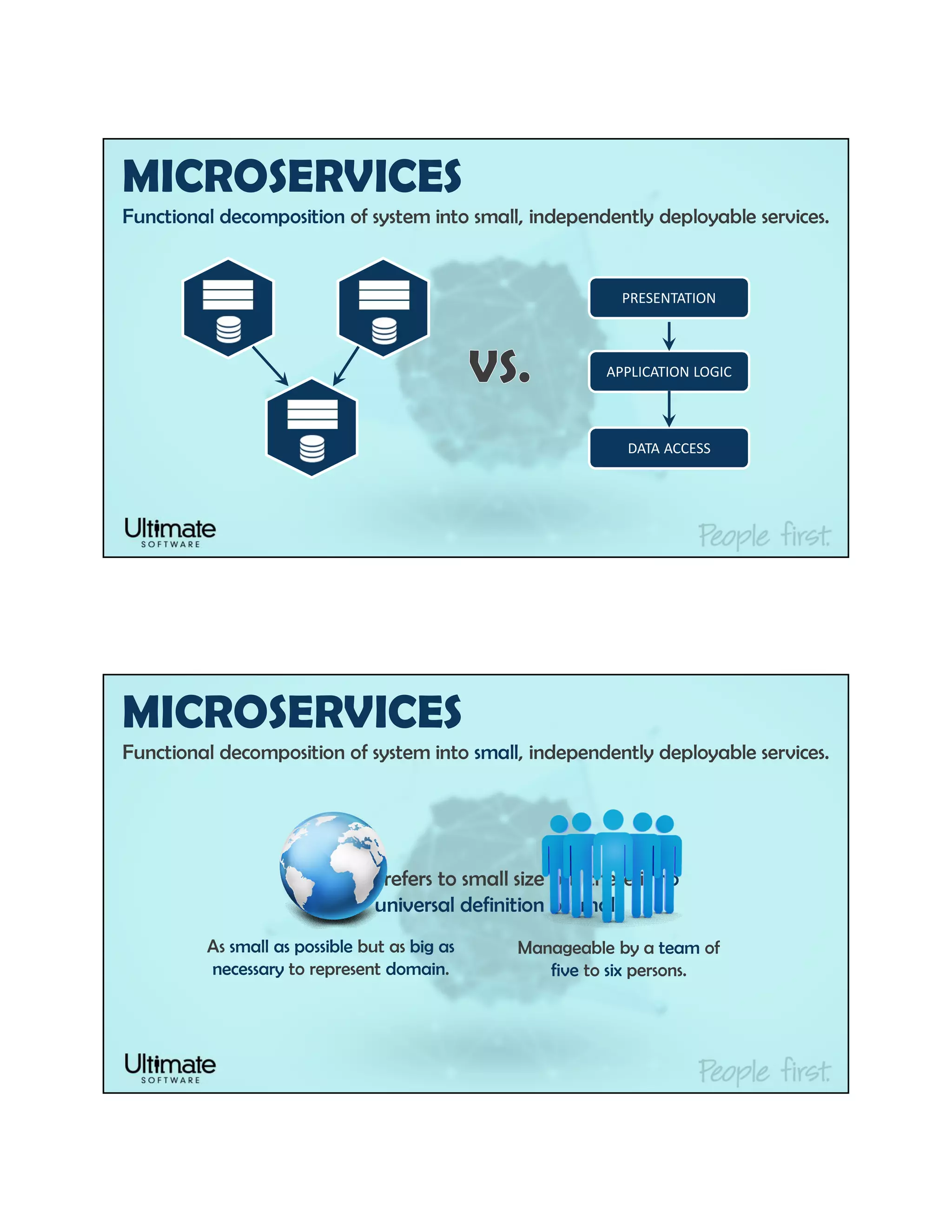
Functional decomposition of system into small, independently deployable services.
Functional decomposition means vertical slicing
as opposed to horizontal slicing into layers.
Functional decomposition of system into small, independently deployable services.
PRESENTATION
APPLICATION LOGIC
DATA ACCESS
MICROSERVICES
Functional decomposition of system into small, independently deployable services.
‘Micro’ refers to small size but there is no
universal definition of small.
As small as possible but as big as
necessary to represent domain.
Manageable by a team of
five to six persons.
MICROSERVICES
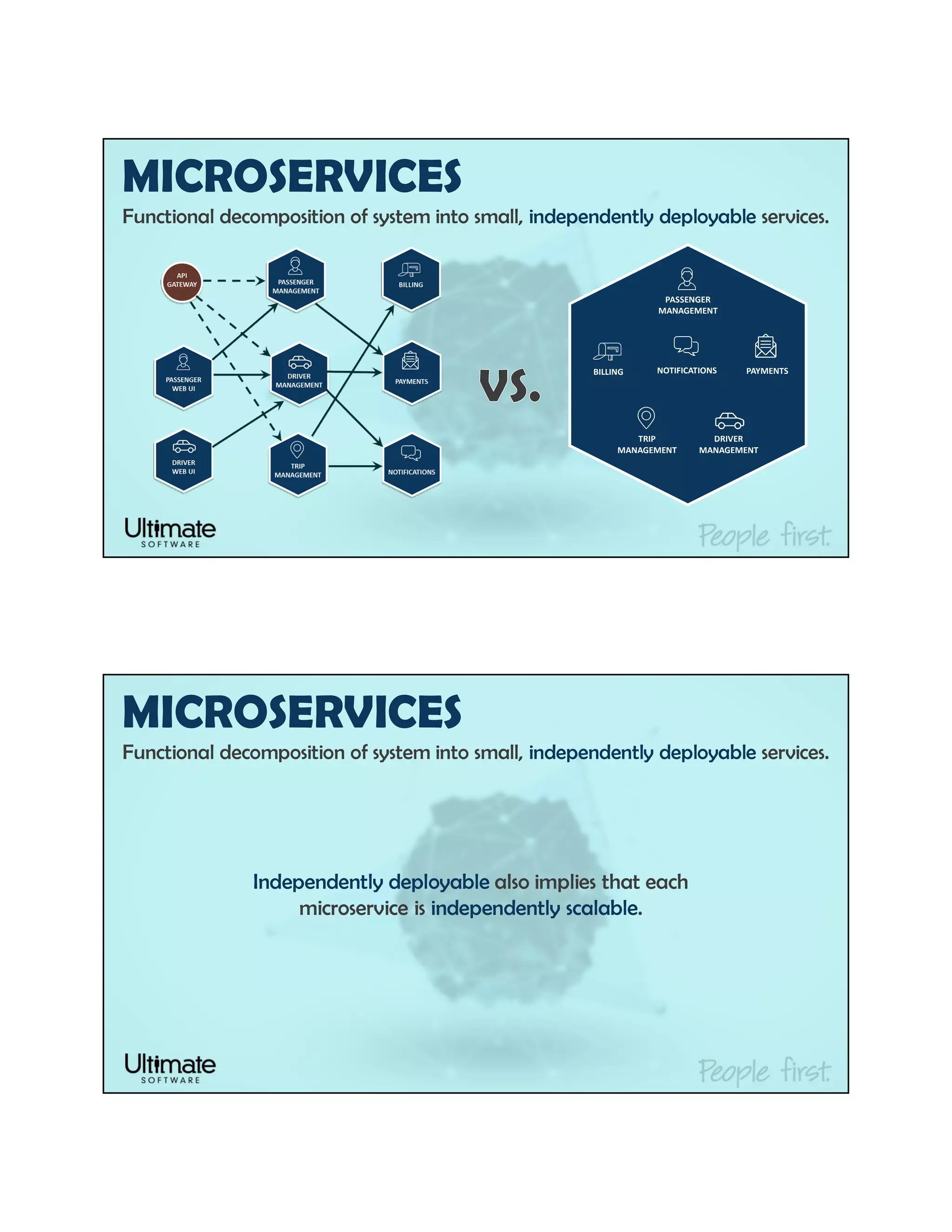
Functional decomposition of system into small, independently deployable services.
PASSENGER
MANAGEMENT
BILLING NOTIFICATIONS PAYMENTS
TRIP
MANAGEMENT
DRIVER
MANAGEMENT
MICROSERVICES
Functional decomposition of system into small, independently deployable services.
Independently deployable also implies that each
microservice is independently scalable.
MICROSERVICES
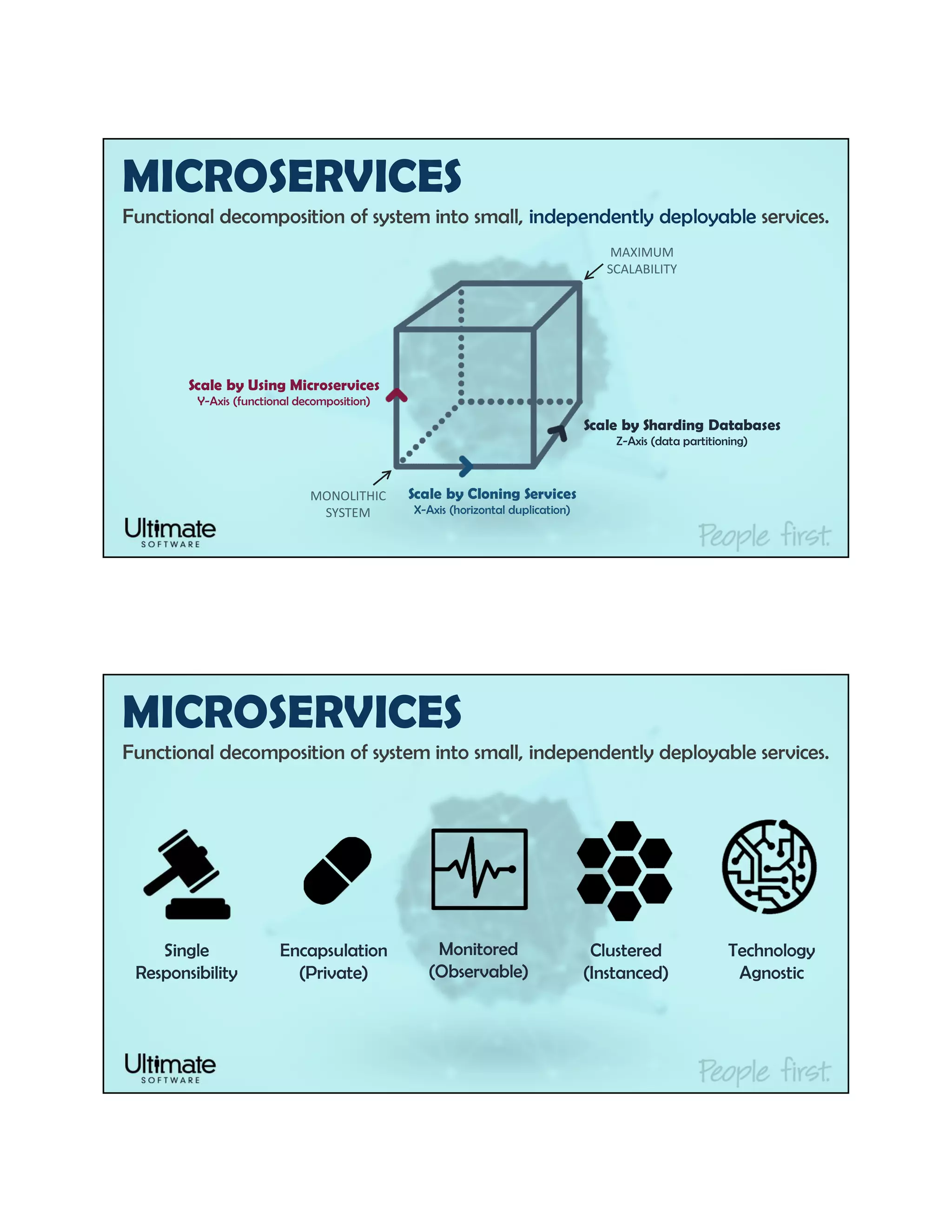
Functional decomposition of system into small, independently deployable services.
Scale by Using Microservices
Y-Axis (functional decomposition)
Scale by Cloning Services
X-Axis (horizontal duplication)
Scale by Sharding Databases
Z-Axis (data partitioning)
MAXIMUM
SCALABILITY
MONOLITHIC
SYSTEM
MICROSERVICES
Functional decomposition of system into small, independently deployable services.
MICROSERVICES
Single
Responsibility
Encapsulation
(Private)
Monitored
(Observable)
Clustered
(Instanced)
Technology
Agnostic
MICROSERVICES TESTING
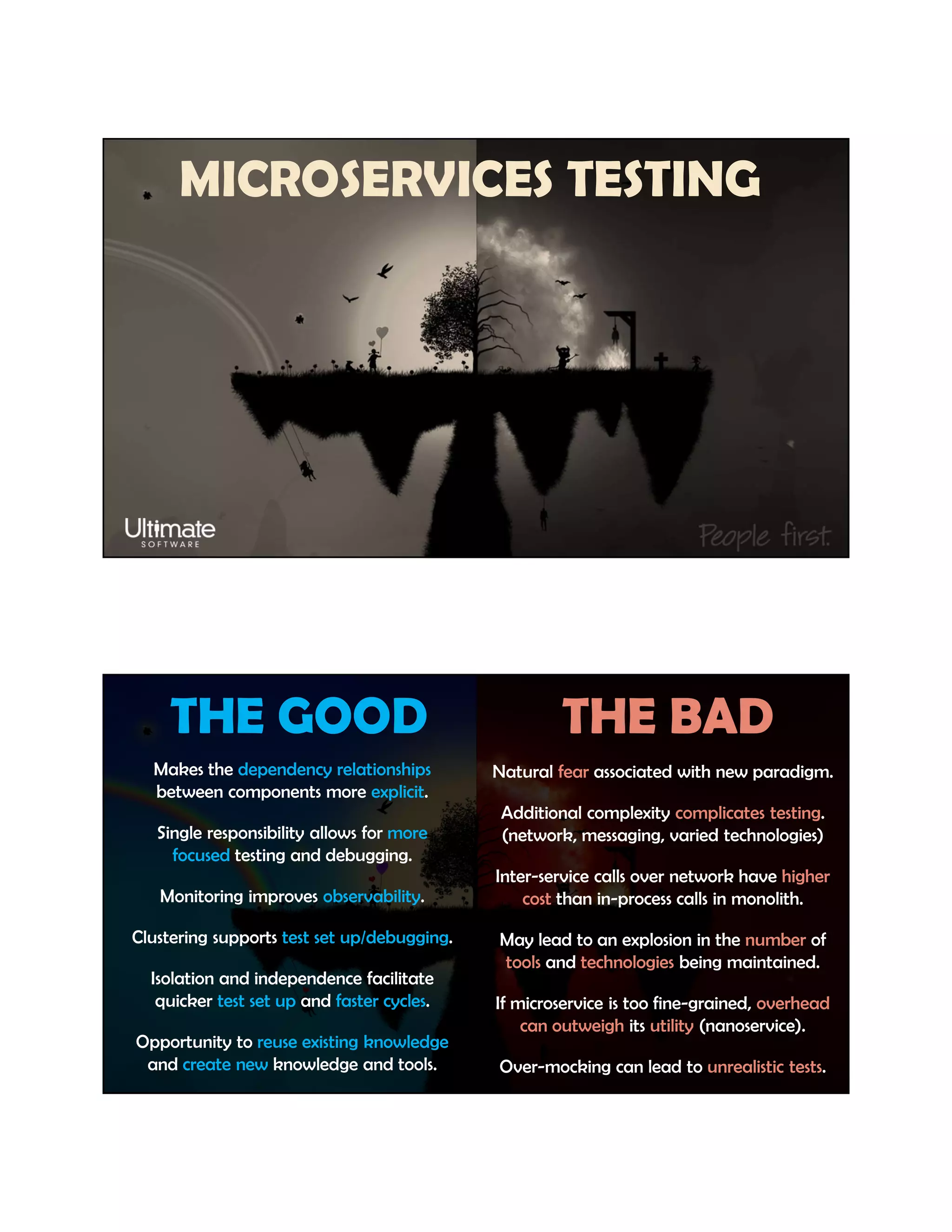
Makes the dependency relationships
between components more explicit.
Single responsibility allows for more
focused testing and debugging.
Monitoring improves observability.
Clustering supports test set up/debugging.
Isolation and independence facilitate
quicker test set up and faster cycles.
Opportunity to reuse existing knowledge
and create new knowledge and tools.
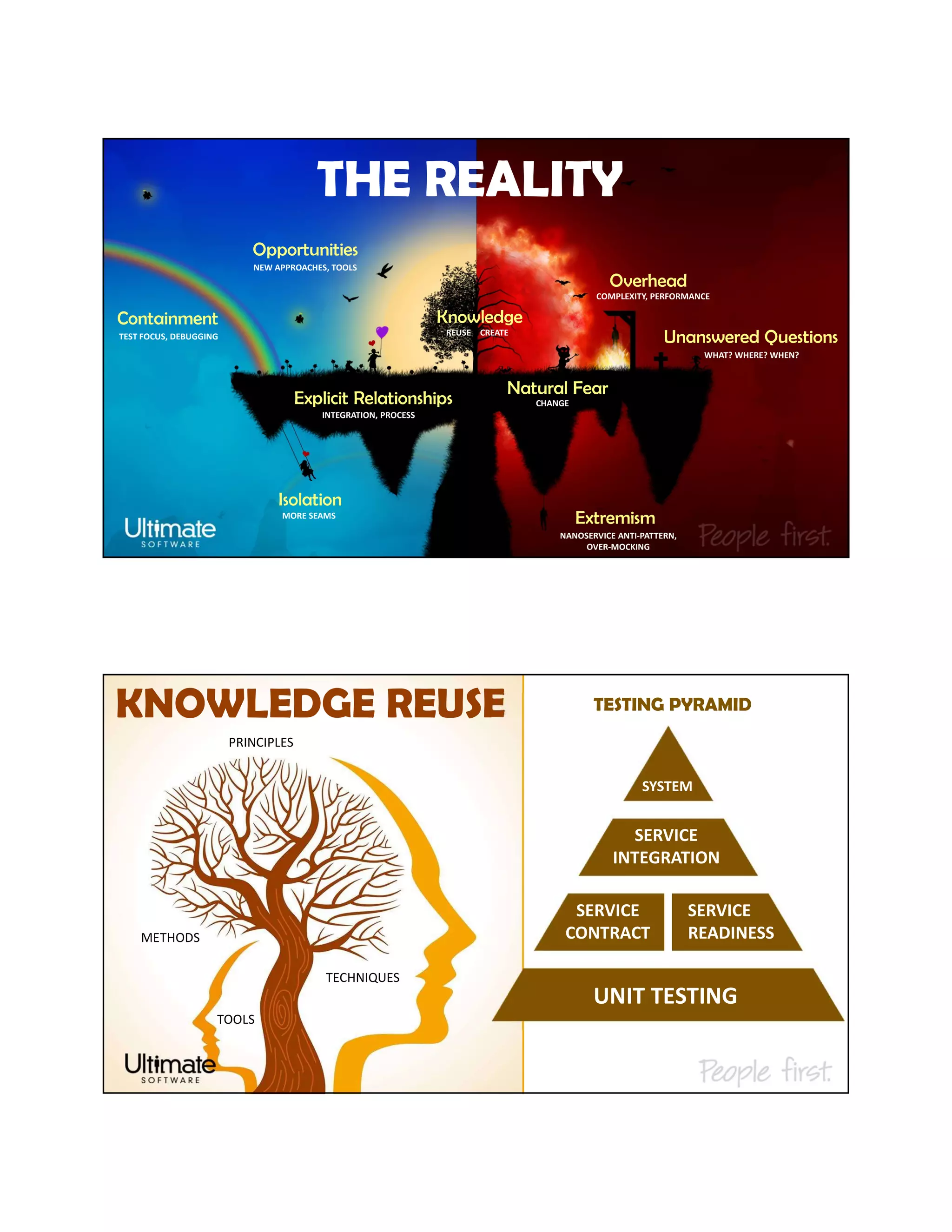
THE GOOD THE BAD
Natural fear associated with new paradigm.
Additional complexity complicates testing.
(network, messaging, varied technologies)
Inter-service calls over network have higher
cost than in-process calls in monolith.
May lead to an explosion in the number of
tools and technologies being maintained.
If microservice is too fine-grained, overhead
can outweigh its utility (nanoservice).
Over-mocking can lead to unrealistic tests.
Isolation
Containment
Explicit Relationships
Knowledge
Extremism
Natural Fear
Overhead
Unanswered Questions
Opportunities
WHAT? WHERE? WHEN?
COMPLEXITY, PERFORMANCE
NANOSERVICE ANTI-PATTERN,
OVER-MOCKING
CHANGE
INTEGRATION, PROCESS
MORE SEAMS
NEW APPROACHES, TOOLS
TEST FOCUS, DEBUGGING REUSE CREATE
THE REALITY
KNOWLEDGE REUSE
TECHNIQUES
METHODS
PRINCIPLES
TOOLS
COMPLEXITY, PERFORMANCE
UNIT TESTING
SERVICE
CONTRACT
SERVICE
READINESS
SERVICE
INTEGRATION
SYSTEM
TESTING PYRAMID
UNIT TESTING
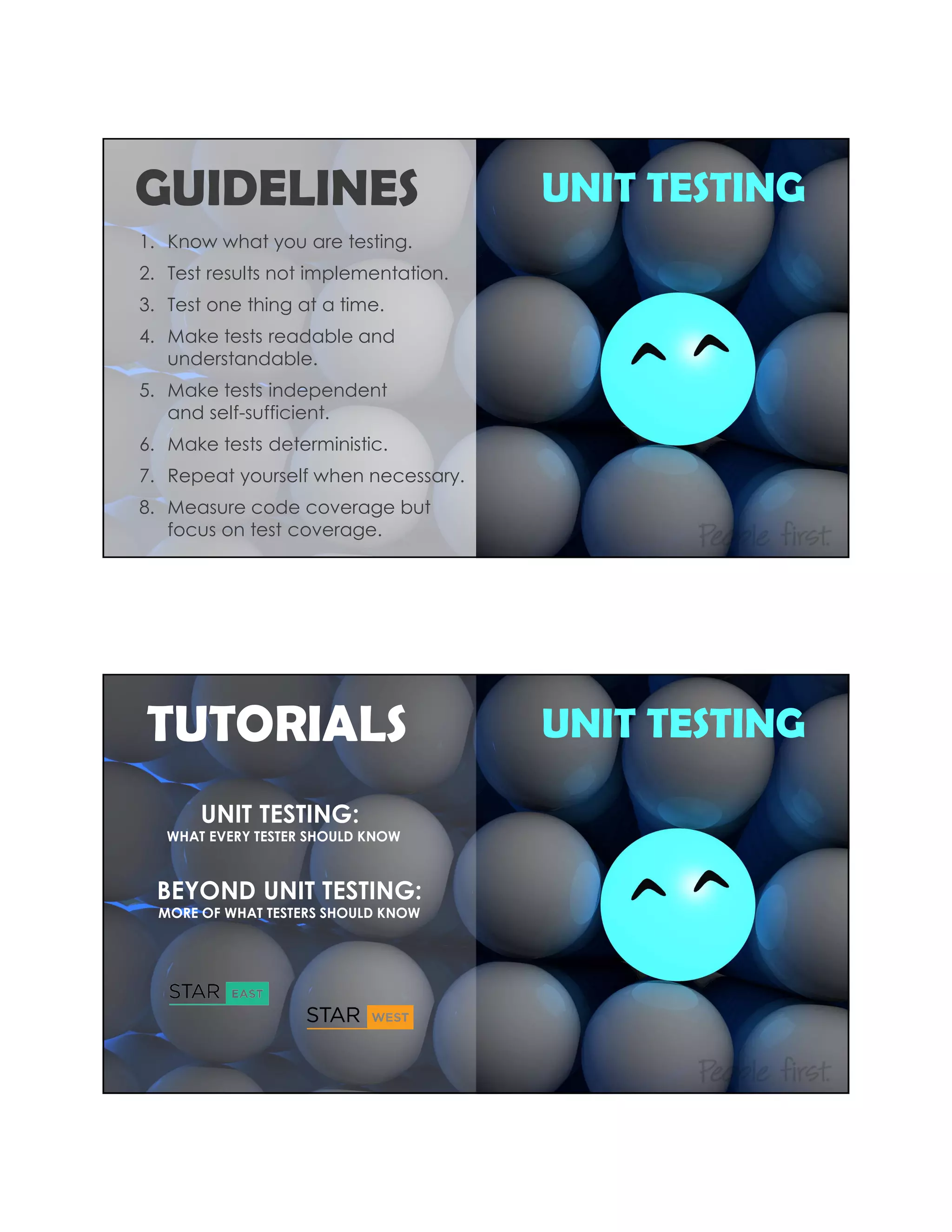
1. Know what you are testing.
2. Test results not implementation.
3. Test one thing at a time.
4. Make tests readable and
understandable.
5. Make tests independent
and self-sufficient.
6. Make tests deterministic.
7. Repeat yourself when necessary.
8. Measure code coverage but
focus on test coverage.
GUIDELINES
UNIT TESTINGTUTORIALS
UNIT TESTING:
WHAT EVERY TESTER SHOULD KNOW
BEYOND UNIT TESTING:
MORE OF WHAT TESTERS SHOULD KNOW
CONTRACT
MUTUAL AGREEMENT
DEFENSIVE
NO TRUST
Benefit for consumer is an obligation for the
provider, and vice-versa.
Full contract (obligation) for provider is the
sum of all consumer contracts (benefits).
MUTUAL AGREEMENT
CONTRACT
obligation(p) benefit(ci)
n
i=1
=
BENEFITS & OBLIGATIONS
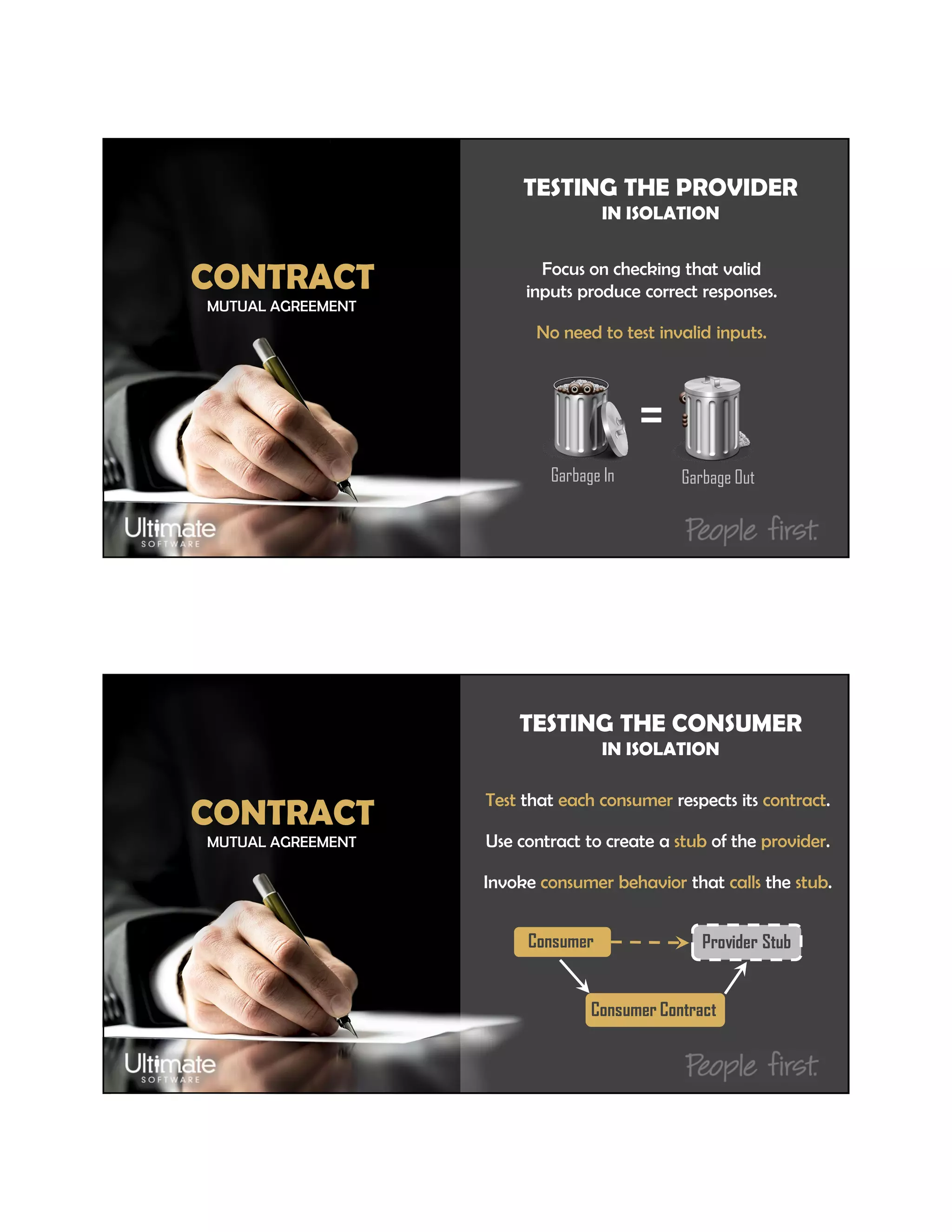
TESTING THE PROVIDER
IN ISOLATION
MUTUAL AGREEMENT
CONTRACT Focus on checking that valid
inputs produce correct responses.
No need to test invalid inputs.
=
Garbage In Garbage Out
TESTING THE CONSUMER
IN ISOLATION
MUTUAL AGREEMENT
CONTRACT
Test that each consumer respects its contract.
Use contract to create a stub of the provider.
Invoke consumer behavior that calls the stub.
Consumer Provider Stub
Consumer Contract
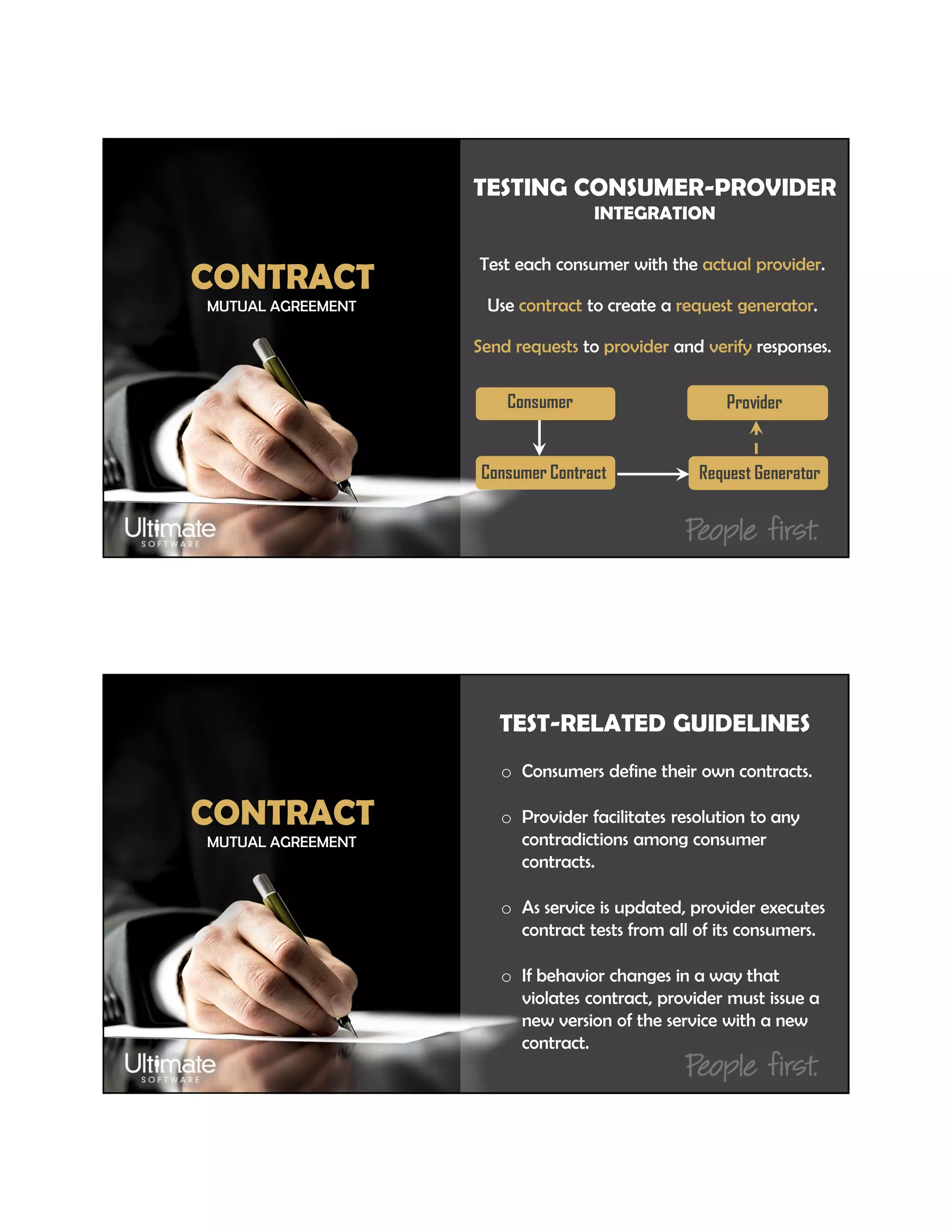
TESTING CONSUMER-PROVIDER
INTEGRATION
MUTUAL AGREEMENT
CONTRACT
Test each consumer with the actual provider.
Use contract to create a request generator.
Send requests to provider and verify responses.
Consumer Provider
Consumer Contract Request Generator
TEST-RELATED GUIDELINES
MUTUAL AGREEMENT
CONTRACT
o Consumers define their own contracts.
o Provider facilitates resolution to any
contradictions among consumer
contracts.
o As service is updated, provider executes
contract tests from all of its consumers.
o If behavior changes in a way that
violates contract, provider must issue a
new version of the service with a new
contract.
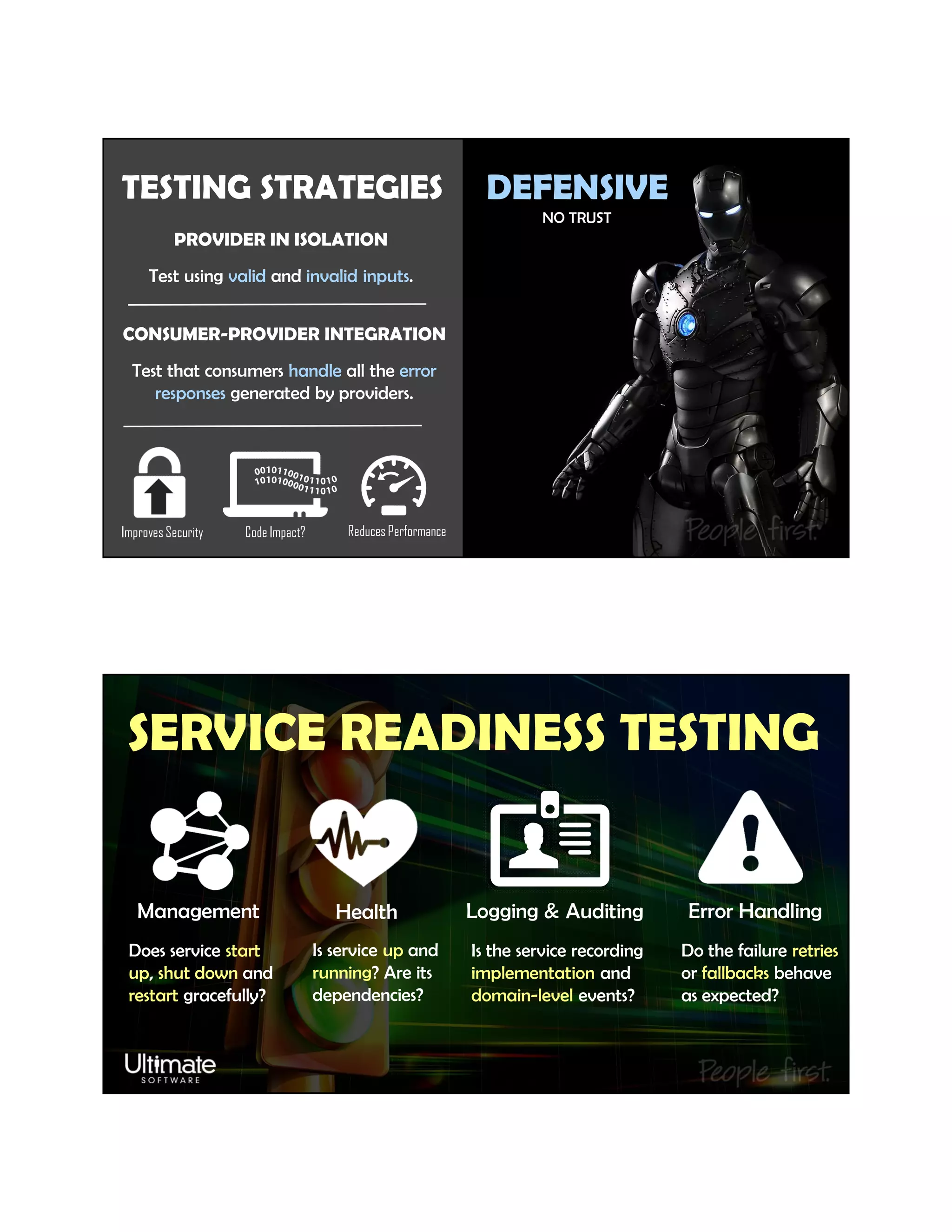
DEFENSIVE
NO TRUST
TESTING STRATEGIES
PROVIDER IN ISOLATION
Test using valid and invalid inputs.
CONSUMER-PROVIDER INTEGRATION
Test that consumers handle all the error
responses generated by providers.
Code Impact?Improves Security Reduces Performance
Management Health Logging & Auditing Error Handling
Does service start
up, shut down and
restart gracefully?
Is service up and
running? Are its
dependencies?
Is the service recording
implementation and
domain-level events?
Do the failure retries
or fallbacks behave
as expected?
SERVICE READINESS TESTING
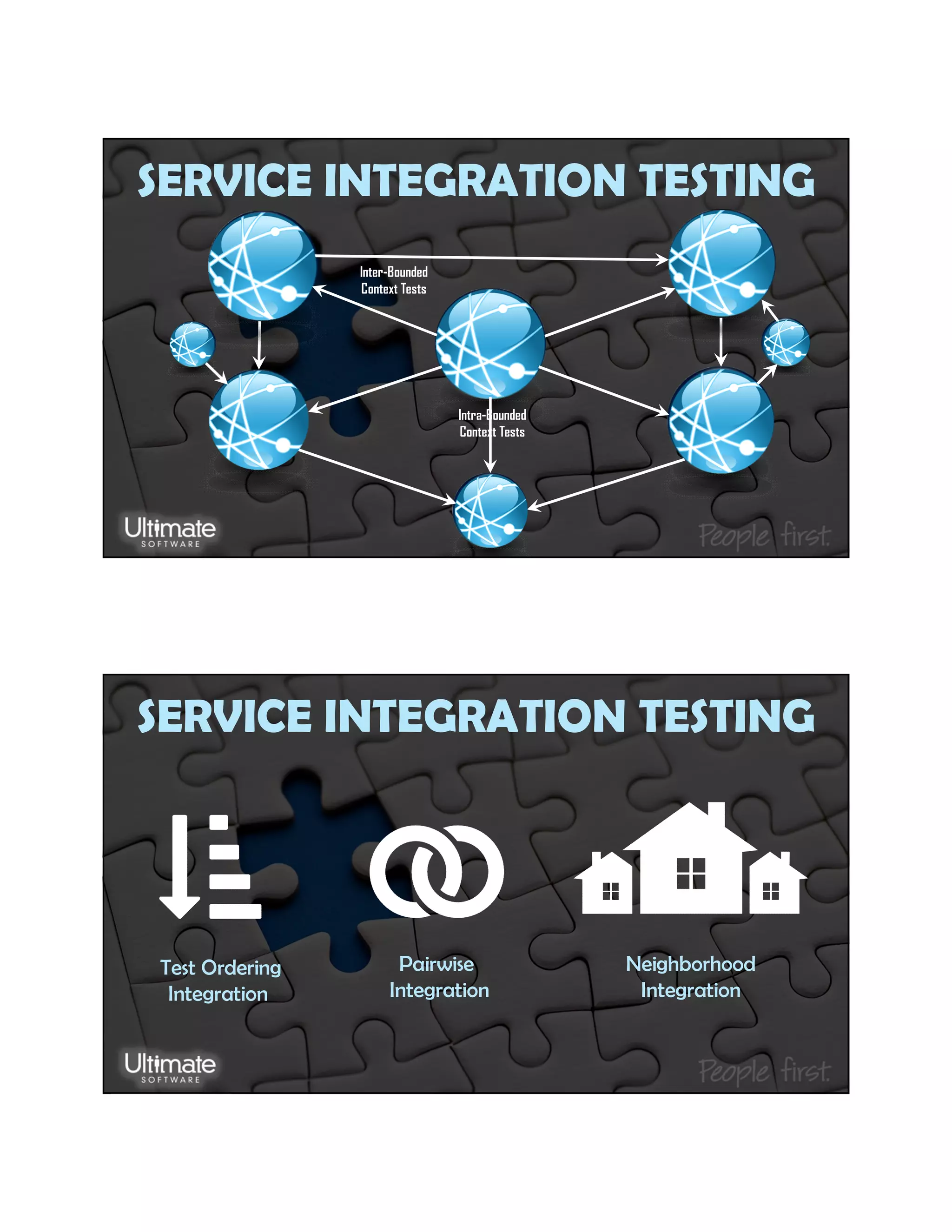
SERVICE INTEGRATION TESTING
Intra-Bounded
Context Tests
Inter-Bounded
Context Tests
Test Ordering
Integration
Pairwise
Integration
Neighborhood
Integration
SERVICE INTEGRATION TESTING
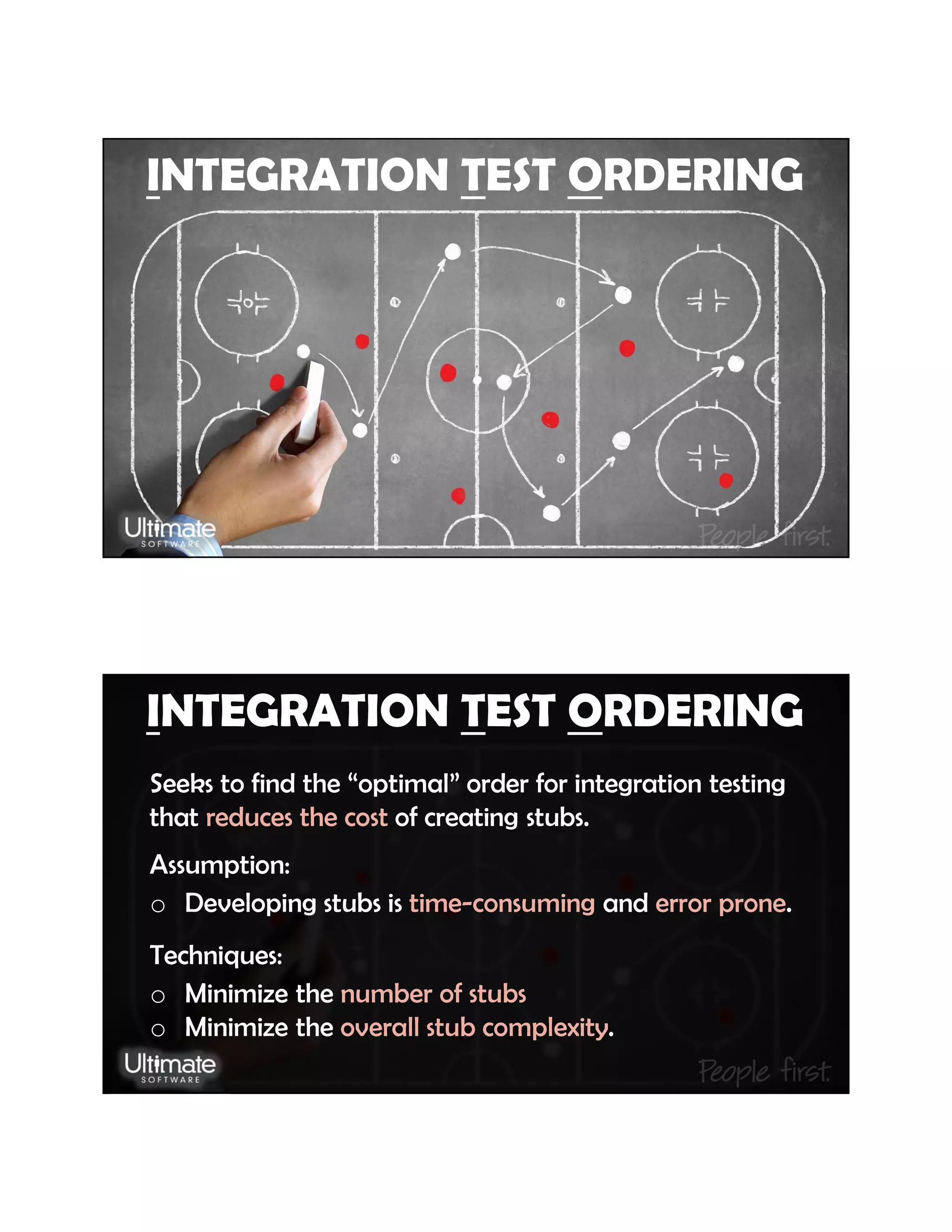
INTEGRATION TEST ORDERING
Seeks to find the “optimal” order for integration testing
that reduces the cost of creating stubs.
Assumption:
o Developing stubs is time-consuming and error prone.
Techniques:
o Minimize the number of stubs
o Minimize the overall stub complexity.
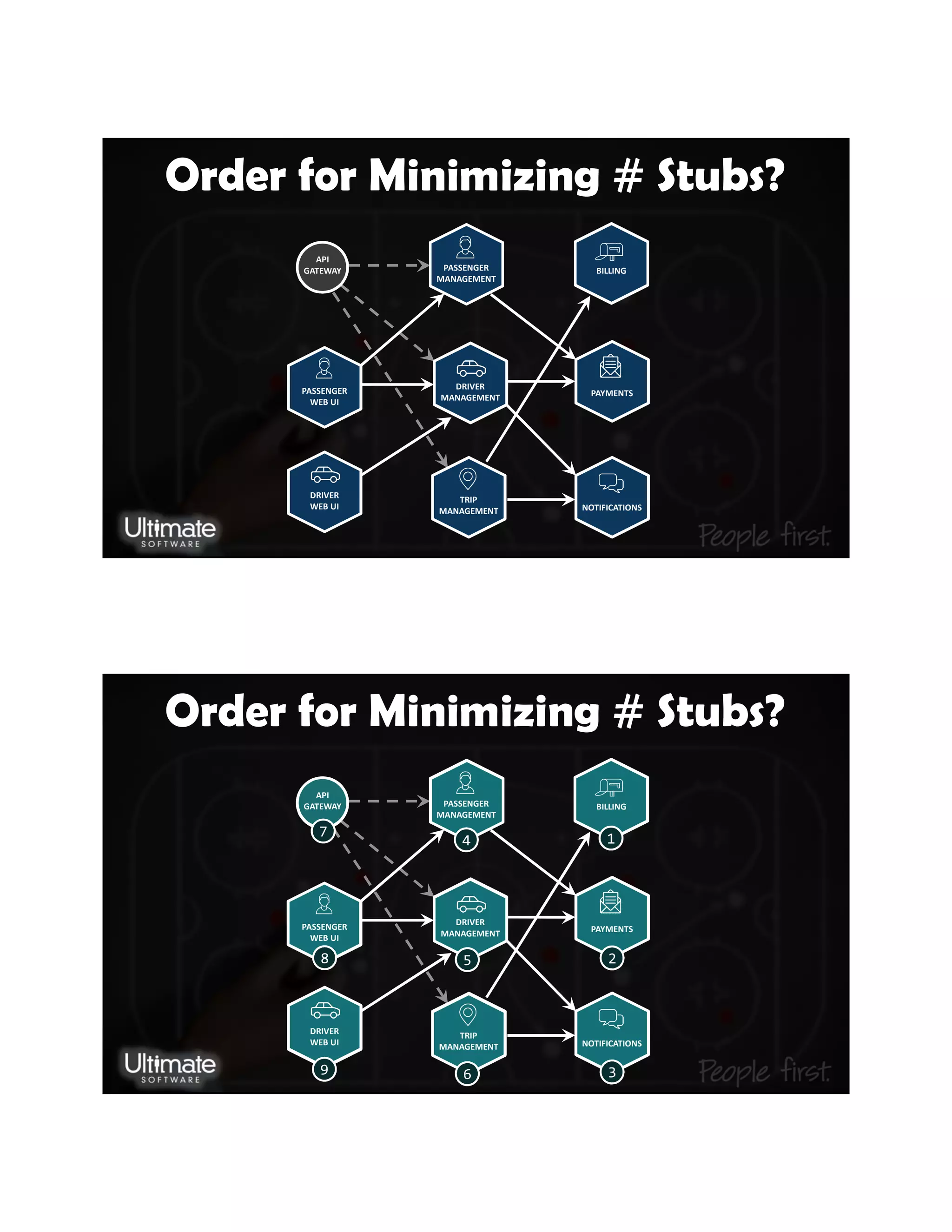
Order for Minimizing # Stubs?
BILLING
PAYMENTS
NOTIFICATIONS
PASSENGER
MANAGEMENT
DRIVER
MANAGEMENT
TRIP
MANAGEMENT
API
GATEWAY
PASSENGER
WEB UI
DRIVER
WEB UI
Order for Minimizing # Stubs?
BILLING
PAYMENTS
NOTIFICATIONS
PASSENGER
MANAGEMENT
DRIVER
MANAGEMENT
TRIP
MANAGEMENT
API
GATEWAY
PASSENGER
WEB UI
DRIVER
WEB UI
1
2
3
4
5
6
7
8
9
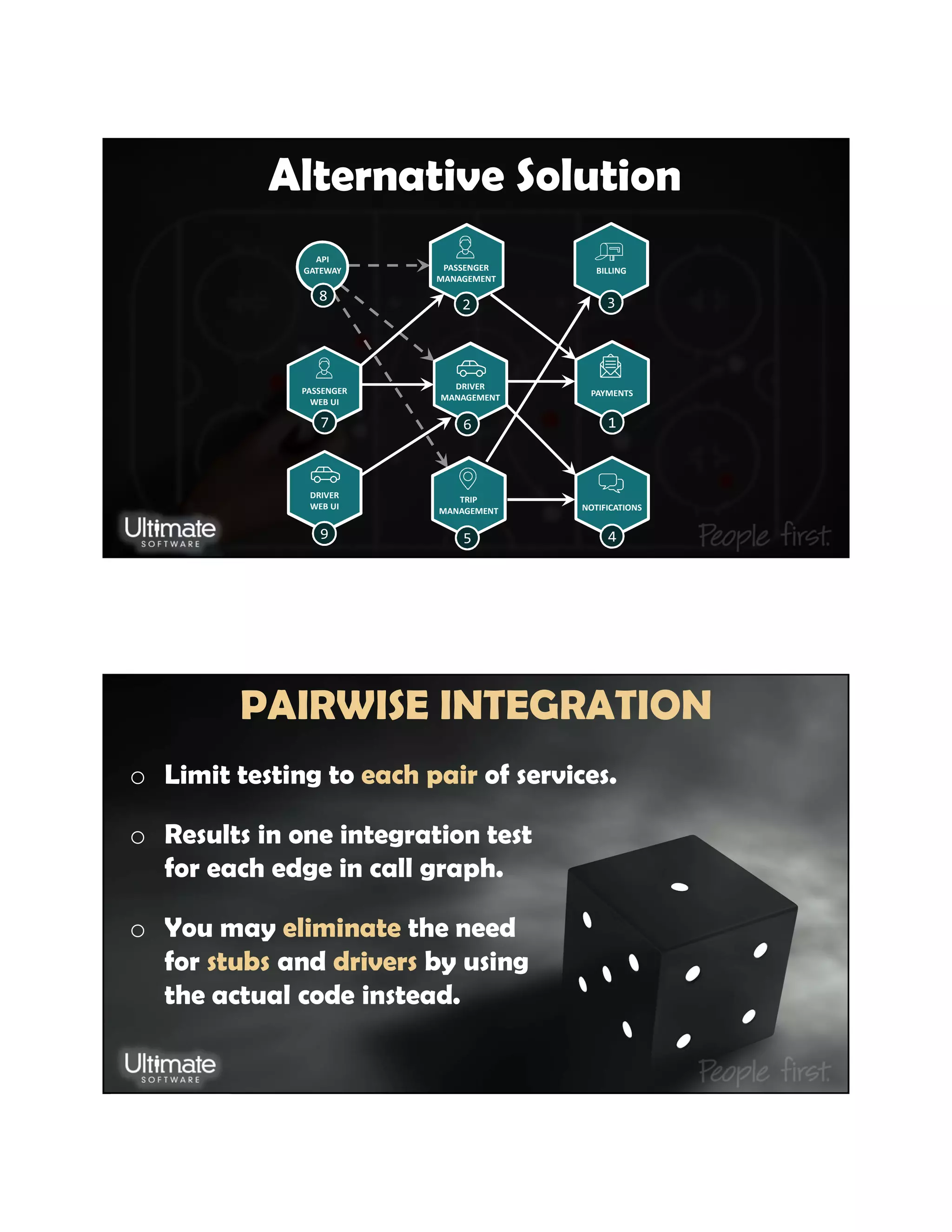
Alternative Solution
BILLING
PAYMENTS
NOTIFICATIONS
PASSENGER
MANAGEMENT
DRIVER
MANAGEMENT
TRIP
MANAGEMENT
API
GATEWAY
PASSENGER
WEB UI
DRIVER
WEB UI
3
1
4
2
6
5
8
7
9
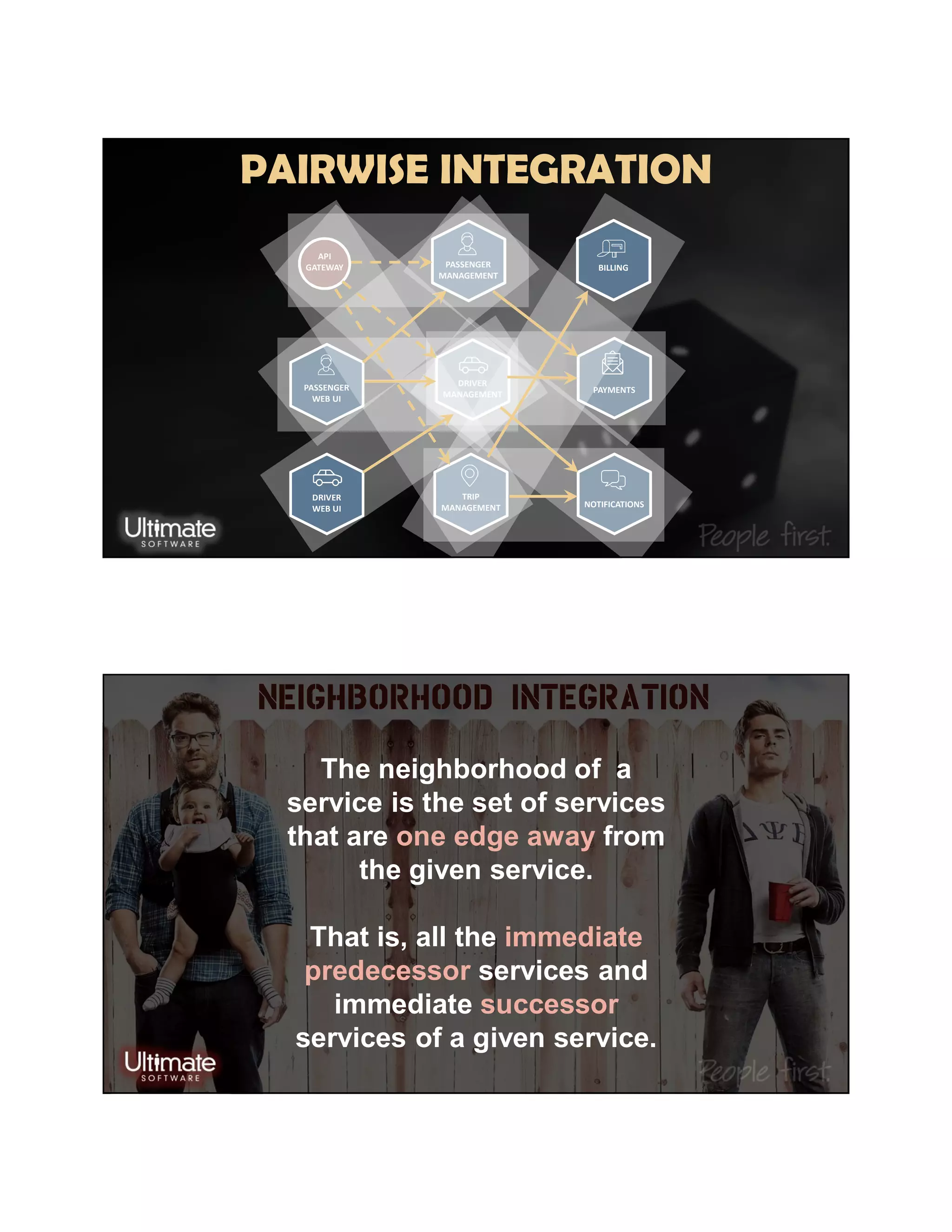
PAIRWISE INTEGRATION
o Limit testing to each pair of services.
o Results in one integration test
for each edge in call graph.
o You may eliminate the need
for stubs and drivers by using
the actual code instead.
TRIP
MANAGEMENT
PASSENGER
WEB UI
BILLING
PAYMENTS
NOTIFICATIONS
DRIVER
MANAGEMENT
DRIVER
WEB UI
API
GATEWAY PASSENGER
MANAGEMENT
PAIRWISE INTEGRATION
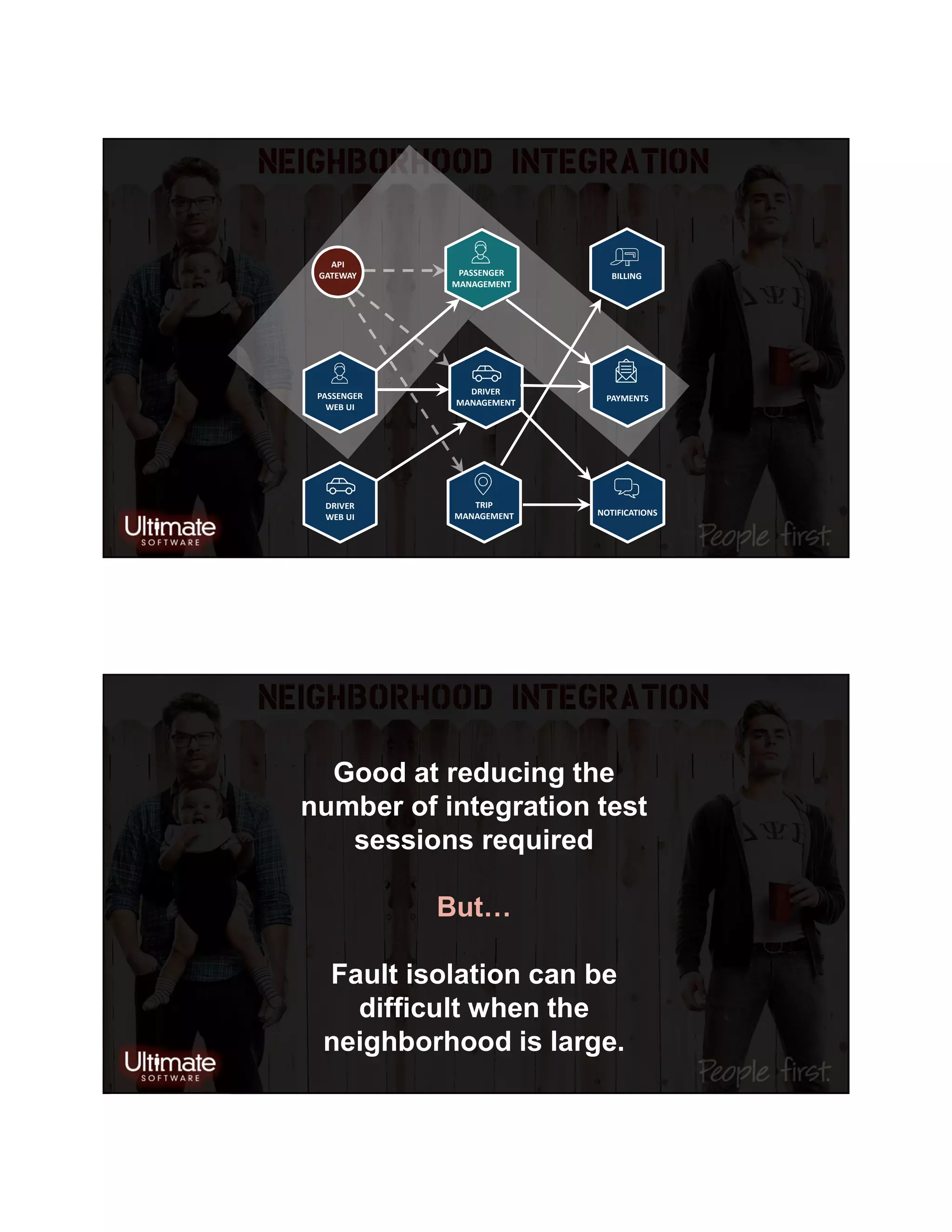
The neighborhood of a
service is the set of services
that are one edge away from
the given service.
That is, all the immediate
predecessor services and
immediate successor
services of a given service.
TRIP
MANAGEMENT
PASSENGER
WEB UI
BILLING
PAYMENTS
NOTIFICATIONS
DRIVER
MANAGEMENT
DRIVER
WEB UI
API
GATEWAY PASSENGER
MANAGEMENT
Good at reducing the
number of integration test
sessions required
But…
Fault isolation can be
difficult when the
neighborhood is large.
TRIP
MANAGEMENT
PASSENGER
WEB UI
BILLING
PAYMENTS
NOTIFICATIONS
DRIVER
WEB UI
API
GATEWAY PASSENGER
MANAGEMENT
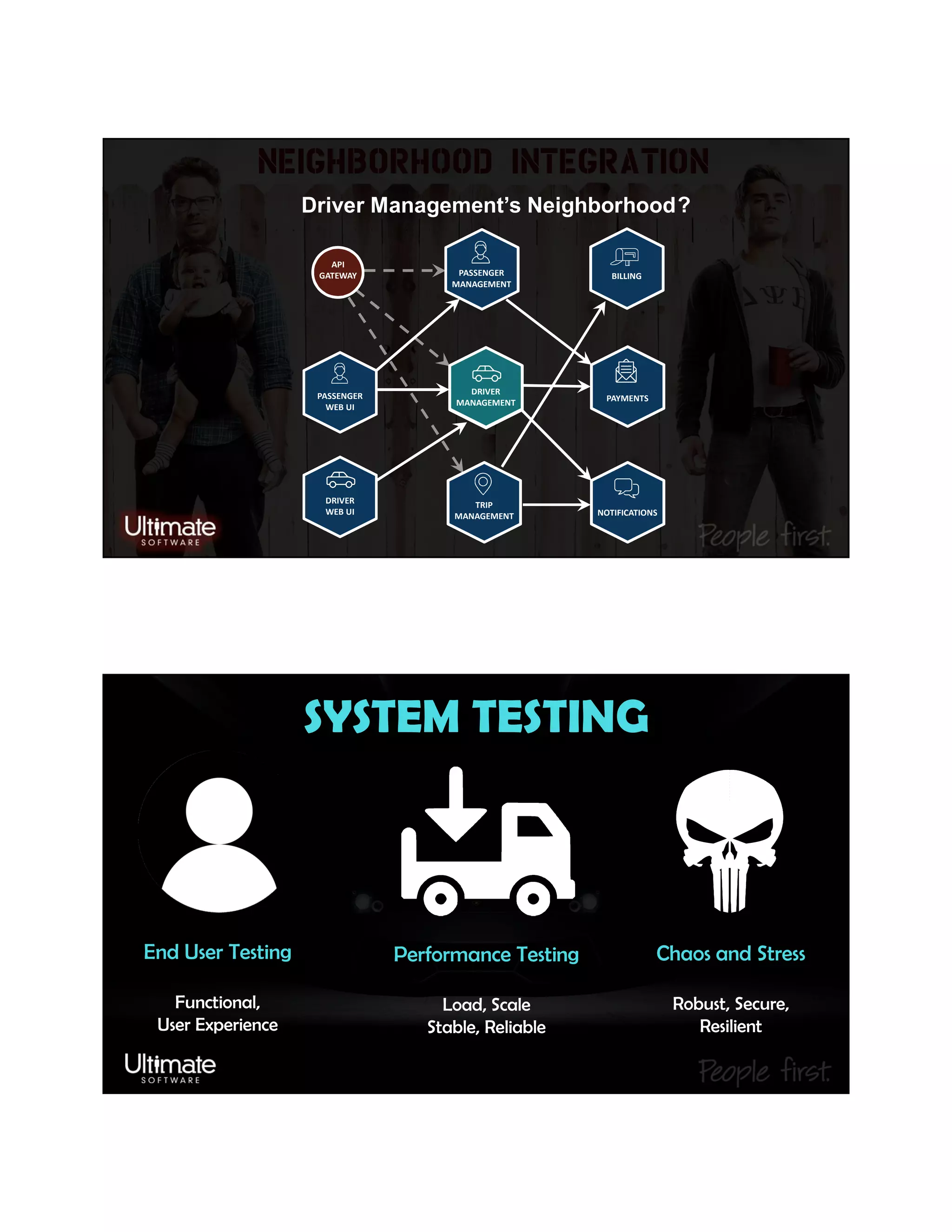
Driver Management’s Neighborhood
DRIVER
MANAGEMENT
?
SYSTEM TESTING
End User Testing
Functional,
User Experience
Performance Testing
Load, Scale
Stable, Reliable
Chaos and Stress
Robust, Secure,
Resilient
REST-assured
QUESTIONS?
THANK YOU.
Acknowledgements
Dionny Santiago, Test Architect
Robert Vanderwall, Test Architect
Contact Information
tariq_king@ultimatesoftware.com
www.linkedin.com/in/tariqking

Microservices Testing Strategies: The Good, the Bad, and the Reality

  • 1.
                    W14   Test  Techniques   5/10/17  15:00             Microservices  Testing  Strategies:  The   Good,  the  Bad,  and  the  Reality     Presented  by:         Tariq  King     Ultimate  Software     Brought  to  you  by:                 350  Corporate  Way,  Suite  400,  Orange  Park,  FL  32073     888-­‐-­‐-­‐268-­‐-­‐-­‐8770  ·∙·∙  904-­‐-­‐-­‐278-­‐-­‐-­‐0524  -­‐  info@techwell.com  -­‐  http://www.starwest.techwell.com/      
  • 2.
            Tariq  King     Tariq  King  is  the  director  of  quality  engineering  at  Ultimate  Software.  With  more   than  fifteen  years  of  experience  in  software  testing  research  and  practice,  Tariq   provides  technical  leadership,  people  leadership,  strategic  direction,  and  staff   training  in  software  quality  and  test  engineering.  He  has  previously  held  positions  of   test  manager,  test  architect,  test  lead,  researcher,  and  college  professor.  Tariq  is  a   frequent  presenter  at  conferences  and  workshops,  has  published  more  than  thirty   research  articles  in  IEEE  and  ACM  sponsored  journals,  and  has  developed  and   taught  software  testing  courses  in  both  industry  and  academia.  Contact  him  via   LinkedIn.    
  • 3.
    MICROSERVICES TESTINGA herowill emerge on 5.10.2017 at the Rosen Center Hotel, Orlando FL. BADTHE THE GOOD REALITY AND THE Tariq King and ARCHITECT
  • 4.
  • 5.
    TESTER AGENDA o INTRODUCTION TOMICROSERVICES o MICROSERVICES TESTING “REALITY CHECK” o TESTING STRATEGIES o UNIT TESTING o CONTRACT TESTING o READINESS TESTING o INTEGRATION TESTING o SYSTEM TESTING Show Up Talk Leave
  • 6.
    MICROSERVICES MICROSERVICES Functional decomposition ofsystem into small, independently deployable services. Functional decomposition means vertical slicing as opposed to horizontal slicing into layers.
  • 7.
    Functional decomposition ofsystem into small, independently deployable services. PRESENTATION APPLICATION LOGIC DATA ACCESS MICROSERVICES Functional decomposition of system into small, independently deployable services. ‘Micro’ refers to small size but there is no universal definition of small. As small as possible but as big as necessary to represent domain. Manageable by a team of five to six persons. MICROSERVICES
  • 8.
    Functional decomposition ofsystem into small, independently deployable services. PASSENGER MANAGEMENT BILLING NOTIFICATIONS PAYMENTS TRIP MANAGEMENT DRIVER MANAGEMENT MICROSERVICES Functional decomposition of system into small, independently deployable services. Independently deployable also implies that each microservice is independently scalable. MICROSERVICES
  • 9.
    Functional decomposition ofsystem into small, independently deployable services. Scale by Using Microservices Y-Axis (functional decomposition) Scale by Cloning Services X-Axis (horizontal duplication) Scale by Sharding Databases Z-Axis (data partitioning) MAXIMUM SCALABILITY MONOLITHIC SYSTEM MICROSERVICES Functional decomposition of system into small, independently deployable services. MICROSERVICES Single Responsibility Encapsulation (Private) Monitored (Observable) Clustered (Instanced) Technology Agnostic
  • 10.
    MICROSERVICES TESTING Makes thedependency relationships between components more explicit. Single responsibility allows for more focused testing and debugging. Monitoring improves observability. Clustering supports test set up/debugging. Isolation and independence facilitate quicker test set up and faster cycles. Opportunity to reuse existing knowledge and create new knowledge and tools. THE GOOD THE BAD Natural fear associated with new paradigm. Additional complexity complicates testing. (network, messaging, varied technologies) Inter-service calls over network have higher cost than in-process calls in monolith. May lead to an explosion in the number of tools and technologies being maintained. If microservice is too fine-grained, overhead can outweigh its utility (nanoservice). Over-mocking can lead to unrealistic tests.
  • 11.
    Isolation Containment Explicit Relationships Knowledge Extremism Natural Fear Overhead UnansweredQuestions Opportunities WHAT? WHERE? WHEN? COMPLEXITY, PERFORMANCE NANOSERVICE ANTI-PATTERN, OVER-MOCKING CHANGE INTEGRATION, PROCESS MORE SEAMS NEW APPROACHES, TOOLS TEST FOCUS, DEBUGGING REUSE CREATE THE REALITY KNOWLEDGE REUSE TECHNIQUES METHODS PRINCIPLES TOOLS COMPLEXITY, PERFORMANCE UNIT TESTING SERVICE CONTRACT SERVICE READINESS SERVICE INTEGRATION SYSTEM TESTING PYRAMID
  • 12.
    UNIT TESTING 1. Knowwhat you are testing. 2. Test results not implementation. 3. Test one thing at a time. 4. Make tests readable and understandable. 5. Make tests independent and self-sufficient. 6. Make tests deterministic. 7. Repeat yourself when necessary. 8. Measure code coverage but focus on test coverage. GUIDELINES UNIT TESTINGTUTORIALS UNIT TESTING: WHAT EVERY TESTER SHOULD KNOW BEYOND UNIT TESTING: MORE OF WHAT TESTERS SHOULD KNOW
  • 13.
    CONTRACT MUTUAL AGREEMENT DEFENSIVE NO TRUST Benefitfor consumer is an obligation for the provider, and vice-versa. Full contract (obligation) for provider is the sum of all consumer contracts (benefits). MUTUAL AGREEMENT CONTRACT obligation(p) benefit(ci) n i=1 = BENEFITS & OBLIGATIONS
  • 14.
    TESTING THE PROVIDER INISOLATION MUTUAL AGREEMENT CONTRACT Focus on checking that valid inputs produce correct responses. No need to test invalid inputs. = Garbage In Garbage Out TESTING THE CONSUMER IN ISOLATION MUTUAL AGREEMENT CONTRACT Test that each consumer respects its contract. Use contract to create a stub of the provider. Invoke consumer behavior that calls the stub. Consumer Provider Stub Consumer Contract
  • 15.
    TESTING CONSUMER-PROVIDER INTEGRATION MUTUAL AGREEMENT CONTRACT Testeach consumer with the actual provider. Use contract to create a request generator. Send requests to provider and verify responses. Consumer Provider Consumer Contract Request Generator TEST-RELATED GUIDELINES MUTUAL AGREEMENT CONTRACT o Consumers define their own contracts. o Provider facilitates resolution to any contradictions among consumer contracts. o As service is updated, provider executes contract tests from all of its consumers. o If behavior changes in a way that violates contract, provider must issue a new version of the service with a new contract.
  • 16.
    DEFENSIVE NO TRUST TESTING STRATEGIES PROVIDERIN ISOLATION Test using valid and invalid inputs. CONSUMER-PROVIDER INTEGRATION Test that consumers handle all the error responses generated by providers. Code Impact?Improves Security Reduces Performance Management Health Logging & Auditing Error Handling Does service start up, shut down and restart gracefully? Is service up and running? Are its dependencies? Is the service recording implementation and domain-level events? Do the failure retries or fallbacks behave as expected? SERVICE READINESS TESTING
  • 17.
    SERVICE INTEGRATION TESTING Intra-Bounded ContextTests Inter-Bounded Context Tests Test Ordering Integration Pairwise Integration Neighborhood Integration SERVICE INTEGRATION TESTING
  • 18.
    INTEGRATION TEST ORDERING INTEGRATIONTEST ORDERING Seeks to find the “optimal” order for integration testing that reduces the cost of creating stubs. Assumption: o Developing stubs is time-consuming and error prone. Techniques: o Minimize the number of stubs o Minimize the overall stub complexity.
  • 19.
    Order for Minimizing# Stubs? BILLING PAYMENTS NOTIFICATIONS PASSENGER MANAGEMENT DRIVER MANAGEMENT TRIP MANAGEMENT API GATEWAY PASSENGER WEB UI DRIVER WEB UI Order for Minimizing # Stubs? BILLING PAYMENTS NOTIFICATIONS PASSENGER MANAGEMENT DRIVER MANAGEMENT TRIP MANAGEMENT API GATEWAY PASSENGER WEB UI DRIVER WEB UI 1 2 3 4 5 6 7 8 9
  • 20.
    Alternative Solution BILLING PAYMENTS NOTIFICATIONS PASSENGER MANAGEMENT DRIVER MANAGEMENT TRIP MANAGEMENT API GATEWAY PASSENGER WEB UI DRIVER WEBUI 3 1 4 2 6 5 8 7 9 PAIRWISE INTEGRATION o Limit testing to each pair of services. o Results in one integration test for each edge in call graph. o You may eliminate the need for stubs and drivers by using the actual code instead.
  • 21.
    TRIP MANAGEMENT PASSENGER WEB UI BILLING PAYMENTS NOTIFICATIONS DRIVER MANAGEMENT DRIVER WEB UI API GATEWAYPASSENGER MANAGEMENT PAIRWISE INTEGRATION The neighborhood of a service is the set of services that are one edge away from the given service. That is, all the immediate predecessor services and immediate successor services of a given service.
  • 22.
    TRIP MANAGEMENT PASSENGER WEB UI BILLING PAYMENTS NOTIFICATIONS DRIVER MANAGEMENT DRIVER WEB UI API GATEWAYPASSENGER MANAGEMENT Good at reducing the number of integration test sessions required But… Fault isolation can be difficult when the neighborhood is large.
  • 23.
    TRIP MANAGEMENT PASSENGER WEB UI BILLING PAYMENTS NOTIFICATIONS DRIVER WEB UI API GATEWAYPASSENGER MANAGEMENT Driver Management’s Neighborhood DRIVER MANAGEMENT ? SYSTEM TESTING End User Testing Functional, User Experience Performance Testing Load, Scale Stable, Reliable Chaos and Stress Robust, Secure, Resilient
  • 24.
    REST-assured QUESTIONS? THANK YOU. Acknowledgements Dionny Santiago,Test Architect Robert Vanderwall, Test Architect Contact Information tariq_king@ultimatesoftware.com www.linkedin.com/in/tariqking