

Software Quality
           and
      Test Strategies
            for
Ruby and Rails Applications
        - Bhavin Javia


        May 29th, 2011
About Me
          Ex ThoughtWorker

Agile/RoR Consultant - Ennova, Australia

        Founder - Ennova, India
bhavinjavia

  @bhavinjavia

bhavin@ennova.in
Co-Author


   Dr Adrian Smith
Managing Director - Technology
        Agile Coach
             @
Content
          Software Quality
            Test Strategy
  Ruby/Rails Testing Ecosystem
Quality and Testing for Rails Projects
Software Quality
Importance of Quality
“Quality is the most important factor for deriving

   long term value from a software product”


        - Jim Highsmith (Co-Author of Agile Manifesto)
”Continuous attention to quality can help

maintain velocity, maintain the ability to deliver,

      without it the team will slow down”


         - Robert C. Martin (Author of Clean Code)
Why worry ?
                Needs to be built in (implicitly)

    Needs to be defined (to prioritize vs cost/scope/time)

Agile project delivery relies on continuous attention to quality

                   Begins at the code level
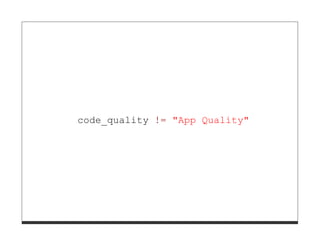
code_quality != "App Quality"
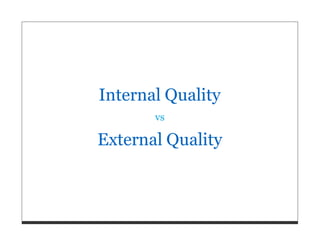
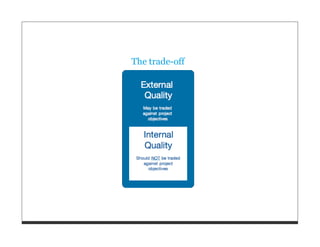
Internal Quality
       vs

External Quality
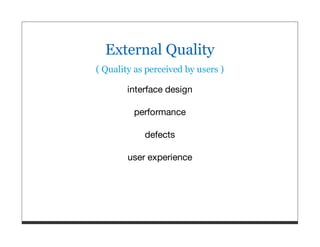
External Quality
( Quality as perceived by users )

        interface design

         performance

            defects

        user experience
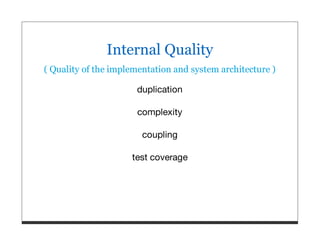
Internal Quality
( Quality of the implementation and system architecture )

                      duplication

                      complexity

                        coupling

                     test coverage
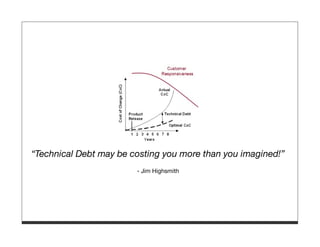
“Technical Debt may be costing you more than you imagined!”
                        - Jim Highsmith
The trade-off
Managing Quality
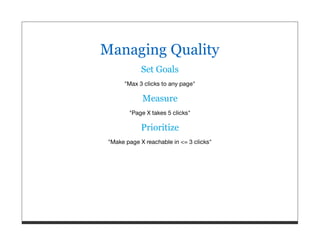
Managing Quality
             Set Goals
       "Max 3 clicks to any page"

             Measure
        "Page X takes 5 clicks"

             Prioritize
 "Make page X reachable in <= 3 clicks"
How to achieve Quality ?
TEST TEST TEST
What/When/How to Test ?
" Test Strategy "
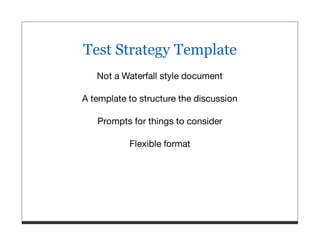
Test Strategy Template
   Not a Waterfall style document

A template to structure the discussion

   Prompts for things to consider

           Flexible format
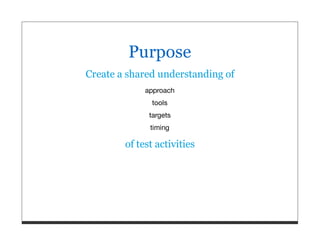
Purpose
Create a shared understanding of
             approach
              tools
              targets
              timing

        of test activities
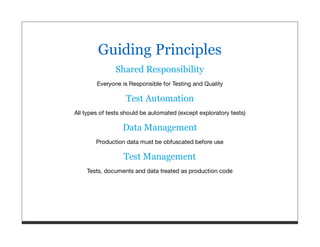
Guiding Principles
               Shared Responsibility
        Everyone is Responsible for Testing and Quality

                   Test Automation
All types of tests should be automated (except exploratory tests)

                  Data Management
        Production data must be obfuscated before use

                  Test Management
    Tests, documents and data treated as production code
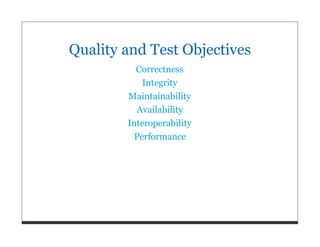
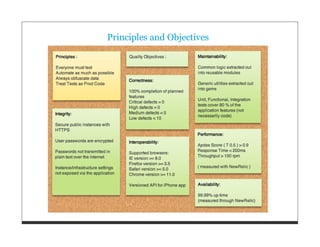
Quality and Test Objectives
          Correctness
            Integrity
        Maintainability
          Availability
        Interoperability
          Performance
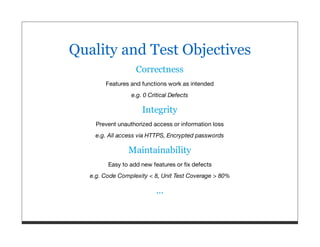
Quality and Test Objectives
                   Correctness
        Features and functions work as intended
                  e.g. 0 Critical Defects

                      Integrity
     Prevent unauthorized access or information loss
     e.g. All access via HTTPS, Encrypted passwords

                Maintainability
         Easy to add new features or fix defects
   e.g. Code Complexity < 8, Unit Test Coverage > 80%

                            ...
Quality and Test Objectives
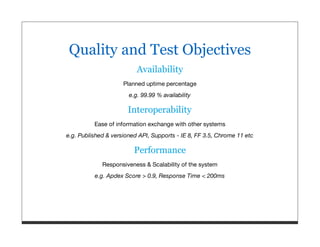
                          Availability
                     Planned uptime percentage
                       e.g. 99.99 % availability

                       Interoperability
          Ease of information exchange with other systems
e.g. Published & versioned API, Supports - IE 8, FF 3.5, Chrome 11 etc

                         Performance
             Responsiveness & Scalability of the system
          e.g. Apdex Score > 0.9, Response Time < 200ms
Quality and Test Objectives
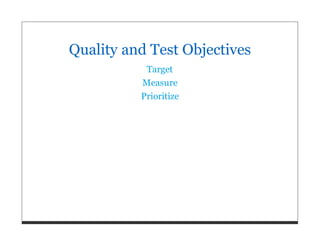
           Target
          Measure
          Prioritize
Test Scope
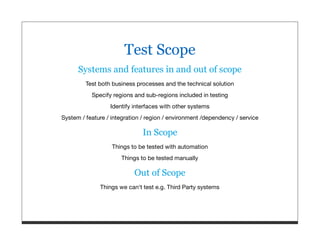
      Systems and features in and out of scope
         Test both business processes and the technical solution
           Specify regions and sub-regions included in testing
                  Identify interfaces with other systems
System / feature / integration / region / environment /dependency / service

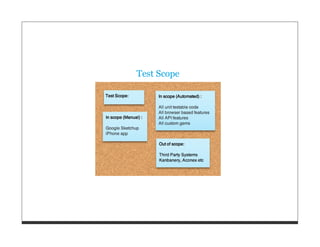
                              In Scope
                   Things to be tested with automation
                      Things to be tested manually

                           Out of Scope
              Things we can't test e.g. Third Party systems
Test Approach
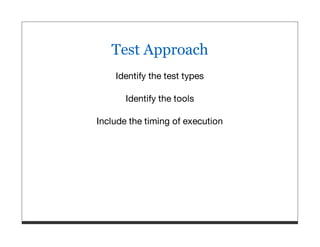
    Identify the test types

       Identify the tools

Include the timing of execution
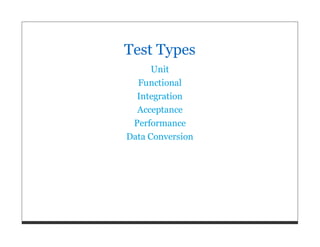
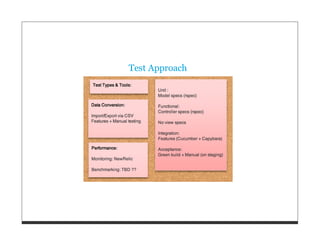
Test Types
      Unit
  Functional
  Integration
  Acceptance
 Performance
Data Conversion
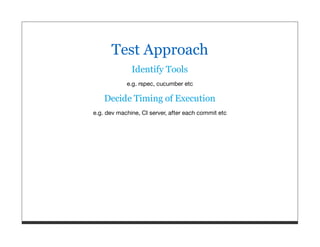
Test Approach
              Identify Tools
            e.g. rspec, cucumber etc

    Decide Timing of Execution
e.g. dev machine, CI server, after each commit etc
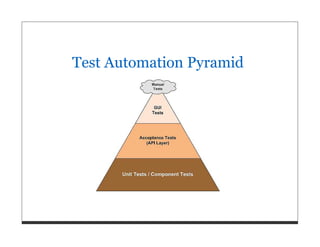
Test Automation Pyramid
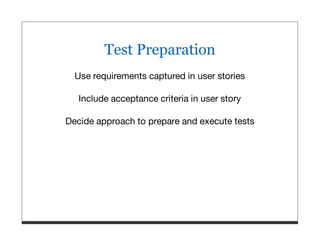
Test Preparation
  Use requirements captured in user stories

   Include acceptance criteria in user story

Decide approach to prepare and execute tests
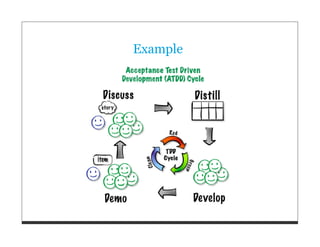
Example
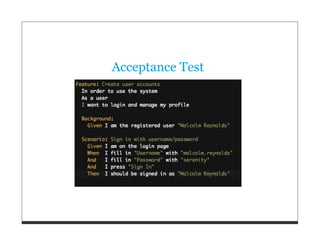
Acceptance Test
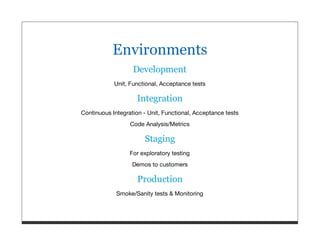
Environments
                   Development
            Unit, Functional, Acceptance tests

                    Integration
Continuous Integration - Unit, Functional, Acceptance tests
                  Code Analysis/Metrics

                       Staging
                  For exploratory testing
                   Demos to customers

                     Production
             Smoke/Sanity tests & Monitoring
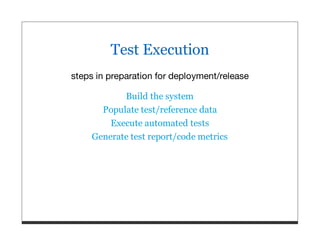
Test Execution
steps in preparation for deployment/release

            Build the system
       Populate test/reference data
         Execute automated tests
     Generate test report/code metrics
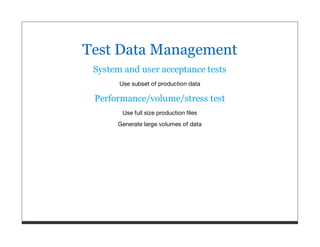
Test Data Management
 System and user acceptance tests
       Use subset of production data

 Performance/volume/stress test
        Use full size production files
      Generate large volumes of data
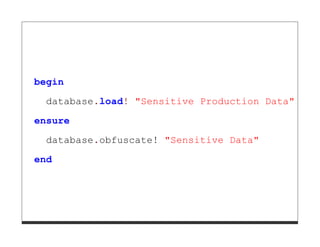
begin

  database.load! "Sensitive Production Data"

ensure

  database.obfuscate! "Sensitive Data"

end
Defect Management
Why defects ?
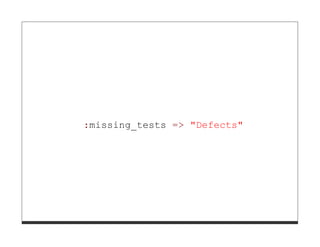
:missing_tests => "Defects"
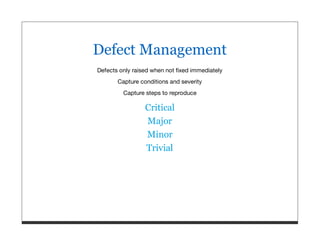
Defect Management
Defects only raised when not fixed immediately
       Capture conditions and severity
         Capture steps to reproduce

                 Critical
                 Major
                 Minor
                 Trivial
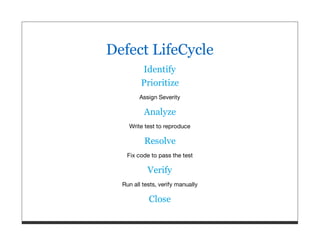
Defect LifeCycle
         Identify
         Prioritize
        Assign Severity

          Analyze
    Write test to reproduce

          Resolve
   Fix code to pass the test

            Verify
  Run all tests, verify manually

            Close
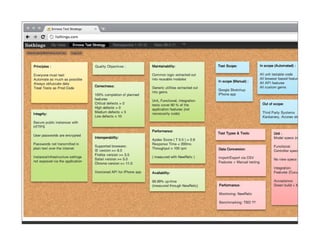
Test Strategy Example
Principles and Objectives
Test Scope
Test Approach
Ruby/Rails
Testing Ecosystem
What's different
      in
 Ruby/Rails ?
Advantages
     Testing built right-in

    Passionate developers

Vibrant open source community

    Excellent tools support
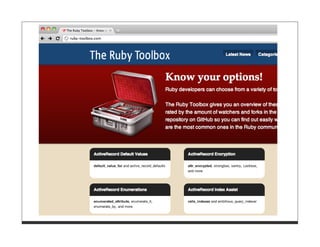
So what are our options ?
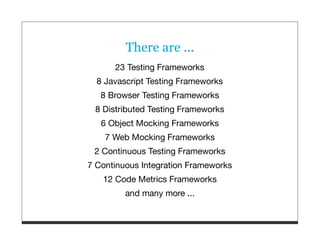
There are ...
      23 Testing Frameworks
  8 Javascript Testing Frameworks
   8 Browser Testing Frameworks
 8 Distributed Testing Frameworks
   6 Object Mocking Frameworks
    7 Web Mocking Frameworks
 2 Continuous Testing Frameworks
7 Continuous Integration Frameworks
   12 Code Metrics Frameworks
         and many more ...
raise "OMG !!"
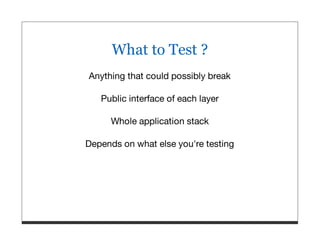
What to Test ?
Anything that could possibly break

   Public interface of each layer

      Whole application stack

Depends on what else you're testing
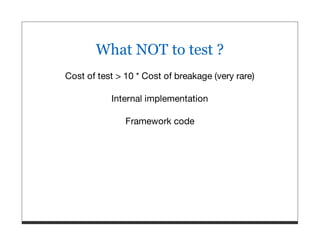
What NOT to test ?
Cost of test > 10 * Cost of breakage (very rare)

           Internal implementation

               Framework code
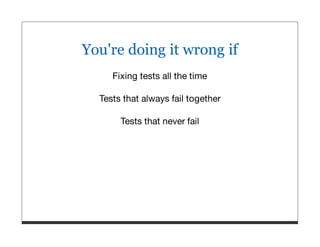
You're doing it wrong if
     Fixing tests all the time

  Tests that always fail together

       Tests that never fail
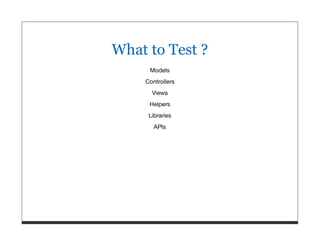
What to Test ?
     Models
    Controllers
      Views
     Helpers
     Libraries
       APIs
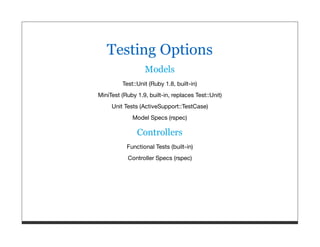
Testing Options
                  Models
         Test::Unit (Ruby 1.8, built-in)
MiniTest (Ruby 1.9, built-in, replaces Test::Unit)
     Unit Tests (ActiveSupport::TestCase)
             Model Specs (rspec)

               Controllers
           Functional Tests (built-in)
            Controller Specs (rspec)
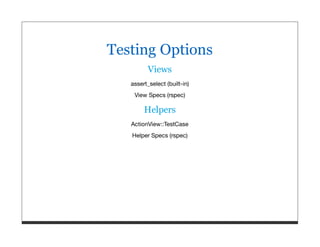
Testing Options
          Views
   assert_select (built-in)
    View Specs (rspec)

        Helpers
   ActionView::TestCase
   Helper Specs (rspec)
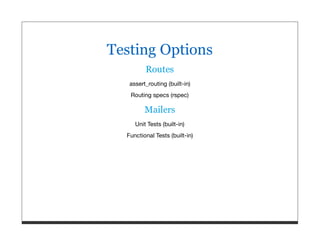
Testing Options
         Routes
   assert_routing (built-in)
   Routing specs (rspec)

         Mailers
     Unit Tests (built-in)
  Functional Tests (built-in)
Testing Options
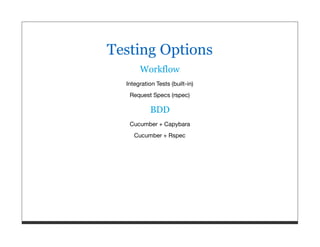
       Workflow
  Integration Tests (built-in)
   Request Specs (rspec)

            BDD
   Cucumber + Capybara
     Cucumber + Rspec
Testing Options
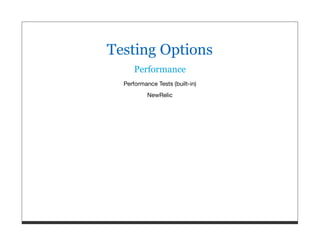
      Performance
  Performance Tests (built-in)
           NewRelic
Testing Helpers
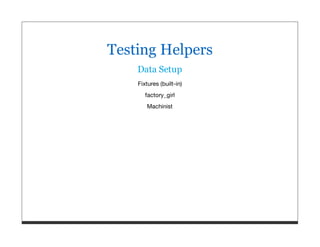
    Data Setup
    Fixtures (built-in)
       factory_girl
       Machinist
Testing Helpers
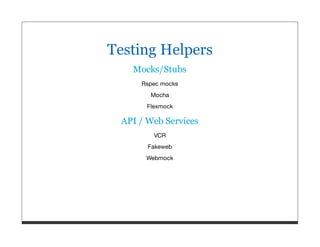
   Mocks/Stubs
     Rspec mocks
        Mocha
       Flexmock

 API / Web Services
         VCR
       Fakeweb
      Webmock
Testing Helpers
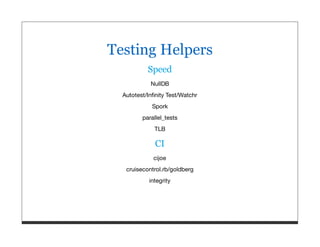
           Speed
            NullDB
  Autotest/Infinity Test/Watchr
             Spork
         parallel_tests
              TLB

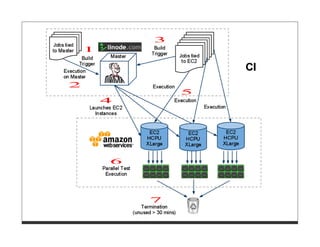
              CI
             cijoe
   cruisecontrol.rb/goldberg
           integrity
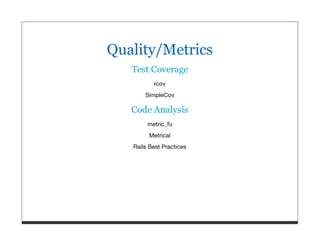
Quality/Metrics
   Test Coverage
          rcov
       SimpleCov

   Code Analysis
        metric_fu
        Metrical
   Rails Best Practices
Which is the Best ?
 Even the God(s) Can't Say !!
Which is the Best for Me ?
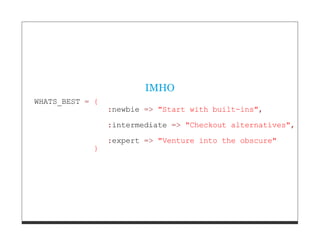
IMHO
WHATS_BEST = {
                 :newbie => "Start with built-ins",
                 :intermediate => "Checkout alternatives",

                 :expert => "Venture into the obscure"
            }
WHATS_BEST[:god] = "Write your own !"
References
 http://ennova.com.au/blog
       http://www.jimhighsmith.com
http://www.mountaingoatsoftware.com/tools
     http://www.informit.com/articles
     http://www.agileacademy.com.au
            http://railsrx.com
     http://www.bootspring.com/blog
Questions ?

http://sqats-rubyconfindia2011.heroku.com


              bhavinjavia

             @bhavinjavia

          bhavin@ennova.in

Software Quality and Test Strategies for Ruby and Rails Applications

  • 1.
    Software Quality and Test Strategies for Ruby and Rails Applications - Bhavin Javia May 29th, 2011
  • 2.
    About Me Ex ThoughtWorker Agile/RoR Consultant - Ennova, Australia Founder - Ennova, India
  • 3.
  • 4.
    Co-Author Dr Adrian Smith Managing Director - Technology Agile Coach @
  • 5.
    Content Software Quality Test Strategy Ruby/Rails Testing Ecosystem Quality and Testing for Rails Projects
  • 6.
  • 7.
  • 8.
    “Quality is themost important factor for deriving long term value from a software product” - Jim Highsmith (Co-Author of Agile Manifesto)
  • 9.
    ”Continuous attention toquality can help maintain velocity, maintain the ability to deliver, without it the team will slow down” - Robert C. Martin (Author of Clean Code)
  • 10.
    Why worry ? Needs to be built in (implicitly) Needs to be defined (to prioritize vs cost/scope/time) Agile project delivery relies on continuous attention to quality Begins at the code level
  • 11.
  • 12.
    Internal Quality vs External Quality
  • 13.
    External Quality ( Qualityas perceived by users ) interface design performance defects user experience
  • 14.
    Internal Quality ( Qualityof the implementation and system architecture ) duplication complexity coupling test coverage
  • 15.
    “Technical Debt maybe costing you more than you imagined!” - Jim Highsmith
  • 16.
  • 19.
  • 20.
    Managing Quality Set Goals "Max 3 clicks to any page" Measure "Page X takes 5 clicks" Prioritize "Make page X reachable in <= 3 clicks"
  • 21.
    How to achieveQuality ?
  • 22.
  • 23.
  • 24.
  • 25.
  • 26.
    Test Strategy Template Not a Waterfall style document A template to structure the discussion Prompts for things to consider Flexible format
  • 27.
    Purpose Create a sharedunderstanding of approach tools targets timing of test activities
  • 28.
    Guiding Principles Shared Responsibility Everyone is Responsible for Testing and Quality Test Automation All types of tests should be automated (except exploratory tests) Data Management Production data must be obfuscated before use Test Management Tests, documents and data treated as production code
  • 29.
    Quality and TestObjectives Correctness Integrity Maintainability Availability Interoperability Performance
  • 30.
    Quality and TestObjectives Correctness Features and functions work as intended e.g. 0 Critical Defects Integrity Prevent unauthorized access or information loss e.g. All access via HTTPS, Encrypted passwords Maintainability Easy to add new features or fix defects e.g. Code Complexity < 8, Unit Test Coverage > 80% ...
  • 31.
    Quality and TestObjectives Availability Planned uptime percentage e.g. 99.99 % availability Interoperability Ease of information exchange with other systems e.g. Published & versioned API, Supports - IE 8, FF 3.5, Chrome 11 etc Performance Responsiveness & Scalability of the system e.g. Apdex Score > 0.9, Response Time < 200ms
  • 32.
    Quality and TestObjectives Target Measure Prioritize
  • 33.
    Test Scope Systems and features in and out of scope Test both business processes and the technical solution Specify regions and sub-regions included in testing Identify interfaces with other systems System / feature / integration / region / environment /dependency / service In Scope Things to be tested with automation Things to be tested manually Out of Scope Things we can't test e.g. Third Party systems
  • 34.
    Test Approach Identify the test types Identify the tools Include the timing of execution
  • 35.
    Test Types Unit Functional Integration Acceptance Performance Data Conversion
  • 36.
    Test Approach Identify Tools e.g. rspec, cucumber etc Decide Timing of Execution e.g. dev machine, CI server, after each commit etc
  • 37.
  • 38.
    Test Preparation Use requirements captured in user stories Include acceptance criteria in user story Decide approach to prepare and execute tests
  • 39.
  • 40.
  • 41.
    Environments Development Unit, Functional, Acceptance tests Integration Continuous Integration - Unit, Functional, Acceptance tests Code Analysis/Metrics Staging For exploratory testing Demos to customers Production Smoke/Sanity tests & Monitoring
  • 42.
    Test Execution steps inpreparation for deployment/release Build the system Populate test/reference data Execute automated tests Generate test report/code metrics
  • 43.
    Test Data Management System and user acceptance tests Use subset of production data Performance/volume/stress test Use full size production files Generate large volumes of data
  • 44.
    begin database.load!"Sensitive Production Data" ensure database.obfuscate! "Sensitive Data" end
  • 45.
  • 46.
  • 47.
  • 48.
    Defect Management Defects onlyraised when not fixed immediately Capture conditions and severity Capture steps to reproduce Critical Major Minor Trivial
  • 49.
    Defect LifeCycle Identify Prioritize Assign Severity Analyze Write test to reproduce Resolve Fix code to pass the test Verify Run all tests, verify manually Close
  • 50.
  • 52.
  • 53.
  • 54.
  • 56.
  • 57.
    What's different in Ruby/Rails ?
  • 59.
    Advantages Testing built right-in Passionate developers Vibrant open source community Excellent tools support
  • 60.
    So what areour options ?
  • 62.
    There are ... 23 Testing Frameworks 8 Javascript Testing Frameworks 8 Browser Testing Frameworks 8 Distributed Testing Frameworks 6 Object Mocking Frameworks 7 Web Mocking Frameworks 2 Continuous Testing Frameworks 7 Continuous Integration Frameworks 12 Code Metrics Frameworks and many more ...
  • 63.
  • 64.
    What to Test? Anything that could possibly break Public interface of each layer Whole application stack Depends on what else you're testing
  • 65.
    What NOT totest ? Cost of test > 10 * Cost of breakage (very rare) Internal implementation Framework code
  • 66.
    You're doing itwrong if Fixing tests all the time Tests that always fail together Tests that never fail
  • 67.
    What to Test? Models Controllers Views Helpers Libraries APIs
  • 68.
    Testing Options Models Test::Unit (Ruby 1.8, built-in) MiniTest (Ruby 1.9, built-in, replaces Test::Unit) Unit Tests (ActiveSupport::TestCase) Model Specs (rspec) Controllers Functional Tests (built-in) Controller Specs (rspec)
  • 69.
    Testing Options Views assert_select (built-in) View Specs (rspec) Helpers ActionView::TestCase Helper Specs (rspec)
  • 70.
    Testing Options Routes assert_routing (built-in) Routing specs (rspec) Mailers Unit Tests (built-in) Functional Tests (built-in)
  • 71.
    Testing Options Workflow Integration Tests (built-in) Request Specs (rspec) BDD Cucumber + Capybara Cucumber + Rspec
  • 72.
    Testing Options Performance Performance Tests (built-in) NewRelic
  • 73.
    Testing Helpers Data Setup Fixtures (built-in) factory_girl Machinist
  • 74.
    Testing Helpers Mocks/Stubs Rspec mocks Mocha Flexmock API / Web Services VCR Fakeweb Webmock
  • 75.
    Testing Helpers Speed NullDB Autotest/Infinity Test/Watchr Spork parallel_tests TLB CI cijoe cruisecontrol.rb/goldberg integrity
  • 76.
    Quality/Metrics Test Coverage rcov SimpleCov Code Analysis metric_fu Metrical Rails Best Practices
  • 77.
    Which is theBest ? Even the God(s) Can't Say !!
  • 78.
    Which is theBest for Me ?
  • 79.
    IMHO WHATS_BEST = { :newbie => "Start with built-ins", :intermediate => "Checkout alternatives", :expert => "Venture into the obscure" }
  • 80.
  • 81.
    References http://ennova.com.au/blog http://www.jimhighsmith.com http://www.mountaingoatsoftware.com/tools http://www.informit.com/articles http://www.agileacademy.com.au http://railsrx.com http://www.bootspring.com/blog
  • 82.
    Questions ? http://sqats-rubyconfindia2011.heroku.com bhavinjavia @bhavinjavia bhavin@ennova.in