WELCOME
TO OUR PRESENTATION
Principles of Microeconomics
Chapter 15 - Monopoly
GROUP 6
LÊ ĐẶNG BẢO CHÂU
NGÔ THÙY DƯƠNG
TRỊNH THỊ CẨM NHUNG
ĐỖ THỊ MINH VY
PHAN TỪ NHƯ Ý
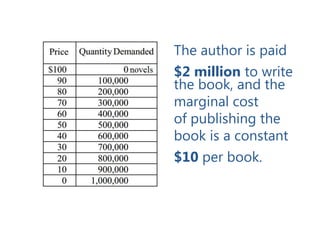
 A publisher faces the following demand
schedule for the next novel one of its popular
authors
The author is paid
$2 million to write
the book, and the
marginal cost
of publishing the
book is a constant
$10 per book.
a) Compute total revenue, total cost,
profit at each quantity. What
quantity would a profit-maximizing
publisher choose? What price would
it charge?
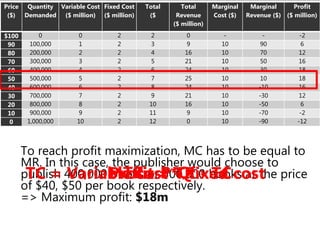
To reach profit maximization, MC has to be equal to
MR. In this case, the publisher would choose to
publish 400,000 books or 500,000 books at the price
of $40, $50 per book respectively.
=> Maximum profit: $18m
Price
($)
Quantity
Demanded
Variable Cost
($ million)
Fixed Cost
($ million)
Total
($
Total
Revenue
($ million)
Marginal
Cost ($)
Marginal
Revenue ($)
Profit
($ million)
$100 0 0 2 2 0 - - -2
90 100,000 1 2 3 9 10 90 6
80 200,000 2 2 4 16 10 70 12
70 300,000 3 2 5 21 10 50 16
60 400,000 4 2 6 24 10 30 18
50 500,000 5 2 7 25 10 10 18
40 600,000 6 2 8 24 10 -10 16
30 700,000 7 2 9 21 10 -30 12
20 800,000 8 2 10 16 10 -50 6
10 900,000 9 2 11 9 10 -70 -2
0 1,000,000 10 2 12 0 10 -90 -12
TR= P*QTC = Variable cost + fixed costProfit = TR - TC
b) Compute marginal revenue.
How does marginal revenue
compare to the price? Explain.
Price
($)
Quantity
Demanded
Variable Cost
($ million)
Fixed Cost
($ million)
Total
($
Total
Revenue
($ million)
Marginal
Cost ($)
Marginal
Revenue ($)
Profit
($ million)
$100 0 0 2 2 0 - - -2
90 100,000 1 2 3 9 10 90 6
80 200,000 2 2 4 16 10 70 12
70 300,000 3 2 5 21 10 50 16
60 400,000 4 2 6 24 10 30 18
50 500,000 5 2 7 25 10 10 18
40 600,000 6 2 8 24 10 -10 16
30 700,000 7 2 9 21 10 -30 12
20 800,000 8 2 10 16 10 -50 6
10 900,000 9 2 11 9 10 -70 -2
0 1,000,000 10 2 12 0 10 -90 -12
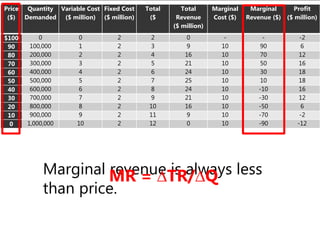
Marginal revenue is always less
than price.
MR = ∆TR/∆Q
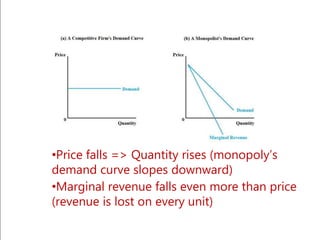
•Price falls => Quantity rises (monopoly’s
demand curve slopes downward)
•Marginal revenue falls even more than price
(revenue is lost on every unit)
c) Graph the marginal-revenue,
marginal-cost, and demand curves.
At what quantity do the marginal-
revenue and marginal-cost curves
cross? What does this signify?
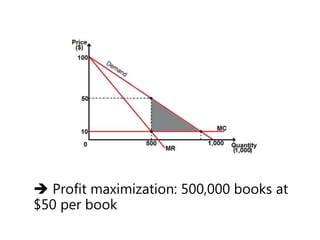
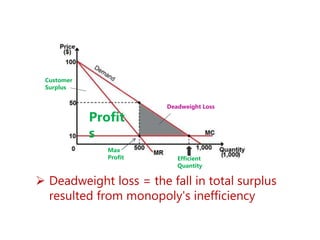
 Profit maximization: 500,000 books at
$50 per book
d) In your graph, shade in
the deadweight loss.
Explain in words what this
means.
 Deadweight loss = the fall in total surplus
resulted from monopoly's inefficiency
Deadweight Loss
Efficient
Quantity
Profit
s
Customer
Surplus
Max
Profit
e) If the author were paid $3
million instead of $2 million to
write the book, how would this
affect the publisher’s decision
regarding the price to charge?
Explain.
Price
($)
Quantity
Demanded
Variable Cost
($ million)
Fixed Cost
($ million)
Total Cost
($ million)
Total
Revenue
($ million)
Marginal
Cost ($)
Marginal
Revenue ($)
Profit
($ million)
$100 0 0 2 2 0 - - -2
90 100,000 1 2 3 9 10 90 6
80 200,000 2 2 4 16 10 70 12
70 300,000 3 2 5 21 10 50 16
60 400,000 4 2 6 24 10 30 18
50 500,000 5 2 7 25 10 10 18
40 600,000 6 2 8 24 10 -10 16
30 700,000 7 2 9 21 10 -30 12
20 800,000 8 2 10 16 10 -50 6
10 900,000 9 2 11 9 10 -70 -2
0 1,000,000 10 2 12 0 10 -90 -12
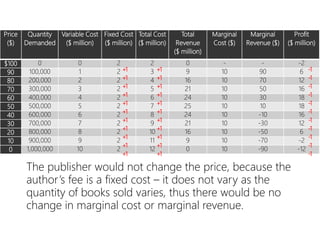
The publisher would not change the price, because the
author’s fee is a fixed cost – it does not vary as the
quantity of books sold varies, thus there would be no
change in marginal cost or marginal revenue.
-1
-1
-1
-1
-1
-1
-1
-1
-1
-1
-1
+1
+1
+1
+1
+1
+1
+1
+1
+1
+1
+1
+1
+1
+1
+1
+1
+1
+1
+1
+1
+1
+1
f) Suppose the publisher were not
profit-maximizing but were
concerned with maximizing
economic efficiency.
What price would it charge for the
book? How much profit would it
make at this price?
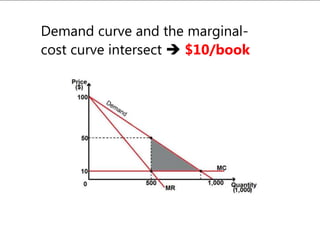
Demand curve and the marginal-
cost curve intersect  $10/book
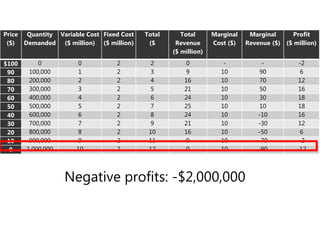
Negative profits: -$2,000,000
Price
($)
Quantity
Demanded
Variable Cost
($ million)
Fixed Cost
($ million)
Total
($
Total
Revenue
($ million)
Marginal
Cost ($)
Marginal
Revenue ($)
Profit
($ million)
$100 0 0 2 2 0 - - -2
90 100,000 1 2 3 9 10 90 6
80 200,000 2 2 4 16 10 70 12
70 300,000 3 2 5 21 10 50 16
60 400,000 4 2 6 24 10 30 18
50 500,000 5 2 7 25 10 10 18
40 600,000 6 2 8 24 10 -10 16
30 700,000 7 2 9 21 10 -30 12
20 800,000 8 2 10 16 10 -50 6
10 900,000 9 2 11 9 10 -70 -2
0 1,000,000 10 2 12 0 10 -90 -12
THANK YOU FOR
LISTENING

[Microeconomics] Chapter 15 - Monopoly

  • 1.
    WELCOME TO OUR PRESENTATION Principlesof Microeconomics Chapter 15 - Monopoly
  • 2.
    GROUP 6 LÊ ĐẶNGBẢO CHÂU NGÔ THÙY DƯƠNG TRỊNH THỊ CẨM NHUNG ĐỖ THỊ MINH VY PHAN TỪ NHƯ Ý
  • 3.
     A publisherfaces the following demand schedule for the next novel one of its popular authors
  • 4.
    The author ispaid $2 million to write the book, and the marginal cost of publishing the book is a constant $10 per book.
  • 5.
    a) Compute totalrevenue, total cost, profit at each quantity. What quantity would a profit-maximizing publisher choose? What price would it charge?
  • 6.
    To reach profitmaximization, MC has to be equal to MR. In this case, the publisher would choose to publish 400,000 books or 500,000 books at the price of $40, $50 per book respectively. => Maximum profit: $18m Price ($) Quantity Demanded Variable Cost ($ million) Fixed Cost ($ million) Total ($ Total Revenue ($ million) Marginal Cost ($) Marginal Revenue ($) Profit ($ million) $100 0 0 2 2 0 - - -2 90 100,000 1 2 3 9 10 90 6 80 200,000 2 2 4 16 10 70 12 70 300,000 3 2 5 21 10 50 16 60 400,000 4 2 6 24 10 30 18 50 500,000 5 2 7 25 10 10 18 40 600,000 6 2 8 24 10 -10 16 30 700,000 7 2 9 21 10 -30 12 20 800,000 8 2 10 16 10 -50 6 10 900,000 9 2 11 9 10 -70 -2 0 1,000,000 10 2 12 0 10 -90 -12 TR= P*QTC = Variable cost + fixed costProfit = TR - TC
  • 7.
    b) Compute marginalrevenue. How does marginal revenue compare to the price? Explain.
  • 8.
    Price ($) Quantity Demanded Variable Cost ($ million) FixedCost ($ million) Total ($ Total Revenue ($ million) Marginal Cost ($) Marginal Revenue ($) Profit ($ million) $100 0 0 2 2 0 - - -2 90 100,000 1 2 3 9 10 90 6 80 200,000 2 2 4 16 10 70 12 70 300,000 3 2 5 21 10 50 16 60 400,000 4 2 6 24 10 30 18 50 500,000 5 2 7 25 10 10 18 40 600,000 6 2 8 24 10 -10 16 30 700,000 7 2 9 21 10 -30 12 20 800,000 8 2 10 16 10 -50 6 10 900,000 9 2 11 9 10 -70 -2 0 1,000,000 10 2 12 0 10 -90 -12 Marginal revenue is always less than price. MR = ∆TR/∆Q
  • 9.
    •Price falls =>Quantity rises (monopoly’s demand curve slopes downward) •Marginal revenue falls even more than price (revenue is lost on every unit)
  • 10.
    c) Graph themarginal-revenue, marginal-cost, and demand curves. At what quantity do the marginal- revenue and marginal-cost curves cross? What does this signify?
  • 11.
     Profit maximization:500,000 books at $50 per book
  • 12.
    d) In yourgraph, shade in the deadweight loss. Explain in words what this means.
  • 13.
     Deadweight loss= the fall in total surplus resulted from monopoly's inefficiency Deadweight Loss Efficient Quantity Profit s Customer Surplus Max Profit
  • 14.
    e) If theauthor were paid $3 million instead of $2 million to write the book, how would this affect the publisher’s decision regarding the price to charge? Explain.
  • 15.
    Price ($) Quantity Demanded Variable Cost ($ million) FixedCost ($ million) Total Cost ($ million) Total Revenue ($ million) Marginal Cost ($) Marginal Revenue ($) Profit ($ million) $100 0 0 2 2 0 - - -2 90 100,000 1 2 3 9 10 90 6 80 200,000 2 2 4 16 10 70 12 70 300,000 3 2 5 21 10 50 16 60 400,000 4 2 6 24 10 30 18 50 500,000 5 2 7 25 10 10 18 40 600,000 6 2 8 24 10 -10 16 30 700,000 7 2 9 21 10 -30 12 20 800,000 8 2 10 16 10 -50 6 10 900,000 9 2 11 9 10 -70 -2 0 1,000,000 10 2 12 0 10 -90 -12 The publisher would not change the price, because the author’s fee is a fixed cost – it does not vary as the quantity of books sold varies, thus there would be no change in marginal cost or marginal revenue. -1 -1 -1 -1 -1 -1 -1 -1 -1 -1 -1 +1 +1 +1 +1 +1 +1 +1 +1 +1 +1 +1 +1 +1 +1 +1 +1 +1 +1 +1 +1 +1 +1
  • 16.
    f) Suppose thepublisher were not profit-maximizing but were concerned with maximizing economic efficiency. What price would it charge for the book? How much profit would it make at this price?
  • 17.
    Demand curve andthe marginal- cost curve intersect  $10/book
  • 18.
    Negative profits: -$2,000,000 Price ($) Quantity Demanded VariableCost ($ million) Fixed Cost ($ million) Total ($ Total Revenue ($ million) Marginal Cost ($) Marginal Revenue ($) Profit ($ million) $100 0 0 2 2 0 - - -2 90 100,000 1 2 3 9 10 90 6 80 200,000 2 2 4 16 10 70 12 70 300,000 3 2 5 21 10 50 16 60 400,000 4 2 6 24 10 30 18 50 500,000 5 2 7 25 10 10 18 40 600,000 6 2 8 24 10 -10 16 30 700,000 7 2 9 21 10 -30 12 20 800,000 8 2 10 16 10 -50 6 10 900,000 9 2 11 9 10 -70 -2 0 1,000,000 10 2 12 0 10 -90 -12
  • 19.