CAPILLARY CIRCULATION
Prof. Sultan Ayoub Meo
MBBS, Ph.D (Pak), M Med Ed (Dundee), FRCP (London),
FRCP (Dublin), FRCP (Glasgow), FRCP (Edinburgh)
Professor and Consultant, Department of Physiology,
College of Medicine, King Saud University, Riyadh, KSA
 Components of the microcirculation
 Types of blood capillaries
 Regulation of flow in the capillary beds.
 Diffusion and filtration.
 Define edema, state its causes and discuss its mechanisms.
LECTURE OBJECTIVES
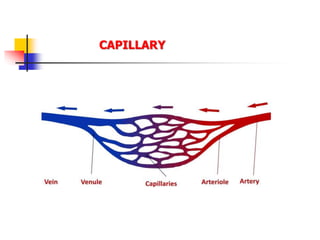
CAPILLARY
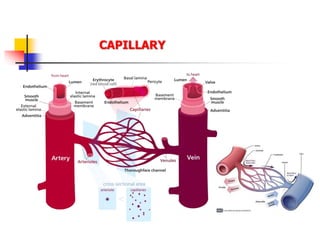
CAPILLARY
CAPILLARY
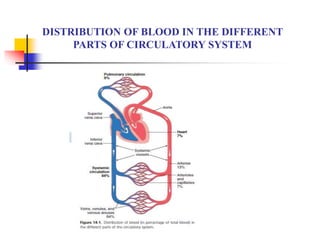
DISTRIBUTION OF BLOOD IN THE DIFFERENT
PARTS OF CIRCULATORY SYSTEM
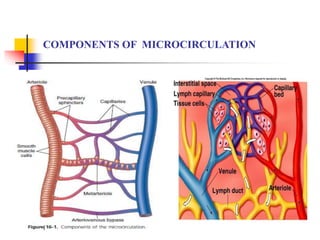
COMPONENTS OF MICROCIRCULATION
Lymphatic capillaries are
small, thin-walled
micro-vessels located in
the spaces between cells
except CNS
Serve to drain and
process ECF.
Lymphatic capillary
carries lymph into
lymphatic vessels,
connects to a lymph
node to the venous
circulation
Lymphatic capillaries are
slightly larger in
diameter than blood
capillaries, allow
interstitial fluid to flow
into them but not out.
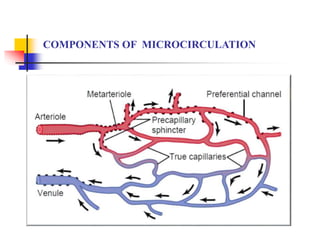
COMPONENTS OF MICROCIRCULATION
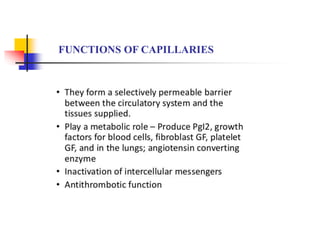
FUNCTIONS OF CAPILLARIES
Aorta: Elastic recoil
Arteries: Muscular,low resistance vessels
Arterioles: High resistance vessels
Capillaries: Exchange vessels
Veins and Venules: Capacitancevessels
COMPONENTS OF MICROCIRCULATION
Smallest blood vessels
Exchange vessels: Provide direct access tocells.
Most permeable: Permits exchange ofnutrients & wastes.
Capillary bed consist of two types
of vessels:
Vascular shunt: Directly connects
an arteriole to a venule
True capillaries: Exchange vessels.
Oxygen & nutrients cross to cells
Carbon dioxide & metabolic waste
products cross into blood
CAPILLARY BED
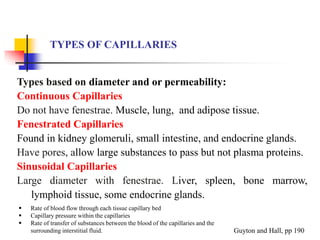
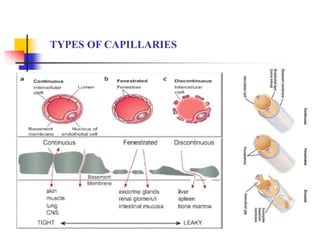
Types based on diameter and or permeability:
Continuous Capillaries
Do not have fenestrae. Muscle, lung, and adipose tissue.
Fenestrated Capillaries
Found in kidney glomeruli, small intestine, and endocrine glands.
Have pores, allow large substances to pass but not plasma proteins.
Sinusoidal Capillaries
Large diameter with fenestrae. Liver, spleen, bone marrow,
lymphoid tissue, some endocrine glands.
TYPES OF CAPILLARIES
Guyton and Hall, pp 190
 Rate of blood flow through each tissue capillary bed
 Capillary pressure within the capillaries
 Rate of transfer of substances between the blood of the capillaries and the
surrounding interstitial fluid.
TYPES OF CAPILLARIES
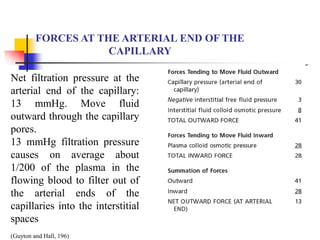
Net filtration pressure at the
arterial end of the capillary:
13 mmHg. Move fluid
outward through the capillary
pores.
13 mmHg filtration pressure
causes on average about
1/200 of the plasma in the
flowing blood to filter out of
the arterial ends of the
capillaries into the interstitial
spaces
(Guyton and Hall, 196)
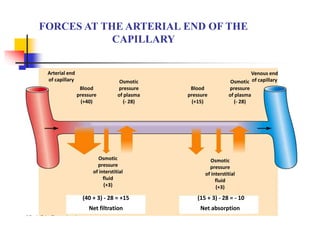
FORCES AT THE ARTERIAL END OF THE
CAPILLARY
Arterial end
of capillary
Blood
pressure
(+40)
Osmotic
pressure
of plasma
(- 28)
Blood
pressure
(+15)
Osmotic
pressure
of plasma
(- 28)
Osmotic
pressure
of interstitial
fluid
(+3)
Osmotic
pressure
of interstitial
fluid
(+3)
(40 + 3) - 28 = +15
Net filtration
(15 + 3) - 28 = - 10
Net absorption
Venous end
of capillary
FORCES AT THE ARTERIAL END OF THE
CAPILLARY
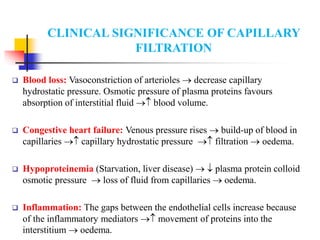
CLINICAL SIGNIFICANCE OF CAPILLARY
FILTRATION
 Blood loss: Vasoconstriction of arterioles  decrease capillary
hydrostatic pressure. Osmotic pressure of plasma proteins favours
absorption of interstitial fluid  blood volume.
 Congestive heart failure: Venous pressure rises  build-up of blood in
capillaries  capillary hydrostatic pressure  filtration  oedema.
 Hypoproteinemia (Starvation, liver disease)   plasma protein colloid
osmotic pressure  loss of fluid from capillaries  oedema.
 Inflammation: The gaps between the endothelial cells increase because
of the inflammatory mediators  movement of proteins into the
interstitium  oedema.
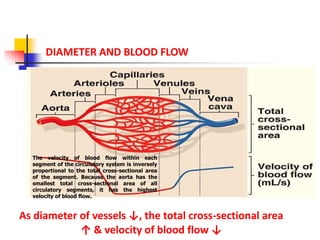
As diameter of vessels ↓, the total cross-sectional area
↑ & velocity of blood flow ↓
DIAMETER AND BLOOD FLOW
The velocity of blood flow within each
segment of the circulatory system is inversely
proportional to the total cross-sectional area
of the segment. Because the aorta has the
smallest total cross-sectional area of all
circulatory segments, it has the highest
velocity of blood flow.
As diameter of vessels ↓, the total cross-sectional area
↑ & velocity of blood flow ↓
DIAMETER AND BLOOD FLOW
capillary Circulation

capillary Circulation

  • 1.
    CAPILLARY CIRCULATION Prof. SultanAyoub Meo MBBS, Ph.D (Pak), M Med Ed (Dundee), FRCP (London), FRCP (Dublin), FRCP (Glasgow), FRCP (Edinburgh) Professor and Consultant, Department of Physiology, College of Medicine, King Saud University, Riyadh, KSA
  • 2.
     Components ofthe microcirculation  Types of blood capillaries  Regulation of flow in the capillary beds.  Diffusion and filtration.  Define edema, state its causes and discuss its mechanisms. LECTURE OBJECTIVES
  • 3.
  • 4.
  • 5.
  • 6.
    DISTRIBUTION OF BLOODIN THE DIFFERENT PARTS OF CIRCULATORY SYSTEM
  • 7.
  • 8.
    COMPONENTS OF MICROCIRCULATION Lymphaticcapillaries are small, thin-walled micro-vessels located in the spaces between cells except CNS Serve to drain and process ECF. Lymphatic capillary carries lymph into lymphatic vessels, connects to a lymph node to the venous circulation Lymphatic capillaries are slightly larger in diameter than blood capillaries, allow interstitial fluid to flow into them but not out.
  • 9.
  • 10.
  • 11.
    Aorta: Elastic recoil Arteries:Muscular,low resistance vessels Arterioles: High resistance vessels Capillaries: Exchange vessels Veins and Venules: Capacitancevessels COMPONENTS OF MICROCIRCULATION Smallest blood vessels Exchange vessels: Provide direct access tocells. Most permeable: Permits exchange ofnutrients & wastes.
  • 12.
    Capillary bed consistof two types of vessels: Vascular shunt: Directly connects an arteriole to a venule True capillaries: Exchange vessels. Oxygen & nutrients cross to cells Carbon dioxide & metabolic waste products cross into blood CAPILLARY BED
  • 13.
    Types based ondiameter and or permeability: Continuous Capillaries Do not have fenestrae. Muscle, lung, and adipose tissue. Fenestrated Capillaries Found in kidney glomeruli, small intestine, and endocrine glands. Have pores, allow large substances to pass but not plasma proteins. Sinusoidal Capillaries Large diameter with fenestrae. Liver, spleen, bone marrow, lymphoid tissue, some endocrine glands. TYPES OF CAPILLARIES Guyton and Hall, pp 190  Rate of blood flow through each tissue capillary bed  Capillary pressure within the capillaries  Rate of transfer of substances between the blood of the capillaries and the surrounding interstitial fluid.
  • 14.
  • 15.
    Net filtration pressureat the arterial end of the capillary: 13 mmHg. Move fluid outward through the capillary pores. 13 mmHg filtration pressure causes on average about 1/200 of the plasma in the flowing blood to filter out of the arterial ends of the capillaries into the interstitial spaces (Guyton and Hall, 196) FORCES AT THE ARTERIAL END OF THE CAPILLARY
  • 16.
    Arterial end of capillary Blood pressure (+40) Osmotic pressure ofplasma (- 28) Blood pressure (+15) Osmotic pressure of plasma (- 28) Osmotic pressure of interstitial fluid (+3) Osmotic pressure of interstitial fluid (+3) (40 + 3) - 28 = +15 Net filtration (15 + 3) - 28 = - 10 Net absorption Venous end of capillary FORCES AT THE ARTERIAL END OF THE CAPILLARY
  • 17.
    CLINICAL SIGNIFICANCE OFCAPILLARY FILTRATION  Blood loss: Vasoconstriction of arterioles  decrease capillary hydrostatic pressure. Osmotic pressure of plasma proteins favours absorption of interstitial fluid  blood volume.  Congestive heart failure: Venous pressure rises  build-up of blood in capillaries  capillary hydrostatic pressure  filtration  oedema.  Hypoproteinemia (Starvation, liver disease)   plasma protein colloid osmotic pressure  loss of fluid from capillaries  oedema.  Inflammation: The gaps between the endothelial cells increase because of the inflammatory mediators  movement of proteins into the interstitium  oedema.
  • 18.
    As diameter ofvessels ↓, the total cross-sectional area ↑ & velocity of blood flow ↓ DIAMETER AND BLOOD FLOW The velocity of blood flow within each segment of the circulatory system is inversely proportional to the total cross-sectional area of the segment. Because the aorta has the smallest total cross-sectional area of all circulatory segments, it has the highest velocity of blood flow.
  • 19.
    As diameter ofvessels ↓, the total cross-sectional area ↑ & velocity of blood flow ↓ DIAMETER AND BLOOD FLOW