Road junction modelling using a scheme based on
Hamilton-Jacobi equation
Guillaume Costeseque
(PhD with supervisors R. Monneau & J-P. Lebacque)
Ecole des Ponts ParisTech, CERMICS & IFSTTAR, GRETTIA
Workshop on Traffic Modeling and Management
March 20-22, 2013 - Sophia-Antipolis
G. Costeseque (Universit´e ParisEst) Numerical scheme for traffic junction Sophia, March 2013 1 / 42
Introduction
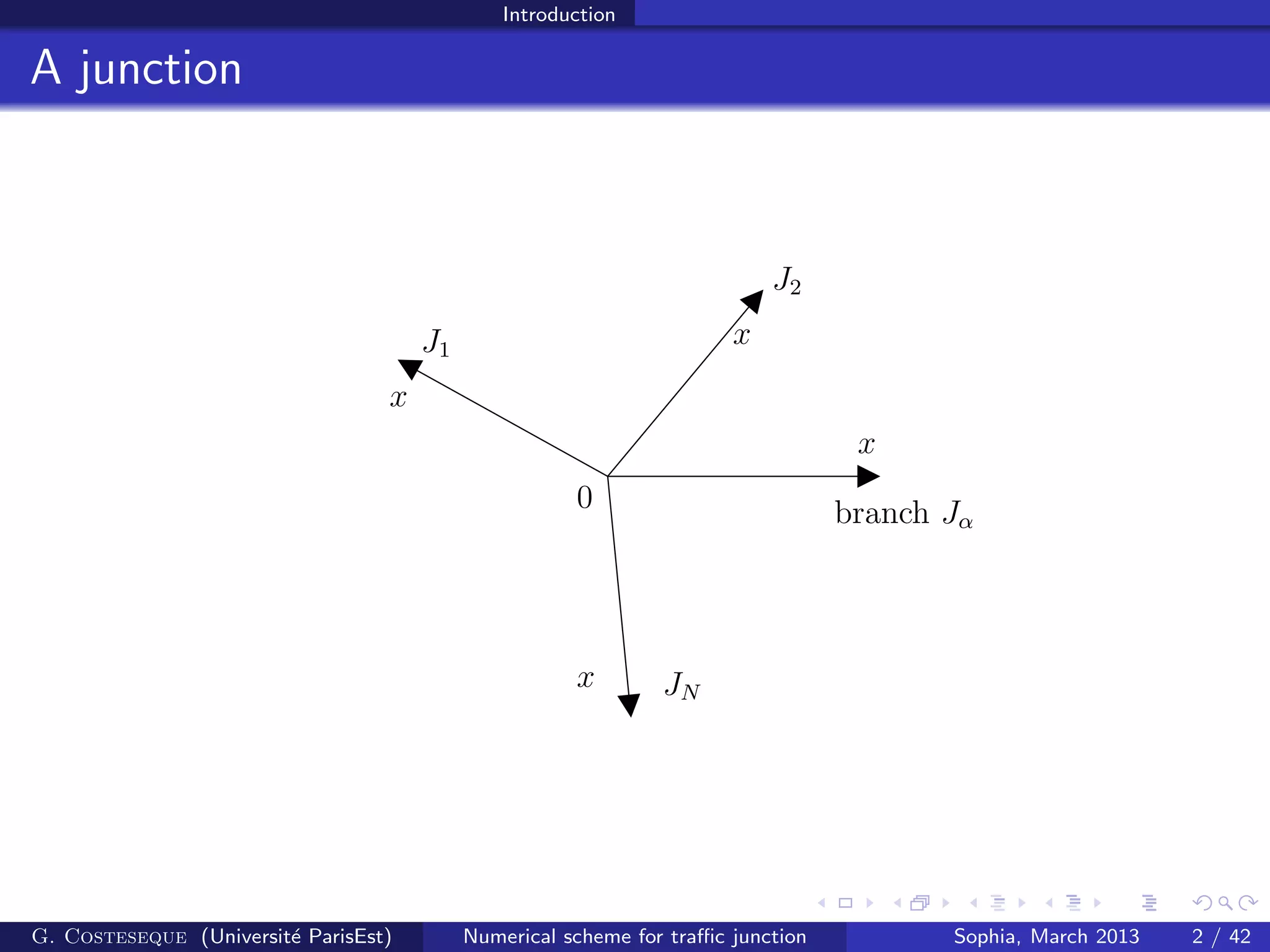
A junction
JN
J1
J2
branch Jα
x
x
0
x
x
G. Costeseque (Universit´e ParisEst) Numerical scheme for traffic junction Sophia, March 2013 2 / 42
Introduction
Ideas of the model
JN
J1
J2
branch Jα
x
x
0
x
x



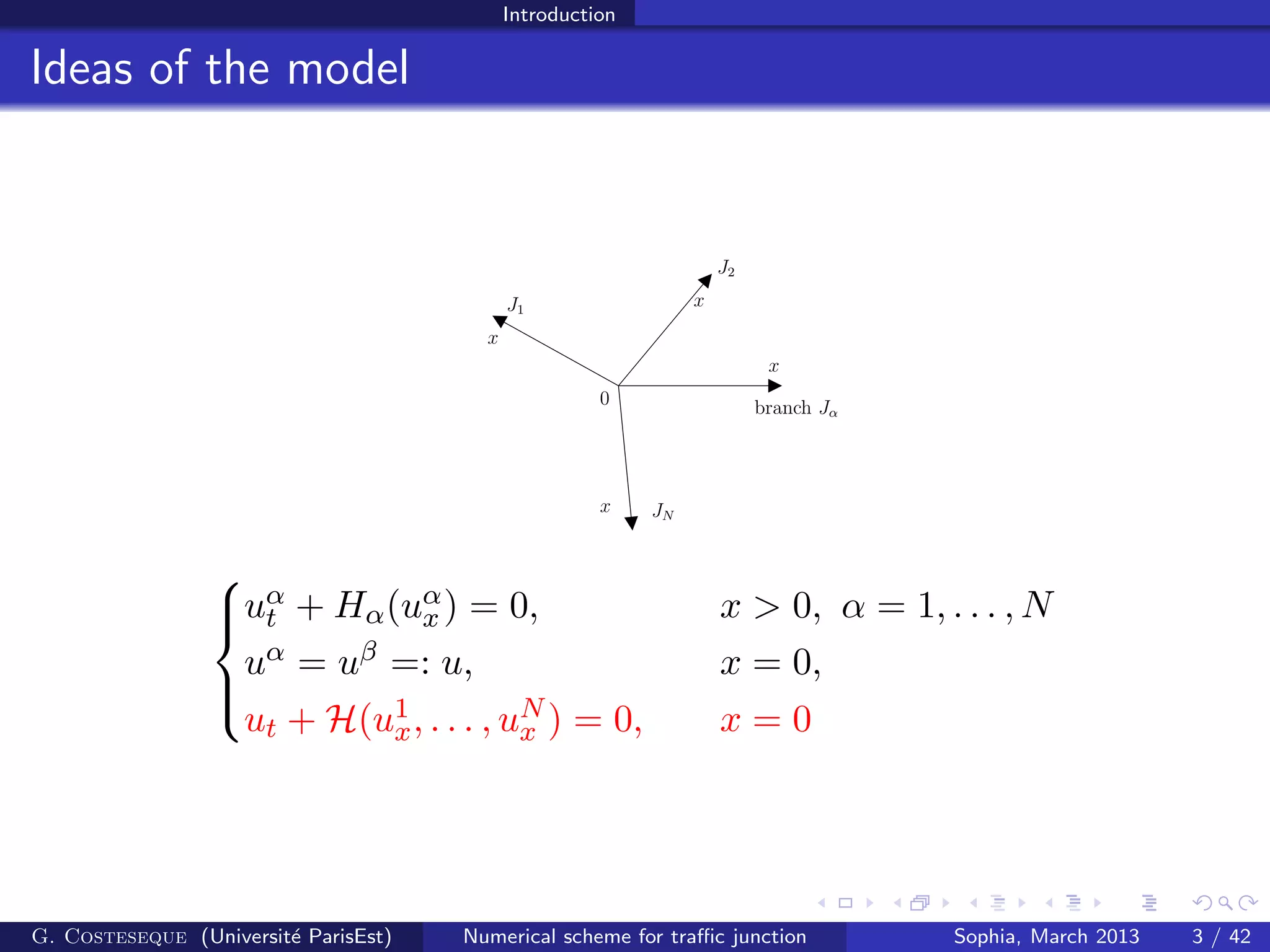
uα
t + Hα(uα
x ) = 0, x > 0, α = 1, . . . , N
uα = uβ =: u, x = 0,
ut + H(u1
x, . . . , uN
x ) = 0, x = 0
G. Costeseque (Universit´e ParisEst) Numerical scheme for traffic junction Sophia, March 2013 3 / 42
Introduction
Outline
1 Motivation
2 Junction model and adapted scheme
3 Traffic interpretation
4 Numerical simulation
5 Conclusion
G. Costeseque (Universit´e ParisEst) Numerical scheme for traffic junction Sophia, March 2013 4 / 42
Motivation
Outline
1 Motivation
2 Junction model and adapted scheme
3 Traffic interpretation
4 Numerical simulation
5 Conclusion
G. Costeseque (Universit´e ParisEst) Numerical scheme for traffic junction Sophia, March 2013 5 / 42
Motivation
The simple divergent road
x > 0
x > 0γl
γrx < 0
Il
Ir
γe
Ie



γe = 1,
0 ≤ γl, γr ≤ 1,
γl + γr = 1
LWR model [Lighthill, Whitham ’55; Richards ’56]:
ρt + (Q(ρ))x = 0
G. Costeseque (Universit´e ParisEst) Numerical scheme for traffic junction Sophia, March 2013 6 / 42
Motivation
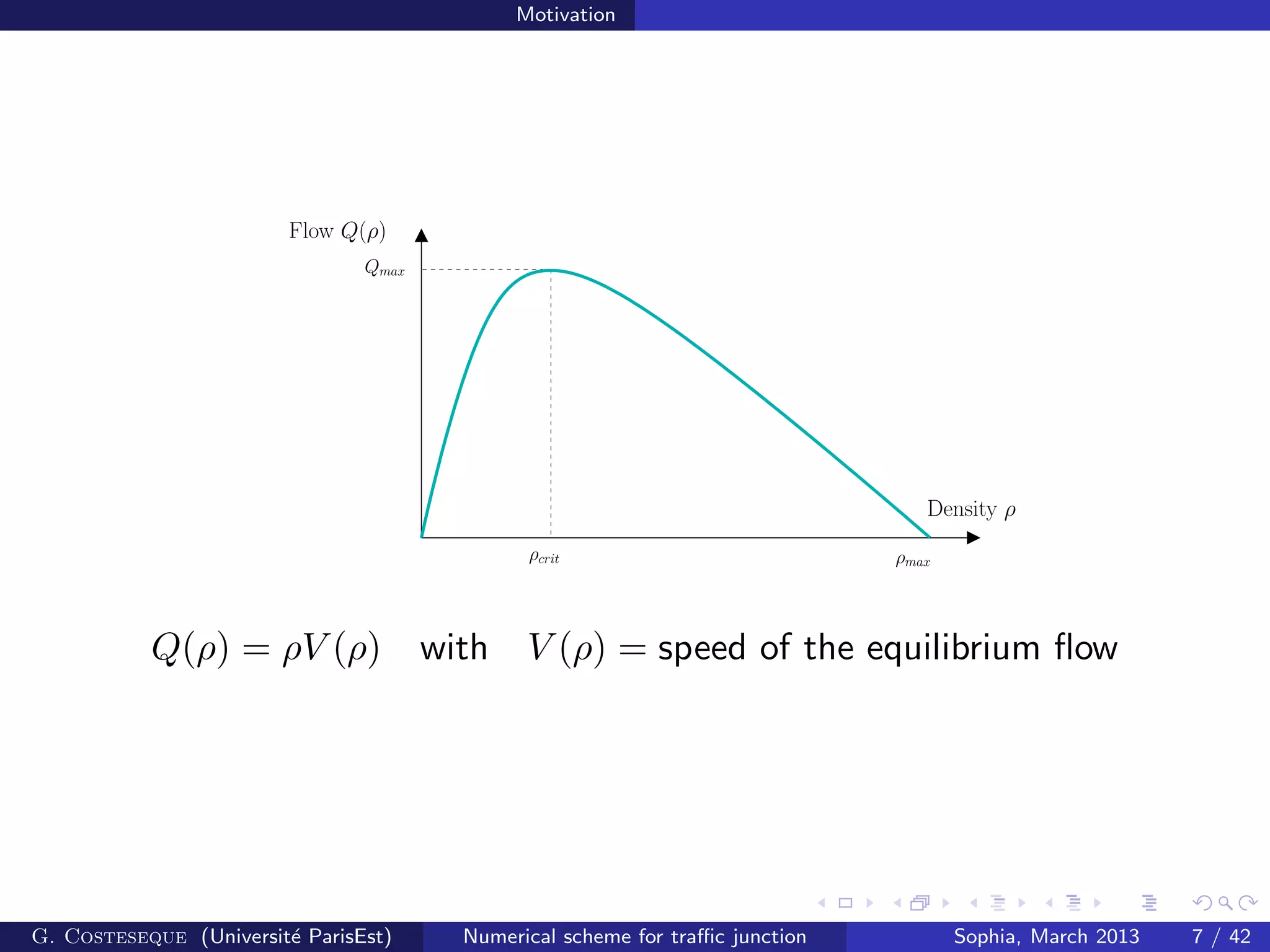
Qmax
ρcrit ρmax
Density ρ
Flow Q(ρ)
Q(ρ) = ρV (ρ) with V (ρ) = speed of the equilibrium flow
G. Costeseque (Universit´e ParisEst) Numerical scheme for traffic junction Sophia, March 2013 7 / 42
Junction model and adapted scheme
Outline
1 Motivation
2 Junction model and adapted scheme
Getting of the HJ equations
Junction model
Numerical scheme
Mathematical results
3 Traffic interpretation
4 Numerical simulation
5 Conclusion
G. Costeseque (Universit´e ParisEst) Numerical scheme for traffic junction Sophia, March 2013 8 / 42
Junction model and adapted scheme Getting of the HJ equations
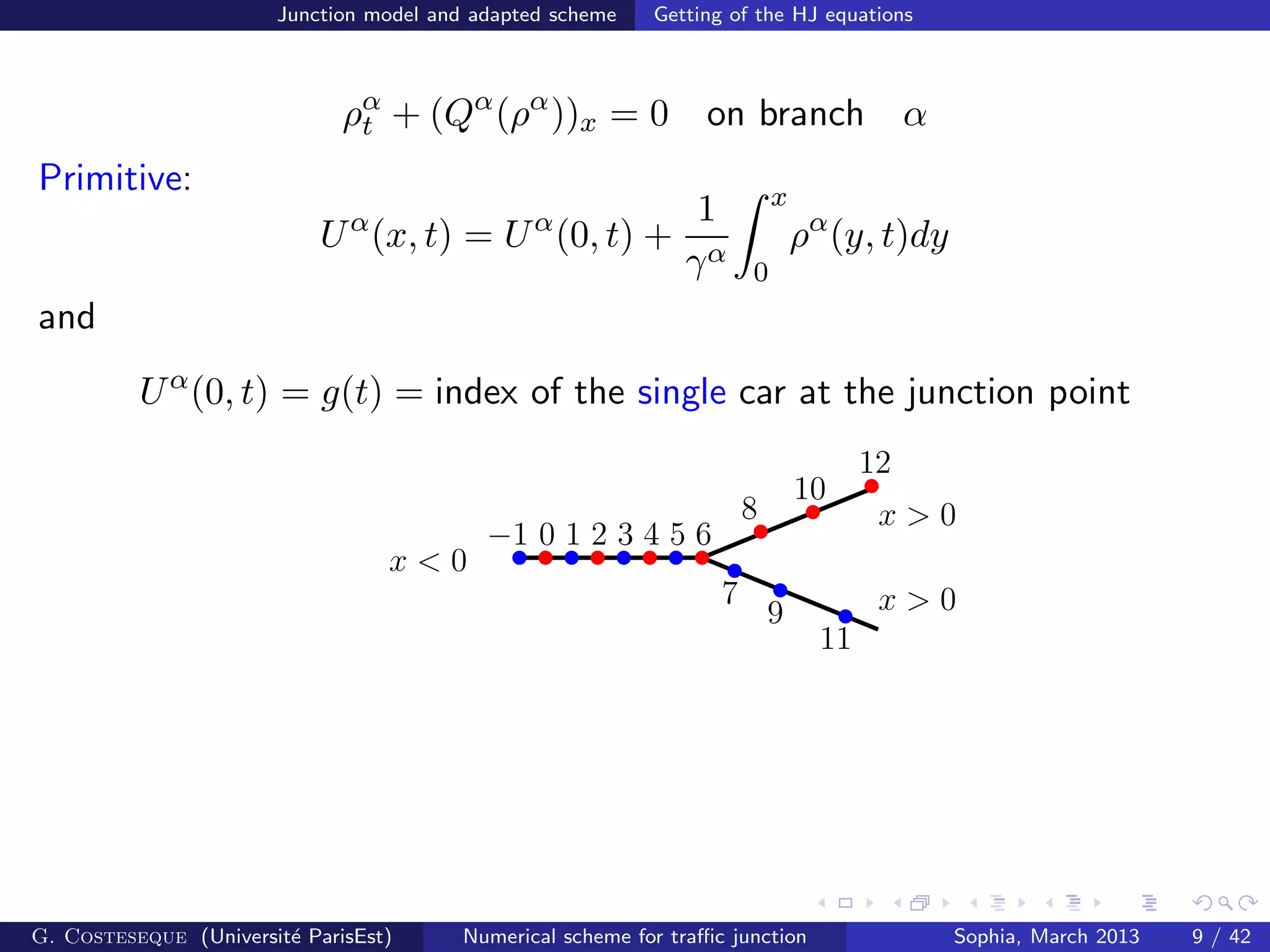
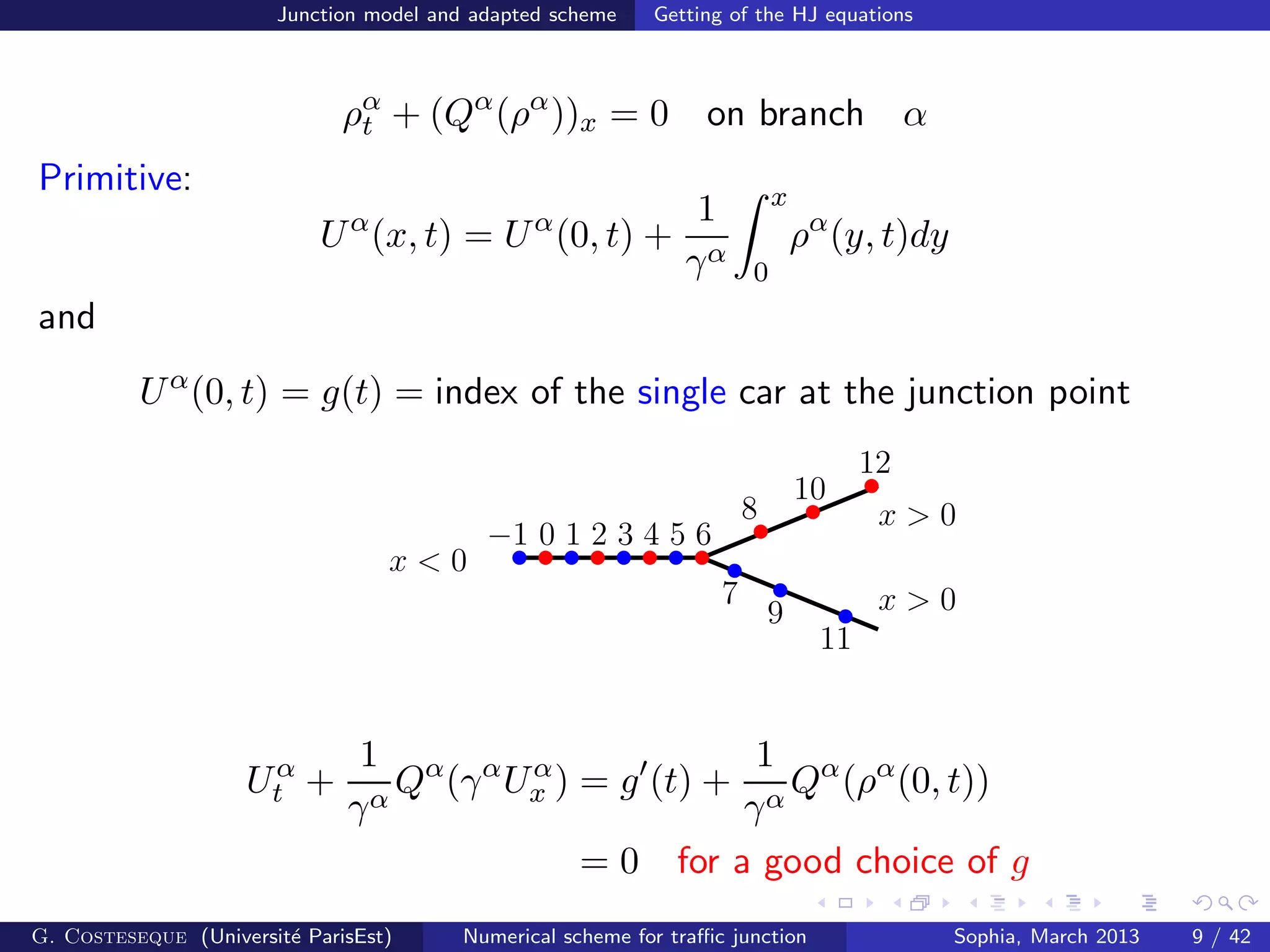
ρα
t + (Qα
(ρα
))x = 0 on branch α
Primitive:
Uα
(x, t) = Uα
(0, t) +
1
γα
x
0
ρα
(y, t)dy
and
Uα
(0, t) = g(t) = index of the single car at the junction point
x > 0
x > 09
11
8
10
12
6420 1 3 5
7
−1
x < 0
G. Costeseque (Universit´e ParisEst) Numerical scheme for traffic junction Sophia, March 2013 9 / 42
Junction model and adapted scheme Getting of the HJ equations
ρα
t + (Qα
(ρα
))x = 0 on branch α
Primitive:
Uα
(x, t) = Uα
(0, t) +
1
γα
x
0
ρα
(y, t)dy
and
Uα
(0, t) = g(t) = index of the single car at the junction point
x > 0
x > 09
11
8
10
12
6420 1 3 5
7
−1
x < 0
Uα
t +
1
γα
Qα
(γα
Uα
x ) = g′
(t) +
1
γα
Qα
(ρα
(0, t))
= 0 for a good choice of g
G. Costeseque (Universit´e ParisEst) Numerical scheme for traffic junction Sophia, March 2013 9 / 42
Junction model and adapted scheme Junction model
Junction model
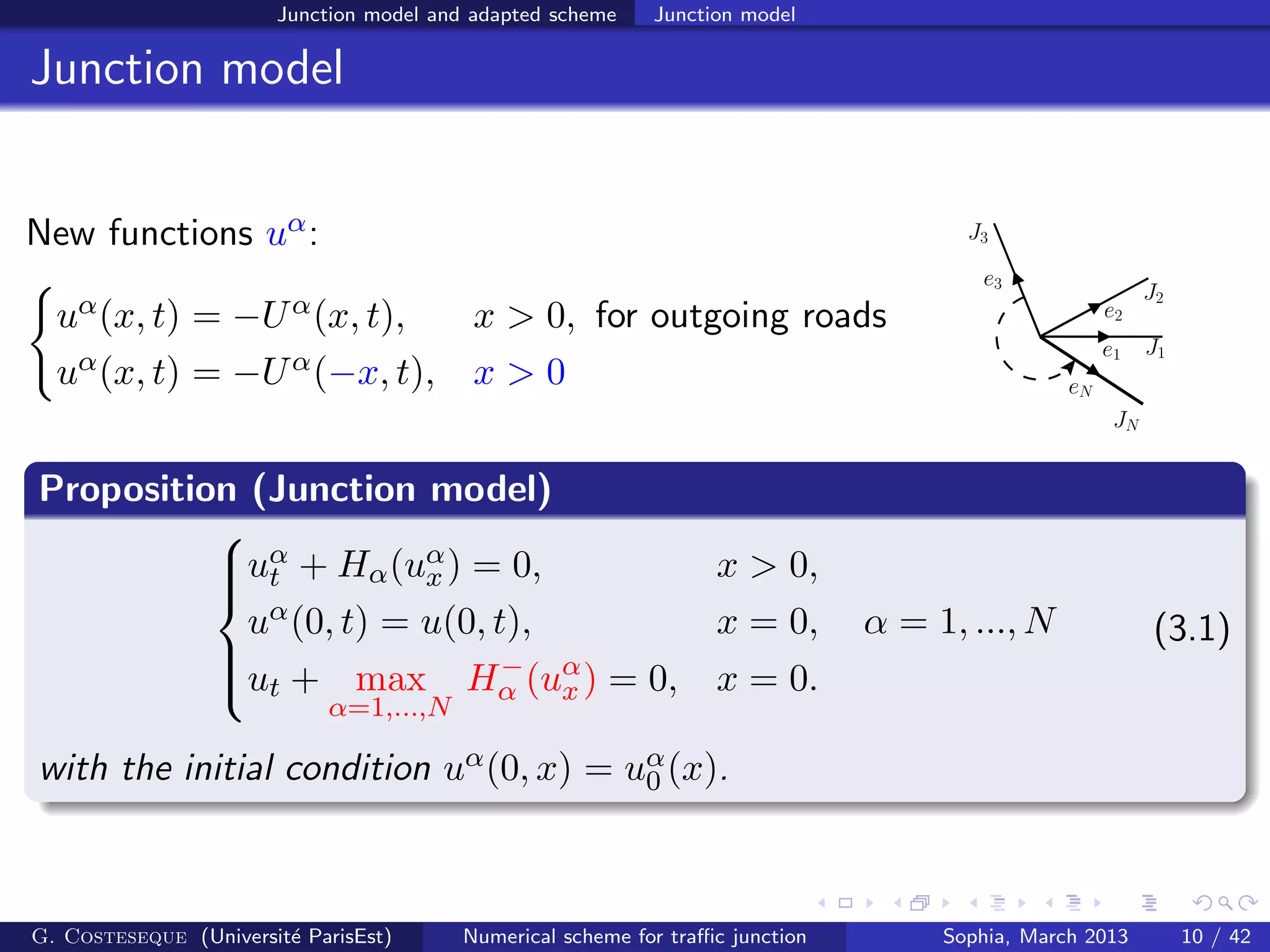
New functions uα:
uα(x, t) = −Uα(x, t), x > 0, for outgoing roads
uα(x, t) = −Uα(−x, t), x > 0
J3
e3
J2
e2
e1 J1
JN
eN
Proposition (Junction model)



uα
t + Hα(uα
x ) = 0, x > 0,
uα(0, t) = u(0, t), x = 0, α = 1, ..., N
ut + max
α=1,...,N
H−
α (uα
x ) = 0, x = 0.
(3.1)
with the initial condition uα(0, x) = uα
0 (x).
G. Costeseque (Universit´e ParisEst) Numerical scheme for traffic junction Sophia, March 2013 10 / 42
Junction model and adapted scheme Junction model
Assumptions
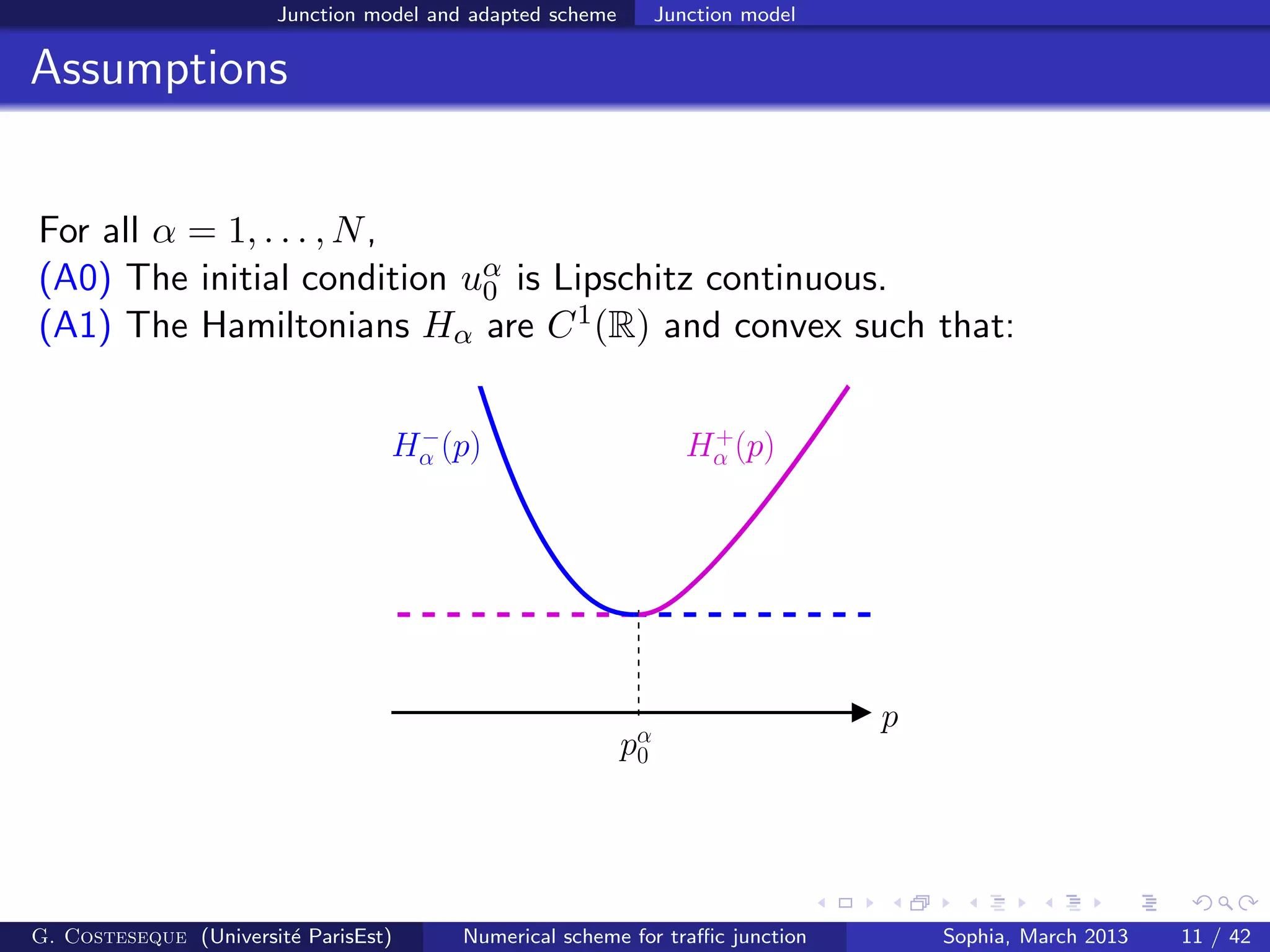
For all α = 1, . . . , N,
(A0) The initial condition uα
0 is Lipschitz continuous.
(A1) The Hamiltonians Hα are C1(R) and convex such that:
p
H−
α (p) H+
α (p)
pα
0
G. Costeseque (Universit´e ParisEst) Numerical scheme for traffic junction Sophia, March 2013 11 / 42
Junction model and adapted scheme Numerical scheme
Presentation of the NS
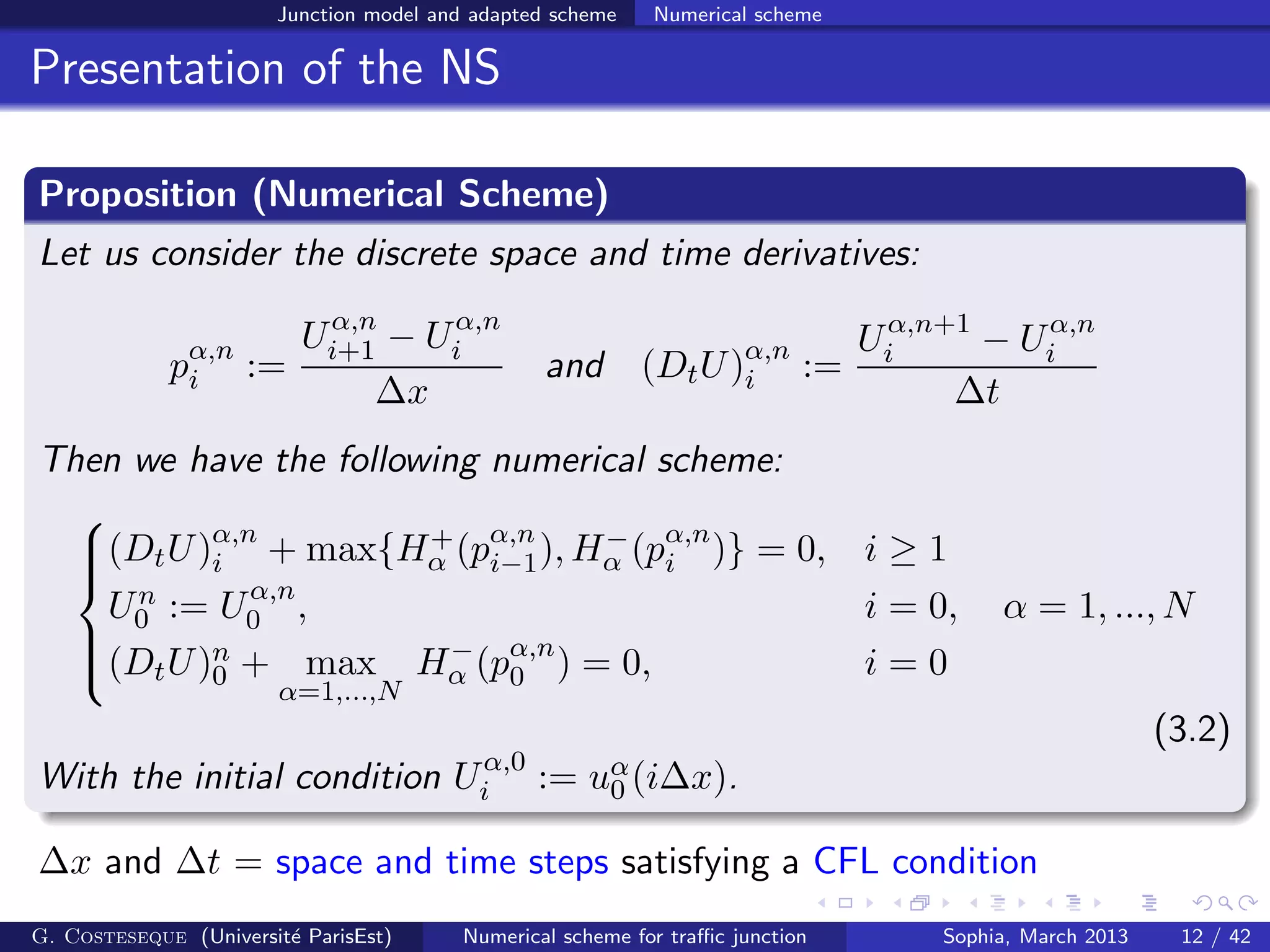
Proposition (Numerical Scheme)
Let us consider the discrete space and time derivatives:
pα,n
i :=
Uα,n
i+1 − Uα,n
i
∆x
and (DtU)α,n
i :=
Uα,n+1
i − Uα,n
i
∆t
Then we have the following numerical scheme:



(DtU)α,n
i + max{H+
α (pα,n
i−1), H−
α (pα,n
i )} = 0, i ≥ 1
Un
0 := Uα,n
0 , i = 0, α = 1, ..., N
(DtU)n
0 + max
α=1,...,N
H−
α (pα,n
0 ) = 0, i = 0
(3.2)
With the initial condition Uα,0
i := uα
0 (i∆x).
∆x and ∆t = space and time steps satisfying a CFL condition
G. Costeseque (Universit´e ParisEst) Numerical scheme for traffic junction Sophia, March 2013 12 / 42
Junction model and adapted scheme Numerical scheme
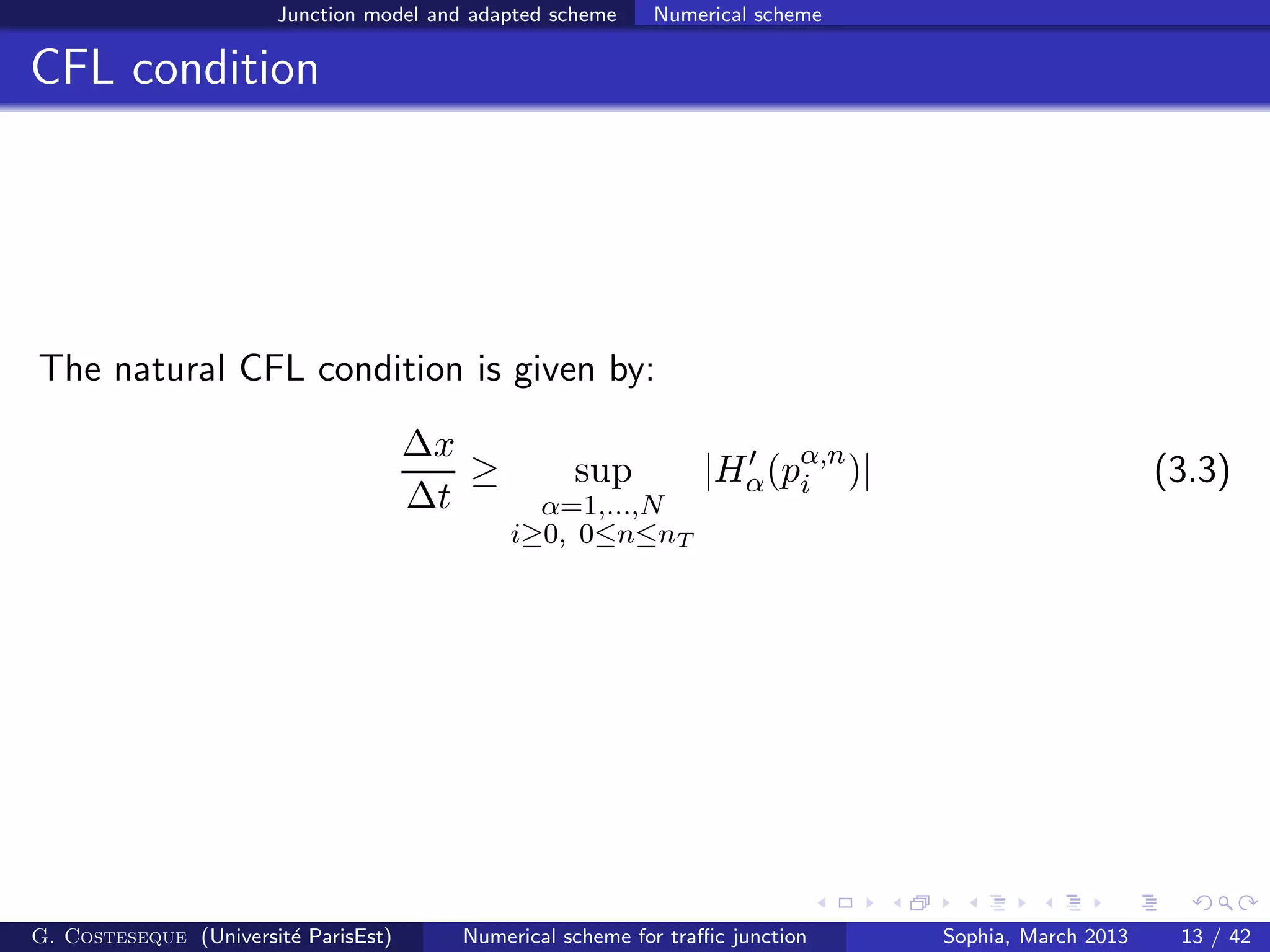
CFL condition
The natural CFL condition is given by:
∆x
∆t
≥ sup
α=1,...,N
i≥0, 0≤n≤nT
|H′
α(pα,n
i )| (3.3)
G. Costeseque (Universit´e ParisEst) Numerical scheme for traffic junction Sophia, March 2013 13 / 42
Junction model and adapted scheme Mathematical results
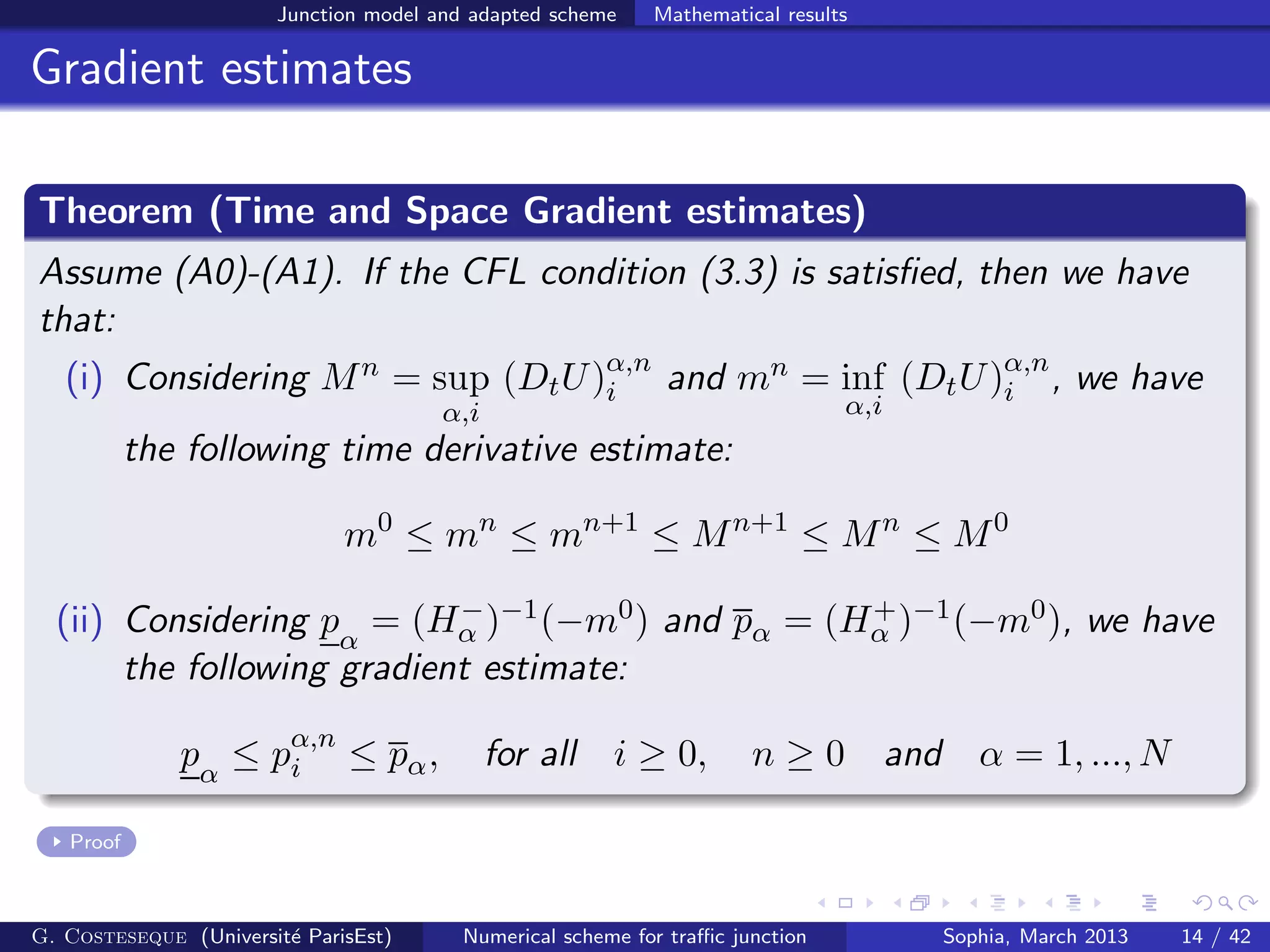
Gradient estimates
Theorem (Time and Space Gradient estimates)
Assume (A0)-(A1). If the CFL condition (3.3) is satisfied, then we have
that:
(i) Considering Mn = sup
α,i
(DtU)α,n
i and mn = inf
α,i
(DtU)α,n
i , we have
the following time derivative estimate:
m0
≤ mn
≤ mn+1
≤ Mn+1
≤ Mn
≤ M0
(ii) Considering pα
= (H−
α )−1(−m0) and pα = (H+
α )−1(−m0), we have
the following gradient estimate:
pα
≤ pα,n
i ≤ pα, for all i ≥ 0, n ≥ 0 and α = 1, ..., N
Proof
G. Costeseque (Universit´e ParisEst) Numerical scheme for traffic junction Sophia, March 2013 14 / 42
Junction model and adapted scheme Mathematical results
Stronger CFL condition
As for any α = 1, . . . , N, we have that:
pα
≤ pα,n
i ≤ pα for all i, n ≥ 0
−m0
pα
p
Hα(p)
pα
Then the CFL condition becomes:
∆x
∆t
≥ sup
α=1,...,N
pα∈[pα
,pα]
|H′
α(pα)| (3.4)
G. Costeseque (Universit´e ParisEst) Numerical scheme for traffic junction Sophia, March 2013 15 / 42
Junction model and adapted scheme Mathematical results
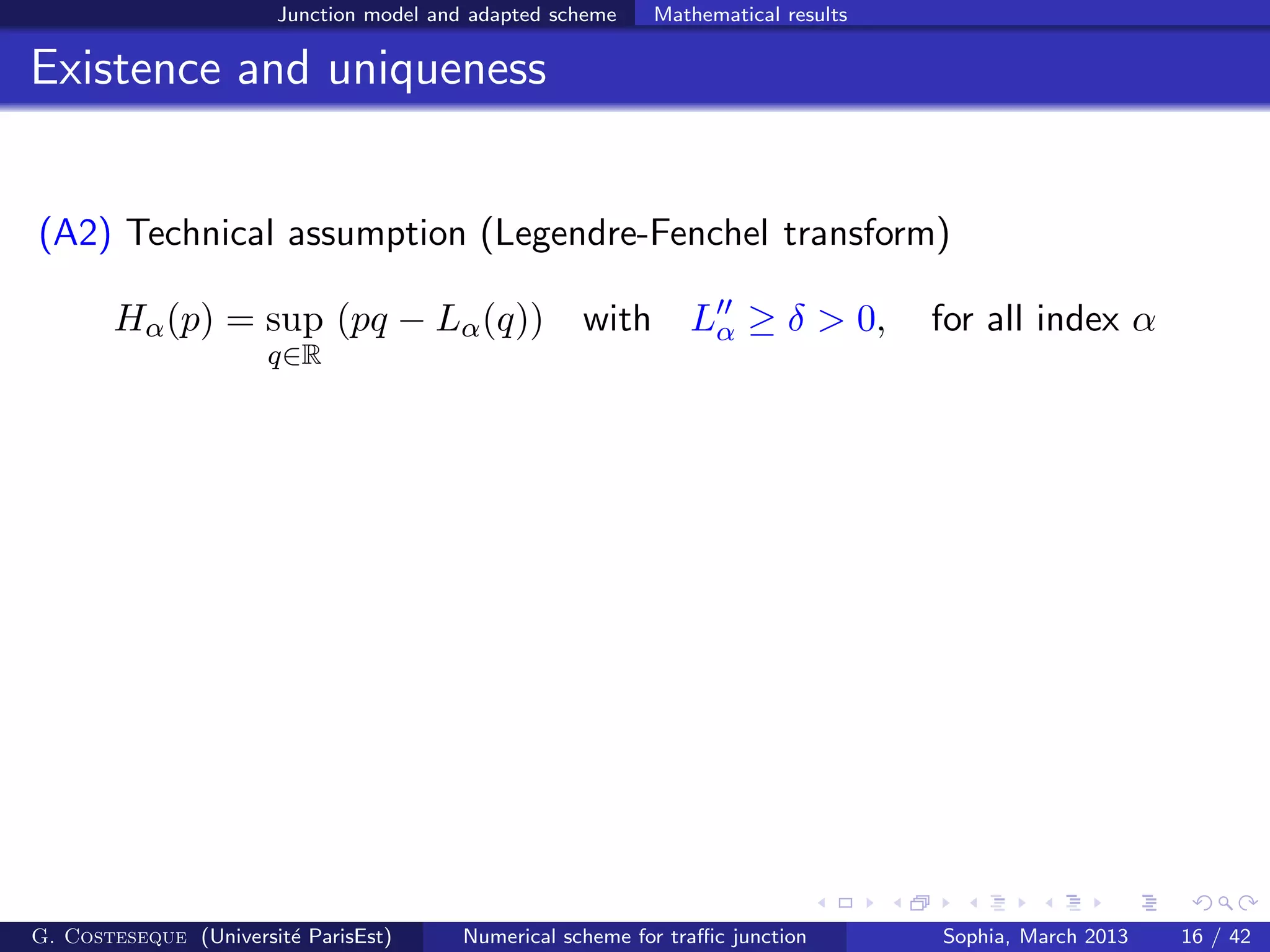
Existence and uniqueness
(A2) Technical assumption (Legendre-Fenchel transform)
Hα(p) = sup
q∈R
(pq − Lα(q)) with L′′
α ≥ δ > 0, for all index α
G. Costeseque (Universit´e ParisEst) Numerical scheme for traffic junction Sophia, March 2013 16 / 42
Junction model and adapted scheme Mathematical results
Existence and uniqueness
(A2) Technical assumption (Legendre-Fenchel transform)
Hα(p) = sup
q∈R
(pq − Lα(q)) with L′′
α ≥ δ > 0, for all index α
Theorem (Existence and uniqueness [IMZ, ’11])
Under (A0)-(A1)-(A2), there exists a unique viscosity solution u of (3.1)
on the junction, satisfying for some constant CT > 0
|u(t, y) − u0(y)| ≤ CT for all (t, y) ∈ JT .
Moreover the function u is Lipschitz continuous with respect to (t, y).
G. Costeseque (Universit´e ParisEst) Numerical scheme for traffic junction Sophia, March 2013 16 / 42
Junction model and adapted scheme Mathematical results
Convergence
Theorem (Convergence from discrete to continuous [CML, ’13])
Assume that (A0)-(A1)-(A2) and the CFL condition (3.4) are satisfied.
Then the numerical solution converges uniformly to u the unique viscosity
solution of (3.1) when ε → 0, locally uniformly on any compact set K:
lim sup
ε→0
sup
(n∆t,i∆x)∈K
|uα
(n∆t, i∆x) − Uα,n
i | = 0
Proof
G. Costeseque (Universit´e ParisEst) Numerical scheme for traffic junction Sophia, March 2013 17 / 42
Traffic interpretation
Outline
1 Motivation
2 Junction model and adapted scheme
3 Traffic interpretation
Traffic notations
Links with “classical” approach
Literature review
4 Numerical simulation
5 Conclusion
G. Costeseque (Universit´e ParisEst) Numerical scheme for traffic junction Sophia, March 2013 18 / 42
Traffic interpretation Traffic notations
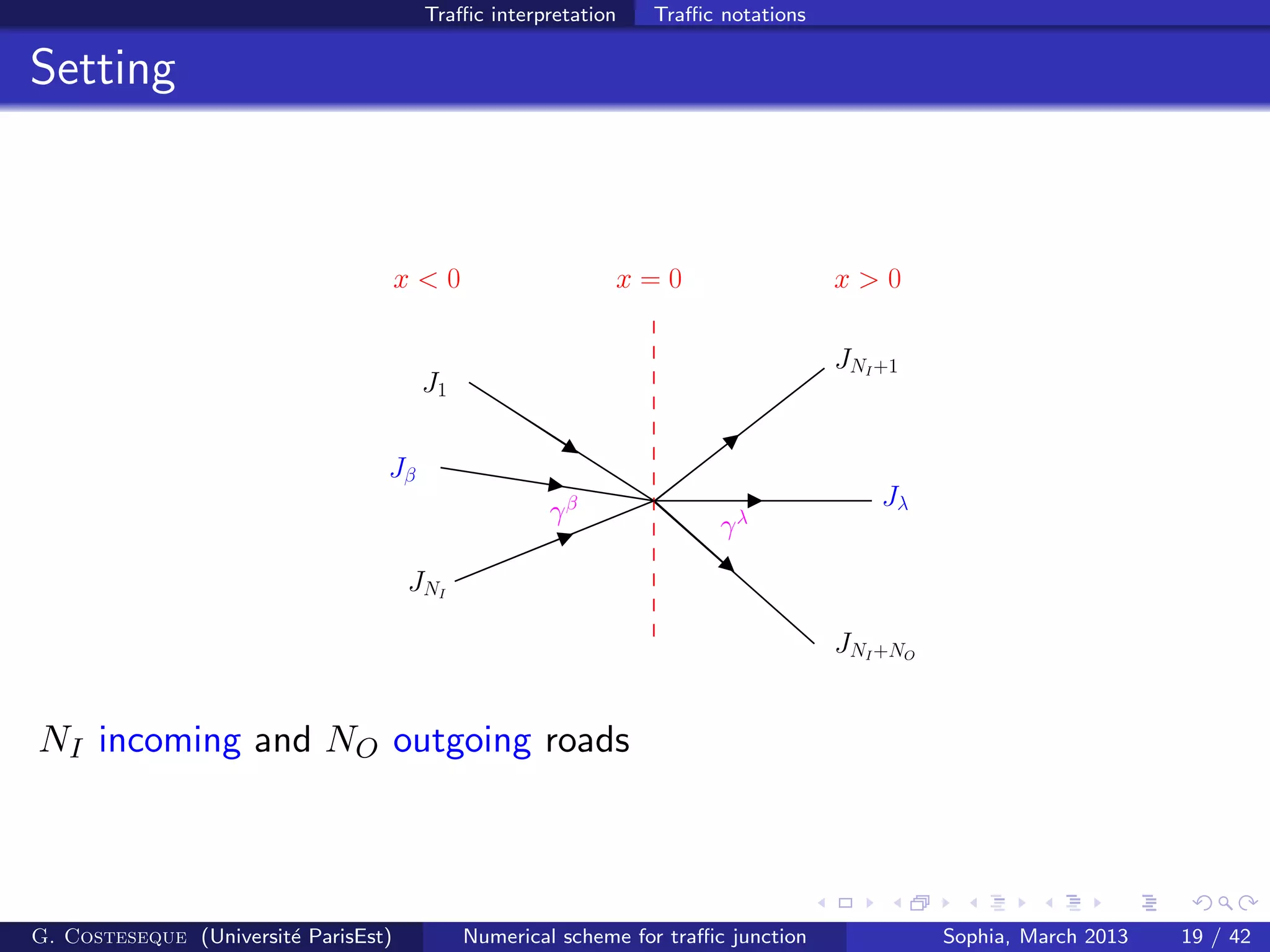
Setting
J1
JNI
JNI+1
JNI+NO
x < 0 x = 0 x > 0
Jβ
γβ Jλ
γλ
NI incoming and NO outgoing roads
G. Costeseque (Universit´e ParisEst) Numerical scheme for traffic junction Sophia, March 2013 19 / 42
Traffic interpretation Traffic notations
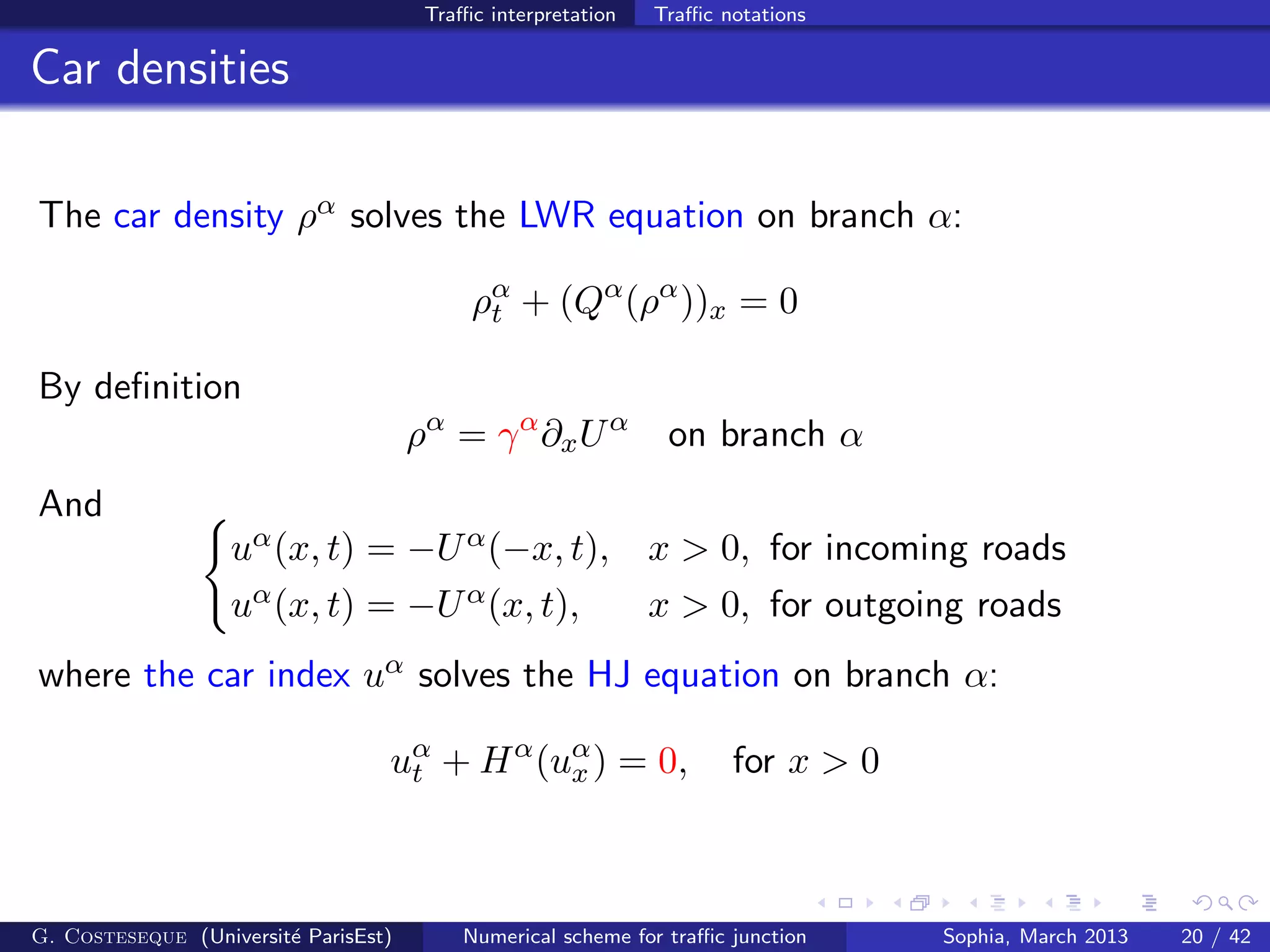
Car densities
The car density ρα solves the LWR equation on branch α:
ρα
t + (Qα
(ρα
))x = 0
By definition
ρα
= γα
∂xUα
on branch α
And
uα(x, t) = −Uα(−x, t), x > 0, for incoming roads
uα(x, t) = −Uα(x, t), x > 0, for outgoing roads
where the car index uα solves the HJ equation on branch α:
uα
t + Hα
(uα
x ) = 0, for x > 0
G. Costeseque (Universit´e ParisEst) Numerical scheme for traffic junction Sophia, March 2013 20 / 42
Traffic interpretation Traffic notations
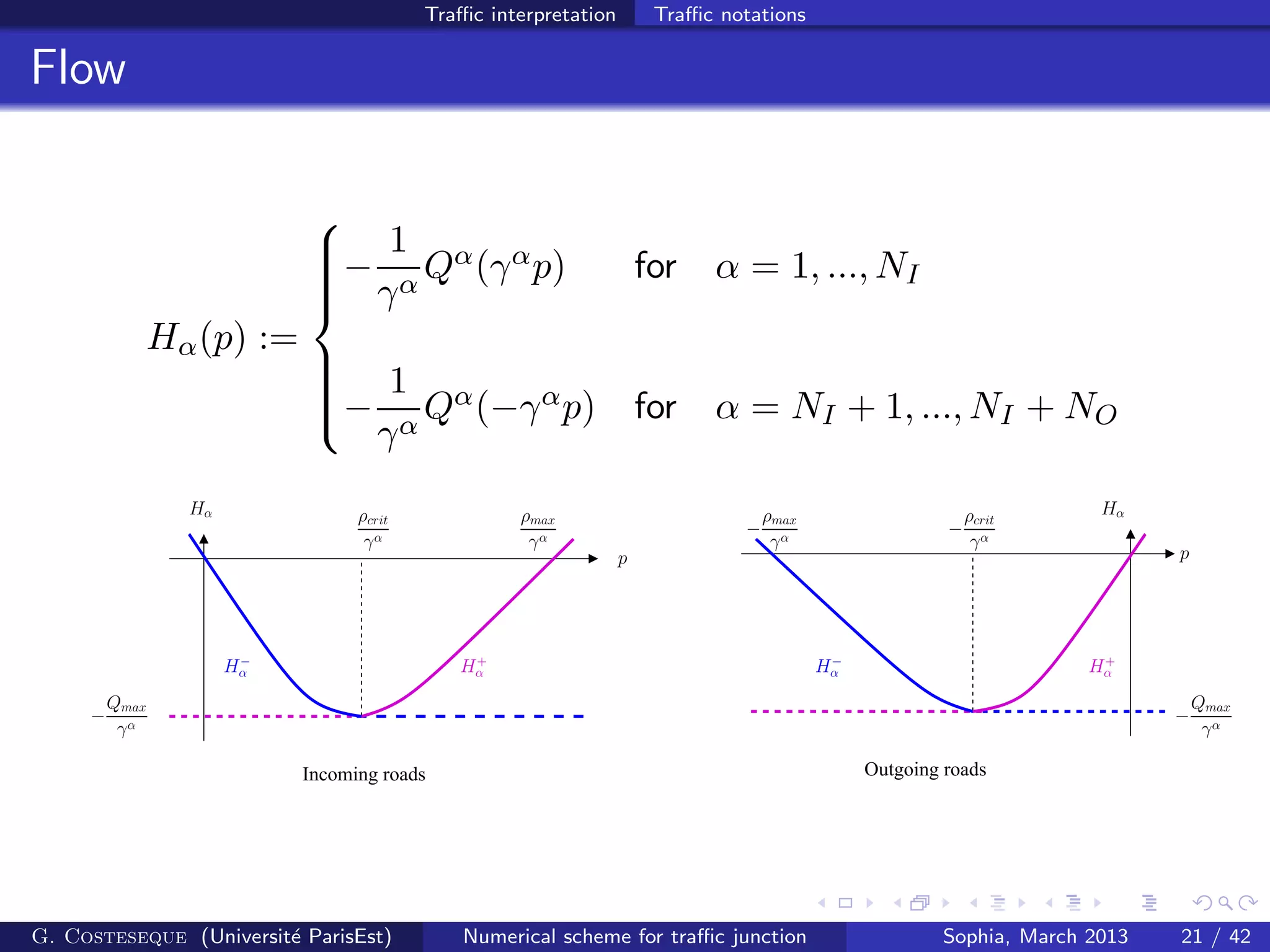
Flow
Hα(p) :=



−
1
γα
Qα(γαp) for α = 1, ..., NI
−
1
γα
Qα(−γαp) for α = NI + 1, ..., NI + NO
Incoming roads Outgoing roads
ρcrit
γα
ρmax
γα
p
−
Qmax
γα
p
−
Qmax
γα
HαHα
H−
α H−
α H+
αH+
α
−
ρmax
γα
−
ρcrit
γα
G. Costeseque (Universit´e ParisEst) Numerical scheme for traffic junction Sophia, March 2013 21 / 42
Traffic interpretation Links with “classical” approach
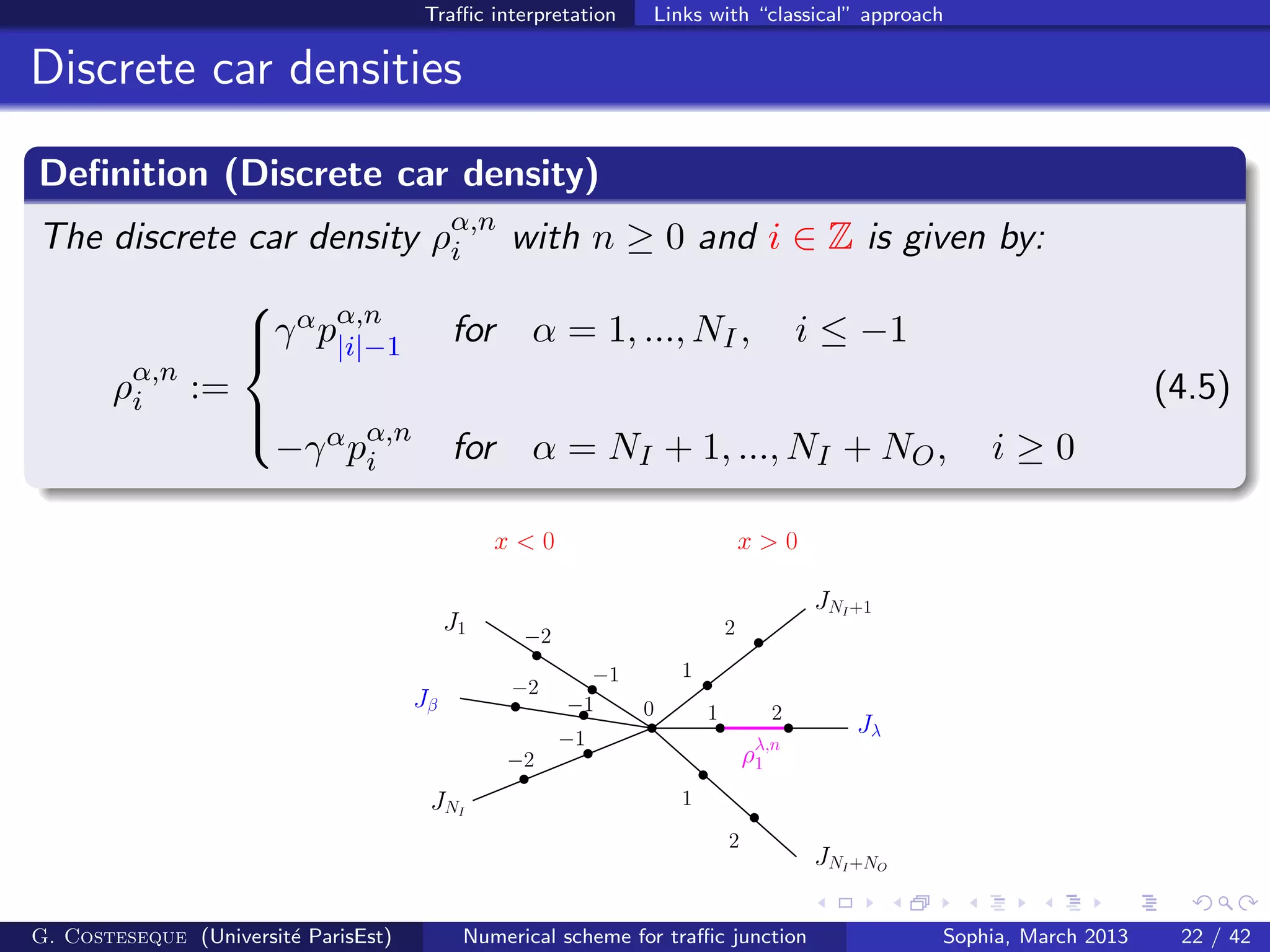
Discrete car densities
Definition (Discrete car density)
The discrete car density ρα,n
i with n ≥ 0 and i ∈ Z is given by:
ρα,n
i :=



γαpα,n
|i|−1 for α = 1, ..., NI , i ≤ −1
−γαpα,n
i for α = NI + 1, ..., NI + NO, i ≥ 0
(4.5)
J1
JNI
JNI+1
JNI+NO
x < 0 x > 0
−2
−1
2
1
0
−2
−2
−1
−1
1
1
2
2
Jβ
Jλ
ρλ,n
1
G. Costeseque (Universit´e ParisEst) Numerical scheme for traffic junction Sophia, March 2013 22 / 42
Traffic interpretation Links with “classical” approach
Traffic interpretation
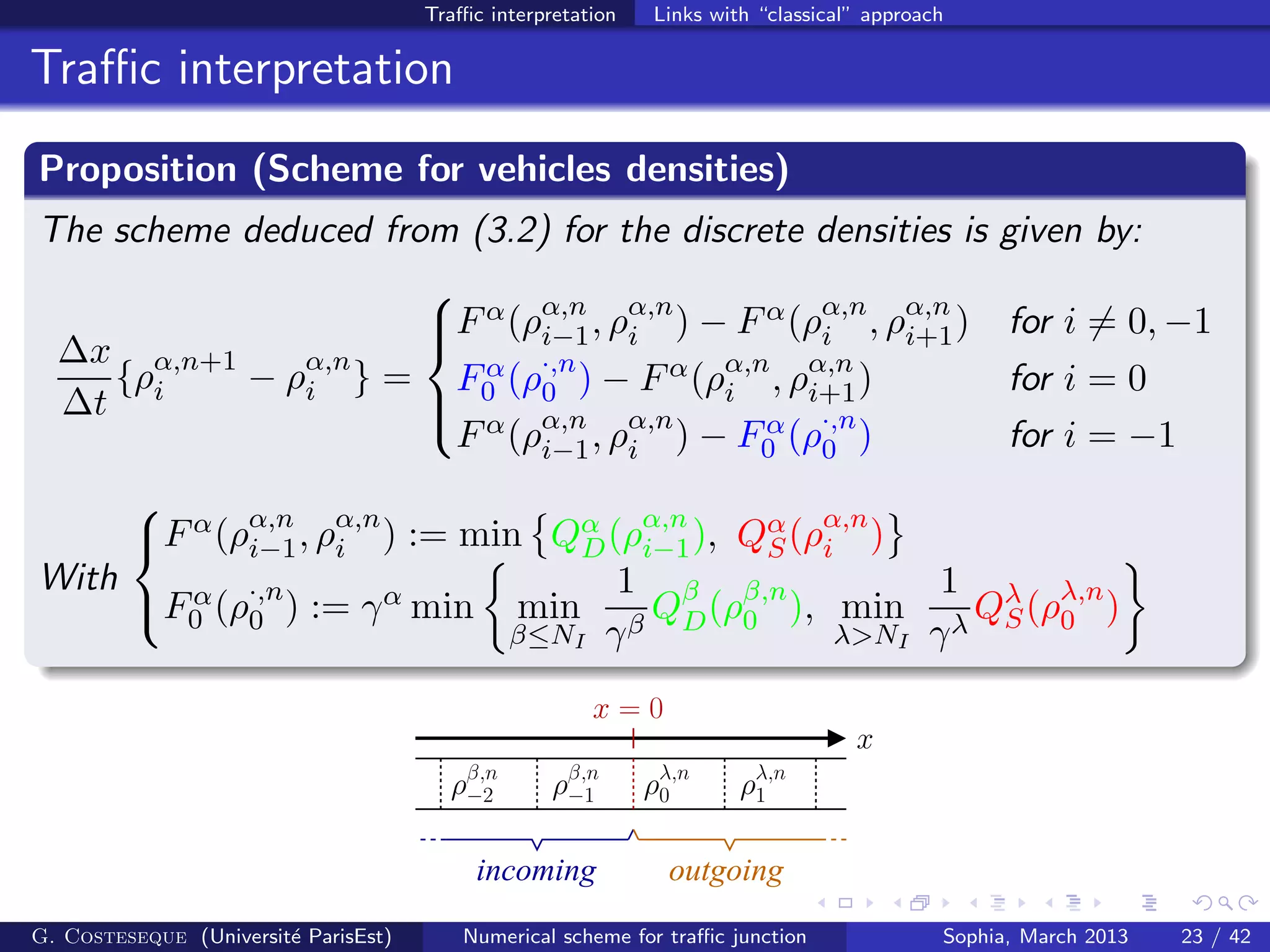
Proposition (Scheme for vehicles densities)
The scheme deduced from (3.2) for the discrete densities is given by:
∆x
∆t
{ρα,n+1
i − ρα,n
i } =



Fα(ρα,n
i−1, ρα,n
i ) − Fα(ρα,n
i , ρα,n
i+1) for i = 0, −1
Fα
0 (ρ·,n
0 ) − Fα(ρα,n
i , ρα,n
i+1) for i = 0
Fα(ρα,n
i−1, ρα,n
i ) − Fα
0 (ρ·,n
0 ) for i = −1
With



Fα(ρα,n
i−1, ρα,n
i ) := min Qα
D(ρα,n
i−1), Qα
S(ρα,n
i )
Fα
0 (ρ·,n
0 ) := γα min min
β≤NI
1
γβ
Qβ
D(ρβ,n
0 ), min
λ>NI
1
γλ
Qλ
S(ρλ,n
0 )
incoming outgoing
ρλ,n
0ρβ,n
−1ρβ,n
−2 ρλ,n
1
x
x = 0
G. Costeseque (Universit´e ParisEst) Numerical scheme for traffic junction Sophia, March 2013 23 / 42
Traffic interpretation Links with “classical” approach
Supply and demand functions
Remark
It recovers the seminal Godunov scheme with passing flow = minimum
between upstream demand QD and downstream supply QS.
Density ρ
ρcrit ρmax
Supply QS
Qmax
Density ρ
ρcrit ρmax
Flow Q
Qmax
Density ρ
ρcrit
Demand QD
Qmax
From [Lebacque ’93, ’96]
G. Costeseque (Universit´e ParisEst) Numerical scheme for traffic junction Sophia, March 2013 24 / 42
Traffic interpretation Links with “classical” approach
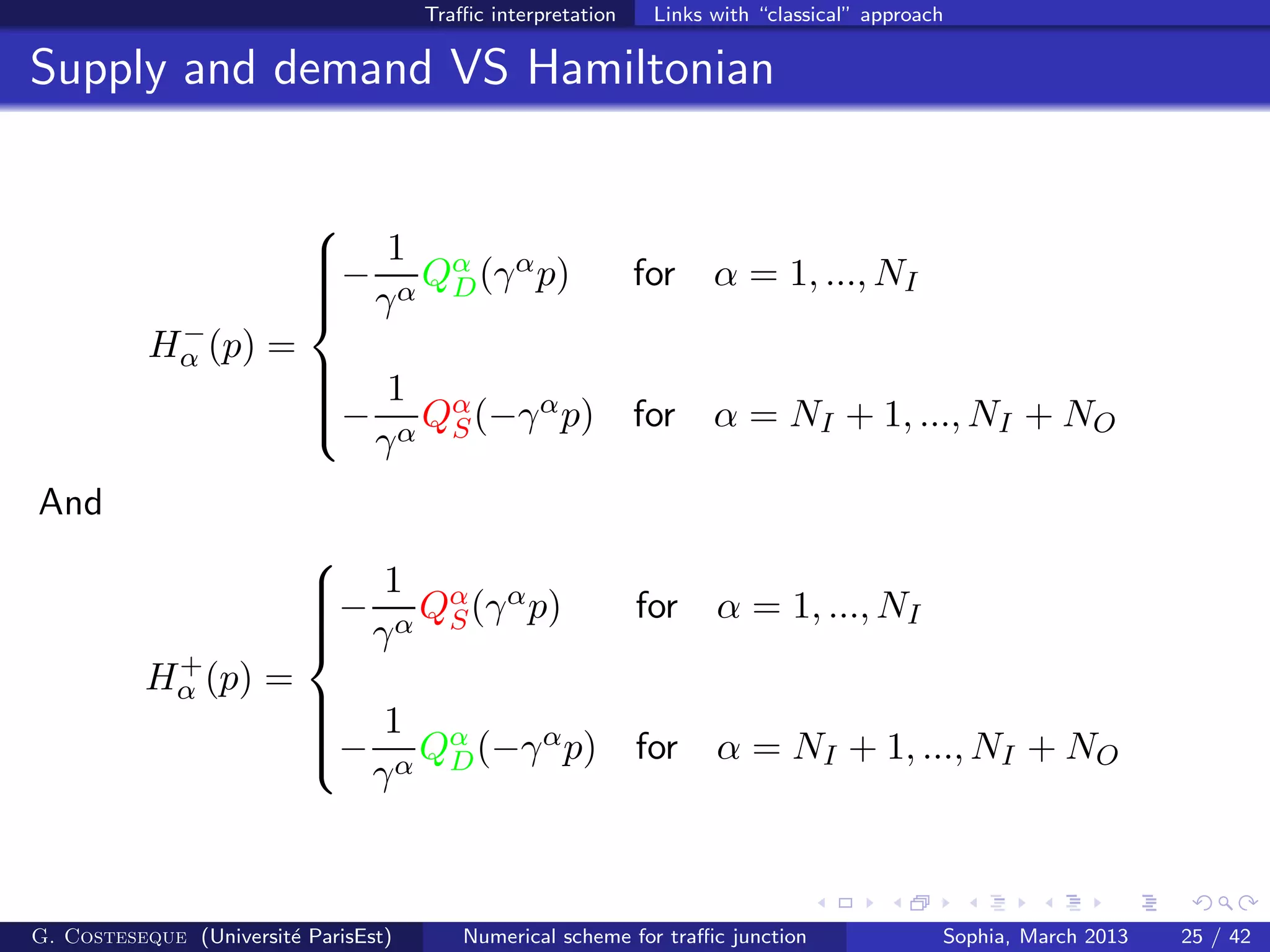
Supply and demand VS Hamiltonian
H−
α (p) =



−
1
γα
Qα
D(γαp) for α = 1, ..., NI
−
1
γα
Qα
S(−γαp) for α = NI + 1, ..., NI + NO
And
H+
α (p) =



−
1
γα
Qα
S(γαp) for α = 1, ..., NI
−
1
γα
Qα
D(−γαp) for α = NI + 1, ..., NI + NO
G. Costeseque (Universit´e ParisEst) Numerical scheme for traffic junction Sophia, March 2013 25 / 42
Traffic interpretation Literature review
Some references for conservation laws
ρt + (Q(x, ρ))x = 0 with Q(x, p) = 1{x<0}Qin
(p) + 1{x≥0}Qout
(p)
Uniqueness results only for restricted configurations:
See [Garavello, Natalini, Piccoli, Terracina ’07]
and [Andreianov, Karlsen, Risebro ’11]
Book of [Garavello, Piccoli ’06] for conservation laws on networks:
Construction of a solution using the “wave front tracking method”
No proof of the uniqueness of the solution on a general network
G. Costeseque (Universit´e ParisEst) Numerical scheme for traffic junction Sophia, March 2013 26 / 42
Traffic interpretation Literature review
Numerics on networks
Godunov scheme mainly used for conservation laws:
[Bretti, Natalini, Piccoli ’06, ’07]: Godunov scheme compared to
kinetic schemes / fast algorithms
[Blandin, Bretti, Cutolo, Piccoli ’09]: Godunov scheme adapted for
Colombo model (only tested for 1 × 1 junctions)
G. Costeseque (Universit´e ParisEst) Numerical scheme for traffic junction Sophia, March 2013 27 / 42
Traffic interpretation Literature review
Numerics on networks
Godunov scheme mainly used for conservation laws:
[Bretti, Natalini, Piccoli ’06, ’07]: Godunov scheme compared to
kinetic schemes / fast algorithms
[Blandin, Bretti, Cutolo, Piccoli ’09]: Godunov scheme adapted for
Colombo model (only tested for 1 × 1 junctions)
[Han, Piccoli, Friesz, Yao ’12]: Lax-Hopf formula for HJ equation coupled
with a Riemann solver at junction
G. Costeseque (Universit´e ParisEst) Numerical scheme for traffic junction Sophia, March 2013 27 / 42
Traffic interpretation Literature review
Junction modelling
State-of-the-art review:
[Lebacque, Khoshyaran ’02, ’05, ’09]
[Tamp`ere, Corthout, Cattrysse, Immers ’11],
[Fl¨otter¨od, Rohde ’11]
Calibration of γα for realistic models:
[Cassidy and Ahn ’05]
[Bar-Gera and Ahn ’10],
[Ni and Leonard ’05] (small data set)
G. Costeseque (Universit´e ParisEst) Numerical scheme for traffic junction Sophia, March 2013 28 / 42
Numerical simulation
Outline
1 Motivation
2 Junction model and adapted scheme
3 Traffic interpretation
4 Numerical simulation
5 Conclusion
G. Costeseque (Universit´e ParisEst) Numerical scheme for traffic junction Sophia, March 2013 29 / 42
Numerical simulation
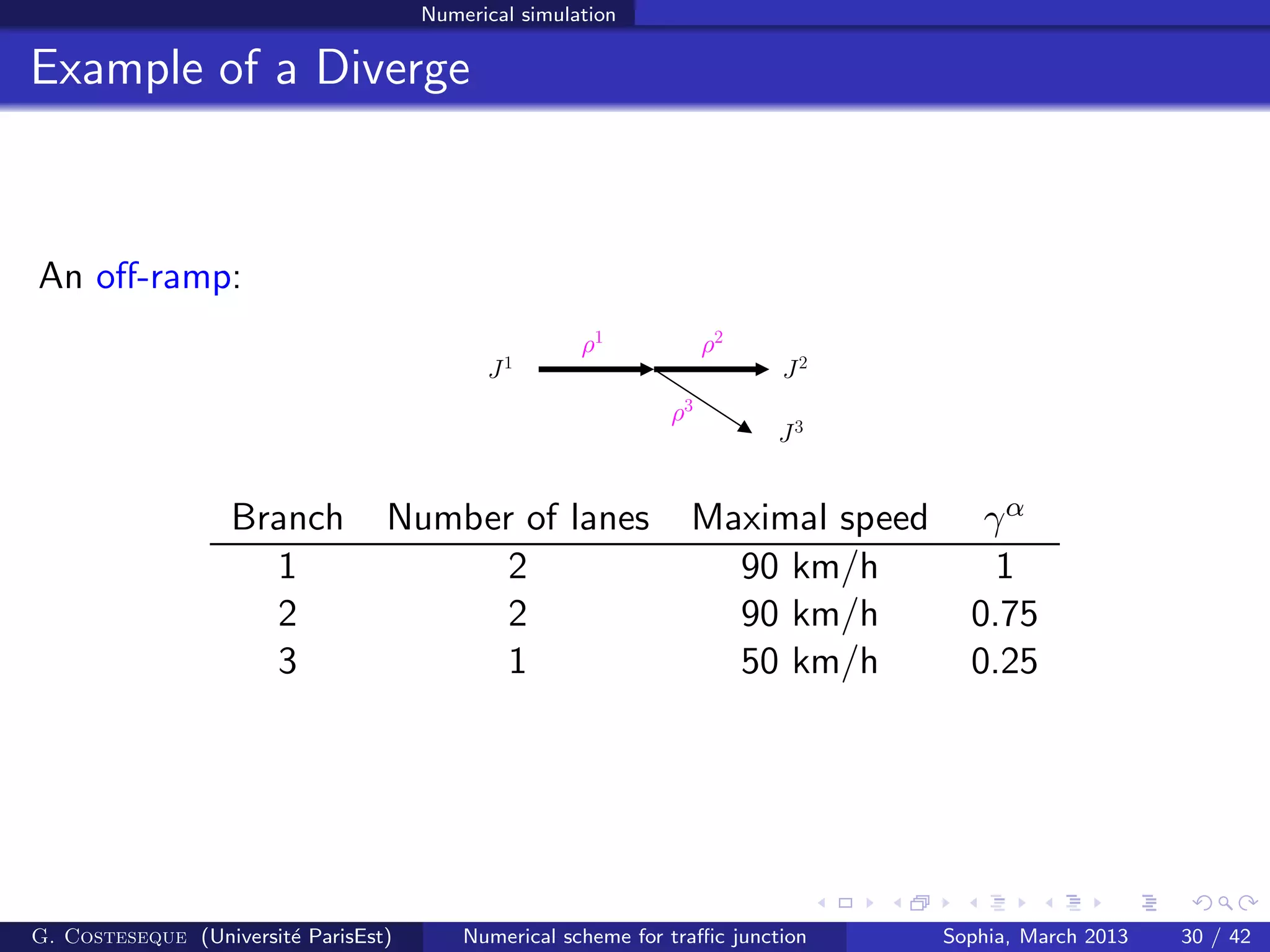
Example of a Diverge
An off-ramp:
J1
ρ1
J2
ρ2
ρ3
J3
Branch Number of lanes Maximal speed γα
1 2 90 km/h 1
2 2 90 km/h 0.75
3 1 50 km/h 0.25
G. Costeseque (Universit´e ParisEst) Numerical scheme for traffic junction Sophia, March 2013 30 / 42
Numerical simulation
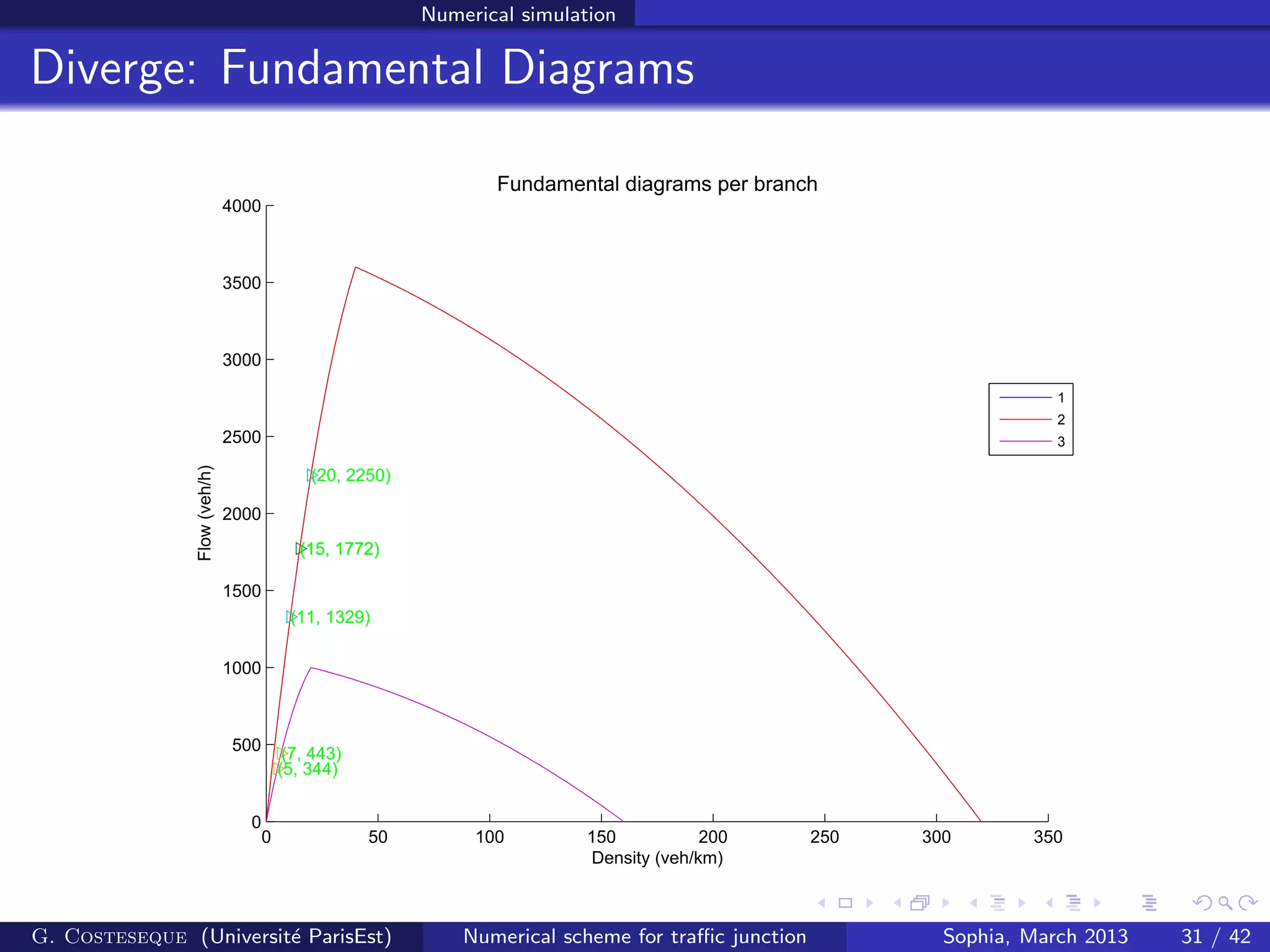
Diverge: Fundamental Diagrams
0 50 100 150 200 250 300 350
0
500
1000
1500
2000
2500
3000
3500
4000
(15, 1772)(15, 1772)
(20, 2250)
(11, 1329)
(5, 344)
(7, 443)
Density (veh/km)
Flow(veh/h)
Fundamental diagrams per branch
1
2
3
G. Costeseque (Universit´e ParisEst) Numerical scheme for traffic junction Sophia, March 2013 31 / 42
Numerical simulation
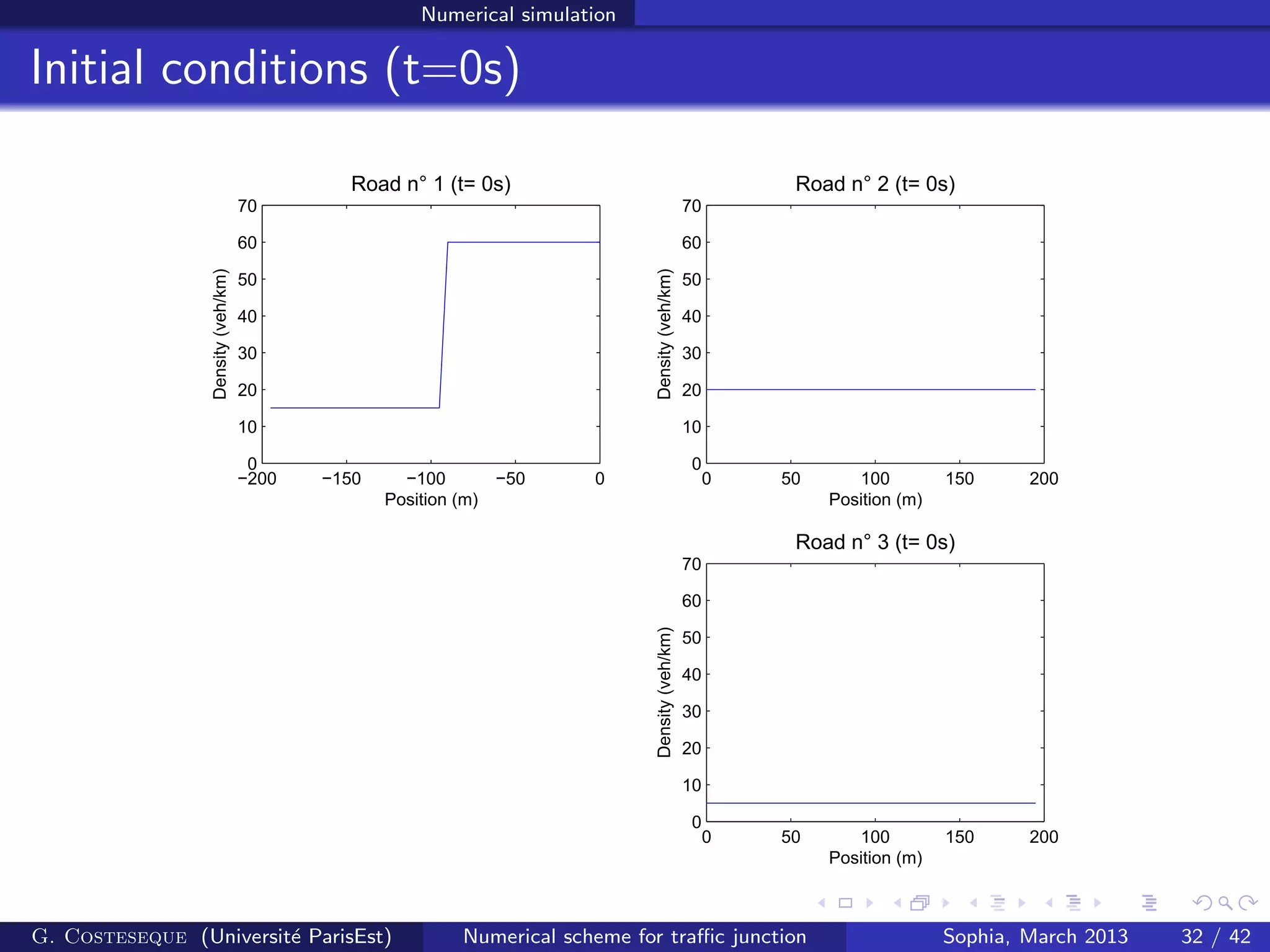
Initial conditions (t=0s)
−200 −150 −100 −50 0
0
10
20
30
40
50
60
70
Road n° 1 (t= 0s)
Position (m)
Density(veh/km)
0 50 100 150 200
0
10
20
30
40
50
60
70
Road n° 2 (t= 0s)
Position (m)
Density(veh/km)
0 50 100 150 200
0
10
20
30
40
50
60
70
Road n° 3 (t= 0s)
Position (m)
Density(veh/km)
G. Costeseque (Universit´e ParisEst) Numerical scheme for traffic junction Sophia, March 2013 32 / 42
Numerical simulation
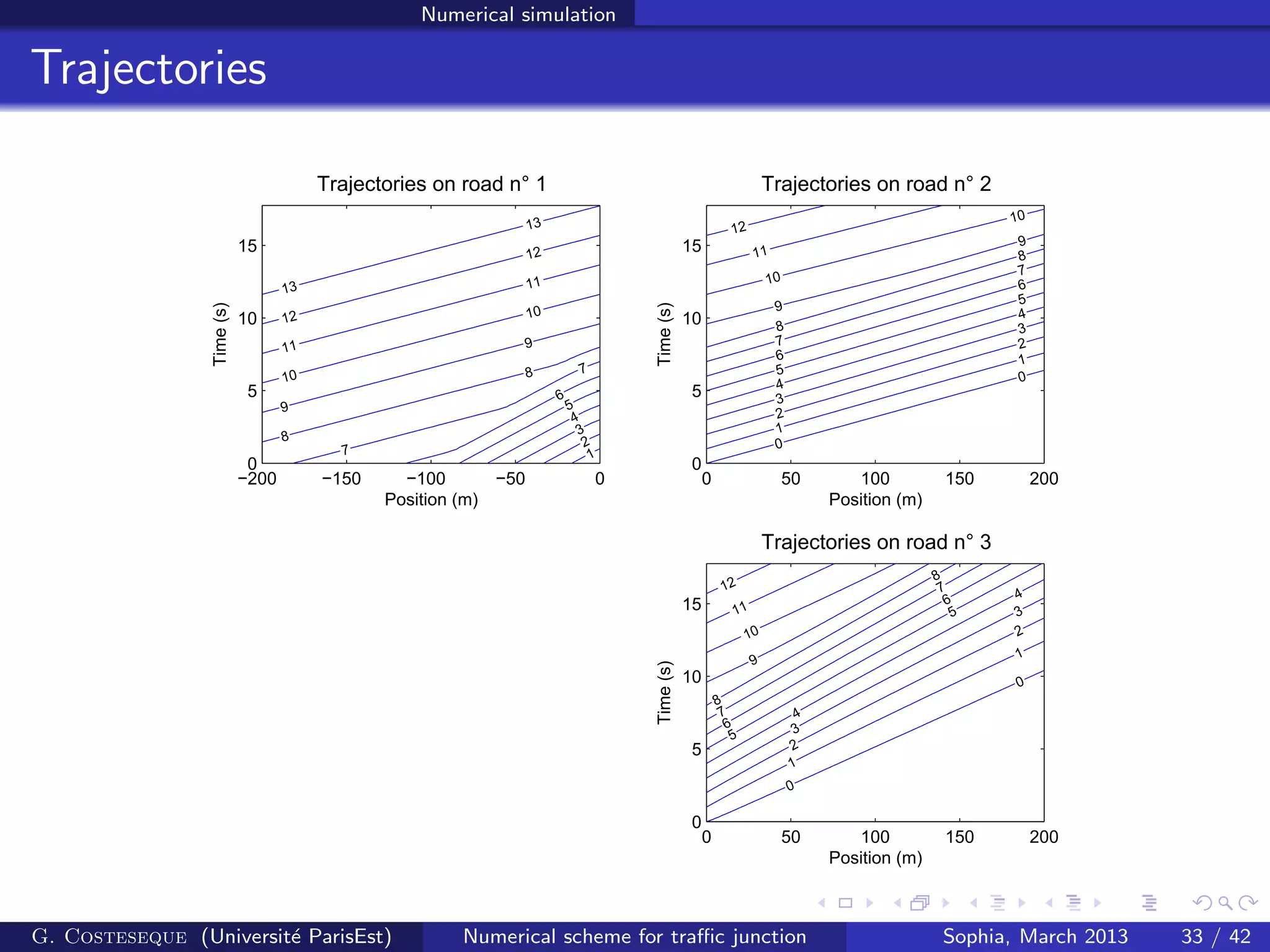
Trajectories
1
2
3
4
5
6
7
78
8
9
9
10
10
11
11
12
12
13
13
Trajectories on road n° 1
Position (m)
Time(s)
−200 −150 −100 −50 0
0
5
10
15
0
0
1
1
2
2
3
3
4
4
5
5
6
6
7
7
8
8
9
9
10
10
11
12
Trajectories on road n° 2
Position (m)
Time(s)
0 50 100 150 200
0
5
10
15
0
0
1
1
2
2
3
3
4
4
5
5
6
6
7
7
8
8
9
10
11
12
Trajectories on road n° 3
Position (m)
Time(s)
0 50 100 150 200
0
5
10
15
G. Costeseque (Universit´e ParisEst) Numerical scheme for traffic junction Sophia, March 2013 33 / 42
Numerical simulation
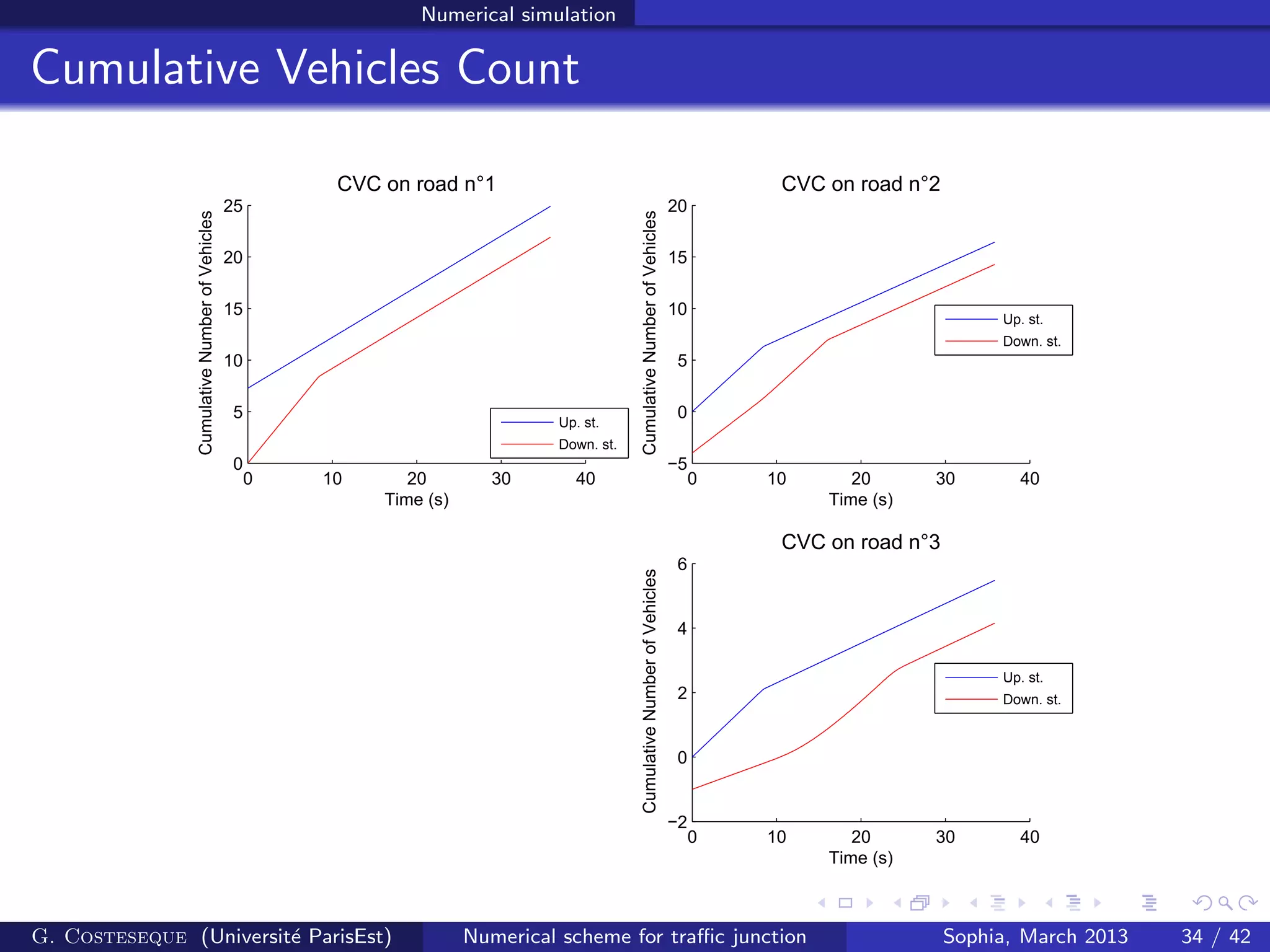
Cumulative Vehicles Count
0 10 20 30 40
0
5
10
15
20
25
Time (s)
CumulativeNumberofVehicles
CVC on road n°1
Up. st.
Down. st.
0 10 20 30 40
−5
0
5
10
15
20
Time (s)
CumulativeNumberofVehicles
CVC on road n°2
Up. st.
Down. st.
0 10 20 30 40
−2
0
2
4
6
Time (s)
CumulativeNumberofVehicles
CVC on road n°3
Up. st.
Down. st.
G. Costeseque (Universit´e ParisEst) Numerical scheme for traffic junction Sophia, March 2013 34 / 42
Numerical simulation
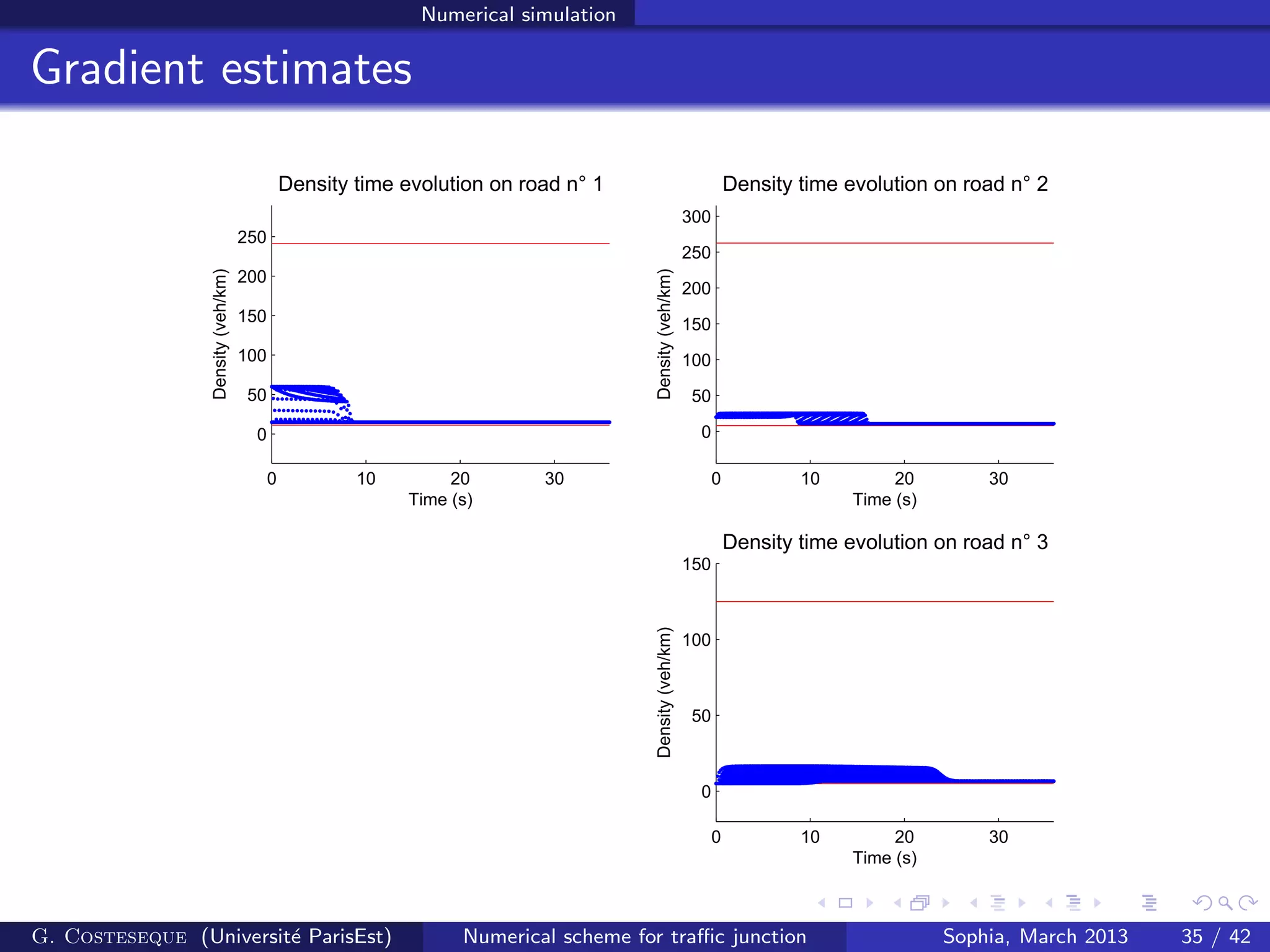
Gradient estimates
0 10 20 30
0
50
100
150
200
250
Time (s)
Density(veh/km)
Density time evolution on road n° 1
0 10 20 30
0
50
100
150
200
250
300
Time (s)
Density(veh/km)
Density time evolution on road n° 2
0 10 20 30
0
50
100
150
Time (s)
Density(veh/km)
Density time evolution on road n° 3
G. Costeseque (Universit´e ParisEst) Numerical scheme for traffic junction Sophia, March 2013 35 / 42
Conclusion
Outline
1 Motivation
2 Junction model and adapted scheme
3 Traffic interpretation
4 Numerical simulation
5 Conclusion
G. Costeseque (Universit´e ParisEst) Numerical scheme for traffic junction Sophia, March 2013 36 / 42
Conclusion
Complementary results [CML ’13]:
Generalization for weaker assumptions on the Hamiltonians
Numerical simulation for other junction configurations (merge)
G. Costeseque (Universit´e ParisEst) Numerical scheme for traffic junction Sophia, March 2013 37 / 42
Conclusion
Complementary results [CML ’13]:
Generalization for weaker assumptions on the Hamiltonians
Numerical simulation for other junction configurations (merge)
Open questions:
Error estimate
Non-fixed coefficients γα
Other link models (GSOM)
Other junction condition
G. Costeseque (Universit´e ParisEst) Numerical scheme for traffic junction Sophia, March 2013 37 / 42
Conclusion
The End
Thanks for your attention
guillaume.costeseque@cermics.enpc.fr
guillaume.costeseque@ifsttar.fr
G. Costeseque (Universit´e ParisEst) Numerical scheme for traffic junction Sophia, March 2013 38 / 42
Complements
Some references
G. Costeseque, R. Monneau, J-P. Lebacque, A convergent numerical
scheme for Hamilton-Jacobi equations on a junction: application to
traffic, Working paper, (2013).
C. Imbert, R. Monneau and H. Zidani, A Hamilton-Jacobi approach to
junction problems and application to traffic flows, ESAIM: COCV,
(2011), 38 pages.
J.P. Lebacque and M.M. Koshyaran, First-order macroscopic traffic
flow models: intersection modeling, network modeling, 16th ISTTT
(2005), pp. 365-386.
C. Tamp`ere, R. Corthout, D. Cattrysse and L. Immers, A generic class
of first order node models for dynamic macroscopic simulations of
traffic flows, Transp. Res. Part B, 45 (1) (2011), pp. 289-309.
G. Costeseque (Universit´e ParisEst) Numerical scheme for traffic junction Sophia, March 2013 39 / 42
Proofs of the main results
Sketch of the proof (gradient estimates):
Time derivative estimate:
1. Estimate on mα,n = inf
i
(DtU)α,n
i and partial result for mn = inf
α
mα,n
2. Similar estimate for Mn
3. Conclusion
Space derivative estimate:
1. New bounded Hamiltonian ˜Hα(p) for p ≤ pα
and p ≥ pα
2. Time derivative estimate from above
3. Lemma: if for any (i, n, α), (DtU)α,n
i ≥ m0 then
pα
≤ pα,n
i ≤ pα
4. Conclusion as ˜Hα = Hα on [pα
, pα]
Back
G. Costeseque (Universit´e ParisEst) Numerical scheme for traffic junction Sophia, March 2013 40 / 42
Proofs of the main results
Convergence with uniqueness assumption
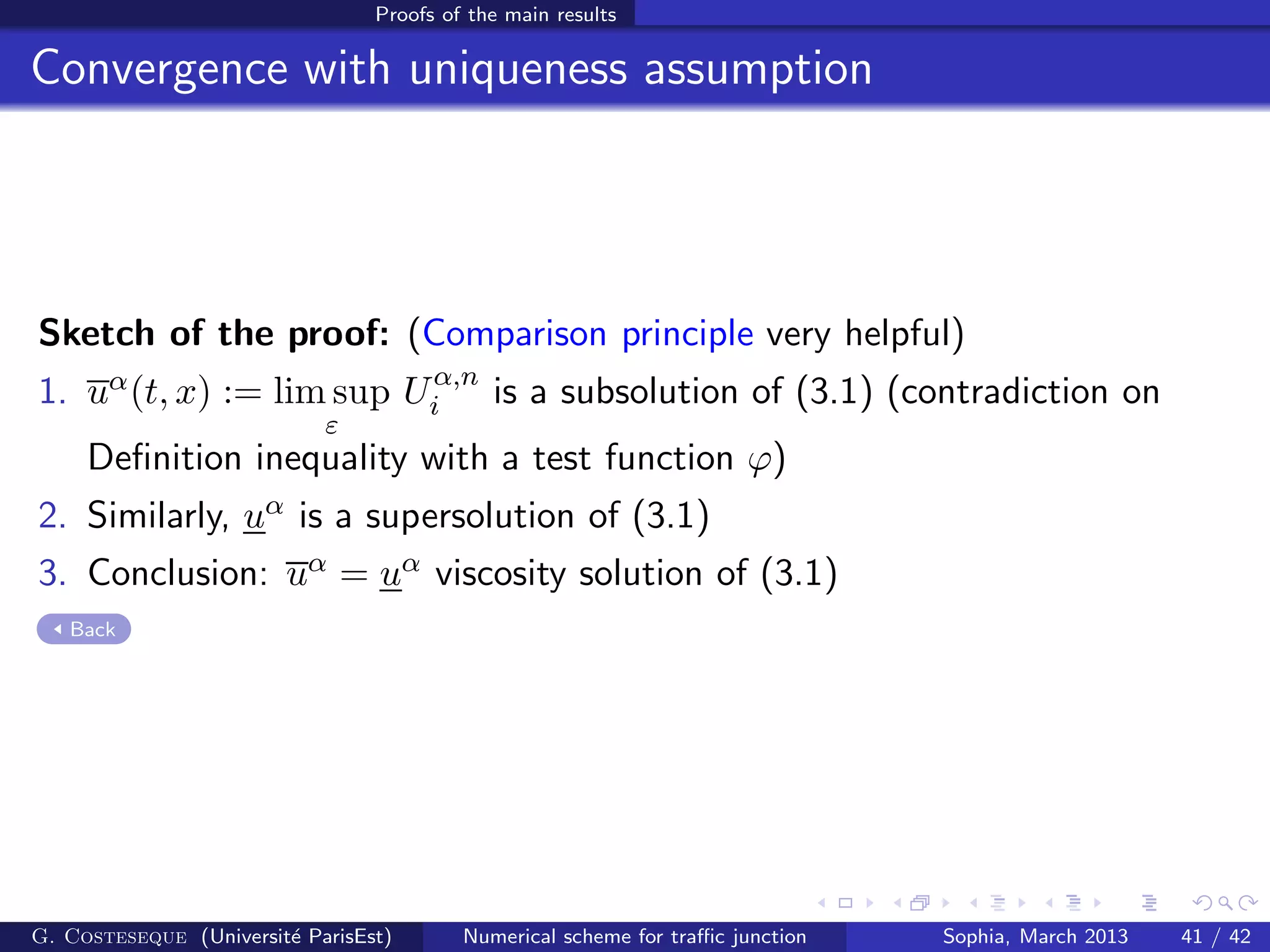
Sketch of the proof: (Comparison principle very helpful)
1. uα(t, x) := lim sup
ε
Uα,n
i is a subsolution of (3.1) (contradiction on
Definition inequality with a test function ϕ)
2. Similarly, uα is a supersolution of (3.1)
3. Conclusion: uα = uα viscosity solution of (3.1)
Back
G. Costeseque (Universit´e ParisEst) Numerical scheme for traffic junction Sophia, March 2013 41 / 42
Proofs of the main results
Convergence without uniqueness assumption
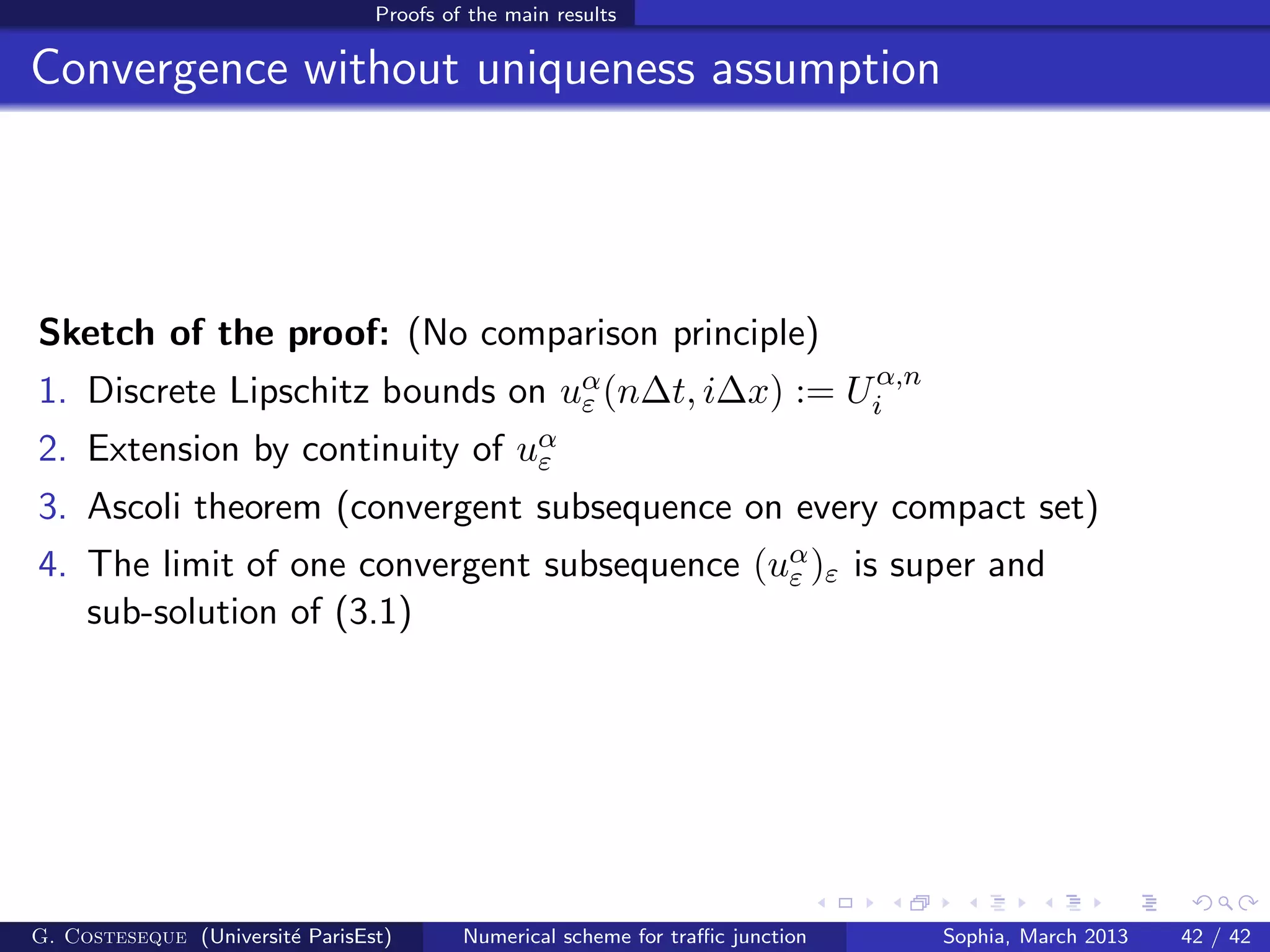
Sketch of the proof: (No comparison principle)
1. Discrete Lipschitz bounds on uα
ε (n∆t, i∆x) := Uα,n
i
2. Extension by continuity of uα
ε
3. Ascoli theorem (convergent subsequence on every compact set)
4. The limit of one convergent subsequence (uα
ε )ε is super and
sub-solution of (3.1)
G. Costeseque (Universit´e ParisEst) Numerical scheme for traffic junction Sophia, March 2013 42 / 42

Road junction modeling using a scheme based on Hamilton-Jacobi equations

  • 1.
    Road junction modellingusing a scheme based on Hamilton-Jacobi equation Guillaume Costeseque (PhD with supervisors R. Monneau & J-P. Lebacque) Ecole des Ponts ParisTech, CERMICS & IFSTTAR, GRETTIA Workshop on Traffic Modeling and Management March 20-22, 2013 - Sophia-Antipolis G. Costeseque (Universit´e ParisEst) Numerical scheme for traffic junction Sophia, March 2013 1 / 42
  • 2.
    Introduction A junction JN J1 J2 branch Jα x x 0 x x G.Costeseque (Universit´e ParisEst) Numerical scheme for traffic junction Sophia, March 2013 2 / 42
  • 3.
    Introduction Ideas of themodel JN J1 J2 branch Jα x x 0 x x    uα t + Hα(uα x ) = 0, x > 0, α = 1, . . . , N uα = uβ =: u, x = 0, ut + H(u1 x, . . . , uN x ) = 0, x = 0 G. Costeseque (Universit´e ParisEst) Numerical scheme for traffic junction Sophia, March 2013 3 / 42
  • 4.
    Introduction Outline 1 Motivation 2 Junctionmodel and adapted scheme 3 Traffic interpretation 4 Numerical simulation 5 Conclusion G. Costeseque (Universit´e ParisEst) Numerical scheme for traffic junction Sophia, March 2013 4 / 42
  • 5.
    Motivation Outline 1 Motivation 2 Junctionmodel and adapted scheme 3 Traffic interpretation 4 Numerical simulation 5 Conclusion G. Costeseque (Universit´e ParisEst) Numerical scheme for traffic junction Sophia, March 2013 5 / 42
  • 6.
    Motivation The simple divergentroad x > 0 x > 0γl γrx < 0 Il Ir γe Ie    γe = 1, 0 ≤ γl, γr ≤ 1, γl + γr = 1 LWR model [Lighthill, Whitham ’55; Richards ’56]: ρt + (Q(ρ))x = 0 G. Costeseque (Universit´e ParisEst) Numerical scheme for traffic junction Sophia, March 2013 6 / 42
  • 7.
    Motivation Qmax ρcrit ρmax Density ρ FlowQ(ρ) Q(ρ) = ρV (ρ) with V (ρ) = speed of the equilibrium flow G. Costeseque (Universit´e ParisEst) Numerical scheme for traffic junction Sophia, March 2013 7 / 42
  • 8.
    Junction model andadapted scheme Outline 1 Motivation 2 Junction model and adapted scheme Getting of the HJ equations Junction model Numerical scheme Mathematical results 3 Traffic interpretation 4 Numerical simulation 5 Conclusion G. Costeseque (Universit´e ParisEst) Numerical scheme for traffic junction Sophia, March 2013 8 / 42
  • 9.
    Junction model andadapted scheme Getting of the HJ equations ρα t + (Qα (ρα ))x = 0 on branch α Primitive: Uα (x, t) = Uα (0, t) + 1 γα x 0 ρα (y, t)dy and Uα (0, t) = g(t) = index of the single car at the junction point x > 0 x > 09 11 8 10 12 6420 1 3 5 7 −1 x < 0 G. Costeseque (Universit´e ParisEst) Numerical scheme for traffic junction Sophia, March 2013 9 / 42
  • 10.
    Junction model andadapted scheme Getting of the HJ equations ρα t + (Qα (ρα ))x = 0 on branch α Primitive: Uα (x, t) = Uα (0, t) + 1 γα x 0 ρα (y, t)dy and Uα (0, t) = g(t) = index of the single car at the junction point x > 0 x > 09 11 8 10 12 6420 1 3 5 7 −1 x < 0 Uα t + 1 γα Qα (γα Uα x ) = g′ (t) + 1 γα Qα (ρα (0, t)) = 0 for a good choice of g G. Costeseque (Universit´e ParisEst) Numerical scheme for traffic junction Sophia, March 2013 9 / 42
  • 11.
    Junction model andadapted scheme Junction model Junction model New functions uα: uα(x, t) = −Uα(x, t), x > 0, for outgoing roads uα(x, t) = −Uα(−x, t), x > 0 J3 e3 J2 e2 e1 J1 JN eN Proposition (Junction model)    uα t + Hα(uα x ) = 0, x > 0, uα(0, t) = u(0, t), x = 0, α = 1, ..., N ut + max α=1,...,N H− α (uα x ) = 0, x = 0. (3.1) with the initial condition uα(0, x) = uα 0 (x). G. Costeseque (Universit´e ParisEst) Numerical scheme for traffic junction Sophia, March 2013 10 / 42
  • 12.
    Junction model andadapted scheme Junction model Assumptions For all α = 1, . . . , N, (A0) The initial condition uα 0 is Lipschitz continuous. (A1) The Hamiltonians Hα are C1(R) and convex such that: p H− α (p) H+ α (p) pα 0 G. Costeseque (Universit´e ParisEst) Numerical scheme for traffic junction Sophia, March 2013 11 / 42
  • 13.
    Junction model andadapted scheme Numerical scheme Presentation of the NS Proposition (Numerical Scheme) Let us consider the discrete space and time derivatives: pα,n i := Uα,n i+1 − Uα,n i ∆x and (DtU)α,n i := Uα,n+1 i − Uα,n i ∆t Then we have the following numerical scheme:    (DtU)α,n i + max{H+ α (pα,n i−1), H− α (pα,n i )} = 0, i ≥ 1 Un 0 := Uα,n 0 , i = 0, α = 1, ..., N (DtU)n 0 + max α=1,...,N H− α (pα,n 0 ) = 0, i = 0 (3.2) With the initial condition Uα,0 i := uα 0 (i∆x). ∆x and ∆t = space and time steps satisfying a CFL condition G. Costeseque (Universit´e ParisEst) Numerical scheme for traffic junction Sophia, March 2013 12 / 42
  • 14.
    Junction model andadapted scheme Numerical scheme CFL condition The natural CFL condition is given by: ∆x ∆t ≥ sup α=1,...,N i≥0, 0≤n≤nT |H′ α(pα,n i )| (3.3) G. Costeseque (Universit´e ParisEst) Numerical scheme for traffic junction Sophia, March 2013 13 / 42
  • 15.
    Junction model andadapted scheme Mathematical results Gradient estimates Theorem (Time and Space Gradient estimates) Assume (A0)-(A1). If the CFL condition (3.3) is satisfied, then we have that: (i) Considering Mn = sup α,i (DtU)α,n i and mn = inf α,i (DtU)α,n i , we have the following time derivative estimate: m0 ≤ mn ≤ mn+1 ≤ Mn+1 ≤ Mn ≤ M0 (ii) Considering pα = (H− α )−1(−m0) and pα = (H+ α )−1(−m0), we have the following gradient estimate: pα ≤ pα,n i ≤ pα, for all i ≥ 0, n ≥ 0 and α = 1, ..., N Proof G. Costeseque (Universit´e ParisEst) Numerical scheme for traffic junction Sophia, March 2013 14 / 42
  • 16.
    Junction model andadapted scheme Mathematical results Stronger CFL condition As for any α = 1, . . . , N, we have that: pα ≤ pα,n i ≤ pα for all i, n ≥ 0 −m0 pα p Hα(p) pα Then the CFL condition becomes: ∆x ∆t ≥ sup α=1,...,N pα∈[pα ,pα] |H′ α(pα)| (3.4) G. Costeseque (Universit´e ParisEst) Numerical scheme for traffic junction Sophia, March 2013 15 / 42
  • 17.
    Junction model andadapted scheme Mathematical results Existence and uniqueness (A2) Technical assumption (Legendre-Fenchel transform) Hα(p) = sup q∈R (pq − Lα(q)) with L′′ α ≥ δ > 0, for all index α G. Costeseque (Universit´e ParisEst) Numerical scheme for traffic junction Sophia, March 2013 16 / 42
  • 18.
    Junction model andadapted scheme Mathematical results Existence and uniqueness (A2) Technical assumption (Legendre-Fenchel transform) Hα(p) = sup q∈R (pq − Lα(q)) with L′′ α ≥ δ > 0, for all index α Theorem (Existence and uniqueness [IMZ, ’11]) Under (A0)-(A1)-(A2), there exists a unique viscosity solution u of (3.1) on the junction, satisfying for some constant CT > 0 |u(t, y) − u0(y)| ≤ CT for all (t, y) ∈ JT . Moreover the function u is Lipschitz continuous with respect to (t, y). G. Costeseque (Universit´e ParisEst) Numerical scheme for traffic junction Sophia, March 2013 16 / 42
  • 19.
    Junction model andadapted scheme Mathematical results Convergence Theorem (Convergence from discrete to continuous [CML, ’13]) Assume that (A0)-(A1)-(A2) and the CFL condition (3.4) are satisfied. Then the numerical solution converges uniformly to u the unique viscosity solution of (3.1) when ε → 0, locally uniformly on any compact set K: lim sup ε→0 sup (n∆t,i∆x)∈K |uα (n∆t, i∆x) − Uα,n i | = 0 Proof G. Costeseque (Universit´e ParisEst) Numerical scheme for traffic junction Sophia, March 2013 17 / 42
  • 20.
    Traffic interpretation Outline 1 Motivation 2Junction model and adapted scheme 3 Traffic interpretation Traffic notations Links with “classical” approach Literature review 4 Numerical simulation 5 Conclusion G. Costeseque (Universit´e ParisEst) Numerical scheme for traffic junction Sophia, March 2013 18 / 42
  • 21.
    Traffic interpretation Trafficnotations Setting J1 JNI JNI+1 JNI+NO x < 0 x = 0 x > 0 Jβ γβ Jλ γλ NI incoming and NO outgoing roads G. Costeseque (Universit´e ParisEst) Numerical scheme for traffic junction Sophia, March 2013 19 / 42
  • 22.
    Traffic interpretation Trafficnotations Car densities The car density ρα solves the LWR equation on branch α: ρα t + (Qα (ρα ))x = 0 By definition ρα = γα ∂xUα on branch α And uα(x, t) = −Uα(−x, t), x > 0, for incoming roads uα(x, t) = −Uα(x, t), x > 0, for outgoing roads where the car index uα solves the HJ equation on branch α: uα t + Hα (uα x ) = 0, for x > 0 G. Costeseque (Universit´e ParisEst) Numerical scheme for traffic junction Sophia, March 2013 20 / 42
  • 23.
    Traffic interpretation Trafficnotations Flow Hα(p) :=    − 1 γα Qα(γαp) for α = 1, ..., NI − 1 γα Qα(−γαp) for α = NI + 1, ..., NI + NO Incoming roads Outgoing roads ρcrit γα ρmax γα p − Qmax γα p − Qmax γα HαHα H− α H− α H+ αH+ α − ρmax γα − ρcrit γα G. Costeseque (Universit´e ParisEst) Numerical scheme for traffic junction Sophia, March 2013 21 / 42
  • 24.
    Traffic interpretation Linkswith “classical” approach Discrete car densities Definition (Discrete car density) The discrete car density ρα,n i with n ≥ 0 and i ∈ Z is given by: ρα,n i :=    γαpα,n |i|−1 for α = 1, ..., NI , i ≤ −1 −γαpα,n i for α = NI + 1, ..., NI + NO, i ≥ 0 (4.5) J1 JNI JNI+1 JNI+NO x < 0 x > 0 −2 −1 2 1 0 −2 −2 −1 −1 1 1 2 2 Jβ Jλ ρλ,n 1 G. Costeseque (Universit´e ParisEst) Numerical scheme for traffic junction Sophia, March 2013 22 / 42
  • 25.
    Traffic interpretation Linkswith “classical” approach Traffic interpretation Proposition (Scheme for vehicles densities) The scheme deduced from (3.2) for the discrete densities is given by: ∆x ∆t {ρα,n+1 i − ρα,n i } =    Fα(ρα,n i−1, ρα,n i ) − Fα(ρα,n i , ρα,n i+1) for i = 0, −1 Fα 0 (ρ·,n 0 ) − Fα(ρα,n i , ρα,n i+1) for i = 0 Fα(ρα,n i−1, ρα,n i ) − Fα 0 (ρ·,n 0 ) for i = −1 With    Fα(ρα,n i−1, ρα,n i ) := min Qα D(ρα,n i−1), Qα S(ρα,n i ) Fα 0 (ρ·,n 0 ) := γα min min β≤NI 1 γβ Qβ D(ρβ,n 0 ), min λ>NI 1 γλ Qλ S(ρλ,n 0 ) incoming outgoing ρλ,n 0ρβ,n −1ρβ,n −2 ρλ,n 1 x x = 0 G. Costeseque (Universit´e ParisEst) Numerical scheme for traffic junction Sophia, March 2013 23 / 42
  • 26.
    Traffic interpretation Linkswith “classical” approach Supply and demand functions Remark It recovers the seminal Godunov scheme with passing flow = minimum between upstream demand QD and downstream supply QS. Density ρ ρcrit ρmax Supply QS Qmax Density ρ ρcrit ρmax Flow Q Qmax Density ρ ρcrit Demand QD Qmax From [Lebacque ’93, ’96] G. Costeseque (Universit´e ParisEst) Numerical scheme for traffic junction Sophia, March 2013 24 / 42
  • 27.
    Traffic interpretation Linkswith “classical” approach Supply and demand VS Hamiltonian H− α (p) =    − 1 γα Qα D(γαp) for α = 1, ..., NI − 1 γα Qα S(−γαp) for α = NI + 1, ..., NI + NO And H+ α (p) =    − 1 γα Qα S(γαp) for α = 1, ..., NI − 1 γα Qα D(−γαp) for α = NI + 1, ..., NI + NO G. Costeseque (Universit´e ParisEst) Numerical scheme for traffic junction Sophia, March 2013 25 / 42
  • 28.
    Traffic interpretation Literaturereview Some references for conservation laws ρt + (Q(x, ρ))x = 0 with Q(x, p) = 1{x<0}Qin (p) + 1{x≥0}Qout (p) Uniqueness results only for restricted configurations: See [Garavello, Natalini, Piccoli, Terracina ’07] and [Andreianov, Karlsen, Risebro ’11] Book of [Garavello, Piccoli ’06] for conservation laws on networks: Construction of a solution using the “wave front tracking method” No proof of the uniqueness of the solution on a general network G. Costeseque (Universit´e ParisEst) Numerical scheme for traffic junction Sophia, March 2013 26 / 42
  • 29.
    Traffic interpretation Literaturereview Numerics on networks Godunov scheme mainly used for conservation laws: [Bretti, Natalini, Piccoli ’06, ’07]: Godunov scheme compared to kinetic schemes / fast algorithms [Blandin, Bretti, Cutolo, Piccoli ’09]: Godunov scheme adapted for Colombo model (only tested for 1 × 1 junctions) G. Costeseque (Universit´e ParisEst) Numerical scheme for traffic junction Sophia, March 2013 27 / 42
  • 30.
    Traffic interpretation Literaturereview Numerics on networks Godunov scheme mainly used for conservation laws: [Bretti, Natalini, Piccoli ’06, ’07]: Godunov scheme compared to kinetic schemes / fast algorithms [Blandin, Bretti, Cutolo, Piccoli ’09]: Godunov scheme adapted for Colombo model (only tested for 1 × 1 junctions) [Han, Piccoli, Friesz, Yao ’12]: Lax-Hopf formula for HJ equation coupled with a Riemann solver at junction G. Costeseque (Universit´e ParisEst) Numerical scheme for traffic junction Sophia, March 2013 27 / 42
  • 31.
    Traffic interpretation Literaturereview Junction modelling State-of-the-art review: [Lebacque, Khoshyaran ’02, ’05, ’09] [Tamp`ere, Corthout, Cattrysse, Immers ’11], [Fl¨otter¨od, Rohde ’11] Calibration of γα for realistic models: [Cassidy and Ahn ’05] [Bar-Gera and Ahn ’10], [Ni and Leonard ’05] (small data set) G. Costeseque (Universit´e ParisEst) Numerical scheme for traffic junction Sophia, March 2013 28 / 42
  • 32.
    Numerical simulation Outline 1 Motivation 2Junction model and adapted scheme 3 Traffic interpretation 4 Numerical simulation 5 Conclusion G. Costeseque (Universit´e ParisEst) Numerical scheme for traffic junction Sophia, March 2013 29 / 42
  • 33.
    Numerical simulation Example ofa Diverge An off-ramp: J1 ρ1 J2 ρ2 ρ3 J3 Branch Number of lanes Maximal speed γα 1 2 90 km/h 1 2 2 90 km/h 0.75 3 1 50 km/h 0.25 G. Costeseque (Universit´e ParisEst) Numerical scheme for traffic junction Sophia, March 2013 30 / 42
  • 34.
    Numerical simulation Diverge: FundamentalDiagrams 0 50 100 150 200 250 300 350 0 500 1000 1500 2000 2500 3000 3500 4000 (15, 1772)(15, 1772) (20, 2250) (11, 1329) (5, 344) (7, 443) Density (veh/km) Flow(veh/h) Fundamental diagrams per branch 1 2 3 G. Costeseque (Universit´e ParisEst) Numerical scheme for traffic junction Sophia, March 2013 31 / 42
  • 35.
    Numerical simulation Initial conditions(t=0s) −200 −150 −100 −50 0 0 10 20 30 40 50 60 70 Road n° 1 (t= 0s) Position (m) Density(veh/km) 0 50 100 150 200 0 10 20 30 40 50 60 70 Road n° 2 (t= 0s) Position (m) Density(veh/km) 0 50 100 150 200 0 10 20 30 40 50 60 70 Road n° 3 (t= 0s) Position (m) Density(veh/km) G. Costeseque (Universit´e ParisEst) Numerical scheme for traffic junction Sophia, March 2013 32 / 42
  • 36.
    Numerical simulation Trajectories 1 2 3 4 5 6 7 78 8 9 9 10 10 11 11 12 12 13 13 Trajectories onroad n° 1 Position (m) Time(s) −200 −150 −100 −50 0 0 5 10 15 0 0 1 1 2 2 3 3 4 4 5 5 6 6 7 7 8 8 9 9 10 10 11 12 Trajectories on road n° 2 Position (m) Time(s) 0 50 100 150 200 0 5 10 15 0 0 1 1 2 2 3 3 4 4 5 5 6 6 7 7 8 8 9 10 11 12 Trajectories on road n° 3 Position (m) Time(s) 0 50 100 150 200 0 5 10 15 G. Costeseque (Universit´e ParisEst) Numerical scheme for traffic junction Sophia, March 2013 33 / 42
  • 37.
    Numerical simulation Cumulative VehiclesCount 0 10 20 30 40 0 5 10 15 20 25 Time (s) CumulativeNumberofVehicles CVC on road n°1 Up. st. Down. st. 0 10 20 30 40 −5 0 5 10 15 20 Time (s) CumulativeNumberofVehicles CVC on road n°2 Up. st. Down. st. 0 10 20 30 40 −2 0 2 4 6 Time (s) CumulativeNumberofVehicles CVC on road n°3 Up. st. Down. st. G. Costeseque (Universit´e ParisEst) Numerical scheme for traffic junction Sophia, March 2013 34 / 42
  • 38.
    Numerical simulation Gradient estimates 010 20 30 0 50 100 150 200 250 Time (s) Density(veh/km) Density time evolution on road n° 1 0 10 20 30 0 50 100 150 200 250 300 Time (s) Density(veh/km) Density time evolution on road n° 2 0 10 20 30 0 50 100 150 Time (s) Density(veh/km) Density time evolution on road n° 3 G. Costeseque (Universit´e ParisEst) Numerical scheme for traffic junction Sophia, March 2013 35 / 42
  • 39.
    Conclusion Outline 1 Motivation 2 Junctionmodel and adapted scheme 3 Traffic interpretation 4 Numerical simulation 5 Conclusion G. Costeseque (Universit´e ParisEst) Numerical scheme for traffic junction Sophia, March 2013 36 / 42
  • 40.
    Conclusion Complementary results [CML’13]: Generalization for weaker assumptions on the Hamiltonians Numerical simulation for other junction configurations (merge) G. Costeseque (Universit´e ParisEst) Numerical scheme for traffic junction Sophia, March 2013 37 / 42
  • 41.
    Conclusion Complementary results [CML’13]: Generalization for weaker assumptions on the Hamiltonians Numerical simulation for other junction configurations (merge) Open questions: Error estimate Non-fixed coefficients γα Other link models (GSOM) Other junction condition G. Costeseque (Universit´e ParisEst) Numerical scheme for traffic junction Sophia, March 2013 37 / 42
  • 42.
    Conclusion The End Thanks foryour attention guillaume.costeseque@cermics.enpc.fr guillaume.costeseque@ifsttar.fr G. Costeseque (Universit´e ParisEst) Numerical scheme for traffic junction Sophia, March 2013 38 / 42
  • 43.
    Complements Some references G. Costeseque,R. Monneau, J-P. Lebacque, A convergent numerical scheme for Hamilton-Jacobi equations on a junction: application to traffic, Working paper, (2013). C. Imbert, R. Monneau and H. Zidani, A Hamilton-Jacobi approach to junction problems and application to traffic flows, ESAIM: COCV, (2011), 38 pages. J.P. Lebacque and M.M. Koshyaran, First-order macroscopic traffic flow models: intersection modeling, network modeling, 16th ISTTT (2005), pp. 365-386. C. Tamp`ere, R. Corthout, D. Cattrysse and L. Immers, A generic class of first order node models for dynamic macroscopic simulations of traffic flows, Transp. Res. Part B, 45 (1) (2011), pp. 289-309. G. Costeseque (Universit´e ParisEst) Numerical scheme for traffic junction Sophia, March 2013 39 / 42
  • 44.
    Proofs of themain results Sketch of the proof (gradient estimates): Time derivative estimate: 1. Estimate on mα,n = inf i (DtU)α,n i and partial result for mn = inf α mα,n 2. Similar estimate for Mn 3. Conclusion Space derivative estimate: 1. New bounded Hamiltonian ˜Hα(p) for p ≤ pα and p ≥ pα 2. Time derivative estimate from above 3. Lemma: if for any (i, n, α), (DtU)α,n i ≥ m0 then pα ≤ pα,n i ≤ pα 4. Conclusion as ˜Hα = Hα on [pα , pα] Back G. Costeseque (Universit´e ParisEst) Numerical scheme for traffic junction Sophia, March 2013 40 / 42
  • 45.
    Proofs of themain results Convergence with uniqueness assumption Sketch of the proof: (Comparison principle very helpful) 1. uα(t, x) := lim sup ε Uα,n i is a subsolution of (3.1) (contradiction on Definition inequality with a test function ϕ) 2. Similarly, uα is a supersolution of (3.1) 3. Conclusion: uα = uα viscosity solution of (3.1) Back G. Costeseque (Universit´e ParisEst) Numerical scheme for traffic junction Sophia, March 2013 41 / 42
  • 46.
    Proofs of themain results Convergence without uniqueness assumption Sketch of the proof: (No comparison principle) 1. Discrete Lipschitz bounds on uα ε (n∆t, i∆x) := Uα,n i 2. Extension by continuity of uα ε 3. Ascoli theorem (convergent subsequence on every compact set) 4. The limit of one convergent subsequence (uα ε )ε is super and sub-solution of (3.1) G. Costeseque (Universit´e ParisEst) Numerical scheme for traffic junction Sophia, March 2013 42 / 42