THE FUTURE
LOOKS BRIGHT
FOR MSME
SECTOR
BUSINESS UPDATE SESSION
GROUP :10
THE NEWS:
 In the last 2 decades, the growth curve of the Indian economy has been largely controlled by
its micro, Small &medium enterprises (MSME’s).
 The sector has done some heavy lifting across operations and is contributing a whopping 40%
to the country's GDP through the 20 lakh cr of goods & services it produces.
 It is also the livelihood to millions of people.
 Significantly MSME sector continues to drive India's fortune despite being marred by various
factors such as lack of adequate capital, infrastructural hurdles inadequate digitalization,
scattered markets and statutory clearance among others.
 This trajectory of growth explains how the sector is achieving the country's vision to become 5
trillion-dollar economy by 2024-25.
INTRODUCTION
 The MSME sector strategically has become the most
important sector fuelling the economic growth of
the country. The sector is slated to gain even greater
prominence in the days to come owing to its
potential for employment generation. It is also the
bedrock from which large corporate of the future
evolves. Hence, it is imperative for all the formal
financial institutions to progressively reach out to
the large extent of MSMEs untouched by these
institutions.
 The MSMEs accessing finance from informal sources
should also upgrade their profile to fall into the
ambit of formal financial institutions, thereby
making them eligible for credit from these
institutions. This would reduce the credit cost of
these MSMEs and increase their profits, thereby
enabling development, reducing disparities, and
fuelling the economic progress of the country.
ANALYSIS:
 Drawing on innovation and adaptability, MSME sector has particularly shown a brave face as the
government set out with its “One India, One tax" Vision with GST regulation. Even though in the
initial stages, the MSME industry face problems with cash flows and GST compliance.
 Many MSME businesses are moving towards a formal economy which is clear from the increase in
the tax payer base. It generates more new opportunities in the market. This formalization of the
sector and the subsequent need for transparency in accounting procedures means that MSME
today need an agile financial partner that can cater to the needs & help them explode new
opportunities in the global market.
ANALYSIS:
The three main features affecting the growth of Indian MSMEs are:
 Availability of finance
The appetite for debt finance to MSMEs is around Rs 69.3 trillion, out of which a major portion of 84 percent
or Rs 58.4 trillion is met from informal sources. Among the formal sources which meet 16 percent of the credit
requirement of MSMEs, Scheduled Commercial Banks account for 84 percent, with the rest met by other
financial institutions like NBFCs, RRBs, etc.
 Lack of formal registration
Out of the total 55.8 million MSMEs, only 8.2 million are registered MSMEs and the rest 47.6 million are un-
registered MSMEs. Given the above scenario, the first and foremost challenge in addressing the hurdles faced
by MSMEs is to bring all the un-registered MSMEs into the formal fold, so as to make them eligible for a
bouquet of benefits. The un-registered nature of the MSMEs also acts as a deterrent for their access to credit
from formal lending sources.
 Competitive market environment
MSMEs function in a highly competitive environment and require an enabling environment to sustain growth.
The three main interventions that can provide the enabling environment are- legal and regulatory support,
government support, and financial infrastructure support. The government is taking a slew of measures to
provide adequate support in these areas like the proposal to bring the change in the definition of MSMEs, the
introduction of Pradhan Mantri Mudra Yojana (PMMY) for enabling hassle-free credit to MSEs, enabling e-
marketplace for MSMEs, two percent Interest Subvention Scheme, introduction of TReDS platform for
discounting of bills, conduct of loan melas, restructuring the loans of stressed MSMEs, etc.
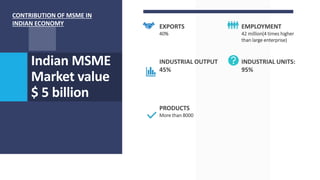
Indian MSME
Market value
$ 5 billion
EXPORTS
40%
INDUSTRIAL OUTPUT
45%
PRODUCTS
More than 8000
EMPLOYMENT
42 million(4 times higher
than large enterprise)
INDUSTRIAL UNITS:
95%
CONTRIBUTION OF MSME IN
INDIAN ECONOMY
IMPLICATIONS:
How MSMEs are being a catalyst for the Indian
economy’s growth
 MSMEs are expected to play a significant role in the
growth of the Indian economy. The development of
this segment is very much essential to meet the
national imperatives of financial inclusion and the
generation of significant levels of employment across
the country.
 The MSME segment accounts for 31 percent of India’s
GDP and 45 percent of exports. There are an
estimated 55.80 million MSMEs employing close to
124 million people. Out of this, 14 percent are
women-led enterprises and 59.5 percent are in the
rural areas. Hence, the sector has the scope for acting
as a catalyst for economic growth across the
geographic, social, and cultural strata of the country.
IMPLICATIONS
HOW MSMES ARE BEING A CATALYST FOR THE INDIAN ECONOMY’S GROWTH
 Many developed and developing economies have demonstrated that the MSME
segment is the catalyst for maintaining growth and employment generation,
which provides stability during economic downturns. As a catalyst for socio-
economic transformation of the country, the sector is critical in meeting the
national objectives of generating employment and discouraging rural-urban
migration.
 The MSME sector is the backbone for high growth businesses, and with the
‘Make in India’ initiative, it has an effective impact in the area of indigenisation.
‘Make in India with zero defect and zero effect’ is a very good platform available
for MSMEs to grow globally.
CONCLUSION
 The new era of MSMEs should enable the
development of a business ecosystem that
will enable and continuously support
businesses, which will gear up to deliver
the right product, the right quality, the
right solution, and the right service at a
competitive price, both in domestic and
international markets.
 The ‘Digital India’ revolution also provides
a wonderful opportunity to promote
MSME participation in the high-tech
sector to enable the dream of digital
India.
Thank you
QUESTIONS?

The future looks bright for msme sector

  • 1.
    THE FUTURE LOOKS BRIGHT FORMSME SECTOR BUSINESS UPDATE SESSION GROUP :10
  • 2.
    THE NEWS:  Inthe last 2 decades, the growth curve of the Indian economy has been largely controlled by its micro, Small &medium enterprises (MSME’s).  The sector has done some heavy lifting across operations and is contributing a whopping 40% to the country's GDP through the 20 lakh cr of goods & services it produces.  It is also the livelihood to millions of people.  Significantly MSME sector continues to drive India's fortune despite being marred by various factors such as lack of adequate capital, infrastructural hurdles inadequate digitalization, scattered markets and statutory clearance among others.  This trajectory of growth explains how the sector is achieving the country's vision to become 5 trillion-dollar economy by 2024-25.
  • 3.
    INTRODUCTION  The MSMEsector strategically has become the most important sector fuelling the economic growth of the country. The sector is slated to gain even greater prominence in the days to come owing to its potential for employment generation. It is also the bedrock from which large corporate of the future evolves. Hence, it is imperative for all the formal financial institutions to progressively reach out to the large extent of MSMEs untouched by these institutions.  The MSMEs accessing finance from informal sources should also upgrade their profile to fall into the ambit of formal financial institutions, thereby making them eligible for credit from these institutions. This would reduce the credit cost of these MSMEs and increase their profits, thereby enabling development, reducing disparities, and fuelling the economic progress of the country.
  • 4.
    ANALYSIS:  Drawing oninnovation and adaptability, MSME sector has particularly shown a brave face as the government set out with its “One India, One tax" Vision with GST regulation. Even though in the initial stages, the MSME industry face problems with cash flows and GST compliance.  Many MSME businesses are moving towards a formal economy which is clear from the increase in the tax payer base. It generates more new opportunities in the market. This formalization of the sector and the subsequent need for transparency in accounting procedures means that MSME today need an agile financial partner that can cater to the needs & help them explode new opportunities in the global market.
  • 5.
    ANALYSIS: The three mainfeatures affecting the growth of Indian MSMEs are:  Availability of finance The appetite for debt finance to MSMEs is around Rs 69.3 trillion, out of which a major portion of 84 percent or Rs 58.4 trillion is met from informal sources. Among the formal sources which meet 16 percent of the credit requirement of MSMEs, Scheduled Commercial Banks account for 84 percent, with the rest met by other financial institutions like NBFCs, RRBs, etc.  Lack of formal registration Out of the total 55.8 million MSMEs, only 8.2 million are registered MSMEs and the rest 47.6 million are un- registered MSMEs. Given the above scenario, the first and foremost challenge in addressing the hurdles faced by MSMEs is to bring all the un-registered MSMEs into the formal fold, so as to make them eligible for a bouquet of benefits. The un-registered nature of the MSMEs also acts as a deterrent for their access to credit from formal lending sources.  Competitive market environment MSMEs function in a highly competitive environment and require an enabling environment to sustain growth. The three main interventions that can provide the enabling environment are- legal and regulatory support, government support, and financial infrastructure support. The government is taking a slew of measures to provide adequate support in these areas like the proposal to bring the change in the definition of MSMEs, the introduction of Pradhan Mantri Mudra Yojana (PMMY) for enabling hassle-free credit to MSEs, enabling e- marketplace for MSMEs, two percent Interest Subvention Scheme, introduction of TReDS platform for discounting of bills, conduct of loan melas, restructuring the loans of stressed MSMEs, etc.
  • 6.
    Indian MSME Market value $5 billion EXPORTS 40% INDUSTRIAL OUTPUT 45% PRODUCTS More than 8000 EMPLOYMENT 42 million(4 times higher than large enterprise) INDUSTRIAL UNITS: 95% CONTRIBUTION OF MSME IN INDIAN ECONOMY
  • 7.
    IMPLICATIONS: How MSMEs arebeing a catalyst for the Indian economy’s growth  MSMEs are expected to play a significant role in the growth of the Indian economy. The development of this segment is very much essential to meet the national imperatives of financial inclusion and the generation of significant levels of employment across the country.  The MSME segment accounts for 31 percent of India’s GDP and 45 percent of exports. There are an estimated 55.80 million MSMEs employing close to 124 million people. Out of this, 14 percent are women-led enterprises and 59.5 percent are in the rural areas. Hence, the sector has the scope for acting as a catalyst for economic growth across the geographic, social, and cultural strata of the country.
  • 8.
    IMPLICATIONS HOW MSMES AREBEING A CATALYST FOR THE INDIAN ECONOMY’S GROWTH  Many developed and developing economies have demonstrated that the MSME segment is the catalyst for maintaining growth and employment generation, which provides stability during economic downturns. As a catalyst for socio- economic transformation of the country, the sector is critical in meeting the national objectives of generating employment and discouraging rural-urban migration.  The MSME sector is the backbone for high growth businesses, and with the ‘Make in India’ initiative, it has an effective impact in the area of indigenisation. ‘Make in India with zero defect and zero effect’ is a very good platform available for MSMEs to grow globally.
  • 9.
    CONCLUSION  The newera of MSMEs should enable the development of a business ecosystem that will enable and continuously support businesses, which will gear up to deliver the right product, the right quality, the right solution, and the right service at a competitive price, both in domestic and international markets.  The ‘Digital India’ revolution also provides a wonderful opportunity to promote MSME participation in the high-tech sector to enable the dream of digital India.
  • 10.