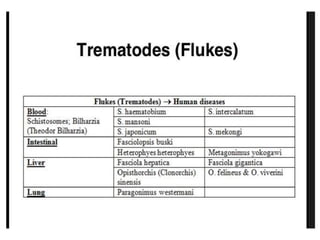
Schistosomes
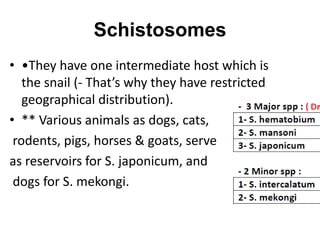
• •They have one intermediate host which is
the snail (- That’s why they have restricted
geographical distribution).
• ** Various animals as dogs, cats,
rodents, pigs, horses & goats, serve
as reservoirs for S. japonicum, and
dogs for S. mekongi.
• They are separate sexes (which is contrary to
the other hermaphroditic ‫خنثى‬trematodes) :
summery
** S. haematobium; Eggs
• large in urine ( in urinary bladder ) with
terminal spine at posterior end.
• looks a like the egg of S. intercalatum,,(if u
suspect between them , refer to the
geographical distribution)
S. japonicum; eggs :
• typically oval or subspherical , with knob
(vestigial spine) on side.
• - Differential Diagnose : it’s similar to S.
mekongi.
• - S. japonicum eggs are sometimes carried to :
(1) CNS , resulting in : headache,
disorientation, amnesia & coma. (2) heart ,
resulting in : arteriolitis & fibrosis →
enlargement & failure of Right ventricle.
‫أبو‬‫ذنيبة‬
• - There is No vehicle of infection (( Its direct
infection )) ‫ناقل‬ ‫بدها‬ ‫ما‬ ‫المرض‬ ‫بتسبب‬ ‫نفسها‬ ‫هي‬ ‫يعني‬
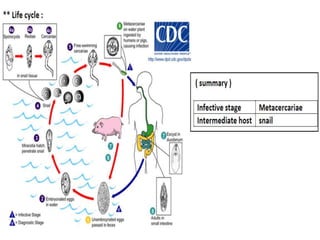
• it will mature in the liver and became adults in ≈3
weeks , then reach a specific place depend on the
type : - it will reach the mesenteric if its (S.
mansoni & S. japonicum) - it will reach the
bladder venous vessels if its (S. hematobium)
where they live & ovulate for Duration of host's
life ( they live through out the host life )
Schistosomes
Schistosomes
• ** Pathology :
• - clinically , the Penetration of cercariae (
the initial penetreation if the intact skin )
will result in transient dermatitis
(swimmers' itch).
• - Adult worms are innocuous (not harmful)
, even that they are coating themselves
with host Ags to evade immune
responses.
• - ((very important )) Deposition of eggs , is
an inducer of pathological changes
Schistosomes
Schistosomes
INTESTINAL FLUKES
• Fasciolopsis buski (Giant intestinal fluke)
• - Adult :
- Lives attached to small
intestinal mucosa of
mammalian hosts
(humans & pigs).
- result in inflammation,
ulceration & abscesses.
Fasciolopsis buski
• Eggs :
• •Immature eggs are discharged into
intestine, passed in
• stool & become embryonated in water.
Fasciolopsis buski
• Human Infection ( or the infective
stage infection for human or pigs )
is by ingesting water plants (water
chestnuts) contaminated with
encysted metacercaria
Fasciolopsis buski
• ** Clinical Picture :
- Light infectons: epigastric pain, nausea &
diarrhea, esp. in morning.
- Heavier infections: generalized edema &
ascites.
** Treatment : Praziquantel
** Heterophyes heterophyes
(Minute = very small intestinal
fluke)
• - linked to
fresh/brackish water
fish ! ‫سمك‬‫ني‬
Heterophyes heterophyes
• ** Clinical picture :
• - Intestinal main symptoms: diarrhea &
colicky ‫مغص‬ abdominal pain.
• Treatment : DOC is Praziquantel
** Metagonimus Yokogawai
Liver Flukes
• a. Fasciola hepatica
• Mostly, the infection occurs from ingestion of
raw/undercooked watercress
• Adult: leaf shaped
• - Eggs : in stool , and It is notable that the eggs
are indistinguishable from those of F. Buski
Fasciola hepatica
• snails as the intermediate host would ingest it
• here, their sole presence would elicit
hepatomegaly hence tenderness during
palpation
• * explains the upper quadrant pain
• Medication: Praziquantel is not effective like
the case of F. Buski.
• we instead Use Triclabendazole ( very
important )
Fasciola hepatica
• Halzoun :
Among the notable disease from such infection of F.
Hepatica.
It is a common disease in the Middle East as some people
enjoys eating raw livers. These may contain immature
flukes of F.Hepatic , which would lead to the disease.
the (immature) flukes would attach itself at the
pharyngeal mucosa; Dysphagia
* Dsypnea
* Edema
* All pt are presented with Immune-allergic like
symptoms in the eye, nose, ears, throat (airway
obstruction)
b. Opisthorchis
• The old name is Clonorchis.
• - It is of three types: 1. O. Sinensis - a.k.a
Chinese liver flukes.
ingested by freshwater fish.
• 2. O. Felinus - the word 'feline' refers to cat
• 3. O. Viverini - related to dogs
cholangiosarcoma which is the tumor for connective
tissue surrounding bile duct
The proper and effective medication would be
Praziquantel
O. Sinensis
Lung Flukes
• A. Paragonimus Westermani
• (transmitted by craps
• Infects man and ( pigs , dogs).
• infection may persist up to 20 years
• The adult takes form, size and color of a coffee
bean
Micro 5
Micro 5
Micro 5

Micro 5

  • 3.
    Schistosomes • •They haveone intermediate host which is the snail (- That’s why they have restricted geographical distribution). • ** Various animals as dogs, cats, rodents, pigs, horses & goats, serve as reservoirs for S. japonicum, and dogs for S. mekongi.
  • 4.
    • They areseparate sexes (which is contrary to the other hermaphroditic ‫خنثى‬trematodes) :
  • 5.
  • 6.
    ** S. haematobium;Eggs • large in urine ( in urinary bladder ) with terminal spine at posterior end. • looks a like the egg of S. intercalatum,,(if u suspect between them , refer to the geographical distribution)
  • 8.
    S. japonicum; eggs: • typically oval or subspherical , with knob (vestigial spine) on side. • - Differential Diagnose : it’s similar to S. mekongi. • - S. japonicum eggs are sometimes carried to : (1) CNS , resulting in : headache, disorientation, amnesia & coma. (2) heart , resulting in : arteriolitis & fibrosis → enlargement & failure of Right ventricle.
  • 10.
  • 11.
    • - Thereis No vehicle of infection (( Its direct infection )) ‫ناقل‬ ‫بدها‬ ‫ما‬ ‫المرض‬ ‫بتسبب‬ ‫نفسها‬ ‫هي‬ ‫يعني‬ • it will mature in the liver and became adults in ≈3 weeks , then reach a specific place depend on the type : - it will reach the mesenteric if its (S. mansoni & S. japonicum) - it will reach the bladder venous vessels if its (S. hematobium) where they live & ovulate for Duration of host's life ( they live through out the host life ) Schistosomes
  • 14.
    Schistosomes • ** Pathology: • - clinically , the Penetration of cercariae ( the initial penetreation if the intact skin ) will result in transient dermatitis (swimmers' itch). • - Adult worms are innocuous (not harmful) , even that they are coating themselves with host Ags to evade immune responses. • - ((very important )) Deposition of eggs , is an inducer of pathological changes
  • 15.
  • 16.
  • 17.
    INTESTINAL FLUKES • Fasciolopsisbuski (Giant intestinal fluke) • - Adult : - Lives attached to small intestinal mucosa of mammalian hosts (humans & pigs). - result in inflammation, ulceration & abscesses.
  • 18.
    Fasciolopsis buski • Eggs: • •Immature eggs are discharged into intestine, passed in • stool & become embryonated in water.
  • 20.
    Fasciolopsis buski • HumanInfection ( or the infective stage infection for human or pigs ) is by ingesting water plants (water chestnuts) contaminated with encysted metacercaria
  • 21.
    Fasciolopsis buski • **Clinical Picture : - Light infectons: epigastric pain, nausea & diarrhea, esp. in morning. - Heavier infections: generalized edema & ascites. ** Treatment : Praziquantel
  • 22.
    ** Heterophyes heterophyes (Minute= very small intestinal fluke) • - linked to fresh/brackish water fish ! ‫سمك‬‫ني‬
  • 24.
    Heterophyes heterophyes • **Clinical picture : • - Intestinal main symptoms: diarrhea & colicky ‫مغص‬ abdominal pain. • Treatment : DOC is Praziquantel
  • 25.
  • 26.
    Liver Flukes • a.Fasciola hepatica • Mostly, the infection occurs from ingestion of raw/undercooked watercress • Adult: leaf shaped • - Eggs : in stool , and It is notable that the eggs are indistinguishable from those of F. Buski
  • 27.
    Fasciola hepatica • snailsas the intermediate host would ingest it • here, their sole presence would elicit hepatomegaly hence tenderness during palpation • * explains the upper quadrant pain • Medication: Praziquantel is not effective like the case of F. Buski. • we instead Use Triclabendazole ( very important )
  • 28.
    Fasciola hepatica • Halzoun: Among the notable disease from such infection of F. Hepatica. It is a common disease in the Middle East as some people enjoys eating raw livers. These may contain immature flukes of F.Hepatic , which would lead to the disease. the (immature) flukes would attach itself at the pharyngeal mucosa; Dysphagia * Dsypnea * Edema * All pt are presented with Immune-allergic like symptoms in the eye, nose, ears, throat (airway obstruction)
  • 29.
    b. Opisthorchis • Theold name is Clonorchis. • - It is of three types: 1. O. Sinensis - a.k.a Chinese liver flukes. ingested by freshwater fish. • 2. O. Felinus - the word 'feline' refers to cat • 3. O. Viverini - related to dogs cholangiosarcoma which is the tumor for connective tissue surrounding bile duct The proper and effective medication would be Praziquantel
  • 30.
  • 31.
    Lung Flukes • A.Paragonimus Westermani • (transmitted by craps • Infects man and ( pigs , dogs). • infection may persist up to 20 years • The adult takes form, size and color of a coffee bean