Overview of Critical Care/Specialty Care transport  Mobile Intensive Care Paramedic Series
Focus Statement Focus Statement: This module will introduce the participant to the History of Critical Care Medicine, the roles and function of CCT, and basic differences between CCT and pre-hospital EMS.  This lecture meets Section 1 of the  Idaho EMS Critical Care Curricula Guide
Presentation Information Last revised 04/20/08 For more information contact the education department  208-287-2972
Terminology CCEMTP: Critical Care Emergency Medical Transport Program  Not Critical Care EMT-P SCT: Specialty Care transport AKA CCT: Critical Care transport IFT: Inter-facility Transport
Role of the Critical Care Paramedic Various Models Standard EMS with critical care role, if needed Dedicated critical care ground transport Rotor transport Fixed-wing transport
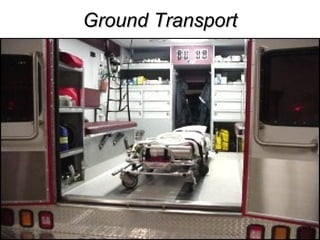
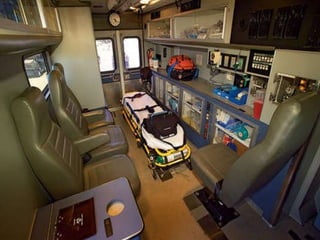
Ground Transport PROS Larger patient compartment Lower cost Relative immunity to changing weather Safer Less severe environmental factors Oxygen levels Acceleration/deceleration forces Gas volume changes with altitude Cabin pressurization Humidity Noise Vibration Specialty UNITS CONS Slower response Needs a designated Driver
 
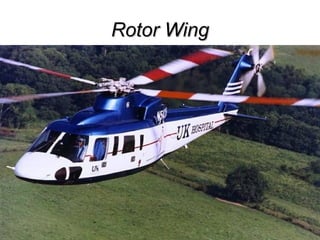
Rotor Wing PROS Can land almost anywhere Scene Direct to ER/OR Quick to launch Flying Billboards CONS Least Safe Most expensive Weight Restrictions Affected by temperature Tiny Patient compartment Affected by weather Not pressurized IFR/VFR Cant Fly “above the weather” Noise and vibration
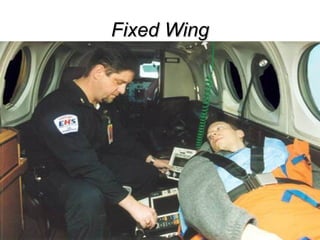
Fixed Wing PROS Larger patient compartment than Rotor Lower cost than Rotor Better Operating parameters than Rotor Safer than Rotor Faster than Rotor Less severe environmental factors Oxygen levels (pressurized) Humidity Noise Vibration CONS Need a runway More expensive up front? More lead time to launch
TEAM Configuration Team configuration ( Four Common Variations) RN/ Paramedic RN/ RN Paramedic/ Paramedic RN/ RT  May or may not include a third crew member (EMT) as a driver on ground operations Some specialize in the transport of patients classified as  Pediatric Neonatal /Maternal Burns
TEAM CONFIGURATION THE RN/Paramedic configuration is the most common. Different view, perspectives, and training Ideally, equal responsibilities  State legislation and Nursing Lobbies may affect this RN/RT more common on specialty teams and inter-hospital focused programs.  Neonatal
CERTIFICATION?? Certification Currently in state of flux Certified Flight Paramedic (FP-C) certification Offered by Board of Critical Care Transport Paramedic  Certification (BCCTPC) Affiliate of the International Flight Paramedics Association (IFPA) Certified Critical Care Paramedic Certification not certified or standardized UMBC CCEMTP Most widely accepted program Course completion not certification
Scope of Practice? MAY  Include: Advanced airway techniques RSI Surgical airway Ventilator management Pulse oximetry and capnogram interpretation Chest tube placement and monitoring Thoracic escharotomies Transvenous pacing Intra-aortic balloon pump 12-Lead ECGCentral venous catheter maintenance/placement/ interpretation Intracranial pressure monitoring Venous cutdown Blood/blood product administration and monitoring Infusion pumps Advanced pharmacological intervention
Scope of Practice?? Lots of Talk, Lots of variability No federal Minimal Standard
Certification? “Advanced Practice Paramedic” Dropped from the National Scope of Practice due to pressure from fire service and affiliated lobbies. Has garnered new support from unlikely sources…. NAEMT AEMS NREMT
NREMT and the Future of Critical Care Paramedic NREMT has taken a stance for the “APP” (Advanced Practice Paramedic) in 2008.  “ This level wouldn't require unique licensure. It would be a specialty certification—earned through continuing education, advanced competencies and clinical requirements. It would require paramedic experience and endorsements as part of the certification process.” William Brown of the NREMT
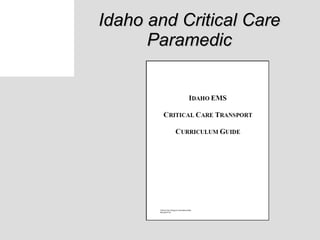
Idaho and Critical Care Paramedic
Medical Control Similar to Pre-Hospital Systems, Critical Care Paramedics are directed by licensed physicians Care guided by protocols, standing orders Unlike Pre-Hospital systems, use of Specific Written , Verbal, and Telephonic Orders (On line medical Control) for specific patients are far more common
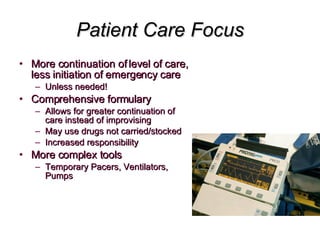
Patient Care Focus More continuation of level of care, less initiation of emergency care Unless needed! Comprehensive formulary Allows for greater continuation of care instead of improvising May use drugs not carried/stocked Increased responsibility More complex tools Temporary Pacers, Ventilators, Pumps
Who Needs CCT/SCT?
Who Needs CCT/SCT? Patients who: Have critical injuries or illnesses resulting in unstable vital signs AND need transport by transport teams with the appropriate levels of care capabilities to centers able to provide definitive care OR Need high-level care during transport (but lack time-critical illness or injury)
So why CCT Now? (Nationally) $$$$$$$$$$$$$$$$ More upfront costs, bigger long term reward Different (better) reimbursement schedule Federal EMTLA and COBRA statues Transfer requirement with appropriate staffing Liability Sending crews without appropriate training Staffing No longer cost effective to pull staff from floors.
Thoughts on Professionalism
In Hospital Culture  Must be able to adapt to hospital environment Remember that you represent the entire prehospital profession “ You never get a second chance to make a first impression” Use common sense and respect when interacting with hospital staff, patients, and their families Be nonjudgmental when completing assessment and care Ask before using hospital equipment, viewing patient charts Thank transferring facility staff, and offer feedback
Culture “ Scene Calls with Walls” Use common sense and respect when interacting with hospital staff, patients, and their families Be nonjudgmental when completing assessment and care Be prepared for staffing and equipment differences than what we normally use
Remember: No matter how different or poor the care, patient care will NOT be served by pissing off the staff! If they are pissed off, they wont call you for the next patient, who might need you help even more!
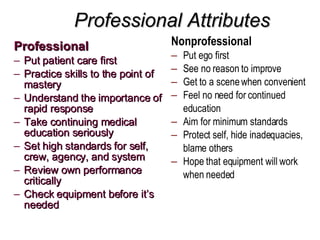
Professional Attributes Professional Put patient care first Practice skills to the point of mastery Understand the importance of rapid response Take continuing medical education seriously Set high standards for self, crew, agency, and system Review own performance critically Check equipment before it’s needed Nonprofessional Put ego first See no reason to improve Get to a scene when convenient Feel no need for continued education Aim for minimum standards Protect self, hide inadequacies, blame others Hope that equipment will work when needed
Political Influence on Critical Care Paramedics Knowledge is power Critical care paramedics should know the entities opposing their presence in CCT Understanding opposing forces better prepares critical care paramedics to interface with those forces at work Helps to bridge the divide between health care team members Role of critical care paramedic in hospital is not to replace other health care team members Goals are integration and enhancement
Nursing’s Longstanding Issues with Critical Care transport Medics Perspective “ Get er done” mentality Broad scope seems to be a good fit. Areas of Expertise Nursing’s perspective Holistic mentality Critical care paramedic is unlicensed provider concerned with skill provision, allegedly lacks breadth of knowledge offered in nursing school Sedom distinguishes between an EMT, a paramedic, and a Critical Care Paramedic. This is reinforced by nursing labor organizations fearing loss of nursing jobs.  RECOMMENDATION: Walk softly, do the job!
 
Remember: When crisis strikes, we don’t “rise to the occasion”, we “sink to the level of our training”.  From “On Combat” Lt Col David Grossman (ret)
National Association of Critical Care Paramedics (NACCP) International Flight Paramedics Association (IFPA) National Flight Paramedics Association (NFPA) National Association of EMS Physicians (NAEMSP) National Association of EMTs (NAEMTs) Society of Critical Care Medicine (SCCM) Professional Organizations
Remember….. You must always strive to earn your status as a health care  professional!

MICP - Introduction into CCT

  • 1.
    Overview of CriticalCare/Specialty Care transport Mobile Intensive Care Paramedic Series
  • 2.
    Focus Statement FocusStatement: This module will introduce the participant to the History of Critical Care Medicine, the roles and function of CCT, and basic differences between CCT and pre-hospital EMS. This lecture meets Section 1 of the Idaho EMS Critical Care Curricula Guide
  • 3.
    Presentation Information Lastrevised 04/20/08 For more information contact the education department 208-287-2972
  • 4.
    Terminology CCEMTP: CriticalCare Emergency Medical Transport Program Not Critical Care EMT-P SCT: Specialty Care transport AKA CCT: Critical Care transport IFT: Inter-facility Transport
  • 5.
    Role of theCritical Care Paramedic Various Models Standard EMS with critical care role, if needed Dedicated critical care ground transport Rotor transport Fixed-wing transport
  • 6.
    Ground Transport PROSLarger patient compartment Lower cost Relative immunity to changing weather Safer Less severe environmental factors Oxygen levels Acceleration/deceleration forces Gas volume changes with altitude Cabin pressurization Humidity Noise Vibration Specialty UNITS CONS Slower response Needs a designated Driver
  • 7.
  • 8.
    Rotor Wing PROSCan land almost anywhere Scene Direct to ER/OR Quick to launch Flying Billboards CONS Least Safe Most expensive Weight Restrictions Affected by temperature Tiny Patient compartment Affected by weather Not pressurized IFR/VFR Cant Fly “above the weather” Noise and vibration
  • 9.
    Fixed Wing PROSLarger patient compartment than Rotor Lower cost than Rotor Better Operating parameters than Rotor Safer than Rotor Faster than Rotor Less severe environmental factors Oxygen levels (pressurized) Humidity Noise Vibration CONS Need a runway More expensive up front? More lead time to launch
  • 10.
    TEAM Configuration Teamconfiguration ( Four Common Variations) RN/ Paramedic RN/ RN Paramedic/ Paramedic RN/ RT May or may not include a third crew member (EMT) as a driver on ground operations Some specialize in the transport of patients classified as Pediatric Neonatal /Maternal Burns
  • 11.
    TEAM CONFIGURATION THERN/Paramedic configuration is the most common. Different view, perspectives, and training Ideally, equal responsibilities State legislation and Nursing Lobbies may affect this RN/RT more common on specialty teams and inter-hospital focused programs. Neonatal
  • 12.
    CERTIFICATION?? Certification Currentlyin state of flux Certified Flight Paramedic (FP-C) certification Offered by Board of Critical Care Transport Paramedic Certification (BCCTPC) Affiliate of the International Flight Paramedics Association (IFPA) Certified Critical Care Paramedic Certification not certified or standardized UMBC CCEMTP Most widely accepted program Course completion not certification
  • 13.
    Scope of Practice?MAY Include: Advanced airway techniques RSI Surgical airway Ventilator management Pulse oximetry and capnogram interpretation Chest tube placement and monitoring Thoracic escharotomies Transvenous pacing Intra-aortic balloon pump 12-Lead ECGCentral venous catheter maintenance/placement/ interpretation Intracranial pressure monitoring Venous cutdown Blood/blood product administration and monitoring Infusion pumps Advanced pharmacological intervention
  • 14.
    Scope of Practice??Lots of Talk, Lots of variability No federal Minimal Standard
  • 15.
    Certification? “Advanced PracticeParamedic” Dropped from the National Scope of Practice due to pressure from fire service and affiliated lobbies. Has garnered new support from unlikely sources…. NAEMT AEMS NREMT
  • 16.
    NREMT and theFuture of Critical Care Paramedic NREMT has taken a stance for the “APP” (Advanced Practice Paramedic) in 2008. “ This level wouldn't require unique licensure. It would be a specialty certification—earned through continuing education, advanced competencies and clinical requirements. It would require paramedic experience and endorsements as part of the certification process.” William Brown of the NREMT
  • 17.
    Idaho and CriticalCare Paramedic
  • 18.
    Medical Control Similarto Pre-Hospital Systems, Critical Care Paramedics are directed by licensed physicians Care guided by protocols, standing orders Unlike Pre-Hospital systems, use of Specific Written , Verbal, and Telephonic Orders (On line medical Control) for specific patients are far more common
  • 19.
    Patient Care FocusMore continuation of level of care, less initiation of emergency care Unless needed! Comprehensive formulary Allows for greater continuation of care instead of improvising May use drugs not carried/stocked Increased responsibility More complex tools Temporary Pacers, Ventilators, Pumps
  • 20.
  • 21.
    Who Needs CCT/SCT?Patients who: Have critical injuries or illnesses resulting in unstable vital signs AND need transport by transport teams with the appropriate levels of care capabilities to centers able to provide definitive care OR Need high-level care during transport (but lack time-critical illness or injury)
  • 22.
    So why CCTNow? (Nationally) $$$$$$$$$$$$$$$$ More upfront costs, bigger long term reward Different (better) reimbursement schedule Federal EMTLA and COBRA statues Transfer requirement with appropriate staffing Liability Sending crews without appropriate training Staffing No longer cost effective to pull staff from floors.
  • 23.
  • 24.
    In Hospital Culture Must be able to adapt to hospital environment Remember that you represent the entire prehospital profession “ You never get a second chance to make a first impression” Use common sense and respect when interacting with hospital staff, patients, and their families Be nonjudgmental when completing assessment and care Ask before using hospital equipment, viewing patient charts Thank transferring facility staff, and offer feedback
  • 25.
    Culture “ SceneCalls with Walls” Use common sense and respect when interacting with hospital staff, patients, and their families Be nonjudgmental when completing assessment and care Be prepared for staffing and equipment differences than what we normally use
  • 26.
    Remember: No matterhow different or poor the care, patient care will NOT be served by pissing off the staff! If they are pissed off, they wont call you for the next patient, who might need you help even more!
  • 27.
    Professional Attributes ProfessionalPut patient care first Practice skills to the point of mastery Understand the importance of rapid response Take continuing medical education seriously Set high standards for self, crew, agency, and system Review own performance critically Check equipment before it’s needed Nonprofessional Put ego first See no reason to improve Get to a scene when convenient Feel no need for continued education Aim for minimum standards Protect self, hide inadequacies, blame others Hope that equipment will work when needed
  • 28.
    Political Influence onCritical Care Paramedics Knowledge is power Critical care paramedics should know the entities opposing their presence in CCT Understanding opposing forces better prepares critical care paramedics to interface with those forces at work Helps to bridge the divide between health care team members Role of critical care paramedic in hospital is not to replace other health care team members Goals are integration and enhancement
  • 29.
    Nursing’s Longstanding Issueswith Critical Care transport Medics Perspective “ Get er done” mentality Broad scope seems to be a good fit. Areas of Expertise Nursing’s perspective Holistic mentality Critical care paramedic is unlicensed provider concerned with skill provision, allegedly lacks breadth of knowledge offered in nursing school Sedom distinguishes between an EMT, a paramedic, and a Critical Care Paramedic. This is reinforced by nursing labor organizations fearing loss of nursing jobs. RECOMMENDATION: Walk softly, do the job!
  • 30.
  • 31.
    Remember: When crisisstrikes, we don’t “rise to the occasion”, we “sink to the level of our training”. From “On Combat” Lt Col David Grossman (ret)
  • 32.
    National Association ofCritical Care Paramedics (NACCP) International Flight Paramedics Association (IFPA) National Flight Paramedics Association (NFPA) National Association of EMS Physicians (NAEMSP) National Association of EMTs (NAEMTs) Society of Critical Care Medicine (SCCM) Professional Organizations
  • 33.
    Remember….. You mustalways strive to earn your status as a health care professional!