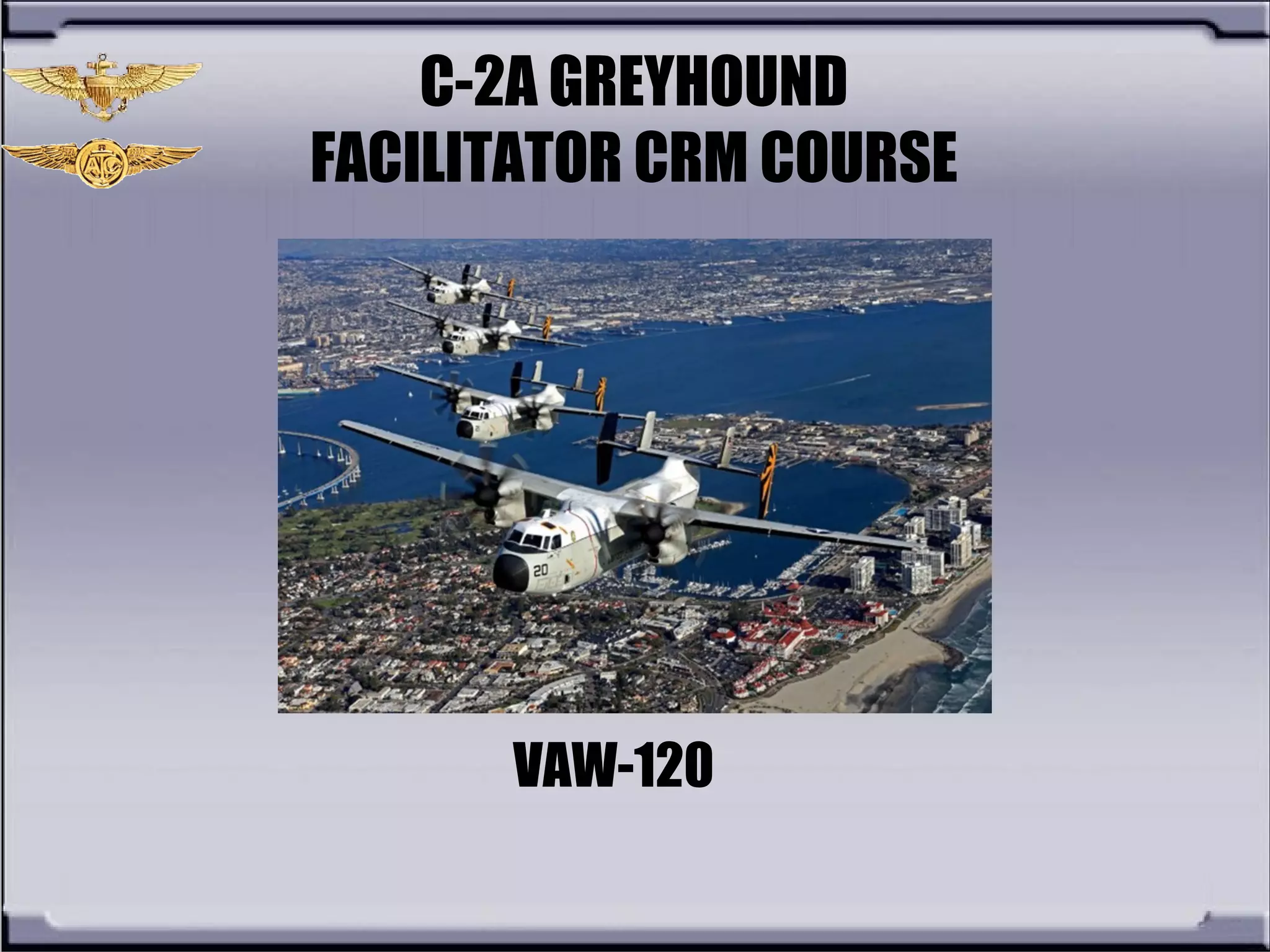
C-2A GREYHOUND
FACILITATOR CRM COURSE
VAW-120
2
OVERVIEW
INTRODUCTIONINTRODUCTION
CRM HISTORYCRM HISTORY
CRM PROGRAMCRM PROGRAM
SEVEN SKILLS OVERVIEWSEVEN SKILLS OVERVIEW
SEVEN SKILLS EXPANDEDSEVEN SKILLS EXPANDED
PRESENTATION TECHNIQUESPRESENTATION TECHNIQUES
REVIEWREVIEW
SUMMARYSUMMARY
PRIVILEGED
3
• For Official Use Only
• This brief contains privileged, limited-use, limited-
distribution information. unauthorized disclosure of
the information in this brief or its supporting
enclosures by military personnel is a criminal offense
punishable under article 92, uniform code of military
justice. unauthorized disclosure of the information in
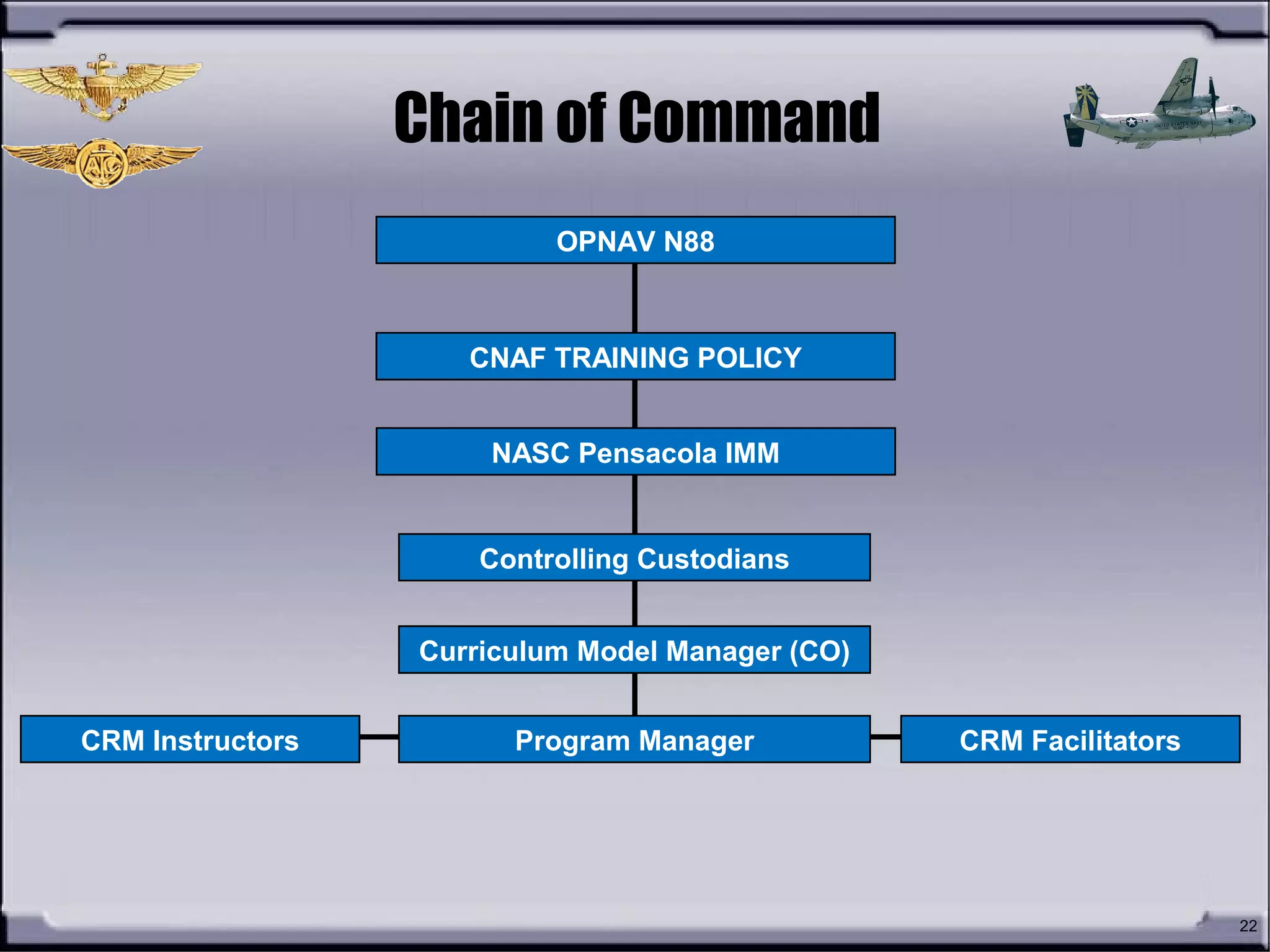
this report or its supporting enclosures by civilian
personnel will subject them to disciplinary action
under civilian personnel instruction 752.
4
Rules of Engagement
• Your active participation
– What experiences you have had
– What potential incidents you have avoided
– What importance you place on CRM
• Application of CRM skills is …
Your ResponsibilityYour Responsibility
Learn from others’ mistakes, because you’re not going to live
long enough to make all of them yourself.
—Roger Coleman, Lead CRM Developer, AAL
Why CRM?
• To IMPROVE MISSION EFFECTIVENESS
of Naval Aviation communities
– minimizing crew preventable errors
– by enhancing crew coordination
– through increased awareness of associated
behavioral skills
5
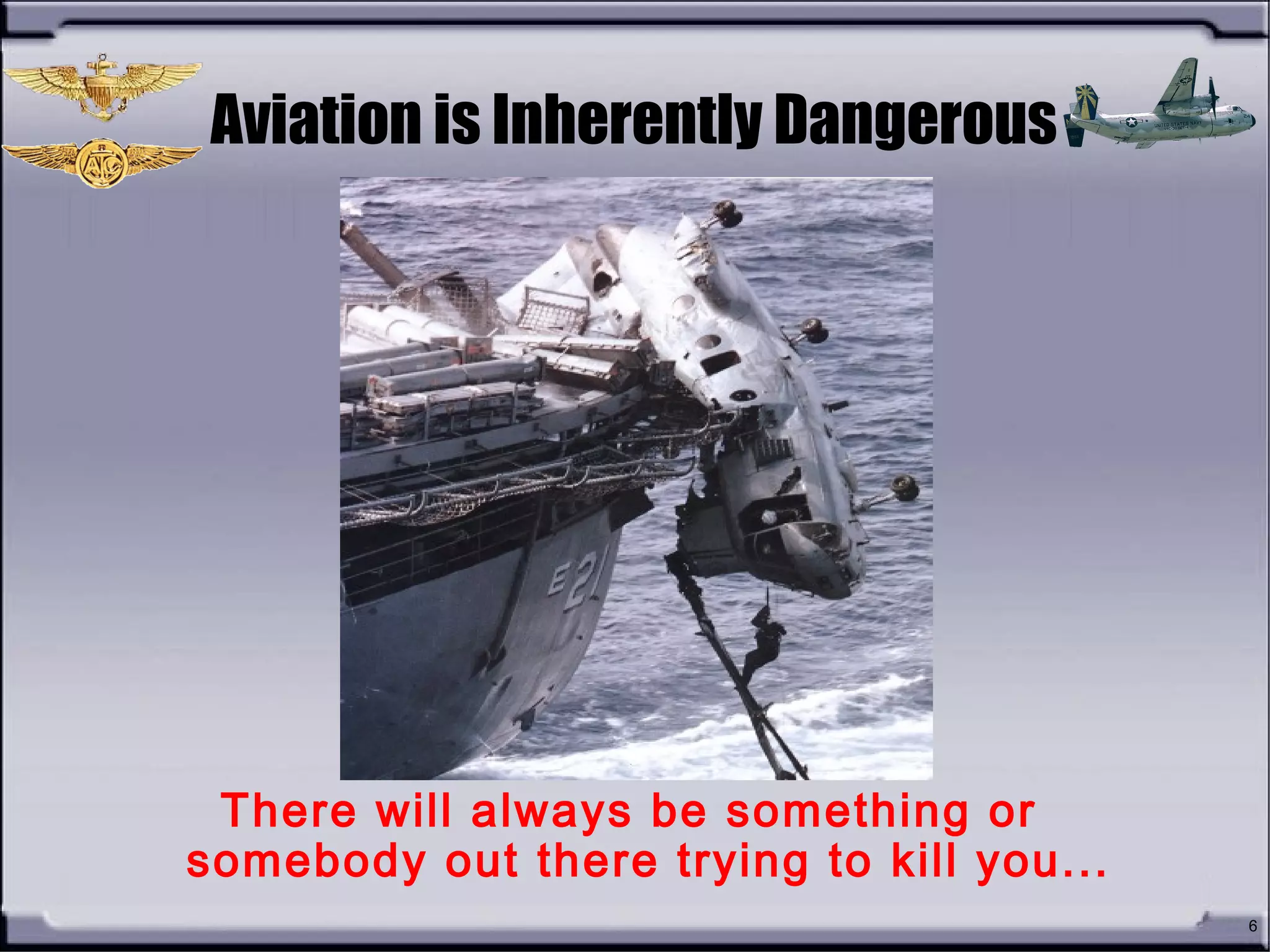
6
Aviation is Inherently Dangerous
There will always be something or
somebody out there trying to kill you...
7
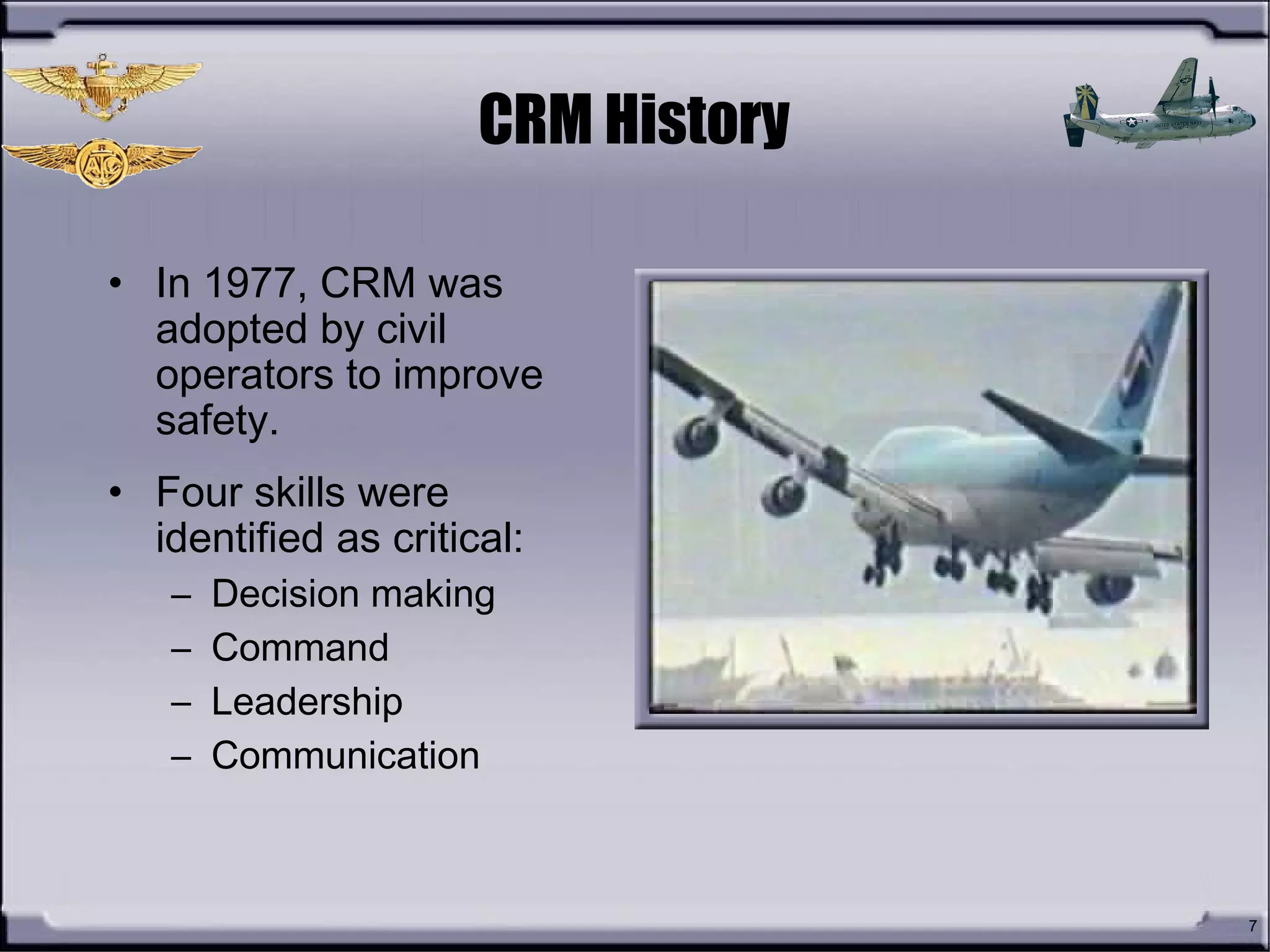
CRM History
• In 1977, CRM was
adopted by civil
operators to improve
safety.
• Four skills were
identified as critical:
– Decision making
– Command
– Leadership
– Communication
8
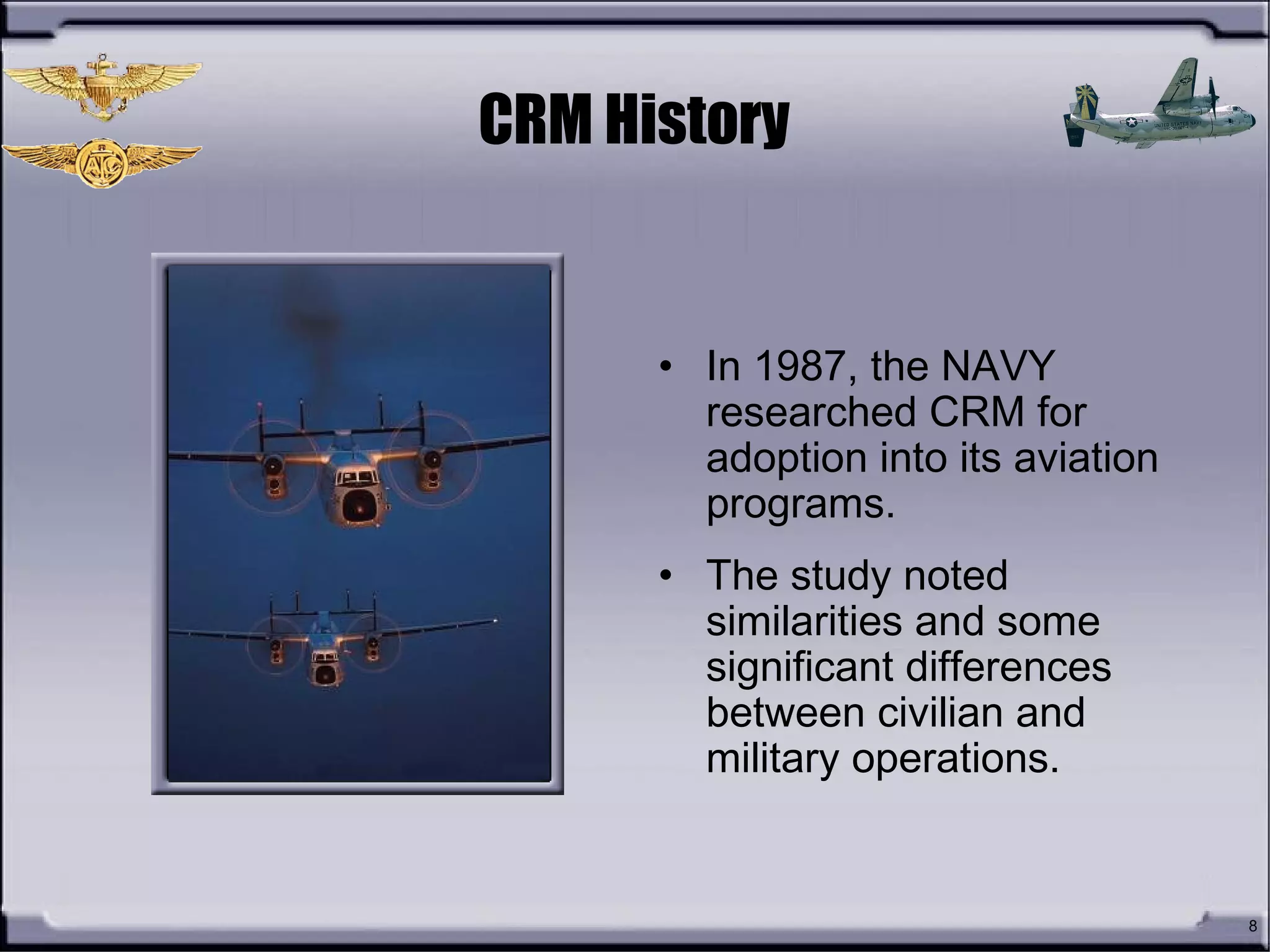
CRM History
• In 1987, the NAVY
researched CRM for
adoption into its aviation
programs.
• The study noted
similarities and some
significant differences
between civilian and
military operations.
9
CRM History
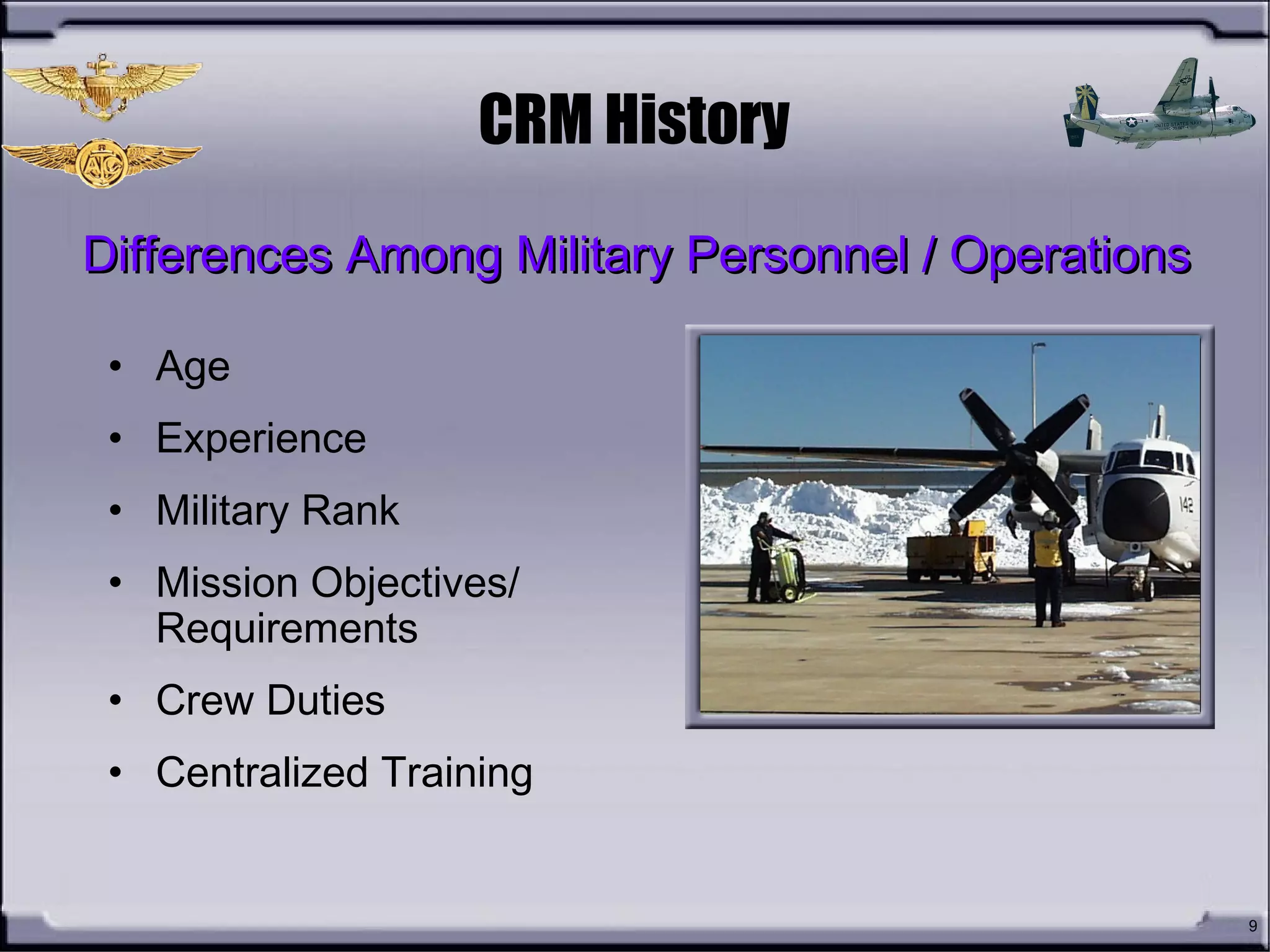
• Age
• Experience
• Military Rank
• Mission Objectives/
Requirements
• Crew Duties
• Centralized Training
Differences Among Military Personnel / OperationsDifferences Among Military Personnel / Operations
10
CRM History
• In 1989, the Naval Air Warfare Center began
R&D on a program to apply CRM to tactical
operations.
• Research identified seven behavioral skills
most common in Naval Aviation.
– Communication
– Leadership
– Adaptability/Flexibility
– Situational Awareness
– Decision Making
– Assertiveness
– Mission Analysis
11
CRM History
• In 1991, the Naval Safety Center found
human error was significant in 50% of all
Class “A” mishaps.
• In 1993, “Interim” Aircrew Coordination
Training (ACT) was implemented.
• In 1995, OPNAVINST 1542.7A established
“Integrated” ACT milestone.
12
CRM History
• In 1998, OPNAVINST 1542.7B established
Aircrew Coordination Training (ACT)
academic requirements/ flight evaluation.
• In 2001, OPNAVINST 1542.7C changed the
ACT program’s name to Crew Resource
Management (CRM).
13
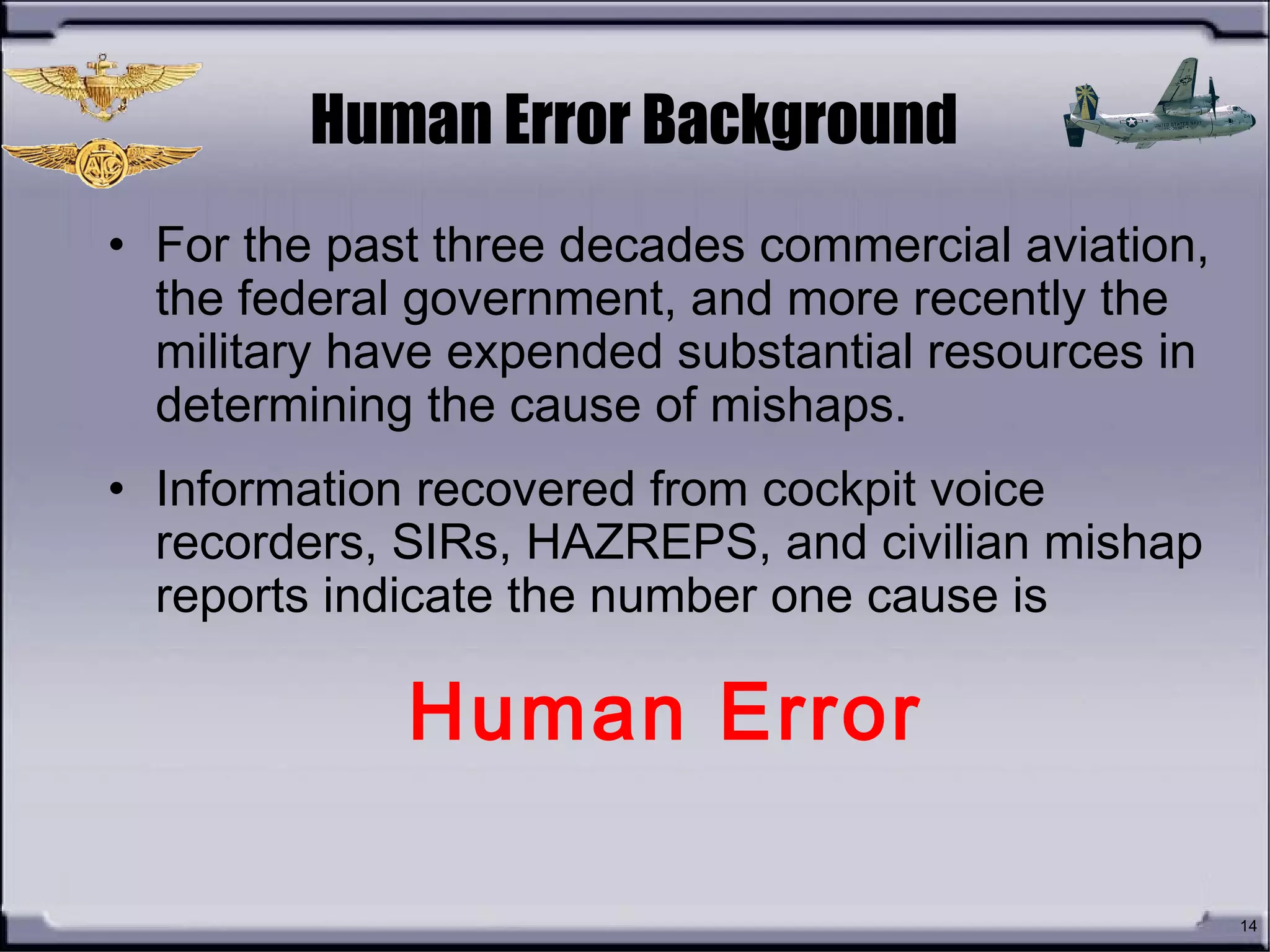
Mishap History
“Human beings by their very nature make mistakes; therefore, it’s
unreasonable to expect error-free human performance”
—Shappell & Wiegmann, 1997
14
• For the past three decades commercial aviation,
the federal government, and more recently the
military have expended substantial resources in
determining the cause of mishaps.
• Information recovered from cockpit voice
recorders, SIRs, HAZREPS, and civilian mishap
reports indicate the number one cause is
Human Error
Human Error Background
15
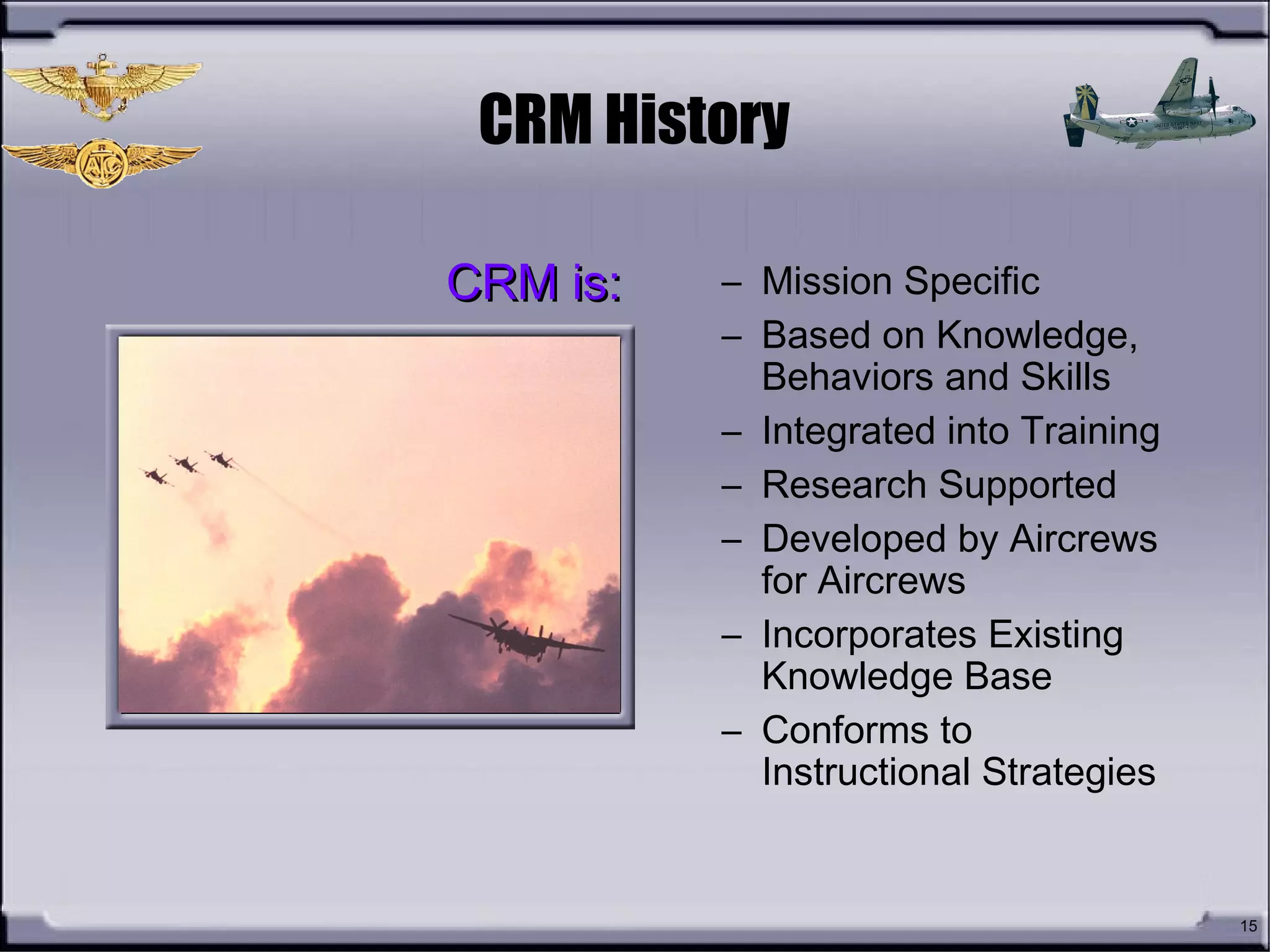
CRM History
– Mission Specific
– Based on Knowledge,
Behaviors and Skills
– Integrated into Training
– Research Supported
– Developed by Aircrews
for Aircrews
– Incorporates Existing
Knowledge Base
– Conforms to
Instructional Strategies
CRM is:CRM is:
16
CRM Future in Navy/ USMC
• Continued integration of CRM concepts into
procedures and NATOPS
• Specific CRM simulator training
• Computer Aided Debriefing Systems
• More focus on individual error prevention/mitigation
• Alignment with ICAO standards Data collection and
trend analysis
• Automation
• CRM application to other fields
17
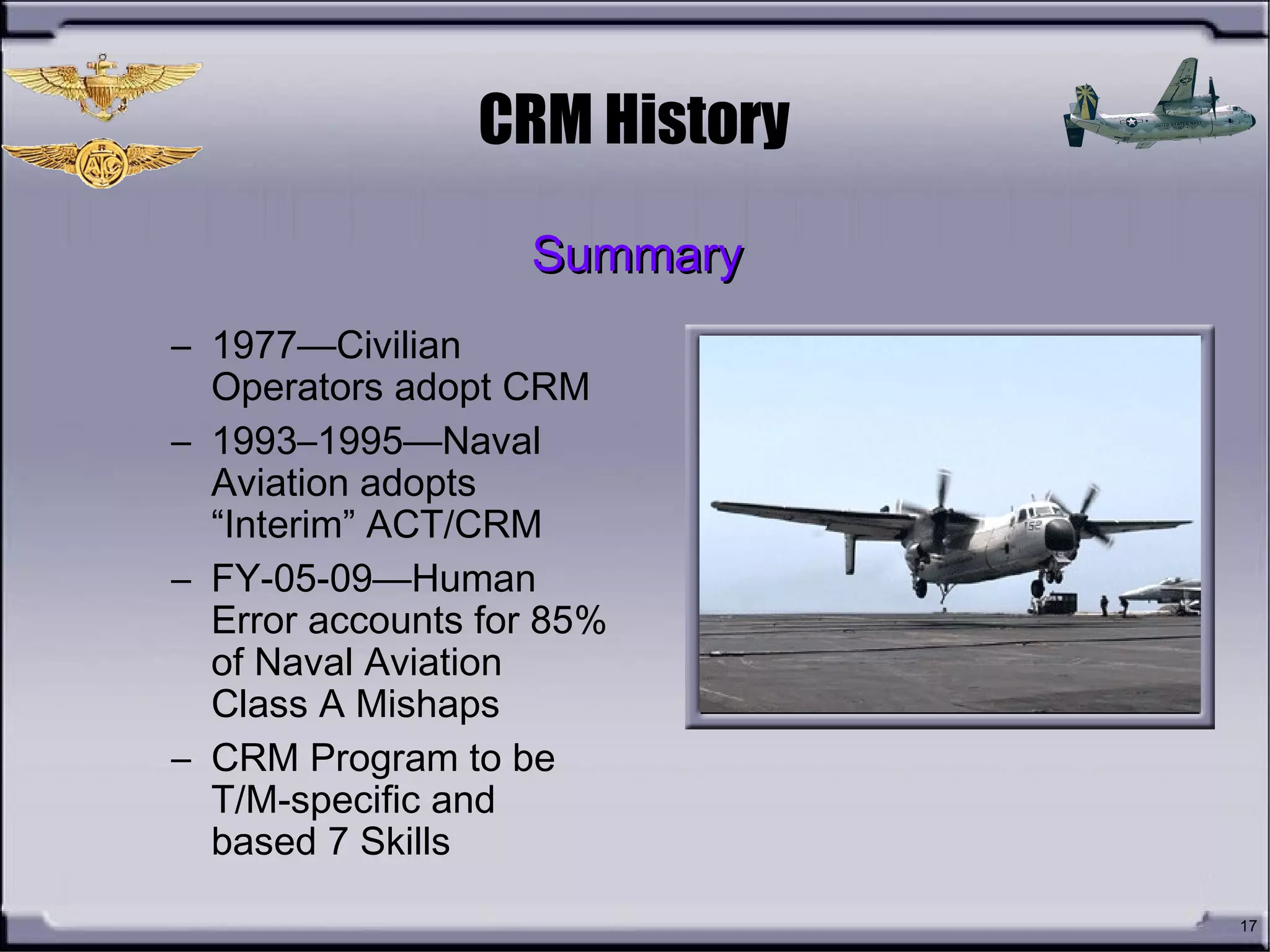
CRM History
– 1977—Civilian
Operators adopt CRM
– 1993–1995—Naval
Aviation adopts
“Interim” ACT/CRM
– FY-05-09—Human
Error accounts for 85%
of Naval Aviation
Class A Mishaps
– CRM Program to be
T/M-specific and
based 7 Skills
SummarySummary
18
DiscussionDiscussion
19
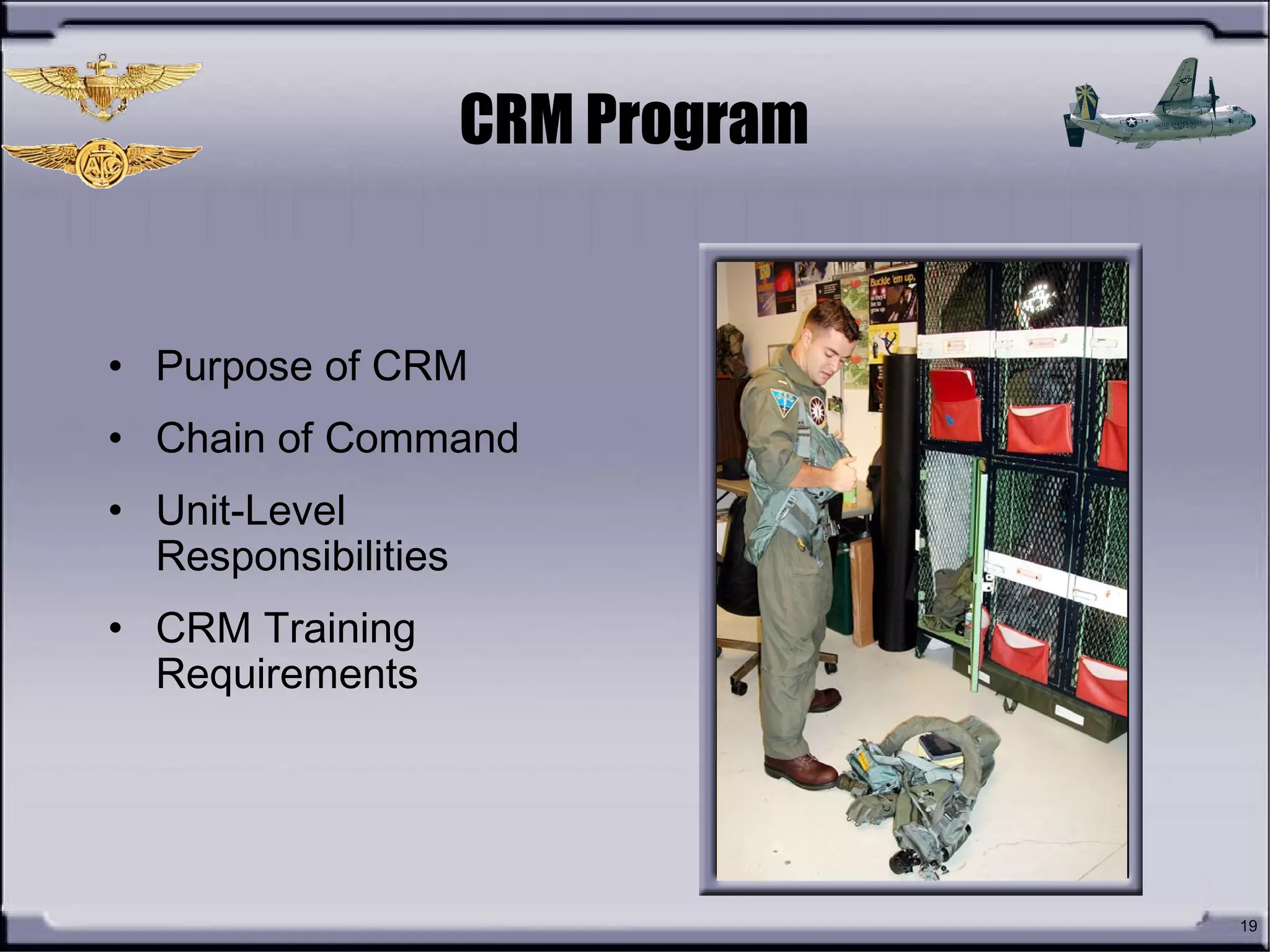
CRM Program
• Purpose of CRM
• Chain of Command
• Unit-Level
Responsibilities
• CRM Training
Requirements
20
Purpose of CRM
• To IMPROVE MISSION EFFECTIVENESS
of Naval Aviation communities
– by enhancing crew coordination
– through increased awareness of associated
behavioral skills
21
Purpose of
CNAFINST 1542.7 Series
• To establish policies, responsibilities and
procedures for administration of the Crew
Resource Management (CRM) program
– Establishes CRM content
– Defines conduct/type of training
– Delineates documentation requirements
– Assigns CRM responsibilities
22
Chain of Command
Controlling Custodians
NASC Pensacola IMM
Curriculum Model Manager (CO)
Program ManagerCRM Instructors CRM Facilitators
CNAF TRAINING POLICY
OPNAV N88
23
Curriculum Model Manager
(CMM)
• CO of a model manager squadron (VAW-120)
• CRM training program for T/M/S
• Correct number of CRM-I and CRM-F
• Coordinate with T/M NATOPS Model Manager
• Sets focus for the community
24
CRM Program Manager (PM)
• A CRM-I designated by the CMM
• Currently: LT HAWKE
• T/M/S SME and fleet POC
• Develop aircraft-specific integrated CRM
programs
• Ensure curriculum current and relevant
• Provide CRM materials to the IMMs
25
CRM Instructor (CRM-I)
• Train new CRM facilitators
• Conduct annual training and check rides
• Assist PM in distribution and standardization
of CRM materials
26
CRM Facilitator (CRM-F)
• Conduct and document annual CRM training
• Submit changes (NATOPS, 1542)
• Feedback to Program Manager
• Check rides
• All FRS Pilot and Aircrew Instructors are
made Facilitators as part of the IUT
Syllabus/Check In.
27
Instructor vs. Facilitator
•NATOPS Qualified O-3/E-5 or
above
•Graduate of both the NASC IMM
CRM Instructor’s Course AND
the Curriculum Program
Manager’s CRM Facilitator
Course
•Designated in writing by the
Type/Model Curriculum Model
Manager
•Qualified to train CRM
Facilitators
• Curriculum Model Manager
establishes minimum
experience level requirements
•Graduate of Curriculum
Program Manager’s CRM
Facilitator Course (T/M
specific)
•Designated in writing by the
unit CO
•Qualified to conduct CRM
initial and refresher training
28
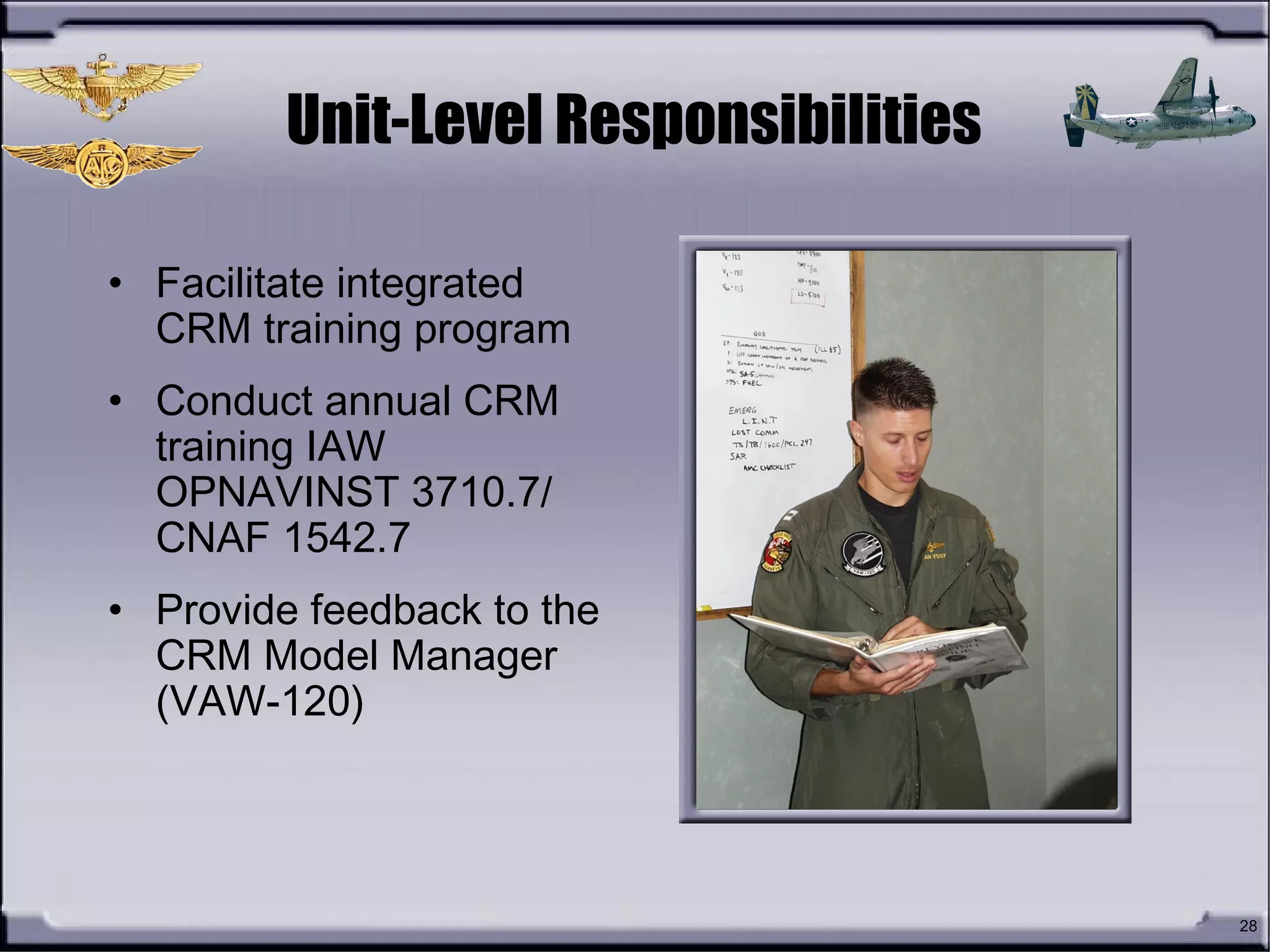
Unit-Level Responsibilities
• Facilitate integrated
CRM training program
• Conduct annual CRM
training IAW
OPNAVINST 3710.7/
CNAF 1542.7
• Provide feedback to the
CRM Model Manager
(VAW-120)
29
CRM training shall be conducted byCRM training shall be conducted by
a designated instructor or facilitatora designated instructor or facilitator
CRM Ground Training
INITIALINITIAL
• Shall occur during
undergraduate aviation
training and during all
fleet replacement/ initial
training leading to T/M
aircrew designation
REFRESHERREFRESHER
• Shall occur annually
while in a flight billet
Specific CRM qualification is required forSpecific CRM qualification is required for
operation of each aircraft T/M/S.operation of each aircraft T/M/S.
30
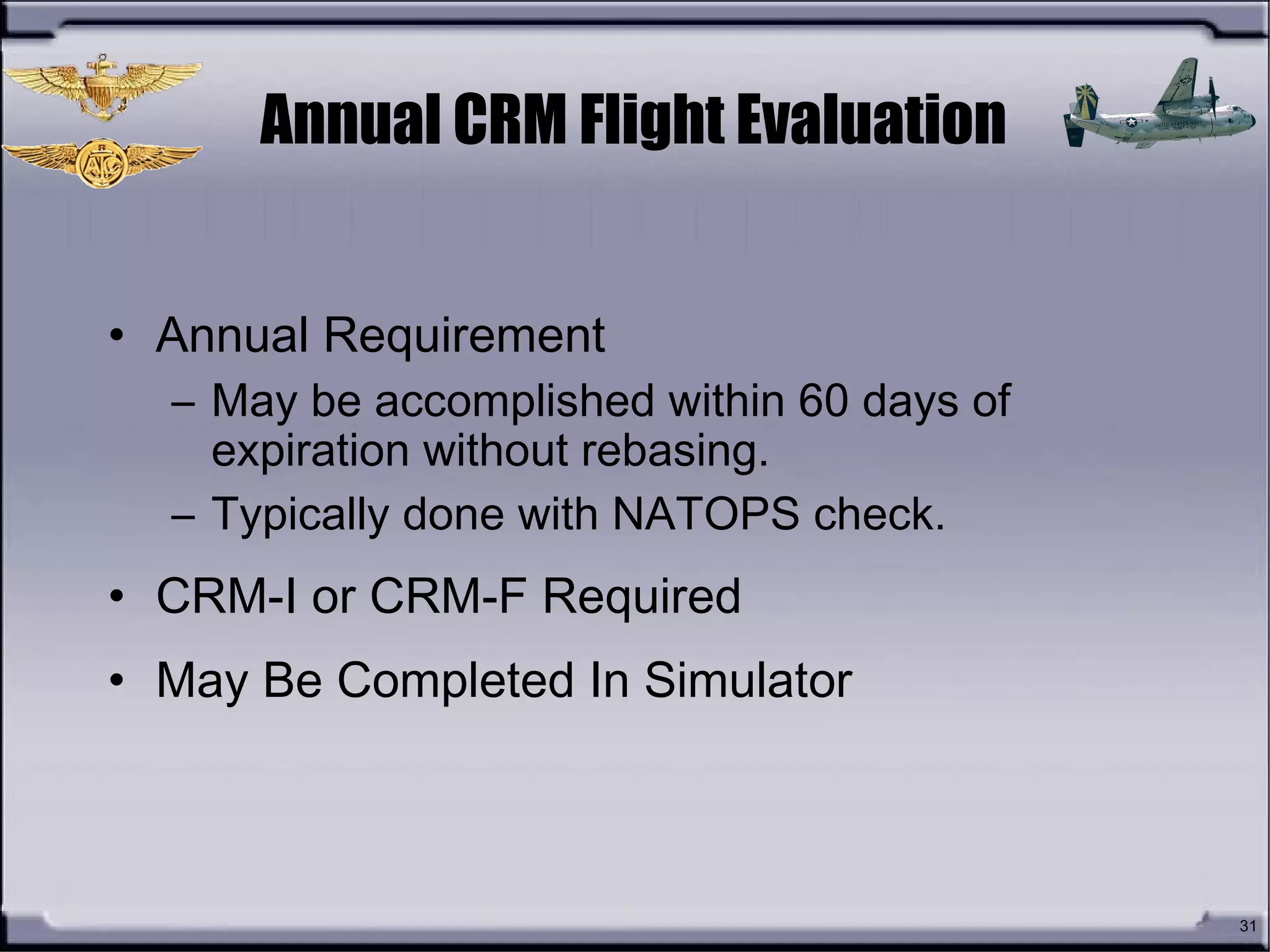
CRM Ground Training
• CRM Principles and Seven
Critical CRM Skills
• Topics Of Concern / Recent
Trends
• T/M-Specific Case Study/
Scenario
• Open and Frank Discussion
on Current State of CRM
• Must use PowerPoint
developed by CRM Model
Manager.
Annual Ground Training RequirementsAnnual Ground Training Requirements
COMNAVAIRFORINST 1542.7A, PARA. 7-D
Annual CRM Flight Evaluation
• Annual Requirement
– May be accomplished within 60 days of
expiration without rebasing.
– Typically done with NATOPS check.
• CRM-I or CRM-F Required
• May Be Completed In Simulator
31
32
• Must be entered into NATOPS Jacket
• Section II, Part C
• Utilize CNAFINST 1542.7 encl. 3
• NATOPS Check Paperwork Shall State
“Conducted CRM flight evaluation per
CNAFINST 1542.7A.”
Training Documentation
33
Training Documentation
• COs may grant extensions for deployed
aircrew whose CRM training will expire.
• Extensions shall not exceed 90 days after
return from deployment.
• Document all extensions in NATOPS jacket.
• REBASE YOUR DETS! DON’T PLAN ON
EXTENSIONS.
ExtensionsExtensions
34
Training Documentation
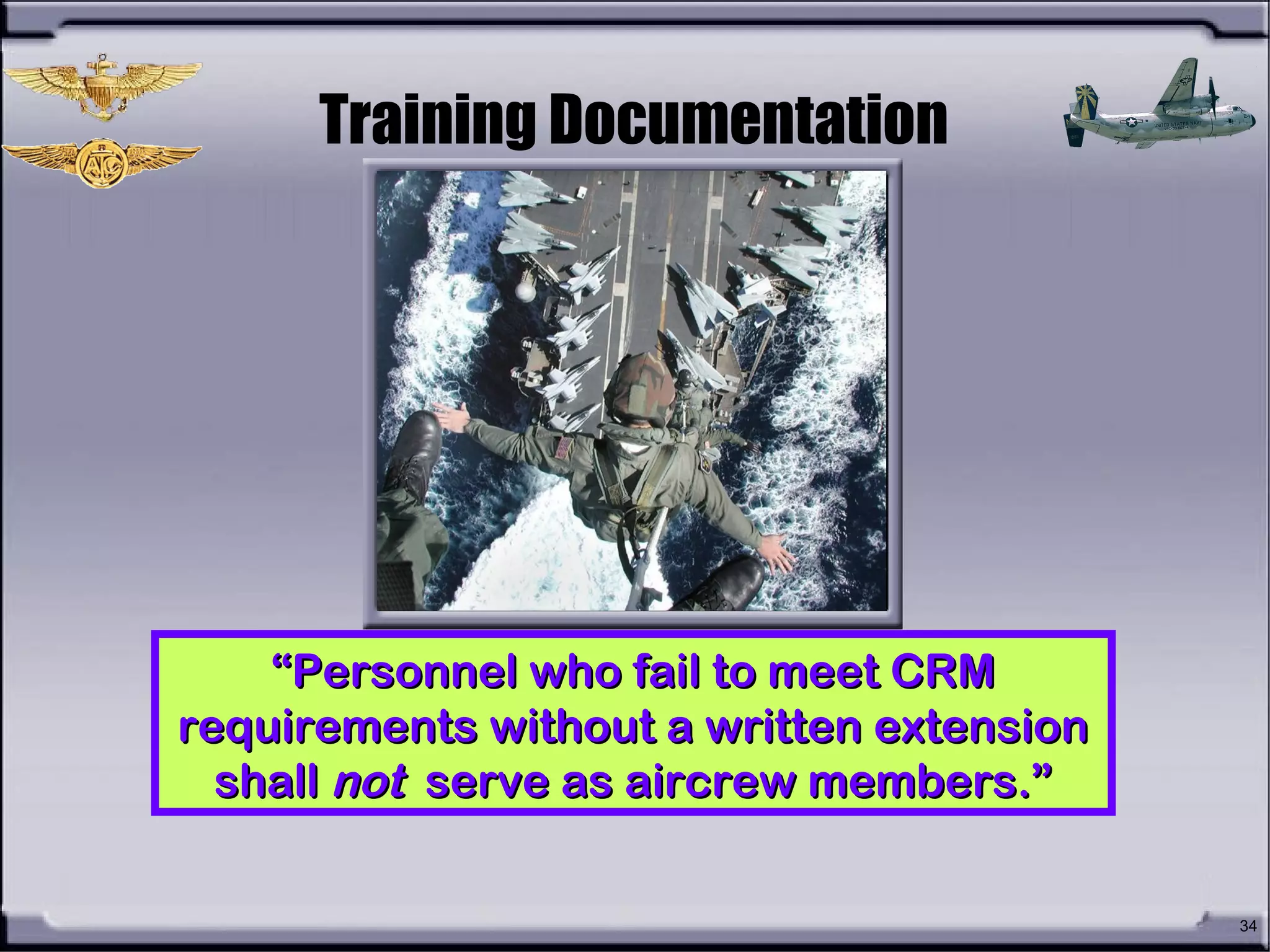
““Personnel who fail to meet CRMPersonnel who fail to meet CRM
requirements without a written extensionrequirements without a written extension
shallshall notnot serve as aircrew members.”serve as aircrew members.”
35
CRM Program
• Purpose of CRM Program
• Chain of Command
• Unit-Level Responsibilities
• Training Policies
• Qualifications/Evaluation
• Extensions
SummarySummary
36
QUESTIONS?QUESTIONS?
37
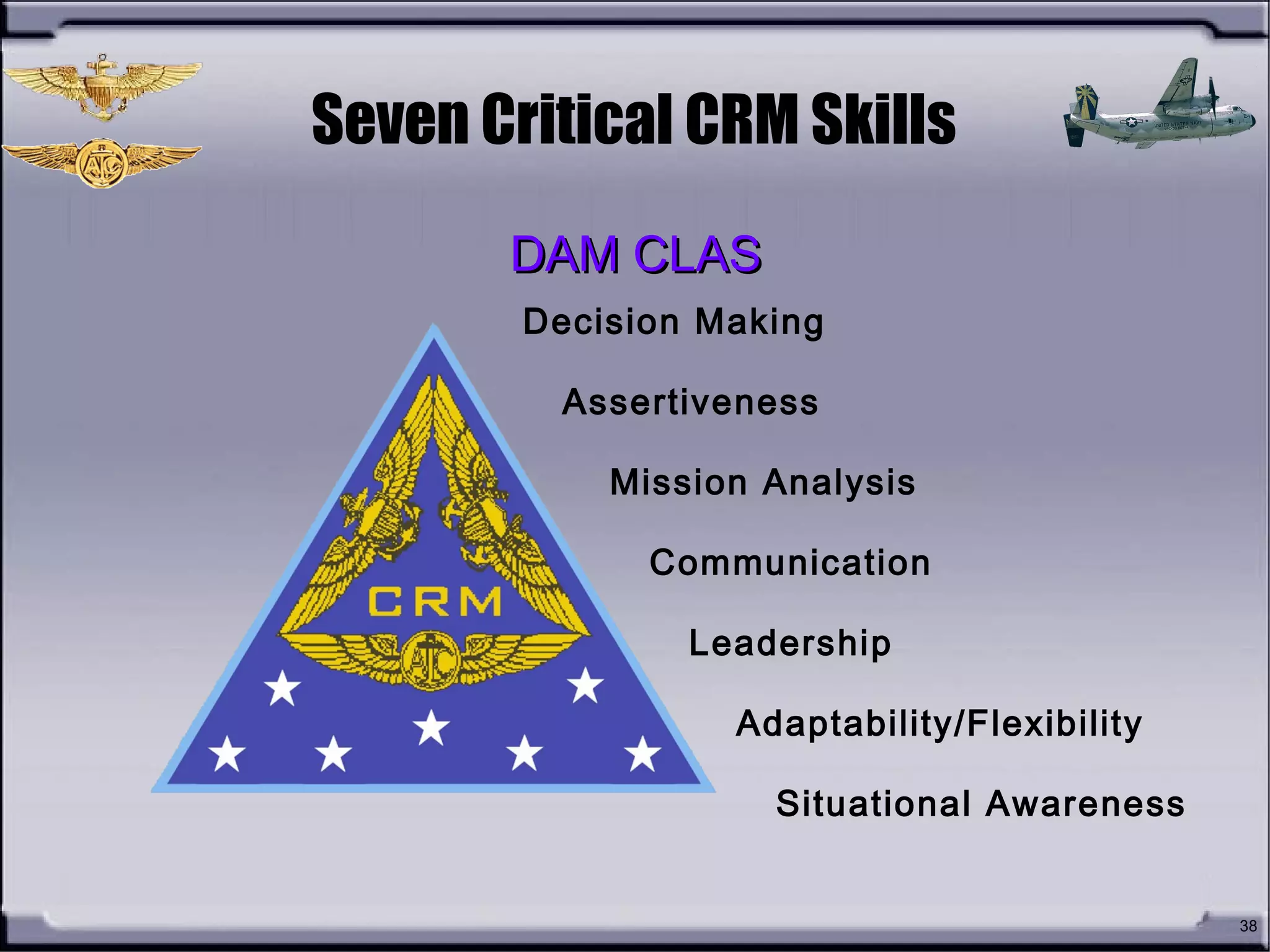
Seven Critical CRM Skills
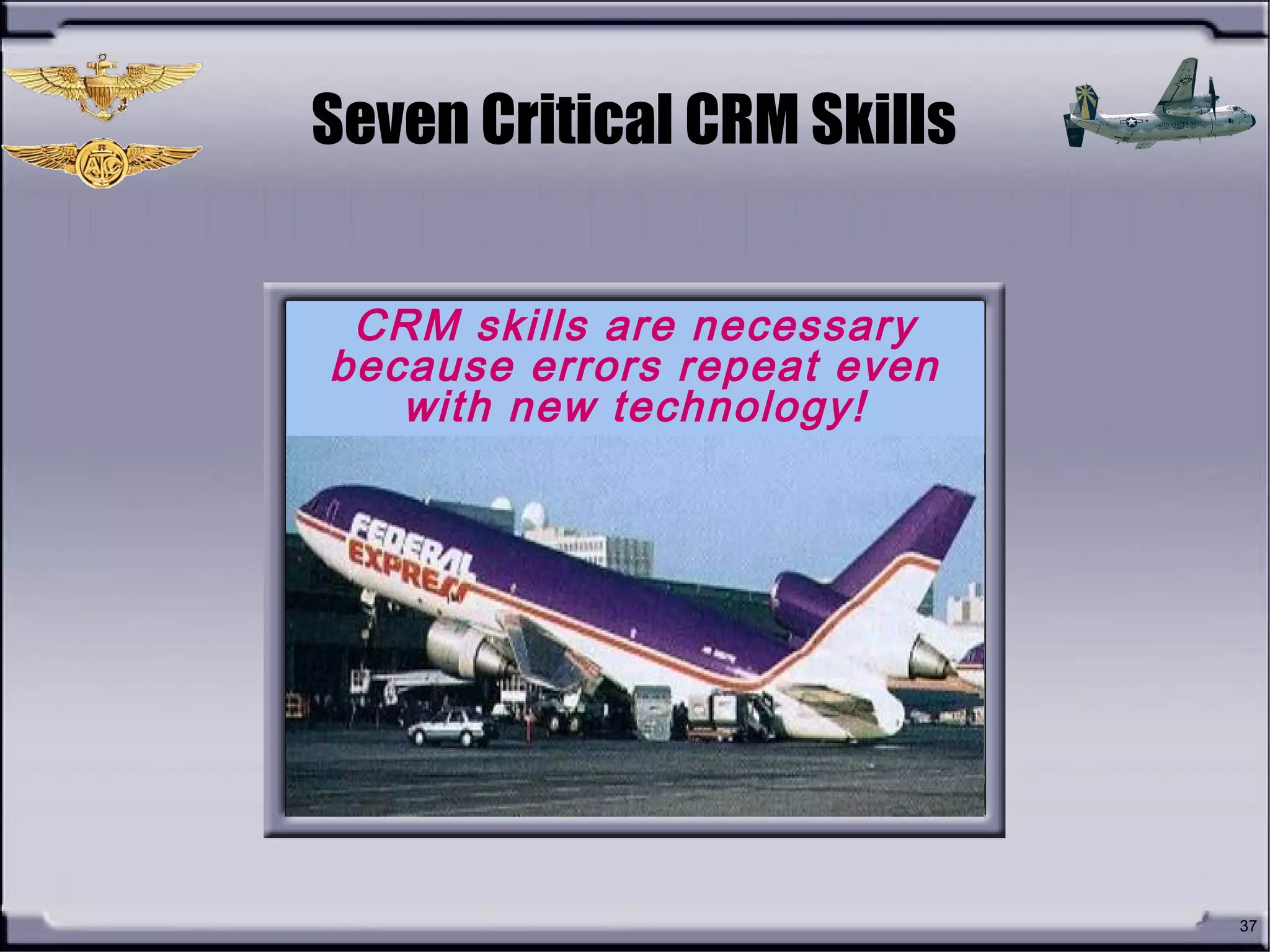
CRM skills are necessary
because errors repeat even
with new technology!
38
Decision Making
Assertiveness
Mission Analysis
Communication
Leadership
Adaptability/Flexibility
Situational Awareness
Seven Critical CRM Skills
DAM CLASDAM CLAS
• How do you define
Decision Making?
39
Decision Making
Definition:
The ability to choose a course of action
using logical and sound judgment based
on available information.
Definition:
The ability to choose a course of action
using logical and sound judgment based
on available information.
40
Decision Making
• Question:
How do hazardous
attitudes affect
decision making?
Negative Effect:Negative Effect:
• Peer pressurePeer pressure
• Mind setMind set
• ““Get home-itis”Get home-itis”
• Getting behind theGetting behind the
aircraftaircraft
41
Decision Making
in the C-2A
• C-2 Capabilities vs. Air
Wing Desires
• Detailed Preflight
Planning vs. “Canned
Route” Attitude
• Any member of a
Detachment can end up
being put in a position
where they need to
speak for the OIC
• What is
Assertiveness?
42
Assertiveness
Definition:
The willingness/readiness to actively
participate, state and maintain a position
until convinced by the facts that other
options are better.
Definition:
The willingness/readiness to actively
participate, state and maintain a position
until convinced by the facts that other
options are better.
43
Assertiveness
• Question:
When is it appropriate
to be assertive?
Speak up when youSpeak up when you
encounter:encounter:
• Unclear mission objectivesUnclear mission objectives
• Overly aggressive orOverly aggressive or
passive crewmemberspassive crewmembers
• Conflict in the aircraftConflict in the aircraft
• Issues not addressed in theIssues not addressed in the
debriefdebrief
Whenever your comfort level is exceeded…
SPEAK UP !
44
Assertiveness
in the C-2A
• 3P vs Aircraft
Commander
• Aircraft Commander vs
Aircraft Commander
• 2P/2P Flights
• C-2 vs Air Wing/Air
Boss/Flight Deck
Handler
• How do you define
Mission Analysis?
45
Definition:
The ability to develop short-term, long-term
and contingency plans and to coordinate,
allocate and monitor crew and aircraft
resources.
Definition:
The ability to develop short-term, long-term
and contingency plans and to coordinate,
allocate and monitor crew and aircraft
resources.
Mission Analysis
46
Mission Analysis
• Question:
What are three
components of Mission
Analysis?
• Planning and preparationPlanning and preparation
• Monitoring inflight missionMonitoring inflight mission
progressprogress
• Postflight debriefingPostflight debriefing
47
Mission Analysis
in the C-2A
• How good is your
Debrief?
• What is
Communication?
48
Communication
Definition:
The ability to clearly and accurately send
and acknowledge information, instructions,
or commands, and provide useful feedback.
Definition:
The ability to clearly and accurately send
and acknowledge information, instructions,
or commands, and provide useful feedback.
49
Communication
• Question:
When can experience in
flight be a barrier to
communication?
• Less experience—Less experience—
Less likely to speak upLess likely to speak up
• More experience—More experience—
May resist change and theMay resist change and the
need to adaptneed to adapt
50
Communication
in the C-2A
• Detachment personality
dynamics
• Enlisted Aircrew/Pilot
relationship
• Ship to Shore
Communication
• How do you define
Leadership?
51
Leadership
Definition:
The ability to direct/coordinate the activities
of other crewmembers or wingmen, and to
encourage them to work together as a team.
Definition:
The ability to direct/coordinate the activities
of other crewmembers or wingmen, and to
encourage them to work together as a team.
52
Leadership
• Question:
What are some
leadership traits that
inspire peak
performance in a crew?
• DecisiveDecisive
• CompetentCompetent
• Keeping crew informedKeeping crew informed
• Open to suggestionsOpen to suggestions
• Leading by exampleLeading by example
• TrustTrust
53
Leadership
in the C-2A
• C-2 Pilots have to grow
up fast
• Any member of a Det
can be cornered by
CAG, Flag, etc
• Leadership challenges
associated with being
on perpetual “Port Call”
• What is Adaptability/
Flexibility?
54
Adaptability/ Flexibility
Definition:
The ability to alter a course of action based
on new information, maintain constructive
behavior under pressure and adapt to
internal/external environmental changes.
Definition:
The ability to alter a course of action based
on new information, maintain constructive
behavior under pressure and adapt to
internal/external environmental changes.
55
Adaptability/ Flexibility
• Question:
What are some
situations that require
Adaptability/ Flexibility?
• Routine becomes anRoutine becomes an
emergencyemergency
• Inclement weatherInclement weather
• CV environmentCV environment
• Changing primaryChanging primary
missionmission
56
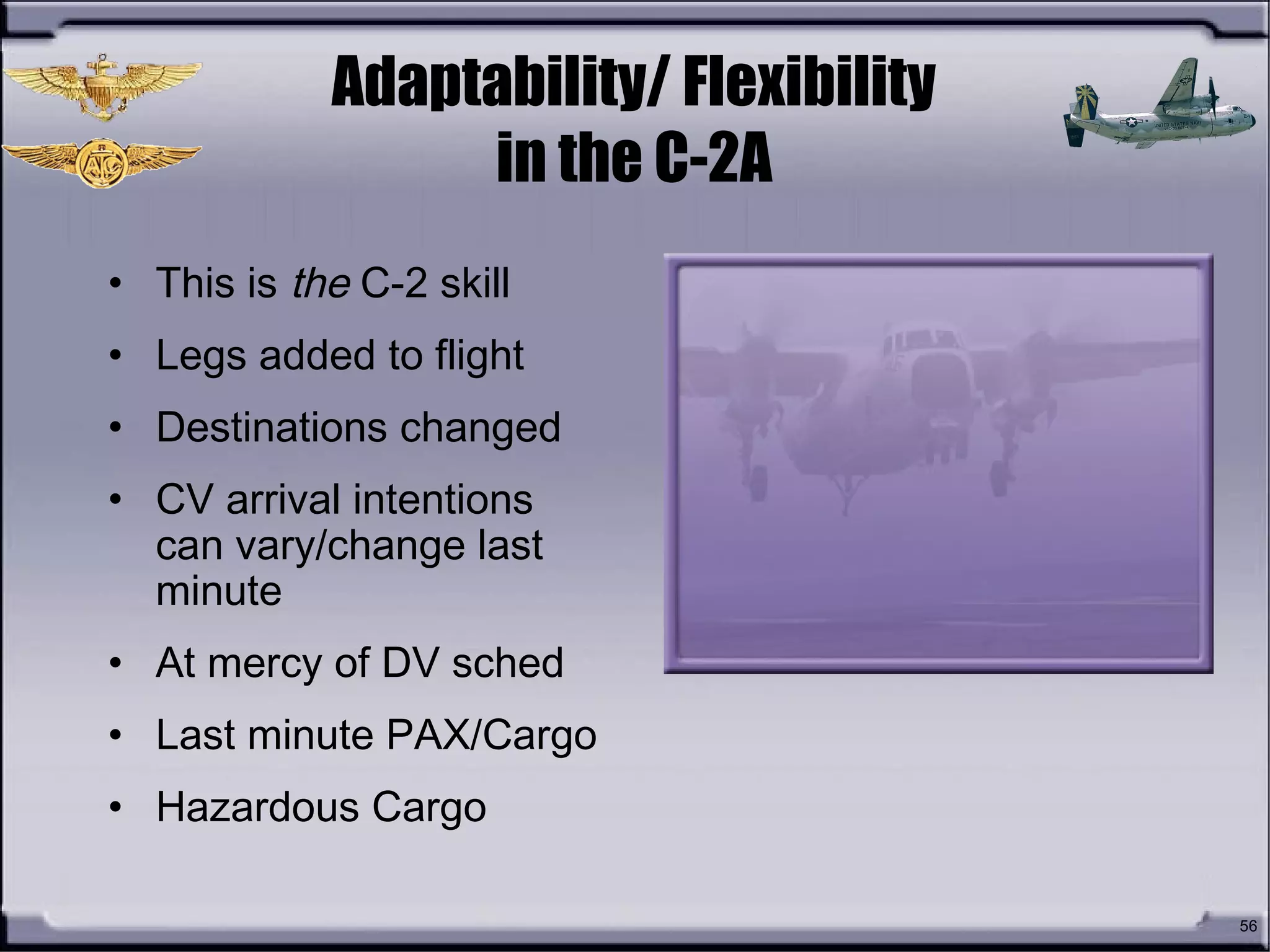
Adaptability/ Flexibility
in the C-2A
• This is the C-2 skill
• Legs added to flight
• Destinations changed
• CV arrival intentions
can vary/change last
minute
• At mercy of DV sched
• Last minute PAX/Cargo
• Hazardous Cargo
• What is
Situational
Awareness?
?
57
Situational Awareness
Definition:
The degree of accuracy by which one’s
perception of the current environment
mirrors reality.
Definition:
The degree of accuracy by which one’s
perception of the current environment
mirrors reality.
58
Situational Awareness
• Question:
If good situational
awareness means
looking around at what’s
happening, what else
must be recognized?
• What led to the presentWhat led to the present
situation?situation?
• What will happen in theWhat will happen in the
next 30 seconds,next 30 seconds,
10 minutes, etc?10 minutes, etc?
• Crosschecking andCrosschecking and
communicationcommunication
59
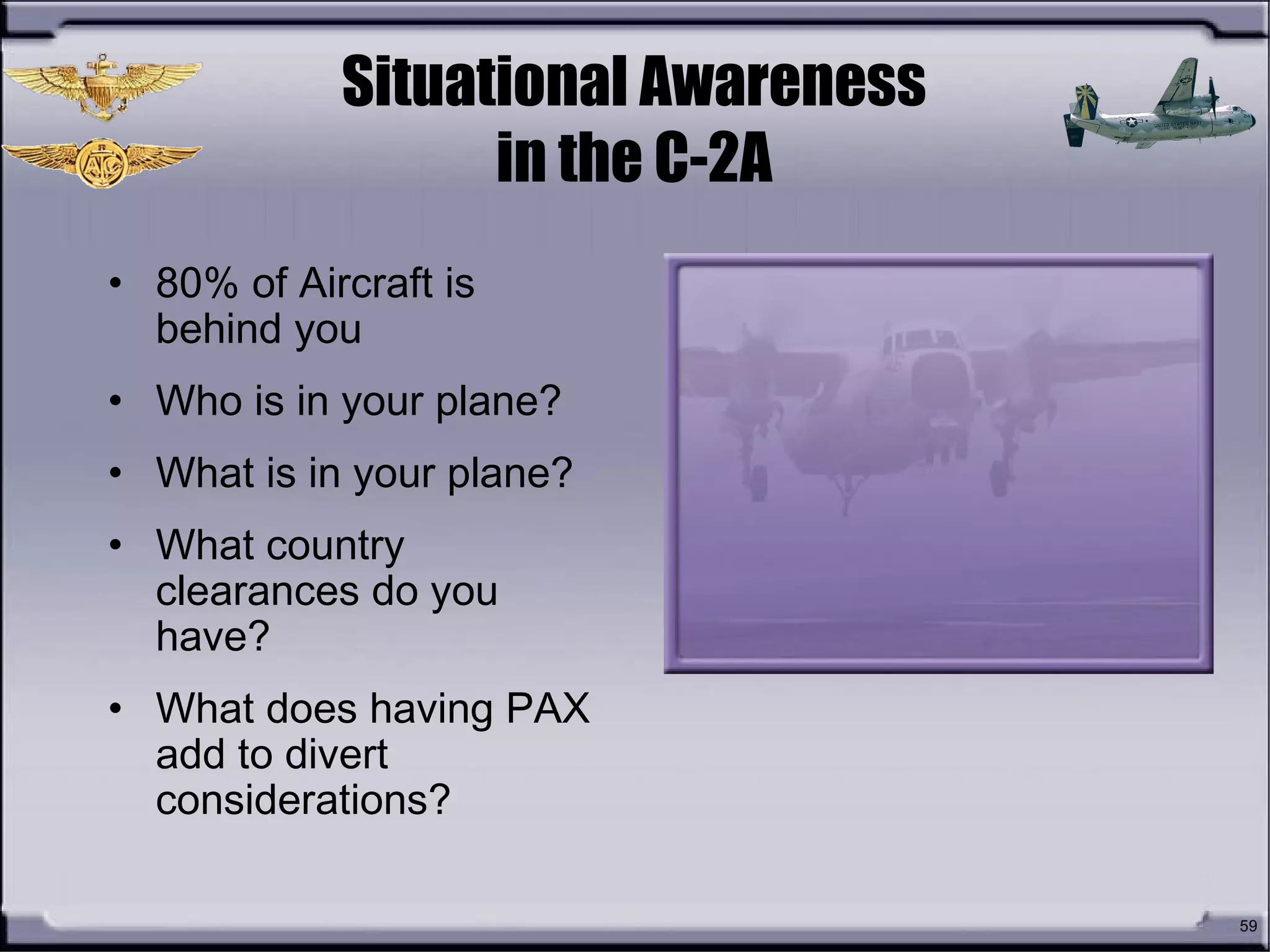
Situational Awareness
in the C-2A
• 80% of Aircraft is
behind you
• Who is in your plane?
• What is in your plane?
• What country
clearances do you
have?
• What does having PAX
add to divert
considerations?
INSTRUCTIONINSTRUCTION
TECHNIQUESTECHNIQUES
60
• Several polls have been conducted
during the last decade, asking
Americans what they fear the most.
• The number 1 response, which is above
even death--by as much as a 2-1 margin
is…..
Adults #1 Fear…
Stage Fright
“The human brain is a wonderful
thing. It operates from the
moment you’re born until the first
time you get up to make a
speech.”
--Howard Goshorn
Principles of Communication
• Desire to communicate
Principles of Communication
• Desire to communicate
• Believe in what you say
Principles of Communication
• Desire to communicate
• Believe in what you say
• Know your subject
Principles of Communication
• Desire to communicate
• Believe in what you
say
• Know your subject
• Know your audience
Principles of Communication
• Desire to communicate
• Believe in what you say
• Know your subject
• Know your audience
• Deliver with enthusiasm
Principles of Communication
• Desire to communicate
• Believe in what you say
• Know your subject
• Know your audience
• Deliver with enthusiasm
• Rehearse, Rehearse, Rehearse
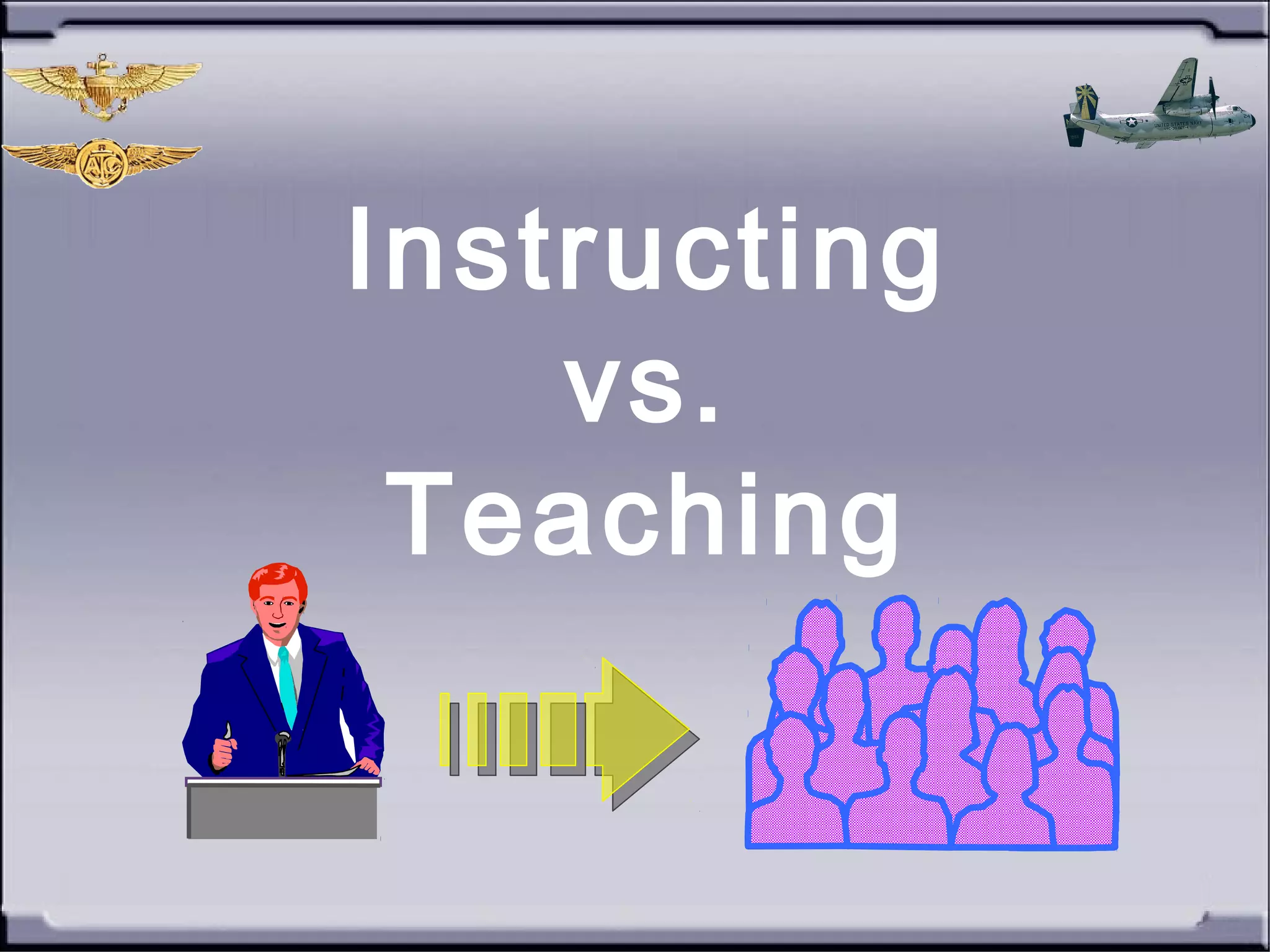
Instructing
vs.
Teaching
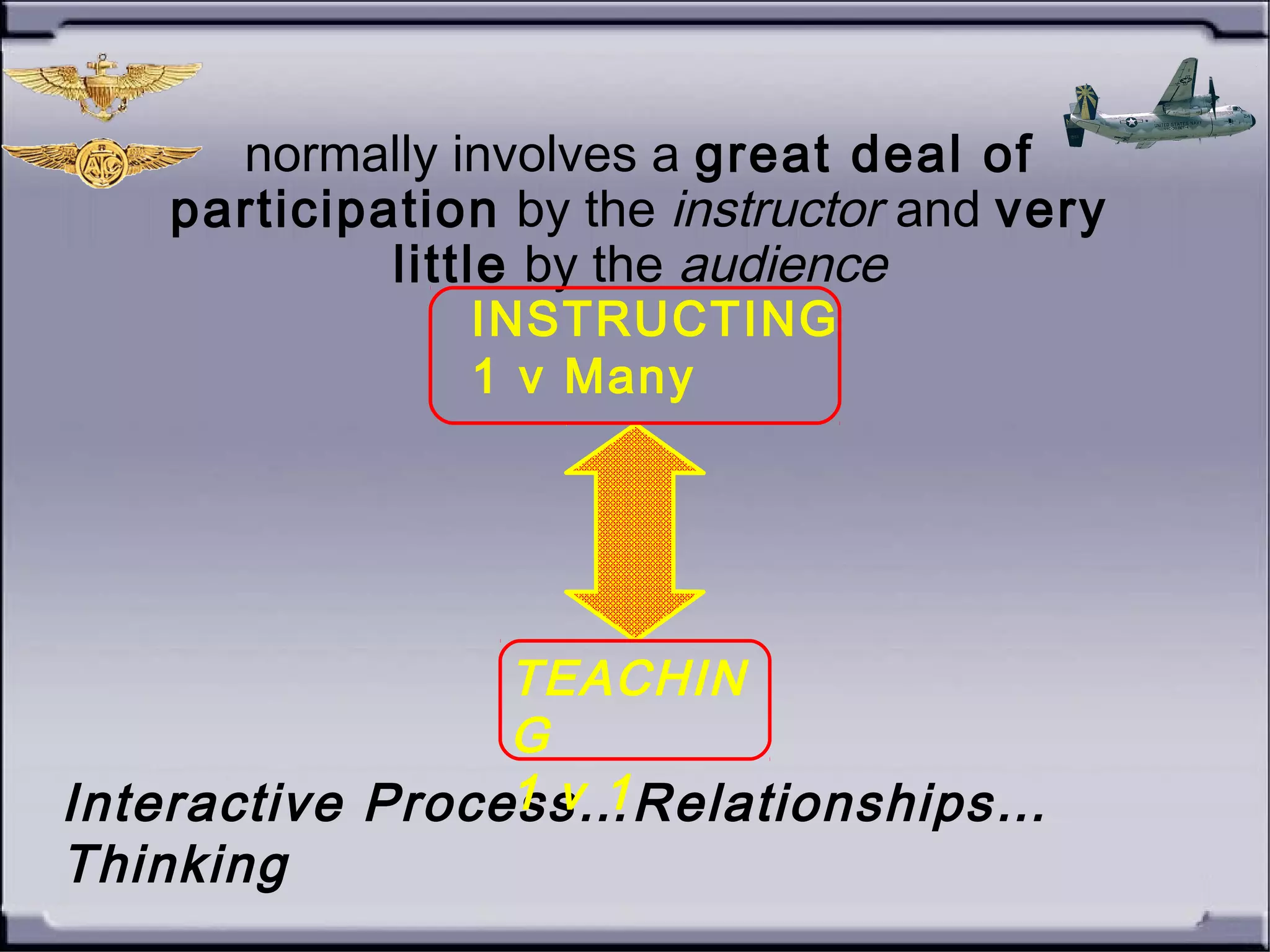
normally involves a great deal of
participation by the instructor and very
little by the audience
Interactive Process…Relationships…
Thinking
INSTRUCTING
1 v Many
TEACHIN
G
1 v 1
3 Basic Questions
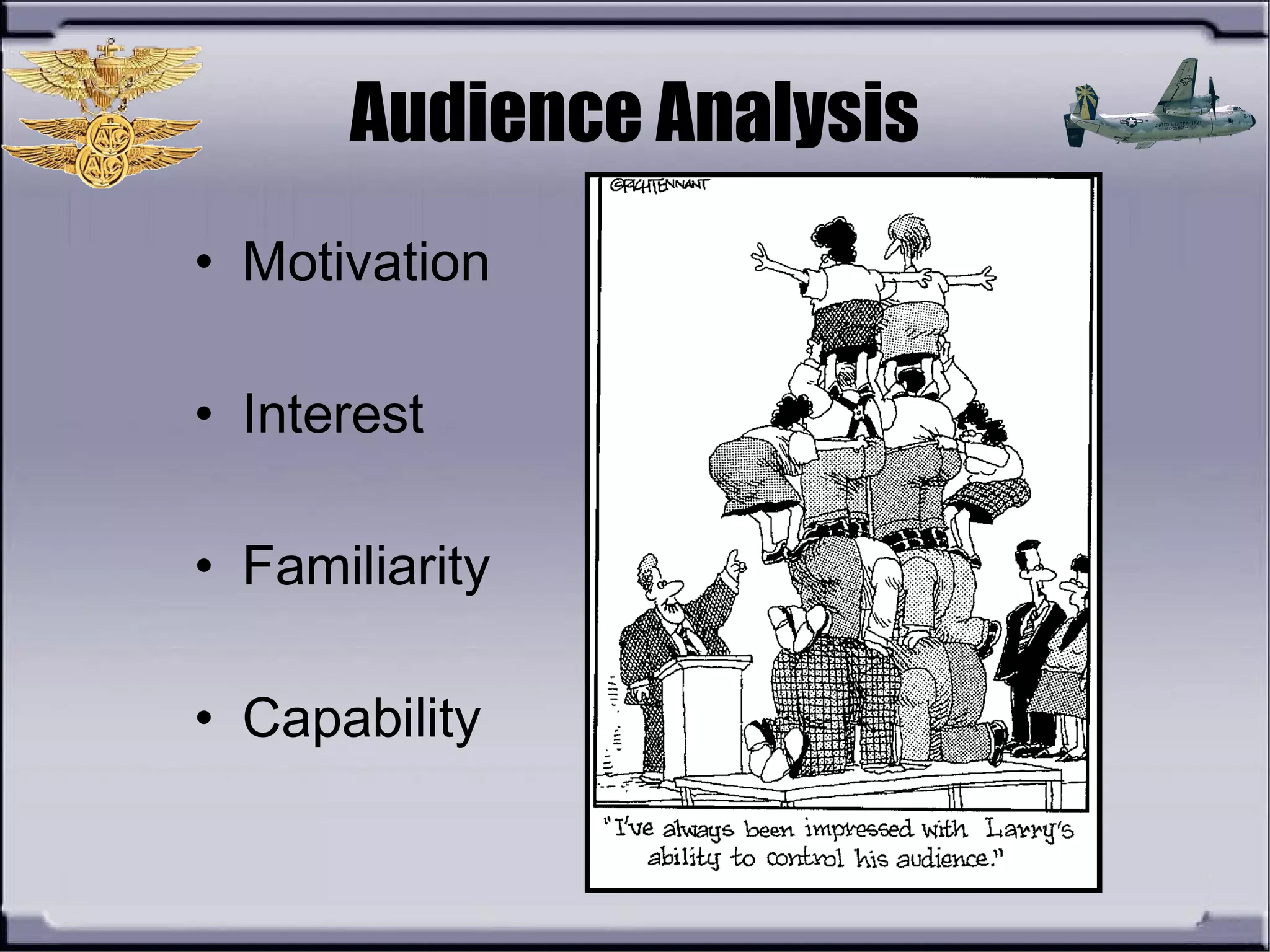
• Audience - Who am I teaching?
• Material - What do they need to know?
• Instructor - How am I going to present it?
Audience Analysis
• Motivation
• Interest
• Familiarity
• Capability
Know the Material
• Read Everything
• Talk to experts – SME’s
• Write Things Down
Remember...
"The mind can only absorb
what the butt can endure.“
Brief Fatigue
Presentation Techniques
• Complete Memorization
• Partial Memorization
• Approximate Memorization
Notes
• Note Cards (3X5)
• Sheets of Paper
– Power Point Notes
Pages
– Fold-over
THERE IS NO SUBSTITUTE FOR
PREPARATION AND REHEARSAL
Notes
• Note Cards (3X5)
• Sheets of Paper
– Power Point Notes Pages
– Fold-over
MAKE IT WORK FOR YOU, NOT
AGAINST YOU…
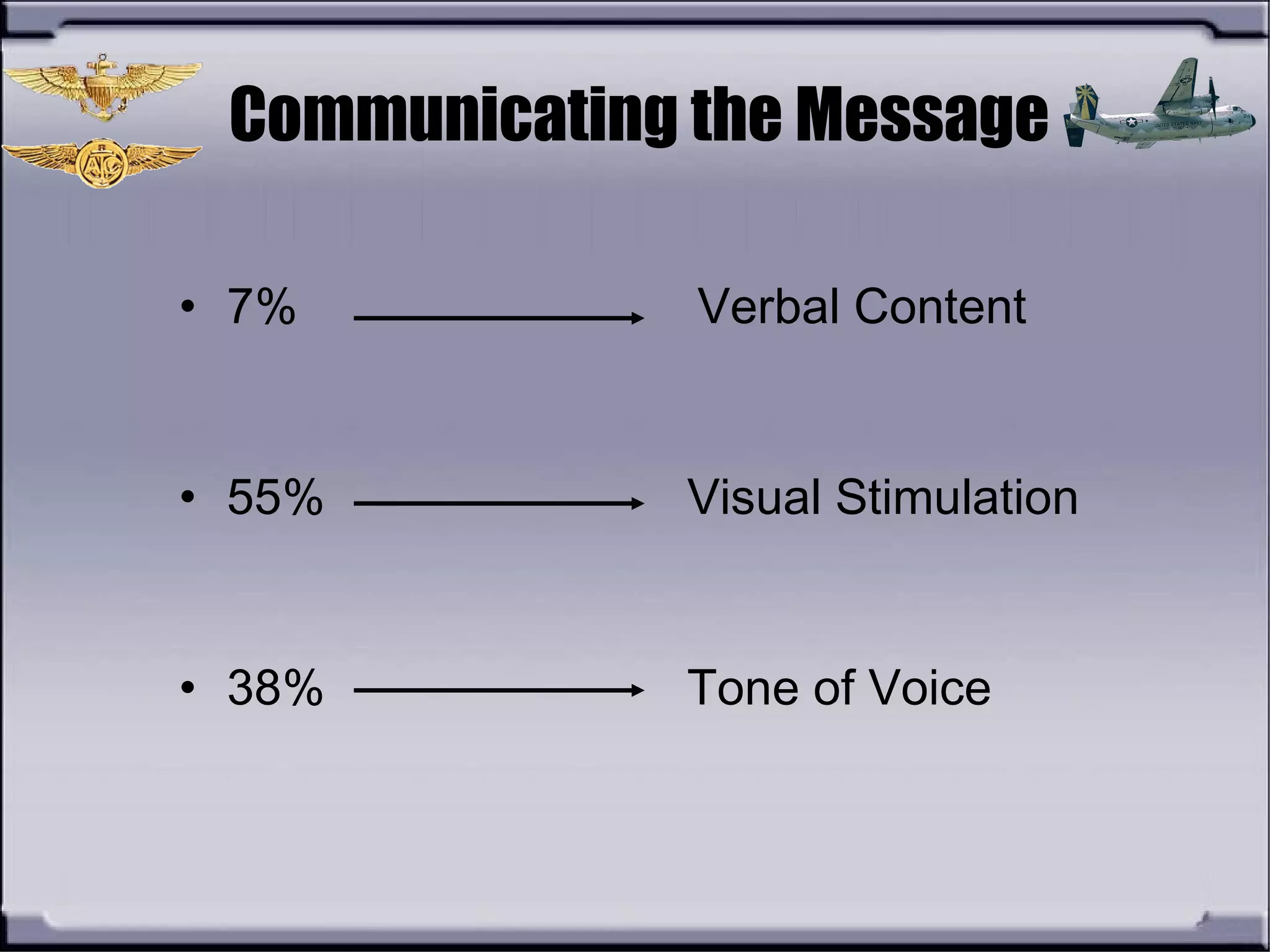
Communicating the Message
• 7% Verbal Content
• 55% Visual Stimulation
• 38% Tone of Voice
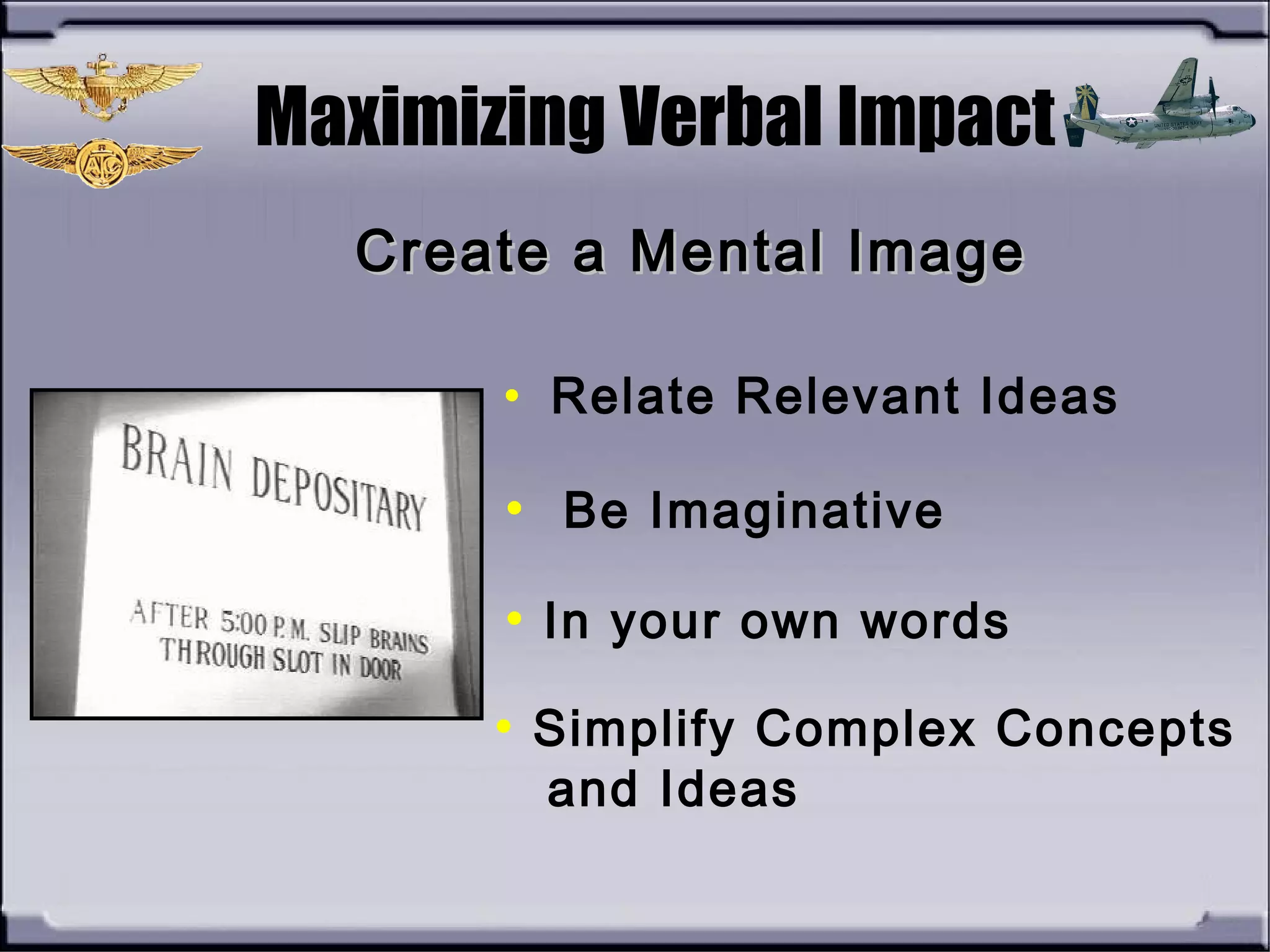
Maximizing Verbal Impact
• Relate Relevant Ideas
Create a Mental ImageCreate a Mental Image
• Be Imaginative
• In your own words
• Simplify Complex Concepts
and Ideas
Delivering Presentations
Public Speaking is a Combination of…
- Presentation Content (Material)
and
- ShowmanshipShowmanship
Delivering Presentations
ENTERTAINING IS
EFFECTIVE
but….
IT IS NOT REQUIRED
NEVER APOLOGIZE !
Your audience will be
very distracted and
few people can rejuvenate an
atmosphere littered with
self-proclaimed weakness
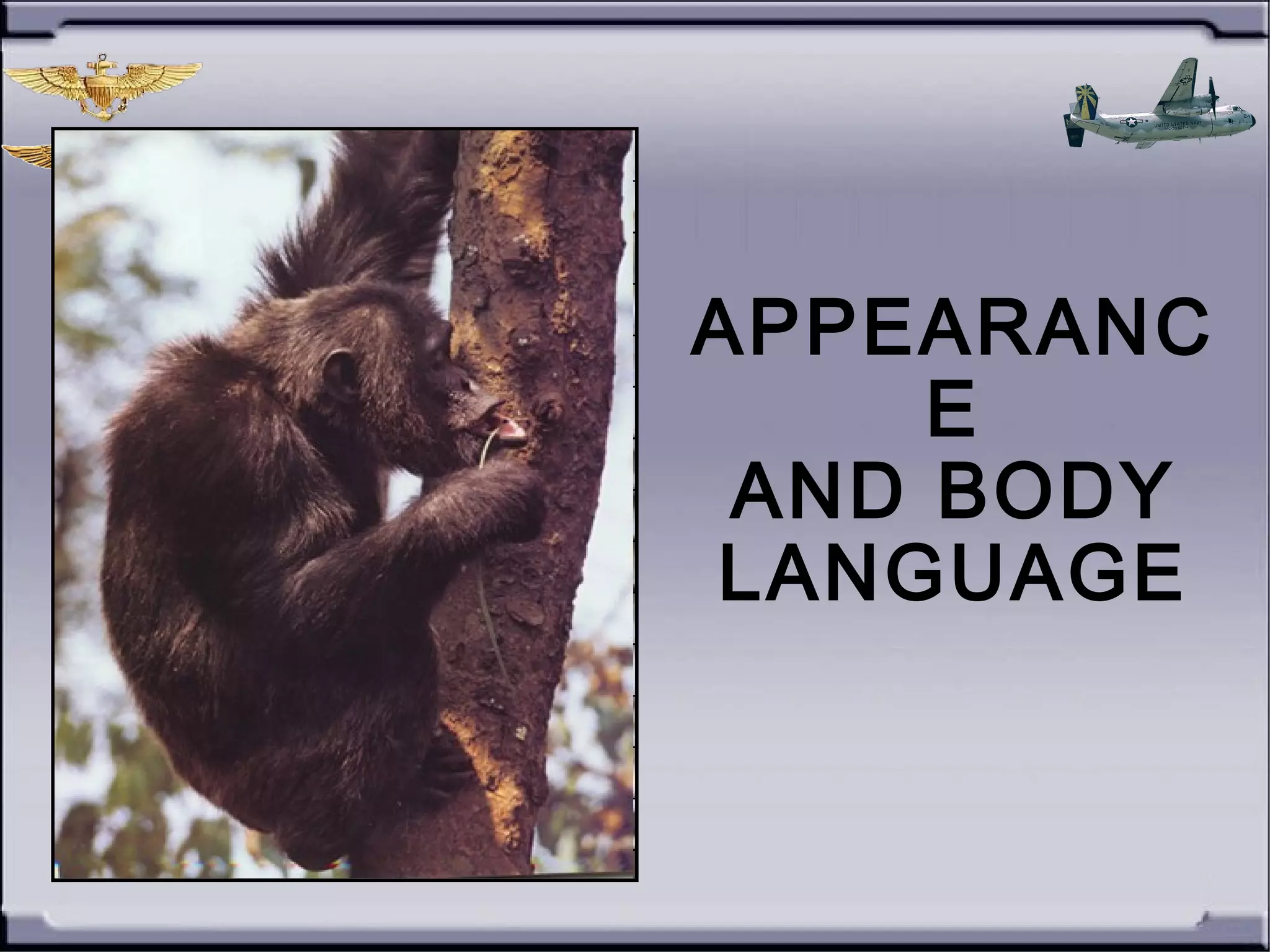
APPEARANC
E
AND BODY
LANGUAGE
Body Language
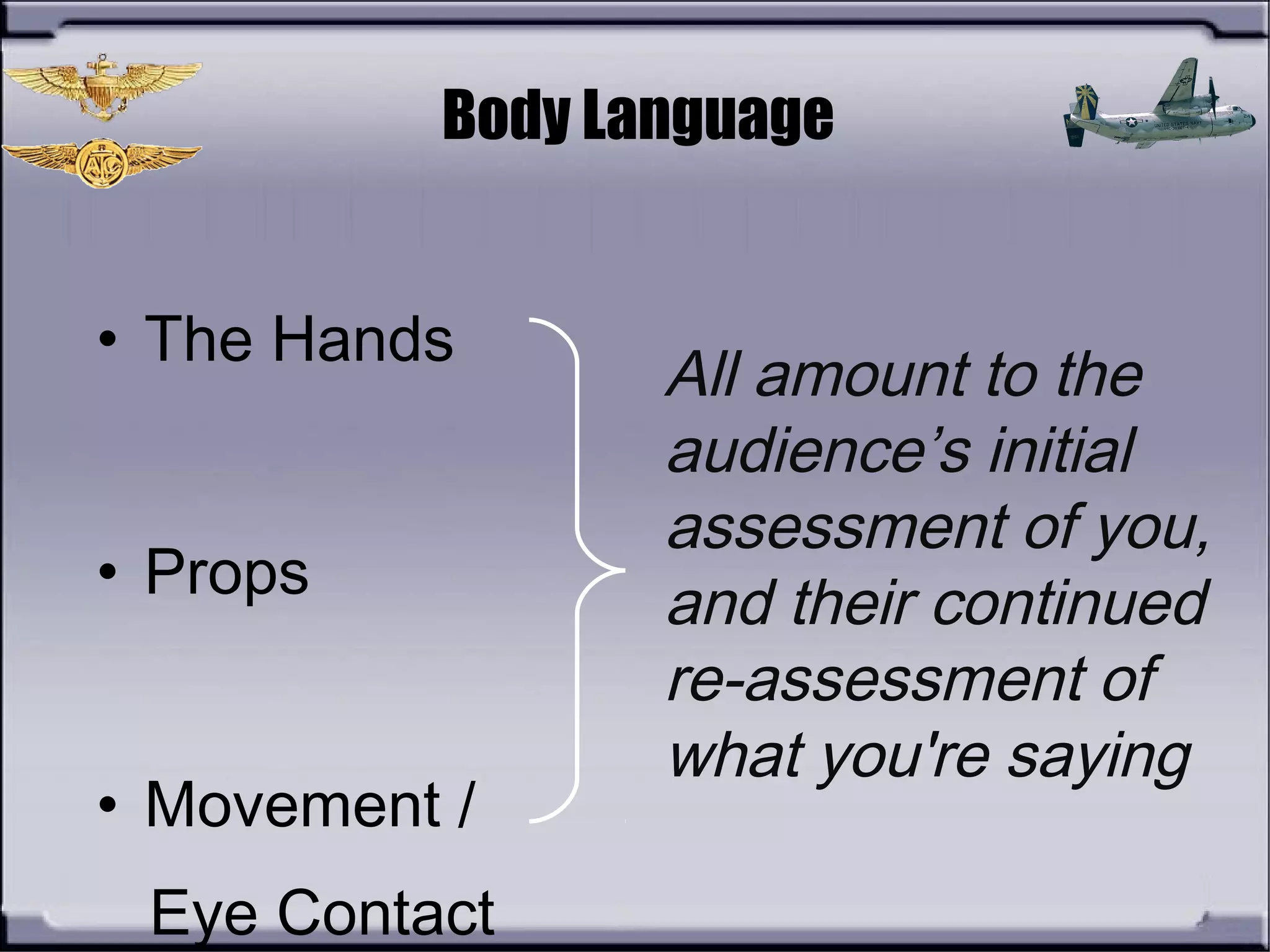
• The Hands
Body Language
• The Hands
• Props
Body Language
• The Hands
• Props
• Movement / Eye Contact
Body Language
• The Hands
• Props
• Movement /
Eye Contact
All amount to the
audience’s initial
assessment of you,
and their continued
re-assessment of
what you're saying
Use of the Voice
• Quality
• Intelligibility
• Variety
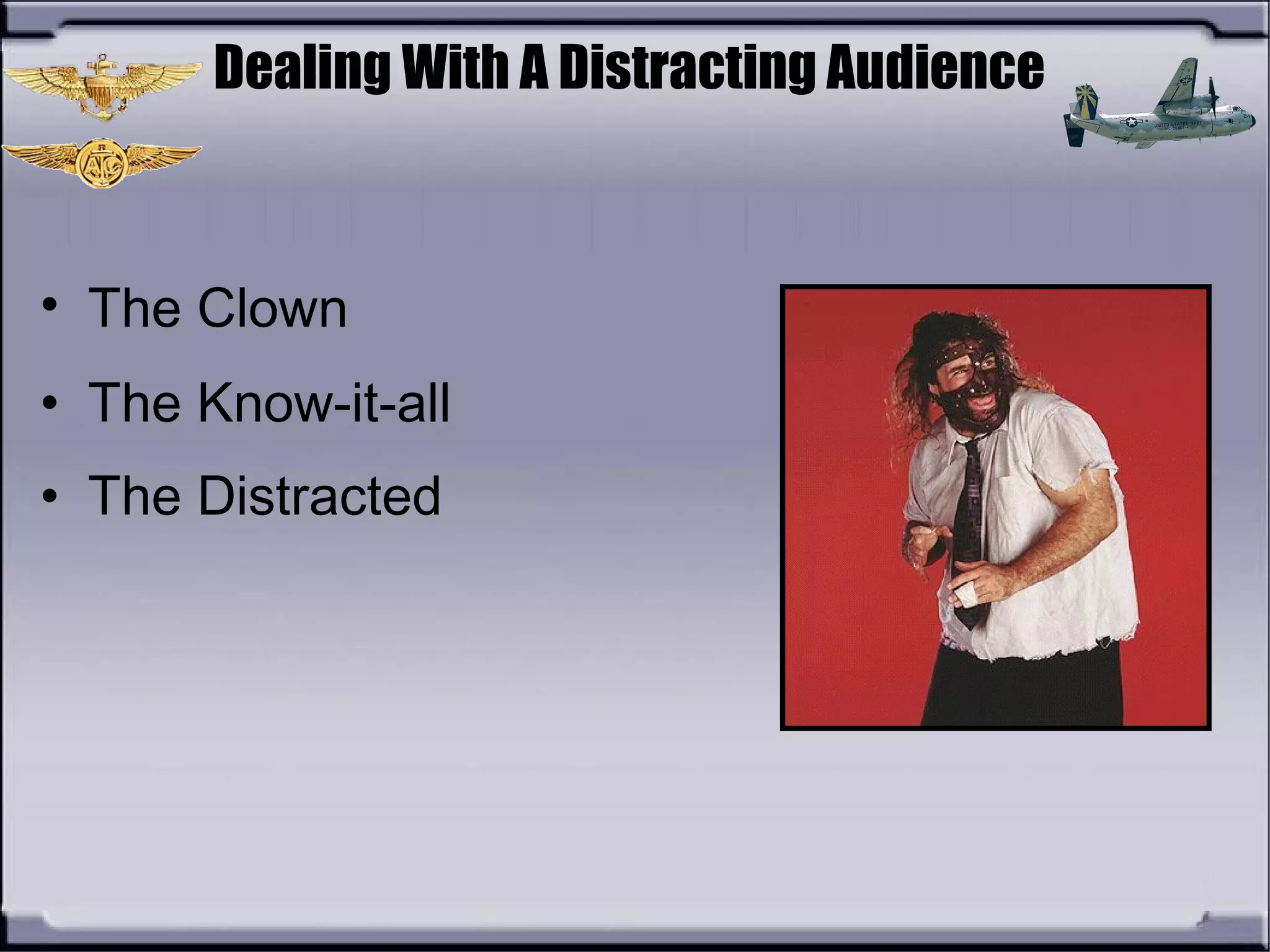
Dealing With A Distracting Audience
• The Clown
• The Know-it-all
• The Distracted
Who are these People?
…People who show the following
signs.
– No Eye Contact
– Cleaning Fingernails
– Looking Out the Window
– Reading or Talking
– Sleeping / Drooling
Close Combat
# 1 - Ignore or Dismiss
Close Combat
# 1 - Ignore or Dismiss
# 2 - Subtle Confrontation
Close Combat
# 1 - Ignore or Dismiss
# 2 - Subtle Confrontation
Get Physically Close
Close Combat
# 1 - Ignore or Dismiss
# 2 - Subtle Confrontation
Get Physically Close
Make Eye Contact
Close Combat
# 1 - Ignore or Dismiss
# 2 - Subtle Confrontation
Get Physically Close
Make Eye Contact
SAY "STOP!"
Close Combat
# 1 - Ignore or Dismiss
# 2 - Subtle Confrontation
Get Physically Close
Make Eye Contact
SAY "STOP!"
Redirect your attention
towards the audience
"Never argue with an idiot;
people watching may not be able
to tell the difference"
--Unknown
Leave time for Questions
• Remain alert
• Repeat the question
• Answer it to the audience
• Finish on a good note
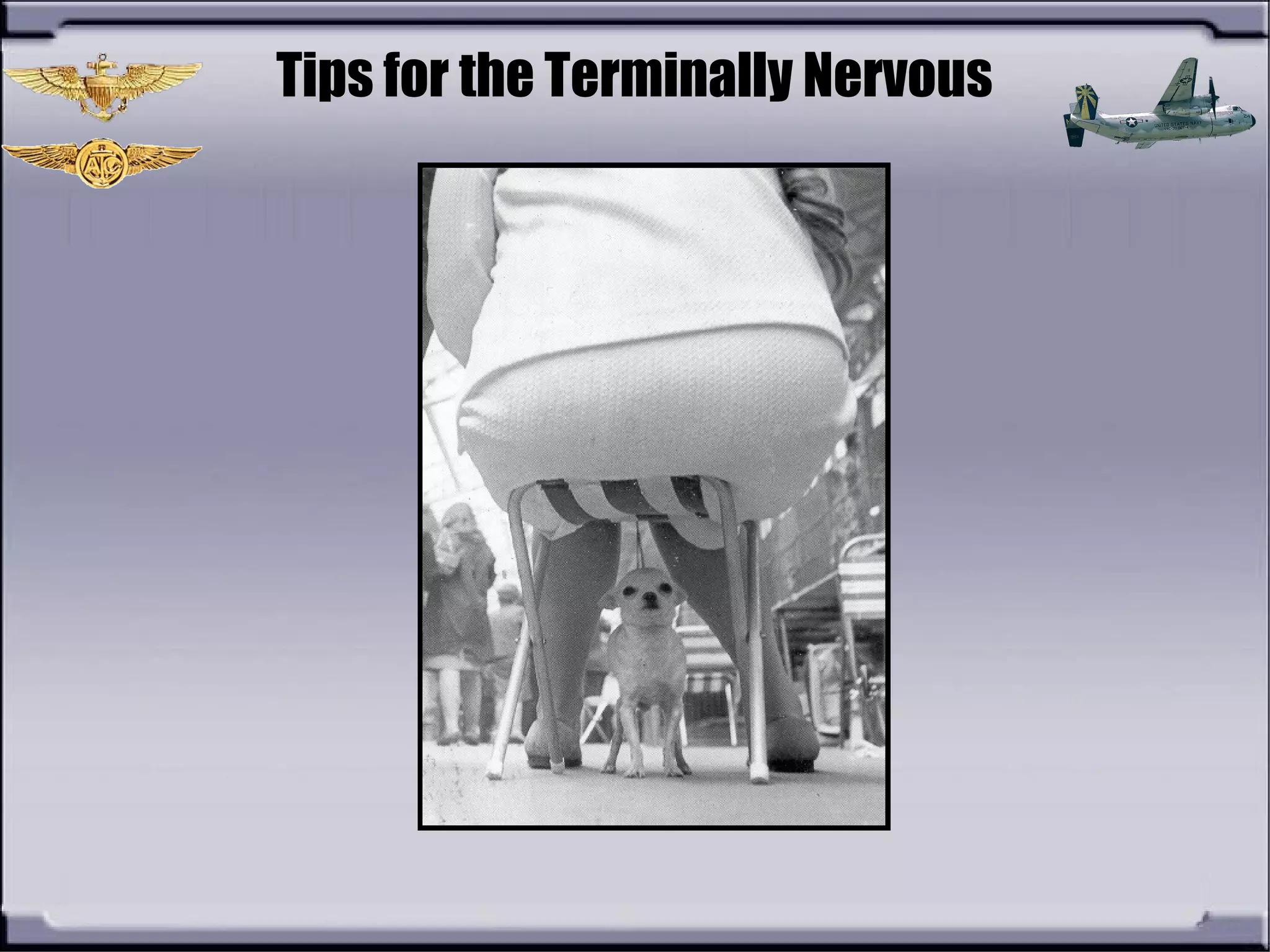
Tips for the Terminally Nervous
Familiarity
• Spaces
• Equipment
• REHEARSE!
"Being able to start is more
than half the whole."
--Aristotle
Have Your Opening Nailed
Reduced to it's most
Basic form...
You’re only talking...
You do that
everyday!!!
Annual Training Brief
• Review Annual Training Brief
• Brief location?
104
Questions???
106
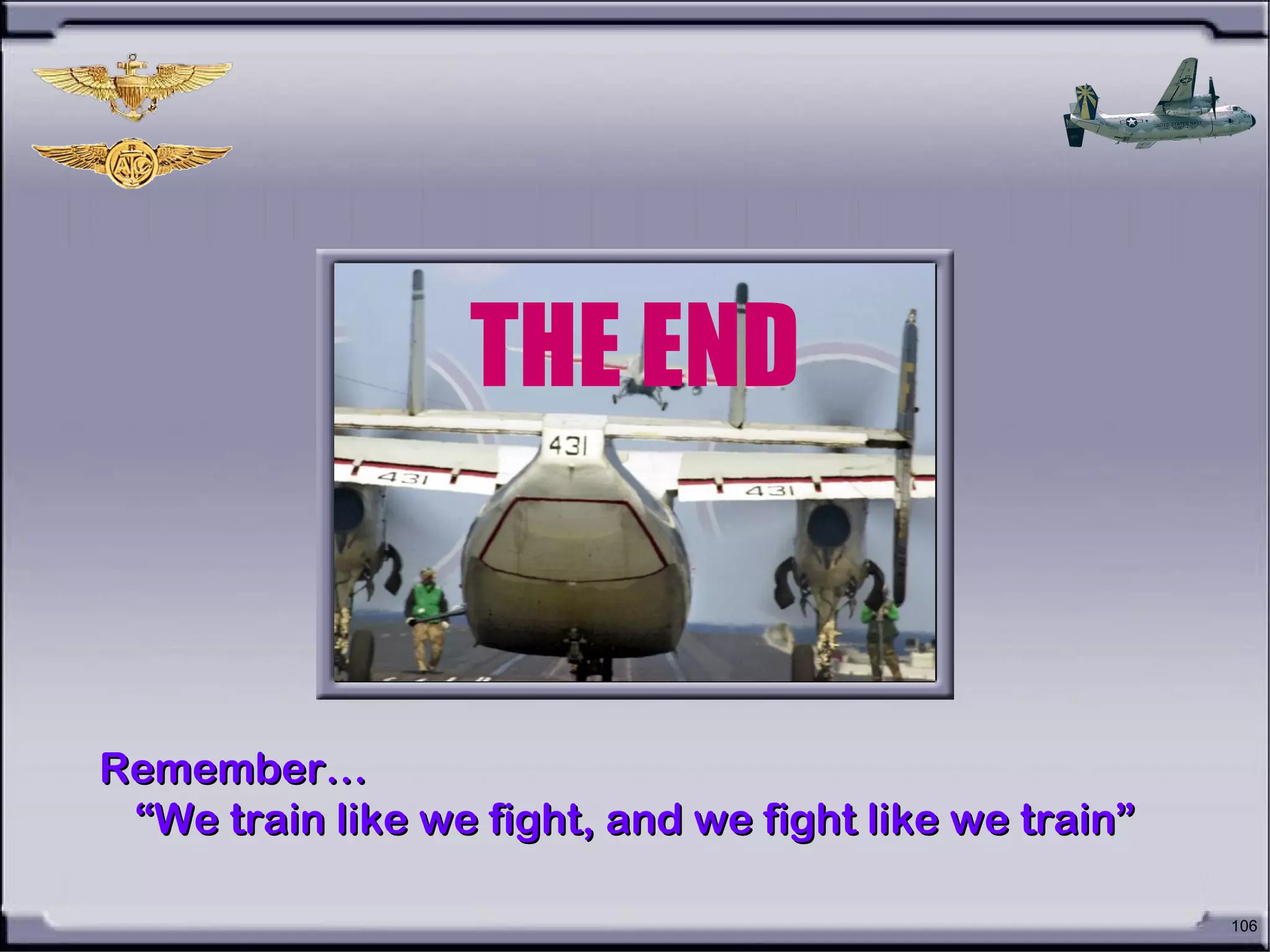
THE END
Remember…Remember…
““We train like we fight, and we fight like we train”We train like we fight, and we fight like we train”

C 2 crm - full facilitator course

  • 1.
  • 2.
    2 OVERVIEW INTRODUCTIONINTRODUCTION CRM HISTORYCRM HISTORY CRMPROGRAMCRM PROGRAM SEVEN SKILLS OVERVIEWSEVEN SKILLS OVERVIEW SEVEN SKILLS EXPANDEDSEVEN SKILLS EXPANDED PRESENTATION TECHNIQUESPRESENTATION TECHNIQUES REVIEWREVIEW SUMMARYSUMMARY
  • 3.
    PRIVILEGED 3 • For OfficialUse Only • This brief contains privileged, limited-use, limited- distribution information. unauthorized disclosure of the information in this brief or its supporting enclosures by military personnel is a criminal offense punishable under article 92, uniform code of military justice. unauthorized disclosure of the information in this report or its supporting enclosures by civilian personnel will subject them to disciplinary action under civilian personnel instruction 752.
  • 4.
    4 Rules of Engagement •Your active participation – What experiences you have had – What potential incidents you have avoided – What importance you place on CRM • Application of CRM skills is … Your ResponsibilityYour Responsibility Learn from others’ mistakes, because you’re not going to live long enough to make all of them yourself. —Roger Coleman, Lead CRM Developer, AAL
  • 5.
    Why CRM? • ToIMPROVE MISSION EFFECTIVENESS of Naval Aviation communities – minimizing crew preventable errors – by enhancing crew coordination – through increased awareness of associated behavioral skills 5
  • 6.
    6 Aviation is InherentlyDangerous There will always be something or somebody out there trying to kill you...
  • 7.
    7 CRM History • In1977, CRM was adopted by civil operators to improve safety. • Four skills were identified as critical: – Decision making – Command – Leadership – Communication
  • 8.
    8 CRM History • In1987, the NAVY researched CRM for adoption into its aviation programs. • The study noted similarities and some significant differences between civilian and military operations.
  • 9.
    9 CRM History • Age •Experience • Military Rank • Mission Objectives/ Requirements • Crew Duties • Centralized Training Differences Among Military Personnel / OperationsDifferences Among Military Personnel / Operations
  • 10.
    10 CRM History • In1989, the Naval Air Warfare Center began R&D on a program to apply CRM to tactical operations. • Research identified seven behavioral skills most common in Naval Aviation. – Communication – Leadership – Adaptability/Flexibility – Situational Awareness – Decision Making – Assertiveness – Mission Analysis
  • 11.
    11 CRM History • In1991, the Naval Safety Center found human error was significant in 50% of all Class “A” mishaps. • In 1993, “Interim” Aircrew Coordination Training (ACT) was implemented. • In 1995, OPNAVINST 1542.7A established “Integrated” ACT milestone.
  • 12.
    12 CRM History • In1998, OPNAVINST 1542.7B established Aircrew Coordination Training (ACT) academic requirements/ flight evaluation. • In 2001, OPNAVINST 1542.7C changed the ACT program’s name to Crew Resource Management (CRM).
  • 13.
    13 Mishap History “Human beingsby their very nature make mistakes; therefore, it’s unreasonable to expect error-free human performance” —Shappell & Wiegmann, 1997
  • 14.
    14 • For thepast three decades commercial aviation, the federal government, and more recently the military have expended substantial resources in determining the cause of mishaps. • Information recovered from cockpit voice recorders, SIRs, HAZREPS, and civilian mishap reports indicate the number one cause is Human Error Human Error Background
  • 15.
    15 CRM History – MissionSpecific – Based on Knowledge, Behaviors and Skills – Integrated into Training – Research Supported – Developed by Aircrews for Aircrews – Incorporates Existing Knowledge Base – Conforms to Instructional Strategies CRM is:CRM is:
  • 16.
    16 CRM Future inNavy/ USMC • Continued integration of CRM concepts into procedures and NATOPS • Specific CRM simulator training • Computer Aided Debriefing Systems • More focus on individual error prevention/mitigation • Alignment with ICAO standards Data collection and trend analysis • Automation • CRM application to other fields
  • 17.
    17 CRM History – 1977—Civilian Operatorsadopt CRM – 1993–1995—Naval Aviation adopts “Interim” ACT/CRM – FY-05-09—Human Error accounts for 85% of Naval Aviation Class A Mishaps – CRM Program to be T/M-specific and based 7 Skills SummarySummary
  • 18.
  • 19.
    19 CRM Program • Purposeof CRM • Chain of Command • Unit-Level Responsibilities • CRM Training Requirements
  • 20.
    20 Purpose of CRM •To IMPROVE MISSION EFFECTIVENESS of Naval Aviation communities – by enhancing crew coordination – through increased awareness of associated behavioral skills
  • 21.
    21 Purpose of CNAFINST 1542.7Series • To establish policies, responsibilities and procedures for administration of the Crew Resource Management (CRM) program – Establishes CRM content – Defines conduct/type of training – Delineates documentation requirements – Assigns CRM responsibilities
  • 22.
    22 Chain of Command ControllingCustodians NASC Pensacola IMM Curriculum Model Manager (CO) Program ManagerCRM Instructors CRM Facilitators CNAF TRAINING POLICY OPNAV N88
  • 23.
    23 Curriculum Model Manager (CMM) •CO of a model manager squadron (VAW-120) • CRM training program for T/M/S • Correct number of CRM-I and CRM-F • Coordinate with T/M NATOPS Model Manager • Sets focus for the community
  • 24.
    24 CRM Program Manager(PM) • A CRM-I designated by the CMM • Currently: LT HAWKE • T/M/S SME and fleet POC • Develop aircraft-specific integrated CRM programs • Ensure curriculum current and relevant • Provide CRM materials to the IMMs
  • 25.
    25 CRM Instructor (CRM-I) •Train new CRM facilitators • Conduct annual training and check rides • Assist PM in distribution and standardization of CRM materials
  • 26.
    26 CRM Facilitator (CRM-F) •Conduct and document annual CRM training • Submit changes (NATOPS, 1542) • Feedback to Program Manager • Check rides • All FRS Pilot and Aircrew Instructors are made Facilitators as part of the IUT Syllabus/Check In.
  • 27.
    27 Instructor vs. Facilitator •NATOPSQualified O-3/E-5 or above •Graduate of both the NASC IMM CRM Instructor’s Course AND the Curriculum Program Manager’s CRM Facilitator Course •Designated in writing by the Type/Model Curriculum Model Manager •Qualified to train CRM Facilitators • Curriculum Model Manager establishes minimum experience level requirements •Graduate of Curriculum Program Manager’s CRM Facilitator Course (T/M specific) •Designated in writing by the unit CO •Qualified to conduct CRM initial and refresher training
  • 28.
    28 Unit-Level Responsibilities • Facilitateintegrated CRM training program • Conduct annual CRM training IAW OPNAVINST 3710.7/ CNAF 1542.7 • Provide feedback to the CRM Model Manager (VAW-120)
  • 29.
    29 CRM training shallbe conducted byCRM training shall be conducted by a designated instructor or facilitatora designated instructor or facilitator CRM Ground Training INITIALINITIAL • Shall occur during undergraduate aviation training and during all fleet replacement/ initial training leading to T/M aircrew designation REFRESHERREFRESHER • Shall occur annually while in a flight billet Specific CRM qualification is required forSpecific CRM qualification is required for operation of each aircraft T/M/S.operation of each aircraft T/M/S.
  • 30.
    30 CRM Ground Training •CRM Principles and Seven Critical CRM Skills • Topics Of Concern / Recent Trends • T/M-Specific Case Study/ Scenario • Open and Frank Discussion on Current State of CRM • Must use PowerPoint developed by CRM Model Manager. Annual Ground Training RequirementsAnnual Ground Training Requirements COMNAVAIRFORINST 1542.7A, PARA. 7-D
  • 31.
    Annual CRM FlightEvaluation • Annual Requirement – May be accomplished within 60 days of expiration without rebasing. – Typically done with NATOPS check. • CRM-I or CRM-F Required • May Be Completed In Simulator 31
  • 32.
    32 • Must beentered into NATOPS Jacket • Section II, Part C • Utilize CNAFINST 1542.7 encl. 3 • NATOPS Check Paperwork Shall State “Conducted CRM flight evaluation per CNAFINST 1542.7A.” Training Documentation
  • 33.
    33 Training Documentation • COsmay grant extensions for deployed aircrew whose CRM training will expire. • Extensions shall not exceed 90 days after return from deployment. • Document all extensions in NATOPS jacket. • REBASE YOUR DETS! DON’T PLAN ON EXTENSIONS. ExtensionsExtensions
  • 34.
    34 Training Documentation ““Personnel whofail to meet CRMPersonnel who fail to meet CRM requirements without a written extensionrequirements without a written extension shallshall notnot serve as aircrew members.”serve as aircrew members.”
  • 35.
    35 CRM Program • Purposeof CRM Program • Chain of Command • Unit-Level Responsibilities • Training Policies • Qualifications/Evaluation • Extensions SummarySummary
  • 36.
  • 37.
    37 Seven Critical CRMSkills CRM skills are necessary because errors repeat even with new technology!
  • 38.
  • 39.
    • How doyou define Decision Making? 39 Decision Making Definition: The ability to choose a course of action using logical and sound judgment based on available information. Definition: The ability to choose a course of action using logical and sound judgment based on available information.
  • 40.
    40 Decision Making • Question: Howdo hazardous attitudes affect decision making? Negative Effect:Negative Effect: • Peer pressurePeer pressure • Mind setMind set • ““Get home-itis”Get home-itis” • Getting behind theGetting behind the aircraftaircraft
  • 41.
    41 Decision Making in theC-2A • C-2 Capabilities vs. Air Wing Desires • Detailed Preflight Planning vs. “Canned Route” Attitude • Any member of a Detachment can end up being put in a position where they need to speak for the OIC
  • 42.
    • What is Assertiveness? 42 Assertiveness Definition: Thewillingness/readiness to actively participate, state and maintain a position until convinced by the facts that other options are better. Definition: The willingness/readiness to actively participate, state and maintain a position until convinced by the facts that other options are better.
  • 43.
    43 Assertiveness • Question: When isit appropriate to be assertive? Speak up when youSpeak up when you encounter:encounter: • Unclear mission objectivesUnclear mission objectives • Overly aggressive orOverly aggressive or passive crewmemberspassive crewmembers • Conflict in the aircraftConflict in the aircraft • Issues not addressed in theIssues not addressed in the debriefdebrief Whenever your comfort level is exceeded… SPEAK UP !
  • 44.
    44 Assertiveness in the C-2A •3P vs Aircraft Commander • Aircraft Commander vs Aircraft Commander • 2P/2P Flights • C-2 vs Air Wing/Air Boss/Flight Deck Handler
  • 45.
    • How doyou define Mission Analysis? 45 Definition: The ability to develop short-term, long-term and contingency plans and to coordinate, allocate and monitor crew and aircraft resources. Definition: The ability to develop short-term, long-term and contingency plans and to coordinate, allocate and monitor crew and aircraft resources. Mission Analysis
  • 46.
    46 Mission Analysis • Question: Whatare three components of Mission Analysis? • Planning and preparationPlanning and preparation • Monitoring inflight missionMonitoring inflight mission progressprogress • Postflight debriefingPostflight debriefing
  • 47.
    47 Mission Analysis in theC-2A • How good is your Debrief?
  • 48.
    • What is Communication? 48 Communication Definition: Theability to clearly and accurately send and acknowledge information, instructions, or commands, and provide useful feedback. Definition: The ability to clearly and accurately send and acknowledge information, instructions, or commands, and provide useful feedback.
  • 49.
    49 Communication • Question: When canexperience in flight be a barrier to communication? • Less experience—Less experience— Less likely to speak upLess likely to speak up • More experience—More experience— May resist change and theMay resist change and the need to adaptneed to adapt
  • 50.
    50 Communication in the C-2A •Detachment personality dynamics • Enlisted Aircrew/Pilot relationship • Ship to Shore Communication
  • 51.
    • How doyou define Leadership? 51 Leadership Definition: The ability to direct/coordinate the activities of other crewmembers or wingmen, and to encourage them to work together as a team. Definition: The ability to direct/coordinate the activities of other crewmembers or wingmen, and to encourage them to work together as a team.
  • 52.
    52 Leadership • Question: What aresome leadership traits that inspire peak performance in a crew? • DecisiveDecisive • CompetentCompetent • Keeping crew informedKeeping crew informed • Open to suggestionsOpen to suggestions • Leading by exampleLeading by example • TrustTrust
  • 53.
    53 Leadership in the C-2A •C-2 Pilots have to grow up fast • Any member of a Det can be cornered by CAG, Flag, etc • Leadership challenges associated with being on perpetual “Port Call”
  • 54.
    • What isAdaptability/ Flexibility? 54 Adaptability/ Flexibility Definition: The ability to alter a course of action based on new information, maintain constructive behavior under pressure and adapt to internal/external environmental changes. Definition: The ability to alter a course of action based on new information, maintain constructive behavior under pressure and adapt to internal/external environmental changes.
  • 55.
    55 Adaptability/ Flexibility • Question: Whatare some situations that require Adaptability/ Flexibility? • Routine becomes anRoutine becomes an emergencyemergency • Inclement weatherInclement weather • CV environmentCV environment • Changing primaryChanging primary missionmission
  • 56.
    56 Adaptability/ Flexibility in theC-2A • This is the C-2 skill • Legs added to flight • Destinations changed • CV arrival intentions can vary/change last minute • At mercy of DV sched • Last minute PAX/Cargo • Hazardous Cargo
  • 57.
    • What is Situational Awareness? ? 57 SituationalAwareness Definition: The degree of accuracy by which one’s perception of the current environment mirrors reality. Definition: The degree of accuracy by which one’s perception of the current environment mirrors reality.
  • 58.
    58 Situational Awareness • Question: Ifgood situational awareness means looking around at what’s happening, what else must be recognized? • What led to the presentWhat led to the present situation?situation? • What will happen in theWhat will happen in the next 30 seconds,next 30 seconds, 10 minutes, etc?10 minutes, etc? • Crosschecking andCrosschecking and communicationcommunication
  • 59.
    59 Situational Awareness in theC-2A • 80% of Aircraft is behind you • Who is in your plane? • What is in your plane? • What country clearances do you have? • What does having PAX add to divert considerations?
  • 60.
  • 61.
    • Several pollshave been conducted during the last decade, asking Americans what they fear the most. • The number 1 response, which is above even death--by as much as a 2-1 margin is….. Adults #1 Fear…
  • 62.
    Stage Fright “The humanbrain is a wonderful thing. It operates from the moment you’re born until the first time you get up to make a speech.” --Howard Goshorn
  • 63.
    Principles of Communication •Desire to communicate
  • 64.
    Principles of Communication •Desire to communicate • Believe in what you say
  • 65.
    Principles of Communication •Desire to communicate • Believe in what you say • Know your subject
  • 66.
    Principles of Communication •Desire to communicate • Believe in what you say • Know your subject • Know your audience
  • 67.
    Principles of Communication •Desire to communicate • Believe in what you say • Know your subject • Know your audience • Deliver with enthusiasm
  • 68.
    Principles of Communication •Desire to communicate • Believe in what you say • Know your subject • Know your audience • Deliver with enthusiasm • Rehearse, Rehearse, Rehearse
  • 69.
  • 70.
    normally involves agreat deal of participation by the instructor and very little by the audience Interactive Process…Relationships… Thinking INSTRUCTING 1 v Many TEACHIN G 1 v 1
  • 71.
    3 Basic Questions •Audience - Who am I teaching? • Material - What do they need to know? • Instructor - How am I going to present it?
  • 72.
    Audience Analysis • Motivation •Interest • Familiarity • Capability
  • 73.
    Know the Material •Read Everything • Talk to experts – SME’s • Write Things Down
  • 74.
    Remember... "The mind canonly absorb what the butt can endure.“ Brief Fatigue
  • 75.
    Presentation Techniques • CompleteMemorization • Partial Memorization • Approximate Memorization
  • 76.
    Notes • Note Cards(3X5) • Sheets of Paper – Power Point Notes Pages – Fold-over
  • 77.
    THERE IS NOSUBSTITUTE FOR PREPARATION AND REHEARSAL Notes • Note Cards (3X5) • Sheets of Paper – Power Point Notes Pages – Fold-over MAKE IT WORK FOR YOU, NOT AGAINST YOU…
  • 78.
    Communicating the Message •7% Verbal Content • 55% Visual Stimulation • 38% Tone of Voice
  • 79.
    Maximizing Verbal Impact •Relate Relevant Ideas Create a Mental ImageCreate a Mental Image • Be Imaginative • In your own words • Simplify Complex Concepts and Ideas
  • 80.
  • 81.
    Public Speaking isa Combination of… - Presentation Content (Material) and - ShowmanshipShowmanship Delivering Presentations
  • 82.
  • 83.
    NEVER APOLOGIZE ! Youraudience will be very distracted and few people can rejuvenate an atmosphere littered with self-proclaimed weakness
  • 84.
  • 85.
  • 86.
    Body Language • TheHands • Props
  • 87.
    Body Language • TheHands • Props • Movement / Eye Contact
  • 88.
    Body Language • TheHands • Props • Movement / Eye Contact All amount to the audience’s initial assessment of you, and their continued re-assessment of what you're saying
  • 89.
    Use of theVoice • Quality • Intelligibility • Variety
  • 90.
    Dealing With ADistracting Audience • The Clown • The Know-it-all • The Distracted
  • 91.
    Who are thesePeople? …People who show the following signs. – No Eye Contact – Cleaning Fingernails – Looking Out the Window – Reading or Talking – Sleeping / Drooling
  • 92.
    Close Combat # 1- Ignore or Dismiss
  • 93.
    Close Combat # 1- Ignore or Dismiss # 2 - Subtle Confrontation
  • 94.
    Close Combat # 1- Ignore or Dismiss # 2 - Subtle Confrontation Get Physically Close
  • 95.
    Close Combat # 1- Ignore or Dismiss # 2 - Subtle Confrontation Get Physically Close Make Eye Contact
  • 96.
    Close Combat # 1- Ignore or Dismiss # 2 - Subtle Confrontation Get Physically Close Make Eye Contact SAY "STOP!"
  • 97.
    Close Combat # 1- Ignore or Dismiss # 2 - Subtle Confrontation Get Physically Close Make Eye Contact SAY "STOP!" Redirect your attention towards the audience
  • 98.
    "Never argue withan idiot; people watching may not be able to tell the difference" --Unknown
  • 99.
    Leave time forQuestions • Remain alert • Repeat the question • Answer it to the audience • Finish on a good note
  • 100.
    Tips for theTerminally Nervous
  • 101.
  • 102.
    "Being able tostart is more than half the whole." --Aristotle Have Your Opening Nailed
  • 103.
    Reduced to it'smost Basic form... You’re only talking... You do that everyday!!!
  • 104.
    Annual Training Brief •Review Annual Training Brief • Brief location? 104
  • 105.
  • 106.
    106 THE END Remember…Remember… ““We trainlike we fight, and we fight like we train”We train like we fight, and we fight like we train”

Editor's Notes

  • #8 This slide introduces an overview and a history of CRM, emphasizing the role it continues to play in ensuring aircrew safety.
  • #9 After 10 years of apparent success within the civilian community, the military decided it was time to infuse CRM into their training programs.
  • #10 The challenge facing NAVAIR was to develop a CRM program that would address tactical aircraft operations. The differences between civil and military flight operations were numerous. The Navy CRM program was developed to address these differences and apply the training to military flight operations.
  • #11 The Navy determined that accident rate reduction was needed. They had noted improvement in civil airline accident rates after the introduction of CRM into their training programs.
  • #23 1542.7C also delineates a change in the chain of command of responsibility for administering and implementing CRM. There is now a direct Marine Corps representative (CG MCCDC) in it. Also, CNO (N78) is now directly in charge.
  • #35 You’re going to be grounded if you don’t comply.
  • #36 In summary, CRM is not just another Navy/Marine program, but like an exercise regimen, CRM develops the skills for successful and safe flight missions.
  • #62 Several polls have been conducted during the last decade, asking Americans what they fear the most. The number 1 response, which is above even death--by as much as a 2-1 margin is…..
  • #64 b. You have to have the desire to communicate. (If you do not feel comfortable in front of a group or do not want to be an instructor then you will not do well in that role.)
  • #65 c. You have to believe in what you say. Your audience will know the difference. Believing in what you say is crucial to delivering an effective message. You can not teach convincingly or brief a plan effectively if you don’t believe wholeheartedly in what you say. Take President Bush’s speech after 9/11 for example: You could tell that he really believed in what he was saying He was very genuine and convincing Even though the had speech writers that did most or all of the writing, you could really tell that he believed in what he was saying
  • #66 d. You have to know your subject. (As instructors it is imperative that we are intimately familiar with our subject.) (Keep in mind that you will very rarely fool your audience. Trying to pull the wool over your audience’s eyes will most likely cause you to lose all credibility is an instructor.)
  • #67 DON’T PLAY THE CLIP RIGHT AWAY!! Knowing your audience can play in important role in getting your message across. We have all sat through classes that have either insulted our intelligence or lost us after the introduction. Knowing your audience and tailoring your class to meet their needs will accomplish two things. The first is that it will prevent information from being misunderstood because of a lack of knowledge. Second, it will minimize the wasting time on information that is already known. NOW, PLAY THE CLIP! What was wrong with that clip? Obviously, these guys didn’t really know their audience. Violence. Language. Displays an abuse of power. Etc. You must know your audience!
  • #68 We all know that enthusiasm is contagious. If the instructor is bored with the information or presents it in a dry way then the audience will have a difficult time remaining interested. On the other hand, if the instructor is even the least bit excited or animated about the subject then the audience will probably remain alert. Senses dull things out, tune things out.
  • #69 The bottom line on rehearsing is that if you do not do it, your presentation will very likely be poor.
  • #70 When discussing the differences between teaching and instructing you need to look at what the desired effect is. 2 different things with 2 different desired effects.
  • #71 Instructing is very formal. The one vs. many fight. It normally involves a great deal of participation by the instructor and very little by the audience. The formal definition of instructing is to provide with authoritative information or advice, or an order or command from one individual to another. Most lectures are periods of instruction. Very structured--a lot of the way we pass info. in the military. Teaching on the other hand connotes a process. It has more of a one vs. one relationship. The goal of teaching is to encourage or require the student to think. It is interactive and challenges the students to debate the issues and develop the answers on their own. Teaching is more difficult because the teacher must find a way for the student to learn.
  • #72 It boils down to three basic questions: 1) Who am I teaching? 2) What do they need to know? 3) How am I going to present the information? We’ll talk about each of these now.
  • #73 Some factors to help you identify these limits are: 1) Determine the motivation of the audience. Find out why they are in the audience. 2) What is their interest in the subject? 3) Determine how familiar they are with the subject and how familiar they need to be by the end of the course. 4) Determine the capability of the audience to understand and grasp the information. Relate to developing the presentation as well as analyzing during the presentation.
  • #74 It starts by reading everything you can about the subject. Additionally, talking to recognized experts on the subject can be beneficial to gaining insight to the subject. Writing down the important points you want to remember is always a good idea.
  • #75 Remember, the mind can only absorb what the but can endure. If you have a tremendous amount of information that needs to be presented break it into usable bites for your audience.
  • #76 Once we have completed putting together our presentation it is now time to decide how to present it. There are several methods that one can use. They are Complete Memorization, Partial Memorization and Approximate Memorization. There are benefits and shortfall associated with each method. Try to find the one that supports the material you are covering and suites your teaching style. Complete memorization: word for word. Good in that it may erase anxiety for the nervous. It is impressive, but it has its drawbacks. If you are interrupted or miss a word, it may mess up your flow, after which you may lose your place and have to run back through the info in your head to get back on track. Partial Memorization: You deliver, verbatim, selected parts of the presentation. This could be the intro, or the first sentence of each paragraph, or maybe quotes. This is better than memorization especially when accuracy is important on key parts of your presentation. Last is approximate memorization.
  • #77 Depending on the time one has to prepare and the volume of information the instructor may need notes to help them through the presentation. Here are some techniques that can be used to help with the coordination of speaker notes. Note Cards: Use 3x5 cards and put only one point or idea on each card. Attach the cards together and number them to make it easy to keep your place. Paper: This method has all the information written out for the instructor to read. Fold-over: This method takes on piece of paper and folds it down the middle. The instructor can then write notes on each section. Overhead Margins: If overheads are used, attach a border around them so you can make notes on this border.
  • #78 Those are a few techniques. Bottom line, no right or wrong answer to this one: if you use notes, pick a technique that will work for you.
  • #79 Research has proven that long term retention and learning is influenced by 3 factors. These factors are verbal content, visual stimulation and tone of voice. The amount they contribute is 7%, 55%, and 38% respectively. Use of hands helps with voice intonation and inflection. Hand movement actually modulates how the air moves through the larynx. Standing stiff, or grasping for life on the podium will make it difficult to use voice inflection. If you ever see someone bolted to the podium, they usually give a lousy brief.
  • #80 Although verbal content accounts for only a small amount of retention there are ways to maximize this small percentage. One way is to create a mental image. When discussing a point try to relate a relevant idea, use imagination in your application and put things in your own words. For complex or highly technical points, try and give your example in laymen’s terms. All these techniques can help increase the learning from the verbal content. .
  • #81 When the time comes to actually present the class there are some common pit falls that should to be avoided.
  • #82 You need to be able to deliver the material that you spent so much time to compile. This is basically a two step process: Preparation: This is where your preparation is going to payoff. If you’ve done your homework, and got the best information you have half of the fight won. If you did a rush job developing your presentation, and are not sure about the accuracy, or depth you may not be able to give a convincing face to your audience. Remember, your audience will be able to tell if you are comfortable in front of them. So ensure you did a good job compiling your information so you’re confident in the material presented. Showmanship: This is where you have to be able to read the audience, and see what type of delivery style will be appropriate.
  • #83 Remember, although telling jokes and entertaining your audience can be an effective teaching technique, it is not required. The only thing required of an instructor is to present the information in a professional way. It is also incumbent on the audience to be professional and stay awake for the class. If you have a good sense of humor use it, if you do not then don’t.
  • #84 Never apologize to your audience for the material or presentation techniques. When the time comes, present the information to the best of your ability. If you goon something up, the audience will know it, and apologizing will only worsen the situation. If the class does not go well, make the adjustment the next time around.
  • #85 As mentioned earlier, people receive a great deal of information through visual stimulation. A person’s appearance and body language will send a strong message to the audience. We know this to especially be so in the military.
  • #86 When teaching a class there are some telltale signs of how comfortable an instructor feels in front of a group. One of these signs maybe the instructors hands. A nervous person will often lose control of his hands and they will shake continuously. This a natural reaction and there is not much a person can do. If you know this is a weakness of yours then try to disguise it as best a possible. Do not hold things that will rattle, try folding your hands or arms to give them stability or simply keep them out of sight. One can keep them out of sight by placing them behind you or standing behind a podium. Obviously in the military we do not want to place our hands in our pockets so try to avoid this technique. Arms folded or on hips occasionally is okay. Besides being nervous there are other ways that a persons hands maybe distracting to an audience. Some people like to wave their hands when they talk. Although there is nothing wrong with this try to avoid some common pit falls. Never wave your hands near someone. Try to avoid pointing directly at people in your audience as this may offend some people.
  • #87 Props are another item that can be very annoying to an audience. The key to effectively using props is to only use them for what they are intended for. Pointers can be one of the biggest offenders. When using a pointer it should only be in the instructor’s hands when pointing out an object. All other times it should be stored in a secure place. If the instructor is caring it around all class, point at everything with it or swinging it like a golf club then people will be focused on his stick work not the class material. The same is true for laser pointers. Be careful not to aim a laser pointer at anyone in the audience. Eye safe or not, people get nervous when laser pointers are directed their way.
  • #88 When trying to discuss a person’s movement in front of a group one can be reminded of basic training. During basic training one of the goals is to teach future Marines how to march. The environment is so stressful and the group is trying so hard to march correctly that some members forget the basics of walking. Focusing so much on stepping in time they forget to swing their arms. In trying to script their movements they look rigid and unnatural. The same happens when trying to script your movements in front of a group: the results often look unnatural. If your are comfortable standing behind the podium or in one place, then that is what you should do. Regardless of the amount you move on stage, you should always try to establish eye contact with your audience. One who is constantly looking at the board or at the ground will not be able to monitor the audience or get the feedback required.
  • #89 All these points add up to one thing, the more the instructor does to distract the audience the less chance his entire message will be received in its entirety.
  • #90 Once rid of all the distracting bad habits an instructor can then focus on improving the qualities of their voice. A good voice has three important characteristics. It is reasonably pleasant, easy to understand and can express differences in meaning. Dr. John A. Kline of Air University refers to these properties as quality, intelligibility and variety. Quality is the hardest aspect of your voice to control. If you consider your voice extremely irritating, you have the ability to retrain it. A good reference for altering characteristics of your voice is 7 Steps to Fearless Speaking, by Lilyan Wilder. Your articulation, pronunciation, vocalization and choice of words affect intelligibility of your speech. Speak carefully, not slowly, intentionally avoiding poor grammar and stock expressions such as OK, like, you know and all right. Variety is the conscious avoidance of monotone delivery. Speaking 100 to 180 words per minute is the norm, but you should vary that considerably to stress particularly lucid points. Changing pitch to be illustrative or humorous is effective but take care to avoid over use. Monotone is like a bad persistent smell.
  • #91 The clown just wants to be the center of attention. This person doesn’t care about learning, they don’t want to be in your class, so they want to give you pain for making them stay. The springbutt. They’re always out there. They’re not asking or answering questions for the good of the class. They’re out there to prove how smart they are. You can use this to your advantage by digging deeper into there question and opening it up the room, but never loose control. When his or her questions are starting to go down a road that’s not supporting your subject, you must take action.
  • #92 Up to this point we have been discussing ways to not distract your audience and we have done it! The audience is inspired and ready to listen to every word of the dynamic presentation. The question is, how do you continue to keep them entertained? The first thing you need to do is monitor the audience. There are obvious signs of boredom. It could be no eye contact, looking out the window or any number of things. Be attentive to these signs and learn to deal with them. As an instructor, try to have a trick up your sleeve that can break up the monotony or recapture the audience’s attention.
  • #93 First, try to ignore the culprit and maybe the spring butt will will go away. If a person is sleeping just accept the fact that some people will nod off during a presentation. As long as the offender doesn’t snore too loud, you can continue with the class.
  • #94 If ignoring does not work, you may have to go to slight, subtle confrontation: Next slide
  • #95 Get close to the person. Continue to ignore him, but get close and keep on talking as if he doesn’t exist. This may send the message that I know that you are messing with me, but you aren’t important enough for me to deal with yet. Ask the person politely to hold his questions until the end or to see you after class and you will answer all his questions. Sometimes, if you move close and stand near the person disrupting the class or sleeping they will get the idea.
  • #96 If that does not work, make eye contact. Stare them straight in the eye and talk directly to them. You will be surprised how uncomfortable some people get when you look them right in the eye. And if that does not work say….
  • #97 STOP! WAKE UP!
  • #98 Knowing that your message was received redirect your attention to the audience and to the topic at hand.
  • #99 No matter what the situation, avoid arguing with a member of the audience. Be receptive to others opinions, but do not give control of the conversation to them. If a person has an issue that they need to debate offer to discuss it after class and move on to the next question or, if need be, end the class.
  • #100 Remain alert! Be prepared for the hard questions. Be honest with the audience. If you do not know the answer to the question say so - credibility is your most important asset. Let them know you will research the answer and provide the answer at a later date. Once you do find the answer ensure the class is provided with that information. However, try to finish by giving at least one good answer to the audience's questions. When a persons asks a question, repeat the question so the entire audience can get the benefit of the question. If you can, explain the answer to the entire audience. Finish on a good note: Try not to ever say, "I've got time for one more question". If you do not answer that last question adequately, you could jeopardize the value of the entire presentation. Use “I have time for a few questions”--what’s a few? Now you get to pick the question to end on. Set up a “safety net” in the audience before hand (here is a question I want you to ask if nobody asks a question at the end). Have a “commonly asked question” in mind to use to break the ice if nobody has a question. And there is the “parachute”…”Are there any more questions before we go on break?” If you get shelled, just tactfully end the class and cut your losses.
  • #102 Everyone is comfortable playing in their backyard or using their local ranges. The same can be true for teaching a class. If you teach in an area that is familiar it will help to put the instructor at ease. This is also true when it comes to the equipment used to present the class. If you have pre-flighted the equipment and are familiar with its use, it will ease your anxiety. Dogs have the right idea. What does a dog do when they go somewhere new? They sniff around, mark the territory, and then there good to go. You need to do the same thing--be familiar with your spaces and pre-flight your equipment. Everyone feels more comfortable playing in their back yard or training in their local ranges. The same holds true for teaching a class.
  • #103 If instructor feels the need to memorize any part of the presentation then memorizing the opening would be a good place to start. The first 5 to 10 minuets of a presentation are normally the most stressful. When a person can start out on a good note then the remaining portion normally goes well. Aristotle was correct when he observed that starting was more than half the whole. Start slow if need be. If you blurt everything out at once you will turn a 50 minute class into a 5 minute class. You’ll be out of breath and the audience won’t be able to keep up. If you have to memorize anything, memorize the opening to get you through the first part, break the ice, and get into the groove.
  • #104 Put things in perspective. When you reduce it to its basic form it is only talking, and you do that every day.
  • #106 Questions.