“Understanding
Early Intervention Evaluations
With Ease”
Presented By:
Dawn L. Mastoridis, M.Ed., CAGS
Executive Director, RCDS
State Director, NY, The MENTOR Network
Monday, May 5th 2008
2 A Partner of The MENTOR Network
Prelude
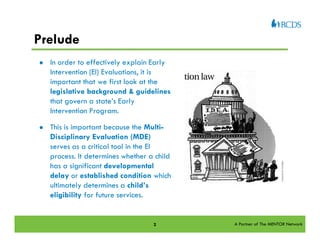
 In order to effectively explain Early
Intervention (EI) Evaluations, it is
important that we first look at the
legislative background & guidelines
that govern a state’s Early
Intervention Program.
 This is important because the Multi-
Disciplinary Evaluation (MDE)
serves as a critical tool in the EI
process. It determines whether a child
has a significant developmental
delay or established condition which
ultimately determines a child’s
eligibility for future services.
3 A Partner of The MENTOR Network
Background on IDEA
 IDEA was introduced in 1997 as the
Individuals with Disabilities
Education Act. It is a United States
federal law that governs how states
and public agencies provide early
intervention, special education, and
related services to children with
disabilities. It addresses the
educational needs of children with
disabilities from birth to the age of
21.
 The IDEA was formerly known as the
Education for All Handicapped
Children Act but has grown
considerably since. IDEA became a
federal standard by an act of
Congressional adoption in 1975 but
has been amended many times since.
The IDEA was most recently
amended in 2004, which was a
significant update.
The attached & proceeding information was
adapted from:
4 A Partner of The MENTOR Network
Overview to the Part C Program Under IDEA
Congress established Part C of IDEA;
Infants & Toddlers with Disabilities, in
1986 in recognition of "an urgent and
substantial need" to:
 enhance the development of infants and
toddlers with disabilities;
 reduce educational costs by minimizing
the need for special education through
early intervention;
 minimize the likelihood of
institutionalization, and maximize
independent living; and,
 enhance the capacity of families to meet
their child's needs.
5 A Partner of The MENTOR Network
Overview to the Part C Program Under IDEA
 The Program for Infants and Toddlers with
Disabilities (Part C of IDEA) is a federal grant
program that assists states in operating a
comprehensive statewide program of early
intervention services for infants and toddlers with
disabilities, ages birth through age 2 years, and
their families.
 In order for a state to participate in the program it
must assure that early intervention will be
available to every eligible child and its family.
 Also, the Governor must designate a lead agency
to receive the grant and administer the program,
and appoint an Interagency Coordinating Council
(ICC), including parents of young children with
disabilities, to advise and assist the lead agency.
 Currently, all states and eligible territories are
participating in the Part C program. Annual funding
to each state is based upon census figures of the
number of children, birth through 2, in the general
population.
6 A Partner of The MENTOR Network
Overview to the Part C Program Under IDEA
 The current statute and regulations for Part C contain
many requirements states have to meet, including
specifying the minimum components of comprehensive
statewide early intervention system.
 States have some discretion in setting the criteria for
child eligibility, including whether or not to serve at
risk children.
 As a result, definitions of eligibility differ significantly
from state to state.
 States also differ concerning which state agency has
been designated "lead agency" for the Part C
program. In fact, statewide early intervention systems
differ in many ways from state to state
On December 3, 2004, President Bush signed legislation reauthorizing IDEA.
7 A Partner of The MENTOR Network
Determining Eligibility
Although the IDEA statute for
Part C specifies the
developmental areas that are
to be included in states’
definitions of developmental
delay (see Table 1), states must
identify appropriate diagnostic
instruments, procedures
(including the use of informed
clinical opinion), and levels of
functioning or other criteria
that will be used to determine
eligibility.
8 A Partner of The MENTOR Network
Determining Eligibility
A review of state eligibility definitions under Part C reveals that
states are expressing criteria for delay quantitatively — such as:
 the difference between chronological
age and actual performance level
expressed as a percentage of
chronological age
 delay expressed as performance at a
certain number of months below
chronological age, or
 delay as indicated by standard
deviation below the mean on a norm-
referenced instrument — and
qualitatively— such as delay indicated
by atypical development or observed
atypical behaviors.
9 A Partner of The MENTOR Network
Determining Eligibility
• Common measurements of level of
delay are 25% delay or 2.0 standard
deviations (SD) below the mean in one
or more developmental areas, or 20%
delay or 1.5 SD in two or more areas.
• Traditional assessment instruments,
yielding scores in standard
deviations or developmental age in
months, may not adequately address
some developmental domains, or may
not be comparable across
developmental domains or across age
levels (Benn, 1994; Brown & Brown,
1993).
• There is wide variability in the type of quantitative criteria states use to
describe developmental delay, and there also is a wide range in the level of
delay states require for eligibility.
• For this reason, some states have included
qualitative criteria for determining
developmental delay. This type of criterion
includes findings of atypical behavior.
10 A Partner of The MENTOR Network
Determining Eligibility
• Because there is an insufficient number of reliable
and valid instruments for the birth-through-2 age
group and questionable predictive validity for available
instruments, determining delay by traditional
assessment can be problematic (Benn, 1994; Shonkoff
& Meisels, 1991).
• For that reason, the existing Part C regulations
require that Informed Clinical Opinion be included for
eligibility determination (see 34 C.F.R. 303.322(c)(2)).
• Informed Clinical Opinion relies on qualitative and
quantitative information to determine the need for early
intervention services, and typically is derived from the
consensus of a multidisciplinary team that includes
parents and information from multiple sources (Benn,
1994; Harbin et al., 1991).
• Several states’ policies specify only informed
clinical opinion as the criterion for eligibility without
providing quantitative criteria.
11 A Partner of The MENTOR Network
Multidisciplinary Evaluation Procedures
This section is adapted from: http://www.health.state.ny.us/community/infants_children/early_intervention/memoranda/2005-
02/multidisciplinary_procedures.htm
Purpose of the Multidisciplinary Evaluation
Under Federal and NY State law and regulations, children thought to be
eligible (e.g., referred with a suspected or confirmed disability) for the EIP are
entitled to a multidisciplinary evaluation. The multidisciplinary evaluation is
necessary to:
• determine whether a child is eligible for the Early Intervention Program;
• assess the status of the child's physical, cognitive, communication,
social-emotional, and adaptive development;
• identify areas of developmental strengths and needs; and,
• learn and understand the parent's resources, priorities, and concerns
related to their child's development.
12 A Partner of The MENTOR Network
Multidisciplinary Evaluation Procedures
Purpose of the Multidisciplinary Evaluation
• Children who are found eligible on the basis of a
diagnosed condition with a high probability of resulting in
developmental delay, such as Down syndrome, cerebral
palsy, extreme prematurity, etc., a primary purpose of
early intervention is to mitigate the impact of the condition
on a child's developmental progress.
• These children do not have to be experiencing
developmental delays to receive specific services
available under the EIP.
• In determining outcomes to be achieved for these
children and the services needed to achieve child and
family outcomes, the Individualized Family Service Plan
(IFSP) team should consider the potential impact of the
condition on child development and functioning as well as
information on children's developmental status obtained
through the evaluation process.
13 A Partner of The MENTOR Network
Multidisciplinary Evaluation Procedures
General Requirements for the Evaluation Process
• The Multidisciplinary Evaluation (MDE) must be completed within sufficient time to
develop an Individualized Family Service Plan (IFSP) within forty-five (45) days of
referral for those children found eligible for the EIP
• Under federal and NY State law and regulation, non-discriminatory evaluation and
assessment procedures must be used in all aspects of the evaluation and assessment
process. Specifically, evaluation and assessment procedures must be responsive to the
cultural and linguistic background of the family.
• No single procedure or instrument may be used as the sole criterion or indicator
of eligibility. In other words, when making a determination as to whether a child is
eligible for the EIP, the multidisciplinary evaluation team must rely on information from a
variety of appropriate sources, which should include standardized instruments and
procedures, when appropriate or possible; observations of the child; parent
interviews; informed clinical opinion; and, any other sources of information about
the child's developmental status available to the team conducting the child's
evaluation.
14 A Partner of The MENTOR Network
Multidisciplinary Evaluation Procedures
General Requirements for the Evaluation Process
Federal and State regulations also require
that evaluations must:
• be conducted by personnel trained to
utilize appropriate methods and
procedures;
• be based on informed clinical opinion;
and,
• include a review of pertinent records
related to the child's current health status
and medical history.
15 A Partner of The MENTOR Network
Multidisciplinary Evaluation Procedures
State regulations further specify that multidisciplinary evaluations must be
conducted in a professional, objective fashion and must:
• consider the unique characteristics
of the child;
• use several sources and types of
information about the child. Examples
of other sources of information might
include, with parent consent, the
child's primary health care provider or
medical specialists, relatives or family
members, family day care or child care
provider, etc.;
16 A Partner of The MENTOR Network
Multidisciplinary Evaluation Procedures
State regulations also specify that multidisciplinary evaluations must be
conducted in a professional, objective fashion and must:
• employ appropriate instruments and procedures.
Instruments used as part of a multidisciplinary
evaluation must be reliable and valid, have
appropriate levels of sensitivity and specificity; and, be
sensitive to the child's and parent's culture and
dominant language or other mode of communication;
and,
• be conducted in a setting conducive to ensuring
accurate results, and the parent's input regarding the
preferred environment should be considered. Prior to
the evaluation, parent input about the setting in which
their child is likely to be most comfortable should be
obtained. After the evaluation, the family should be
asked whether they believe their child's response was
optimal, and the family's response should be included
in the evaluation summary and report.
17 A Partner of The MENTOR Network
Multidisciplinary Evaluation Procedures
Standardized Evaluation & Assessment Instruments
• Standardized evaluation, assessment and/or
diagnostic instruments should be used,
whenever such instruments are available and
appropriate for the child's age,
culture/language, and developmental
concern, as part of a child's multidisciplinary
evaluation to determine initial or ongoing
eligibility for the EIP.
• Standardized evaluation and assessment
instruments must be used by appropriately
trained and qualified professionals. Some
test developers require professionals to
complete additional training and/or certification
prior to using the instrument, and under these
circumstances, only those professionals with
this training are qualified to use the
instrument.
18 A Partner of The MENTOR Network
Multidisciplinary Evaluation Procedures
Standardized Evaluation & Assessment Instruments
• In addition, evaluators are responsible for ensuring that
standardized tests are used and scored as specified in
the test manual, in a manner that does not violate the
psychometric properties of the test or the purpose for
which the test was designed.
• Sub scores returned on standardized tests must be
used in a manner consistent with the test manual, and are
generally not averaged unless the manual provides
explicit instructions for use of sub-scores in this manner.
• Standardized instruments selected should be norm-
referenced to the population to be evaluated. Tests and
other materials and procedures used must be
administered in the child's dominant language or other
mode of communication unless it is clearly not feasible to
do so.
• When evaluation and assessment instruments are
revised or re-normed and reissued by test developers,
the most recent edition of the instrument should be used
as soon as practicable (that is, when the new edition is
available to professionals) to assure valid results.
19 A Partner of The MENTOR Network
Multidisciplinary Evaluation Procedures
Standardized Evaluation and Assessment Instruments
• If a child is suspected of having a condition
with a high probability of resulting in
developmental delay, such as autism,
standardized assessment instruments
designed specifically to diagnose and
assess the presence of the condition should
be used.
• The six Clinical Practice Guidelines
developed by the NYS Department of Health
make specific recommendations on
standardized assessment instruments and
clinical procedures for evaluation of children
with Autism/Pervasive Developmental
Disorders, Communication Disorders,
Down Syndrome, Motor Disorders, Hearing
Loss, and Vision Impairment.
20 A Partner of The MENTOR Network
Multidisciplinary Evaluation Procedures
Standardized Evaluation & Assessment Instruments
• Norm-referenced, standardized tests yield
standard scores, standard deviations, and
percentile ranks that are derived in relationship
to a normal distribution, and therefore have a
consistent and predictable relationship to each
other and provide comparable information about a
child's performance relative to a normative
sample. Standard deviation scores, deviation
quotients, and percentile ranks are all acceptable
ways of reporting test scores to document
children's eligibility, when norm-referenced,
standardized instruments are used.
There are two types of standardized tests that are used to assess children's developmental status.
The use of each of these two types of tests to determine eligibility for the EIP is briefly described
below.
• Some norm-referenced tests also yield a "developmental age" or "age equivalency" score.
These scores represent the chronological age of the children in the sample for whom a specific
raw score was the mean score (i.e., the scores represent a mathematically calculated
performance rather than actual performance of children in the standardization sample
[Andersson, 2004]).
21 A Partner of The MENTOR Network
Multidisciplinary Evaluation Procedures
Standardized Evaluation & Assessment Instruments
• Assessment experts discourage the reporting of
age-equivalent/developmental age scores
because these scores do not provide comparative
information and do not indicate the presence of a
disorder or delay.
• These scores do not indicate what a child's
performance should be, nor do they indicate
qualitative differences in a child's performance.
In addition, a reduction in an age equivalent score
does not have the same consequence at all stages
of development or across all developmental
domains.
•Finally, these scores can be imprecise, because
age-equivalent scores may not be available to
match the full range of chronological ages.
• Age-equivalent or developmental age scores derived from standardized tests should not
be used for eligibility determinations unless the test manual explicitly indicates that the test has
been designed to calculate percentage of delay and the manual provides data to support the use
of these scores as valid and reliable.
22 A Partner of The MENTOR Network
Multidisciplinary Evaluation Procedures
Standardized Evaluation & Assessment Instruments
• Criterion-referenced tests are not designed to
compare one child's performance to other children.
Criterion-referenced instruments are helpful in
assessing children's functionality, measuring progress,
and linking assessment to intervention; however,
these tests generally do not provide sufficient
information to determine the extent to which a child is
experiencing developmental delays.
• In addition, criterion-referenced tests can be helpful
in evaluating children for whom norm-referenced tests
are not available or appropriate due to the child's
age, condition, language/culture, or other factors
that influence test performance.
• Criterion-reference tests can be used in conjunction with other methods of
gathering information about a child's development (e.g., parent report, observation,
etc.) and informed clinical opinion to establish a child's eligibility based on level of
developmental delay.
23 A Partner of The MENTOR Network
Multidisciplinary Evaluation Procedures
Standardized Evaluation & Assessment Instruments
• Norm-referenced test are known to have a higher
degree of reliability and validity than criterion-
referenced tests, and are specifically designed for use in
comparing the performance of an individual child to the
performance of a referent group (for example, children of
the same age).
• Norm-referenced tests should be used, whenever
possible and appropriate to the child's individualized
needs, as part of the eligibility determination process.
• Norm-referenced tested can be particularly helpful
when evaluating children who are referred to the EIP
based only on a concern about development and when
no underlying condition with a high probability of resulting
in developmental delay is suspected or confirmed.
24 A Partner of The MENTOR Network
Multidisciplinary Evaluation Procedures
Informed Clinical Opinion
• When using informed clinical opinion in the evaluation
process, practitioners draw upon clinical training and
experience; standardized instruments, as available
and appropriate; recognized clinical assessment
procedures (e.g., observation techniques; interviewing
techniques; use of objective measurement techniques
specific to the developmental problem or circumstances
and concerns related to child and family, etc.); experience
with children of different cultures and languages; and,
their ability to gather and include family perceptions
about children's development.
• Clinicians should also refer to recognized clinical
practice guidelines and standards, including NYS DOH's
Clinical Practice Guidelines. An article on informed
clinical opinion is available through the Web site of the
National Early Childhood Technical Assistance Center
(NECTAC) at http://www.nectac.org/.
25 A Partner of The MENTOR Network
Multidisciplinary Evaluation Procedures
Parental Involvement
• EIP regulations require that parents have the opportunity to participate
in the performance of screenings, evaluations, and assessments unless the
parent's circumstances prevent the parent's presence.
• For children in the care and custody, or custody and guardianship, of
the local social services commissioner, the commissioner or designee (i.e., the
child's case worker or other local department of social services staff designated
by the commissioner) may be present in lieu of a parent (or surrogate parent)
who elects not to participate.
• Parents should always be present and participate in the child's
evaluation, unless there are exceptional circumstances as to why the
parent’s) cannot be present.
• The presence and participation of a parent (or parents) is necessary for many
reasons. Parents have a responsibility to be informed about, understand,
and consent to the evaluation procedures. In addition, parents can assist the
multidisciplinary evaluation team with the evaluation process, can help elicit
optimal responses from their children and/or can help the team understand the
extent to which children's responses are typical/optimal.
26 A Partner of The MENTOR Network
Multidisciplinary Evaluation Procedures
Parental Involvement
• The evaluation team is required to conduct a parent interview about
the family's resources, priorities, and concerns about the child's
development and developmental progress.
• With the parent's consent, the evaluation team may also interview
other family members or individuals who have pertinent knowledge
about the child's development (e.g., child care providers).
• Children's parents have critical information about their children to
share and are integral to the evaluation process. Parental presence and
participation in their child's multidisciplinary evaluation is important to
facilitating parents' understanding of evaluation results.
• The multidisciplinary evaluation team is responsible for fully sharing
the results of child evaluations with parents following the
completion of evaluations and assessments. Parents must be
afforded the opportunity to discuss the evaluation results with
evaluators, including any concerns they have with the evaluation
process
27 A Partner of The MENTOR Network
Multidisciplinary Evaluation Procedures
Intake & Screening Procedures
• While parents always have the option to pursue
a multidisciplinary evaluation for their child upon
referral to the EIP, there are some circumstances
when performance of a screening is appropriate.
• Screening tests are generally intended to be
brief, easy to administer, and lead to a yes/no
decision as to whether or not a developmental
problem is likely and further in-depth
assessment/evaluation is needed.
• The evaluator is responsible for determining what
type of screening should be conducted (for
example, whether a screening should address one or
more domains of development, or if the screening
should address a specific concern, such as potential
hearing loss).
28 A Partner of The MENTOR Network
Multidisciplinary Evaluation Procedures
Intake & Screening Procedures
Circumstances under which it may be appropriate for an evaluator to
conduct a screening include when there are:
• concerns about only one area of
development (e.g., communication
development, physical development, etc.),
• or if there is a generalized concern about
the child's development, a screening may be
conducted to determine whether the child is
typically developing or whether there are
indications of problems that require further
evaluation and assessment; or,
• very specific concerns for which
procedures exist to clearly "rule out" or identify
a problem (e.g., hearing loss).
29 A Partner of The MENTOR Network
Multidisciplinary Evaluation Procedures
Intake & Screening Procedures
Screenings may be helpful in the following ways:
• When a screening indicates that a child's
development is within normal range, and no
problems or delays are identified, parental
concerns can be alleviated without
necessitating that the child and family undergo
a full evaluation (unless the parent requests a
full evaluation).
• Screenings can assist the evaluator in
deciding upon the most effective
composition of the child's multidisciplinary
evaluation team. For example, if a screening
indicates that a child's communication
development is age appropriate, but motor
development is delayed, the multidisciplinary
evaluation team should include a professional
who can assess the child's motor functioning.
30 A Partner of The MENTOR Network
Multidisciplinary Evaluation Procedures
Intake & Screening Procedures
• If the screening indicates cause for concern, a
multidisciplinary evaluation must be completed to determine
whether the child is eligible for the EIP. It is important to note
that the multidisciplinary evaluation must include an in-
depth assessment of all five areas of development,
regardless of screening results.
• When a screening is completed as part of the evaluation
process, the evaluator must use, whenever feasible and
appropriate, standardized instruments with demonstrated
reliability and validity, and appropriate sensitivity and
specificity.
• In addition, parents must consent to and be present for
the screening, unless the parent's circumstances prevent the
parent's presence.
• Evaluators who perform a screening are responsible for
discussing the results of the screening with the parent,
facilitating the parent's understanding of the screening results,
and addressing any concerns identified by the parent.
31 A Partner of The MENTOR Network
Multidisciplinary Evaluation Procedures
Composition of the Evaluation Team
• At a minimum, the team must include two
differently qualified professionals.
• In addition, NY State EIP regulations stipulate that
at least one member of the evaluation team must
be a specialist in the area of the child's
suspected delay or disability, if known.
• The team must be trained in appropriate
methods and procedures, and across the
members of the team, have sufficient expertise to
fully assess all five developmental domains.
• At least one member of the team must also have
expertise and be trained in appropriate methods
and procedures to conduct the family assessment
(optional to the parents]). .
32 A Partner of The MENTOR Network
Multidisciplinary Evaluation Procedures
Composition of the Evaluation Team
An EI Evaluation MDE Team may include the following licensed and/or certified professionals:
• Special Education Teacher: Serves as the Generalist providing the Developmental
Assessment assessing all five domains of development, including the area of Cognition
(Problem-Solving)
• Social Worker: May conduct the Parent Interview and/or Family Assessment (Family
Concerns, Priorities & Resources)
• Speech-Language Pathologist: Assesses the areas of Communication Development
(Expressive & Receptive Language Skills)
• Occupational Therapist: Assesses the area of Adaptive/Self-Help or Physical Development
(Fine Motor Skills)
• Physical Therapist: Assesses the area of Physical Development (Gross Motor Skills)
• Clinical Psychologist: Assesses the area of Social-Emotional Development and/or provides a
diagnosis such as Autistic Spectrum Disorders (ASD)
• Physician: Provides a Physical Health Assessment including Vision & Hearing
33 A Partner of The MENTOR Network
Multidisciplinary Evaluation Procedures
Required Components of the MDE
The FIVE DOMAINS of Development:
See RCDS Handout:
Child Development & Related Services
Adapted From “The Child Development Web” ©
34 A Partner of The MENTOR Network
Multidisciplinary Evaluation Procedures
Required Components of the MDE
• Parent Interview about the family's resources, priorities,
and concerns related to the child's development and
developmental progress. Interviews with other family members or
individuals knowledgeable about the child, such as childcare
providers, may be conducted with parent consent.
• With parent consent, a review of pertinent records related to
the child's current health status and medical history.
• An evaluation of the child's level of functioning in each of
five developmental domains: cognitive, physical (including
vision and hearing), communication, social or emotional, and
adaptive development.
• The evaluation of the child's physical development must
include a health assessment. The health assessment is comprised
of a physical examination, routine vision and hearing
screening, and where appropriate, a neurological assessment
Under the EIP regulations, the following components must be included in performance of
multidisciplinary evaluations:
35 A Partner of The MENTOR Network
Multidisciplinary Evaluation Procedures
Required Components of the MDE
• With parent consent, findings from current
examinations, evaluations or assessments, in addition
to health assessments for the child, other assessments
may be used to augment and not replace the
multidisciplinary evaluation to determine eligibility, as long
as these assessments have been performed in a manner
consistent with the requirements for multidisciplinary
evaluations, and no clinical indicators are present to
suggest the need to repeat procedures.
• An assessment of the unique needs of the child in
each developmental domain, including identification of
services appropriate to meet those needs. It is
appropriate for evaluators to identify the types of
interventions and services that are indicated for the
child, and family based on the results of the evaluation.
36 A Partner of The MENTOR Network
Multidisciplinary Evaluation Procedures
Voluntary Family Assessment
• EIP regulations require that all parents
be given the opportunity to participate in a
family-directed assessment to determine
the resources, priorities, and concerns
of the family related to enhancement of
the child's development, conducted by
appropriately qualified personnel on the
multidisciplinary evaluation team.
• Family assessments are voluntary on
the part of the family; however, evaluators
approved under the EIP must have the
personnel resources to offer a family
assessment to all families and to conduct
these assessments for parents who wish to
participate in a family assessment
37 A Partner of The MENTOR Network
Multidisciplinary Evaluation Procedures
Parent Interview vs. Family Assessment
• It is important to differentiate between the
parent interview that must be conducted
as part of the child's multidisciplinary
evaluation and the family assessment
process, which is voluntary on the part of
the family.
• The purpose of the parent interview is
to obtain information from the
perspective of the child's parents, and
with parent consent, from other individuals
familiar with the child's development
regarding concerns about the child's
developmental status and progress.
38 A Partner of The MENTOR Network
Multidisciplinary Evaluation Procedures
Parent Interview vs. Family Assessment
• The parent interview assists the
multidisciplinary evaluation team in
assessing the unique needs of the
child in each developmental domain,
and the family's resources, priorities, and
concerns related to the child's
development.
• The subject of the parent interview,
in other words, is the child's
development. The parent interview
(and/or interviews with other individuals,
with the parent's consent) is a required
part of the child's evaluation, focused
on the child's developmental status.
39 A Partner of The MENTOR Network
Multidisciplinary Evaluation Procedures
Parent Interview vs. Family Assessment
• The purpose of the voluntary family assessment
is to assist the family in determining the
resources, priorities, and concerns of the family
related to enhancing their child's development.
• The multidisciplinary evaluation team is
required to offer families the opportunity to
participate in a family assessment; however,
participation in this assessment process is
voluntary for the family.
• The family assessment process is defined in
EIP regulations as "the process of information
gathering and identification of family priorities,
resources and concerns, which the family
decides are relevant to their ability to enhance
their child's development."
40 A Partner of The MENTOR Network
Multidisciplinary Evaluation Procedures
Parent Interview vs. Family Assessment
• be conducted by qualified personnel
trained to utilize appropriate methods and
procedures;
• be based on information provided by the
family through a personal interview;
• incorporate the family's description of its
resources, priorities, and concerns related to
enhancing the child's development; and,
be completed within a sufficient time frame
to enable convening of the IFSP meeting
within 45 days of the date of the child's referral
to the EIP.
When carried out, family assessments must:
41 A Partner of The MENTOR Network
Multidisciplinary Evaluation Procedures
Use of Findings From Other Examinations
• Evaluators may use findings from other
current examinations, evaluations,
assessments, or health assessments
performed for the child, with parental
consent, including those conducted prior
to the initiation of the multidisciplinary
evaluation.
• This can facilitate the timeliness of the
evaluation process by reducing the
amount of time needed to complete the
evaluation, and by reducing the number of
professionals involved and/or evaluations
that must be completed.
42 A Partner of The MENTOR Network
Multidisciplinary Evaluation Procedures
Use of Findings From Other Examinations
Use of such findings will also ensure that children do not have to undergo
duplicative or unnecessary evaluation procedures. Under these circumstances,
the evaluator must ensure that:
• the procedures were performed in a
manner consistent with EIP
requirements;
• the findings are used to augment and
not replace the multidisciplinary
evaluation to determine eligibility; and,
• there are no indications present
which suggest the need to repeat such
procedures (e.g., the strengths/needs of
the child have changed sufficiently to
warrant re-examination).
43 A Partner of The MENTOR Network
Multidisciplinary Evaluation Procedures
Use of Findings From Other Examinations
• If a child has been evaluated using a specific
standardized instrument/test/procedure prior to
his/her referral to the EIP, the EIP multidisciplinary
evaluation team is responsible for determining
whether it is necessary and appropriate (i.e., will not
impact the validity/reliability of test scores) to repeat
the instrument/test/procedure
• Finally, if a child is referred as having a
diagnosed physical or mental condition with a
high probability of resulting in developmental delay,
which has also been identified on the DOH’s list of
conditions that establish a child's eligibility for the
EIP, the evaluator is responsible for confirming
that the child has the condition and is eligible
for the EIP based on the presence of the
condition.
44 A Partner of The MENTOR Network
The Evaluation Report
The evaluation report and summary must include the following information:
• the names, titles, and qualifications
of the persons performing the evaluation
and assessment;
• a description of the assessment
process;
• the child's responses to the
procedures and instruments used as
part of the evaluation process, and the
family's belief about whether the
responses were optimal;
• the developmental status of the child
in each of the five developmental
domains, including the unique strengths
and needs in each area;
• documentation of how clinical opinion
was used by the evaluation team in
evaluating and assessing the child's
developmental status and potential eligibility
for the EIP; and,
• measures and/or scores that were
used, if any; and, an explanation of these
measures or scores.
• the evaluation report should also include
diagnostic information and ICD-9 codes
related to the child's eligibility, where
appropriate.
45 A Partner of The MENTOR Network
The Evaluation Report
• The evaluation report must include
a clear statement of the child's
eligibility. The eligibility statement
must include either a diagnosed
condition with a high probability of
resulting in developmental delay and
associated ICD-9 code;
or,
• A statement of developmental
delay consistent with the state
definition of developmental delay and
associated ICD-9 code for
developmental delay.
• When a diagnosis is made by the
evaluation team, one or more members
of the team must be qualified under the
practice acts in the education law
governing their profession to render a
diagnosis
• If the results of the multidisciplinary
evaluation indicate the child is not
eligible for the EIP, the evaluation report
should also clearly document reasons
why the child is not eligible (for
example, the child's development is
within normal range, or the child is not
experiencing a developmental delay
consistent with the State's definition
of developmental delay).
46 A Partner of The MENTOR Network
Question & Answer
Feel Free To Direct Future Questions Via Email:
dawn.mastoridis@thementornetwork.com
Experience the RCDS Difference.
Quality Developmental Home & Community-Based Services For Young Children
Caring & Qualified Early Intervention Professionals Needed.
PHYSICAL & OCCUPATIONAL THERAPISTS ~ COTAS & CLINICAL FELLOWS
SPEECH LANGUAGE PATHOLOGISTS ~ CLINICAL PSYCHOLOGISTS
SPECIAL EDUCATORS ~ CERTIFIED SOCIAL WORKERS ~ NUTRITIONISTS
TEACHERS OF THE VISUALLY IMPAIRED ~ TEACHERS OF SPEECH & LANGUAGE DISABILITIES
Certified/Licensed Providers Needed to Serve Children & Families
Residing in Queens, Brooklyn, Manhattan, the Bronx as well as
Rockland & Orange County.
To Apply Simply Email Your Resume To:
dawn.mastoridis@thementornetwork.com
Learn More Online at: www.rcdseip.com

Understanding EIP Evals Ppt

  • 1.
    “Understanding Early Intervention Evaluations WithEase” Presented By: Dawn L. Mastoridis, M.Ed., CAGS Executive Director, RCDS State Director, NY, The MENTOR Network Monday, May 5th 2008
  • 2.
    2 A Partnerof The MENTOR Network Prelude  In order to effectively explain Early Intervention (EI) Evaluations, it is important that we first look at the legislative background & guidelines that govern a state’s Early Intervention Program.  This is important because the Multi- Disciplinary Evaluation (MDE) serves as a critical tool in the EI process. It determines whether a child has a significant developmental delay or established condition which ultimately determines a child’s eligibility for future services.
  • 3.
    3 A Partnerof The MENTOR Network Background on IDEA  IDEA was introduced in 1997 as the Individuals with Disabilities Education Act. It is a United States federal law that governs how states and public agencies provide early intervention, special education, and related services to children with disabilities. It addresses the educational needs of children with disabilities from birth to the age of 21.  The IDEA was formerly known as the Education for All Handicapped Children Act but has grown considerably since. IDEA became a federal standard by an act of Congressional adoption in 1975 but has been amended many times since. The IDEA was most recently amended in 2004, which was a significant update. The attached & proceeding information was adapted from:
  • 4.
    4 A Partnerof The MENTOR Network Overview to the Part C Program Under IDEA Congress established Part C of IDEA; Infants & Toddlers with Disabilities, in 1986 in recognition of "an urgent and substantial need" to:  enhance the development of infants and toddlers with disabilities;  reduce educational costs by minimizing the need for special education through early intervention;  minimize the likelihood of institutionalization, and maximize independent living; and,  enhance the capacity of families to meet their child's needs.
  • 5.
    5 A Partnerof The MENTOR Network Overview to the Part C Program Under IDEA  The Program for Infants and Toddlers with Disabilities (Part C of IDEA) is a federal grant program that assists states in operating a comprehensive statewide program of early intervention services for infants and toddlers with disabilities, ages birth through age 2 years, and their families.  In order for a state to participate in the program it must assure that early intervention will be available to every eligible child and its family.  Also, the Governor must designate a lead agency to receive the grant and administer the program, and appoint an Interagency Coordinating Council (ICC), including parents of young children with disabilities, to advise and assist the lead agency.  Currently, all states and eligible territories are participating in the Part C program. Annual funding to each state is based upon census figures of the number of children, birth through 2, in the general population.
  • 6.
    6 A Partnerof The MENTOR Network Overview to the Part C Program Under IDEA  The current statute and regulations for Part C contain many requirements states have to meet, including specifying the minimum components of comprehensive statewide early intervention system.  States have some discretion in setting the criteria for child eligibility, including whether or not to serve at risk children.  As a result, definitions of eligibility differ significantly from state to state.  States also differ concerning which state agency has been designated "lead agency" for the Part C program. In fact, statewide early intervention systems differ in many ways from state to state On December 3, 2004, President Bush signed legislation reauthorizing IDEA.
  • 7.
    7 A Partnerof The MENTOR Network Determining Eligibility Although the IDEA statute for Part C specifies the developmental areas that are to be included in states’ definitions of developmental delay (see Table 1), states must identify appropriate diagnostic instruments, procedures (including the use of informed clinical opinion), and levels of functioning or other criteria that will be used to determine eligibility.
  • 8.
    8 A Partnerof The MENTOR Network Determining Eligibility A review of state eligibility definitions under Part C reveals that states are expressing criteria for delay quantitatively — such as:  the difference between chronological age and actual performance level expressed as a percentage of chronological age  delay expressed as performance at a certain number of months below chronological age, or  delay as indicated by standard deviation below the mean on a norm- referenced instrument — and qualitatively— such as delay indicated by atypical development or observed atypical behaviors.
  • 9.
    9 A Partnerof The MENTOR Network Determining Eligibility • Common measurements of level of delay are 25% delay or 2.0 standard deviations (SD) below the mean in one or more developmental areas, or 20% delay or 1.5 SD in two or more areas. • Traditional assessment instruments, yielding scores in standard deviations or developmental age in months, may not adequately address some developmental domains, or may not be comparable across developmental domains or across age levels (Benn, 1994; Brown & Brown, 1993). • There is wide variability in the type of quantitative criteria states use to describe developmental delay, and there also is a wide range in the level of delay states require for eligibility. • For this reason, some states have included qualitative criteria for determining developmental delay. This type of criterion includes findings of atypical behavior.
  • 10.
    10 A Partnerof The MENTOR Network Determining Eligibility • Because there is an insufficient number of reliable and valid instruments for the birth-through-2 age group and questionable predictive validity for available instruments, determining delay by traditional assessment can be problematic (Benn, 1994; Shonkoff & Meisels, 1991). • For that reason, the existing Part C regulations require that Informed Clinical Opinion be included for eligibility determination (see 34 C.F.R. 303.322(c)(2)). • Informed Clinical Opinion relies on qualitative and quantitative information to determine the need for early intervention services, and typically is derived from the consensus of a multidisciplinary team that includes parents and information from multiple sources (Benn, 1994; Harbin et al., 1991). • Several states’ policies specify only informed clinical opinion as the criterion for eligibility without providing quantitative criteria.
  • 11.
    11 A Partnerof The MENTOR Network Multidisciplinary Evaluation Procedures This section is adapted from: http://www.health.state.ny.us/community/infants_children/early_intervention/memoranda/2005- 02/multidisciplinary_procedures.htm Purpose of the Multidisciplinary Evaluation Under Federal and NY State law and regulations, children thought to be eligible (e.g., referred with a suspected or confirmed disability) for the EIP are entitled to a multidisciplinary evaluation. The multidisciplinary evaluation is necessary to: • determine whether a child is eligible for the Early Intervention Program; • assess the status of the child's physical, cognitive, communication, social-emotional, and adaptive development; • identify areas of developmental strengths and needs; and, • learn and understand the parent's resources, priorities, and concerns related to their child's development.
  • 12.
    12 A Partnerof The MENTOR Network Multidisciplinary Evaluation Procedures Purpose of the Multidisciplinary Evaluation • Children who are found eligible on the basis of a diagnosed condition with a high probability of resulting in developmental delay, such as Down syndrome, cerebral palsy, extreme prematurity, etc., a primary purpose of early intervention is to mitigate the impact of the condition on a child's developmental progress. • These children do not have to be experiencing developmental delays to receive specific services available under the EIP. • In determining outcomes to be achieved for these children and the services needed to achieve child and family outcomes, the Individualized Family Service Plan (IFSP) team should consider the potential impact of the condition on child development and functioning as well as information on children's developmental status obtained through the evaluation process.
  • 13.
    13 A Partnerof The MENTOR Network Multidisciplinary Evaluation Procedures General Requirements for the Evaluation Process • The Multidisciplinary Evaluation (MDE) must be completed within sufficient time to develop an Individualized Family Service Plan (IFSP) within forty-five (45) days of referral for those children found eligible for the EIP • Under federal and NY State law and regulation, non-discriminatory evaluation and assessment procedures must be used in all aspects of the evaluation and assessment process. Specifically, evaluation and assessment procedures must be responsive to the cultural and linguistic background of the family. • No single procedure or instrument may be used as the sole criterion or indicator of eligibility. In other words, when making a determination as to whether a child is eligible for the EIP, the multidisciplinary evaluation team must rely on information from a variety of appropriate sources, which should include standardized instruments and procedures, when appropriate or possible; observations of the child; parent interviews; informed clinical opinion; and, any other sources of information about the child's developmental status available to the team conducting the child's evaluation.
  • 14.
    14 A Partnerof The MENTOR Network Multidisciplinary Evaluation Procedures General Requirements for the Evaluation Process Federal and State regulations also require that evaluations must: • be conducted by personnel trained to utilize appropriate methods and procedures; • be based on informed clinical opinion; and, • include a review of pertinent records related to the child's current health status and medical history.
  • 15.
    15 A Partnerof The MENTOR Network Multidisciplinary Evaluation Procedures State regulations further specify that multidisciplinary evaluations must be conducted in a professional, objective fashion and must: • consider the unique characteristics of the child; • use several sources and types of information about the child. Examples of other sources of information might include, with parent consent, the child's primary health care provider or medical specialists, relatives or family members, family day care or child care provider, etc.;
  • 16.
    16 A Partnerof The MENTOR Network Multidisciplinary Evaluation Procedures State regulations also specify that multidisciplinary evaluations must be conducted in a professional, objective fashion and must: • employ appropriate instruments and procedures. Instruments used as part of a multidisciplinary evaluation must be reliable and valid, have appropriate levels of sensitivity and specificity; and, be sensitive to the child's and parent's culture and dominant language or other mode of communication; and, • be conducted in a setting conducive to ensuring accurate results, and the parent's input regarding the preferred environment should be considered. Prior to the evaluation, parent input about the setting in which their child is likely to be most comfortable should be obtained. After the evaluation, the family should be asked whether they believe their child's response was optimal, and the family's response should be included in the evaluation summary and report.
  • 17.
    17 A Partnerof The MENTOR Network Multidisciplinary Evaluation Procedures Standardized Evaluation & Assessment Instruments • Standardized evaluation, assessment and/or diagnostic instruments should be used, whenever such instruments are available and appropriate for the child's age, culture/language, and developmental concern, as part of a child's multidisciplinary evaluation to determine initial or ongoing eligibility for the EIP. • Standardized evaluation and assessment instruments must be used by appropriately trained and qualified professionals. Some test developers require professionals to complete additional training and/or certification prior to using the instrument, and under these circumstances, only those professionals with this training are qualified to use the instrument.
  • 18.
    18 A Partnerof The MENTOR Network Multidisciplinary Evaluation Procedures Standardized Evaluation & Assessment Instruments • In addition, evaluators are responsible for ensuring that standardized tests are used and scored as specified in the test manual, in a manner that does not violate the psychometric properties of the test or the purpose for which the test was designed. • Sub scores returned on standardized tests must be used in a manner consistent with the test manual, and are generally not averaged unless the manual provides explicit instructions for use of sub-scores in this manner. • Standardized instruments selected should be norm- referenced to the population to be evaluated. Tests and other materials and procedures used must be administered in the child's dominant language or other mode of communication unless it is clearly not feasible to do so. • When evaluation and assessment instruments are revised or re-normed and reissued by test developers, the most recent edition of the instrument should be used as soon as practicable (that is, when the new edition is available to professionals) to assure valid results.
  • 19.
    19 A Partnerof The MENTOR Network Multidisciplinary Evaluation Procedures Standardized Evaluation and Assessment Instruments • If a child is suspected of having a condition with a high probability of resulting in developmental delay, such as autism, standardized assessment instruments designed specifically to diagnose and assess the presence of the condition should be used. • The six Clinical Practice Guidelines developed by the NYS Department of Health make specific recommendations on standardized assessment instruments and clinical procedures for evaluation of children with Autism/Pervasive Developmental Disorders, Communication Disorders, Down Syndrome, Motor Disorders, Hearing Loss, and Vision Impairment.
  • 20.
    20 A Partnerof The MENTOR Network Multidisciplinary Evaluation Procedures Standardized Evaluation & Assessment Instruments • Norm-referenced, standardized tests yield standard scores, standard deviations, and percentile ranks that are derived in relationship to a normal distribution, and therefore have a consistent and predictable relationship to each other and provide comparable information about a child's performance relative to a normative sample. Standard deviation scores, deviation quotients, and percentile ranks are all acceptable ways of reporting test scores to document children's eligibility, when norm-referenced, standardized instruments are used. There are two types of standardized tests that are used to assess children's developmental status. The use of each of these two types of tests to determine eligibility for the EIP is briefly described below. • Some norm-referenced tests also yield a "developmental age" or "age equivalency" score. These scores represent the chronological age of the children in the sample for whom a specific raw score was the mean score (i.e., the scores represent a mathematically calculated performance rather than actual performance of children in the standardization sample [Andersson, 2004]).
  • 21.
    21 A Partnerof The MENTOR Network Multidisciplinary Evaluation Procedures Standardized Evaluation & Assessment Instruments • Assessment experts discourage the reporting of age-equivalent/developmental age scores because these scores do not provide comparative information and do not indicate the presence of a disorder or delay. • These scores do not indicate what a child's performance should be, nor do they indicate qualitative differences in a child's performance. In addition, a reduction in an age equivalent score does not have the same consequence at all stages of development or across all developmental domains. •Finally, these scores can be imprecise, because age-equivalent scores may not be available to match the full range of chronological ages. • Age-equivalent or developmental age scores derived from standardized tests should not be used for eligibility determinations unless the test manual explicitly indicates that the test has been designed to calculate percentage of delay and the manual provides data to support the use of these scores as valid and reliable.
  • 22.
    22 A Partnerof The MENTOR Network Multidisciplinary Evaluation Procedures Standardized Evaluation & Assessment Instruments • Criterion-referenced tests are not designed to compare one child's performance to other children. Criterion-referenced instruments are helpful in assessing children's functionality, measuring progress, and linking assessment to intervention; however, these tests generally do not provide sufficient information to determine the extent to which a child is experiencing developmental delays. • In addition, criterion-referenced tests can be helpful in evaluating children for whom norm-referenced tests are not available or appropriate due to the child's age, condition, language/culture, or other factors that influence test performance. • Criterion-reference tests can be used in conjunction with other methods of gathering information about a child's development (e.g., parent report, observation, etc.) and informed clinical opinion to establish a child's eligibility based on level of developmental delay.
  • 23.
    23 A Partnerof The MENTOR Network Multidisciplinary Evaluation Procedures Standardized Evaluation & Assessment Instruments • Norm-referenced test are known to have a higher degree of reliability and validity than criterion- referenced tests, and are specifically designed for use in comparing the performance of an individual child to the performance of a referent group (for example, children of the same age). • Norm-referenced tests should be used, whenever possible and appropriate to the child's individualized needs, as part of the eligibility determination process. • Norm-referenced tested can be particularly helpful when evaluating children who are referred to the EIP based only on a concern about development and when no underlying condition with a high probability of resulting in developmental delay is suspected or confirmed.
  • 24.
    24 A Partnerof The MENTOR Network Multidisciplinary Evaluation Procedures Informed Clinical Opinion • When using informed clinical opinion in the evaluation process, practitioners draw upon clinical training and experience; standardized instruments, as available and appropriate; recognized clinical assessment procedures (e.g., observation techniques; interviewing techniques; use of objective measurement techniques specific to the developmental problem or circumstances and concerns related to child and family, etc.); experience with children of different cultures and languages; and, their ability to gather and include family perceptions about children's development. • Clinicians should also refer to recognized clinical practice guidelines and standards, including NYS DOH's Clinical Practice Guidelines. An article on informed clinical opinion is available through the Web site of the National Early Childhood Technical Assistance Center (NECTAC) at http://www.nectac.org/.
  • 25.
    25 A Partnerof The MENTOR Network Multidisciplinary Evaluation Procedures Parental Involvement • EIP regulations require that parents have the opportunity to participate in the performance of screenings, evaluations, and assessments unless the parent's circumstances prevent the parent's presence. • For children in the care and custody, or custody and guardianship, of the local social services commissioner, the commissioner or designee (i.e., the child's case worker or other local department of social services staff designated by the commissioner) may be present in lieu of a parent (or surrogate parent) who elects not to participate. • Parents should always be present and participate in the child's evaluation, unless there are exceptional circumstances as to why the parent’s) cannot be present. • The presence and participation of a parent (or parents) is necessary for many reasons. Parents have a responsibility to be informed about, understand, and consent to the evaluation procedures. In addition, parents can assist the multidisciplinary evaluation team with the evaluation process, can help elicit optimal responses from their children and/or can help the team understand the extent to which children's responses are typical/optimal.
  • 26.
    26 A Partnerof The MENTOR Network Multidisciplinary Evaluation Procedures Parental Involvement • The evaluation team is required to conduct a parent interview about the family's resources, priorities, and concerns about the child's development and developmental progress. • With the parent's consent, the evaluation team may also interview other family members or individuals who have pertinent knowledge about the child's development (e.g., child care providers). • Children's parents have critical information about their children to share and are integral to the evaluation process. Parental presence and participation in their child's multidisciplinary evaluation is important to facilitating parents' understanding of evaluation results. • The multidisciplinary evaluation team is responsible for fully sharing the results of child evaluations with parents following the completion of evaluations and assessments. Parents must be afforded the opportunity to discuss the evaluation results with evaluators, including any concerns they have with the evaluation process
  • 27.
    27 A Partnerof The MENTOR Network Multidisciplinary Evaluation Procedures Intake & Screening Procedures • While parents always have the option to pursue a multidisciplinary evaluation for their child upon referral to the EIP, there are some circumstances when performance of a screening is appropriate. • Screening tests are generally intended to be brief, easy to administer, and lead to a yes/no decision as to whether or not a developmental problem is likely and further in-depth assessment/evaluation is needed. • The evaluator is responsible for determining what type of screening should be conducted (for example, whether a screening should address one or more domains of development, or if the screening should address a specific concern, such as potential hearing loss).
  • 28.
    28 A Partnerof The MENTOR Network Multidisciplinary Evaluation Procedures Intake & Screening Procedures Circumstances under which it may be appropriate for an evaluator to conduct a screening include when there are: • concerns about only one area of development (e.g., communication development, physical development, etc.), • or if there is a generalized concern about the child's development, a screening may be conducted to determine whether the child is typically developing or whether there are indications of problems that require further evaluation and assessment; or, • very specific concerns for which procedures exist to clearly "rule out" or identify a problem (e.g., hearing loss).
  • 29.
    29 A Partnerof The MENTOR Network Multidisciplinary Evaluation Procedures Intake & Screening Procedures Screenings may be helpful in the following ways: • When a screening indicates that a child's development is within normal range, and no problems or delays are identified, parental concerns can be alleviated without necessitating that the child and family undergo a full evaluation (unless the parent requests a full evaluation). • Screenings can assist the evaluator in deciding upon the most effective composition of the child's multidisciplinary evaluation team. For example, if a screening indicates that a child's communication development is age appropriate, but motor development is delayed, the multidisciplinary evaluation team should include a professional who can assess the child's motor functioning.
  • 30.
    30 A Partnerof The MENTOR Network Multidisciplinary Evaluation Procedures Intake & Screening Procedures • If the screening indicates cause for concern, a multidisciplinary evaluation must be completed to determine whether the child is eligible for the EIP. It is important to note that the multidisciplinary evaluation must include an in- depth assessment of all five areas of development, regardless of screening results. • When a screening is completed as part of the evaluation process, the evaluator must use, whenever feasible and appropriate, standardized instruments with demonstrated reliability and validity, and appropriate sensitivity and specificity. • In addition, parents must consent to and be present for the screening, unless the parent's circumstances prevent the parent's presence. • Evaluators who perform a screening are responsible for discussing the results of the screening with the parent, facilitating the parent's understanding of the screening results, and addressing any concerns identified by the parent.
  • 31.
    31 A Partnerof The MENTOR Network Multidisciplinary Evaluation Procedures Composition of the Evaluation Team • At a minimum, the team must include two differently qualified professionals. • In addition, NY State EIP regulations stipulate that at least one member of the evaluation team must be a specialist in the area of the child's suspected delay or disability, if known. • The team must be trained in appropriate methods and procedures, and across the members of the team, have sufficient expertise to fully assess all five developmental domains. • At least one member of the team must also have expertise and be trained in appropriate methods and procedures to conduct the family assessment (optional to the parents]). .
  • 32.
    32 A Partnerof The MENTOR Network Multidisciplinary Evaluation Procedures Composition of the Evaluation Team An EI Evaluation MDE Team may include the following licensed and/or certified professionals: • Special Education Teacher: Serves as the Generalist providing the Developmental Assessment assessing all five domains of development, including the area of Cognition (Problem-Solving) • Social Worker: May conduct the Parent Interview and/or Family Assessment (Family Concerns, Priorities & Resources) • Speech-Language Pathologist: Assesses the areas of Communication Development (Expressive & Receptive Language Skills) • Occupational Therapist: Assesses the area of Adaptive/Self-Help or Physical Development (Fine Motor Skills) • Physical Therapist: Assesses the area of Physical Development (Gross Motor Skills) • Clinical Psychologist: Assesses the area of Social-Emotional Development and/or provides a diagnosis such as Autistic Spectrum Disorders (ASD) • Physician: Provides a Physical Health Assessment including Vision & Hearing
  • 33.
    33 A Partnerof The MENTOR Network Multidisciplinary Evaluation Procedures Required Components of the MDE The FIVE DOMAINS of Development: See RCDS Handout: Child Development & Related Services Adapted From “The Child Development Web” ©
  • 34.
    34 A Partnerof The MENTOR Network Multidisciplinary Evaluation Procedures Required Components of the MDE • Parent Interview about the family's resources, priorities, and concerns related to the child's development and developmental progress. Interviews with other family members or individuals knowledgeable about the child, such as childcare providers, may be conducted with parent consent. • With parent consent, a review of pertinent records related to the child's current health status and medical history. • An evaluation of the child's level of functioning in each of five developmental domains: cognitive, physical (including vision and hearing), communication, social or emotional, and adaptive development. • The evaluation of the child's physical development must include a health assessment. The health assessment is comprised of a physical examination, routine vision and hearing screening, and where appropriate, a neurological assessment Under the EIP regulations, the following components must be included in performance of multidisciplinary evaluations:
  • 35.
    35 A Partnerof The MENTOR Network Multidisciplinary Evaluation Procedures Required Components of the MDE • With parent consent, findings from current examinations, evaluations or assessments, in addition to health assessments for the child, other assessments may be used to augment and not replace the multidisciplinary evaluation to determine eligibility, as long as these assessments have been performed in a manner consistent with the requirements for multidisciplinary evaluations, and no clinical indicators are present to suggest the need to repeat procedures. • An assessment of the unique needs of the child in each developmental domain, including identification of services appropriate to meet those needs. It is appropriate for evaluators to identify the types of interventions and services that are indicated for the child, and family based on the results of the evaluation.
  • 36.
    36 A Partnerof The MENTOR Network Multidisciplinary Evaluation Procedures Voluntary Family Assessment • EIP regulations require that all parents be given the opportunity to participate in a family-directed assessment to determine the resources, priorities, and concerns of the family related to enhancement of the child's development, conducted by appropriately qualified personnel on the multidisciplinary evaluation team. • Family assessments are voluntary on the part of the family; however, evaluators approved under the EIP must have the personnel resources to offer a family assessment to all families and to conduct these assessments for parents who wish to participate in a family assessment
  • 37.
    37 A Partnerof The MENTOR Network Multidisciplinary Evaluation Procedures Parent Interview vs. Family Assessment • It is important to differentiate between the parent interview that must be conducted as part of the child's multidisciplinary evaluation and the family assessment process, which is voluntary on the part of the family. • The purpose of the parent interview is to obtain information from the perspective of the child's parents, and with parent consent, from other individuals familiar with the child's development regarding concerns about the child's developmental status and progress.
  • 38.
    38 A Partnerof The MENTOR Network Multidisciplinary Evaluation Procedures Parent Interview vs. Family Assessment • The parent interview assists the multidisciplinary evaluation team in assessing the unique needs of the child in each developmental domain, and the family's resources, priorities, and concerns related to the child's development. • The subject of the parent interview, in other words, is the child's development. The parent interview (and/or interviews with other individuals, with the parent's consent) is a required part of the child's evaluation, focused on the child's developmental status.
  • 39.
    39 A Partnerof The MENTOR Network Multidisciplinary Evaluation Procedures Parent Interview vs. Family Assessment • The purpose of the voluntary family assessment is to assist the family in determining the resources, priorities, and concerns of the family related to enhancing their child's development. • The multidisciplinary evaluation team is required to offer families the opportunity to participate in a family assessment; however, participation in this assessment process is voluntary for the family. • The family assessment process is defined in EIP regulations as "the process of information gathering and identification of family priorities, resources and concerns, which the family decides are relevant to their ability to enhance their child's development."
  • 40.
    40 A Partnerof The MENTOR Network Multidisciplinary Evaluation Procedures Parent Interview vs. Family Assessment • be conducted by qualified personnel trained to utilize appropriate methods and procedures; • be based on information provided by the family through a personal interview; • incorporate the family's description of its resources, priorities, and concerns related to enhancing the child's development; and, be completed within a sufficient time frame to enable convening of the IFSP meeting within 45 days of the date of the child's referral to the EIP. When carried out, family assessments must:
  • 41.
    41 A Partnerof The MENTOR Network Multidisciplinary Evaluation Procedures Use of Findings From Other Examinations • Evaluators may use findings from other current examinations, evaluations, assessments, or health assessments performed for the child, with parental consent, including those conducted prior to the initiation of the multidisciplinary evaluation. • This can facilitate the timeliness of the evaluation process by reducing the amount of time needed to complete the evaluation, and by reducing the number of professionals involved and/or evaluations that must be completed.
  • 42.
    42 A Partnerof The MENTOR Network Multidisciplinary Evaluation Procedures Use of Findings From Other Examinations Use of such findings will also ensure that children do not have to undergo duplicative or unnecessary evaluation procedures. Under these circumstances, the evaluator must ensure that: • the procedures were performed in a manner consistent with EIP requirements; • the findings are used to augment and not replace the multidisciplinary evaluation to determine eligibility; and, • there are no indications present which suggest the need to repeat such procedures (e.g., the strengths/needs of the child have changed sufficiently to warrant re-examination).
  • 43.
    43 A Partnerof The MENTOR Network Multidisciplinary Evaluation Procedures Use of Findings From Other Examinations • If a child has been evaluated using a specific standardized instrument/test/procedure prior to his/her referral to the EIP, the EIP multidisciplinary evaluation team is responsible for determining whether it is necessary and appropriate (i.e., will not impact the validity/reliability of test scores) to repeat the instrument/test/procedure • Finally, if a child is referred as having a diagnosed physical or mental condition with a high probability of resulting in developmental delay, which has also been identified on the DOH’s list of conditions that establish a child's eligibility for the EIP, the evaluator is responsible for confirming that the child has the condition and is eligible for the EIP based on the presence of the condition.
  • 44.
    44 A Partnerof The MENTOR Network The Evaluation Report The evaluation report and summary must include the following information: • the names, titles, and qualifications of the persons performing the evaluation and assessment; • a description of the assessment process; • the child's responses to the procedures and instruments used as part of the evaluation process, and the family's belief about whether the responses were optimal; • the developmental status of the child in each of the five developmental domains, including the unique strengths and needs in each area; • documentation of how clinical opinion was used by the evaluation team in evaluating and assessing the child's developmental status and potential eligibility for the EIP; and, • measures and/or scores that were used, if any; and, an explanation of these measures or scores. • the evaluation report should also include diagnostic information and ICD-9 codes related to the child's eligibility, where appropriate.
  • 45.
    45 A Partnerof The MENTOR Network The Evaluation Report • The evaluation report must include a clear statement of the child's eligibility. The eligibility statement must include either a diagnosed condition with a high probability of resulting in developmental delay and associated ICD-9 code; or, • A statement of developmental delay consistent with the state definition of developmental delay and associated ICD-9 code for developmental delay. • When a diagnosis is made by the evaluation team, one or more members of the team must be qualified under the practice acts in the education law governing their profession to render a diagnosis • If the results of the multidisciplinary evaluation indicate the child is not eligible for the EIP, the evaluation report should also clearly document reasons why the child is not eligible (for example, the child's development is within normal range, or the child is not experiencing a developmental delay consistent with the State's definition of developmental delay).
  • 46.
    46 A Partnerof The MENTOR Network Question & Answer Feel Free To Direct Future Questions Via Email: dawn.mastoridis@thementornetwork.com
  • 47.
    Experience the RCDSDifference. Quality Developmental Home & Community-Based Services For Young Children Caring & Qualified Early Intervention Professionals Needed. PHYSICAL & OCCUPATIONAL THERAPISTS ~ COTAS & CLINICAL FELLOWS SPEECH LANGUAGE PATHOLOGISTS ~ CLINICAL PSYCHOLOGISTS SPECIAL EDUCATORS ~ CERTIFIED SOCIAL WORKERS ~ NUTRITIONISTS TEACHERS OF THE VISUALLY IMPAIRED ~ TEACHERS OF SPEECH & LANGUAGE DISABILITIES Certified/Licensed Providers Needed to Serve Children & Families Residing in Queens, Brooklyn, Manhattan, the Bronx as well as Rockland & Orange County. To Apply Simply Email Your Resume To: dawn.mastoridis@thementornetwork.com Learn More Online at: www.rcdseip.com