



Building Machine
Learning Applications
with Sparkling Water
MLConf 2015 NYC
Michal Malohlava and Alex Tellez and H2O.ai
TBD
Head of Sales
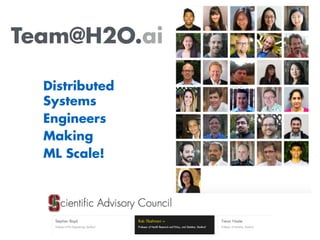
Distributed
Systems
Engineers
Making

ML Scale!
Team@H2O.ai
Scalable 

Machine Learning
For Smarter
Applications
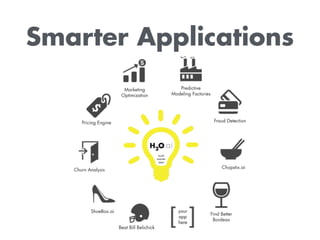
Smarter Applications
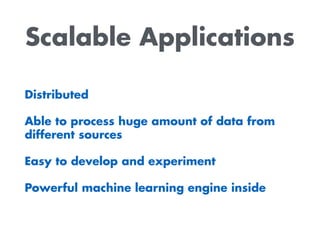
Scalable Applications
Distributed
Able to process huge amount of data from
different sources
Easy to develop and experiment
Powerful machine learning engine inside
BUT
how to build
them?
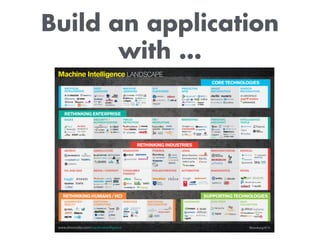
Build an application
with …
Build an application
with …
?
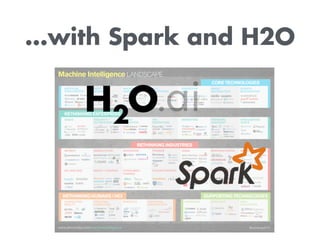
…with Spark and H2O
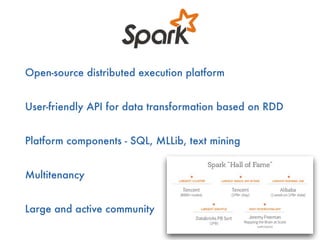
Open-source distributed execution platform
User-friendly API for data transformation based on RDD
Platform components - SQL, MLLib, text mining
Multitenancy
Large and active community
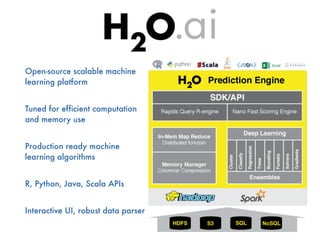
Open-source scalable machine
learning platform
Tuned for efficient computation
and memory use
Production ready machine
learning algorithms
R, Python, Java, Scala APIs
Interactive UI, robust data parser
Sparkling Water
Provides
Transparent integration of H2O with Spark ecosystem
Transparent use of H2O data structures and
algorithms with Spark API
Platform for building Smarter Applications
Excels in existing Spark workflows requiring
advanced Machine Learning algorithms
Lets build
an application !
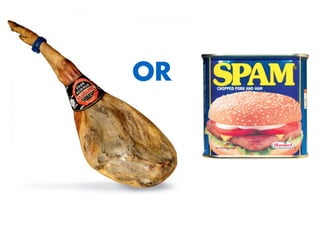
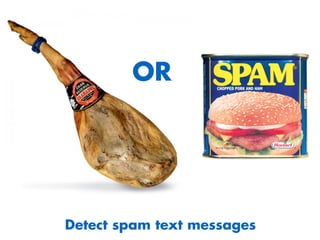
OR
OR
OR
Detect spam text messages
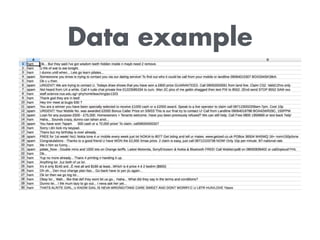
Data example
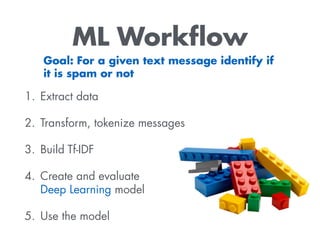
ML Workflow
1. Extract data
2. Transform, tokenize messages
3. Build Tf-IDF
4. Create and evaluate 

Deep Learning model
5. Use the model
Goal: For a given text message identify if
it is spam or not
Lego #1: Data load
// Data load

def load(dataFile: String): RDD[Array[String]] = {

sc.textFile(dataFile).map(l => l.split(“t"))
.filter(r => !r(0).isEmpty)

}
Lego #2: Ad-hoc
Tokenization
def tokenize(data: RDD[String]): RDD[Seq[String]] = {

val ignoredWords = Seq("the", “a", …)

val ignoredChars = Seq(',', ‘:’, …)


val texts = data.map( r => {

var smsText = r.toLowerCase

for( c <- ignoredChars) {

smsText = smsText.replace(c, ' ')

}


val words =smsText.split(" ").filter(w =>
!ignoredWords.contains(w) && w.length>2).distinct

words.toSeq

})

texts

}
Lego #3: Tf-IDF
def buildIDFModel(tokens: RDD[Seq[String]],

minDocFreq:Int = 4,

hashSpaceSize:Int = 1 << 10):
(HashingTF, IDFModel, RDD[Vector]) = {

// Hash strings into the given space

val hashingTF = new HashingTF(hashSpaceSize)

val tf = hashingTF.transform(tokens)

// Build term frequency-inverse document frequency

val idfModel = new IDF(minDocFreq=minDocFreq).fit(tf)

val expandedText = idfModel.transform(tf)

(hashingTF, idfModel, expandedText)

}
“Thank for the order…”
[…,0,3.5,0,1,0,0.3,0,1.3,0,0,…]
Thank Order
Lego #3: Tf-IDF
def buildIDFModel(tokens: RDD[Seq[String]],

minDocFreq:Int = 4,

hashSpaceSize:Int = 1 << 10):
(HashingTF, IDFModel, RDD[Vector]) = {

// Hash strings into the given space

val hashingTF = new HashingTF(hashSpaceSize)

val tf = hashingTF.transform(tokens)

// Build term frequency-inverse document frequency

val idfModel = new IDF(minDocFreq=minDocFreq).fit(tf)

val expandedText = idfModel.transform(tf)

(hashingTF, idfModel, expandedText)

}
Hash words

into large 

space
“Thank for the order…”
[…,0,3.5,0,1,0,0.3,0,1.3,0,0,…]
Thank Order
Lego #3: Tf-IDF
def buildIDFModel(tokens: RDD[Seq[String]],

minDocFreq:Int = 4,

hashSpaceSize:Int = 1 << 10):
(HashingTF, IDFModel, RDD[Vector]) = {

// Hash strings into the given space

val hashingTF = new HashingTF(hashSpaceSize)

val tf = hashingTF.transform(tokens)

// Build term frequency-inverse document frequency

val idfModel = new IDF(minDocFreq=minDocFreq).fit(tf)

val expandedText = idfModel.transform(tf)

(hashingTF, idfModel, expandedText)

}
Hash words

into large 

space
Term freq scale
“Thank for the order…”
[…,0,3.5,0,1,0,0.3,0,1.3,0,0,…]
Thank Order
Lego #4: Build a model
def buildDLModel(train: Frame, valid: Frame,

epochs: Int = 10, l1: Double = 0.001, l2: Double = 0.0,

hidden: Array[Int] = Array[Int](200, 200))

(implicit h2oContext: H2OContext): DeepLearningModel = {

import h2oContext._

// Build a model

val dlParams = new DeepLearningParameters()

dlParams._destination_key = Key.make("dlModel.hex").asInstanceOf[Key[Frame]]

dlParams._train = train

dlParams._valid = valid

dlParams._response_column = 'target

dlParams._epochs = epochs

dlParams._l1 = l1

dlParams._hidden = hidden


// Create a job

val dl = new DeepLearning(dlParams)

val dlModel = dl.trainModel.get


// Compute metrics on both datasets

dlModel.score(train).delete()

dlModel.score(valid).delete()


dlModel

}
Deep Learning: Create
multi-layer feed forward
neural networks starting
with an input layer
followed by multiple
l a y e r s o f n o n l i n e a r
transformations
Assembly application
// Data load

val data = load(DATAFILE)

// Extract response spam or ham

val hamSpam = data.map( r => r(0))

val message = data.map( r => r(1))

// Tokenize message content

val tokens = tokenize(message)


// Build IDF model

var (hashingTF, idfModel, tfidf) = buildIDFModel(tokens)


// Merge response with extracted vectors

val resultRDD: SchemaRDD = hamSpam.zip(tfidf).map(v => SMS(v._1, v._2))

val table:DataFrame = resultRDD


// Split table

val keys = Array[String]("train.hex", "valid.hex")

val ratios = Array[Double](0.8)

val frs = split(table, keys, ratios)

val (train, valid) = (frs(0), frs(1))

table.delete()


// Build a model

val dlModel = buildDLModel(train, valid)
Assembly application
// Data load

val data = load(DATAFILE)

// Extract response spam or ham

val hamSpam = data.map( r => r(0))

val message = data.map( r => r(1))

// Tokenize message content

val tokens = tokenize(message)


// Build IDF model

var (hashingTF, idfModel, tfidf) = buildIDFModel(tokens)


// Merge response with extracted vectors

val resultRDD: SchemaRDD = hamSpam.zip(tfidf).map(v => SMS(v._1, v._2))

val table:DataFrame = resultRDD


// Split table

val keys = Array[String]("train.hex", "valid.hex")

val ratios = Array[Double](0.8)

val frs = split(table, keys, ratios)

val (train, valid) = (frs(0), frs(1))

table.delete()


// Build a model

val dlModel = buildDLModel(train, valid)
Data munging
Assembly application
// Data load

val data = load(DATAFILE)

// Extract response spam or ham

val hamSpam = data.map( r => r(0))

val message = data.map( r => r(1))

// Tokenize message content

val tokens = tokenize(message)


// Build IDF model

var (hashingTF, idfModel, tfidf) = buildIDFModel(tokens)


// Merge response with extracted vectors

val resultRDD: SchemaRDD = hamSpam.zip(tfidf).map(v => SMS(v._1, v._2))

val table:DataFrame = resultRDD


// Split table

val keys = Array[String]("train.hex", "valid.hex")

val ratios = Array[Double](0.8)

val frs = split(table, keys, ratios)

val (train, valid) = (frs(0), frs(1))

table.delete()


// Build a model

val dlModel = buildDLModel(train, valid)
Split dataset
Data munging
Assembly application
// Data load

val data = load(DATAFILE)

// Extract response spam or ham

val hamSpam = data.map( r => r(0))

val message = data.map( r => r(1))

// Tokenize message content

val tokens = tokenize(message)


// Build IDF model

var (hashingTF, idfModel, tfidf) = buildIDFModel(tokens)


// Merge response with extracted vectors

val resultRDD: SchemaRDD = hamSpam.zip(tfidf).map(v => SMS(v._1, v._2))

val table:DataFrame = resultRDD


// Split table

val keys = Array[String]("train.hex", "valid.hex")

val ratios = Array[Double](0.8)

val frs = split(table, keys, ratios)

val (train, valid) = (frs(0), frs(1))

table.delete()


// Build a model

val dlModel = buildDLModel(train, valid)
Split dataset
Build model
Data munging
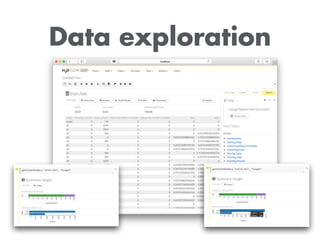
Data exploration
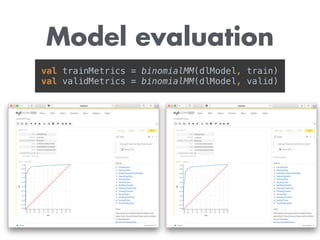
Model evaluation
val trainMetrics = binomialMM(dlModel, train)

val validMetrics = binomialMM(dlModel, valid)
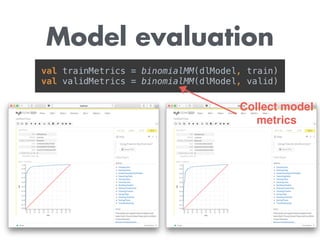
Model evaluation
val trainMetrics = binomialMM(dlModel, train)

val validMetrics = binomialMM(dlModel, valid)
Collect model 

metrics
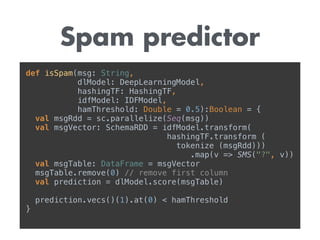
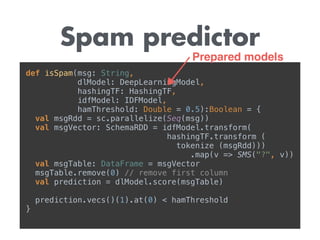
Spam predictor
def isSpam(msg: String,

dlModel: DeepLearningModel,

hashingTF: HashingTF,

idfModel: IDFModel,

hamThreshold: Double = 0.5):Boolean = {

val msgRdd = sc.parallelize(Seq(msg))

val msgVector: SchemaRDD = idfModel.transform(

hashingTF.transform (

tokenize (msgRdd)))
.map(v => SMS("?", v))

val msgTable: DataFrame = msgVector

msgTable.remove(0) // remove first column

val prediction = dlModel.score(msgTable)

prediction.vecs()(1).at(0) < hamThreshold

}
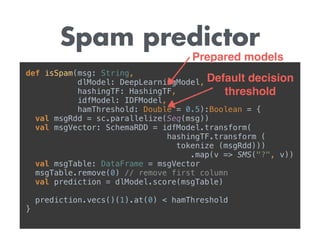
Spam predictor
def isSpam(msg: String,

dlModel: DeepLearningModel,

hashingTF: HashingTF,

idfModel: IDFModel,

hamThreshold: Double = 0.5):Boolean = {

val msgRdd = sc.parallelize(Seq(msg))

val msgVector: SchemaRDD = idfModel.transform(

hashingTF.transform (

tokenize (msgRdd)))
.map(v => SMS("?", v))

val msgTable: DataFrame = msgVector

msgTable.remove(0) // remove first column

val prediction = dlModel.score(msgTable)

prediction.vecs()(1).at(0) < hamThreshold

}
Prepared models
Spam predictor
def isSpam(msg: String,

dlModel: DeepLearningModel,

hashingTF: HashingTF,

idfModel: IDFModel,

hamThreshold: Double = 0.5):Boolean = {

val msgRdd = sc.parallelize(Seq(msg))

val msgVector: SchemaRDD = idfModel.transform(

hashingTF.transform (

tokenize (msgRdd)))
.map(v => SMS("?", v))

val msgTable: DataFrame = msgVector

msgTable.remove(0) // remove first column

val prediction = dlModel.score(msgTable)

prediction.vecs()(1).at(0) < hamThreshold

}
Prepared models
Default decision
threshold
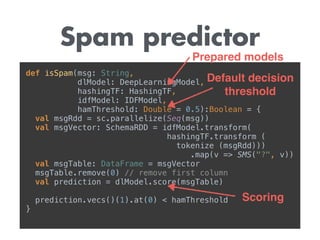
Spam predictor
def isSpam(msg: String,

dlModel: DeepLearningModel,

hashingTF: HashingTF,

idfModel: IDFModel,

hamThreshold: Double = 0.5):Boolean = {

val msgRdd = sc.parallelize(Seq(msg))

val msgVector: SchemaRDD = idfModel.transform(

hashingTF.transform (

tokenize (msgRdd)))
.map(v => SMS("?", v))

val msgTable: DataFrame = msgVector

msgTable.remove(0) // remove first column

val prediction = dlModel.score(msgTable)

prediction.vecs()(1).at(0) < hamThreshold

}
Prepared models
Default decision
threshold
Scoring
Predict spam
Predict spam
isSpam("Michal, beer
tonight in MV?")
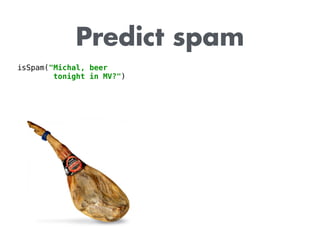
Predict spam
isSpam("Michal, beer
tonight in MV?")
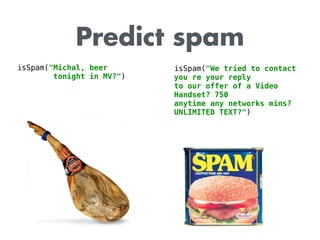
Predict spam
isSpam("Michal, beer
tonight in MV?")
isSpam("We tried to contact
you re your reply
to our offer of a Video
Handset? 750
anytime any networks mins?
UNLIMITED TEXT?")
Predict spam
isSpam("Michal, beer
tonight in MV?")
isSpam("We tried to contact
you re your reply
to our offer of a Video
Handset? 750
anytime any networks mins?
UNLIMITED TEXT?")
Checkout H2O.ai Training Books
http://learn.h2o.ai/

Checkout H2O.ai Blog
http://h2o.ai/blog/

Checkout H2O.ai Youtube Channel
https://www.youtube.com/user/0xdata

Checkout GitHub
https://github.com/h2oai/sparkling-water
Meetups
https://meetup.com/
More info
Learn more at h2o.ai
Follow us at @h2oai
Thank you!
Sparkling Water is
open-source

ML application platform
combining

power of Spark and H2O

Michal Malohlava, Software Engineer, H2O.ai at MLconf NYC

  • 1.
    Building Machine Learning Applications withSparkling Water MLConf 2015 NYC Michal Malohlava and Alex Tellez and H2O.ai
  • 2.
  • 3.
  • 4.
  • 5.
    Scalable Applications Distributed Able toprocess huge amount of data from different sources Easy to develop and experiment Powerful machine learning engine inside
  • 6.
  • 7.
  • 8.
  • 9.
  • 10.
    Open-source distributed executionplatform User-friendly API for data transformation based on RDD Platform components - SQL, MLLib, text mining Multitenancy Large and active community
  • 11.
    Open-source scalable machine learningplatform Tuned for efficient computation and memory use Production ready machine learning algorithms R, Python, Java, Scala APIs Interactive UI, robust data parser
  • 13.
    Sparkling Water Provides Transparent integrationof H2O with Spark ecosystem Transparent use of H2O data structures and algorithms with Spark API Platform for building Smarter Applications Excels in existing Spark workflows requiring advanced Machine Learning algorithms
  • 14.
  • 16.
  • 17.
  • 18.
  • 19.
  • 20.
    ML Workflow 1. Extractdata 2. Transform, tokenize messages 3. Build Tf-IDF 4. Create and evaluate 
 Deep Learning model 5. Use the model Goal: For a given text message identify if it is spam or not
  • 21.
    Lego #1: Dataload // Data load
 def load(dataFile: String): RDD[Array[String]] = {
 sc.textFile(dataFile).map(l => l.split(“t")) .filter(r => !r(0).isEmpty)
 }
  • 22.
    Lego #2: Ad-hoc Tokenization deftokenize(data: RDD[String]): RDD[Seq[String]] = {
 val ignoredWords = Seq("the", “a", …)
 val ignoredChars = Seq(',', ‘:’, …)
 
 val texts = data.map( r => {
 var smsText = r.toLowerCase
 for( c <- ignoredChars) {
 smsText = smsText.replace(c, ' ')
 }
 
 val words =smsText.split(" ").filter(w => !ignoredWords.contains(w) && w.length>2).distinct
 words.toSeq
 })
 texts
 }
  • 23.
    Lego #3: Tf-IDF defbuildIDFModel(tokens: RDD[Seq[String]],
 minDocFreq:Int = 4,
 hashSpaceSize:Int = 1 << 10): (HashingTF, IDFModel, RDD[Vector]) = {
 // Hash strings into the given space
 val hashingTF = new HashingTF(hashSpaceSize)
 val tf = hashingTF.transform(tokens)
 // Build term frequency-inverse document frequency
 val idfModel = new IDF(minDocFreq=minDocFreq).fit(tf)
 val expandedText = idfModel.transform(tf)
 (hashingTF, idfModel, expandedText)
 } “Thank for the order…” […,0,3.5,0,1,0,0.3,0,1.3,0,0,…] Thank Order
  • 24.
    Lego #3: Tf-IDF defbuildIDFModel(tokens: RDD[Seq[String]],
 minDocFreq:Int = 4,
 hashSpaceSize:Int = 1 << 10): (HashingTF, IDFModel, RDD[Vector]) = {
 // Hash strings into the given space
 val hashingTF = new HashingTF(hashSpaceSize)
 val tf = hashingTF.transform(tokens)
 // Build term frequency-inverse document frequency
 val idfModel = new IDF(minDocFreq=minDocFreq).fit(tf)
 val expandedText = idfModel.transform(tf)
 (hashingTF, idfModel, expandedText)
 } Hash words
 into large 
 space “Thank for the order…” […,0,3.5,0,1,0,0.3,0,1.3,0,0,…] Thank Order
  • 25.
    Lego #3: Tf-IDF defbuildIDFModel(tokens: RDD[Seq[String]],
 minDocFreq:Int = 4,
 hashSpaceSize:Int = 1 << 10): (HashingTF, IDFModel, RDD[Vector]) = {
 // Hash strings into the given space
 val hashingTF = new HashingTF(hashSpaceSize)
 val tf = hashingTF.transform(tokens)
 // Build term frequency-inverse document frequency
 val idfModel = new IDF(minDocFreq=minDocFreq).fit(tf)
 val expandedText = idfModel.transform(tf)
 (hashingTF, idfModel, expandedText)
 } Hash words
 into large 
 space Term freq scale “Thank for the order…” […,0,3.5,0,1,0,0.3,0,1.3,0,0,…] Thank Order
  • 26.
    Lego #4: Builda model def buildDLModel(train: Frame, valid: Frame,
 epochs: Int = 10, l1: Double = 0.001, l2: Double = 0.0,
 hidden: Array[Int] = Array[Int](200, 200))
 (implicit h2oContext: H2OContext): DeepLearningModel = {
 import h2oContext._
 // Build a model
 val dlParams = new DeepLearningParameters()
 dlParams._destination_key = Key.make("dlModel.hex").asInstanceOf[Key[Frame]]
 dlParams._train = train
 dlParams._valid = valid
 dlParams._response_column = 'target
 dlParams._epochs = epochs
 dlParams._l1 = l1
 dlParams._hidden = hidden
 
 // Create a job
 val dl = new DeepLearning(dlParams)
 val dlModel = dl.trainModel.get
 
 // Compute metrics on both datasets
 dlModel.score(train).delete()
 dlModel.score(valid).delete()
 
 dlModel
 } Deep Learning: Create multi-layer feed forward neural networks starting with an input layer followed by multiple l a y e r s o f n o n l i n e a r transformations
  • 27.
    Assembly application // Dataload
 val data = load(DATAFILE)
 // Extract response spam or ham
 val hamSpam = data.map( r => r(0))
 val message = data.map( r => r(1))
 // Tokenize message content
 val tokens = tokenize(message)
 
 // Build IDF model
 var (hashingTF, idfModel, tfidf) = buildIDFModel(tokens)
 
 // Merge response with extracted vectors
 val resultRDD: SchemaRDD = hamSpam.zip(tfidf).map(v => SMS(v._1, v._2))
 val table:DataFrame = resultRDD
 
 // Split table
 val keys = Array[String]("train.hex", "valid.hex")
 val ratios = Array[Double](0.8)
 val frs = split(table, keys, ratios)
 val (train, valid) = (frs(0), frs(1))
 table.delete()
 
 // Build a model
 val dlModel = buildDLModel(train, valid)
  • 28.
    Assembly application // Dataload
 val data = load(DATAFILE)
 // Extract response spam or ham
 val hamSpam = data.map( r => r(0))
 val message = data.map( r => r(1))
 // Tokenize message content
 val tokens = tokenize(message)
 
 // Build IDF model
 var (hashingTF, idfModel, tfidf) = buildIDFModel(tokens)
 
 // Merge response with extracted vectors
 val resultRDD: SchemaRDD = hamSpam.zip(tfidf).map(v => SMS(v._1, v._2))
 val table:DataFrame = resultRDD
 
 // Split table
 val keys = Array[String]("train.hex", "valid.hex")
 val ratios = Array[Double](0.8)
 val frs = split(table, keys, ratios)
 val (train, valid) = (frs(0), frs(1))
 table.delete()
 
 // Build a model
 val dlModel = buildDLModel(train, valid) Data munging
  • 29.
    Assembly application // Dataload
 val data = load(DATAFILE)
 // Extract response spam or ham
 val hamSpam = data.map( r => r(0))
 val message = data.map( r => r(1))
 // Tokenize message content
 val tokens = tokenize(message)
 
 // Build IDF model
 var (hashingTF, idfModel, tfidf) = buildIDFModel(tokens)
 
 // Merge response with extracted vectors
 val resultRDD: SchemaRDD = hamSpam.zip(tfidf).map(v => SMS(v._1, v._2))
 val table:DataFrame = resultRDD
 
 // Split table
 val keys = Array[String]("train.hex", "valid.hex")
 val ratios = Array[Double](0.8)
 val frs = split(table, keys, ratios)
 val (train, valid) = (frs(0), frs(1))
 table.delete()
 
 // Build a model
 val dlModel = buildDLModel(train, valid) Split dataset Data munging
  • 30.
    Assembly application // Dataload
 val data = load(DATAFILE)
 // Extract response spam or ham
 val hamSpam = data.map( r => r(0))
 val message = data.map( r => r(1))
 // Tokenize message content
 val tokens = tokenize(message)
 
 // Build IDF model
 var (hashingTF, idfModel, tfidf) = buildIDFModel(tokens)
 
 // Merge response with extracted vectors
 val resultRDD: SchemaRDD = hamSpam.zip(tfidf).map(v => SMS(v._1, v._2))
 val table:DataFrame = resultRDD
 
 // Split table
 val keys = Array[String]("train.hex", "valid.hex")
 val ratios = Array[Double](0.8)
 val frs = split(table, keys, ratios)
 val (train, valid) = (frs(0), frs(1))
 table.delete()
 
 // Build a model
 val dlModel = buildDLModel(train, valid) Split dataset Build model Data munging
  • 31.
  • 32.
    Model evaluation val trainMetrics= binomialMM(dlModel, train)
 val validMetrics = binomialMM(dlModel, valid)
  • 33.
    Model evaluation val trainMetrics= binomialMM(dlModel, train)
 val validMetrics = binomialMM(dlModel, valid) Collect model 
 metrics
  • 34.
    Spam predictor def isSpam(msg:String,
 dlModel: DeepLearningModel,
 hashingTF: HashingTF,
 idfModel: IDFModel,
 hamThreshold: Double = 0.5):Boolean = {
 val msgRdd = sc.parallelize(Seq(msg))
 val msgVector: SchemaRDD = idfModel.transform(
 hashingTF.transform (
 tokenize (msgRdd))) .map(v => SMS("?", v))
 val msgTable: DataFrame = msgVector
 msgTable.remove(0) // remove first column
 val prediction = dlModel.score(msgTable)
 prediction.vecs()(1).at(0) < hamThreshold
 }
  • 35.
    Spam predictor def isSpam(msg:String,
 dlModel: DeepLearningModel,
 hashingTF: HashingTF,
 idfModel: IDFModel,
 hamThreshold: Double = 0.5):Boolean = {
 val msgRdd = sc.parallelize(Seq(msg))
 val msgVector: SchemaRDD = idfModel.transform(
 hashingTF.transform (
 tokenize (msgRdd))) .map(v => SMS("?", v))
 val msgTable: DataFrame = msgVector
 msgTable.remove(0) // remove first column
 val prediction = dlModel.score(msgTable)
 prediction.vecs()(1).at(0) < hamThreshold
 } Prepared models
  • 36.
    Spam predictor def isSpam(msg:String,
 dlModel: DeepLearningModel,
 hashingTF: HashingTF,
 idfModel: IDFModel,
 hamThreshold: Double = 0.5):Boolean = {
 val msgRdd = sc.parallelize(Seq(msg))
 val msgVector: SchemaRDD = idfModel.transform(
 hashingTF.transform (
 tokenize (msgRdd))) .map(v => SMS("?", v))
 val msgTable: DataFrame = msgVector
 msgTable.remove(0) // remove first column
 val prediction = dlModel.score(msgTable)
 prediction.vecs()(1).at(0) < hamThreshold
 } Prepared models Default decision threshold
  • 37.
    Spam predictor def isSpam(msg:String,
 dlModel: DeepLearningModel,
 hashingTF: HashingTF,
 idfModel: IDFModel,
 hamThreshold: Double = 0.5):Boolean = {
 val msgRdd = sc.parallelize(Seq(msg))
 val msgVector: SchemaRDD = idfModel.transform(
 hashingTF.transform (
 tokenize (msgRdd))) .map(v => SMS("?", v))
 val msgTable: DataFrame = msgVector
 msgTable.remove(0) // remove first column
 val prediction = dlModel.score(msgTable)
 prediction.vecs()(1).at(0) < hamThreshold
 } Prepared models Default decision threshold Scoring
  • 38.
  • 39.
  • 40.
  • 41.
    Predict spam isSpam("Michal, beer tonightin MV?") isSpam("We tried to contact you re your reply to our offer of a Video Handset? 750 anytime any networks mins? UNLIMITED TEXT?")
  • 42.
    Predict spam isSpam("Michal, beer tonightin MV?") isSpam("We tried to contact you re your reply to our offer of a Video Handset? 750 anytime any networks mins? UNLIMITED TEXT?")
  • 43.
    Checkout H2O.ai TrainingBooks http://learn.h2o.ai/
 Checkout H2O.ai Blog http://h2o.ai/blog/
 Checkout H2O.ai Youtube Channel https://www.youtube.com/user/0xdata
 Checkout GitHub https://github.com/h2oai/sparkling-water Meetups https://meetup.com/ More info
  • 44.
    Learn more ath2o.ai Follow us at @h2oai Thank you! Sparkling Water is open-source
 ML application platform combining
 power of Spark and H2O