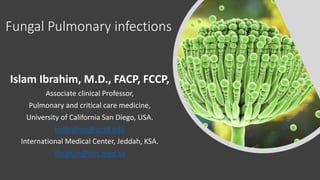







Fungal Pulmonary infections
Islam Ibrahim, M.D., FACP, FCCP,
Associate clinical Professor,
Pulmonary and critical care medicine,
University of California San Diego, USA.
imibrahim@ucsd.edu
International Medical Center, Jeddah, KSA.
iibrahim@imc.med.sa
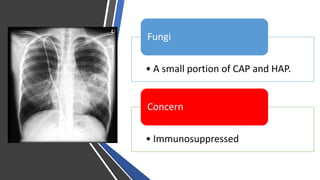
• A small portion of CAP and HAP.
Fungi
• Immunosuppressed
Concern
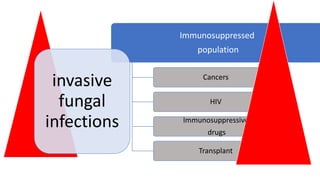
Immunosuppressed
population
Cancers
HIV
Immunosuppressive
drugs
Transplant
invasive
fungal
infections
7
Invasive Fungal Infections Are a Growing Problem:
Focus on Candidiasis
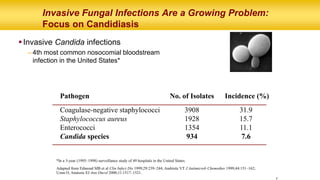
Invasive Candida infections
– 4th most common nosocomial bloodstream
infection in the United States*
*In a 3-year (1995–1998) surveillance study of 49 hospitals in the United States.
Adapted from Edmond MB et al Clin Infect Dis 1999;29:239–244; Andriole VT J Antimicrob Chemother 1999;44:151–162;
Uzun O, Anaissie EJ Ann Oncol 2000;11:1517–1521.
Coagulase-negative staphylococci 3908 31.9
Staphylococcus aureus 1928 15.7
Enterococci 1354 11.1
Candida species 934 7.6
Pathogen No. of Isolates Incidence (%)
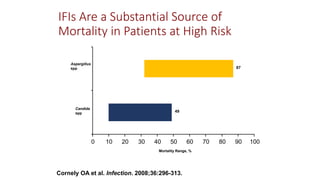
IFIs Are a Substantial Source of
Mortality in Patients at High Risk
Cornely OA et al. Infection. 2008;36:296-313.
0 10 20 30 40 50 60 70 80 90 100
Candida
spp
Aspergillus
spp
Mortality Range, %
49
87
9
Patients with
candidal bloodstream
infections
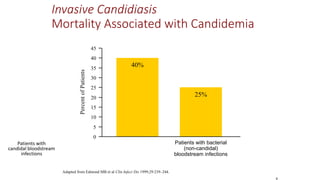
Invasive Candidiasis
Mortality Associated with Candidemia
Adapted from Edmond MB et al Clin Infect Dis 1999;29:239–244.
0
5
10
15
20
25
30
35
40
45
40%
25%
PercentofPatients
Patients with bacterial
(non-candidal)
bloodstream infections
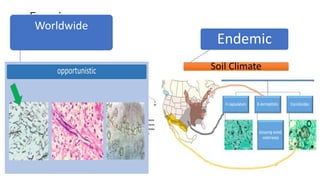
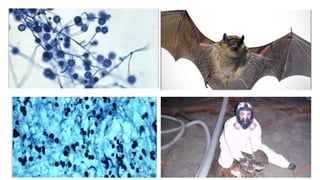
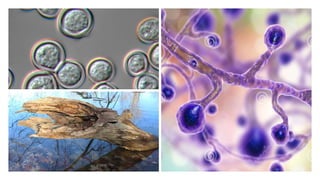
Fungi
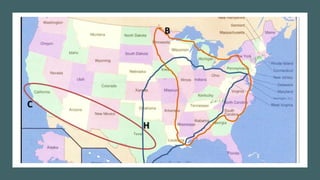
Worldwide
Opportunistic
Aspergillosis
Candidiasis
Endemic
Soil Climate
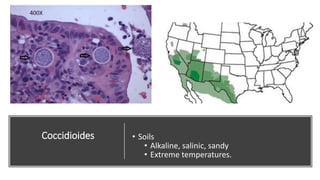
Coccidioides • Soils
• Alkaline, salinic, sandy
• Extreme temperatures.
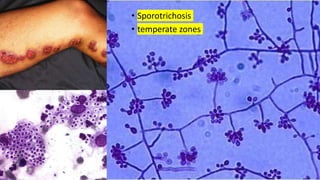
• Sporotrichosis
• temperate zones
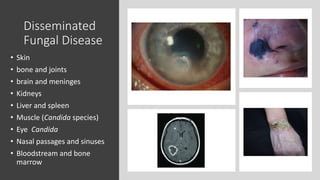
Disseminated
Fungal Disease
• Skin
• bone and joints
• brain and meninges
• Kidneys
• Liver and spleen
• Muscle (Candida species)
• Eye Candida
• Nasal passages and sinuses
• Bloodstream and bone
marrow
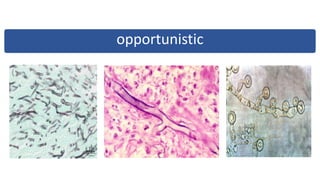
opportunistic
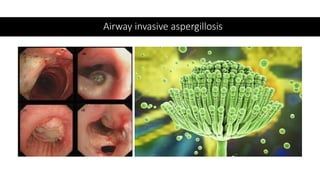
Airway invasive aspergillosis
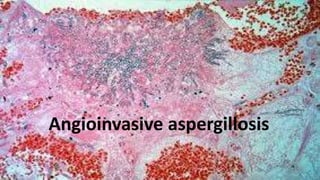
Angioinvasive aspergillosis
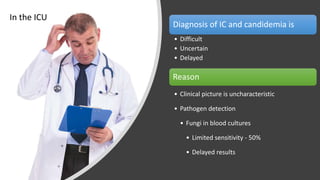
Diagnosis of IC and candidemia is
• Difficult
• Uncertain
• Delayed
Reason
• Clinical picture is uncharacteristic
• Pathogen detection
• Fungi in blood cultures
• Limited sensitivity - 50%
• Delayed results
In the ICU
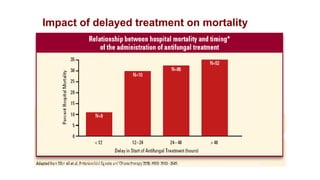
Impact of delayed treatment on mortality
Morrell M, Fraser VJ, Kollef MH. Delaying the empiric treatment of Candida bloodstream infection until positive blood
culture results are obtained: a potential risk factor for hospital mortality. Antimicrob Agents Chemother 2005;49: 3640–5.
When should I suspect fungal pulmonary infection?
High index of suspicion.
Immunocompromised
patient.
Poor response to
antibiotics.
Persistent fever and
illness.
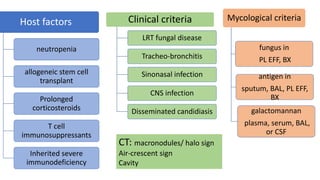
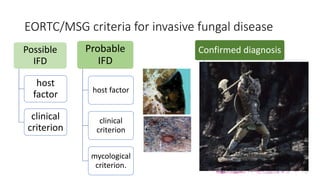
EORTC/MSG criteria for invasive fungal disease
Host factors
neutropenia
allogeneic stem cell
transplant
Prolonged
corticosteroids
T cell
immunosuppressants
Inherited severe
immunodeficiency
Clinical criteria
LRT fungal disease
Tracheo-bronchitis
Sinonasal infection
CNS infection
Disseminated candidiasis
Mycological criteria
antigen in
sputum, BAL, PL EFF,
BX
galactomannan
plasma, serum, BAL,
or CSF
fungus in
PL EFF, BX
CT: macronodules/ halo sign
Air-crescent sign
Cavity
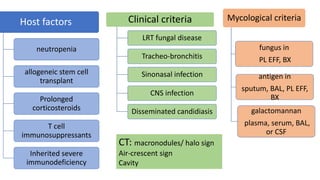
Host factors
neutropenia
allogeneic stem cell
transplant
Prolonged
corticosteroids
T cell
immunosuppressants
Inherited severe
immunodeficiency
Clinical criteria
LRT fungal disease
Tracheo-bronchitis
Sinonasal infection
CNS infection
Disseminated candidiasis
Mycological criteria
antigen in
sputum, BAL, PL EFF,
BX
galactomannan
plasma, serum, BAL,
or CSF
fungus in
PL EFF, BX
CT: macronodules/ halo sign
Air-crescent sign
Cavity
EORTC/MSG criteria for invasive fungal disease
Probable
IFD
host factor
clinical
criterion
mycological
criterion.
Possible
IFD
host
factor
clinical
criterion
Confirmed diagnosis
Evidence of fungal
invasion of tissue.
Fungus recovered from
a sterile site.
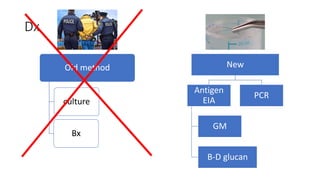
Dx
Old method
Bx
culture
New
Antigen
EIA
GM
B-D glucan
PCR
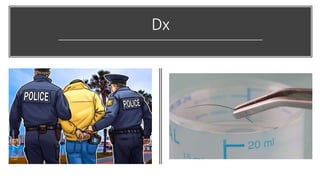
Dx
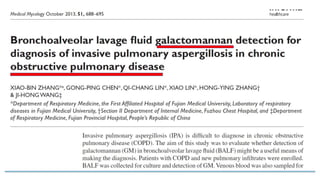
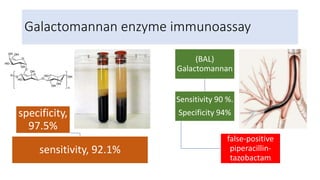
Galactomannan enzyme immunoassay
specificity,
97.5%
sensitivity, 92.1%
(BAL)
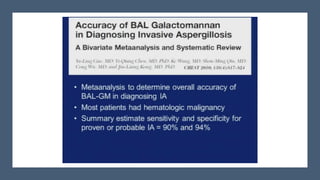
Galactomannan
Sensitivity 90 %.
Specificity 94%
false-positive
piperacillin-
tazobactam
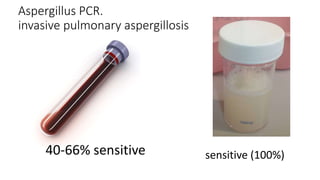
Aspergillus PCR.
invasive pulmonary aspergillosis
sensitive (100%)40-66% sensitive
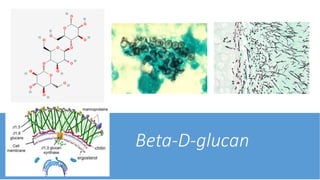
Beta-D-glucan
Beta-D-
glucan
• Fungal-derived antibiotics
• Pseudomonas aeruginosa
infections
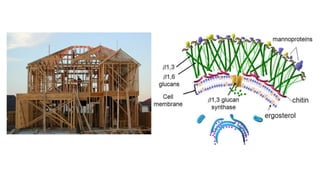
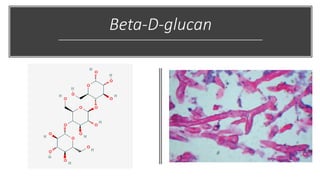
Beta-D-glucan
Treatment
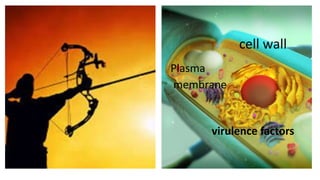
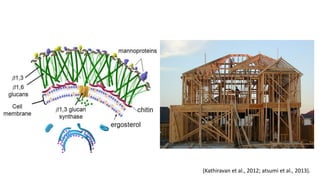
Plasma
membrane
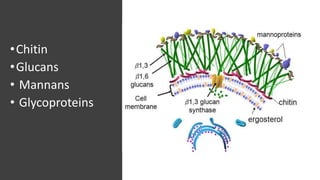
cell wall
virulence factors
(Kathiravan et al., 2012; atsumi et al., 2013).
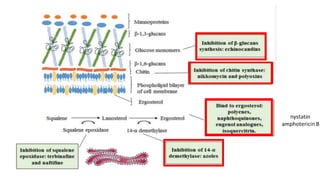
•Chitin
•Glucans
• Mannans
• Glycoproteins
(Kathiravan et al., 2012; atsumi et al., 2013).
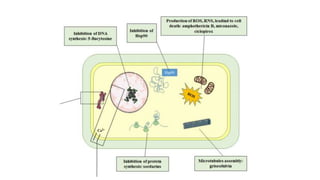
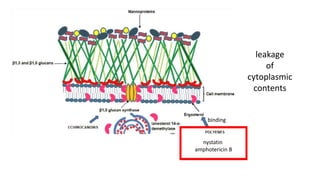
nystatin
amphotericin B
binding
leakage
of
cytoplasmic
contents
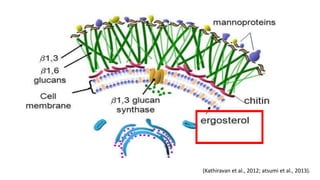
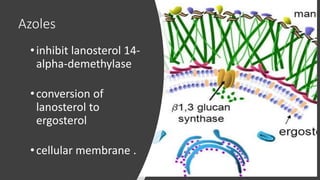
Azoles
•inhibit lanosterol 14-
alpha-demethylase
•conversion of
lanosterol to
ergosterol
•cellular membrane .
Fluconazole
•excellent safety profile
•Inexpensive
•highly bioavailable
voriconazole
• superior to fluconazole
• active against C. krusei
• cross-resistance
• C. glabrata.
Posaconazole
• approved as a prophylactic agent
allogeneic hematopoietic cell
transplant recipients
graft-versus-host disease
prolonged neutropenia
approved for oropharyngeal
candidiasis
Not approved for systemic
candidiasis
Itraconazole
•mucosal candidiasis
•not for systemic infections.
Isavuconazole
•approved for treatment
of aspergillosis
•not approved for the
treatment of
candidiasis.
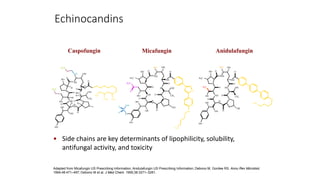
AnidulafunginCaspofungin Micafungin
Adapted from Micafungin US Prescribing Information; Anidulafungin US Prescribing Information; Debono M, Gordee RS. Annu Rev Microbiol.
1994;48:471–497; Debono M et al. J Med Chem. 1995;38:3271–3281.
Echinocandins
N
O
O
O
NH
O
H
H
H H
O
H
CH3
O
O
H2N
OH
NH
HO
H2N
HO NH
H
N
OH
OH
HN OH
N
H
HO
H3C
CH3 CH3
O
O
O
N
O
O
HN
N
O
O
O
O
O
N
O
H3C
S
O
O
HO
OH
HO
HO
OH
H
N
NH
NH
H3C
H2N
HO
HO
OH
NH
OH
OH
CH3
O
O
N
H3C
O
N
O
O
O
O
O
HO
HO
HO
OH
H
N
NH
OH
HO
HO OH
NH
HN
CH3
OH
NH
H3C
H3C
• Side chains are key determinants of lipophilicity, solubility,
antifungal activity, and toxicity
Echinocandins
• inhibit synthesis of 1,3-beta-D-glucan
of the fungal cell wall
• Cidal for most Candida species
• favorable toxicity profiles
• approved for the treatment of
candidemia and other forms of
invasive candidiasis.
• preferred over azoles for the initial
treatment of candidemia
• C. glabrata or C. krusei
• previously treated with an azole .
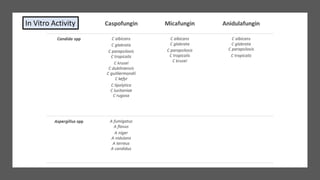
In Vitro Activity
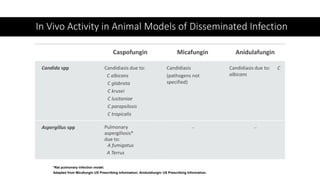
In Vivo Activity in Animal Models of Disseminated Infection
*Rat pulmonary infection model.
Adapted from Micafungin US Prescribing Information; Anidulafungin US Prescribing Information.
Caspofungin Micafungin Anidulafungin
Candida spp Candidiasis due to:
C albicans
C glabrata
C krusei
C lusitaniae
C parapsilosis
C tropicalis
Candidiasis
(pathogens not
specified)
Candidiasis due to: C
albicans
Aspergillus spp Pulmonary
aspergillosis*
due to:
A fumigatus
A Terrus
– –
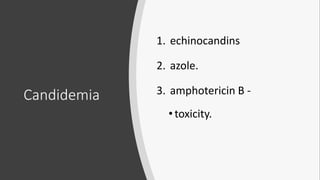
Candidemia
1. echinocandins
2. azole.
3. amphotericin B -
• toxicity.
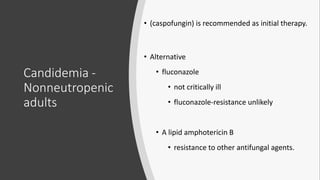
Candidemia -
Nonneutropenic
adults
• (caspofungin) is recommended as initial therapy.
• Alternative
• fluconazole
• not critically ill
• fluconazole-resistance unlikely
• A lipid amphotericin B
• resistance to other antifungal agents.
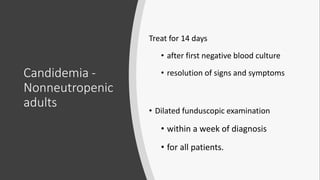
Candidemia -
Nonneutropenic
adults
Treat for 14 days
• after first negative blood culture
• resolution of signs and symptoms
• Dilated funduscopic examination
• within a week of diagnosis
• for all patients.
Candidemia -
Neutropenic
patients
• (caspofungin is recommended as initial
therapy.
• alternative
• A lipid formulation of amphotericin B
• less attractive toxicity.
• fluconazole 800
• not critically ill
• no prior azole exposure
• Additional mold coverage -voriconazole
400 mg orally
Candidemia -
Neutropenic
patients
therapy is 14 days
• after documented clearance of Candida
from the bloodstream
• neutropenia and signs and symptoms
have resolved.
• Dilated funduscopic examination is
recommended for all patients within 7
days after recovery from neutropenia.
C. glabrata
and C. krusei
• An echinocandin is preferred over
amphotericin B
• Voriconazole is approved for this
indication
• but
• cross-resistance between
fluconazole and voriconazole
• usually susceptible to
• echinocandins
• Voriconazole
• resistant to
• fluconazole.
• high (MICs) to amphotericin B
C. krusei
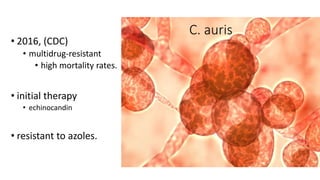
• 2016, (CDC)
• multidrug-resistant
• high mortality rates.
• initial therapy
• echinocandin
• resistant to azoles.
C. auris
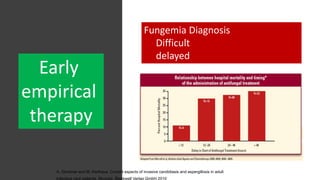
A. Glockner and M. Karthaus. Current aspects of invasive candidiasis and aspergillosis in adult
intensive care patients, Mycosis, Blackwell Verlag GmbH 2010
Early
empirical
therapy
Fungemia Diagnosis
Difficult
delayed
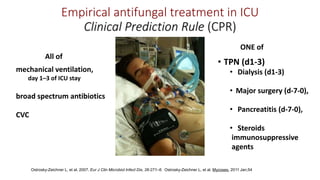
Empirical antifungal treatment in ICU
Clinical Prediction Rule (CPR)
All of
mechanical ventilation,
day 1–3 of ICU stay
broad spectrum antibiotics
CVC
ONE of
• TPN (d1-3)
• Dialysis (d1-3)
• Major surgery (d-7-0),
• Pancreatitis (d-7-0),
• Steroids
immunosuppressive
agents
Ostrosky-Zeichner L, et al. 2007. Eur J Clin Microbiol Infect Dis, 26:271–6.
Ostrosky-Zeichner L, et al. Mycoses. 2011 Jan;54Ostrosky-Zeichner L, et al. 2007. Eur J Clin Microbiol Infect Dis, 26:271–6. Ostrosky-Zeichner L, et al. Mycoses. 2011 Jan;54
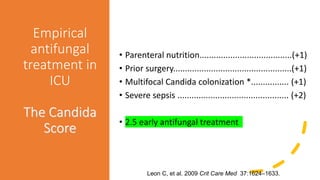
Empirical
antifungal
treatment in
ICU
The Candida
Score
• Parenteral nutrition.......................................(+1)
• Prior surgery..................................................(+1)
• Multifocal Candida colonization *................ (+1)
• Severe sepsis ............................................... (+2)
• 2.5 early antifungal treatment
Leon C, et al. 2006. Crit Care Med, 34:730–7.Leon C, et al. 2009 Crit Care Med 37:1624–1633.
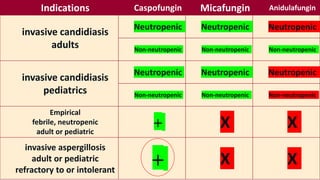
1- Indication
Indications Caspofungin Micafungin Anidulafungin
invasive candidiasis
adults
Neutropenic Neutropenic Neutropenic
Non-neutropenic Non-neutropenic Non-neutropenic
invasive candidiasis
pediatrics
Neutropenic Neutropenic Neutropenic
Non-neutropenic Non-neutropenic Non-neutropenic
Empirical
febrile, neutropenic
adult or pediatric
+ X X
invasive aspergillosis
adult or pediatric
refractory to or intolerant
+ X X
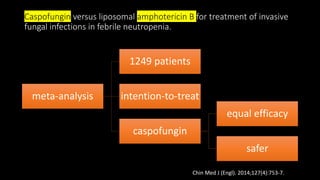
Caspofungin versus liposomal amphotericin B for treatment of invasive
fungal infections in febrile neutropenia.
Chin Med J (Engl). 2014;127(4):753-7.
meta-analysis
1249 patients
intention-to-treat
caspofungin
equal efficacy
safer
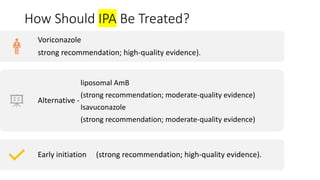
How Should IPA Be Treated?
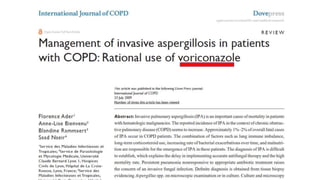
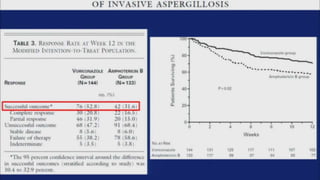
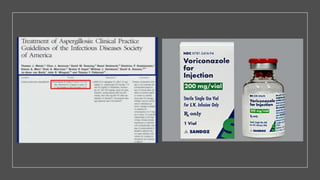
Voriconazole
strong recommendation; high-quality evidence).
Alternative -
liposomal AmB
(strong recommendation; moderate-quality evidence)
Isavuconazole
(strong recommendation; moderate-quality evidence)
Early initiation (strong recommendation; high-quality evidence).
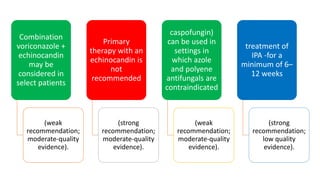
Combination
voriconazole +
echinocandin
may be
considered in
select patients
(weak
recommendation;
moderate-quality
evidence).
Primary
therapy with an
echinocandin is
not
recommended
(strong
recommendation;
moderate-quality
evidence).
caspofungin)
can be used in
settings in
which azole
and polyene
antifungals are
contraindicated
(weak
recommendation;
moderate-quality
evidence).
treatment of
IPA -for a
minimum of 6–
12 weeks
(strong
recommendation;
low quality
evidence).
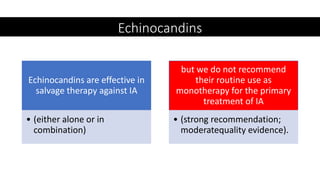
Echinocandins
Echinocandins are effective in
salvage therapy against IA
• (either alone or in
combination)
but we do not recommend
their routine use as
monotherapy for the primary
treatment of IA
• (strong recommendation;
moderatequality evidence).
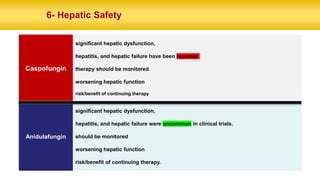
6- Hepatic Safety
Caspofungin
significant hepatic dysfunction,
hepatitis, and hepatic failure have been reported
therapy should be monitored
worsening hepatic function
risk/benefit of continuing therapy
Anidulafungin
significant hepatic dysfunction,
hepatitis, and hepatic failure were uncommon in clinical trials.
should be monitored
worsening hepatic function
risk/benefit of continuing therapy.
Therapeutic Indications

Fungal pneumonia 11

  • 1.
    Fungal Pulmonary infections IslamIbrahim, M.D., FACP, FCCP, Associate clinical Professor, Pulmonary and critical care medicine, University of California San Diego, USA. imibrahim@ucsd.edu International Medical Center, Jeddah, KSA. iibrahim@imc.med.sa
  • 5.
    • A smallportion of CAP and HAP. Fungi • Immunosuppressed Concern
  • 6.
  • 7.
    7 Invasive Fungal InfectionsAre a Growing Problem: Focus on Candidiasis Invasive Candida infections – 4th most common nosocomial bloodstream infection in the United States* *In a 3-year (1995–1998) surveillance study of 49 hospitals in the United States. Adapted from Edmond MB et al Clin Infect Dis 1999;29:239–244; Andriole VT J Antimicrob Chemother 1999;44:151–162; Uzun O, Anaissie EJ Ann Oncol 2000;11:1517–1521. Coagulase-negative staphylococci 3908 31.9 Staphylococcus aureus 1928 15.7 Enterococci 1354 11.1 Candida species 934 7.6 Pathogen No. of Isolates Incidence (%)
  • 8.
    IFIs Are aSubstantial Source of Mortality in Patients at High Risk Cornely OA et al. Infection. 2008;36:296-313. 0 10 20 30 40 50 60 70 80 90 100 Candida spp Aspergillus spp Mortality Range, % 49 87
  • 9.
    9 Patients with candidal bloodstream infections InvasiveCandidiasis Mortality Associated with Candidemia Adapted from Edmond MB et al Clin Infect Dis 1999;29:239–244. 0 5 10 15 20 25 30 35 40 45 40% 25% PercentofPatients Patients with bacterial (non-candidal) bloodstream infections
  • 10.
  • 14.
    Coccidioides • Soils •Alkaline, salinic, sandy • Extreme temperatures.
  • 15.
  • 16.
    Disseminated Fungal Disease • Skin •bone and joints • brain and meninges • Kidneys • Liver and spleen • Muscle (Candida species) • Eye Candida • Nasal passages and sinuses • Bloodstream and bone marrow
  • 17.
  • 22.
  • 23.
  • 25.
    Diagnosis of ICand candidemia is • Difficult • Uncertain • Delayed Reason • Clinical picture is uncharacteristic • Pathogen detection • Fungi in blood cultures • Limited sensitivity - 50% • Delayed results In the ICU
  • 26.
    Impact of delayedtreatment on mortality Morrell M, Fraser VJ, Kollef MH. Delaying the empiric treatment of Candida bloodstream infection until positive blood culture results are obtained: a potential risk factor for hospital mortality. Antimicrob Agents Chemother 2005;49: 3640–5.
  • 27.
    When should Isuspect fungal pulmonary infection? High index of suspicion. Immunocompromised patient. Poor response to antibiotics. Persistent fever and illness.
  • 28.
    EORTC/MSG criteria forinvasive fungal disease
  • 29.
    Host factors neutropenia allogeneic stemcell transplant Prolonged corticosteroids T cell immunosuppressants Inherited severe immunodeficiency Clinical criteria LRT fungal disease Tracheo-bronchitis Sinonasal infection CNS infection Disseminated candidiasis Mycological criteria antigen in sputum, BAL, PL EFF, BX galactomannan plasma, serum, BAL, or CSF fungus in PL EFF, BX CT: macronodules/ halo sign Air-crescent sign Cavity
  • 31.
    Host factors neutropenia allogeneic stemcell transplant Prolonged corticosteroids T cell immunosuppressants Inherited severe immunodeficiency Clinical criteria LRT fungal disease Tracheo-bronchitis Sinonasal infection CNS infection Disseminated candidiasis Mycological criteria antigen in sputum, BAL, PL EFF, BX galactomannan plasma, serum, BAL, or CSF fungus in PL EFF, BX CT: macronodules/ halo sign Air-crescent sign Cavity
  • 33.
    EORTC/MSG criteria forinvasive fungal disease Probable IFD host factor clinical criterion mycological criterion. Possible IFD host factor clinical criterion Confirmed diagnosis Evidence of fungal invasion of tissue. Fungus recovered from a sterile site.
  • 34.
  • 35.
  • 39.
    Galactomannan enzyme immunoassay specificity, 97.5% sensitivity,92.1% (BAL) Galactomannan Sensitivity 90 %. Specificity 94% false-positive piperacillin- tazobactam
  • 40.
    Aspergillus PCR. invasive pulmonaryaspergillosis sensitive (100%)40-66% sensitive
  • 41.
  • 42.
    Beta-D- glucan • Fungal-derived antibiotics •Pseudomonas aeruginosa infections
  • 43.
  • 44.
  • 45.
  • 46.
    (Kathiravan et al.,2012; atsumi et al., 2013).
  • 48.
  • 49.
    (Kathiravan et al.,2012; atsumi et al., 2013).
  • 50.
  • 53.
    Azoles •inhibit lanosterol 14- alpha-demethylase •conversionof lanosterol to ergosterol •cellular membrane .
  • 54.
  • 55.
    voriconazole • superior tofluconazole • active against C. krusei • cross-resistance • C. glabrata.
  • 56.
    Posaconazole • approved asa prophylactic agent allogeneic hematopoietic cell transplant recipients graft-versus-host disease prolonged neutropenia approved for oropharyngeal candidiasis Not approved for systemic candidiasis
  • 57.
  • 58.
    Isavuconazole •approved for treatment ofaspergillosis •not approved for the treatment of candidiasis.
  • 59.
    AnidulafunginCaspofungin Micafungin Adapted fromMicafungin US Prescribing Information; Anidulafungin US Prescribing Information; Debono M, Gordee RS. Annu Rev Microbiol. 1994;48:471–497; Debono M et al. J Med Chem. 1995;38:3271–3281. Echinocandins N O O O NH O H H H H O H CH3 O O H2N OH NH HO H2N HO NH H N OH OH HN OH N H HO H3C CH3 CH3 O O O N O O HN N O O O O O N O H3C S O O HO OH HO HO OH H N NH NH H3C H2N HO HO OH NH OH OH CH3 O O N H3C O N O O O O O HO HO HO OH H N NH OH HO HO OH NH HN CH3 OH NH H3C H3C • Side chains are key determinants of lipophilicity, solubility, antifungal activity, and toxicity
  • 60.
    Echinocandins • inhibit synthesisof 1,3-beta-D-glucan of the fungal cell wall • Cidal for most Candida species • favorable toxicity profiles • approved for the treatment of candidemia and other forms of invasive candidiasis. • preferred over azoles for the initial treatment of candidemia • C. glabrata or C. krusei • previously treated with an azole .
  • 61.
  • 62.
    In Vivo Activityin Animal Models of Disseminated Infection *Rat pulmonary infection model. Adapted from Micafungin US Prescribing Information; Anidulafungin US Prescribing Information. Caspofungin Micafungin Anidulafungin Candida spp Candidiasis due to: C albicans C glabrata C krusei C lusitaniae C parapsilosis C tropicalis Candidiasis (pathogens not specified) Candidiasis due to: C albicans Aspergillus spp Pulmonary aspergillosis* due to: A fumigatus A Terrus – –
  • 63.
    Candidemia 1. echinocandins 2. azole. 3.amphotericin B - • toxicity.
  • 64.
    Candidemia - Nonneutropenic adults • (caspofungin)is recommended as initial therapy. • Alternative • fluconazole • not critically ill • fluconazole-resistance unlikely • A lipid amphotericin B • resistance to other antifungal agents.
  • 65.
    Candidemia - Nonneutropenic adults Treat for14 days • after first negative blood culture • resolution of signs and symptoms • Dilated funduscopic examination • within a week of diagnosis • for all patients.
  • 66.
    Candidemia - Neutropenic patients • (caspofunginis recommended as initial therapy. • alternative • A lipid formulation of amphotericin B • less attractive toxicity. • fluconazole 800 • not critically ill • no prior azole exposure • Additional mold coverage -voriconazole 400 mg orally
  • 67.
    Candidemia - Neutropenic patients therapy is14 days • after documented clearance of Candida from the bloodstream • neutropenia and signs and symptoms have resolved. • Dilated funduscopic examination is recommended for all patients within 7 days after recovery from neutropenia.
  • 68.
    C. glabrata and C.krusei • An echinocandin is preferred over amphotericin B • Voriconazole is approved for this indication • but • cross-resistance between fluconazole and voriconazole
  • 69.
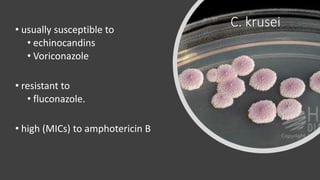
    • usually susceptibleto • echinocandins • Voriconazole • resistant to • fluconazole. • high (MICs) to amphotericin B C. krusei
  • 70.
    • 2016, (CDC) •multidrug-resistant • high mortality rates. • initial therapy • echinocandin • resistant to azoles. C. auris
  • 71.
    A. Glockner andM. Karthaus. Current aspects of invasive candidiasis and aspergillosis in adult intensive care patients, Mycosis, Blackwell Verlag GmbH 2010 Early empirical therapy Fungemia Diagnosis Difficult delayed
  • 72.
    Empirical antifungal treatmentin ICU Clinical Prediction Rule (CPR) All of mechanical ventilation, day 1–3 of ICU stay broad spectrum antibiotics CVC ONE of • TPN (d1-3) • Dialysis (d1-3) • Major surgery (d-7-0), • Pancreatitis (d-7-0), • Steroids immunosuppressive agents Ostrosky-Zeichner L, et al. 2007. Eur J Clin Microbiol Infect Dis, 26:271–6. Ostrosky-Zeichner L, et al. Mycoses. 2011 Jan;54Ostrosky-Zeichner L, et al. 2007. Eur J Clin Microbiol Infect Dis, 26:271–6. Ostrosky-Zeichner L, et al. Mycoses. 2011 Jan;54
  • 73.
    Empirical antifungal treatment in ICU The Candida Score •Parenteral nutrition.......................................(+1) • Prior surgery..................................................(+1) • Multifocal Candida colonization *................ (+1) • Severe sepsis ............................................... (+2) • 2.5 early antifungal treatment Leon C, et al. 2006. Crit Care Med, 34:730–7.Leon C, et al. 2009 Crit Care Med 37:1624–1633.
  • 74.
    1- Indication Indications CaspofunginMicafungin Anidulafungin invasive candidiasis adults Neutropenic Neutropenic Neutropenic Non-neutropenic Non-neutropenic Non-neutropenic invasive candidiasis pediatrics Neutropenic Neutropenic Neutropenic Non-neutropenic Non-neutropenic Non-neutropenic Empirical febrile, neutropenic adult or pediatric + X X invasive aspergillosis adult or pediatric refractory to or intolerant + X X
  • 79.
    Caspofungin versus liposomalamphotericin B for treatment of invasive fungal infections in febrile neutropenia. Chin Med J (Engl). 2014;127(4):753-7. meta-analysis 1249 patients intention-to-treat caspofungin equal efficacy safer
  • 81.
    How Should IPABe Treated? Voriconazole strong recommendation; high-quality evidence). Alternative - liposomal AmB (strong recommendation; moderate-quality evidence) Isavuconazole (strong recommendation; moderate-quality evidence) Early initiation (strong recommendation; high-quality evidence).
  • 82.
    Combination voriconazole + echinocandin may be consideredin select patients (weak recommendation; moderate-quality evidence). Primary therapy with an echinocandin is not recommended (strong recommendation; moderate-quality evidence). caspofungin) can be used in settings in which azole and polyene antifungals are contraindicated (weak recommendation; moderate-quality evidence). treatment of IPA -for a minimum of 6– 12 weeks (strong recommendation; low quality evidence).
  • 83.
    Echinocandins Echinocandins are effectivein salvage therapy against IA • (either alone or in combination) but we do not recommend their routine use as monotherapy for the primary treatment of IA • (strong recommendation; moderatequality evidence).
  • 84.
    6- Hepatic Safety Caspofungin significanthepatic dysfunction, hepatitis, and hepatic failure have been reported therapy should be monitored worsening hepatic function risk/benefit of continuing therapy Anidulafungin significant hepatic dysfunction, hepatitis, and hepatic failure were uncommon in clinical trials. should be monitored worsening hepatic function risk/benefit of continuing therapy.
  • 87.