MICAFUNGIN : ECHINOCANDIN WITH THE EDGE
FOR INVASIVE CANDIDIASIS
Dr.
Overview
• Invasive Fungal infections
• Challenges in management of Fungal infections
• Antifungals
• Micafungin in Candidiasis
• Micafungin compared with other antifungals
Invasive fungal infections (IFI)
• Invasive fungal infections (IFI) have significantly increased due to
advances in medical care in the at risk immunocompromised population
• Fungal species are widely distributed in soil, plant debris and other
organic substrates, and make up approximately 7 per cent (611,000
species) of all eukaryotic species on earth, although only about 600
species are human pathogens.
MAJOR RISK FACTORS FOR IFI
• Prolonged (>7 days) stays in intensive care
• Invasive medical procedures
• Newer immune suppressive agents
• Chemotherapy
• HIV infection
• Neutropenia (4 wk) treatment with corticosteroids
• Other risk factors are
• Malnutrition
• Solid organ transplantation
• Severe burns or prolonged stays in intensive care (>21 days)
• Systemic corticosteroids for >7 days, and major surgery
Badiee P et al. Opportunistic invasive fungal infections: diagnosis & clinical management. INDIAN J MED RES, february 2014
INVASIVE CANDIDIASIS
• Invasive candidiasis is the most common invasive mycotic infection across
india
• Incidence varies from 1 to 12 per 1000 admissions in different hospitals
across india
• Candidemia is the 4th most common blood stream infection
INVASIVE CANDIDIASIS : A GROWING MENACE
• Candidemia : Life threatening infection with mortality rate of 38%
• Shift towards Non albicans species(85.7%)
– Candida tropicalis (50.5%), Candida glabrata (19.0%), Candida parapsilosis (14.3%)
• Developing Resistance
– Non-albicans Candida demonstrated high resistance to azole group of antifungal agents
DISSEMINATED CANDIDIASIS
• Disseminated candidiasis is associated with a mortality in excess of 25 %
(Kibbler et al., 2003)
• Candida is a normal commensal of the skin, and gastrointestinal and
genitourinary tracts
• Candida albicans is the most frequent species isolated from clinical
specimens, but other species (nonalbicans Candida, NAC) are increasingly
seen.
• C. albicans was responsible for 79.4 % of candidaemias in intensive-care
patients, & 37.5 % in haematology patients (Kibbler et al., 2003)
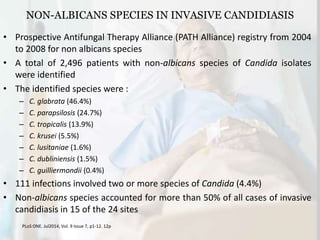
NON-ALBICANS SPECIES IN INVASIVE CANDIDIASIS
• Prospective Antifungal Therapy Alliance (PATH Alliance) registry from 2004
to 2008 for non albicans species
• A total of 2,496 patients with non-albicans species of Candida isolates
were identified
• The identified species were :
– C. glabrata (46.4%)
– C. parapsilosis (24.7%)
– C. tropicalis (13.9%)
– C. krusei (5.5%)
– C. lusitaniae (1.6%)
– C. dubliniensis (1.5%)
– C. guilliermondii (0.4%)
• 111 infections involved two or more species of Candida (4.4%)
• Non-albicans species accounted for more than 50% of all cases of invasive
candidiasis in 15 of the 24 sites
PLoS ONE. Jul2014, Vol. 9 Issue 7, p1-12. 12p
Fungal infections in indian scenario
• A multicentric study by Dr Chakrabarti A.et. al. in indian ICUs
showed
– Non albicans to be present in 79% cases
– Candida tropicalis isolates in 41.6% cases
– Azole resistance to be presentin 11.9% cases
– 30 day mortality of 44.7% in candidemia
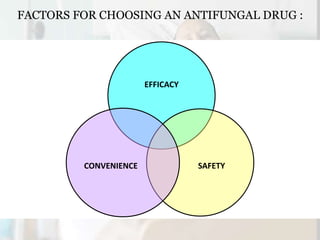
FACTORS FOR CHOOSING AN ANTIFUNGAL DRUG :
EFFICACY
SAFETY
CONVENIENCE
Majority of antifungals in clinical practice
 Majority of the antifungals described
till date are acting on the fungal cell
membrane
 Azoles, Polyenes and terbinafine act
on ergosterol synthesis , thus
inhibiting fungal cell membrane
synthesis
 Echinocandins have a novel
mechanism of action as it inhibits the
fungal cell wall synthesis via inhibition
of 1-3,B d glucan
COMPARATIVE MICs : Common Candida species
Candida species Anidulafungin Caspofungin Micafungin
MIC
90
µg/ml MIC
90
µg/ml MIC
90
µg/ml
C.albicans 0.03 0.5 0.03
C.glabrata 0.13 1.0 0.06
C.parapsilosis 2.00 2.0 2.00
C.tropicalis 0.13 1.0 0.06
C.krusei 0.13 2.0 0.25
C.lusitaniae 0.25 2.0 2.00
C.dubliniensis 0.06 0.5 0.03
C.guilliermondii 2.0 1.0 1.0
1. Fritz J et al. Micafungin for the propphylaxis and treatment of Candida infections. Expert Rev.Anti Infect. Ther 2008. 6(2); 153-62
Echinocandins in lung tissue
• The concentrations of caspofungin in alveolar macrophages were5 times
the corresponding concentrations in plasma in a single patient
• Both anidulafungin and micafungin also accumulated in alveolar
macrophages of volunteers, attaining concentrations approximately 14 and
4 times higher than those in plasma
• 18 lung transplant patients receiving a single 150-mg i.v. micafungin dose,
ELF/plasma and alveolar cell/plasma concentration ratios varied with time
post dose
• Mean ratios ranged from 0.1 to 1.53 at 3 h and from 1.1 to 6.2 at 24 h post
dose
Echinocandins in lung tissue
• The vast majority of anidulafungin and micafungin found in the ELF is
present within macrophages rather than in the fluid itself
• Caspofungin, micafungin, and anidulafungin exhibit lung tissue exposures
in rodents that exceed those in plasma by 1.1-fold, 2.8-fold, and 10-fold,
respectively
MIC OF CANDIDA STRAINS in caspofungin susceptible and
nonsusceptible species
Shirazi et al. Virulence 6:4, 385--394; May/June 2015;
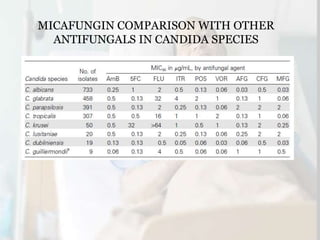
MICAFUNGIN COMPARISON WITH OTHER
ANTIFUNGALS IN CANDIDA SPECIES
PK PD COMPARISON OF ECHINOCANDINS
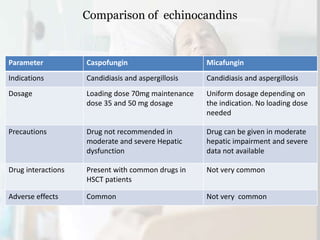
Comparison of echinocandins
Parameter Caspofungin Micafungin
Indications Candidiasis and aspergillosis Candidiasis and aspergillosis
Dosage Loading dose 70mg maintenance
dose 35 and 50 mg dosage
Uniform dosage depending on
the indication. No loading dose
needed
Precautions Drug not recommended in
moderate and severe Hepatic
dysfunction
Drug can be given in moderate
hepatic impairment and severe
data not available
Drug interactions Present with common drugs in
HSCT patients
Not very common
Adverse effects Common Not very common
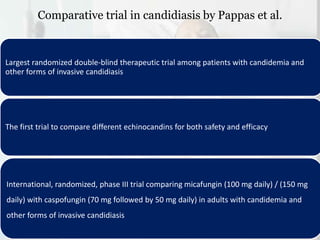
Comparative trial in candidiasis by Pappas et al.
Largest randomized double-blind therapeutic trial among patients with candidemia and
other forms of invasive candidiasis
The first trial to compare different echinocandins for both safety and efficacy
International, randomized, phase III trial comparing micafungin (100 mg daily) / (150 mg
daily) with caspofungin (70 mg followed by 50 mg daily) in adults with candidemia and
other forms of invasive candidiasis
The primary efficacy end point –
treatment success in candidemic patients :
 Clinical success : defined as
 Complete response to treatment (i.e., resolution of all attributable
signs, symptoms, and abnormal radiographic findings associated
with fungal infection) or
 Partial response to treatment (i.e., improvement of attributable
signs, symptoms, and abnormal radiographic findings since baseline)
 Mycological success :
 Eradication if 2 cultures of blood specimens obtained at least 24 h
apart had negative results
Epidemiology in study
• Candidemia was observed in 492 (85.1%) of 578 patients at baseline
• The most commonly isolated non-albicans species of Candida were :
– C. tropicalis (16.6%)
– C. glabrata (16.4%)
– C. parapsilosis (15.9%)
Efficacy analysis in Candidemia and other candida infections
Drug Micafungin 100mg Caspofungin
Success in candidemic patients 78.5% 76.4%
Treatment Success (investigators) 76.4% 72.3 %
Success in non candidemic
patients 50% 57.7%
Adverse events leading to
termination of treatment
2.5% 3.6%
COMPARABLE ACTION WITH CASPOFUNGIN IN
CANDIDEMIA AND OTHER FORMS OF INVASIVE
CANDIDIASIS
68
69
70
71
72
73
74
75
76
77
Micafungin 100mg Micafungin 150mg Caspofungin
Success rate (%)
Dosages of micafungin 100 mg daily and 150 mg daily were noninferior to a standard dosage
of caspofungin for the treatment of candidemia and other forms of invasive candidiasis
Caspofungin and micafungin : HEOR survey
 Studies have shown Micafungin to be cost-effective in comparison with
caspofungin in ICU candidemic infections
Micafungin MICs v/s anidulafungin in fluconazole resistant
candida
Deepa et al. Int.J.Curr.Microbiol.App.Sci (2014)
COMPARABLE ACTION WITH LIPOSOMAL
AMPHOTERICIN IN ICU PATIENTS
62.5
66.4
73.3
71.8
56
58
60
62
64
66
68
70
72
74
76
Micafungin Liposomal Amphotericin B
Percentage(%)
Overall success rate
Mycological response
Treatment success rates for micafungin versus liposomal amphotericin B were
similar . Mycological response rate were slightly higher in micafungin.
POWERFUL ACTIVITY AGAINST RESISTANCE PATHOGENS
Micafungin possesses broad spectrum activity against Candida species,
including those with:
1. Reduced fluconazole susceptibility (C. glabrata) 1
2. Intrinsic resistance to fluconazole (C. krusei) 1
1. Fritz J et al. Micafungin for the propphylaxis and treatment of Candida infections. Expert Rev.Anti Infect. Ther 2008. 6(2); 153-62
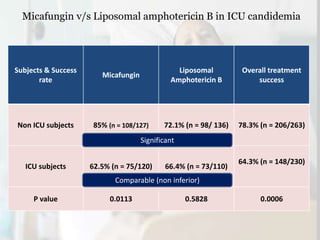
Micafungin v/s Liposomal amphotericin B in ICU candidemia
Subjects & Success
rate
Micafungin
Liposomal
Amphotericin B
Overall treatment
success
Non ICU subjects 85% (n = 108/127) 72.1% (n = 98/ 136) 78.3% (n = 206/263)
ICU subjects 62.5% (n = 75/120) 66.4% (n = 73/110)
64.3% (n = 148/230)
P value 0.0113 0.5828 0.0006
Significant
Comparable (non inferior)
Micafungin is superior to Liposomal Amphotericin B
Incidence of treatment related/infusion related reactions2
Micafungin
( n=264)
Liposomal
Amphoterecin B
(n=267)
•*Patients with candidemia and invasive candidiasis
•# patients with candidemia
Better renal function 1*
 Lesser treatment related adverse effects2#
In hepatic impaired patients
Micafungin is well tolerated in subjects with hepatic dysfunction after a single dose of 100 mg
SAFETY PROFILE
Safety profile
Caspofungin
• Unlike caspofungin no drug
interactions with cyclo-sporine,
tacrlimus and other
immunosuppressant drugs
• Micafungin is Well tolerated in
hepatic dysfunction patients
Amphotericin B
• Unlike amphotericin B no
drug interaction with
Antineoplastic agents,
Corticosteroids, digitalis
glycosides, leukocyte
transfusion, skeletal muscle
relaxants etc.
• Micafungin is well tolerated
in renal dysfunction patients
Convenience profile :
Once daily doing
No loading dose required.
No dosing adjustments in patients
with severe renal dysfunction or mild-
to-moderate hepatic insufficiency.
HAEMOPOEITIC STEM CELL TRANSPLANT PATIENTS
• Incidence of fungal infections is around 10%-20% post- transplantation
• Fungal infections can cause a high mortality following HSCT, particularly
allogenic grafts, because of receiving post transplantation
immunosuppressive medications
• Candida (C) albicans is the most common isolate, although the
incidences of candida non-albicans have raised in recent years
• During immediate and late post engraftment, the most common fungal
infection is Invasive Aspergillosis (IA) secondary to increased risk of GVHD
and prolonged use of corticosteroids
ESCMID GUIDELINES FOR CANDIDIAL INFECTIONS
WITH MALIGNANCY
MICAFUNGIN IN INVASIVE CANDIDIASIS AMONG
ONCO-HEMATOLOGICAL PATIENTS
In a study on 126 patients with candidemia treated with micafungin, an
overall response rate of 83% was reported
A double-blind study of 531 patients with invasive candidiasis comparing
micafungin (100 mg/day) versus liposomal amphotericin B (3 mg/kg/day)
reported success in 90% of patients in both arms, with a more favorable
safety profile with micafungin
Other double blind randomized, phase III study compared two doses of
micafungin in adults with invasive candidiasis
Overall success rate was 74% for micafungin 100 mg/day, 70% for micafungin
150 mg/day, and 71% for caspofungin
In HSCT patients
• In view of low efficacy of fluconazole prophylaxis in preventing mould
infections, predominantly Invasive Aspergillosis, orally administered
posaconazole and IV micafungin are recommended in high-risk
hematological patients
• Doses of micafungin in adult (100 mg/day, 150 mg/day) and in pediatric
(3 mg/kg/ day) HSCT recipients, after treatment with vinca alkaloids,
have been found to be effective and safe
• Micafungin elicits activity against both Candida and Aspergillus, displays
favorable pharmacokinetic profile and is devoid of drug--drug
interactions.
MICAFUNGIN IN INVASIVE CANDIDIASIS
AMONG ONCO-HEMATOLOGICAL PATIENTS
• Conclusions: Comparative phase III studies have demonstrated non-
inferiority of micafungin compared to standard antifungal agents for
invasive candidiasis. Micafungin is safe and effective in the treatment of
children and adults with invasive candidiasis. Effectivity in invasive
infections caused by non-albicans
• Candida spp is especially relevant in onco-hematological patients
receiving fluconazole prophylaxis
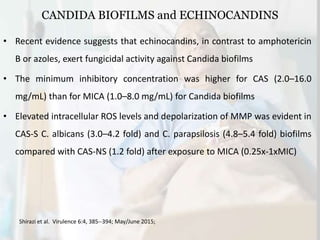
CANDIDA BIOFILMS and ECHINOCANDINS
• Recent evidence suggests that echinocandins, in contrast to amphotericin
B or azoles, exert fungicidal activity against Candida biofilms
• The minimum inhibitory concentration was higher for CAS (2.0–16.0
mg/mL) than for MICA (1.0–8.0 mg/mL) for Candida biofilms
• Elevated intracellular ROS levels and depolarization of MMP was evident in
CAS-S C. albicans (3.0–4.2 fold) and C. parapsilosis (4.8–5.4 fold) biofilms
compared with CAS-NS (1.2 fold) after exposure to MICA (0.25x-1xMIC)
Shirazi et al. Virulence 6:4, 385--394; May/June 2015;
CANDIDA BIOFILMS and ECHINOCANDINS
• Elevated intracellular ROS levels and depolarization of MMP was evident in
CAS-S C. albicans (3.0–4.2 fold) and C. parapsilosis (4.8–5.4 fold) biofilms
compared with CAS-NS (1.2 fold) after exposure to MICA (0.25x-1xMIC)
• Finally higher ß-1, 3 glucan levels were seen in sessile cells compared to
planktonic cells, especially in CAS-NS strains
• MICA treatment might induce a metacaspase-dependent apoptotic
process in biofilms of both CAS-S C. albicans and C. parapsilosis, and to
some degree in CAS-NS strains
Shirazi et al. Virulence 6:4, 385--394; May/June 2015;
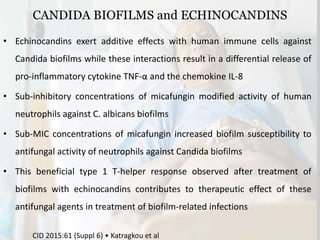
CANDIDA BIOFILMS and ECHINOCANDINS
• Echinocandins exert additive effects with human immune cells against
Candida biofilms while these interactions result in a differential release of
pro-inflammatory cytokine TNF-α and the chemokine IL-8
• Sub-inhibitory concentrations of micafungin modified activity of human
neutrophils against C. albicans biofilms
• Sub-MIC concentrations of micafungin increased biofilm susceptibility to
antifungal activity of neutrophils against Candida biofilms
• This beneficial type 1 T-helper response observed after treatment of
biofilms with echinocandins contributes to therapeutic effect of these
antifungal agents in treatment of biofilm-related infections
CID 2015:61 (Suppl 6) • Katragkou et al
MICAFUNGIN
1. For the treatment of patients with candidemia, acute disseminated
candidiasis, candida peritonitis, abscess and esophageal candidiasis
2. For the prophylaxis of Candida infection in patients undergoing
hematopoietic stem cell transplantation (HSCT)
3. Prophylaxis of Aspergillus Infections in Patients Undergoing
Hematopoietic Stem Cell Transplantation
4. Treatment of Patients with Fungemia, Respiratory mycosis,
Gastrointestinal mycosis caused by Aspergillus sp.
THANK YOU

Micedge CME module .pptx

  • 1.
    MICAFUNGIN : ECHINOCANDINWITH THE EDGE FOR INVASIVE CANDIDIASIS Dr.
  • 2.
    Overview • Invasive Fungalinfections • Challenges in management of Fungal infections • Antifungals • Micafungin in Candidiasis • Micafungin compared with other antifungals
  • 3.
    Invasive fungal infections(IFI) • Invasive fungal infections (IFI) have significantly increased due to advances in medical care in the at risk immunocompromised population • Fungal species are widely distributed in soil, plant debris and other organic substrates, and make up approximately 7 per cent (611,000 species) of all eukaryotic species on earth, although only about 600 species are human pathogens.
  • 4.
    MAJOR RISK FACTORSFOR IFI • Prolonged (>7 days) stays in intensive care • Invasive medical procedures • Newer immune suppressive agents • Chemotherapy • HIV infection • Neutropenia (4 wk) treatment with corticosteroids • Other risk factors are • Malnutrition • Solid organ transplantation • Severe burns or prolonged stays in intensive care (>21 days) • Systemic corticosteroids for >7 days, and major surgery Badiee P et al. Opportunistic invasive fungal infections: diagnosis & clinical management. INDIAN J MED RES, february 2014
  • 5.
    INVASIVE CANDIDIASIS • Invasivecandidiasis is the most common invasive mycotic infection across india • Incidence varies from 1 to 12 per 1000 admissions in different hospitals across india • Candidemia is the 4th most common blood stream infection
  • 6.
    INVASIVE CANDIDIASIS :A GROWING MENACE • Candidemia : Life threatening infection with mortality rate of 38% • Shift towards Non albicans species(85.7%) – Candida tropicalis (50.5%), Candida glabrata (19.0%), Candida parapsilosis (14.3%) • Developing Resistance – Non-albicans Candida demonstrated high resistance to azole group of antifungal agents
  • 7.
    DISSEMINATED CANDIDIASIS • Disseminatedcandidiasis is associated with a mortality in excess of 25 % (Kibbler et al., 2003) • Candida is a normal commensal of the skin, and gastrointestinal and genitourinary tracts • Candida albicans is the most frequent species isolated from clinical specimens, but other species (nonalbicans Candida, NAC) are increasingly seen. • C. albicans was responsible for 79.4 % of candidaemias in intensive-care patients, & 37.5 % in haematology patients (Kibbler et al., 2003)
  • 8.
    NON-ALBICANS SPECIES ININVASIVE CANDIDIASIS • Prospective Antifungal Therapy Alliance (PATH Alliance) registry from 2004 to 2008 for non albicans species • A total of 2,496 patients with non-albicans species of Candida isolates were identified • The identified species were : – C. glabrata (46.4%) – C. parapsilosis (24.7%) – C. tropicalis (13.9%) – C. krusei (5.5%) – C. lusitaniae (1.6%) – C. dubliniensis (1.5%) – C. guilliermondii (0.4%) • 111 infections involved two or more species of Candida (4.4%) • Non-albicans species accounted for more than 50% of all cases of invasive candidiasis in 15 of the 24 sites PLoS ONE. Jul2014, Vol. 9 Issue 7, p1-12. 12p
  • 9.
    Fungal infections inindian scenario • A multicentric study by Dr Chakrabarti A.et. al. in indian ICUs showed – Non albicans to be present in 79% cases – Candida tropicalis isolates in 41.6% cases – Azole resistance to be presentin 11.9% cases – 30 day mortality of 44.7% in candidemia
  • 10.
    FACTORS FOR CHOOSINGAN ANTIFUNGAL DRUG : EFFICACY SAFETY CONVENIENCE
  • 11.
    Majority of antifungalsin clinical practice  Majority of the antifungals described till date are acting on the fungal cell membrane  Azoles, Polyenes and terbinafine act on ergosterol synthesis , thus inhibiting fungal cell membrane synthesis  Echinocandins have a novel mechanism of action as it inhibits the fungal cell wall synthesis via inhibition of 1-3,B d glucan
  • 12.
    COMPARATIVE MICs :Common Candida species Candida species Anidulafungin Caspofungin Micafungin MIC 90 µg/ml MIC 90 µg/ml MIC 90 µg/ml C.albicans 0.03 0.5 0.03 C.glabrata 0.13 1.0 0.06 C.parapsilosis 2.00 2.0 2.00 C.tropicalis 0.13 1.0 0.06 C.krusei 0.13 2.0 0.25 C.lusitaniae 0.25 2.0 2.00 C.dubliniensis 0.06 0.5 0.03 C.guilliermondii 2.0 1.0 1.0 1. Fritz J et al. Micafungin for the propphylaxis and treatment of Candida infections. Expert Rev.Anti Infect. Ther 2008. 6(2); 153-62
  • 13.
    Echinocandins in lungtissue • The concentrations of caspofungin in alveolar macrophages were5 times the corresponding concentrations in plasma in a single patient • Both anidulafungin and micafungin also accumulated in alveolar macrophages of volunteers, attaining concentrations approximately 14 and 4 times higher than those in plasma • 18 lung transplant patients receiving a single 150-mg i.v. micafungin dose, ELF/plasma and alveolar cell/plasma concentration ratios varied with time post dose • Mean ratios ranged from 0.1 to 1.53 at 3 h and from 1.1 to 6.2 at 24 h post dose
  • 14.
    Echinocandins in lungtissue • The vast majority of anidulafungin and micafungin found in the ELF is present within macrophages rather than in the fluid itself • Caspofungin, micafungin, and anidulafungin exhibit lung tissue exposures in rodents that exceed those in plasma by 1.1-fold, 2.8-fold, and 10-fold, respectively
  • 15.
    MIC OF CANDIDASTRAINS in caspofungin susceptible and nonsusceptible species Shirazi et al. Virulence 6:4, 385--394; May/June 2015;
  • 16.
    MICAFUNGIN COMPARISON WITHOTHER ANTIFUNGALS IN CANDIDA SPECIES
  • 17.
    PK PD COMPARISONOF ECHINOCANDINS
  • 18.
    Comparison of echinocandins ParameterCaspofungin Micafungin Indications Candidiasis and aspergillosis Candidiasis and aspergillosis Dosage Loading dose 70mg maintenance dose 35 and 50 mg dosage Uniform dosage depending on the indication. No loading dose needed Precautions Drug not recommended in moderate and severe Hepatic dysfunction Drug can be given in moderate hepatic impairment and severe data not available Drug interactions Present with common drugs in HSCT patients Not very common Adverse effects Common Not very common
  • 19.
    Comparative trial incandidiasis by Pappas et al. Largest randomized double-blind therapeutic trial among patients with candidemia and other forms of invasive candidiasis The first trial to compare different echinocandins for both safety and efficacy International, randomized, phase III trial comparing micafungin (100 mg daily) / (150 mg daily) with caspofungin (70 mg followed by 50 mg daily) in adults with candidemia and other forms of invasive candidiasis
  • 20.
    The primary efficacyend point – treatment success in candidemic patients :  Clinical success : defined as  Complete response to treatment (i.e., resolution of all attributable signs, symptoms, and abnormal radiographic findings associated with fungal infection) or  Partial response to treatment (i.e., improvement of attributable signs, symptoms, and abnormal radiographic findings since baseline)  Mycological success :  Eradication if 2 cultures of blood specimens obtained at least 24 h apart had negative results
  • 21.
    Epidemiology in study •Candidemia was observed in 492 (85.1%) of 578 patients at baseline • The most commonly isolated non-albicans species of Candida were : – C. tropicalis (16.6%) – C. glabrata (16.4%) – C. parapsilosis (15.9%)
  • 22.
    Efficacy analysis inCandidemia and other candida infections Drug Micafungin 100mg Caspofungin Success in candidemic patients 78.5% 76.4% Treatment Success (investigators) 76.4% 72.3 % Success in non candidemic patients 50% 57.7% Adverse events leading to termination of treatment 2.5% 3.6%
  • 23.
    COMPARABLE ACTION WITHCASPOFUNGIN IN CANDIDEMIA AND OTHER FORMS OF INVASIVE CANDIDIASIS 68 69 70 71 72 73 74 75 76 77 Micafungin 100mg Micafungin 150mg Caspofungin Success rate (%) Dosages of micafungin 100 mg daily and 150 mg daily were noninferior to a standard dosage of caspofungin for the treatment of candidemia and other forms of invasive candidiasis
  • 24.
    Caspofungin and micafungin: HEOR survey  Studies have shown Micafungin to be cost-effective in comparison with caspofungin in ICU candidemic infections
  • 25.
    Micafungin MICs v/sanidulafungin in fluconazole resistant candida Deepa et al. Int.J.Curr.Microbiol.App.Sci (2014)
  • 26.
    COMPARABLE ACTION WITHLIPOSOMAL AMPHOTERICIN IN ICU PATIENTS 62.5 66.4 73.3 71.8 56 58 60 62 64 66 68 70 72 74 76 Micafungin Liposomal Amphotericin B Percentage(%) Overall success rate Mycological response Treatment success rates for micafungin versus liposomal amphotericin B were similar . Mycological response rate were slightly higher in micafungin.
  • 27.
    POWERFUL ACTIVITY AGAINSTRESISTANCE PATHOGENS Micafungin possesses broad spectrum activity against Candida species, including those with: 1. Reduced fluconazole susceptibility (C. glabrata) 1 2. Intrinsic resistance to fluconazole (C. krusei) 1 1. Fritz J et al. Micafungin for the propphylaxis and treatment of Candida infections. Expert Rev.Anti Infect. Ther 2008. 6(2); 153-62
  • 28.
    Micafungin v/s Liposomalamphotericin B in ICU candidemia Subjects & Success rate Micafungin Liposomal Amphotericin B Overall treatment success Non ICU subjects 85% (n = 108/127) 72.1% (n = 98/ 136) 78.3% (n = 206/263) ICU subjects 62.5% (n = 75/120) 66.4% (n = 73/110) 64.3% (n = 148/230) P value 0.0113 0.5828 0.0006 Significant Comparable (non inferior)
  • 29.
    Micafungin is superiorto Liposomal Amphotericin B Incidence of treatment related/infusion related reactions2 Micafungin ( n=264) Liposomal Amphoterecin B (n=267) •*Patients with candidemia and invasive candidiasis •# patients with candidemia Better renal function 1*  Lesser treatment related adverse effects2# In hepatic impaired patients Micafungin is well tolerated in subjects with hepatic dysfunction after a single dose of 100 mg SAFETY PROFILE
  • 30.
    Safety profile Caspofungin • Unlikecaspofungin no drug interactions with cyclo-sporine, tacrlimus and other immunosuppressant drugs • Micafungin is Well tolerated in hepatic dysfunction patients Amphotericin B • Unlike amphotericin B no drug interaction with Antineoplastic agents, Corticosteroids, digitalis glycosides, leukocyte transfusion, skeletal muscle relaxants etc. • Micafungin is well tolerated in renal dysfunction patients
  • 31.
    Convenience profile : Oncedaily doing No loading dose required. No dosing adjustments in patients with severe renal dysfunction or mild- to-moderate hepatic insufficiency.
  • 32.
    HAEMOPOEITIC STEM CELLTRANSPLANT PATIENTS • Incidence of fungal infections is around 10%-20% post- transplantation • Fungal infections can cause a high mortality following HSCT, particularly allogenic grafts, because of receiving post transplantation immunosuppressive medications • Candida (C) albicans is the most common isolate, although the incidences of candida non-albicans have raised in recent years • During immediate and late post engraftment, the most common fungal infection is Invasive Aspergillosis (IA) secondary to increased risk of GVHD and prolonged use of corticosteroids
  • 33.
    ESCMID GUIDELINES FORCANDIDIAL INFECTIONS WITH MALIGNANCY
  • 34.
    MICAFUNGIN IN INVASIVECANDIDIASIS AMONG ONCO-HEMATOLOGICAL PATIENTS In a study on 126 patients with candidemia treated with micafungin, an overall response rate of 83% was reported A double-blind study of 531 patients with invasive candidiasis comparing micafungin (100 mg/day) versus liposomal amphotericin B (3 mg/kg/day) reported success in 90% of patients in both arms, with a more favorable safety profile with micafungin Other double blind randomized, phase III study compared two doses of micafungin in adults with invasive candidiasis Overall success rate was 74% for micafungin 100 mg/day, 70% for micafungin 150 mg/day, and 71% for caspofungin
  • 35.
    In HSCT patients •In view of low efficacy of fluconazole prophylaxis in preventing mould infections, predominantly Invasive Aspergillosis, orally administered posaconazole and IV micafungin are recommended in high-risk hematological patients • Doses of micafungin in adult (100 mg/day, 150 mg/day) and in pediatric (3 mg/kg/ day) HSCT recipients, after treatment with vinca alkaloids, have been found to be effective and safe • Micafungin elicits activity against both Candida and Aspergillus, displays favorable pharmacokinetic profile and is devoid of drug--drug interactions.
  • 36.
    MICAFUNGIN IN INVASIVECANDIDIASIS AMONG ONCO-HEMATOLOGICAL PATIENTS • Conclusions: Comparative phase III studies have demonstrated non- inferiority of micafungin compared to standard antifungal agents for invasive candidiasis. Micafungin is safe and effective in the treatment of children and adults with invasive candidiasis. Effectivity in invasive infections caused by non-albicans • Candida spp is especially relevant in onco-hematological patients receiving fluconazole prophylaxis
  • 37.
    CANDIDA BIOFILMS andECHINOCANDINS • Recent evidence suggests that echinocandins, in contrast to amphotericin B or azoles, exert fungicidal activity against Candida biofilms • The minimum inhibitory concentration was higher for CAS (2.0–16.0 mg/mL) than for MICA (1.0–8.0 mg/mL) for Candida biofilms • Elevated intracellular ROS levels and depolarization of MMP was evident in CAS-S C. albicans (3.0–4.2 fold) and C. parapsilosis (4.8–5.4 fold) biofilms compared with CAS-NS (1.2 fold) after exposure to MICA (0.25x-1xMIC) Shirazi et al. Virulence 6:4, 385--394; May/June 2015;
  • 38.
    CANDIDA BIOFILMS andECHINOCANDINS • Elevated intracellular ROS levels and depolarization of MMP was evident in CAS-S C. albicans (3.0–4.2 fold) and C. parapsilosis (4.8–5.4 fold) biofilms compared with CAS-NS (1.2 fold) after exposure to MICA (0.25x-1xMIC) • Finally higher ß-1, 3 glucan levels were seen in sessile cells compared to planktonic cells, especially in CAS-NS strains • MICA treatment might induce a metacaspase-dependent apoptotic process in biofilms of both CAS-S C. albicans and C. parapsilosis, and to some degree in CAS-NS strains Shirazi et al. Virulence 6:4, 385--394; May/June 2015;
  • 39.
    CANDIDA BIOFILMS andECHINOCANDINS • Echinocandins exert additive effects with human immune cells against Candida biofilms while these interactions result in a differential release of pro-inflammatory cytokine TNF-α and the chemokine IL-8 • Sub-inhibitory concentrations of micafungin modified activity of human neutrophils against C. albicans biofilms • Sub-MIC concentrations of micafungin increased biofilm susceptibility to antifungal activity of neutrophils against Candida biofilms • This beneficial type 1 T-helper response observed after treatment of biofilms with echinocandins contributes to therapeutic effect of these antifungal agents in treatment of biofilm-related infections CID 2015:61 (Suppl 6) • Katragkou et al
  • 40.
    MICAFUNGIN 1. For thetreatment of patients with candidemia, acute disseminated candidiasis, candida peritonitis, abscess and esophageal candidiasis 2. For the prophylaxis of Candida infection in patients undergoing hematopoietic stem cell transplantation (HSCT) 3. Prophylaxis of Aspergillus Infections in Patients Undergoing Hematopoietic Stem Cell Transplantation 4. Treatment of Patients with Fungemia, Respiratory mycosis, Gastrointestinal mycosis caused by Aspergillus sp.
  • 41.