COMMUNICATION
COMMUNICATION GAME
BASICS OF COMMUNICATION
 We communicate with somebody
 Communication is an action
 Information is content
 Communication is non repeatable
 Total message = messages we speak, verbal + non
verbal
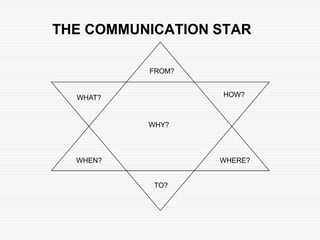
THE COMMUNICATION STAR
WHY?
TO?
WHERE?
HOW?
FROM?
WHAT?
WHEN?
EFFECTIVENESS OF VERBAL
COMMUNICATION ?
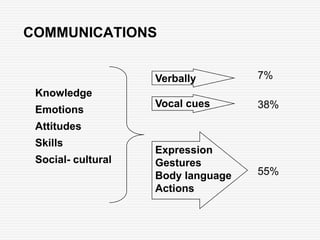
COMMUNICATIONS
Knowledge
Emotions
Attitudes
Skills
Social- cultural
Verbally 7%
Vocal cues 38%
Expression
Gestures
Body language
Actions
55%
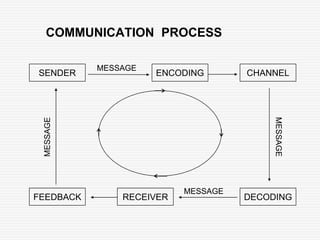
COMMUNICATION PROCESS
SENDER ENCODING CHANNEL
DECODING
RECEIVER
FEEDBACK
MESSAGE
MESSAGE
MESSAGE
MESSAGE
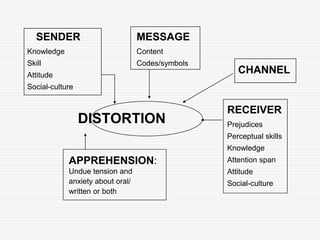
DISTORTION
MESSAGE
Content
Codes/symbols
CHANNEL
RECEIVER
Prejudices
Perceptual skills
Knowledge
Attention span
Attitude
Social-culture
APPREHENSION:
Undue tension and
anxiety about oral/
written or both
SENDER
Knowledge
Skill
Attitude
Social-culture
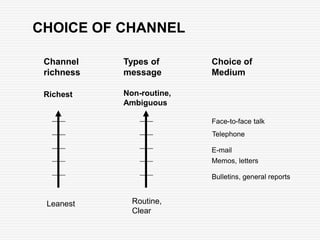
CHOICE OF CHANNEL
Channel
richness
Types of
message
Choice of
Medium
Richest Non-routine,
Ambiguous
Leanest Routine,
Clear
Face-to-face talk
Telephone
E-mail
Memos, letters
Bulletins, general reports
COMMUNICATION BARRIERS
 Filters
 Selective perception
 Emotions
 Physical
 Semantic (language)
Human nature makes us want to hear only what
pleases us and to reject that which does not.
NON-VERBAL COMMUNICATION
 Expressions are confused with the message itself.
 We tend to analyze and respond to the other’s non verbal
communication.
 Accurate and timely reading of non verbal language is
necessary to understand the meaning of the message.
 Our feelings of self-confidence, attitudes are transmitted by our
body language
 Actions speak louder than words
NON VERBAL BEHAVIORAL ASPECTS
 Eye-contact
 Hand shake
 Body space
 Body posture
 Facial expressions
 Gestures
 Dressing style
 Timing
KEY COMMUNICATION SKILLS
 ACTIVE LISTENING
 Make eye contact
 Exhibit appropriate facial expressions, affirmative head nods
 Avoid distracting gestures or actions
 Ask questions
 Paraphrase
 Avoid interrupting the speaker
 Don’t over talk
 be sensitive
KEY COMMUNICATION SKILLS
 FEEDBACK SKILLS
 Focus on specific behaviors
 Keep feedback impersonal
 Keep feedback goal oriented
 Make feedback well timed
 Ensure understanding
 Direct negative feedback toward behavior that is controllable by
the recipient
LISTENING GAME
You weredriving a car on the DELHI -
AGRA highway. As he reached the cross-
junction of the highway, fast moving truck
from the left approached the road and hit
the car on the left rear side.
The car hit an electric post on the right
side of the highway and the window
glasses were shattered. The car driver
got injured and hospitalized.
The truck hit a passing bus and
overturned near a culvert.
LISTENING SKILLS
 Be there * MENTALLY
 * EMOTIONALLY
 * PHYSICALLY
 Empathize with the speaker
 Use positive body language and other
responses to show you are listening.
 Avoid distracting actions or gestures.
 Ask questions
 Listen to CONTEXT- Listen for CONTENT.
 Judge later.
LISTEN TO CONTEXT,
LISTEN FOR CONTENT,
AND
YOU WILL LISTEN
EFFECTIVELY.
THE MORE YOU TALK,
THE LESS YOU LISTEN,
AND THE MORE YOU TALK,
THE LESS OTHERS WILL LISTEN.
 IS YOUR COMMENT PERTINANT?
 IS YOUR COMMENT
INFORMATIVE?
 DO YOU HAVE YOUR THOUGHTS
IN ORDER?
IF NOT, YOU'RE BETTER OFF
LISTENING.
CAREFUL LISTENING
ELIMINATES
MISUNDERSTANDING
If anything can be misunderstood, it WILL be misunderstood.
Most people are AFRAID to admit that they do not understand.
Others are TOO PROUD to say that they haven't understood.
As a result you don't even realize that they haven't got
your message until everything is all messed up.
One way to be sure that your message has gone home is to
ASK your listener to repeat the message back to you in his
own words. Like that, you can be sure that you are both
on the right wavelength and that your listener understands
your message and NOT HIS OWN INTERPRETATION OF IT.
LISTEN TO OTHERS
SOME VALUABLE TIPS
 When listening, always follow this order:
 1. Hear > 2.Understand > 3.Interpret
>4.Respond
 don't jump from "hear" to "respond" without
making sure you understand
 Focus your attention on
understanding someone's meaning
instead of formulating your response.
 Avoid interrupting people; wait until
they have finished making their
points.
 Ask open-ended questions to draw out a
person's thoughts and feelings by using
phrases beginning with "what," "how,"
"describe," "explain," and so forth.
 Avoid close-ended questions that can
be answered with a "yes" or a "no."
 Attend to the feelings, as well as the
content, of the message.
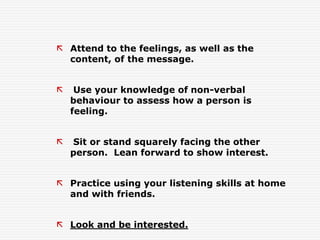
 Use your knowledge of non-verbal
behaviour to assess how a person is
feeling.
 Sit or stand squarely facing the other
person. Lean forward to show interest.
 Practice using your listening skills at home
and with friends.
 Look and be interested.
LISTENING SKILLS
 Be patient; DO NOT complete sentences
for the speaker; avoid interrupting the
speaker.
 Watch your LISTEN/TALK ratio.
 PARAPHRASE to verify your
understanding.
 Avoid PHYSICAL & PSYCHOLOGICAL
barriers.
 Listening mostly leads to ACTION.
YOU ARE JUDGED BY THE
WAY YOU SPEAK
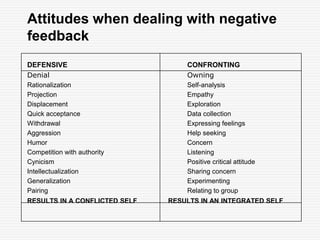
Attitudes when dealing with negative
feedback
DEFENSIVE CONFRONTING
Denial Owning
Rationalization Self-analysis
Projection Empathy
Displacement Exploration
Quick acceptance Data collection
Withdrawal Expressing feelings
Aggression Help seeking
Humor Concern
Competition with authority Listening
Cynicism Positive critical attitude
Intellectualization Sharing concern
Generalization Experimenting
Pairing Relating to group
RESULTS IN A CONFLICTED SELF RESULTS IN AN INTEGRATED SELF
JOHARI WINDOW
Arena
(A)
Blind
(B)
Closed
(C)
Dark
(D)
Known to Self Not Known to Self
Not
Known
to others
Known
to others
JOHARI WINDOW
Arena
(A)
Feedback
Self
disclosure

Communication Not Simple.ppt

  • 1.
  • 2.
  • 3.
    BASICS OF COMMUNICATION We communicate with somebody  Communication is an action  Information is content  Communication is non repeatable  Total message = messages we speak, verbal + non verbal
  • 4.
  • 5.
  • 6.
  • 7.
    COMMUNICATION PROCESS SENDER ENCODINGCHANNEL DECODING RECEIVER FEEDBACK MESSAGE MESSAGE MESSAGE MESSAGE
  • 8.
  • 9.
    CHOICE OF CHANNEL Channel richness Typesof message Choice of Medium Richest Non-routine, Ambiguous Leanest Routine, Clear Face-to-face talk Telephone E-mail Memos, letters Bulletins, general reports
  • 10.
    COMMUNICATION BARRIERS  Filters Selective perception  Emotions  Physical  Semantic (language) Human nature makes us want to hear only what pleases us and to reject that which does not.
  • 11.
    NON-VERBAL COMMUNICATION  Expressionsare confused with the message itself.  We tend to analyze and respond to the other’s non verbal communication.  Accurate and timely reading of non verbal language is necessary to understand the meaning of the message.  Our feelings of self-confidence, attitudes are transmitted by our body language  Actions speak louder than words
  • 12.
    NON VERBAL BEHAVIORALASPECTS  Eye-contact  Hand shake  Body space  Body posture  Facial expressions  Gestures  Dressing style  Timing
  • 13.
    KEY COMMUNICATION SKILLS ACTIVE LISTENING  Make eye contact  Exhibit appropriate facial expressions, affirmative head nods  Avoid distracting gestures or actions  Ask questions  Paraphrase  Avoid interrupting the speaker  Don’t over talk  be sensitive
  • 14.
    KEY COMMUNICATION SKILLS FEEDBACK SKILLS  Focus on specific behaviors  Keep feedback impersonal  Keep feedback goal oriented  Make feedback well timed  Ensure understanding  Direct negative feedback toward behavior that is controllable by the recipient
  • 16.
    LISTENING GAME You weredrivinga car on the DELHI - AGRA highway. As he reached the cross- junction of the highway, fast moving truck from the left approached the road and hit the car on the left rear side. The car hit an electric post on the right side of the highway and the window glasses were shattered. The car driver got injured and hospitalized. The truck hit a passing bus and overturned near a culvert.
  • 17.
    LISTENING SKILLS  Bethere * MENTALLY  * EMOTIONALLY  * PHYSICALLY  Empathize with the speaker  Use positive body language and other responses to show you are listening.  Avoid distracting actions or gestures.  Ask questions  Listen to CONTEXT- Listen for CONTENT.  Judge later.
  • 18.
    LISTEN TO CONTEXT, LISTENFOR CONTENT, AND YOU WILL LISTEN EFFECTIVELY.
  • 19.
    THE MORE YOUTALK, THE LESS YOU LISTEN, AND THE MORE YOU TALK, THE LESS OTHERS WILL LISTEN.
  • 20.
     IS YOURCOMMENT PERTINANT?  IS YOUR COMMENT INFORMATIVE?  DO YOU HAVE YOUR THOUGHTS IN ORDER? IF NOT, YOU'RE BETTER OFF LISTENING.
  • 21.
    CAREFUL LISTENING ELIMINATES MISUNDERSTANDING If anythingcan be misunderstood, it WILL be misunderstood. Most people are AFRAID to admit that they do not understand. Others are TOO PROUD to say that they haven't understood. As a result you don't even realize that they haven't got your message until everything is all messed up. One way to be sure that your message has gone home is to ASK your listener to repeat the message back to you in his own words. Like that, you can be sure that you are both on the right wavelength and that your listener understands your message and NOT HIS OWN INTERPRETATION OF IT.
  • 22.
    LISTEN TO OTHERS SOMEVALUABLE TIPS  When listening, always follow this order:  1. Hear > 2.Understand > 3.Interpret >4.Respond  don't jump from "hear" to "respond" without making sure you understand
  • 23.
     Focus yourattention on understanding someone's meaning instead of formulating your response.  Avoid interrupting people; wait until they have finished making their points.
  • 24.
     Ask open-endedquestions to draw out a person's thoughts and feelings by using phrases beginning with "what," "how," "describe," "explain," and so forth.  Avoid close-ended questions that can be answered with a "yes" or a "no."
  • 25.
     Attend tothe feelings, as well as the content, of the message.  Use your knowledge of non-verbal behaviour to assess how a person is feeling.  Sit or stand squarely facing the other person. Lean forward to show interest.  Practice using your listening skills at home and with friends.  Look and be interested.
  • 26.
    LISTENING SKILLS  Bepatient; DO NOT complete sentences for the speaker; avoid interrupting the speaker.  Watch your LISTEN/TALK ratio.  PARAPHRASE to verify your understanding.  Avoid PHYSICAL & PSYCHOLOGICAL barriers.  Listening mostly leads to ACTION.
  • 27.
    YOU ARE JUDGEDBY THE WAY YOU SPEAK
  • 28.
    Attitudes when dealingwith negative feedback DEFENSIVE CONFRONTING Denial Owning Rationalization Self-analysis Projection Empathy Displacement Exploration Quick acceptance Data collection Withdrawal Expressing feelings Aggression Help seeking Humor Concern Competition with authority Listening Cynicism Positive critical attitude Intellectualization Sharing concern Generalization Experimenting Pairing Relating to group RESULTS IN A CONFLICTED SELF RESULTS IN AN INTEGRATED SELF
  • 29.
    JOHARI WINDOW Arena (A) Blind (B) Closed (C) Dark (D) Known toSelf Not Known to Self Not Known to others Known to others
  • 30.

Editor's Notes

  • #4 Communication serves four major functions within a group or in any organization. Control, communication acts to control member behavior in several ways. Formal and informal communication controls the member’s behavior. Motivation, communication fosters motivation by clarifying to employees what is to be done, how well they are doing, and what can be done to improve performance. The formation of specific goals, feedback on progress toward the goals, and the reinforcement of desired behavior all stimulate motivation require communication. Emotional expression, the communication by which members show their frustrations and feelings of satisfaction. Communication, therefore, provides a release for the emotional expression of feelings and for fulfillment social needs. Information, communication facilitates decision making. It provides the information that individuals and groups need to make decisions by transmitting the data to identify and evaluate choices.
  • #13 Look directly at another person to whom you are speaking , it is an effective way of declaring that you sincere about what you are talking and that it is directed towards that person. A firm handshake conveys confidence. People react emotionally to the surroundings. Environment can affect how people feel, ranging from pleasure to dominance. All of us can identify with an area that indicates ownership, comfort zone, and defense our territory against those who may invade it. The ‘weight’ of your messages to others will be increased if face the person, stand or sit appropriately close, lean towards him/her, and hold your head erect. Expression of appropriate feelings on your face. Hand or arm gestures to describe and emphasize your message takes on added emphasis. Volume, tone and inflection - rate of speech, pitch of the words and stress on different words Dressing habits that make you look confident. Judgement is necessary as when to say something or act in a particular situation.
  • #14 While you listen with your ears, people judge whether you are listening by looking at your eyes. Through nonverbal signals a listener shows interest in what is being is said. The other side of showing interest is avoiding actions that suggest your mind is somewhere else; looking at the watch, shuffling papers, playing with paper weight, looking at the door or other similar actions. A critical listener asks questions, this behavior provides clarification, ensures understanding and assures the speaker that you are listening. Restating what the speaker has said in your own words. By rephrasing what the speaker has said in your own words and feeding it back to the speaker verifies your accuracy of understanding. Let the speaker complete his/her own thoughts before you try t respond. Most of us would rather speak our own ideas than listen to what someone else says. You can’t talk and listen at the same time. Don’t make fun of what is being said.
  • #15 Feedback should be specific rather than general. Avoid statements like “you have bad attitude” or “I am really impressed with the good job you have done.” they are vague, and while they provide information, they don’t tell the recipient how “bad attitude” or on what basis a good job has been done. A negative feedback should be descriptive rather than judgmental or evaluative. Keep the feedback job related and never criticize one personally because of an inappropriate action. Better to say “you interrupted me twice with questions that were not urgent.” If you have to say something negative, make it sure it’s directed towards the recipients goals. Such feedback undermines your credibility and lessens the meaning and influence of feedback. Feedback is more meaningful if there is a short interval between his/her behavior and the receipt of the feedback about the behavior. Is your feedback concise and complete enough so that the recipient clearly understands your communication. There is a little value in reminding a person of some shortcoming over which he/she has no control. When negative feedback is given concerning something that is controllable by the recipient, indicate specifically what can be done to improve the situation.