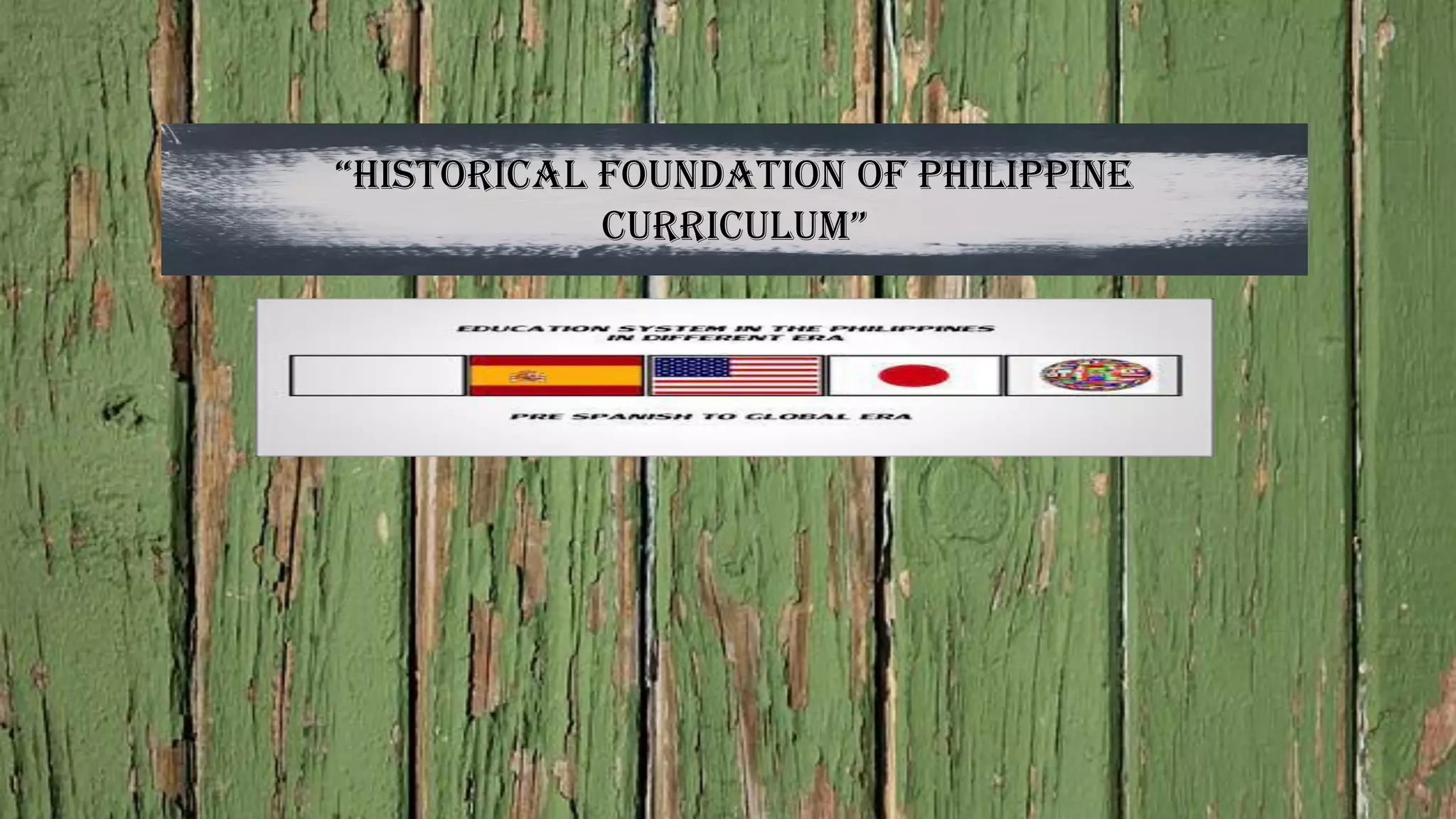
“Historical Foundation oF PHiliPPine
curriculum”
Curriculum Development
❑ A process of selecting, organizing, executing and
evaluating learning experiences on the basis of the needs, abilities,
and interests of learners and the nature of the society or
community.
❑ The motives of curriculum
development are Religious, Political, Utilitarian, for mass education and
for excellence in
education.
Pre-Hispanic Period
❑ Filipinos had no formal schools.
❑ Education was oral, practical and hands-on
❑ The objective of education during this period was
to prepare children to become good husbands
and wives as well as to become productive
members of the community.
Spanish Period
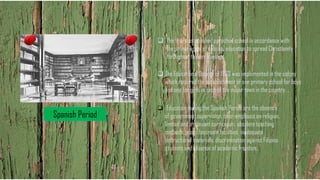
❑ The friars established parochial school in accordance with
the primary goal of colonial education to spread Christianity
throughout the archipelago.
❑ The Educational Decree of 1863 was implemented in the colony
which required the establishment of one primary school for boys
and one for girls in each of the major town in the country.
❑ Education during the Spanish Period are the absence
of government supervision, over-emphasis on religion,
limited and irrelevant curriculum, obsolete teaching
methods, poor classroom facilities, inadequate
instructional materials, discrimination against Filipino
students and absence of academic freedom.
American Period
❑ The education was used as an instrument to pacify the natives and
eventually colonizing the island.
❑ Taft Commission Act No. 74 established the Philippine public-school
system for free education and teacher training.
❑ On August 23, 1901, the first group of American Teachers arrived in
Manila through the Thomas ship. The Thomasites are one of the
first American teachers beside the American soldiers The Filipinos
learned to speak English and appreciate the American way of life.
❑ University of the Philippines was created in 1908 by the Act
No. 1870 by the Philippine Commission and the Philippine
Assembly. T
❑ The establishment of higher education institution (HEI)
was also encouraged. Promising Filipinos were given
the opportunity by the American government to pursue
higher education degrees in the United States.
❑ President Quezon created the National Council of
Education in 1936 as an advisory body on educational
matters. Its first chairman was Dr. Rafael Palma.
❑ In the 1983, the National Assembly enacted a law
providing for the establishment of national
vocational schools in different parts of the country.
❑ The Adult Education in 1936 started the adult
education in 1936. The National Language was a made
a compulsory subject in all schools in the beginning
of school year 1940-1941.
❑ President Quezon issued his famous Code of
Ethics which was required to be taught in all
schools.
❑ Educational Act of 1940 reduced the elementary
levels from 7 years to 6 years. The minimum age
for Grade 1 was raised to 7. School starts from
July to April.
Japanese Period
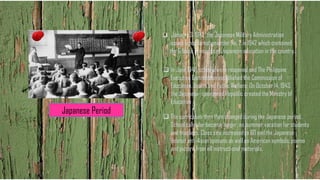
❑ January 3, 1942, the Japanese Military Administration
issued a proclamation order No. 2 in 1942 which contained
the 6 basic principles of Japanese education in the country.
❑ In June 1942, schools were reopened and The Philippine
Executive Commission established the Commission of
Education, Health and Public Welfare. On October 14, 1943,
the Japanese- sponsored Republic created the Ministry of
Education
❑ The curriculum then then changed during the Japanese period.
School calendar became longer, no summer vacation for students
and teachers. Class size increased to 60 and the Japanese
deleted anti-Asian opinions as well as American symbols, poems
and picture from all instructional materials.
❑ They banned the singing of American songs and
Nihongo was used as means of introducing and
cultivating love for Japanese culture. Department of
Instruction became Department of Education
❑ Regulation and supervision of public and private
schools belonged to the Bureau of Public and
Private Schools. Integrated, nationalistic and
democracy-inspired educational system.
❑ The objectives of Japanese Occupation were: to inculcate moral and
spiritual values inspired by an abiding faith in God; develop an
enlightened, patriotic, useful and upright citizenry in a democratic
society; conservation of the national resources, perpetuation of our
desirable values; and promote the science, arts and letters for the
enrichment of life and the recognition of the dignity of the human
person.
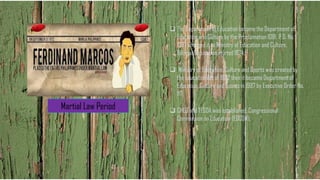
Martial Law Period
❑ The Department of Education became the Department of
Education and Culture by the Proclamation 1081. P.D. No.
1397 changed it to Ministry of Education and Culture.
Bilingual education started 1974.
❑ Ministry of Education, Culture and Sports was created by
the Education Act of 1982 then it became Department of
Education, Culture and Sports in 1987 by Executive Order No.
117.
❑ CHED and TESDA was established. Congressional
Commission on Education (EDCOM).
BEC in the Philippines
National Elementary School Curriculum (NESC) New
Secondary Education Curriculum (NSEC) Revised Basic
Education Curriculum (RBEC) Secondary Education
Curriculum (SEC 2010) K to 12 Basic Education Curriculum
❑ Republic Act 10533 also known as “Enhanced Basic Education
Act of 2013”, or the K to 12 Curriculum encompasses at least
one (1) year of kindergarten education, six (6) years of
elementary education and six (6) of secondary education, in
that sequence.
❑ Secondary education includes four (4) years of junior high school and
two (2) years of senior high school. The standards of the curriculum:
a. learner-centered b. relevant, responsive and research-based c.
culture-sensitive d. contextualized and global e. uses pedagogical
approaches that are constructivist, inquiry based, reflective,
collaborative, and integrative f. adheres to the principles and
framework of MTB-MLE g. uses spiral progression approach to ensure
mastery of knowledge and skills after each level h. flexible enough to
enable and allow schools to localize, indigenize and enhance the same
based on their respective educational and social contexts.
tHe end …
Raydin Abayon Sumalinog
Bsed-English 2
Educ7

Sumalinog raydin a. educ7 midterm_lp3

  • 1.
    “Historical Foundation oFPHiliPPine curriculum”
  • 2.
    Curriculum Development ❑ Aprocess of selecting, organizing, executing and evaluating learning experiences on the basis of the needs, abilities, and interests of learners and the nature of the society or community. ❑ The motives of curriculum development are Religious, Political, Utilitarian, for mass education and for excellence in education.
  • 3.
    Pre-Hispanic Period ❑ Filipinoshad no formal schools. ❑ Education was oral, practical and hands-on ❑ The objective of education during this period was to prepare children to become good husbands and wives as well as to become productive members of the community.
  • 4.
    Spanish Period ❑ Thefriars established parochial school in accordance with the primary goal of colonial education to spread Christianity throughout the archipelago. ❑ The Educational Decree of 1863 was implemented in the colony which required the establishment of one primary school for boys and one for girls in each of the major town in the country. ❑ Education during the Spanish Period are the absence of government supervision, over-emphasis on religion, limited and irrelevant curriculum, obsolete teaching methods, poor classroom facilities, inadequate instructional materials, discrimination against Filipino students and absence of academic freedom.
  • 5.
    American Period ❑ Theeducation was used as an instrument to pacify the natives and eventually colonizing the island. ❑ Taft Commission Act No. 74 established the Philippine public-school system for free education and teacher training. ❑ On August 23, 1901, the first group of American Teachers arrived in Manila through the Thomas ship. The Thomasites are one of the first American teachers beside the American soldiers The Filipinos learned to speak English and appreciate the American way of life. ❑ University of the Philippines was created in 1908 by the Act No. 1870 by the Philippine Commission and the Philippine Assembly. T
  • 6.
    ❑ The establishmentof higher education institution (HEI) was also encouraged. Promising Filipinos were given the opportunity by the American government to pursue higher education degrees in the United States. ❑ President Quezon created the National Council of Education in 1936 as an advisory body on educational matters. Its first chairman was Dr. Rafael Palma. ❑ In the 1983, the National Assembly enacted a law providing for the establishment of national vocational schools in different parts of the country. ❑ The Adult Education in 1936 started the adult education in 1936. The National Language was a made a compulsory subject in all schools in the beginning of school year 1940-1941. ❑ President Quezon issued his famous Code of Ethics which was required to be taught in all schools. ❑ Educational Act of 1940 reduced the elementary levels from 7 years to 6 years. The minimum age for Grade 1 was raised to 7. School starts from July to April.
  • 7.
    Japanese Period ❑ January3, 1942, the Japanese Military Administration issued a proclamation order No. 2 in 1942 which contained the 6 basic principles of Japanese education in the country. ❑ In June 1942, schools were reopened and The Philippine Executive Commission established the Commission of Education, Health and Public Welfare. On October 14, 1943, the Japanese- sponsored Republic created the Ministry of Education ❑ The curriculum then then changed during the Japanese period. School calendar became longer, no summer vacation for students and teachers. Class size increased to 60 and the Japanese deleted anti-Asian opinions as well as American symbols, poems and picture from all instructional materials.
  • 8.
    ❑ They bannedthe singing of American songs and Nihongo was used as means of introducing and cultivating love for Japanese culture. Department of Instruction became Department of Education ❑ Regulation and supervision of public and private schools belonged to the Bureau of Public and Private Schools. Integrated, nationalistic and democracy-inspired educational system. ❑ The objectives of Japanese Occupation were: to inculcate moral and spiritual values inspired by an abiding faith in God; develop an enlightened, patriotic, useful and upright citizenry in a democratic society; conservation of the national resources, perpetuation of our desirable values; and promote the science, arts and letters for the enrichment of life and the recognition of the dignity of the human person.
  • 9.
    Martial Law Period ❑The Department of Education became the Department of Education and Culture by the Proclamation 1081. P.D. No. 1397 changed it to Ministry of Education and Culture. Bilingual education started 1974. ❑ Ministry of Education, Culture and Sports was created by the Education Act of 1982 then it became Department of Education, Culture and Sports in 1987 by Executive Order No. 117. ❑ CHED and TESDA was established. Congressional Commission on Education (EDCOM).
  • 10.
    BEC in thePhilippines National Elementary School Curriculum (NESC) New Secondary Education Curriculum (NSEC) Revised Basic Education Curriculum (RBEC) Secondary Education Curriculum (SEC 2010) K to 12 Basic Education Curriculum ❑ Republic Act 10533 also known as “Enhanced Basic Education Act of 2013”, or the K to 12 Curriculum encompasses at least one (1) year of kindergarten education, six (6) years of elementary education and six (6) of secondary education, in that sequence. ❑ Secondary education includes four (4) years of junior high school and two (2) years of senior high school. The standards of the curriculum: a. learner-centered b. relevant, responsive and research-based c. culture-sensitive d. contextualized and global e. uses pedagogical approaches that are constructivist, inquiry based, reflective, collaborative, and integrative f. adheres to the principles and framework of MTB-MLE g. uses spiral progression approach to ensure mastery of knowledge and skills after each level h. flexible enough to enable and allow schools to localize, indigenize and enhance the same based on their respective educational and social contexts.
  • 11.
    tHe end … RaydinAbayon Sumalinog Bsed-English 2 Educ7