The document provides a comprehensive overview of the management processes involved in surgical patient care. It outlines the essential goals, clinical diagnostic processes, and treatment modalities, detailing the roles of physicians and the significance of rapport with patients. Additionally, it covers preoperative, intraoperative, postoperative care, and the criteria for selecting and interpreting paraclinical diagnostic procedures.
![Management of a Surgical Patient
[Process]
Reynaldo O. Joson, MD, MS Surg
1998; 2001; 2003; 2004](https://image.slidesharecdn.com/mgtpt04rj14apr17-140420111015-phpapp01/85/Management-of-a-Surgical-Patient-Process-1-320.jpg)
![Management of a Surgical Patient
[Process]
Reynaldo O. Joson, MD, MS Surg
1998; 2001; 2003; 2004](https://image.slidesharecdn.com/mgtpt04rj14apr17-140420111015-phpapp01/75/Management-of-a-Surgical-Patient-Process-1-2048.jpg)
![Management of a Surgical Patient [Process]
Introduction](https://image.slidesharecdn.com/mgtpt04rj14apr17-140420111015-phpapp01/85/Management-of-a-Surgical-Patient-Process-2-320.jpg)
![Management of a Surgical Patient [Process]
Introduction
Practice of medicine - essentially management of a patient,
a person with a health problem
Surgical patient - person with a surgical disorder
Surgical disorder - health problem or condition that
is treated by surgery or an operation
Nonsurgical patient - one with a nonsurgical
disorder](https://image.slidesharecdn.com/mgtpt04rj14apr17-140420111015-phpapp01/85/Management-of-a-Surgical-Patient-Process-3-320.jpg)
![Management of a Surgical Patient [Process]
Introduction
Regardless of type of patient or disorder, whether surgical
or nonsurgical,
basic processes in the management are essentially
similar
Only difference lies in the specific treatment
modality and procedure employed,
whether surgical or nonsurgical means](https://image.slidesharecdn.com/mgtpt04rj14apr17-140420111015-phpapp01/85/Management-of-a-Surgical-Patient-Process-4-320.jpg)
![Management of a Surgical Patient [Process]
Introduction
All primary health care physicians are expected at least to
know the basic processes in the management of a
surgical patient.
This learning session gives an overview of the processes
involved in the management of a surgical patient.](https://image.slidesharecdn.com/mgtpt04rj14apr17-140420111015-phpapp01/85/Management-of-a-Surgical-Patient-Process-5-320.jpg)
![Management of a Surgical Patient [Process]
Learning Objectives](https://image.slidesharecdn.com/mgtpt04rj14apr17-140420111015-phpapp01/85/Management-of-a-Surgical-Patient-Process-6-320.jpg)
![Management of a Surgical Patient [Process]
Learning Objectives
1. State the overall goals in the management of a patient
(whether surgical or not).
2. Enumerate the four functions of a physician in the
management of a patient (whether surgical or not).
3. Describe the clinical diagnostic process.
4. Describe how to determine the indication for a
paraclinical diagnostic procedure.
5. Describe how a paraclinical diagnostic procedure should
be selected among several options.](https://image.slidesharecdn.com/mgtpt04rj14apr17-140420111015-phpapp01/85/Management-of-a-Surgical-Patient-Process-7-320.jpg)
![Management of a Surgical Patient [Process]
Learning Objectives
6. Describe how to interpret results of a paraclinical
diagnostic procedure to come out with a
pretreatment diagnosis.
7. Describe how a treatment modality should be selected
among several options.
8. Enumerate at least 4 essential items in the preoperative
preparation of a surgical patient.
9. Enumerate in correct chronological order 7 phases in
the intraoperative management starting from the
incision to wound closure.](https://image.slidesharecdn.com/mgtpt04rj14apr17-140420111015-phpapp01/85/Management-of-a-Surgical-Patient-Process-8-320.jpg)
![Management of a Surgical Patient [Process]
Learning Objectives
10. Enumerate at least 4 items in the immediate
postoperative care of a surgical patient.
11. Enumerate the two objectives of a follow-up plan after
treatment of a patient (whether surgical or not).
12. Describe how to advice patients on clinical diagnosis,
paraclinical diagnostic procedures, treatment,
follow-up, and health promotion and maintenance.
13. Describe when and to whom to refer.](https://image.slidesharecdn.com/mgtpt04rj14apr17-140420111015-phpapp01/85/Management-of-a-Surgical-Patient-Process-9-320.jpg)
![Management of a Surgical Patient
[Process]
Reynaldo O. Joson, MD, MS Surg
2004
Self-Instructional Program
http://edhedephi.tripod.com RJoson’s Writings](https://image.slidesharecdn.com/mgtpt04rj14apr17-140420111015-phpapp01/85/Management-of-a-Surgical-Patient-Process-10-320.jpg)
![Facilitator’s
Approach to
Learning Session
Management of a Surgical Patient [Process]](https://image.slidesharecdn.com/mgtpt04rj14apr17-140420111015-phpapp01/85/Management-of-a-Surgical-Patient-Process-11-320.jpg)
![Management of a Surgical Patient [Process]
• I have decided to approach the topic by first presenting
the steps in the management of a surgical patient in
outline form.
Facilitator’s Approach to Learning Session
• Then, I will present some simulated patients or exercises
to expound on the process.](https://image.slidesharecdn.com/mgtpt04rj14apr17-140420111015-phpapp01/85/Management-of-a-Surgical-Patient-Process-12-320.jpg)
![Management of a Surgical Patient [Process]
Goals](https://image.slidesharecdn.com/mgtpt04rj14apr17-140420111015-phpapp01/85/Management-of-a-Surgical-Patient-Process-13-320.jpg)
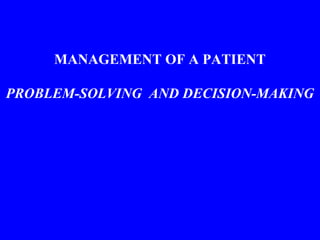
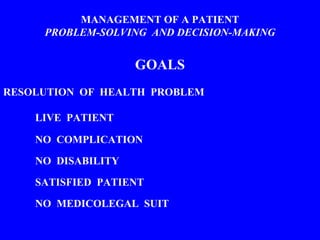
![Management of a Surgical Patient [Process]
MD’s Tasks](https://image.slidesharecdn.com/mgtpt04rj14apr17-140420111015-phpapp01/85/Management-of-a-Surgical-Patient-Process-16-320.jpg)
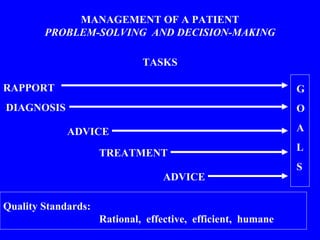
![Management of a Surgical Patient [Process]
Rapport](https://image.slidesharecdn.com/mgtpt04rj14apr17-140420111015-phpapp01/85/Management-of-a-Surgical-Patient-Process-18-320.jpg)
![Management of a Surgical Patient [Process]
Rapport
Establishing rapport with the patient and his/her relatives
- best strategy for obtaining satisfaction from
patient and his/her relative
- strongest strategy in the prevention of
medicolegal suit in case of errors of
commission and omission](https://image.slidesharecdn.com/mgtpt04rj14apr17-140420111015-phpapp01/85/Management-of-a-Surgical-Patient-Process-19-320.jpg)
![Management of a Surgical Patient [Process]
Rapport
Some ways of establishing rapport with patient and his/her
relatives:
1. Being courteous
2. Showing respect to person and beliefs
3. Giving honest and clear advice on diagnosis,
paraclinical diagnostic procedures,
and treatment
4. Demonstrating humaneness and compassion](https://image.slidesharecdn.com/mgtpt04rj14apr17-140420111015-phpapp01/85/Management-of-a-Surgical-Patient-Process-20-320.jpg)
![Management of a Surgical Patient [Process]
Rapport
Some ways of establishing rapport with patient and his/her
relatives:
5. Being gentle in words and deeds (physical
examination, procedure)
6. Showing the patient and relatives that you are
trying your very best
7. Being helpful when it comes to medical expenses
8. Making the patient and relatives feel that you are
approachable and easy to talk to](https://image.slidesharecdn.com/mgtpt04rj14apr17-140420111015-phpapp01/85/Management-of-a-Surgical-Patient-Process-21-320.jpg)
![Management of a Surgical Patient [Process]
Learning Objectives
1. State the overall goals in the management of a patient
(whether surgical or not).
2. Enumerate the four functions of a physician in the
management of a patient (whether surgical or not).](https://image.slidesharecdn.com/mgtpt04rj14apr17-140420111015-phpapp01/85/Management-of-a-Surgical-Patient-Process-22-320.jpg)
![Management of a Surgical Patient [Process]
Clinical Diagnostic
Process](https://image.slidesharecdn.com/mgtpt04rj14apr17-140420111015-phpapp01/85/Management-of-a-Surgical-Patient-Process-23-320.jpg)
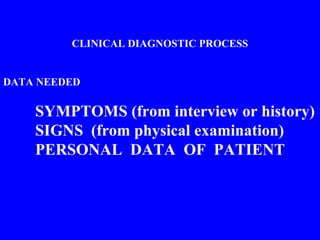
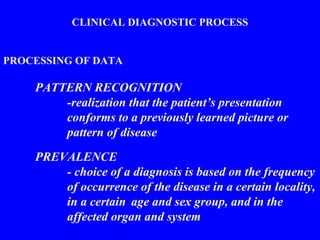
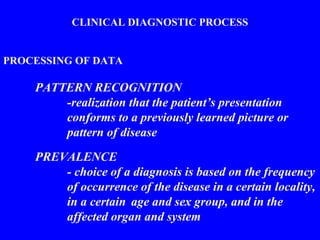
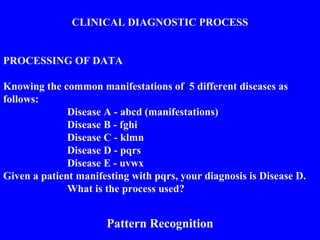
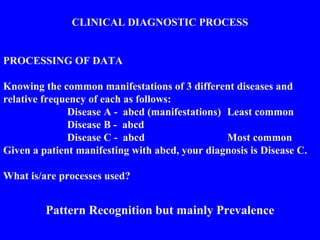
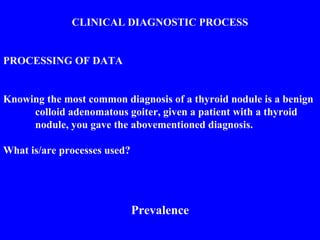
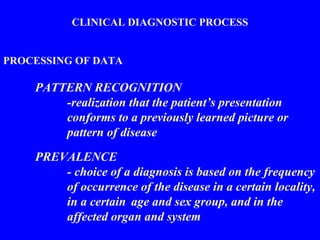
![Management of a Surgical Patient [Process]
Clinical Diagnostic Process
Diagnosis - label or nature of the health problem
Clinical Diagnosis - diagnosis derived from interview
(history) and physical examination
Clinical Diagnostic Process - processing of data from
interview and physical examination to arrive to a
diagnosis](https://image.slidesharecdn.com/mgtpt04rj14apr17-140420111015-phpapp01/85/Management-of-a-Surgical-Patient-Process-24-320.jpg)
![Management of a Surgical Patient [Process]
Paraclinical
Diagnostic Process](https://image.slidesharecdn.com/mgtpt04rj14apr17-140420111015-phpapp01/85/Management-of-a-Surgical-Patient-Process-33-320.jpg)
![Management of a Surgical Patient [Process]
Paraclinical Diagnostic Process
Indication - to be more definite on the clinical diagnosis
Selection
Interpretation](https://image.slidesharecdn.com/mgtpt04rj14apr17-140420111015-phpapp01/85/Management-of-a-Surgical-Patient-Process-34-320.jpg)
![Management of a Surgical Patient [Process]
Paraclinical Diagnostic Process - Indication
DATA NEEDED
PRIMARY CLINICAL DIAGNOSIS
SECONDARY CLINICAL DIAGNOSIS](https://image.slidesharecdn.com/mgtpt04rj14apr17-140420111015-phpapp01/85/Management-of-a-Surgical-Patient-Process-35-320.jpg)
![Management of a Surgical Patient [Process]
Paraclinical Diagnostic Process - Indication
PROCESSING OF DATA
CERTAINTY OF CLINICAL Dx
1O
Dx 60% 99%
needed not needed
TREATMENT PLAN FOR 1O
& 2O
Dx
Different Same
needed not needed](https://image.slidesharecdn.com/mgtpt04rj14apr17-140420111015-phpapp01/85/Management-of-a-Surgical-Patient-Process-36-320.jpg)
![Management of a Surgical Patient [Process]
Paraclinical Diagnostic Process - Indication
OUTPUT EXPECTED
DIAGNOSTIC PROCEDURE
NEEDED or
NOT NEEDED](https://image.slidesharecdn.com/mgtpt04rj14apr17-140420111015-phpapp01/85/Management-of-a-Surgical-Patient-Process-37-320.jpg)
![Management of a Surgical Patient [Process]
Paraclinical Diagnostic Process - Indication
Certainty Plan of Treatment
Primary clinical diagnosis 98% Surgical
Secondary clinical diagnosis 1-2% Nonsurgical
Is a paraclinical diagnostic procedure needed?
NO unless there is a strong reason to do so (exception to
the rule)](https://image.slidesharecdn.com/mgtpt04rj14apr17-140420111015-phpapp01/85/Management-of-a-Surgical-Patient-Process-38-320.jpg)
![Management of a Surgical Patient [Process]
Paraclinical Diagnostic Process - Indication
Certainty Plan of Treatment
Primary clinical diagnosis 60% Surgical
Secondary clinical diagnosis 40% Nonsurgical
Is a paraclinical diagnostic procedure needed?
YES](https://image.slidesharecdn.com/mgtpt04rj14apr17-140420111015-phpapp01/85/Management-of-a-Surgical-Patient-Process-39-320.jpg)
![Management of a Surgical Patient [Process]
Paraclinical Diagnostic Process - Indication
Certainty Plan of Treatment
Primary clinical diagnosis 60%Surgical Excision
Secondary clinical diagnosis 40%Surgical Excision
Is a paraclinical diagnostic procedure needed?
NO unless there is a strong reason to do so (exception to
the rule)](https://image.slidesharecdn.com/mgtpt04rj14apr17-140420111015-phpapp01/85/Management-of-a-Surgical-Patient-Process-40-320.jpg)
![Management of a Surgical Patient [Process]
Paraclinical Diagnostic Process - Indication
Certainty Plan of Treatment
Primary clinical diagnosis 90% Mutilating Op
Secondary clinical diagnosis 10%
Nonmutilating Op
Is a paraclinical diagnostic procedure needed?
YES unless there is a strong reason NOTto do so
(exception to the rule)](https://image.slidesharecdn.com/mgtpt04rj14apr17-140420111015-phpapp01/85/Management-of-a-Surgical-Patient-Process-41-320.jpg)
![Management of a Surgical Patient [Process]
Paraclinical Diagnostic Process - Indication
Certainty Plan of Treatment
Primary clinical diagnosis 70% Chemotherapy
Secondary clinical diagnosis 30%
Radiotherapy
Is a paraclinical diagnostic procedure needed?
YES unless there is a strong reason NOTto do so
(exception to the rule)](https://image.slidesharecdn.com/mgtpt04rj14apr17-140420111015-phpapp01/85/Management-of-a-Surgical-Patient-Process-42-320.jpg)
![Management of a Surgical Patient [Process]
Paraclinical Diagnostic Process - Indication
Tickler -
Which of the following statements is the strongest indication for a
paraclinical diagnostic procedure?
A. You can never be absolutely certain of your clinical diagnosis
B. You want to confirm a clinical diagnosis which are certain of
C. You want to document a clinical diagnosis which you are certain
of
D. When you are not certain of your clinical diagnosis
Best Answer is D](https://image.slidesharecdn.com/mgtpt04rj14apr17-140420111015-phpapp01/85/Management-of-a-Surgical-Patient-Process-43-320.jpg)
![Management of a Surgical Patient [Process]
Paraclinical Diagnostic Process - Selection
DATA NEEDED
OPTIONS OF
DIAGNOSTIC PROCEDURES](https://image.slidesharecdn.com/mgtpt04rj14apr17-140420111015-phpapp01/85/Management-of-a-Surgical-Patient-Process-44-320.jpg)
![Management of a Surgical Patient [Process]
Paraclinical Diagnostic Process - Selection
SELECTION PROCESS
Options Benefit Risk Cost Availability
1
2
3](https://image.slidesharecdn.com/mgtpt04rj14apr17-140420111015-phpapp01/85/Management-of-a-Surgical-Patient-Process-45-320.jpg)
![Management of a Surgical Patient [Process]
Paraclinical Diagnostic Process - Selection
OUTPUT EXPECTED
MOST COST-EFFECTIVE
DIAGNOSTIC PROCEDURE](https://image.slidesharecdn.com/mgtpt04rj14apr17-140420111015-phpapp01/85/Management-of-a-Surgical-Patient-Process-46-320.jpg)
![Management of a Surgical Patient [Process]
Paraclinical Diagnostic Process - Selection
SELECTION PROCESS
Procedure Benefit Risk Cost (PhP) Availability
Options
1 most direct acceptable 1000 available
2 indirect acceptable 1500 available
3 indirect acceptable 1000 available
Which is the most cost-effective procedure?
Option 1](https://image.slidesharecdn.com/mgtpt04rj14apr17-140420111015-phpapp01/85/Management-of-a-Surgical-Patient-Process-47-320.jpg)
![Management of a Surgical Patient [Process]
Paraclinical Diagnostic Process - Selection
SELECTION PROCESS
Procedure Benefit Risk Cost (PhP) Availability
Options
1 accuracy 99% acceptable 5000 available
2 accuracy 90% acceptable 3000 available
3 accuracy 50% acceptable 1000 available
Which is the most cost-effective procedure?
Option 2 or Option 1?](https://image.slidesharecdn.com/mgtpt04rj14apr17-140420111015-phpapp01/85/Management-of-a-Surgical-Patient-Process-48-320.jpg)
![Management of a Surgical Patient [Process]
Paraclinical Diagnostic Process - Selection
SELECTION PROCESS
Procedure Benefit Risk Cost (PhP) Availability
Options
1 accuracy 95% acceptable 5000 available
2 accuracy 90% acceptable 3000 available
3 accuracy 50% acceptable 1000 available
Which is the most cost-effective procedure?
Option 2 or Option 1?](https://image.slidesharecdn.com/mgtpt04rj14apr17-140420111015-phpapp01/85/Management-of-a-Surgical-Patient-Process-49-320.jpg)
![Management of a Surgical Patient [Process]
Paraclinical Diagnostic Process - Selection
SELECTION PROCESS
Procedure Benefit Risk Cost (PhP) Availability
Options
1 yield greatest acceptable 4000 available
2 yield 90% acceptable 4000 available
3 yield 80% acceptable 3000 available
Which is the most cost-effective procedure?
Option 1](https://image.slidesharecdn.com/mgtpt04rj14apr17-140420111015-phpapp01/85/Management-of-a-Surgical-Patient-Process-50-320.jpg)
![Management of a Surgical Patient [Process]
Paraclinical Diagnostic Process - Interpretation
DATA NEEDED
PRIMARY CLINICAL DIAGNOSIS
SECONDARY CLINICAL DIAGNOSIS
RESULT OF PARACLINICAL
DIAGNOSTIC PROCEDURE](https://image.slidesharecdn.com/mgtpt04rj14apr17-140420111015-phpapp01/85/Management-of-a-Surgical-Patient-Process-51-320.jpg)
![Management of a Surgical Patient [Process]
Paraclinical Diagnostic Process - Interpretation
INTERPRETATION PROCESS
CORRELATE
RESULT OF PARACLINICAL DIAGNOSTIC PROCEDURE
WITH
PRIMARY AND SECONDARY CLINICAL DIAGNOSIS
CONGRUENT - ACCEPT
INCONGRUENT - MAKE A DECISION!
(Accept or Hold!)](https://image.slidesharecdn.com/mgtpt04rj14apr17-140420111015-phpapp01/85/Management-of-a-Surgical-Patient-Process-52-320.jpg)
![Management of a Surgical Patient [Process]
Paraclinical Diagnostic Process - Interpretation
Tickler -
Determine which paraclinical diagnosis should be accepted as the
pretreatment diagnosis and which one should be put on hold for further
decision-making. Write (A) for accept and (H) for hold.
7.1 Paraclinical diagnosis is the same as the primary clinical
diagnosis.
7.2 Paraclinical diagnosis is the same as the secondary clinical
diagnosis
7.3 Paraclinical diagnosis is a clinical diagnosis least considered.
7.4 Paraclinical diagnosis does not jibe with the clinical picture or
diagnosis.
7.1 A 7.2 A 7.3 H 7.4 H](https://image.slidesharecdn.com/mgtpt04rj14apr17-140420111015-phpapp01/85/Management-of-a-Surgical-Patient-Process-53-320.jpg)
![Management of a Surgical Patient [Process]
Learning Objectives
3. Describe the clinical diagnostic process.
4. Describe how to determine the indication for a
paraclinical diagnostic procedure.
5. Describe how a paraclinical diagnostic procedure should
be selected among several options.
6. Describe how to interpret results of a paraclinical
diagnostic procedure to come out with a
pretreatment diagnosis.](https://image.slidesharecdn.com/mgtpt04rj14apr17-140420111015-phpapp01/85/Management-of-a-Surgical-Patient-Process-54-320.jpg)
![Management of a Surgical Patient [Process]
Learning Objectives
7. Describe how a treatment modality should be selected
among several options.
8. Enumerate at least 4 essential items in the preoperative
preparation of a surgical patient.
9. Enumerate in correct chronological order 7 phases in
the intraoperative management starting from the
incision to wound closure.](https://image.slidesharecdn.com/mgtpt04rj14apr17-140420111015-phpapp01/85/Management-of-a-Surgical-Patient-Process-55-320.jpg)
![Management of a Surgical Patient [Process]
Learning Objectives
10. Enumerate at least 4 items in the immediate
postoperative care of a surgical patient.
11. Enumerate the two objectives of a follow-up plan after
treatment of a patient (whether surgical or not).](https://image.slidesharecdn.com/mgtpt04rj14apr17-140420111015-phpapp01/85/Management-of-a-Surgical-Patient-Process-56-320.jpg)
![Management of a Surgical Patient [Process]
Treatment Process](https://image.slidesharecdn.com/mgtpt04rj14apr17-140420111015-phpapp01/85/Management-of-a-Surgical-Patient-Process-57-320.jpg)
![Management of a Surgical Patient [Process]
Treatment Process - Selection
DATA NEEDED
PRETREATMENT DIAGNOSIS
SEVERITY OR STAGE
GOALS AND OBJECTIVES
TREATMENT OPTIONS](https://image.slidesharecdn.com/mgtpt04rj14apr17-140420111015-phpapp01/85/Management-of-a-Surgical-Patient-Process-58-320.jpg)
![Management of a Surgical Patient [Process]
Treatment Process - Selection
SELECTION PROCESS
Options Benefit Risk Cost Availability
1
2
3](https://image.slidesharecdn.com/mgtpt04rj14apr17-140420111015-phpapp01/85/Management-of-a-Surgical-Patient-Process-59-320.jpg)
![Management of a Surgical Patient [Process]
Treatment Process - Selection
OUTPUT EXPECTED
MOST COST-EFFECTIVE
TREATMENT PROCEDURE
ACHIEVEMENT OF GOALS OF
PATIENT MANAGEMENT!](https://image.slidesharecdn.com/mgtpt04rj14apr17-140420111015-phpapp01/85/Management-of-a-Surgical-Patient-Process-60-320.jpg)
![Management of a Surgical Patient [Process]
Treatment Process - Selection
SELECTION PROCESS
Treatment Benefit Risk Cost (PhP) Availability
Options
1 greatest surv rate acceptable 5000 available
2 rate < 1 > 3 acceptable 4000 available
3 least surv rate acceptable 3000 available
Which is the most cost-effective treatment option?
Option 1](https://image.slidesharecdn.com/mgtpt04rj14apr17-140420111015-phpapp01/85/Management-of-a-Surgical-Patient-Process-61-320.jpg)
![Management of a Surgical Patient [Process]
Treatment Process - Selection
SELECTION PROCESS
Treatment Benefit Risk Cost (PhP) Availability
Options
1 SR1 = SR2 lesser 5000 available
2 SR2= SR1 more 5000 available
Which is the more cost-effective treatment option?
Option 1](https://image.slidesharecdn.com/mgtpt04rj14apr17-140420111015-phpapp01/85/Management-of-a-Surgical-Patient-Process-62-320.jpg)
![Management of a Surgical Patient [Process]
Treatment Process - Selection
SELECTION PROCESS
Treatment Benefit Risk Cost (PhP) Availability
Options
1 as effective as 2 acceptable 8000 available
2 as effective as 1 acceptable 4000 available
Which is the more cost-effective treatment option?
Option 2](https://image.slidesharecdn.com/mgtpt04rj14apr17-140420111015-phpapp01/85/Management-of-a-Surgical-Patient-Process-63-320.jpg)
![Management of a Surgical Patient [Process]
Treatment Process - Selection
SELECTION PROCESS
Treatment Benefit Risk Cost (PhP) Availability
Options
1 most effective acceptable 2000 available
2 effectivity <1 >3 acceptable 3000 available
3 least effective acceptable 4000 available
Which is the most cost-effective treatment option?
Option 1](https://image.slidesharecdn.com/mgtpt04rj14apr17-140420111015-phpapp01/85/Management-of-a-Surgical-Patient-Process-64-320.jpg)
![Management of a Surgical Patient [Process]
Surgical Treatment Process
PREOP PREPARATION](https://image.slidesharecdn.com/mgtpt04rj14apr17-140420111015-phpapp01/85/Management-of-a-Surgical-Patient-Process-65-320.jpg)
![Management of a Surgical Patient [Process]
Surgical Treatment Process - Preop Preparation
•INFORMED CONSENT
•PSYCHOSOCIAL SUPPORT
•OPTIMIZATION
•SCREENING
•OPERATIVE MATERIALS](https://image.slidesharecdn.com/mgtpt04rj14apr17-140420111015-phpapp01/85/Management-of-a-Surgical-Patient-Process-66-320.jpg)
![Management of a Surgical Patient [Process]
Surgical Treatment Process
INTRAOP
MANAGEMENT](https://image.slidesharecdn.com/mgtpt04rj14apr17-140420111015-phpapp01/85/Management-of-a-Surgical-Patient-Process-67-320.jpg)
![Management of a Surgical Patient [Process]
Surgical Treatment Process - Intraop Mgt
PHASES
•INCISION
•EXPOSURE
•INTRAOP EVALUATION
•OPERATIVE PROCEDURE PROPER
•HEMOSTASIS CHECK
•CORRECT COUNT
•WOUND CLOSURE](https://image.slidesharecdn.com/mgtpt04rj14apr17-140420111015-phpapp01/85/Management-of-a-Surgical-Patient-Process-68-320.jpg)
![Management of a Surgical Patient [Process]
Surgical Treatment Process - Intraop Mgt
Quality Standards:
GENTLE
METICULOUS and PRECISE
NO IATROGENIC INJURIES
NO UNNECESSARY MOVES
EVERY MOVE HAS A REASON!](https://image.slidesharecdn.com/mgtpt04rj14apr17-140420111015-phpapp01/85/Management-of-a-Surgical-Patient-Process-69-320.jpg)
![Management of a Surgical Patient [Process]
Surgical Treatment Process
POSTOP CARE](https://image.slidesharecdn.com/mgtpt04rj14apr17-140420111015-phpapp01/85/Management-of-a-Surgical-Patient-Process-70-320.jpg)
![Management of a Surgical Patient [Process]
Surgical Treatment Process - Postop Care
•SUPPLY BASIC NEEDS OF PATIENT
•COMFORT
•ANALGESICS
•FLUID AND ELECTROLYTES
•NUTRITION
•SUPPORT ORGAN FUNCTION
•WOUND CARE
•MONITORING FOR COMPLICATIONS
•ADVICE ON
•HOME CARE
•FOLLOW-UP PLAN](https://image.slidesharecdn.com/mgtpt04rj14apr17-140420111015-phpapp01/85/Management-of-a-Surgical-Patient-Process-71-320.jpg)
![Management of a Surgical Patient [Process]
Surgical Treatment Process
POSTOP FOLLOW-UP
PLAN](https://image.slidesharecdn.com/mgtpt04rj14apr17-140420111015-phpapp01/85/Management-of-a-Surgical-Patient-Process-72-320.jpg)
![Management of a Surgical Patient [Process]
Surgical Treatment Process - Postop Follow-up
Plan
OBJECTIVES:
•EVALUATE TREATMENT OUTCOME
•PROVIDE PSYCHOSOCIAL SUPPORT
MONITORING GUIDELINE:
PHYSICAL EXAMINATION
SYMPTOM-DIRECTED
INVESTIGATION](https://image.slidesharecdn.com/mgtpt04rj14apr17-140420111015-phpapp01/85/Management-of-a-Surgical-Patient-Process-73-320.jpg)
![Management of a Surgical Patient [Process]
Surgical Treatment Process - Postop Follow-up
Plan
FF-UP FREQUENCY GUIDELINES: CONSIDER
•USUAL COURSE OF DISEASE
•PERSONALITY OF PATIENT
•PATIENT’S CONVENIENCE](https://image.slidesharecdn.com/mgtpt04rj14apr17-140420111015-phpapp01/85/Management-of-a-Surgical-Patient-Process-74-320.jpg)
![Management of a Surgical Patient [Process]
Learning Objectives
7. Describe how a treatment modality should be selected
among several options.
8. Enumerate at least 4 essential items in the preoperative
preparation of a surgical patient.
9. Enumerate in correct chronological order 7 phases in
the intraoperative management starting from the
incision to wound closure.](https://image.slidesharecdn.com/mgtpt04rj14apr17-140420111015-phpapp01/85/Management-of-a-Surgical-Patient-Process-75-320.jpg)
![Management of a Surgical Patient [Process]
Learning Objectives
10. Enumerate at least 4 items in the immediate
postoperative care of a surgical patient.
11. Enumerate the two objectives of a follow-up plan after
treatment of a patient (whether surgical or not).](https://image.slidesharecdn.com/mgtpt04rj14apr17-140420111015-phpapp01/85/Management-of-a-Surgical-Patient-Process-76-320.jpg)
![Management of a Surgical Patient [Process]
Learning Objectives
12. Describe how to advice patients on clinical diagnosis,
paraclinical diagnostic procedures, treatment,
follow-up, and health promotion and maintenance.
13. Describe when and to whom to refer.](https://image.slidesharecdn.com/mgtpt04rj14apr17-140420111015-phpapp01/85/Management-of-a-Surgical-Patient-Process-77-320.jpg)
![Management of a Surgical Patient [Process]
HOW TO GIVE
ADVICES](https://image.slidesharecdn.com/mgtpt04rj14apr17-140420111015-phpapp01/85/Management-of-a-Surgical-Patient-Process-78-320.jpg)
![Management of a Surgical Patient [Process]
HOW TO GIVE ADVICES
1. Always include the relatives of the patient in the
advising, if they are available.
2. Assess the psychological make-up, the health beliefs, and
the level of competency of the patient and the
relatives before making any advice. Make strategies
that will promote rapport.
2.1 Be honest but not brutally frank.
Example, slowly divulge the diagnosis of an
incurable disease or a frightening disease.
2.2 Use terminologies or explanations that can be
easily understood by the patient and his
relatives.](https://image.slidesharecdn.com/mgtpt04rj14apr17-140420111015-phpapp01/85/Management-of-a-Surgical-Patient-Process-79-320.jpg)
![Management of a Surgical Patient [Process]
HOW TO GIVE ADVICES
3. Use all kinds of strategies that will make the patient and
his relatives like you.
4. Explain to the patient and relatives the processes you
use in arriving to a diagnosis, recommendation for a
paraclinical diagnostic procedures and treatment.](https://image.slidesharecdn.com/mgtpt04rj14apr17-140420111015-phpapp01/85/Management-of-a-Surgical-Patient-Process-80-320.jpg)
![Management of a Surgical Patient [Process]
REFERRAL
WHEN
TO WHOM](https://image.slidesharecdn.com/mgtpt04rj14apr17-140420111015-phpapp01/85/Management-of-a-Surgical-Patient-Process-81-320.jpg)
![Management of a Surgical Patient [Process]
Referral - When to Refer?
All physicians, both certified and not yet certified, must
know their limitations.
Only they themselves can determine their own limitations.
They must realize their limitations so that they do not
cause undue harm to their patients and so that they
know when to refer to colleagues.](https://image.slidesharecdn.com/mgtpt04rj14apr17-140420111015-phpapp01/85/Management-of-a-Surgical-Patient-Process-82-320.jpg)
![Management of a Surgical Patient [Process]
Referral - To Whom to Refer?
Referral must be made to somebody
who may or can solve the patient’s health
problem
rationally, effectively, efficiently, and
humanely, and
who has a good track record of handling
the kind of problem on hand.](https://image.slidesharecdn.com/mgtpt04rj14apr17-140420111015-phpapp01/85/Management-of-a-Surgical-Patient-Process-83-320.jpg)
![Management of a Surgical Patient [Process]
Learning Objectives](https://image.slidesharecdn.com/mgtpt04rj14apr17-140420111015-phpapp01/85/Management-of-a-Surgical-Patient-Process-84-320.jpg)
![Management of a Surgical Patient [Process]
Learning Objectives
1. State the overall goals in the management of a patient
(whether surgical or not).
2. Enumerate the four functions of a physician in the
management of a patient (whether surgical or not).
3. Describe the clinical diagnostic process.
4. Describe how to determine the indication for a
paraclinical diagnostic procedure.
5. Describe how a paraclinical diagnostic procedure should
be selected among several options.](https://image.slidesharecdn.com/mgtpt04rj14apr17-140420111015-phpapp01/85/Management-of-a-Surgical-Patient-Process-85-320.jpg)
![Management of a Surgical Patient [Process]
Learning Objectives
6. Describe how to interpret results of a paraclinical
diagnostic procedure to come out with a
pretreatment diagnosis.
7. Describe how a treatment modality should be selected
among several options.
8. Enumerate at least 4 essential items in the preoperative
preparation of a surgical patient.
9. Enumerate in correct chronological order 7 phases in
the intraoperative management starting from the
incision to wound closure.](https://image.slidesharecdn.com/mgtpt04rj14apr17-140420111015-phpapp01/85/Management-of-a-Surgical-Patient-Process-86-320.jpg)
![Management of a Surgical Patient [Process]
Learning Objectives
10. Enumerate at least 4 items in the immediate
postoperative care of a surgical patient.
11. Enumerate the two objectives of a follow-up plan after
treatment of a patient (whether surgical or not).
12. Describe how to advice patients on clinical diagnosis,
paraclinical diagnostic procedures, treatment,
follow-up, and health promotion and maintenance.
13. Describe when and to whom to refer.](https://image.slidesharecdn.com/mgtpt04rj14apr17-140420111015-phpapp01/85/Management-of-a-Surgical-Patient-Process-87-320.jpg)
![Management of a Surgical Patient [Process]
HOPE
u have enjoyed this
learning session!
Email me for any feedback and questions:
rjoson@maniladoctors.com.ph](https://image.slidesharecdn.com/mgtpt04rj14apr17-140420111015-phpapp01/85/Management-of-a-Surgical-Patient-Process-88-320.jpg)


![ONFH[AVN HIP] -TRIPLE REGIME -A NOVAL SURGICAL CONCEPT .pptx](https://cdn.slidesharecdn.com/ss_thumbnails/onfhavnhip2026koaconcalicutdrgokuldevdrmashraf-260210064517-213ec005-thumbnail.jpg?width=640&height=640&fit=bounds)


