Ab t l t t t ti i itAbout plant responses to vegetation proximity
Sobre les respostes de la planta a la proximitat d'altres vegetalsSobre les respostes de la planta a la proximitat d altres vegetals
Marçal Gallemí Rovira
J. F. Martínez García
July 2013
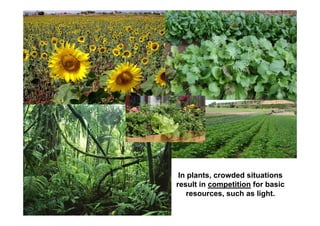
Crowded situations
represent a challenge forp g
individual living organisms.
In plants, crowded situations
result in competition for basic
resources, such as light.
The R:FR ratio informs about plant’s competition
l R FR
(ON)
high R:FR
low R:FR
(OFF)
high R:FR
Aft ti f l R FR ti b th h t h th h d idAfter perception of low R:FR ratio by the phytochromes, the shade avoidance
syndrome (SAS) gets activated, even before the plant is actually shaded.
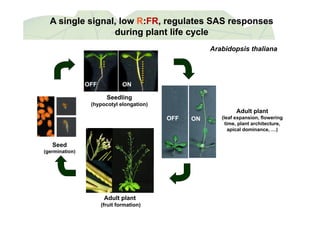
A single signal, lowA single signal, low RR::FRFR, regulates SAS responses, regulates SAS responses
during plant life cycleduring plant life cycleg p yg p y
Arabidopsis thaliana
ONOFF
Adult plant
Seedling
(hypocotyl elongation)
Adult plant
(leaf expansion, flowering
time, plant architecture,
apical dominance, …)
ONOFF
Seed
(germination)
Adult plant
(fruit formation)
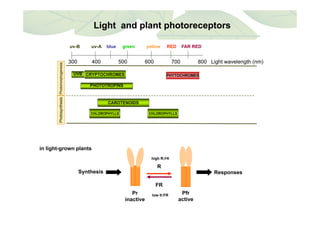
Light and plant photoreceptorsLight and plant photoreceptors
300 400 500 600 700 800 Light wavelength (nm)
uv-B uv-A blue green yellow RED FAR RED
300 400 500 600 700 800 Light wavelength (nm)
CRYPTOCHROMES
PHOTOTROPINS
PHYTOCHROMES
omorphogenesis
UVB
CAROTENOIDS
CHLOROPHYLLS
Photsynthesis
CHLOROPHYLLS CHLOROPHYLLS
Photo
CHLOROPHYLLS
in light-grown plants
high R:FR
ResponsesSynthesis
R
FR
Pr
inactive
low R:FR Pfr
active
Phytochromes are directly regulating gene expressionPhytochromes are directly regulating gene expression
hi h R
Phytochromes, in its active form, regulate the expression of primary (1ry) genes by binding to PIF
proteins.
high R:FR
PfrPr
IF
IF
Pfr
B
genes 2ry
nucleus
P
P
genes 1ry
B
cytoplasmcytoplasm
Phytochromes are directly regulating gene expressionPhytochromes are directly regulating gene expression
l FR
Focus on early transcriptional events after low R:FR perception to identify DIRECT target genes
of phytochrome action.
low R:FR
CHX
PfrPr
TFTF
nucleus
genes 2ry
Pfr
IF
IF
genes 1ry
cytoplasm
PAR genes
P
P
PHYB, ATHB4
cytoplasm
PAR (Phytochrome rApidly Regulated) genes[Roig-Villanova et al. (2006) Plant Physiol 141, 85-96]
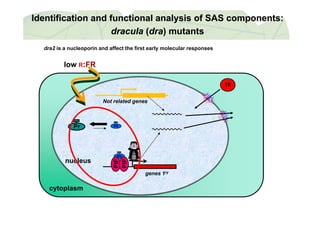
Identification and functional analysis of SAS components:Identification and functional analysis of SAS components:
draculadracula ((dradra) mutants) mutants
l FR
dra2 is a nucleoporin and affect the first early molecular responses
(( ))
low R:FR
TFTF
Not related genes
PfrPr
nucleus
Pfr
IF
IF
cytoplasm
P
P
genes 1ry
cytoplasm
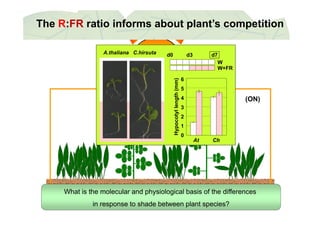
The R:FR ratio informs about plant’s competition
C.hirsutaA.thaliana d0 d3 d7
W
mm)
6
5
W
W+FR
low R:FR (ON)
yllength(m
3
4
5
At Ch
Hypocoty
0
1
2
At Ch
shade-AVOIDANCEshade-TOLERANT
Wh t i th l l d h i l i l b i f th diff(A. thaliana)(Cardamine hirsuta)What is the molecular and physiological basis of the differences
in response to shade between plant species?
Phytochromes are directly regulating gene expressionPhytochromes are directly regulating gene expression
l FR
Focus on early transcriptional events after low R:FR perception to identify DIRECT target genes
of phytochrome action.
low R:FR
CHX
PfrPr
TFTF
nucleus
genes 2ry
Pfr
IF
IF
genes 1ry
cytoplasm
PAR genes
P
P
PHYB, ATHB4
cytoplasm
PAR (Phytochrome rApidly Regulated) genes[Roig-Villanova et al. (2006) Plant Physiol 141, 85-96]
ATHB4 is aATHB4 is a HomeoHomeo--DomainDomain LeucineLeucine--Zipper (HDZipper (HD--Zip) transcription factorZip) transcription factor
athb4hat3Col-0
M. Salla-Martret
HD-Zip II
[Ariel et al. TRENDS in Plant Science (2007); Bou-Torrent J, Salla-Martret M et al. Plant Signal Behav. (2012)]
ATHB4 overexpresion presents a severe phenotype
Constitutive O/E O/E with inducible activity
ATHB435S ATHB4 GR35S
wt - DEX + DEX
wt
1 cm
wt
ATHB4-GR
homozygotes
ATHB4
O/E ATHB4 present strong dwarf phenotype and sterile adult plant.
We have to use an inducible line with the GR domainWe have to use an inducible line with the GR domain.
[Sorin et al. (2009) The Plant Journal 59(2):266-77]
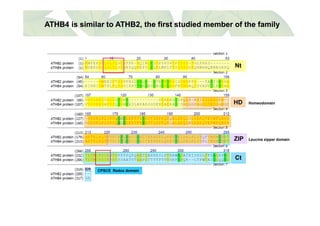
ATHB4 is similar to ATHB2, the first studied member of the familyATHB4 is similar to ATHB2, the first studied member of the family
Nt
HomeodomainHD
L i i d iZIP Leucine zipper domainZIP
Ct
CPSCE Redox domain
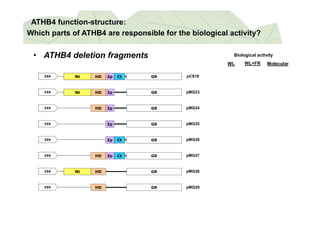
ATHB4 function-structure:
Which parts of ATHB4 are responsible for the biological activity?p p g y
• ATHB4 deletion fragments
WL FR
Biological activity
WL+FR MolecularWL
Nt HD Zp GRCt pCS1935S
Nt HD Zp GR pMG2335S
HD Zp GR pMG2435S
Zp GR pMG2535S
GR MG2635S Z C GR pMG2635S Zp Ct
HD GR pMG2735S Zp Ct
HD GR pMG2835S Nt
pMG29HD GR35S
Phenotype and response to DEX in WL
Nt HD Zp GRCt pCS1935S
GNt HD Zp GR pMG2335S
HD Zp GR pMG2435S
- DEX + DEX
pMG24
- DEX + DEX
pMG23 pMG24
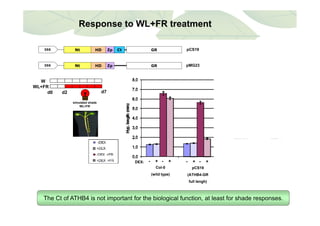
Response to WL+FR treatment
Nt HD Zp GRCt pCS1935S
W
WL+FR
Nt HD Zp GR pMG2335S
simulated shade
WL+FR
WL+FR
d0 d2 d7
- + - +- + - +- + - + - + - +DEX:
pMG23.2.5pMG23.1.4Col-0
(wild type)
pCS19
(ATHB4-GR
full lengh)
The Ct of ATHB4 is not important for the biological function, at least for shade responses.
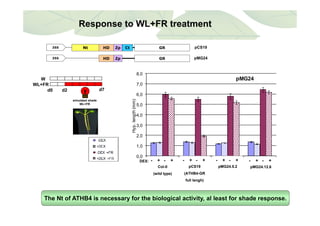
Response to WL+FR treatment
Nt HD Zp GRCt pCS1935S
HD Zp GR pMG2435S
7,0
8,0
pMG24W
WL+FR
5,0
6,0
th(mm)
simulated shade
WL+FR
d0 d2 d7
2,0
3,0
4,0
Hyp.lengt
0,0
1,0
Col-0 pCS19 pMG24.5.2 pMG24.12.6- + - + - + - + - + - +- + - +DEX:
Col-0
(wild type)
pCS19
(ATHB4-GR
full lengh)
pMG24.12.6pMG24.5.2
The Nt of ATHB4 is necessary for the biological activity, al least for shade response.
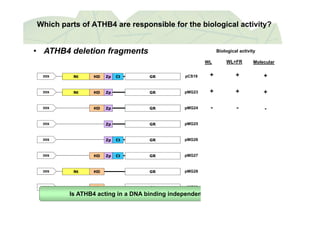
Which parts of ATHB4 are responsible for the biological activity?
• ATHB4 deletion fragments
WL+FR Molecular
Biological activity
WL
+ +
WL+FR MolecularWL
+Nt HD Zp GRCt pCS1935S
+
-
+
-
+
-
Nt HD Zp GR pMG2335S
HD Zp GR pMG2435S
- n.a.-Zp GR pMG2535S
GR MG2635S Z C -
-
-
-
-
-
GR pMG2635S Zp Ct
HD GR pMG2735S Zp Ct
+
-
+
n a
+
-
HD GR pMG2835S Nt
pMG29HD GR35S
- n.a.-
Is ATHB4 acting in a DNA binding independent manner?
Which parts of ATHB4 are responsible for the biological activity?
+
Biological activity• ATHB4 deletion fragments
WL+FRWL
+Nt HD Zp GRCt pCS1935S
+
-
+
-
Nt HD Zp GRCt pCS1935S
Nt HD Zp GR pMG2335S
HD Zp GR pMG2435S
-
-
-
-
Zp GR pMG2535S
GR pMG2635S Zp Ct
-
+
-
+HD GR pMG2835S Nt
HD GR pMG2735S Zp Ct
-
?
+
-
?
+
pMG29HD GR35S
Nt GR pMG6035S
MG37 +
-
-
+
-
-
Nt HD Zp GRCt pMG3735S
Nt HD Zp GRCt pMG3835S
Nt HD Zp GRCt pMG4335S -
-
-
-Nt HD Zp GRCt pMG4435S
Nt HD Zp GRCt pMG4335S
Is ATHB4 acting in a DNA binding independent manner?
AcknowledgementAcknowledgement
Jaime F. Martínez García
Christianne Then
Mercè Salla Martret
MªJosé Molina
Nicolás Cifuentes Esquivel
Mercè Salla Martret
Anahit Galstyan
Jordi Bou Torrent
Services of CRAGServices of CRAG.
Ministry of Education
and Science of Spain (FPI)
Thank you for your attention!

Dr. Marçal Gallemí. Unitat de Genètica Molecular Vegetal / About plant responses to vegetation proximity

  • 1.
    Ab t lt t t ti i itAbout plant responses to vegetation proximity Sobre les respostes de la planta a la proximitat d'altres vegetalsSobre les respostes de la planta a la proximitat d altres vegetals Marçal Gallemí Rovira J. F. Martínez García July 2013
  • 2.
    Crowded situations represent achallenge forp g individual living organisms.
  • 3.
    In plants, crowdedsituations result in competition for basic resources, such as light.
  • 4.
    The R:FR ratioinforms about plant’s competition l R FR (ON) high R:FR low R:FR (OFF) high R:FR Aft ti f l R FR ti b th h t h th h d idAfter perception of low R:FR ratio by the phytochromes, the shade avoidance syndrome (SAS) gets activated, even before the plant is actually shaded.
  • 5.
    A single signal,lowA single signal, low RR::FRFR, regulates SAS responses, regulates SAS responses during plant life cycleduring plant life cycleg p yg p y Arabidopsis thaliana ONOFF Adult plant Seedling (hypocotyl elongation) Adult plant (leaf expansion, flowering time, plant architecture, apical dominance, …) ONOFF Seed (germination) Adult plant (fruit formation)
  • 6.
    Light and plantphotoreceptorsLight and plant photoreceptors 300 400 500 600 700 800 Light wavelength (nm) uv-B uv-A blue green yellow RED FAR RED 300 400 500 600 700 800 Light wavelength (nm) CRYPTOCHROMES PHOTOTROPINS PHYTOCHROMES omorphogenesis UVB CAROTENOIDS CHLOROPHYLLS Photsynthesis CHLOROPHYLLS CHLOROPHYLLS Photo CHLOROPHYLLS in light-grown plants high R:FR ResponsesSynthesis R FR Pr inactive low R:FR Pfr active
  • 7.
    Phytochromes are directlyregulating gene expressionPhytochromes are directly regulating gene expression hi h R Phytochromes, in its active form, regulate the expression of primary (1ry) genes by binding to PIF proteins. high R:FR PfrPr IF IF Pfr B genes 2ry nucleus P P genes 1ry B cytoplasmcytoplasm
  • 8.
    Phytochromes are directlyregulating gene expressionPhytochromes are directly regulating gene expression l FR Focus on early transcriptional events after low R:FR perception to identify DIRECT target genes of phytochrome action. low R:FR CHX PfrPr TFTF nucleus genes 2ry Pfr IF IF genes 1ry cytoplasm PAR genes P P PHYB, ATHB4 cytoplasm PAR (Phytochrome rApidly Regulated) genes[Roig-Villanova et al. (2006) Plant Physiol 141, 85-96]
  • 9.
    Identification and functionalanalysis of SAS components:Identification and functional analysis of SAS components: draculadracula ((dradra) mutants) mutants l FR dra2 is a nucleoporin and affect the first early molecular responses (( )) low R:FR TFTF Not related genes PfrPr nucleus Pfr IF IF cytoplasm P P genes 1ry cytoplasm
  • 10.
    The R:FR ratioinforms about plant’s competition C.hirsutaA.thaliana d0 d3 d7 W mm) 6 5 W W+FR low R:FR (ON) yllength(m 3 4 5 At Ch Hypocoty 0 1 2 At Ch shade-AVOIDANCEshade-TOLERANT Wh t i th l l d h i l i l b i f th diff(A. thaliana)(Cardamine hirsuta)What is the molecular and physiological basis of the differences in response to shade between plant species?
  • 11.
    Phytochromes are directlyregulating gene expressionPhytochromes are directly regulating gene expression l FR Focus on early transcriptional events after low R:FR perception to identify DIRECT target genes of phytochrome action. low R:FR CHX PfrPr TFTF nucleus genes 2ry Pfr IF IF genes 1ry cytoplasm PAR genes P P PHYB, ATHB4 cytoplasm PAR (Phytochrome rApidly Regulated) genes[Roig-Villanova et al. (2006) Plant Physiol 141, 85-96]
  • 12.
    ATHB4 is aATHB4is a HomeoHomeo--DomainDomain LeucineLeucine--Zipper (HDZipper (HD--Zip) transcription factorZip) transcription factor athb4hat3Col-0 M. Salla-Martret HD-Zip II [Ariel et al. TRENDS in Plant Science (2007); Bou-Torrent J, Salla-Martret M et al. Plant Signal Behav. (2012)]
  • 13.
    ATHB4 overexpresion presentsa severe phenotype Constitutive O/E O/E with inducible activity ATHB435S ATHB4 GR35S wt - DEX + DEX wt 1 cm wt ATHB4-GR homozygotes ATHB4 O/E ATHB4 present strong dwarf phenotype and sterile adult plant. We have to use an inducible line with the GR domainWe have to use an inducible line with the GR domain. [Sorin et al. (2009) The Plant Journal 59(2):266-77]
  • 14.
    ATHB4 is similarto ATHB2, the first studied member of the familyATHB4 is similar to ATHB2, the first studied member of the family Nt HomeodomainHD L i i d iZIP Leucine zipper domainZIP Ct CPSCE Redox domain
  • 15.
    ATHB4 function-structure: Which partsof ATHB4 are responsible for the biological activity?p p g y • ATHB4 deletion fragments WL FR Biological activity WL+FR MolecularWL Nt HD Zp GRCt pCS1935S Nt HD Zp GR pMG2335S HD Zp GR pMG2435S Zp GR pMG2535S GR MG2635S Z C GR pMG2635S Zp Ct HD GR pMG2735S Zp Ct HD GR pMG2835S Nt pMG29HD GR35S
  • 16.
    Phenotype and responseto DEX in WL Nt HD Zp GRCt pCS1935S GNt HD Zp GR pMG2335S HD Zp GR pMG2435S - DEX + DEX pMG24 - DEX + DEX pMG23 pMG24
  • 17.
    Response to WL+FRtreatment Nt HD Zp GRCt pCS1935S W WL+FR Nt HD Zp GR pMG2335S simulated shade WL+FR WL+FR d0 d2 d7 - + - +- + - +- + - + - + - +DEX: pMG23.2.5pMG23.1.4Col-0 (wild type) pCS19 (ATHB4-GR full lengh) The Ct of ATHB4 is not important for the biological function, at least for shade responses.
  • 18.
    Response to WL+FRtreatment Nt HD Zp GRCt pCS1935S HD Zp GR pMG2435S 7,0 8,0 pMG24W WL+FR 5,0 6,0 th(mm) simulated shade WL+FR d0 d2 d7 2,0 3,0 4,0 Hyp.lengt 0,0 1,0 Col-0 pCS19 pMG24.5.2 pMG24.12.6- + - + - + - + - + - +- + - +DEX: Col-0 (wild type) pCS19 (ATHB4-GR full lengh) pMG24.12.6pMG24.5.2 The Nt of ATHB4 is necessary for the biological activity, al least for shade response.
  • 19.
    Which parts ofATHB4 are responsible for the biological activity? • ATHB4 deletion fragments WL+FR Molecular Biological activity WL + + WL+FR MolecularWL +Nt HD Zp GRCt pCS1935S + - + - + - Nt HD Zp GR pMG2335S HD Zp GR pMG2435S - n.a.-Zp GR pMG2535S GR MG2635S Z C - - - - - - GR pMG2635S Zp Ct HD GR pMG2735S Zp Ct + - + n a + - HD GR pMG2835S Nt pMG29HD GR35S - n.a.- Is ATHB4 acting in a DNA binding independent manner?
  • 20.
    Which parts ofATHB4 are responsible for the biological activity? + Biological activity• ATHB4 deletion fragments WL+FRWL +Nt HD Zp GRCt pCS1935S + - + - Nt HD Zp GRCt pCS1935S Nt HD Zp GR pMG2335S HD Zp GR pMG2435S - - - - Zp GR pMG2535S GR pMG2635S Zp Ct - + - +HD GR pMG2835S Nt HD GR pMG2735S Zp Ct - ? + - ? + pMG29HD GR35S Nt GR pMG6035S MG37 + - - + - - Nt HD Zp GRCt pMG3735S Nt HD Zp GRCt pMG3835S Nt HD Zp GRCt pMG4335S - - - -Nt HD Zp GRCt pMG4435S Nt HD Zp GRCt pMG4335S Is ATHB4 acting in a DNA binding independent manner?
  • 21.
    AcknowledgementAcknowledgement Jaime F. MartínezGarcía Christianne Then Mercè Salla Martret MªJosé Molina Nicolás Cifuentes Esquivel Mercè Salla Martret Anahit Galstyan Jordi Bou Torrent Services of CRAGServices of CRAG. Ministry of Education and Science of Spain (FPI) Thank you for your attention!