MANAGEMENT THEORIES
FREDRICK TAYLOR: SCIENTIFIC MGMT
Analysis and synthesis of workflow: economic
efficiency .
Principles:
1. Development of true science
2. Scientific selection of workmen, Scientific
education
3. Cooperation between MGMT and workers
4. Splitting work into equal shares, teamwork
HENRI FAYOL: 6 PRIMARY MGMT FUNCTIONS
1) Forecasting
 2) Planning
 3) Organizing
 4) Commanding
 5) Coordinating
 6) Controlling

MAX WEBER: BUREAUCRATIC MGMT
Divide the Organization into hierarchies
 Develop standard operating procedures
 Strong lines of authority and control

HAWTHORNE: HAWTHORNE EFFECT
A happy worker is a good worker
 People are not naturally rational or economic
beings (that’s what MGMT is for)
 Social interaction is key
 Experiments with breaks

DEMING: PROFOUND KNOWLEDGE
1) Appreciation: for the system and
interdependency
 2) Variation: change MGMT style based on
variables, workers, supplies, etc.
 3) Theory of Knowledge: evaluate the
process
 4) Psychology: understand your people

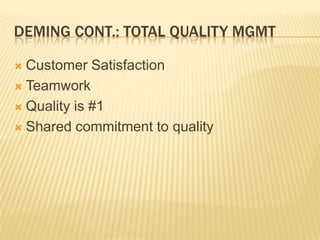
DEMING CONT.: TOTAL QUALITY MGMT
Customer Satisfaction
 Teamwork
 Quality is #1
 Shared commitment to quality

DOUGLASS MCGREGOR: THEORY X
Theory X: People are lazy, don’t want to work
 1) We dislike work
 2) We must be controlled or coerced into
working
 3) We prefer to be directed, we don’t want
responsibility

MCGREGOR: THEORY Y
Workers respond differently depending on how
MGMT interact with them
1) Avg human does not hate work and it is as
natural as play
2) People have self direction
3) Self actualization as motivation
4) Everyone seeks responsibility
5) Humans are creative and potential is only
partially realized
WILLIAM OUCHI: THEORY Z
Higher order of needs
 Lower-level needs: Employee’s well being
 Mid-level needs: incorporate the decision
making process
 High-level needs: encourage responsibility

PETER DRUCKER: MGMT BY OBJECTIVES
Setting goals
 Participative decision-making
 Implementing plans
 Performance feedback

SMITH: LAISSEZ FAIRE
Specialization of Labor (even though it
wastes a person’s mind)
 People are motivated by self interest and will
do what benefits them the most


Mgmt theory

  • 1.
  • 2.
    FREDRICK TAYLOR: SCIENTIFICMGMT Analysis and synthesis of workflow: economic efficiency . Principles: 1. Development of true science 2. Scientific selection of workmen, Scientific education 3. Cooperation between MGMT and workers 4. Splitting work into equal shares, teamwork
  • 3.
    HENRI FAYOL: 6PRIMARY MGMT FUNCTIONS 1) Forecasting  2) Planning  3) Organizing  4) Commanding  5) Coordinating  6) Controlling 
  • 4.
    MAX WEBER: BUREAUCRATICMGMT Divide the Organization into hierarchies  Develop standard operating procedures  Strong lines of authority and control 
  • 5.
    HAWTHORNE: HAWTHORNE EFFECT Ahappy worker is a good worker  People are not naturally rational or economic beings (that’s what MGMT is for)  Social interaction is key  Experiments with breaks 
  • 6.
    DEMING: PROFOUND KNOWLEDGE 1)Appreciation: for the system and interdependency  2) Variation: change MGMT style based on variables, workers, supplies, etc.  3) Theory of Knowledge: evaluate the process  4) Psychology: understand your people 
  • 7.
    DEMING CONT.: TOTALQUALITY MGMT Customer Satisfaction  Teamwork  Quality is #1  Shared commitment to quality 
  • 8.
    DOUGLASS MCGREGOR: THEORYX Theory X: People are lazy, don’t want to work  1) We dislike work  2) We must be controlled or coerced into working  3) We prefer to be directed, we don’t want responsibility 
  • 9.
    MCGREGOR: THEORY Y Workersrespond differently depending on how MGMT interact with them 1) Avg human does not hate work and it is as natural as play 2) People have self direction 3) Self actualization as motivation 4) Everyone seeks responsibility 5) Humans are creative and potential is only partially realized
  • 10.
    WILLIAM OUCHI: THEORYZ Higher order of needs  Lower-level needs: Employee’s well being  Mid-level needs: incorporate the decision making process  High-level needs: encourage responsibility 
  • 11.
    PETER DRUCKER: MGMTBY OBJECTIVES Setting goals  Participative decision-making  Implementing plans  Performance feedback 
  • 12.
    SMITH: LAISSEZ FAIRE Specializationof Labor (even though it wastes a person’s mind)  People are motivated by self interest and will do what benefits them the most 

Editor's Notes

  • #3 Develop the most efficient scientific way of completing the jobSelect the men based on competency and train them scientifically
  • #6 People respond well when they feel valued