BLAKE AND MOUTON’S MANAGERIAL
            GRID


                     By Maritza Koponen
HOW IT BEGAN…
 Built from the work of researchers at these University of Michigan
  and Ohio State University.
 Robert Blake and Jane Mouton (1960s) proposed a graphic
  portrayal of leadership styles through a managerial grid.
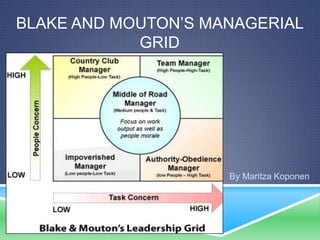
 The grid depicts two dimensions of leader behavior, concern for
  people on y-axis and concern for production on x-axis,
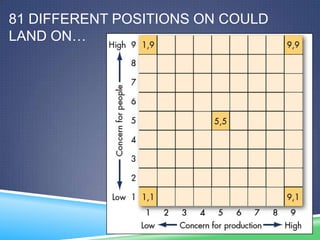
 each dimension ranging from low (1) to high (9), creates 81
  different positions in which the leader’s style may fall.
81 DIFFERENT POSITIONS ON COULD
LAND ON…
5 RESULTING LEADERSHIP

    STYLES
    Impoverished Management (1, 1): Exercise minimum effort to get work done from subordinates. Leader has low
    concern for employee satisfaction. Organization becomes disorganized. Leaders are ineffective, taking action only
    when preserving job and seniority.


   Task management (9, 1): Leader has more concern for production than for people. Leader believes efficiency can
    result through organization of work systems and the elimination of people wherever possible. Increases the output of
    organization in short run but high labor turnover is a factor.


   Middle-of-the-Road (5, 5): Leader tries to maintain a balance between goals of company and the needs of people.
    The leader does not push the boundaries of achievement resulting in average performance. Neither employee nor
    production needs are fully met.


   Country Club (1, 9): Characterized by low task and high people orientation. Leader gives thoughtful attention to the
    needs of people. Leader feels that if employees are supported it will lead to self-motivation. However, a low focus
    on tasks can hamper production and lead to questionable results.


   Team Management (9, 9): Characterized by high people and task focus, style is based on theory Y of McGregor.
    Most effective style according to Blake and Mouton. Leader feels that empowerment, commitment, trust, and respect
    are the key elements in creating a team atmosphere which automatically result in high employee satisfaction and
    production.
ADVANTAGES & DISADVANTAGES
 Advantages of Blake and Mouton’s Managerial Grid
    Grid is used to help managers analyze their own leadership styles through
      grid training. Questionnaires help managers identify how they stand with
      respect to their concern for production and people. The goal is to reach the
      team management status.
 Limitations of Blake and Mouton’s Managerial Grid
    Model ignores importance of internal and external factors.

Current leadership theory

  • 1.
    BLAKE AND MOUTON’SMANAGERIAL GRID By Maritza Koponen
  • 2.
    HOW IT BEGAN… Built from the work of researchers at these University of Michigan and Ohio State University.  Robert Blake and Jane Mouton (1960s) proposed a graphic portrayal of leadership styles through a managerial grid.  The grid depicts two dimensions of leader behavior, concern for people on y-axis and concern for production on x-axis,  each dimension ranging from low (1) to high (9), creates 81 different positions in which the leader’s style may fall.
  • 3.
    81 DIFFERENT POSITIONSON COULD LAND ON…
  • 4.
    5 RESULTING LEADERSHIP  STYLES Impoverished Management (1, 1): Exercise minimum effort to get work done from subordinates. Leader has low concern for employee satisfaction. Organization becomes disorganized. Leaders are ineffective, taking action only when preserving job and seniority.  Task management (9, 1): Leader has more concern for production than for people. Leader believes efficiency can result through organization of work systems and the elimination of people wherever possible. Increases the output of organization in short run but high labor turnover is a factor.  Middle-of-the-Road (5, 5): Leader tries to maintain a balance between goals of company and the needs of people. The leader does not push the boundaries of achievement resulting in average performance. Neither employee nor production needs are fully met.  Country Club (1, 9): Characterized by low task and high people orientation. Leader gives thoughtful attention to the needs of people. Leader feels that if employees are supported it will lead to self-motivation. However, a low focus on tasks can hamper production and lead to questionable results.  Team Management (9, 9): Characterized by high people and task focus, style is based on theory Y of McGregor. Most effective style according to Blake and Mouton. Leader feels that empowerment, commitment, trust, and respect are the key elements in creating a team atmosphere which automatically result in high employee satisfaction and production.
  • 5.
    ADVANTAGES & DISADVANTAGES Advantages of Blake and Mouton’s Managerial Grid  Grid is used to help managers analyze their own leadership styles through grid training. Questionnaires help managers identify how they stand with respect to their concern for production and people. The goal is to reach the team management status.  Limitations of Blake and Mouton’s Managerial Grid  Model ignores importance of internal and external factors.