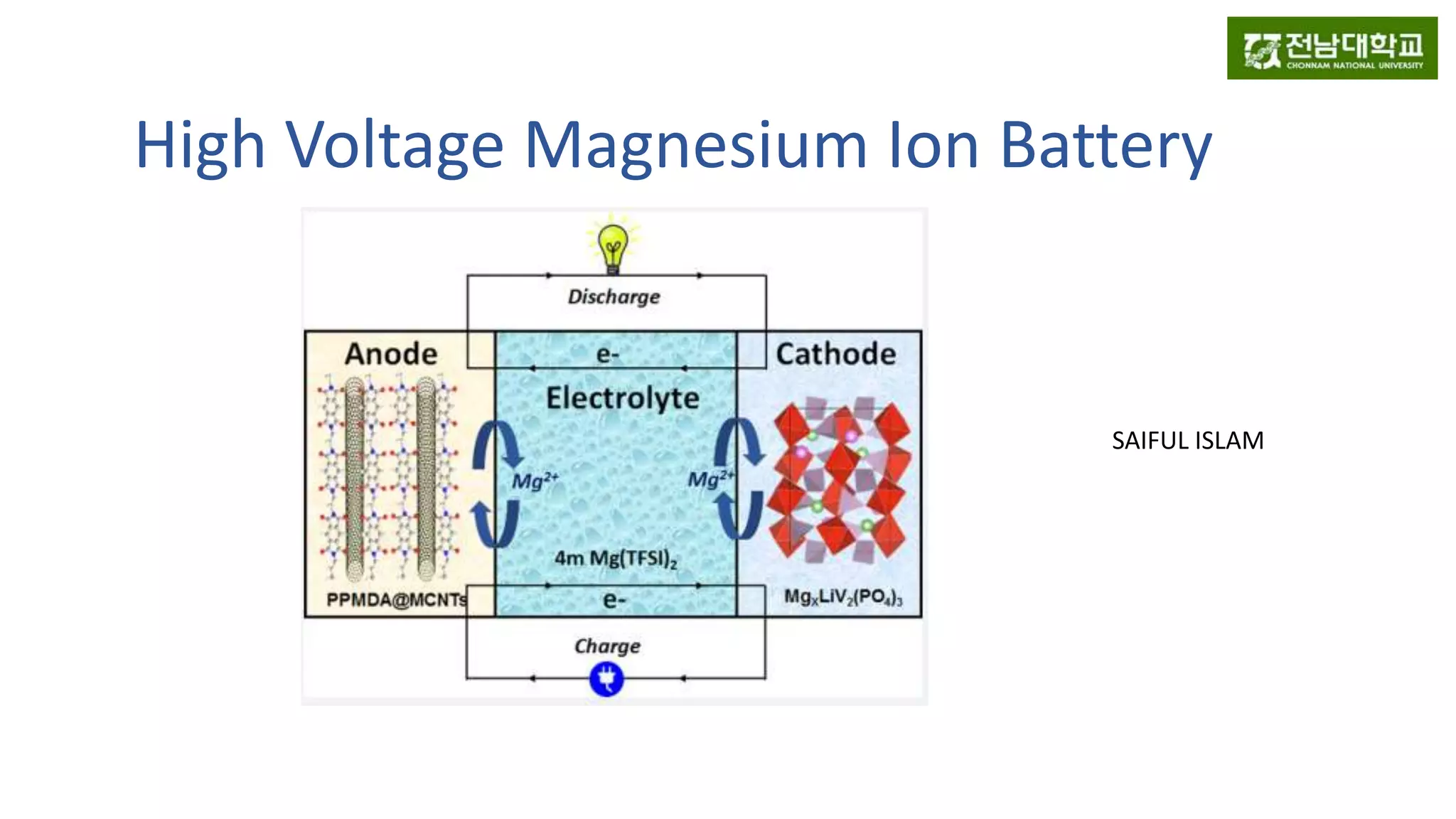
High Voltage Magnesium Ion Battery
SAIFUL ISLAM
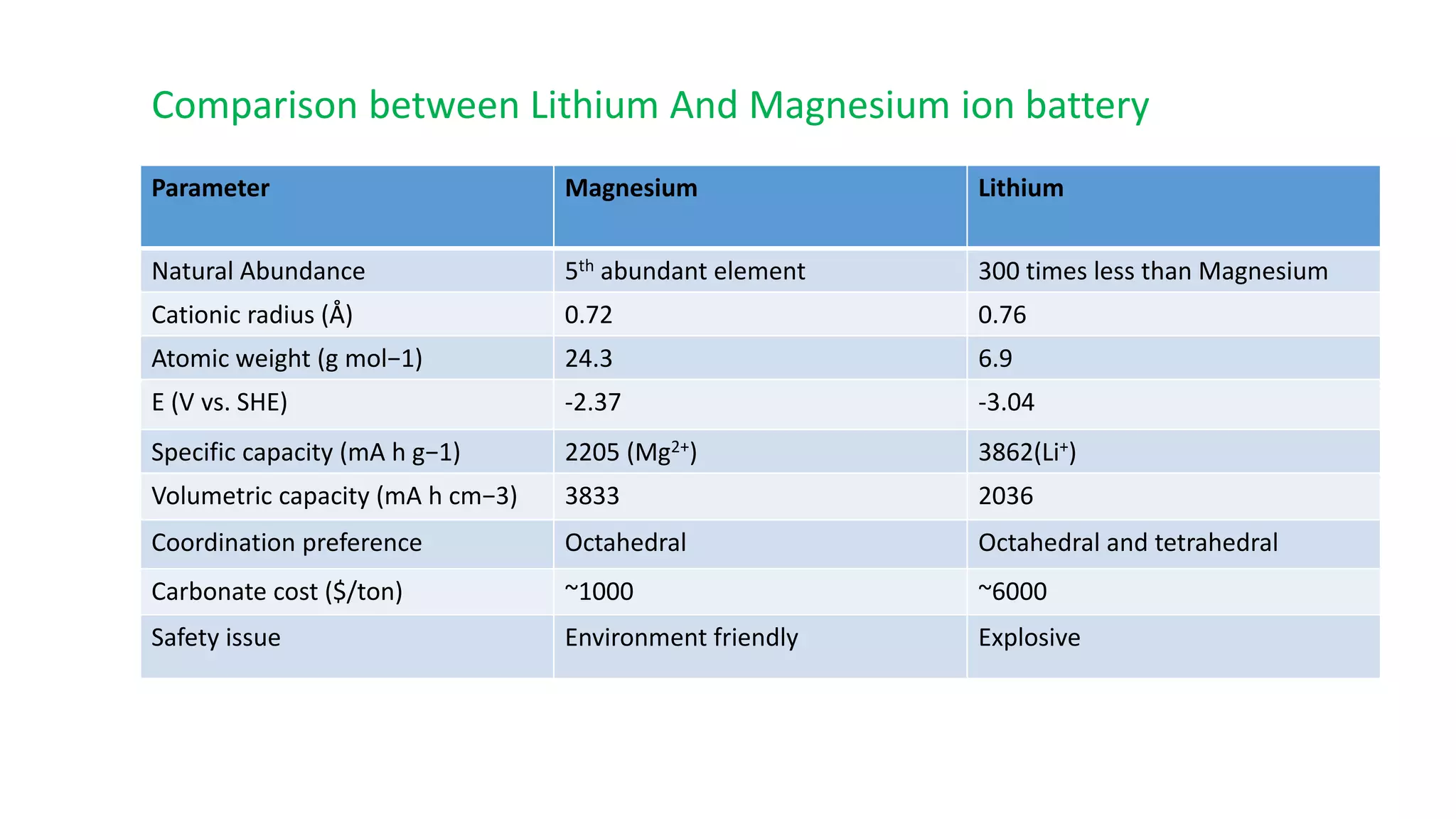
Parameter Magnesium Lithium
Natural Abundance 5th abundant element 300 times less than Magnesium
Cationic radius (Å) 0.72 0.76
Atomic weight (g mol−1) 24.3 6.9
E (V vs. SHE) -2.37 -3.04
Specific capacity (mA h g−1) 2205 (Mg2+) 3862(Li+)
Volumetric capacity (mA h cm−3) 3833 2036
Coordination preference Octahedral Octahedral and tetrahedral
Carbonate cost ($/ton) ~1000 ~6000
Safety issue Environment friendly Explosive
Comparison between Lithium And Magnesium ion battery
(a) Illustration of the operating principle of a Mg–Na
hybrid battery. During battery discharging, Na+ ions
intercalate into the cathode and Mg2+ ions dissolve
from a Mg anode. The corresponding voltage
profiles of the positive and negative electrodes are
shown in orange and blue lines, respectively.
(b) Electro-active species involved during charging a
hybrid battery made of a Na3V2(PO4)3 cathode, a Mg
anode, and an electrolyte of 0.2 M [Mg2Cl2][AlCl4]2
and 0.4 M NaAlCl4 in DME
A high-voltage rechargeable magnesium-sodium hybrid battery
Nano Energy 34 (2017) 188–194
(a) SEM and (b) TEM images of carbon-coated
Na3V2(PO4)3 particles.
(c) Cyclic voltammograms of a pure Mg
electrolyte and a hybrid Mg–Na electrolyte at
a scan rate of 25 mV s−1 in a three-electrode
cell. Inset shows the accumulated charge
during Mg deposition–dissolution cycle.
(d) The voltage profiles for the first three
galvanostatic cycles for the
Na3V2(PO4)3 cathode (red) and Mg anode
(black) in a three-electrode cell setup.
(e) Capacity retention and coulombic
efficiency over 50 cycles at 1C-rate cycling.
(f) EDS spectrum of Mg anode after 50 cycles
of Mg deposition/dissolution.
Nano Energy 34 (2017) 188–194
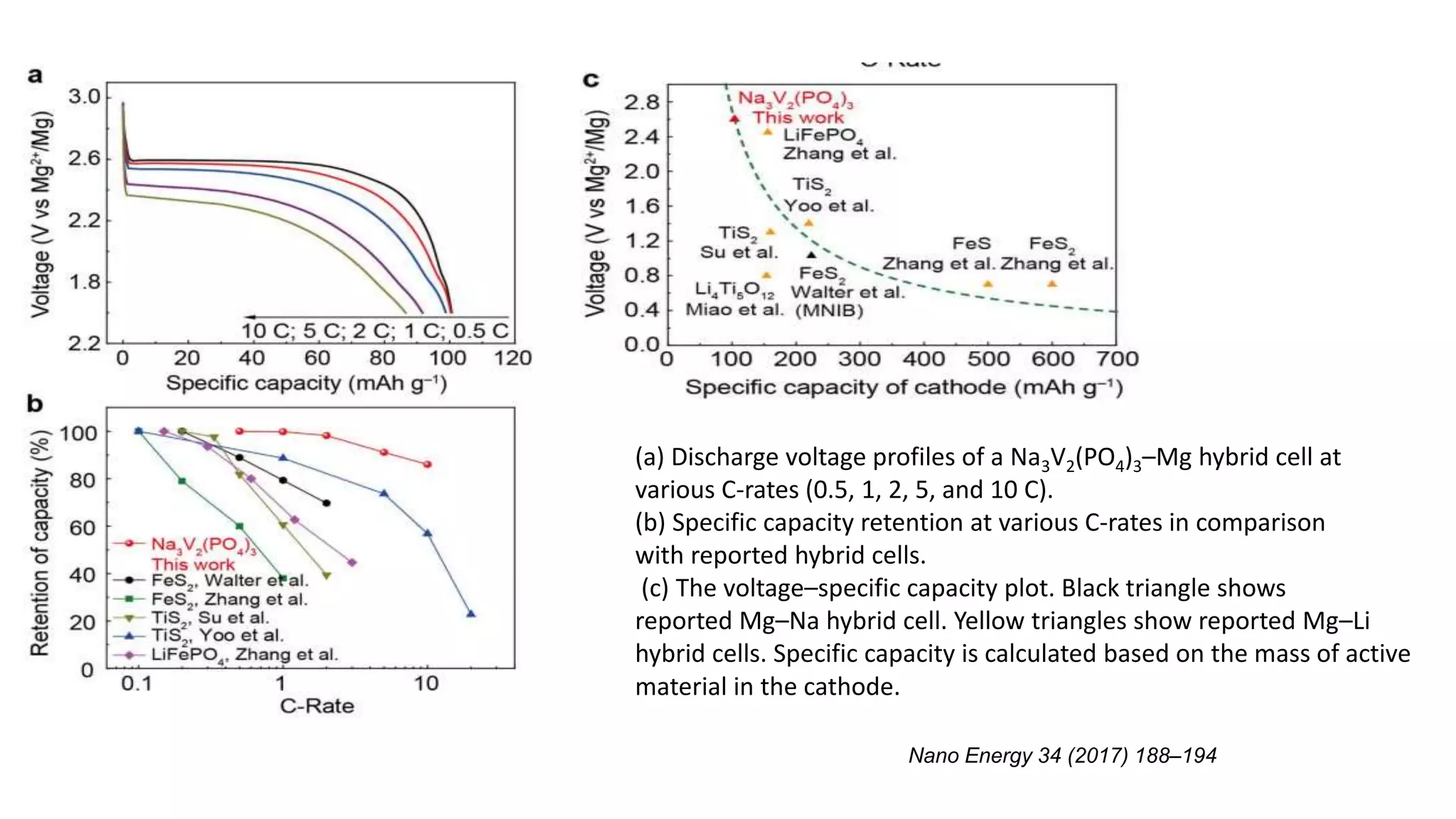
(a) Discharge voltage profiles of a Na3V2(PO4)3–Mg hybrid cell at
various C-rates (0.5, 1, 2, 5, and 10 C).
(b) Specific capacity retention at various C-rates in comparison
with reported hybrid cells.
(c) The voltage–specific capacity plot. Black triangle shows
reported Mg–Na hybrid cell. Yellow triangles show reported Mg–Li
hybrid cells. Specific capacity is calculated based on the mass of active
material in the cathode.
Nano Energy 34 (2017) 188–194
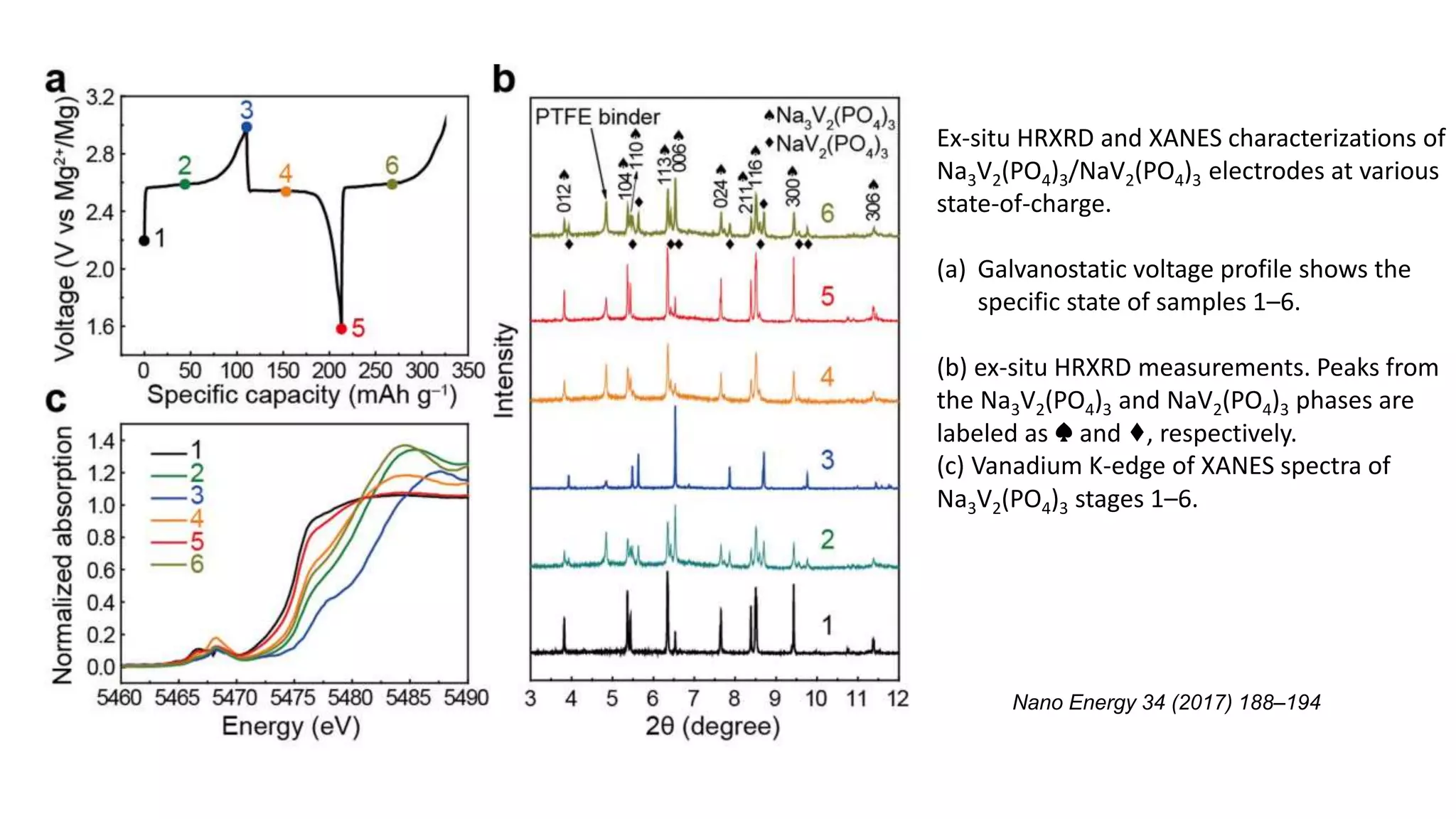
Ex-situ HRXRD and XANES characterizations of
Na3V2(PO4)3/NaV2(PO4)3 electrodes at various
state-of-charge.
(a) Galvanostatic voltage profile shows the
specific state of samples 1–6.
(b) ex-situ HRXRD measurements. Peaks from
the Na3V2(PO4)3 and NaV2(PO4)3 phases are
labeled as ♠ and ♦, respectively.
(c) Vanadium K-edge of XANES spectra of
Na3V2(PO4)3 stages 1–6.
Nano Energy 34 (2017) 188–194
Comparison of this work with previous reported Mg–Li and Mg–Na hybrid batteries.
Nano Energy 34 (2017) 188–194
Schematic illustration of the high voltage AMIB.
(a) Schematic of the proposed AMIB components.
(b) The expanded electrochemical stability window of 4 m
Mg(TFSI)2 aqueous electrolytes measured with cyclic
voltammetry (CV) on stainless steel working electrodes
between −1.3 and 1.3 V vs Ag/AgCl at 10 mV/s. The potential
has also been converted to Mg/Mg2+ reference (upper X-axis)
for convenience. The O2/H2 evolution potential and Mg2+-
intercalation potentials of various reported electrode
materials are marked in the graph.
High-Voltage Aqueous Magnesium Ion Batteries
ACS Cent. Sci. 2017, 3, 1121−1128
(a) The schematic of the working mechanism
for the LVP cathode.
(b) Powder X-ray diffraction patterns for the
LVP cathode (inset: the TEM image). (c) The
typical voltage profiles of LVP in 4 m
Mg(TFSI)2 electrolyte at constant current of
1 C (100 mA/g as 1 C) with activated carbon
and Ag/AgCl as counter and reference
electrodes, respectively.
(d) The cycling stability and Coulombic
efficiencies of LVP cathode at 1 C rate. (e)
The voltage profile of LVP cathode at various
rates.
ACS Cent. Sci. 2017, 3, 1121−1128
Electrochemical performance of the LVP cathode.
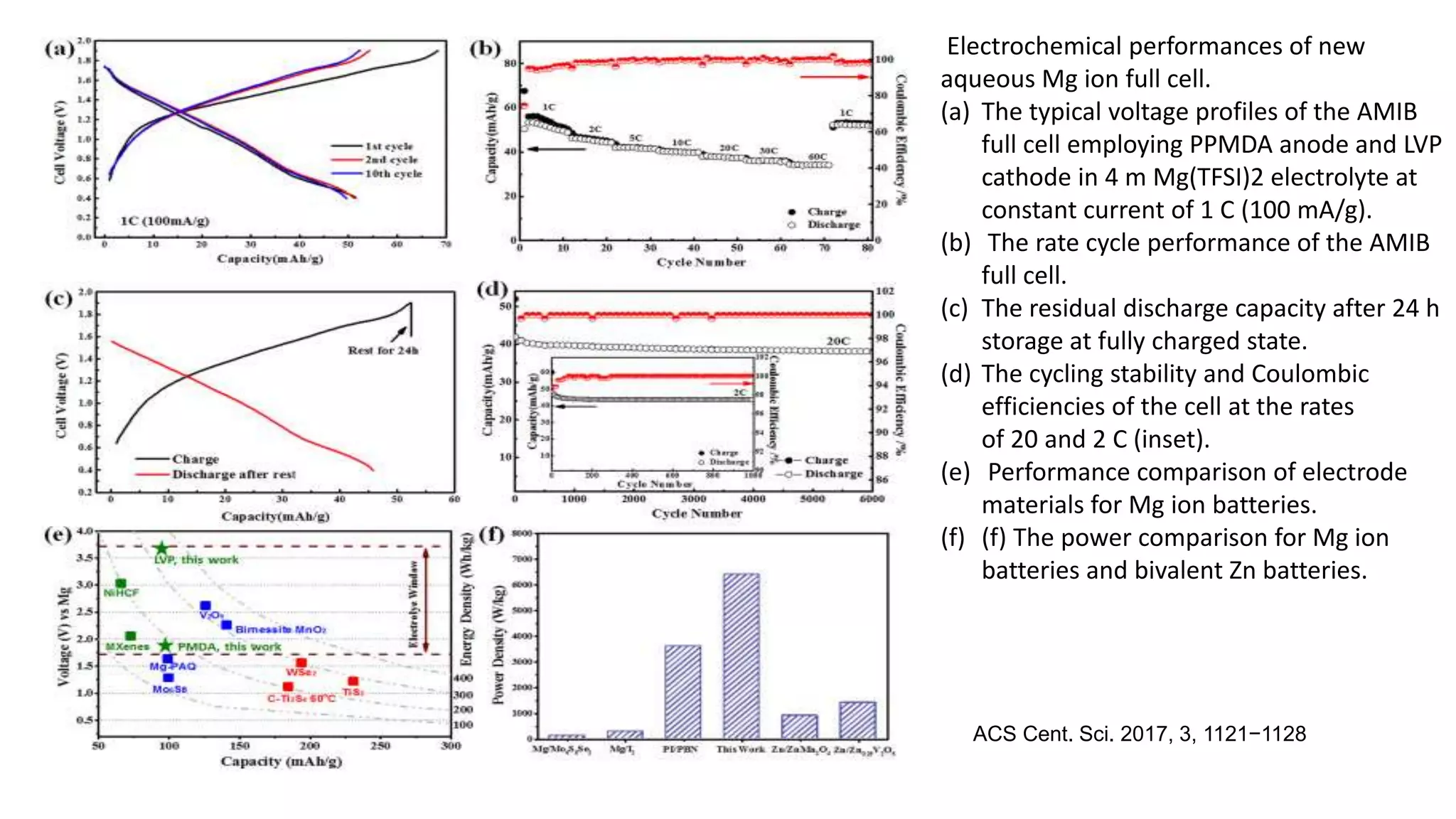
Electrochemical performances of new
aqueous Mg ion full cell.
(a) The typical voltage profiles of the AMIB
full cell employing PPMDA anode and LVP
cathode in 4 m Mg(TFSI)2 electrolyte at
constant current of 1 C (100 mA/g).
(b) The rate cycle performance of the AMIB
full cell.
(c) The residual discharge capacity after 24 h
storage at fully charged state.
(d) The cycling stability and Coulombic
efficiencies of the cell at the rates
of 20 and 2 C (inset).
(e) Performance comparison of electrode
materials for Mg ion batteries.
(f) (f) The power comparison for Mg ion
batteries and bivalent Zn batteries.
ACS Cent. Sci. 2017, 3, 1121−1128
Mg ib
Mg ib

Mg ib

  • 1.
    High Voltage MagnesiumIon Battery SAIFUL ISLAM
  • 2.
    Parameter Magnesium Lithium NaturalAbundance 5th abundant element 300 times less than Magnesium Cationic radius (Å) 0.72 0.76 Atomic weight (g mol−1) 24.3 6.9 E (V vs. SHE) -2.37 -3.04 Specific capacity (mA h g−1) 2205 (Mg2+) 3862(Li+) Volumetric capacity (mA h cm−3) 3833 2036 Coordination preference Octahedral Octahedral and tetrahedral Carbonate cost ($/ton) ~1000 ~6000 Safety issue Environment friendly Explosive Comparison between Lithium And Magnesium ion battery
  • 3.
    (a) Illustration ofthe operating principle of a Mg–Na hybrid battery. During battery discharging, Na+ ions intercalate into the cathode and Mg2+ ions dissolve from a Mg anode. The corresponding voltage profiles of the positive and negative electrodes are shown in orange and blue lines, respectively. (b) Electro-active species involved during charging a hybrid battery made of a Na3V2(PO4)3 cathode, a Mg anode, and an electrolyte of 0.2 M [Mg2Cl2][AlCl4]2 and 0.4 M NaAlCl4 in DME A high-voltage rechargeable magnesium-sodium hybrid battery Nano Energy 34 (2017) 188–194
  • 4.
    (a) SEM and(b) TEM images of carbon-coated Na3V2(PO4)3 particles. (c) Cyclic voltammograms of a pure Mg electrolyte and a hybrid Mg–Na electrolyte at a scan rate of 25 mV s−1 in a three-electrode cell. Inset shows the accumulated charge during Mg deposition–dissolution cycle. (d) The voltage profiles for the first three galvanostatic cycles for the Na3V2(PO4)3 cathode (red) and Mg anode (black) in a three-electrode cell setup. (e) Capacity retention and coulombic efficiency over 50 cycles at 1C-rate cycling. (f) EDS spectrum of Mg anode after 50 cycles of Mg deposition/dissolution. Nano Energy 34 (2017) 188–194
  • 5.
    (a) Discharge voltageprofiles of a Na3V2(PO4)3–Mg hybrid cell at various C-rates (0.5, 1, 2, 5, and 10 C). (b) Specific capacity retention at various C-rates in comparison with reported hybrid cells. (c) The voltage–specific capacity plot. Black triangle shows reported Mg–Na hybrid cell. Yellow triangles show reported Mg–Li hybrid cells. Specific capacity is calculated based on the mass of active material in the cathode. Nano Energy 34 (2017) 188–194
  • 6.
    Ex-situ HRXRD andXANES characterizations of Na3V2(PO4)3/NaV2(PO4)3 electrodes at various state-of-charge. (a) Galvanostatic voltage profile shows the specific state of samples 1–6. (b) ex-situ HRXRD measurements. Peaks from the Na3V2(PO4)3 and NaV2(PO4)3 phases are labeled as ♠ and ♦, respectively. (c) Vanadium K-edge of XANES spectra of Na3V2(PO4)3 stages 1–6. Nano Energy 34 (2017) 188–194
  • 7.
    Comparison of thiswork with previous reported Mg–Li and Mg–Na hybrid batteries. Nano Energy 34 (2017) 188–194
  • 8.
    Schematic illustration ofthe high voltage AMIB. (a) Schematic of the proposed AMIB components. (b) The expanded electrochemical stability window of 4 m Mg(TFSI)2 aqueous electrolytes measured with cyclic voltammetry (CV) on stainless steel working electrodes between −1.3 and 1.3 V vs Ag/AgCl at 10 mV/s. The potential has also been converted to Mg/Mg2+ reference (upper X-axis) for convenience. The O2/H2 evolution potential and Mg2+- intercalation potentials of various reported electrode materials are marked in the graph. High-Voltage Aqueous Magnesium Ion Batteries ACS Cent. Sci. 2017, 3, 1121−1128
  • 9.
    (a) The schematicof the working mechanism for the LVP cathode. (b) Powder X-ray diffraction patterns for the LVP cathode (inset: the TEM image). (c) The typical voltage profiles of LVP in 4 m Mg(TFSI)2 electrolyte at constant current of 1 C (100 mA/g as 1 C) with activated carbon and Ag/AgCl as counter and reference electrodes, respectively. (d) The cycling stability and Coulombic efficiencies of LVP cathode at 1 C rate. (e) The voltage profile of LVP cathode at various rates. ACS Cent. Sci. 2017, 3, 1121−1128 Electrochemical performance of the LVP cathode.
  • 10.
    Electrochemical performances ofnew aqueous Mg ion full cell. (a) The typical voltage profiles of the AMIB full cell employing PPMDA anode and LVP cathode in 4 m Mg(TFSI)2 electrolyte at constant current of 1 C (100 mA/g). (b) The rate cycle performance of the AMIB full cell. (c) The residual discharge capacity after 24 h storage at fully charged state. (d) The cycling stability and Coulombic efficiencies of the cell at the rates of 20 and 2 C (inset). (e) Performance comparison of electrode materials for Mg ion batteries. (f) (f) The power comparison for Mg ion batteries and bivalent Zn batteries. ACS Cent. Sci. 2017, 3, 1121−1128