Why MFG is different?
•   Material to Sales Ratio is high, usually >50%
•   (Material+Utilities) to Sales Ratio, >60%
•   Operating Margin %, Net Profit % is low
•   Employee Benefit Cost is low, <10% of Sales
•   Asset Intensive, ROA is low
Industry Attractiveness
• Less attractive:
  – Fierce Competition
  – Dominant Customers
  – Dominant Suppliers
     • Results in very low margins as price of finished goods is
       dictated by customers and cost of inputs i.e. price of
       inputs is controlled by the suppliers and competitors
       fight to retain or gain market share.
Cyclicality
• Industries such as Steel, Automobiles,
  Commodity Chemicals exhibit high degree of
  cyclicality (high amplitude or higher peaks and
  lower troughs) compared to FMCG or Pharma
• Near the trough or during a recession,
  demand falls drastically leading to a possibility
  of operating near or below break even volume
Implications
• Focus on Cost Control:
  – Reduce Unit Consumption or Improve Yield
  – Reduce cost of Input (price from Suppliers)
  – Reduce Inventories
  – Reduce Transport/ Freight Cost
  – Reduce Cash Cycle (time between payment to
    suppliers for input and receipt of payment from
    customers for finished goods)
  – Minimize Total Cost in the Network (from RM
    supplier to delivery to Customer)
Implications
• Increase Production
  – Reduce cycle time / increase rate of production
  – Reduce time to set up ( tool change time)
  – Reduce unplanned maintenance time
  – Reduce stock outs of inputs/tools
  – Reduce Rework and Rejections
  – Maximize Production
Implications
• Operate above the Breakeven volume
  –   Retain or Gain Market Share
  –   Develop new products/markets
  –   differentiation
  –   Improve Customer Satisfaction
       • On time delivery
       • Quality fit for use
       • Prompt service
       • Proper pricing (Value For Money perceived by customer)
       Operate at Full Capacity
Possible Conflicts
• Low Inventory & High On Time Delivery
• Large Number of Set Up Changes i.e. lower
  Production Time & High Production Volume
• Quality & High Production
• Lowest Cost & TCO (Total Cost of Ownership)
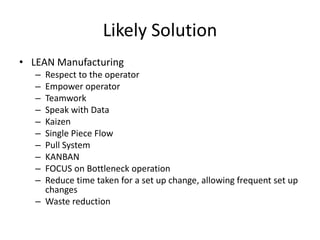
Likely Solution
• LEAN Manufacturing
   – Respect to the operator
   – Empower operator
   – Teamwork
   – Speak with Data
   – Kaizen
   – Single Piece Flow
   – Pull System
   – KANBAN
   – FOCUS on Bottleneck operation
   – Reduce time taken for a set up change, allowing frequent set up
     changes
   – Waste reduction
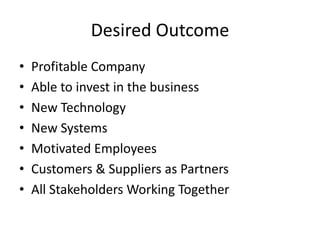
Desired Outcome
•   Profitable Company
•   Able to invest in the business
•   New Technology
•   New Systems
•   Motivated Employees
•   Customers & Suppliers as Partners
•   All Stakeholders Working Together
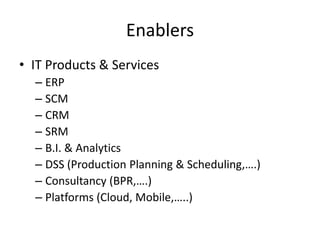
Enablers
• IT Products & Services
  – ERP
  – SCM
  – CRM
  – SRM
  – B.I. & Analytics
  – DSS (Production Planning & Scheduling,….)
  – Consultancy (BPR,….)
  – Platforms (Cloud, Mobile,…..)

Mfg summary l1 l3

  • 1.
    Why MFG isdifferent? • Material to Sales Ratio is high, usually >50% • (Material+Utilities) to Sales Ratio, >60% • Operating Margin %, Net Profit % is low • Employee Benefit Cost is low, <10% of Sales • Asset Intensive, ROA is low
  • 2.
    Industry Attractiveness • Lessattractive: – Fierce Competition – Dominant Customers – Dominant Suppliers • Results in very low margins as price of finished goods is dictated by customers and cost of inputs i.e. price of inputs is controlled by the suppliers and competitors fight to retain or gain market share.
  • 3.
    Cyclicality • Industries suchas Steel, Automobiles, Commodity Chemicals exhibit high degree of cyclicality (high amplitude or higher peaks and lower troughs) compared to FMCG or Pharma • Near the trough or during a recession, demand falls drastically leading to a possibility of operating near or below break even volume
  • 4.
    Implications • Focus onCost Control: – Reduce Unit Consumption or Improve Yield – Reduce cost of Input (price from Suppliers) – Reduce Inventories – Reduce Transport/ Freight Cost – Reduce Cash Cycle (time between payment to suppliers for input and receipt of payment from customers for finished goods) – Minimize Total Cost in the Network (from RM supplier to delivery to Customer)
  • 5.
    Implications • Increase Production – Reduce cycle time / increase rate of production – Reduce time to set up ( tool change time) – Reduce unplanned maintenance time – Reduce stock outs of inputs/tools – Reduce Rework and Rejections – Maximize Production
  • 6.
    Implications • Operate abovethe Breakeven volume – Retain or Gain Market Share – Develop new products/markets – differentiation – Improve Customer Satisfaction • On time delivery • Quality fit for use • Prompt service • Proper pricing (Value For Money perceived by customer) Operate at Full Capacity
  • 7.
    Possible Conflicts • LowInventory & High On Time Delivery • Large Number of Set Up Changes i.e. lower Production Time & High Production Volume • Quality & High Production • Lowest Cost & TCO (Total Cost of Ownership)
  • 8.
    Likely Solution • LEANManufacturing – Respect to the operator – Empower operator – Teamwork – Speak with Data – Kaizen – Single Piece Flow – Pull System – KANBAN – FOCUS on Bottleneck operation – Reduce time taken for a set up change, allowing frequent set up changes – Waste reduction
  • 9.
    Desired Outcome • Profitable Company • Able to invest in the business • New Technology • New Systems • Motivated Employees • Customers & Suppliers as Partners • All Stakeholders Working Together
  • 10.
    Enablers • IT Products& Services – ERP – SCM – CRM – SRM – B.I. & Analytics – DSS (Production Planning & Scheduling,….) – Consultancy (BPR,….) – Platforms (Cloud, Mobile,…..)