messina@google.com   •   @chrismessina   •   factoryjoe.com
@chris.messina
                          buzz.google.com/chrismessina


                            @chrismessina
                                      #devfest


Hello.

Here are some useful coordinates before we begin: chris.messina on Buzz; chrismessina on
Twitter.

The hashtag is #devfest
Google y la Web Social
Google Search   I’m Feeling Lucky


So Google is thought of by most people to be a search company. But it’s actually an
information company.

Even still, there’s no reason why Google shouldn’t do more to enhance its information
products with social information, helping to make more information that’s relevance, timely,
and useful available to everyone.
Google Search   I’m Feeling Lucky
                                                               Social


So Google is thought of by most people to be a search company. But it’s actually an
information company.

Even still, there’s no reason why Google shouldn’t do more to enhance its information
products with social information, helping to make more information that’s relevance, timely,
and useful available to everyone.
chris messina

                                       Google Search   I’m Feeling Lucky
                                                                   Social


So Google is thought of by most people to be a search company. But it’s actually an
information company.

Even still, there’s no reason why Google shouldn’t do more to enhance its information
products with social information, helping to make more information that’s relevance, timely,
and useful available to everyone.
?


but there’s still a question about what this should really look like. And a question about the
right way for Google to get involved with and help advance the social web.
Google Social Products


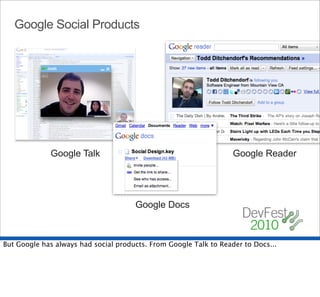
But Google has always had social products. From Google Talk to Reader to Docs...
Google Social Products


             Google Talk                                           Google Reader


                                      Google Docs


But Google has always had social products. From Google Talk to Reader to Docs...
Google Social Products
   Search                                      Communicate, show & share

        Blog Search                                 Blogger
        Find blogs on your favorite topics          Share your life online with a blog - it's quick, easy and free

        Earth                                       Calendar
        Explore the world from your computer        Organize your schedule and share events with friends

        Maps                                        Docs
        View maps and directions                    Create and share your online documents, presentations and spreadsheets

        Web Search                                  Google Mail
        Search billions of web pages                Fast, searchable email with less spam

                                                    Groups
                                                    Create mailing lists and discussion groups

                                                    Orkut
                                                    Meet new people and stay in touch with friends

                                                    Picasa
                                                    Find, edit and share your photos

                                                    Reader
                                                    Get all your blogs and news feeds fast

                                                    Sites
                                                    Create websites and secure group wikis

                                                    Talk
                                                    IM and call your friends through your computer

                                                    Translate
                                                    View web pages in other languages

                                                    YouTube
                                                    Watch, upload and share videos


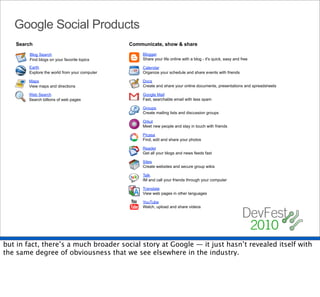
but in fact, there’s a much broader social story at Google — it just hasn’t revealed itself with
the same degree of obviousness that we see elsewhere in the industry.
In fact it’s important to keep in mind that Google’s original algorithm, called PageRank is
Google’s original “social web” product. How so?
“PageRank can be thought of as a model
   of user behavior.”


   Sergey Brin and Larry Page, 1998


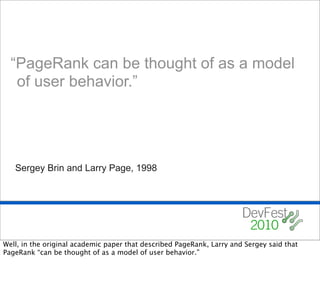
Well, in the original academic paper that described PageRank, Larry and Sergey said that
PageRank “can be thought of as a model of user behavior.”
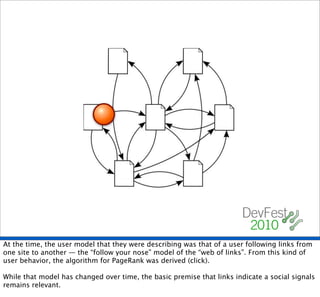
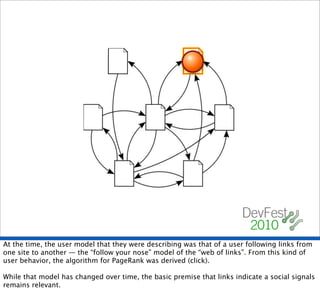
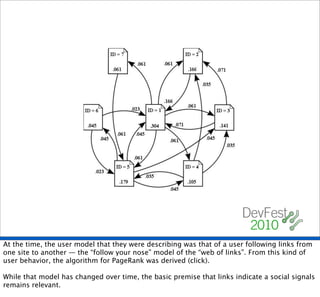
At the time, the user model that they were describing was that of a user following links from
one site to another — the “follow your nose” model of the “web of links”. From this kind of
user behavior, the algorithm for PageRank was derived (click).

While that model has changed over time, the basic premise that links indicate a social signals
remains relevant.
At the time, the user model that they were describing was that of a user following links from
one site to another — the “follow your nose” model of the “web of links”. From this kind of
user behavior, the algorithm for PageRank was derived (click).

While that model has changed over time, the basic premise that links indicate a social signals
remains relevant.
At the time, the user model that they were describing was that of a user following links from
one site to another — the “follow your nose” model of the “web of links”. From this kind of
user behavior, the algorithm for PageRank was derived (click).

While that model has changed over time, the basic premise that links indicate a social signals
remains relevant.
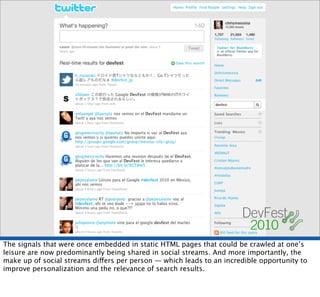
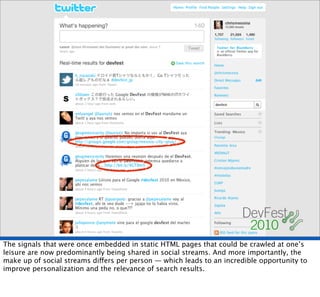
The signals that were once embedded in static HTML pages that could be crawled at one’s
leisure are now predominantly being shared in social streams. And more importantly, the
make up of social streams differs per person — which leads to an incredible opportunity to
improve personalization and the relevance of search results.
The signals that were once embedded in static HTML pages that could be crawled at one’s
leisure are now predominantly being shared in social streams. And more importantly, the
make up of social streams differs per person — which leads to an incredible opportunity to
improve personalization and the relevance of search results.
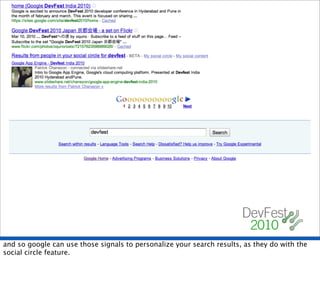
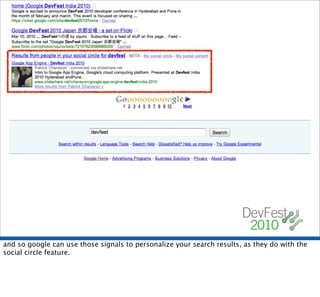
and so google can use those signals to personalize your search results, as they do with the
social circle feature.
and so google can use those signals to personalize your search results, as they do with the
social circle feature.
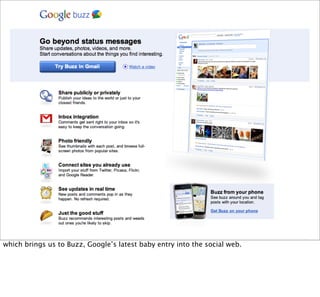
which brings us to Buzz, Google’s latest baby entry into the social web.
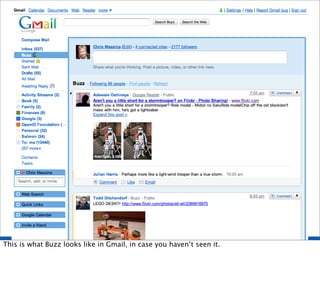
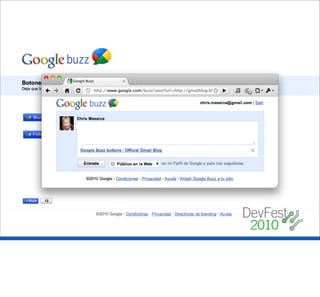
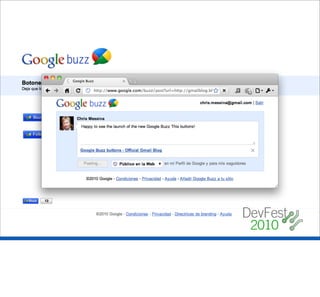
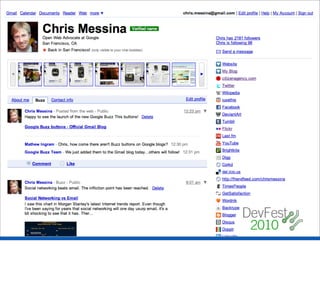
This is what Buzz looks like in Gmail, in case you haven’t seen it.
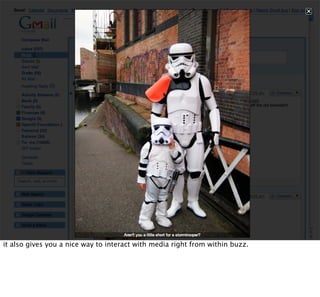
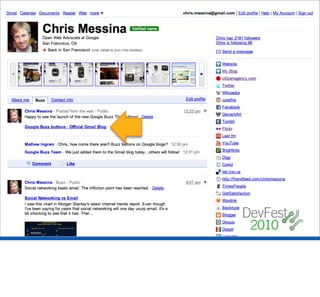
it also gives you a nice way to interact with media right from within buzz.
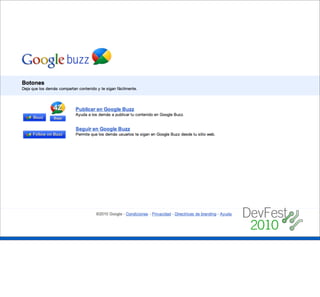
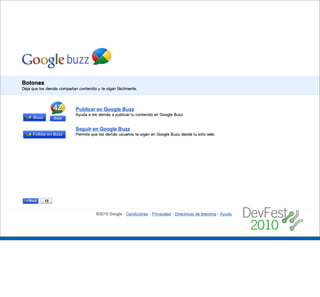
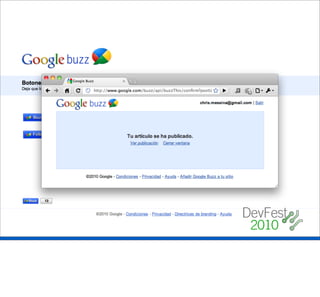
Announcing Buzz This Buttons
http://j.mp/buzz-this-api
Google Buzz and the social web
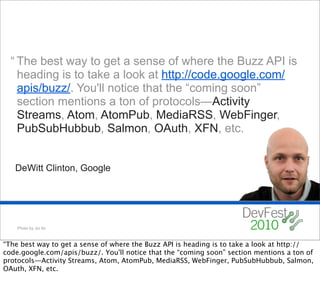
“ The best way to get a sense of where the Buzz API is
    heading is to take a look at http://code.google.com/
    apis/buzz/. You'll notice that the “coming soon”
    section mentions a ton of protocols—Activity
    Streams, Atom, AtomPub, MediaRSS, WebFinger,
    PubSubHubbub, Salmon, OAuth, XFN, etc.


   DeWitt Clinton, Google


    Photo by Joi Ito


“The best way to get a sense of where the Buzz API is heading is to take a look at http://
code.google.com/apis/buzz/. You'll notice that the “coming soon” section mentions a ton of
protocols—Activity Streams, Atom, AtomPub, MediaRSS, WebFinger, PubSubHubbub, Salmon,
OAuth, XFN, etc.
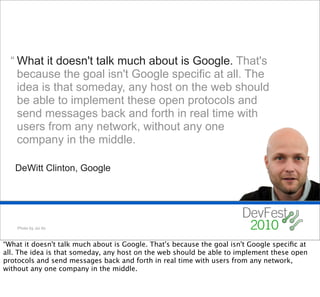
“ What it doesn't talk much about is Google. That's
    because the goal isn't Google specific at all. The
    idea is that someday, any host on the web should
    be able to implement these open protocols and
    send messages back and forth in real time with
    users from any network, without any one
    company in the middle.

   DeWitt Clinton, Google


    Photo by Joi Ito


“What it doesn't talk much about is Google. That's because the goal isn't Google specific at
all. The idea is that someday, any host on the web should be able to implement these open
protocols and send messages back and forth in real time with users from any network,
without any one company in the middle.
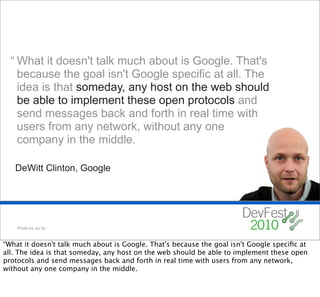
“ What it doesn't talk much about is Google. That's
    because the goal isn't Google specific at all. The
    idea is that someday, any host on the web should
    be able to implement these open protocols and
    send messages back and forth in real time with
    users from any network, without any one
    company in the middle.

   DeWitt Clinton, Google


    Photo by Joi Ito


“What it doesn't talk much about is Google. That's because the goal isn't Google specific at
all. The idea is that someday, any host on the web should be able to implement these open
protocols and send messages back and forth in real time with users from any network,
without any one company in the middle.
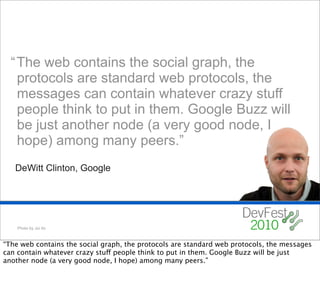
“ The web contains the social graph, the
    protocols are standard web protocols, the
    messages can contain whatever crazy stuff
    people think to put in them. Google Buzz will
    be just another node (a very good node, I
    hope) among many peers.”
   DeWitt Clinton, Google


    Photo by Joi Ito


“The web contains the social graph, the protocols are standard web protocols, the messages
can contain whatever crazy stuff people think to put in them. Google Buzz will be just
another node (a very good node, I hope) among many peers.”
“ The web contains the social graph, the
    protocols are standard web protocols, the
    messages can contain whatever crazy stuff
    people think to put in them. Google Buzz will
    be just another node (a very good node, I
    hope) among many peers.”
   DeWitt Clinton, Google


    Photo by Joi Ito


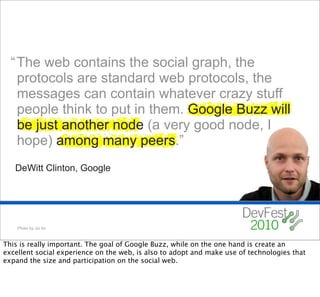
This is really important. The goal of Google Buzz, while on the one hand is create an
excellent social experience on the web, is also to adopt and make use of technologies that
expand the size and participation on the social web.
What is the social web?
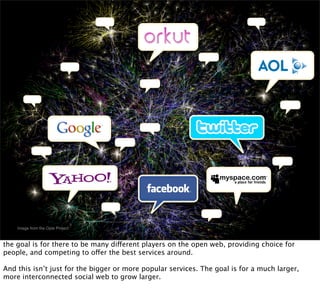
Image from the Opte Project


So if this is the web, it’s important to understand that the goal is NOT for Google to own the
web. On the contrary... [CLICK]
{                                                                           }
    Image from the Opte Project


So if this is the web, it’s important to understand that the goal is NOT for Google to own the
web. On the contrary... [CLICK]
{                                                                           }
    Image from the Opte Project


So if this is the web, it’s important to understand that the goal is NOT for Google to own the
web. On the contrary... [CLICK]
Image from the Opte Project


So if this is the web, it’s important to understand that the goal is NOT for Google to own the
web. On the contrary... [CLICK]
Image from the Opte Project


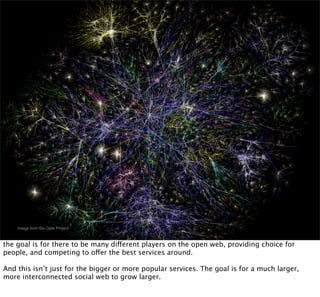
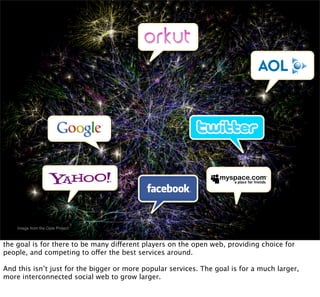
the goal is for there to be many different players on the open web, providing choice for
people, and competing to offer the best services around.

And this isn’t just for the bigger or more popular services. The goal is for a much larger,
more interconnected social web to grow larger.
Image from the Opte Project


the goal is for there to be many different players on the open web, providing choice for
people, and competing to offer the best services around.

And this isn’t just for the bigger or more popular services. The goal is for a much larger,
more interconnected social web to grow larger.
Image from the Opte Project


the goal is for there to be many different players on the open web, providing choice for
people, and competing to offer the best services around.

And this isn’t just for the bigger or more popular services. The goal is for a much larger,
more interconnected social web to grow larger.
The web is better when it’s social


The web is better when it’s social.

And that means that we want to make sure that every page and site on the web can offer
social functionality, and compelling social experiences.
What do I mean by social?


it’s about enabling new verbs on the web... verbs like follow, share, discuss, comment,
mention, like, rate,
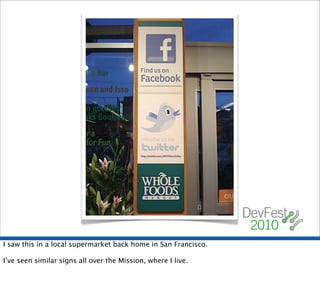
I saw this in a local supermarket back home in San Francisco.

I’ve seen similar signs all over the Mission, where I live.
This is where the social web begins — an invitation from the real world to join others online.

But the social web is about much more. However...
“Find us on Facebook”

                    “Follow us on Twitter”


This is where the social web begins — an invitation from the real world to join others online.

But the social web is about much more. However...
Engagement & interaction


This is where the social web begins — an invitation from the real world to join others online.

But the social web is about much more. However...
Consuming


                                                          Participating


  Source: groundswell.forrester.com


...current trends indicate a 1-10-90 (the math doesn’t add up, no) split on creators,
commentors, and consumers.

our challenge is to flip that trend [CLICK] — to help people feel more comfortable sharing
online.
Participating


                                                           Consuming


  Source: groundswell.forrester.com


...current trends indicate a 1-10-90 (the math doesn’t add up, no) split on creators,
commentors, and consumers.

our challenge is to flip that trend [CLICK] — to help people feel more comfortable sharing
online.
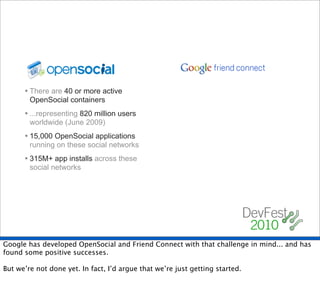
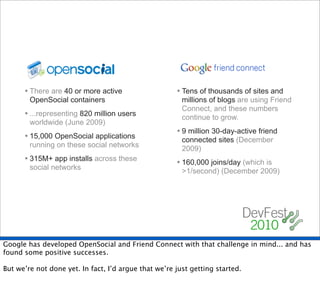
Google has developed OpenSocial and Friend Connect with that challenge in mind... and has
found some positive successes.

But we’re not done yet. In fact, I’d argue that we’re just getting started.
• There are 40 or more active
        OpenSocial containers
      • ...representing 820 million users
        worldwide (June 2009)
      • 15,000 OpenSocial applications
        running on these social networks
      • 315M+ app installs across these
        social networks


Google has developed OpenSocial and Friend Connect with that challenge in mind... and has
found some positive successes.

But we’re not done yet. In fact, I’d argue that we’re just getting started.
• There are 40 or more active                   • Tens of thousands of sites and
        OpenSocial containers                           millions of blogs are using Friend
                                                        Connect, and these numbers
      • ...representing 820 million users               continue to grow.
        worldwide (June 2009)
                                                      • 9 million 30-day-active friend
      • 15,000 OpenSocial applications                  connected sites (December
        running on these social networks                2009)
      • 315M+ app installs across these               • 160,000 joins/day (which is
        social networks                                 >1/second) (December 2009)


Google has developed OpenSocial and Friend Connect with that challenge in mind... and has
found some positive successes.

But we’re not done yet. In fact, I’d argue that we’re just getting started.
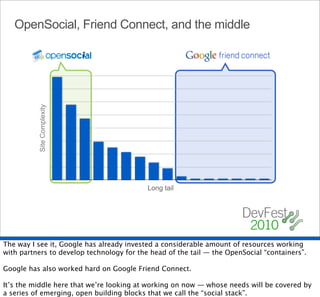
OpenSocial, Friend Connect, and the middle
          Site Complexity


                                           Long tail


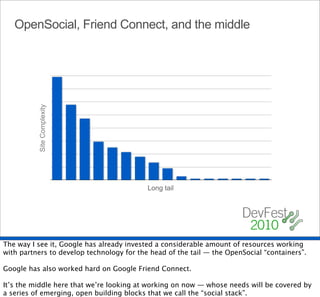
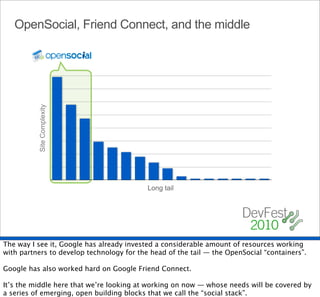
The way I see it, Google has already invested a considerable amount of resources working
with partners to develop technology for the head of the tail — the OpenSocial “containers”.

Google has also worked hard on Google Friend Connect.

It’s the middle here that we’re looking at working on now — whose needs will be covered by
a series of emerging, open building blocks that we call the “social stack”.
OpenSocial, Friend Connect, and the middle
          Site Complexity


                                           Long tail


The way I see it, Google has already invested a considerable amount of resources working
with partners to develop technology for the head of the tail — the OpenSocial “containers”.

Google has also worked hard on Google Friend Connect.

It’s the middle here that we’re looking at working on now — whose needs will be covered by
a series of emerging, open building blocks that we call the “social stack”.
OpenSocial, Friend Connect, and the middle
          Site Complexity


                                           Long tail


The way I see it, Google has already invested a considerable amount of resources working
with partners to develop technology for the head of the tail — the OpenSocial “containers”.

Google has also worked hard on Google Friend Connect.

It’s the middle here that we’re looking at working on now — whose needs will be covered by
a series of emerging, open building blocks that we call the “social stack”.
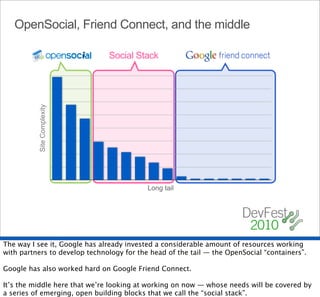
OpenSocial, Friend Connect, and the middle

                               Social Stack
          Site Complexity


                                           Long tail


The way I see it, Google has already invested a considerable amount of resources working
with partners to develop technology for the head of the tail — the OpenSocial “containers”.

Google has also worked hard on Google Friend Connect.

It’s the middle here that we’re looking at working on now — whose needs will be covered by
a series of emerging, open building blocks that we call the “social stack”.
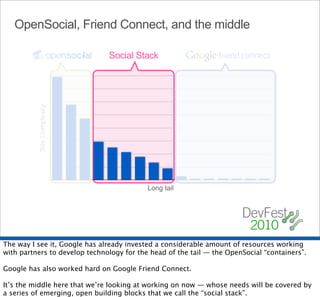
OpenSocial, Friend Connect, and the middle

                               Social Stack
          Site Complexity


                                           Long tail


The way I see it, Google has already invested a considerable amount of resources working
with partners to develop technology for the head of the tail — the OpenSocial “containers”.

Google has also worked hard on Google Friend Connect.

It’s the middle here that we’re looking at working on now — whose needs will be covered by
a series of emerging, open building blocks that we call the “social stack”.
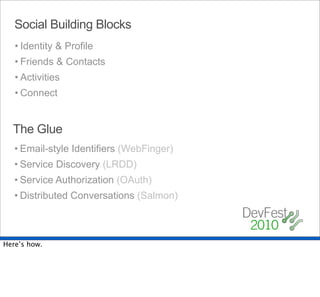
Social Building Blocks


Here’s how.
Social Building Blocks
   • Identity & Profile


Here’s how.
Social Building Blocks
   • Identity & Profile
   • Friends & Contacts


Here’s how.
Social Building Blocks
   • Identity & Profile
   • Friends & Contacts
   • Activities


Here’s how.
Social Building Blocks
   • Identity & Profile
   • Friends & Contacts
   • Activities
   • Connect


Here’s how.
Social Building Blocks
   • Identity & Profile
   • Friends & Contacts
   • Activities
   • Connect


  The Glue


Here’s how.
Social Building Blocks
   • Identity & Profile
   • Friends & Contacts
   • Activities
   • Connect


  The Glue
   • Email-style Identifiers (WebFinger)


Here’s how.
Social Building Blocks
   • Identity & Profile
   • Friends & Contacts
   • Activities
   • Connect


  The Glue
   • Email-style Identifiers (WebFinger)
   • Service Discovery (LRDD)


Here’s how.
Social Building Blocks
   • Identity & Profile
   • Friends & Contacts
   • Activities
   • Connect


  The Glue
   • Email-style Identifiers (WebFinger)
   • Service Discovery (LRDD)
   • Service Authorization (OAuth)


Here’s how.
Social Building Blocks
   • Identity & Profile
   • Friends & Contacts
   • Activities
   • Connect


  The Glue
   • Email-style Identifiers (WebFinger)
   • Service Discovery (LRDD)
   • Service Authorization (OAuth)
   • Distributed Conversations (Salmon)


Here’s how.
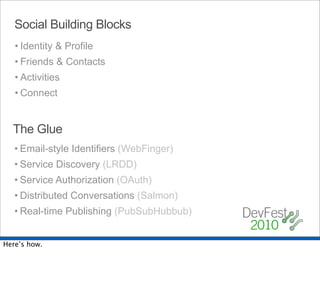
Social Building Blocks
   • Identity & Profile
   • Friends & Contacts
   • Activities
   • Connect


  The Glue
   • Email-style Identifiers (WebFinger)
   • Service Discovery (LRDD)
   • Service Authorization (OAuth)
   • Distributed Conversations (Salmon)
   • Real-time Publishing (PubSubHubbub)


Here’s how.
Social Building Blocks
Identity & Profile
OpenID
Photo by Teresa Stanton


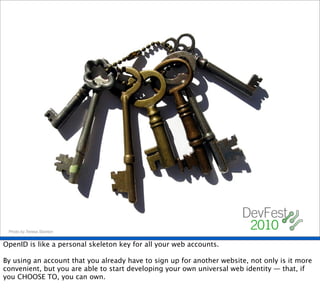
OpenID is like a personal skeleton key for all your web accounts.

By using an account that you already have to sign up for another website, not only is it more
convenient, but you are able to start developing your own universal web identity — that, if
you CHOOSE TO, you can own.
Why is OpenID important?


* People use different identities for different purposes
* Ultimately choice and competition is a good thing to foster in this early landscape.
* With greater diversity of providers, publishers may see the potential for wider distribution
of shareable content.
* Digital identity is in its infancy now; the final chapter has not yet been written.
Why is OpenID important?

   • People use different identities for different purposes


* People use different identities for different purposes
* Ultimately choice and competition is a good thing to foster in this early landscape.
* With greater diversity of providers, publishers may see the potential for wider distribution
of shareable content.
* Digital identity is in its infancy now; the final chapter has not yet been written.
Why is OpenID important?

   • People use different identities for different purposes
   • Ultimately choice and competition is a good thing to foster in
     this early landscape.


* People use different identities for different purposes
* Ultimately choice and competition is a good thing to foster in this early landscape.
* With greater diversity of providers, publishers may see the potential for wider distribution
of shareable content.
* Digital identity is in its infancy now; the final chapter has not yet been written.
Why is OpenID important?

   • People use different identities for different purposes
   • Ultimately choice and competition is a good thing to foster in
     this early landscape.
   • With greater diversity of providers, publishers may see the
     potential for wider distribution of shareable content.


* People use different identities for different purposes
* Ultimately choice and competition is a good thing to foster in this early landscape.
* With greater diversity of providers, publishers may see the potential for wider distribution
of shareable content.
* Digital identity is in its infancy now; the final chapter has not yet been written.
Why is OpenID important?

   • People use different identities for different purposes
   • Ultimately choice and competition is a good thing to foster in
     this early landscape.
   • With greater diversity of providers, publishers may see the
     potential for wider distribution of shareable content.
   • Digital identity is in its infancy now; the final chapter has not
     yet been written.


* People use different identities for different purposes
* Ultimately choice and competition is a good thing to foster in this early landscape.
* With greater diversity of providers, publishers may see the potential for wider distribution
of shareable content.
* Digital identity is in its infancy now; the final chapter has not yet been written.
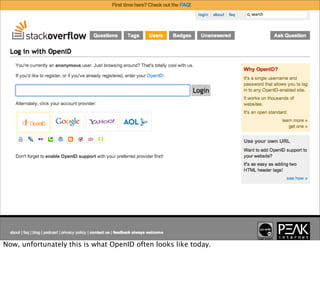
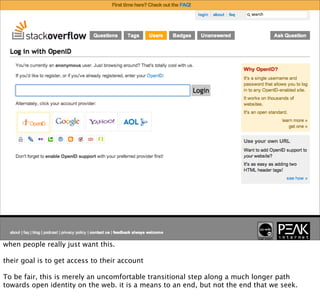
Now, unfortunately this is what OpenID often looks like today.
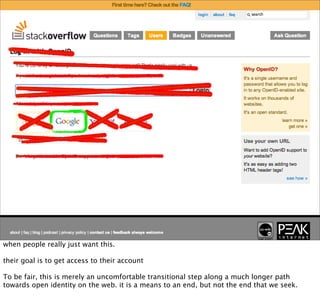
when people really just want this.

their goal is to get access to their account

To be fair, this is merely an uncomfortable transitional step along a much longer path
towards open identity on the web. it is a means to an end, but not the end that we seek.
when people really just want this.

their goal is to get access to their account

To be fair, this is merely an uncomfortable transitional step along a much longer path
towards open identity on the web. it is a means to an end, but not the end that we seek.
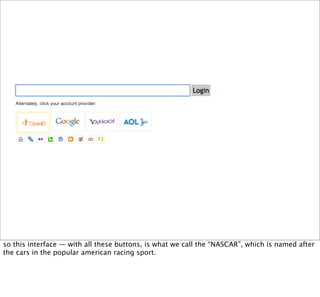
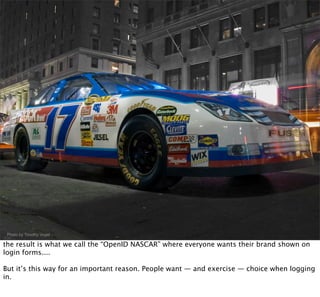
so this interface — with all these buttons, is what we call the “NASCAR”, which is named after
the cars in the popular american racing sport.
Photo by Timothy Vogel

the result is what we call the “OpenID NASCAR” where everyone wants their brand shown on
login forms....

But it’s this way for an important reason. People want — and exercise — choice when logging
in.
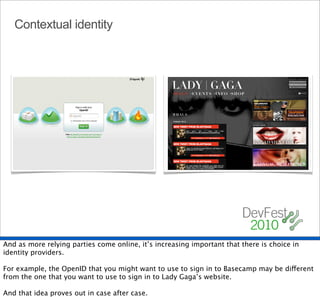
Contextual identity


And as more relying parties come online, it’s increasing important that there is choice in
identity providers.

For example, the OpenID that you might want to use to sign in to Basecamp may be different
from the one that you want to use to sign in to Lady Gaga’s website.

And that idea proves out in case after case.
Unique OpenID Relying Parties
    As of July 1, 2009


 Data from Janrain


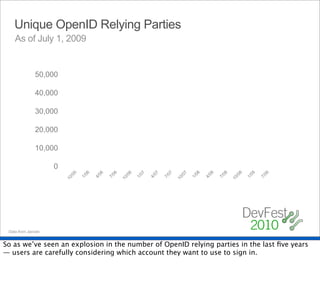
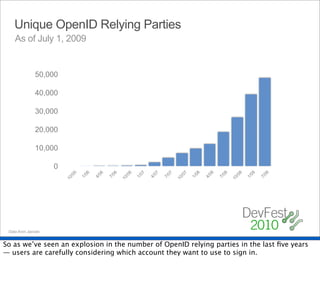
So as we’ve seen an explosion in the number of OpenID relying parties in the last five years
— users are carefully considering which account they want to use to sign in.
Unique OpenID Relying Parties
    As of July 1, 2009


               50,000

               40,000

               30,000

               20,000

               10,000

                     0
                          5

                               06


                                    06


                                         06


                                               6

                                                    07


                                                         07


                                                              07


                                                                    7

                                                                         08


                                                                              08


                                                                                   08


                                                                                         8

                                                                                              09


                                                                                                   09
                          /0


                                               /0


                                                                    /0


                                                                                         /0
                               1/


                                    4/


                                         7/


                                                    1/


                                                         4/


                                                              7/


                                                                         1/


                                                                              4/


                                                                                   7/


                                                                                              1/


                                                                                                   7/
                         10


                                              10


                                                                   10


 Data from Janrain                                                                      10

So as we’ve seen an explosion in the number of OpenID relying parties in the last five years
— users are carefully considering which account they want to use to sign in.
Unique OpenID Relying Parties
    As of July 1, 2009


               50,000

               40,000

               30,000

               20,000

               10,000

                     0
                          5

                               06


                                    06


                                         06


                                               6

                                                    07


                                                         07


                                                              07


                                                                    7

                                                                         08


                                                                              08


                                                                                   08


                                                                                         8

                                                                                              09


                                                                                                   09
                          /0


                                               /0


                                                                    /0


                                                                                         /0
                               1/


                                    4/


                                         7/


                                                    1/


                                                         4/


                                                              7/


                                                                         1/


                                                                              4/


                                                                                   7/


                                                                                              1/


                                                                                                   7/
                         10


                                              10


                                                                   10


 Data from Janrain                                                                      10

So as we’ve seen an explosion in the number of OpenID relying parties in the last five years
— users are carefully considering which account they want to use to sign in.
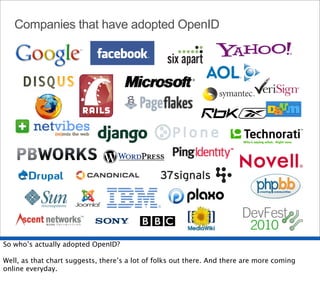
Companies that have adopted OpenID


So who’s actually adopted OpenID?

Well, as that chart suggests, there’s a lot of folks out there. And there are more coming
online everyday.
Companies that have adopted OpenID


So who’s actually adopted OpenID?

Well, as that chart suggests, there’s a lot of folks out there. And there are more coming
online everyday.
OpenID Usage Trends


This is some data from a company called Janrain that makes a product called RPX which
makes it easy to integrate third-party authentication services.
OpenID usage trends
    UserVoice Providers
                                          13%


           19%                                       9%


                                                           4%
                                                           2%
                                                           1%
                                                           1%
                                                           1%


                                    52%

                 Google               Facebook   Yahoo!
                 MyOpenID             Other      AOL
                 VeriSign PIP         Blogger    ClaimID


 Chart from Janrain, January 2009


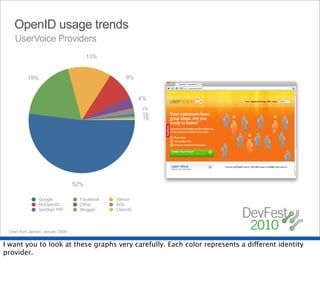
I want you to look at these graphs very carefully. Each color represents a different identity
provider.
OpenID usage trends
    Interscope Records Providers

                              43%


                                                               19%


      12%

                                                      1%
                                                    2% 0%


                                    24%


              Google        Facebook      Yahoo!    MyOpenID
              Other         AOL           MySpace


 Chart from Janrain, January 2009


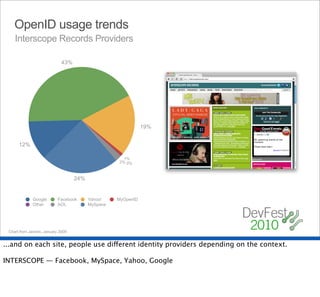
...and on each site, people use different identity providers depending on the context.

INTERSCOPE — Facebook, MySpace, Yahoo, Google
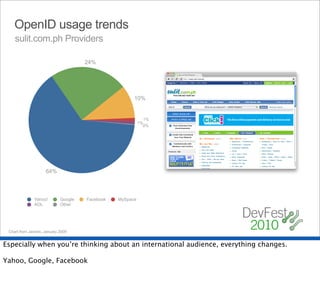
OpenID usage trends
    sulit.com.ph Providers

                                      24%


                                                       10%


                                                              1%
                                                           1%
                                                             0%


                     64%


               Yahoo!        Google   Facebook   MySpace
               AOL           Other


 Chart from Janrain, January 2009


Especially when you’re thinking about an international audience, everything changes.

Yahoo, Google, Facebook
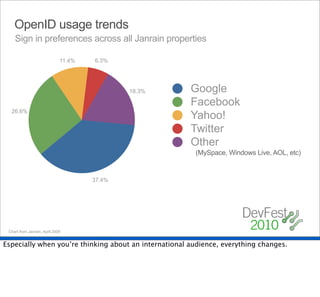
OpenID usage trends
    Sign in preferences across all Janrain properties

                              11.4%   6.3%


                                              18.3%    Google
                                                       Facebook
  26.6%
                                                       Yahoo!
                                                       Twitter
                                                       Other
                                                        (MySpace, Windows Live, AOL, etc)

                                      37.4%


 Chart from Janrain, April 2009


Especially when you’re thinking about an international audience, everything changes.
Making OpenID easier


one of the challenges of OpenID has been figuring out how to make OpenID easier.

One of the biggest challenges is helping people to know what their OpenID is and to
remember it.
people can remember their address, their phone number, AOL screenname, email, MySpace...
Twitter... Facebook? Gmail...? OpenID?
• What’s your address?


people can remember their address, their phone number, AOL screenname, email, MySpace...
Twitter... Facebook? Gmail...? OpenID?
• What’s your address?
   • What’s your phone number?


people can remember their address, their phone number, AOL screenname, email, MySpace...
Twitter... Facebook? Gmail...? OpenID?
• What’s your address?
   • What’s your phone number?
   • What’s your AOL screenname?


people can remember their address, their phone number, AOL screenname, email, MySpace...
Twitter... Facebook? Gmail...? OpenID?
• What’s your address?
   • What’s your phone number?
   • What’s your AOL screenname?
   • What’s your email address?


people can remember their address, their phone number, AOL screenname, email, MySpace...
Twitter... Facebook? Gmail...? OpenID?
• What’s your address?
   • What’s your phone number?
   • What’s your AOL screenname?
   • What’s your email address?
   • What’s your MySpace?


people can remember their address, their phone number, AOL screenname, email, MySpace...
Twitter... Facebook? Gmail...? OpenID?
• What’s your address?
   • What’s your phone number?
   • What’s your AOL screenname?
   • What’s your email address?
   • What’s your MySpace?
   • Twitter?


people can remember their address, their phone number, AOL screenname, email, MySpace...
Twitter... Facebook? Gmail...? OpenID?
• What’s your address?
   • What’s your phone number?
   • What’s your AOL screenname?
   • What’s your email address?
   • What’s your MySpace?
   • Twitter?
   • Are you on Facebook?


people can remember their address, their phone number, AOL screenname, email, MySpace...
Twitter... Facebook? Gmail...? OpenID?
• What’s your address?
   • What’s your phone number?
   • What’s your AOL screenname?
   • What’s your email address?
   • What’s your MySpace?
   • Twitter?
   • Are you on Facebook?
   • What’s your Gmail?


people can remember their address, their phone number, AOL screenname, email, MySpace...
Twitter... Facebook? Gmail...? OpenID?
• What’s your address?
   • What’s your phone number?
   • What’s your AOL screenname?
   • What’s your email address?
   • What’s your MySpace?
   • Twitter?
   • Are you on Facebook?
   • What’s your Gmail?
   • What’s your OpenID?


people can remember their address, their phone number, AOL screenname, email, MySpace...
Twitter... Facebook? Gmail...? OpenID?
• What’s your address?
   • What’s your phone number?
   • What’s your AOL screenname?
   • What’s your email address?
   • What’s your MySpace?
   • Twitter?
   • Are you on Facebook?
   • What’s your Gmail?
   • What’s your OpenID?


turns out that email addresses seem to be much more universal and memorable than an
“OpenID”, and so the OpenID community has been working on ways to make it possible to
use an email address as a way to bootstrap the OpenID authentication process. (more on that
later)
• What’s your address?
   • What’s your phone number?
   • What’s your AOL screenname?
   • What’s your email address?
   • What’s your MySpace?
   • Twitter?
   • Are you on Facebook?
   • What’s your Gmail?
   • What’s your OpenID?


turns out that email addresses seem to be much more universal and memorable than an
“OpenID”, and so the OpenID community has been working on ways to make it possible to
use an email address as a way to bootstrap the OpenID authentication process. (more on that
later)
which brings us to WebFinger.
WebFinger


which brings us to WebFinger.
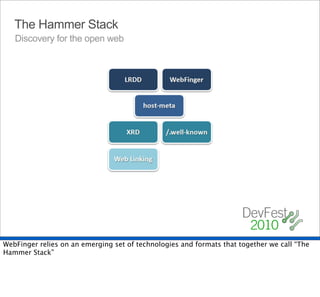
The Hammer Stack
   Discovery for the open web


WebFinger relies on an emerging set of technologies and formats that together we call “The
Hammer Stack”
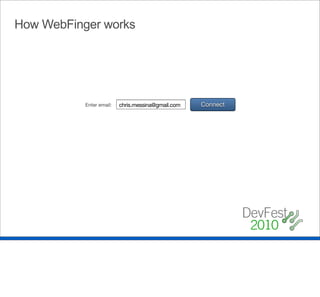
How WebFinger works


           Enter email:   Email   Connect
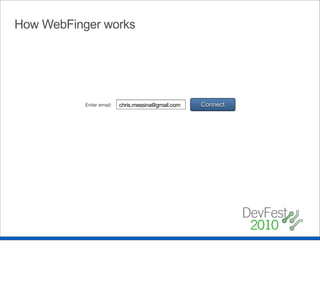
How WebFinger works


           Enter email:   chris.messina@gmail.com   Connect
How WebFinger works


           Enter email:   chris.messina@gmail.com   Connect
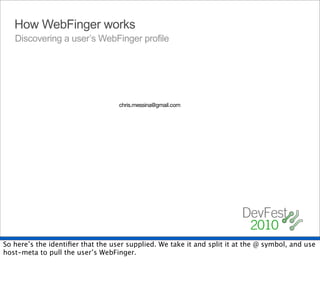
How WebFinger works
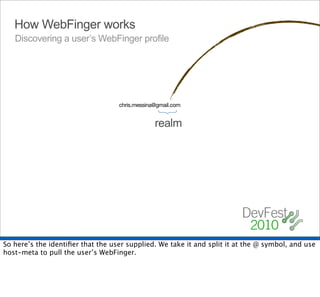
   Discovering a user’s WebFinger profile


                                   chris.messina@gmail.com


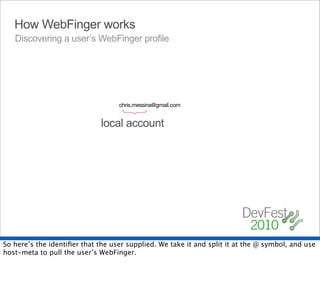
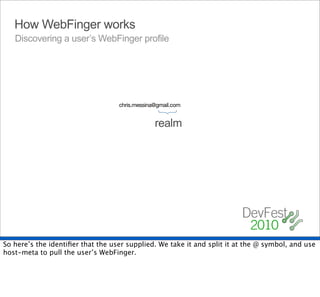
So here’s the identifier that the user supplied. We take it and split it at the @ symbol, and use
host-meta to pull the user’s WebFinger.
How WebFinger works
   Discovering a user’s WebFinger profile


                                   chris.messina@gmail.com


                                   {
                              local account


So here’s the identifier that the user supplied. We take it and split it at the @ symbol, and use
host-meta to pull the user’s WebFinger.
How WebFinger works
   Discovering a user’s WebFinger profile


                                   chris.messina@gmail.com


                                                {
                                                realm


So here’s the identifier that the user supplied. We take it and split it at the @ symbol, and use
host-meta to pull the user’s WebFinger.
How WebFinger works
   Discovering a user’s WebFinger profile


                                   chris.messina@gmail.com


                                                {
                                                realm


So here’s the identifier that the user supplied. We take it and split it at the @ symbol, and use
host-meta to pull the user’s WebFinger.
How WebFinger works
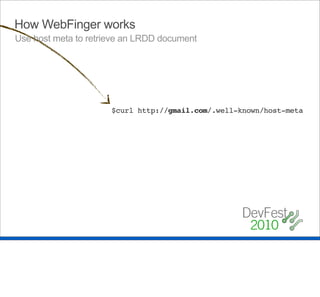
Use host meta to retrieve an LRDD document


                      $curl http://gmail.com/.well-known/host-meta
How WebFinger works
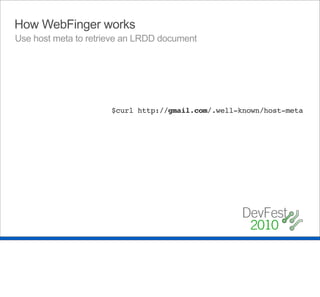
Use host meta to retrieve an LRDD document


                      $curl http://gmail.com/.well-known/host-meta
How WebFinger works
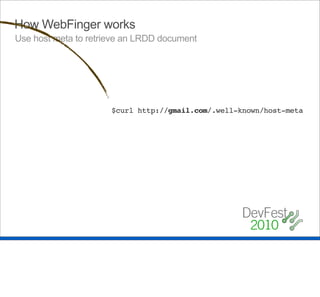
Use host meta to retrieve an LRDD document


                      $curl http://gmail.com/.well-known/host-meta
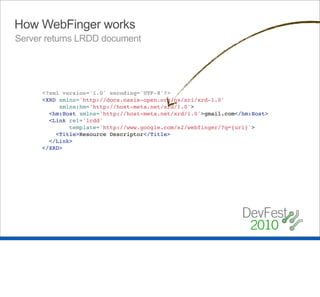
How WebFinger works
Server returns LRDD document


      <?xml version='1.0' encoding='UTF-8'?>
      <XRD xmlns='http://docs.oasis-open.org/ns/xri/xrd-1.0'
           xmlns:hm='http://host-meta.net/xrd/1.0'>
        <hm:Host xmlns='http://host-meta.net/xrd/1.0'>gmail.com</hm:Host>
        <Link rel='lrdd'
              template='http://www.google.com/s2/webfinger/?q={uri}'>
          <Title>Resource Descriptor</Title>
        </Link>
      </XRD>
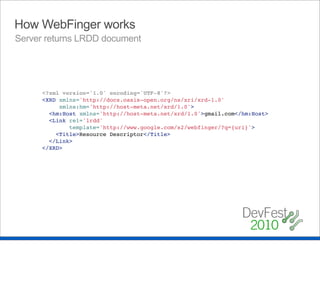
How WebFinger works
Server returns LRDD document


      <?xml version='1.0' encoding='UTF-8'?>
      <XRD xmlns='http://docs.oasis-open.org/ns/xri/xrd-1.0'
           xmlns:hm='http://host-meta.net/xrd/1.0'>
        <hm:Host xmlns='http://host-meta.net/xrd/1.0'>gmail.com</hm:Host>
        <Link rel='lrdd'
              template='http://www.google.com/s2/webfinger/?q={uri}'>
          <Title>Resource Descriptor</Title>
        </Link>
      </XRD>
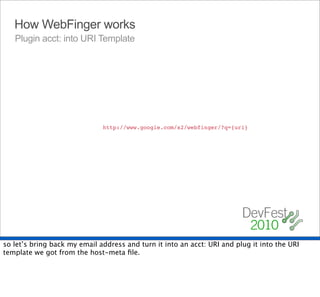
How WebFinger works
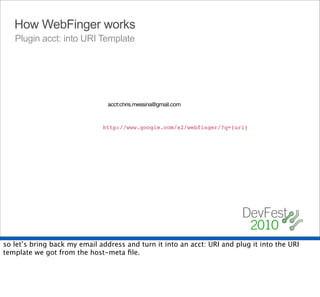
   Plugin acct: into URI Template


                              http://www.google.com/s2/webfinger/?q={uri}


so let’s bring back my email address and turn it into an acct: URI and plug it into the URI
template we got from the host-meta file.
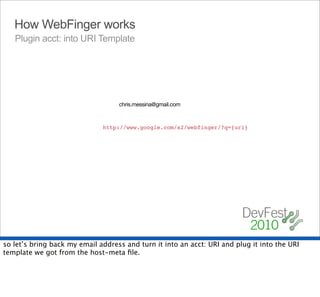
How WebFinger works
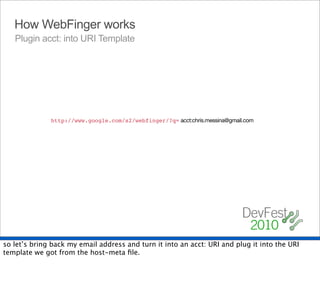
   Plugin acct: into URI Template


                                   chris.messina@gmail.com


                              http://www.google.com/s2/webfinger/?q={uri}


so let’s bring back my email address and turn it into an acct: URI and plug it into the URI
template we got from the host-meta file.
How WebFinger works
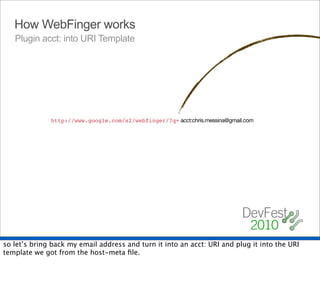
   Plugin acct: into URI Template


                                acct:chris.messina@gmail.com


                              http://www.google.com/s2/webfinger/?q={uri}


so let’s bring back my email address and turn it into an acct: URI and plug it into the URI
template we got from the host-meta file.
How WebFinger works
   Plugin acct: into URI Template


                                                    acct:chris.messina@gmail.com
              http://www.google.com/s2/webfinger/?q={uri}


so let’s bring back my email address and turn it into an acct: URI and plug it into the URI
template we got from the host-meta file.
How WebFinger works
   Plugin acct: into URI Template


                                                    acct:chris.messina@gmail.com
              http://www.google.com/s2/webfinger/?q={uri}


so let’s bring back my email address and turn it into an acct: URI and plug it into the URI
template we got from the host-meta file.
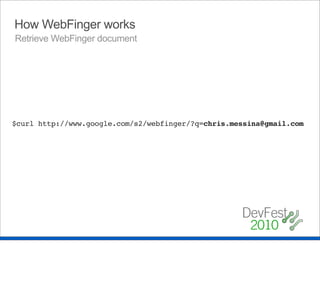
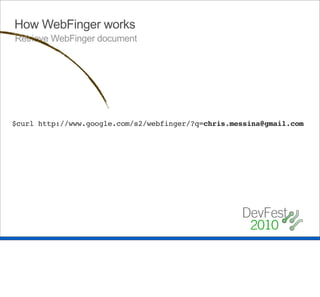
How WebFinger works
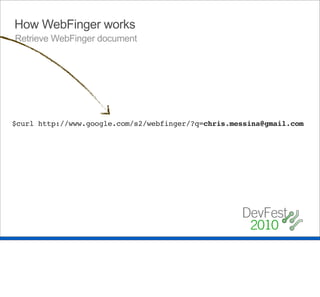
Retrieve WebFinger document


$curl http://www.google.com/s2/webfinger/?q=chris.messina@gmail.com
How WebFinger works
Retrieve WebFinger document


$curl http://www.google.com/s2/webfinger/?q=chris.messina@gmail.com
How WebFinger works
Retrieve WebFinger document


$curl http://www.google.com/s2/webfinger/?q=chris.messina@gmail.com
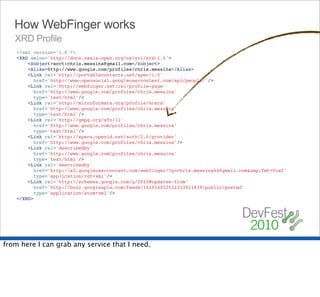
How WebFinger works
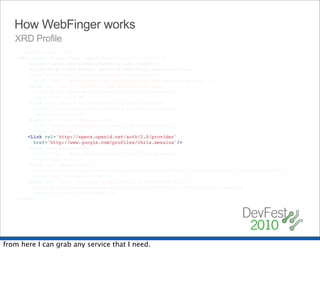
   XRD Profile
    <?xml version='1.0'?>
    <XRD xmlns='http://docs.oasis-open.org/ns/xri/xrd-1.0'>
    "   <Subject>acct:chris.messina@gmail.com</Subject>
    "   <Alias>http://www.google.com/profiles/chris.messina</Alias>
    "   <Link rel='http://portablecontacts.net/spec/1.0'
    "     href='http://www-opensocial.googleusercontent.com/api/people/'/>
    "   <Link rel='http://webfinger.net/rel/profile-page'
    "     href='http://www.google.com/profiles/chris.messina'
    "     type='text/html'/>
    "   <Link rel='http://microformats.org/profile/hcard'
    "     href='http://www.google.com/profiles/chris.messina'
    "     type='text/html'/>
    "   <Link rel='http://gmpg.org/xfn/11'
    "     href='http://www.google.com/profiles/chris.messina'
    "     type='text/html'/>
    "   <Link rel='http://specs.openid.net/auth/2.0/provider'
    "     href='http://www.google.com/profiles/chris.messina'/>
    "   <Link rel='describedby'
    "     href='http://www.google.com/profiles/chris.messina'
    "     type='text/html'/>
    "   <Link rel='describedby'
    "     href='http://s2.googleusercontent.com/webfinger/?q=chris.messina%40gmail.com&amp;fmt=foaf'
    "     type='application/rdf+xml'/>
    "   <Link rel='http://schemas.google.com/g/2010#updates-from'
    "     href='http://buzz.googleapis.com/feeds/102034052532213921839/public/posted'
    "     type='application/atom+xml'/>
    </XRD>


from here I can grab any service that I need.
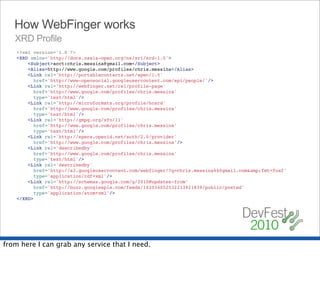
How WebFinger works
   XRD Profile
    <?xml version='1.0'?>
    <XRD xmlns='http://docs.oasis-open.org/ns/xri/xrd-1.0'>
    "   <Subject>acct:chris.messina@gmail.com</Subject>
    "   <Alias>http://www.google.com/profiles/chris.messina</Alias>
    "   <Link rel='http://portablecontacts.net/spec/1.0'
    "     href='http://www-opensocial.googleusercontent.com/api/people/'/>
    "   <Link rel='http://webfinger.net/rel/profile-page'
    "     href='http://www.google.com/profiles/chris.messina'
    "     type='text/html'/>
    "   <Link rel='http://microformats.org/profile/hcard'
    "     href='http://www.google.com/profiles/chris.messina'
    "     type='text/html'/>
    "   <Link rel='http://gmpg.org/xfn/11'
    "     href='http://www.google.com/profiles/chris.messina'
    "     type='text/html'/>
    "   <Link rel='http://specs.openid.net/auth/2.0/provider'
    "     href='http://www.google.com/profiles/chris.messina'/>
    "   <Link rel='describedby'
    "     href='http://www.google.com/profiles/chris.messina'
    "     type='text/html'/>
    "   <Link rel='describedby'
    "     href='http://s2.googleusercontent.com/webfinger/?q=chris.messina%40gmail.com&amp;fmt=foaf'
    "     type='application/rdf+xml'/>
    "   <Link rel='http://schemas.google.com/g/2010#updates-from'
    "     href='http://buzz.googleapis.com/feeds/102034052532213921839/public/posted'
    "     type='application/atom+xml'/>
    </XRD>


from here I can grab any service that I need.
How WebFinger works
   XRD Profile
    <?xml version='1.0'?>
    <XRD xmlns='http://docs.oasis-open.org/ns/xri/xrd-1.0'>
    "   <Subject>acct:chris.messina@gmail.com</Subject>
    "   <Alias>http://www.google.com/profiles/chris.messina</Alias>
    "   <Link rel='http://portablecontacts.net/spec/1.0'
    "     href='http://www-opensocial.googleusercontent.com/api/people/'/>
    "   <Link rel='http://webfinger.net/rel/profile-page'
    "     href='http://www.google.com/profiles/chris.messina'
    "     type='text/html'/>
    "   <Link rel='http://microformats.org/profile/hcard'
    "     href='http://www.google.com/profiles/chris.messina'
    "     type='text/html'/>
    "   <Link rel='http://gmpg.org/xfn/11'
    "     href='http://www.google.com/profiles/chris.messina'
    "     type='text/html'/>
    "   <Link rel='http://specs.openid.net/auth/2.0/provider'
    "     href='http://www.google.com/profiles/chris.messina'/>
    "   <Link rel='describedby'
    "     href='http://www.google.com/profiles/chris.messina'
    "     type='text/html'/>
    "   <Link rel='describedby'
    "     href='http://s2.googleusercontent.com/webfinger/?q=chris.messina%40gmail.com&amp;fmt=foaf'
    "     type='application/rdf+xml'/>
    "   <Link rel='http://schemas.google.com/g/2010#updates-from'
    "     href='http://buzz.googleapis.com/feeds/102034052532213921839/public/posted'
    "     type='application/atom+xml'/>
    </XRD>


from here I can grab any service that I need.
Putting it all together


                        Enter email:   Email     Connect


so let’s go back to the beginning of this flow.
Putting it all together


                        Enter email:   chris.messina@gmail.com   Connect


so let’s go back to the beginning of this flow.
Putting it all together


                        Enter email:   chris.messina@gmail.com   Connect


so let’s go back to the beginning of this flow.
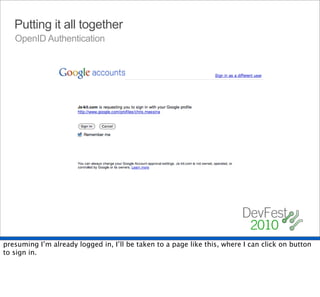
Putting it all together
   OpenID Authentication


presuming I’m already logged in, I’ll be taken to a page like this, where I can click on button
to sign in.
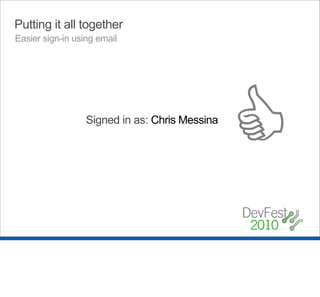
Putting it all together
Easier sign-in using email


                  Signed in as: Chris Messina

                                                
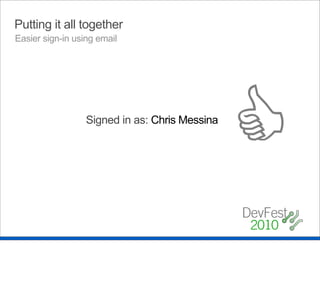
Putting it all together
Easier sign-in using email


                  Signed in as: Chris Messina

                                                
http://openid.net
                      http://webfinger.info


to learn more, this is where it all happens.
Friends & Contacts
Portable Contacts & OAuth
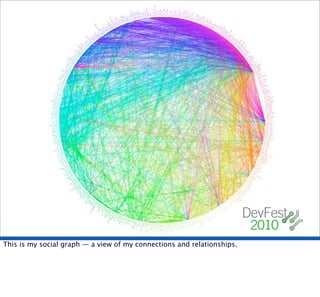
This is my social graph — a view of my connections and relationships.
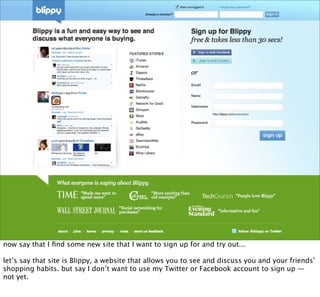
now say that I find some new site that I want to sign up for and try out...

let’s say that site is Blippy, a website that allows you to see and discuss you and your friends’
shopping habits. but say I don’t want to use my Twitter or Facebook account to sign up —
not yet.
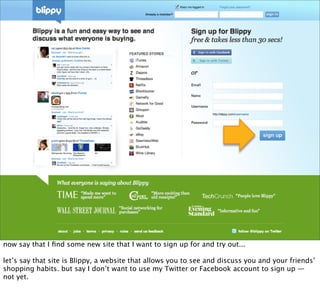
now say that I find some new site that I want to sign up for and try out...

let’s say that site is Blippy, a website that allows you to see and discuss you and your friends’
shopping habits. but say I don’t want to use my Twitter or Facebook account to sign up —
not yet.
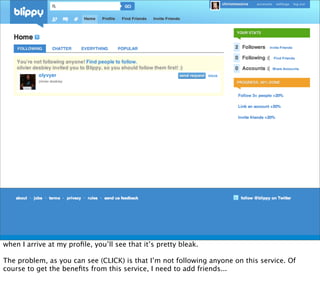
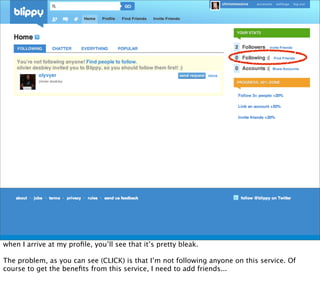
when I arrive at my profile, you’ll see that it’s pretty bleak.

The problem, as you can see (CLICK) is that I’m not following anyone on this service. Of
course to get the benefits from this service, I need to add friends...
when I arrive at my profile, you’ll see that it’s pretty bleak.

The problem, as you can see (CLICK) is that I’m not following anyone on this service. Of
course to get the benefits from this service, I need to add friends...
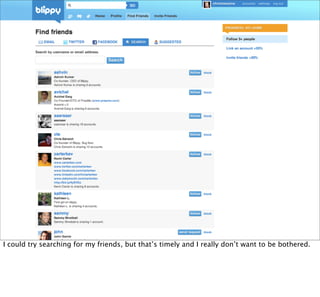
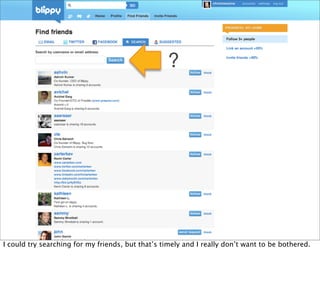
I could try searching for my friends, but that’s timely and I really don’t want to be bothered.
?


I could try searching for my friends, but that’s timely and I really don’t want to be bothered.
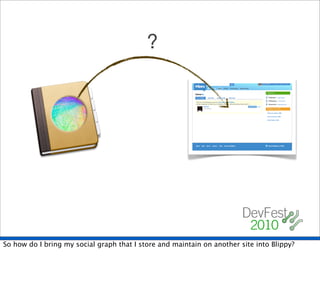
So how do I bring my social graph that I store and maintain on another site into Blippy?
?


So how do I bring my social graph that I store and maintain on another site into Blippy?
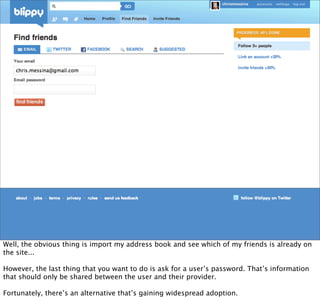
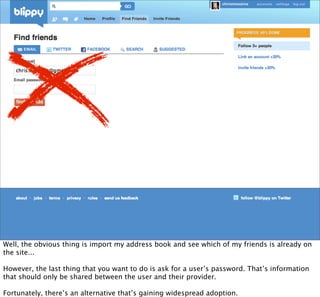
Well, the obvious thing is import my address book and see which of my friends is already on
the site...

However, the last thing that you want to do is ask for a user’s password. That’s information
that should only be shared between the user and their provider.

Fortunately, there’s an alternative that’s gaining widespread adoption.
Well, the obvious thing is import my address book and see which of my friends is already on
the site...

However, the last thing that you want to do is ask for a user’s password. That’s information
that should only be shared between the user and their provider.

Fortunately, there’s an alternative that’s gaining widespread adoption.
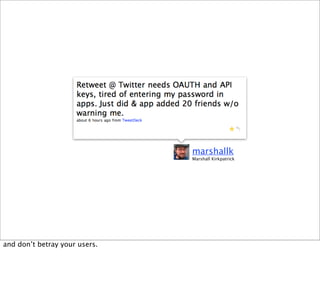
it’s just a bad idea. don’t do it, [CLICK]
marshallk
                               Marshall Kirkpatrick


and don’t betray your users.
anyway, the answer to the question of how to get the address book into Blippy safely? [CLICK]

Portable Contacts.
?


anyway, the answer to the question of how to get the address book into Blippy safely? [CLICK]

Portable Contacts.
Portable Contacts!


anyway, the answer to the question of how to get the address book into Blippy safely? [CLICK]

Portable Contacts.
Portable Contacts Primer
                           {
                             "startIndex": 10,
                             "itemsPerPage": 10,
                             "totalResults": 12,
                               {
                                 "id": "703887",
                                 "displayName": "Mark Hashimoto",
                                 "name": {
                                   "familyName": "Hashimoto",
                                   "givenName": "Mark"
                                 },
                                 "birthday": "0000-01-16",
                                 "gender": "male",
                                 "drinker": "heavily",
                                 "tags": [
                                   "plaxo guy"
                                 ],
                                 "emails": [
                                   {
                                     "value": "mhashimoto-04@plaxo.com",
                                     "type": "work",
                                     "primary": "true"
                                   },
                                   {
                                     "value": "mhashimoto@plaxo.com",
                                     "type": "home"
                                   }
                                 ],
                                 "urls": [
                                   {
                                     "value": "http://www.seeyellow.com",
                                     "type": "work"
                                   },

                               ...
                           }


So what does Portable Contacts look like? Your typical JSON feed...
Portable Contacts Primer
   Typical Response
                     {
                         {
                           "id": "1",
                           "name": "Chris Messina",
                           "urls": [
                             { "value": "http://factoryjoe.com/blog", "type": "blog" }
                           ]
                         },
                         {
                           "id": "2",
                           "name": "Joseph Smarr",
                           "emails": [
                             { "value": "joseph@plaxo.com", "type": "work", "primary": "true" },
                             { "value": "jsmarr@gmail.com", "type": "home" }
                           ],
                         }
                     }


with some handy filtering abilities.

So you take a basic PoCo snippet like this and tweak your API call...
Portable Contacts Primer
   filterBy=name&filterOp=startswith&filterValue=Chr
                        {
                            {
                              "id": "1",
                              "name": "Chris Messina",
                              "urls": [
                                { "value": "http://factoryjoe.com/blog", "type": "blog" }
                              ]
                            },
                            {
                              "id": "2",
                              "name": "Joseph Smarr",
                              "emails": [
                                { "value": "joseph@plaxo.com", "type": "work", "primary": "true" },
                                { "value": "jsmarr@gmail.com", "type": "home" }
                              ],
                            }
                        }


and you’ll get this..
Portable Contacts Primer
   filterBy=name&filterOp=contacts&filterValue=plaxo.com
                      {
                          {
                            "id": "1",
                            "name": "Chris Messina",
                            "urls": [
                              { "value": "http://factoryjoe.com/blog", "type": "blog" }
                            ]
                          },
                          {
                            "id": "2",
                            "name": "Joseph Smarr",
                            "emails": [
                              { "value": "joseph@plaxo.com", "type": "work", "primary": "true" },
                              { "value": "jsmarr@gmail.com", "type": "home" }
                            ],
                          }
                      }


change it again, and you’ll get this.
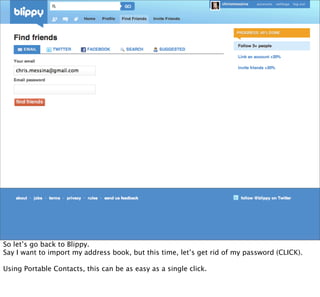
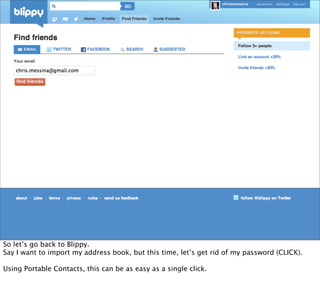
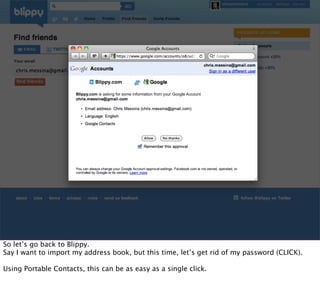
So let’s go back to Blippy.
Say I want to import my address book, but this time, let’s get rid of my password (CLICK).

Using Portable Contacts, this can be as easy as a single click.
So let’s go back to Blippy.
Say I want to import my address book, but this time, let’s get rid of my password (CLICK).

Using Portable Contacts, this can be as easy as a single click.
Blippy.com

                      Blippy.com is asking for some information from your Google Account


So let’s go back to Blippy.
Say I want to import my address book, but this time, let’s get rid of my password (CLICK).

Using Portable Contacts, this can be as easy as a single click.
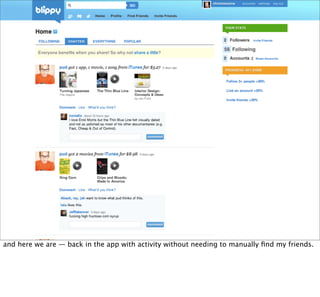
56 Following


and here we are — back in the app with activity without needing to manually find my friends.
http://portablecontacts.net


you can learn more at portablecontacts.net.
Now, the secret behind this is called OAuth.

How many people are familiar with OAuth?
Now, the secret behind this is called OAuth.

How many people are familiar with OAuth?
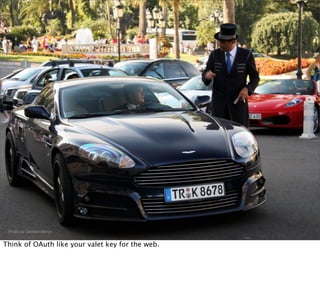
Photo by Damian Morys


Think of OAuth like your valet key for the web.
On the desktop


let’s take a look at how OAuth works on the desktop using the Yammer Adobe Air app.
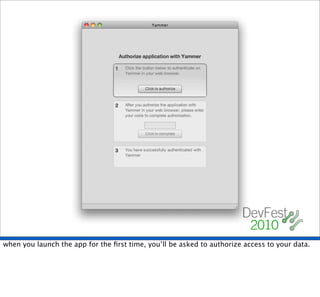
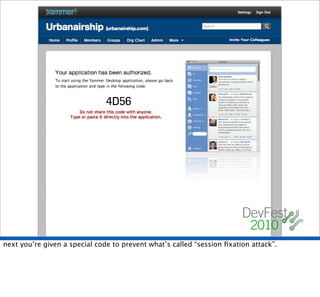
when you launch the app for the first time, you’ll be asked to authorize access to your data.
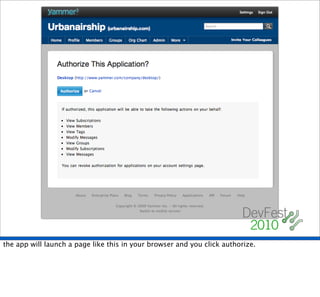
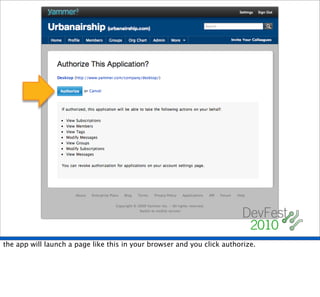
the app will launch a page like this in your browser and you click authorize.
4D56


next you’re given a special code to prevent what’s called “session fixation attack”.
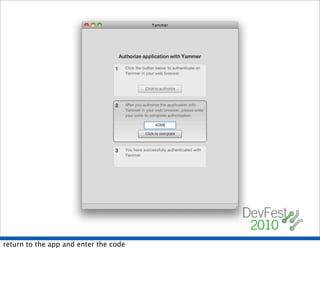
return to the app and enter the code
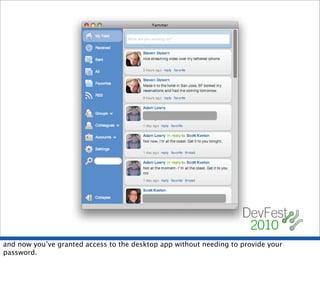
and now you’ve granted access to the desktop app without needing to provide your
password.
On the web
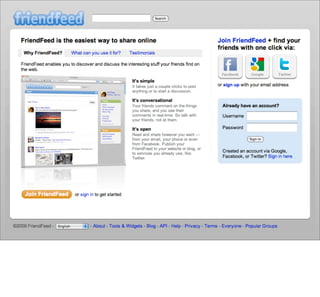
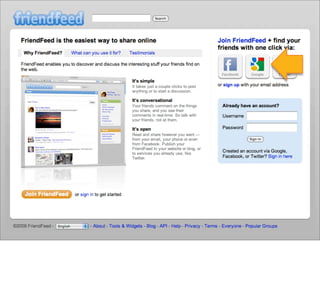
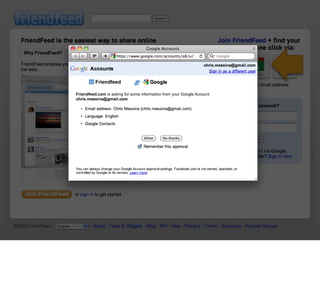
Friendfeed

Friendfeed.com is asking for some information from your Google Account
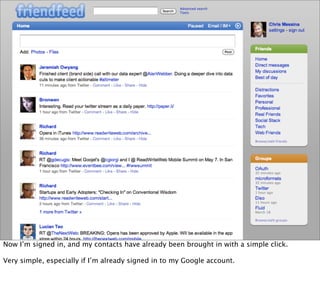
Now I’m signed in, and my contacts have already been brought in with a simple click.

Very simple, especially if I’m already signed in to my Google account.
On mobile
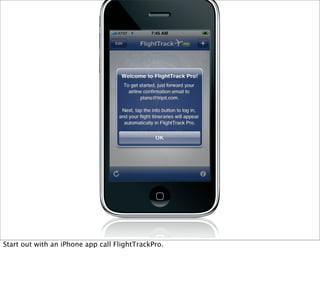
Start out with an iPhone app call FlightTrackPro.
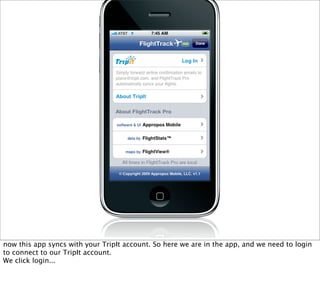
now this app syncs with your TripIt account. So here we are in the app, and we need to login
to connect to our TripIt account.
We click login...
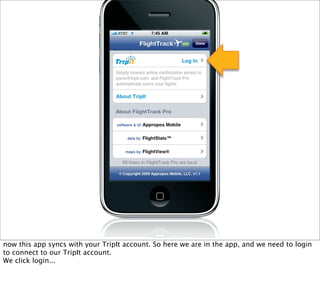
now this app syncs with your TripIt account. So here we are in the app, and we need to login
to connect to our TripIt account.
We click login...
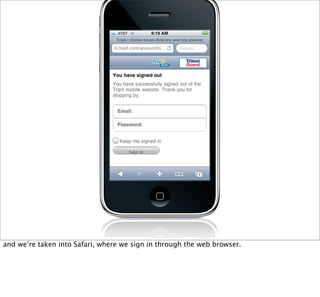
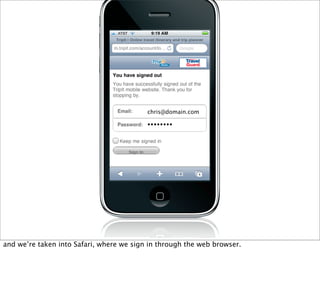
and we’re taken into Safari, where we sign in through the web browser.
chris@domain.com

                                          ••••••••


and we’re taken into Safari, where we sign in through the web browser.
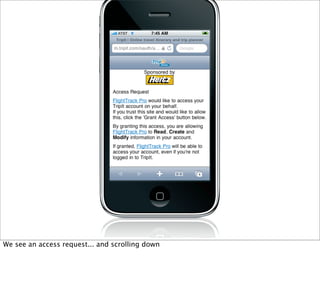
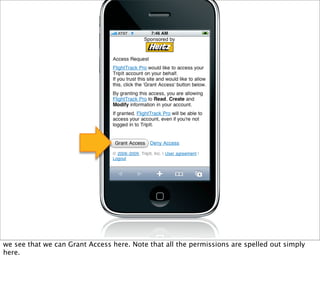
We see an access request... and scrolling down
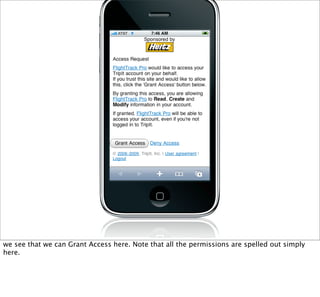
we see that we can Grant Access here. Note that all the permissions are spelled out simply
here.
we see that we can Grant Access here. Note that all the permissions are spelled out simply
here.
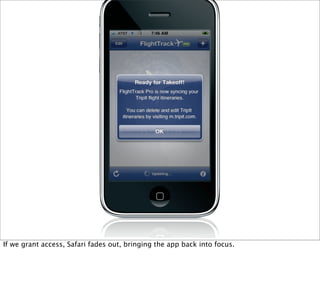
If we grant access, Safari fades out, bringing the app back into focus.
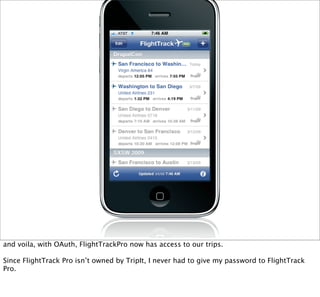
and voila, with OAuth, FlightTrackPro now has access to our trips.

Since FlightTrack Pro isn’t owned by TripIt, I never had to give my password to FlightTrack
Pro.
http://oauth.net


you can learn more at oauth.net
Activities
ActivityStreams
1999


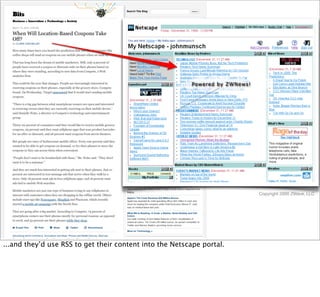
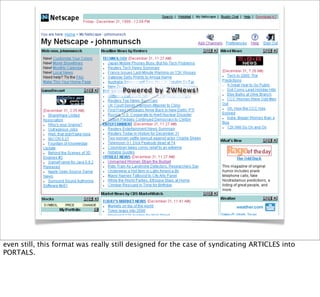
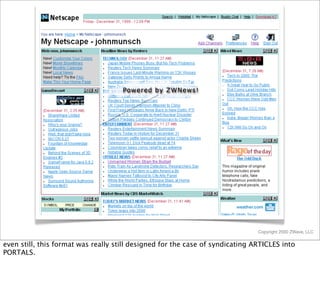
RSS 0.9 was introduced in 1999 by Netscape as a content-gathering mechanism for My
Netscape Network (MNN) back when portals were all the rage (pre-social networks).

By providing a simple snapshot-in-a-document, web site producers acquired audience
through the presence of their content on My Netscape.
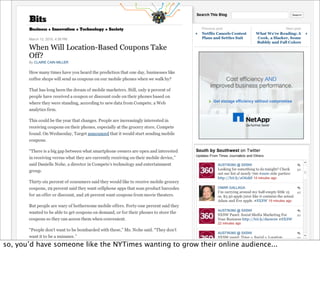
so, you’d have someone like the NYTimes wanting to grow their online audience...
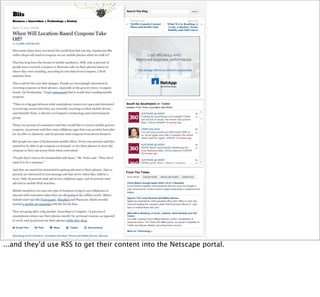
...and they’d use RSS to get their content into the Netscape portal.
Copyright 2000 ZWave, LLC


...and they’d use RSS to get their content into the Netscape portal.
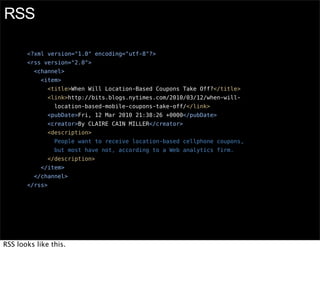
RSS

       <?xml version="1.0" encoding="utf-8"?>
       <rss version="2.0">
         <channel>
            <item>
              <title>When Will Location-Based Coupons Take Off?</title>
              <link>http://bits.blogs.nytimes.com/2010/03/12/when-will-
                location-based-mobile-coupons-take-off/</link>
              <pubDate>Fri, 12 Mar 2010 21:38:26 +0000</pubDate>
              <creator>By CLAIRE CAIN MILLER</creator>
              <description>
                People want to receive location-based cellphone coupons,
                but most have not, according to a Web analytics firm.
              </description>
            </item>
         </channel>
       </rss>


RSS looks like this.
RSS


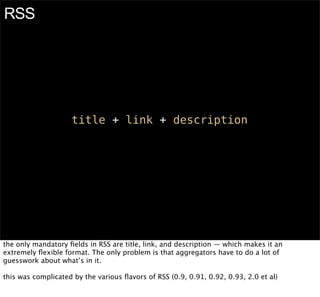
                    title + link + description


the only mandatory fields in RSS are title, link, and description — which makes it an
extremely flexible format. The only problem is that aggregators have to do a lot of
guesswork about what’s in it.

this was complicated by the various flavors of RSS (0.9, 0.91, 0.92, 0.93, 2.0 et al)
2005


this in 2005, a group of people got together to create a “better specified” syndication format
called Atom.
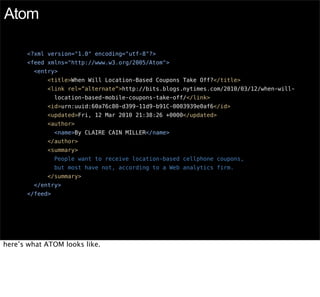
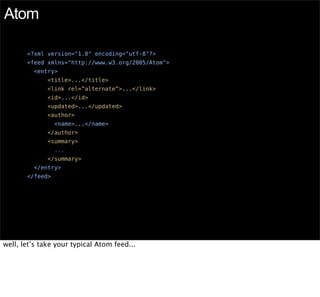
Atom

      <?xml version="1.0" encoding="utf-8"?>
      <feed xmlns="http://www.w3.org/2005/Atom">
        <entry>
            <title>When Will Location-Based Coupons Take Off?</title>
            <link rel=”alternate”>http://bits.blogs.nytimes.com/2010/03/12/when-will-
                location-based-mobile-coupons-take-off/</link>
            <id>urn:uuid:60a76c80-d399-11d9-b91C-0003939e0af6</id>
            <updated>Fri, 12 Mar 2010 21:38:26 +0000</updated>
            <author>
                <name>By CLAIRE CAIN MILLER</name>
            </author>
            <summary>
                People want to receive location-based cellphone coupons,
                but most have not, according to a Web analytics firm.
            </summary>
        </entry>
      </feed>


here’s what ATOM looks like.
Atom


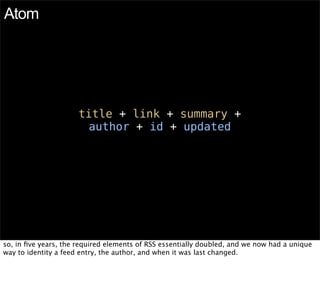
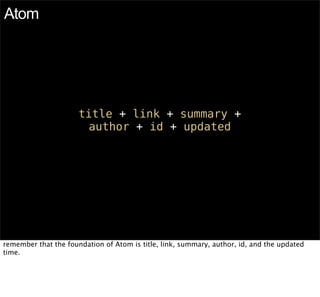
                      title + link + summary +
                       author + id + updated


so, in five years, the required elements of RSS essentially doubled, and we now had a unique
way to identity a feed entry, the author, and when it was last changed.
even still, this format was really still designed for the case of syndicating ARTICLES into
PORTALS.
Copyright 2000 ZWave, LLC


even still, this format was really still designed for the case of syndicating ARTICLES into
PORTALS.
2010
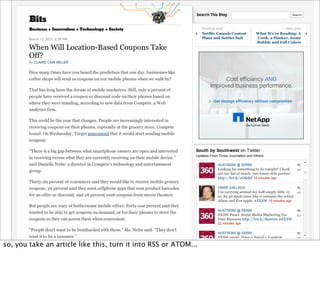
so, you take an article like this, turn it into RSS or ATOM...
and the most interesting thing the browser can do for you is turn this rich and well designed
page into something like this... [click]
and the most interesting thing the browser can do for you is turn this rich and well designed
page into something like this... [click]
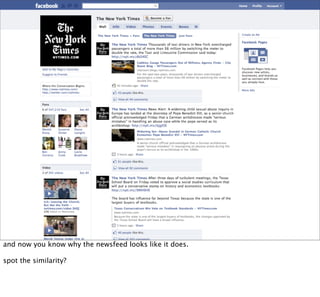
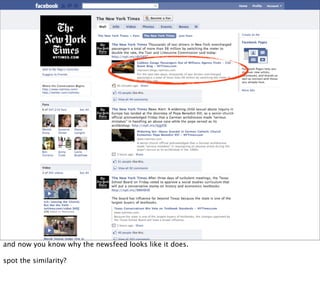
and now you know why the newsfeed looks like it does.

spot the similarity?
and now you know why the newsfeed looks like it does.

spot the similarity?
and yet we know that people are performing more and more activities online.

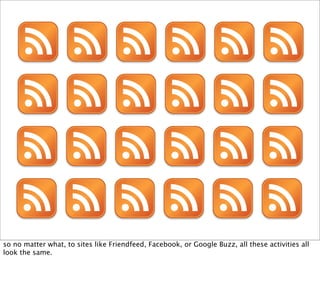
and yet, regardless of its type, sites only publish this information as RSS or Atom
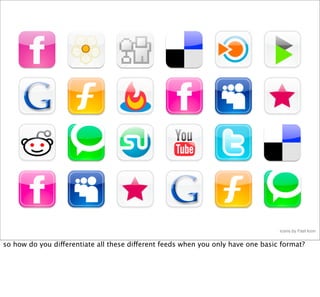
so no matter what, to sites like Friendfeed, Facebook, or Google Buzz, all these activities all
look the same.
icons by Fast Icon


so how do you differentiate all these different feeds when you only have one basic format?
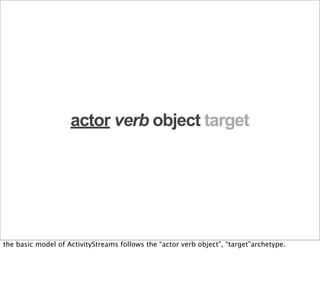
actor verb object target


the basic model of ActivityStreams follows the “actor verb object”, “target”archetype.
Atom

       <?xml version="1.0" encoding="utf-8"?>
       <feed xmlns="http://www.w3.org/2005/Atom">
         <entry>
              <title>...</title>
              <link rel=”alternate”>...</link>
              <id>...</id>
              <updated>...</updated>
              <author>
                 <name>...</name>
              </author>
              <summary>
                 ...
              </summary>
         </entry>
       </feed>


well, let’s take your typical Atom feed...
Atom


                      title + link + summary +
                       author + id + updated


remember that the foundation of Atom is title, link, summary, author, id, and the updated
time.
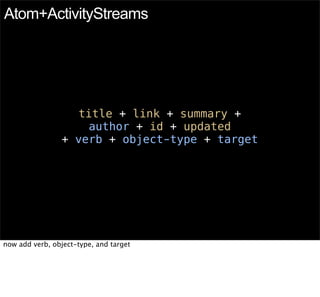
Atom+ActivityStreams


                   title + link + summary +
                     author + id + updated
                 + verb + object-type + target


now add verb, object-type, and target
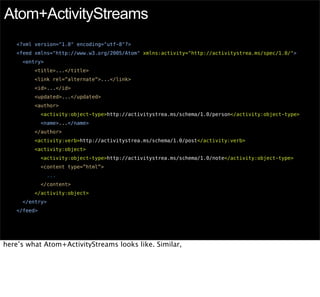
Atom+ActivityStreams
   <?xml version="1.0" encoding="utf-8"?>
   <feed xmlns="http://www.w3.org/2005/Atom" xmlns:activity="http://activitystrea.ms/spec/1.0/">
     <entry>
         <title>...</title>
         <link rel=”alternate”>...</link>
         <id>...</id>
         <updated>...</updated>
         <author>
             <activity:object-type>http://activitystrea.ms/schema/1.0/person</activity:object-type>
             <name>...</name>
         </author>
         <activity:verb>http://activitystrea.ms/schema/1.0/post</activity:verb>
         <activity:object>
             <activity:object-type>http://activitystrea.ms/schema/1.0/note</activity:object-type>
             <content type=”html”>
               ...
             </content>
         </activity:object>
     </entry>
   </feed>


here’s what Atom+ActivityStreams looks like. Similar,
Atom+ActivityStreams
    <?xml version="1.0" encoding="utf-8"?>
                                              xmlns:activity="http://activitystrea.ms/spec/1.0/"
    <feed xmlns="http://www.w3.org/2005/Atom" xmlns:activity="http://activitystrea.ms/spec/1.0/">
      <entry>
          <title>...</title>
          <link rel=”alternate”>...</link>
          <id>...</id>
          <updated>...</updated>
          <author>
              <activity:object-type>http://activitystrea.ms/schema/1.0/person</activity:object-type>
              <name>...</name>
          </author>
          <activity:verb>http://activitystrea.ms/schema/1.0/post</activity:verb>
          <activity:object>
              <activity:object-type>http://activitystrea.ms/schema/1.0/note</activity:object-type>
              <content type=”html”>
                ...
              </content>
          </activity:object>
      </entry>
    </feed>


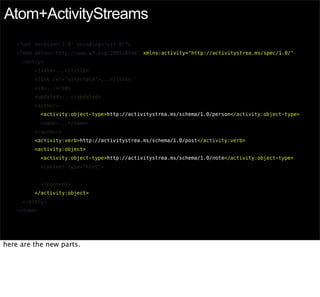
here are the new parts.
Atom+ActivityStreams
    <?xml version="1.0" encoding="utf-8"?>
    <feed xmlns="http://www.w3.org/2005/Atom" xmlns:activity="http://activitystrea.ms/spec/1.0/">
      <entry>
          <title>...</title>
          <link rel=”alternate”>...</link>
          <id>...</id>
          <updated>...</updated>
          <author>
                                                                       person
              <activity:object-type>http://activitystrea.ms/schema/1.0/person</activity:object-type>
              <name>...</name>
          </author>
                                                            post
          <activity:verb>http://activitystrea.ms/schema/1.0/post</activity:verb>
          <activity:object>
                                                                       note
              <activity:object-type>http://activitystrea.ms/schema/1.0/note</activity:object-type>
              <content type=”html”>
                ...
              </content>
          </activity:object>
      </entry>
    </feed>


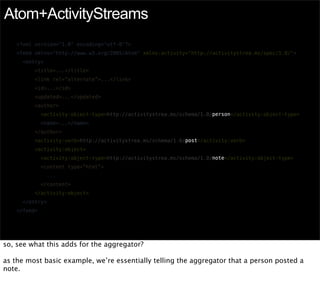
so, see what this adds for the aggregator?

as the most basic example, we’re essentially telling the aggregator that a person posted a
note.
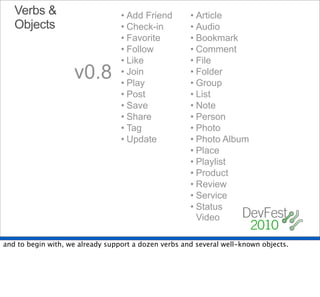
Verbs &
   Objects


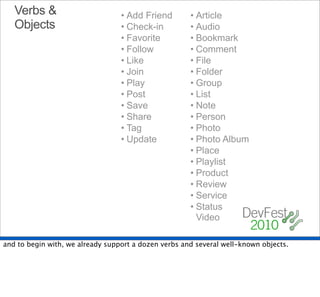
and to begin with, we already support a dozen verbs and several well-known objects.
Verbs &                        • Add Friend        • Article
   Objects                        • Check-in          • Audio
                                  • Favorite          • Bookmark
                                  • Follow            • Comment
                                  • Like              • File
                                  • Join              • Folder
                                  • Play              • Group
                                  • Post              • List
                                  • Save              • Note
                                  • Share             • Person
                                  • Tag               • Photo
                                  • Update            • Photo Album
                                                      • Place
                                                      • Playlist
                                                      • Product
                                                      • Review
                                                      • Service
                                                      • Status
                                                        Video

and to begin with, we already support a dozen verbs and several well-known objects.
Verbs &                        • Add Friend        • Article
   Objects                        • Check-in          • Audio
                                  • Favorite          • Bookmark
                                  • Follow            • Comment
                                  • Like              • File
                    v0.8          • Join
                                  • Play
                                                      • Folder
                                                      • Group
                                  • Post              • List
                                  • Save              • Note
                                  • Share             • Person
                                  • Tag               • Photo
                                  • Update            • Photo Album
                                                      • Place
                                                      • Playlist
                                                      • Product
                                                      • Review
                                                      • Service
                                                      • Status
                                                        Video

and to begin with, we already support a dozen verbs and several well-known objects.
Process


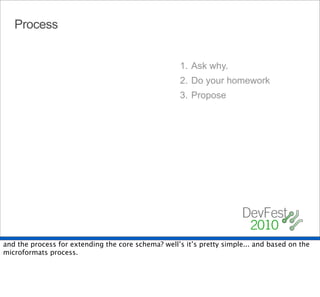
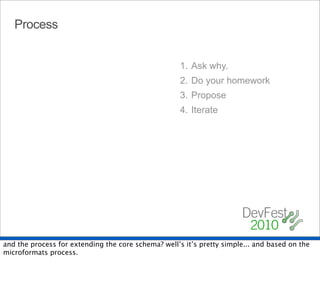
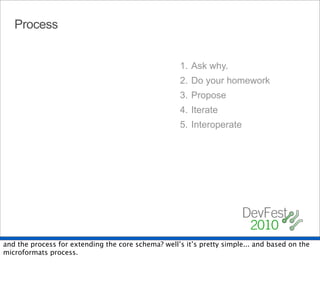
and the process for extending the core schema? well’s it’s pretty simple... and based on the
microformats process.
Process


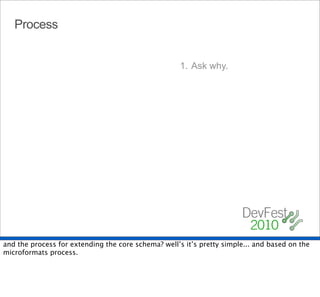
                                                     1. Ask why.


and the process for extending the core schema? well’s it’s pretty simple... and based on the
microformats process.
Process


                                                     1. Ask why.
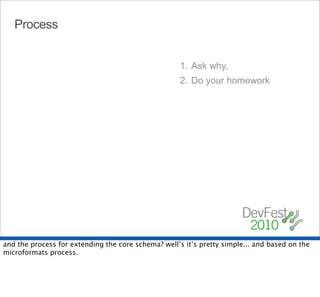
                                                     2. Do your homework


and the process for extending the core schema? well’s it’s pretty simple... and based on the
microformats process.
Process


                                                     1. Ask why.
                                                     2. Do your homework
                                                     3. Propose


and the process for extending the core schema? well’s it’s pretty simple... and based on the
microformats process.
Process


                                                     1. Ask why.
                                                     2. Do your homework
                                                     3. Propose
                                                     4. Iterate


and the process for extending the core schema? well’s it’s pretty simple... and based on the
microformats process.
Process


                                                     1. Ask why.
                                                     2. Do your homework
                                                     3. Propose
                                                     4. Iterate
                                                     5. Interoperate


and the process for extending the core schema? well’s it’s pretty simple... and based on the
microformats process.
http://activitystrea.ms


to learn more, this is where it all happens.

so, what does and activitystream-formatted feed look like?
Connect
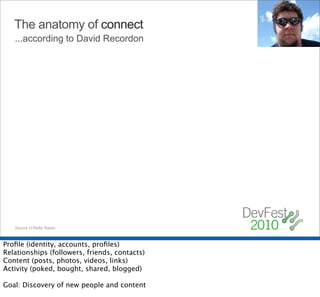
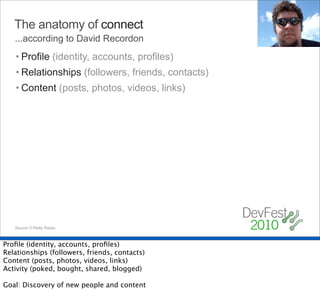
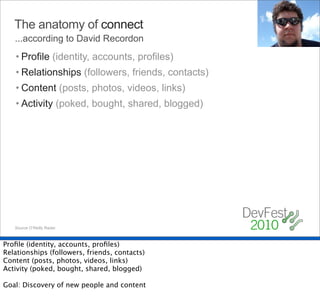
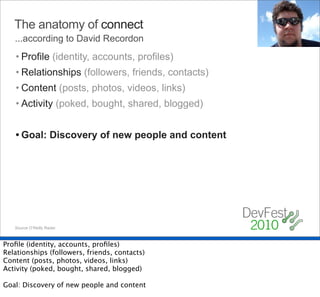
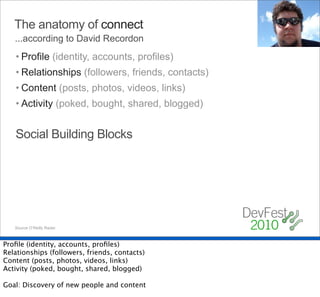
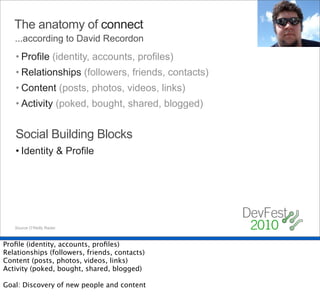
The anatomy of connect
   ...according to David Recordon


   Source O’Reilly Radar.


Profile (identity, accounts, profiles)
Relationships (followers, friends, contacts)
Content (posts, photos, videos, links)
Activity (poked, bought, shared, blogged)

Goal: Discovery of new people and content
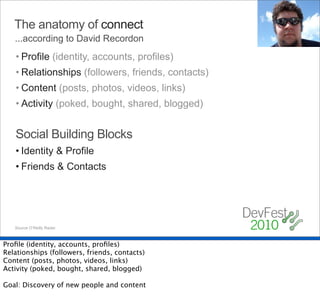
The anatomy of connect
   ...according to David Recordon
   • Profile (identity, accounts, profiles)


   Source O’Reilly Radar.


Profile (identity, accounts, profiles)
Relationships (followers, friends, contacts)
Content (posts, photos, videos, links)
Activity (poked, bought, shared, blogged)

Goal: Discovery of new people and content
The anatomy of connect
   ...according to David Recordon
   • Profile (identity, accounts, profiles)
   • Relationships (followers, friends, contacts)


   Source O’Reilly Radar.


Profile (identity, accounts, profiles)
Relationships (followers, friends, contacts)
Content (posts, photos, videos, links)
Activity (poked, bought, shared, blogged)

Goal: Discovery of new people and content
The anatomy of connect
   ...according to David Recordon
   • Profile (identity, accounts, profiles)
   • Relationships (followers, friends, contacts)
   • Content (posts, photos, videos, links)


   Source O’Reilly Radar.


Profile (identity, accounts, profiles)
Relationships (followers, friends, contacts)
Content (posts, photos, videos, links)
Activity (poked, bought, shared, blogged)

Goal: Discovery of new people and content
The anatomy of connect
   ...according to David Recordon
   • Profile (identity, accounts, profiles)
   • Relationships (followers, friends, contacts)
   • Content (posts, photos, videos, links)
   • Activity (poked, bought, shared, blogged)


   Source O’Reilly Radar.


Profile (identity, accounts, profiles)
Relationships (followers, friends, contacts)
Content (posts, photos, videos, links)
Activity (poked, bought, shared, blogged)

Goal: Discovery of new people and content
The anatomy of connect
   ...according to David Recordon
   • Profile (identity, accounts, profiles)
   • Relationships (followers, friends, contacts)
   • Content (posts, photos, videos, links)
   • Activity (poked, bought, shared, blogged)


   • Goal: Discovery of new people and content


   Source O’Reilly Radar.


Profile (identity, accounts, profiles)
Relationships (followers, friends, contacts)
Content (posts, photos, videos, links)
Activity (poked, bought, shared, blogged)

Goal: Discovery of new people and content
The anatomy of connect
   ...according to David Recordon
   • Profile (identity, accounts, profiles)
   • Relationships (followers, friends, contacts)
   • Content (posts, photos, videos, links)
   • Activity (poked, bought, shared, blogged)


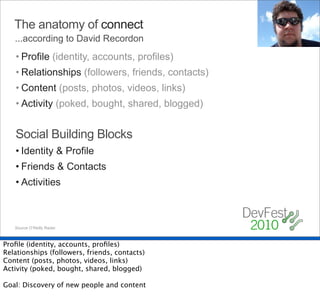
   Social Building Blocks


   Source O’Reilly Radar.


Profile (identity, accounts, profiles)
Relationships (followers, friends, contacts)
Content (posts, photos, videos, links)
Activity (poked, bought, shared, blogged)

Goal: Discovery of new people and content
The anatomy of connect
   ...according to David Recordon
   • Profile (identity, accounts, profiles)
   • Relationships (followers, friends, contacts)
   • Content (posts, photos, videos, links)
   • Activity (poked, bought, shared, blogged)


   Social Building Blocks
   • Identity & Profile


   Source O’Reilly Radar.


Profile (identity, accounts, profiles)
Relationships (followers, friends, contacts)
Content (posts, photos, videos, links)
Activity (poked, bought, shared, blogged)

Goal: Discovery of new people and content
The anatomy of connect
   ...according to David Recordon
   • Profile (identity, accounts, profiles)
   • Relationships (followers, friends, contacts)
   • Content (posts, photos, videos, links)
   • Activity (poked, bought, shared, blogged)


   Social Building Blocks
   • Identity & Profile
   • Friends & Contacts


   Source O’Reilly Radar.


Profile (identity, accounts, profiles)
Relationships (followers, friends, contacts)
Content (posts, photos, videos, links)
Activity (poked, bought, shared, blogged)

Goal: Discovery of new people and content
The anatomy of connect
   ...according to David Recordon
   • Profile (identity, accounts, profiles)
   • Relationships (followers, friends, contacts)
   • Content (posts, photos, videos, links)
   • Activity (poked, bought, shared, blogged)


   Social Building Blocks
   • Identity & Profile
   • Friends & Contacts
   • Activities


   Source O’Reilly Radar.


Profile (identity, accounts, profiles)
Relationships (followers, friends, contacts)
Content (posts, photos, videos, links)
Activity (poked, bought, shared, blogged)

Goal: Discovery of new people and content
Connect


and so I before I joined Google, I proposed a simple idea built upon all these open
technologies called OpenID Connect that ties all these technologies that I’ve told you about
together.

This concept is emerging and I think you’ll see some exciting moves in this area this year —
so I want to leave you with that vision for the future.
Google Search   I’m Feeling Lucky


and when you think about Google and the social web, I think it’s important to really consider
where we’re headed.
Google Search   I’m Feeling Lucky
                                                                Social


and when you think about Google and the social web, I think it’s important to really consider
where we’re headed.
this is what we think of when we think of the social web, and the most exciting thing about it
[CLICK]

is that there’s plenty of space for you to establish yourself and make a name for your app.
YOU


this is what we think of when we think of the social web, and the most exciting thing about it
[CLICK]

is that there’s plenty of space for you to establish yourself and make a name for your app.
messina@google.com   •   @chrismessina   •   factoryjoe.com
Don’t forget! GTUG Meetup at 6pm

Google and the Social Web (Mexico City Dev Fest 2010)

  • 1.
    messina@google.com • @chrismessina • factoryjoe.com
  • 2.
    @chris.messina buzz.google.com/chrismessina @chrismessina #devfest Hello. Here are some useful coordinates before we begin: chris.messina on Buzz; chrismessina on Twitter. The hashtag is #devfest
  • 3.
    Google y laWeb Social
  • 4.
    Google Search I’m Feeling Lucky So Google is thought of by most people to be a search company. But it’s actually an information company. Even still, there’s no reason why Google shouldn’t do more to enhance its information products with social information, helping to make more information that’s relevance, timely, and useful available to everyone.
  • 5.
    Google Search I’m Feeling Lucky Social So Google is thought of by most people to be a search company. But it’s actually an information company. Even still, there’s no reason why Google shouldn’t do more to enhance its information products with social information, helping to make more information that’s relevance, timely, and useful available to everyone.
  • 6.
    chris messina Google Search I’m Feeling Lucky Social So Google is thought of by most people to be a search company. But it’s actually an information company. Even still, there’s no reason why Google shouldn’t do more to enhance its information products with social information, helping to make more information that’s relevance, timely, and useful available to everyone.
  • 7.
    ? but there’s stilla question about what this should really look like. And a question about the right way for Google to get involved with and help advance the social web.
  • 8.
    Google Social Products ButGoogle has always had social products. From Google Talk to Reader to Docs...
  • 9.
    Google Social Products Google Talk Google Reader Google Docs But Google has always had social products. From Google Talk to Reader to Docs...
  • 10.
    Google Social Products Search Communicate, show & share Blog Search Blogger Find blogs on your favorite topics Share your life online with a blog - it's quick, easy and free Earth Calendar Explore the world from your computer Organize your schedule and share events with friends Maps Docs View maps and directions Create and share your online documents, presentations and spreadsheets Web Search Google Mail Search billions of web pages Fast, searchable email with less spam Groups Create mailing lists and discussion groups Orkut Meet new people and stay in touch with friends Picasa Find, edit and share your photos Reader Get all your blogs and news feeds fast Sites Create websites and secure group wikis Talk IM and call your friends through your computer Translate View web pages in other languages YouTube Watch, upload and share videos but in fact, there’s a much broader social story at Google — it just hasn’t revealed itself with the same degree of obviousness that we see elsewhere in the industry.
  • 11.
    In fact it’simportant to keep in mind that Google’s original algorithm, called PageRank is Google’s original “social web” product. How so?
  • 12.
    “PageRank can bethought of as a model of user behavior.” Sergey Brin and Larry Page, 1998 Well, in the original academic paper that described PageRank, Larry and Sergey said that PageRank “can be thought of as a model of user behavior.”
  • 13.
    At the time,the user model that they were describing was that of a user following links from one site to another — the “follow your nose” model of the “web of links”. From this kind of user behavior, the algorithm for PageRank was derived (click). While that model has changed over time, the basic premise that links indicate a social signals remains relevant.
  • 14.
    At the time,the user model that they were describing was that of a user following links from one site to another — the “follow your nose” model of the “web of links”. From this kind of user behavior, the algorithm for PageRank was derived (click). While that model has changed over time, the basic premise that links indicate a social signals remains relevant.
  • 15.
    At the time,the user model that they were describing was that of a user following links from one site to another — the “follow your nose” model of the “web of links”. From this kind of user behavior, the algorithm for PageRank was derived (click). While that model has changed over time, the basic premise that links indicate a social signals remains relevant.
  • 16.
    The signals thatwere once embedded in static HTML pages that could be crawled at one’s leisure are now predominantly being shared in social streams. And more importantly, the make up of social streams differs per person — which leads to an incredible opportunity to improve personalization and the relevance of search results.
  • 17.
    The signals thatwere once embedded in static HTML pages that could be crawled at one’s leisure are now predominantly being shared in social streams. And more importantly, the make up of social streams differs per person — which leads to an incredible opportunity to improve personalization and the relevance of search results.
  • 18.
    and so googlecan use those signals to personalize your search results, as they do with the social circle feature.
  • 19.
    and so googlecan use those signals to personalize your search results, as they do with the social circle feature.
  • 20.
    which brings usto Buzz, Google’s latest baby entry into the social web.
  • 21.
    This is whatBuzz looks like in Gmail, in case you haven’t seen it.
  • 22.
    it also givesyou a nice way to interact with media right from within buzz.
  • 23.
  • 31.
  • 32.
    Google Buzz andthe social web
  • 33.
    “ The bestway to get a sense of where the Buzz API is heading is to take a look at http://code.google.com/ apis/buzz/. You'll notice that the “coming soon” section mentions a ton of protocols—Activity Streams, Atom, AtomPub, MediaRSS, WebFinger, PubSubHubbub, Salmon, OAuth, XFN, etc. DeWitt Clinton, Google Photo by Joi Ito “The best way to get a sense of where the Buzz API is heading is to take a look at http:// code.google.com/apis/buzz/. You'll notice that the “coming soon” section mentions a ton of protocols—Activity Streams, Atom, AtomPub, MediaRSS, WebFinger, PubSubHubbub, Salmon, OAuth, XFN, etc.
  • 34.
    “ What itdoesn't talk much about is Google. That's because the goal isn't Google specific at all. The idea is that someday, any host on the web should be able to implement these open protocols and send messages back and forth in real time with users from any network, without any one company in the middle. DeWitt Clinton, Google Photo by Joi Ito “What it doesn't talk much about is Google. That's because the goal isn't Google specific at all. The idea is that someday, any host on the web should be able to implement these open protocols and send messages back and forth in real time with users from any network, without any one company in the middle.
  • 35.
    “ What itdoesn't talk much about is Google. That's because the goal isn't Google specific at all. The idea is that someday, any host on the web should be able to implement these open protocols and send messages back and forth in real time with users from any network, without any one company in the middle. DeWitt Clinton, Google Photo by Joi Ito “What it doesn't talk much about is Google. That's because the goal isn't Google specific at all. The idea is that someday, any host on the web should be able to implement these open protocols and send messages back and forth in real time with users from any network, without any one company in the middle.
  • 36.
    “ The webcontains the social graph, the protocols are standard web protocols, the messages can contain whatever crazy stuff people think to put in them. Google Buzz will be just another node (a very good node, I hope) among many peers.” DeWitt Clinton, Google Photo by Joi Ito “The web contains the social graph, the protocols are standard web protocols, the messages can contain whatever crazy stuff people think to put in them. Google Buzz will be just another node (a very good node, I hope) among many peers.”
  • 37.
    “ The webcontains the social graph, the protocols are standard web protocols, the messages can contain whatever crazy stuff people think to put in them. Google Buzz will be just another node (a very good node, I hope) among many peers.” DeWitt Clinton, Google Photo by Joi Ito This is really important. The goal of Google Buzz, while on the one hand is create an excellent social experience on the web, is also to adopt and make use of technologies that expand the size and participation on the social web.
  • 38.
    What is thesocial web?
  • 39.
    Image from theOpte Project So if this is the web, it’s important to understand that the goal is NOT for Google to own the web. On the contrary... [CLICK]
  • 40.
    { } Image from the Opte Project So if this is the web, it’s important to understand that the goal is NOT for Google to own the web. On the contrary... [CLICK]
  • 41.
    { } Image from the Opte Project So if this is the web, it’s important to understand that the goal is NOT for Google to own the web. On the contrary... [CLICK]
  • 42.
    Image from theOpte Project So if this is the web, it’s important to understand that the goal is NOT for Google to own the web. On the contrary... [CLICK]
  • 43.
    Image from theOpte Project the goal is for there to be many different players on the open web, providing choice for people, and competing to offer the best services around. And this isn’t just for the bigger or more popular services. The goal is for a much larger, more interconnected social web to grow larger.
  • 44.
    Image from theOpte Project the goal is for there to be many different players on the open web, providing choice for people, and competing to offer the best services around. And this isn’t just for the bigger or more popular services. The goal is for a much larger, more interconnected social web to grow larger.
  • 45.
    Image from theOpte Project the goal is for there to be many different players on the open web, providing choice for people, and competing to offer the best services around. And this isn’t just for the bigger or more popular services. The goal is for a much larger, more interconnected social web to grow larger.
  • 46.
    The web isbetter when it’s social The web is better when it’s social. And that means that we want to make sure that every page and site on the web can offer social functionality, and compelling social experiences.
  • 47.
    What do Imean by social? it’s about enabling new verbs on the web... verbs like follow, share, discuss, comment, mention, like, rate,
  • 48.
    I saw thisin a local supermarket back home in San Francisco. I’ve seen similar signs all over the Mission, where I live.
  • 49.
    This is wherethe social web begins — an invitation from the real world to join others online. But the social web is about much more. However...
  • 50.
    “Find us onFacebook” “Follow us on Twitter” This is where the social web begins — an invitation from the real world to join others online. But the social web is about much more. However...
  • 51.
    Engagement & interaction Thisis where the social web begins — an invitation from the real world to join others online. But the social web is about much more. However...
  • 52.
    Consuming Participating Source: groundswell.forrester.com ...current trends indicate a 1-10-90 (the math doesn’t add up, no) split on creators, commentors, and consumers. our challenge is to flip that trend [CLICK] — to help people feel more comfortable sharing online.
  • 53.
    Participating Consuming Source: groundswell.forrester.com ...current trends indicate a 1-10-90 (the math doesn’t add up, no) split on creators, commentors, and consumers. our challenge is to flip that trend [CLICK] — to help people feel more comfortable sharing online.
  • 54.
    Google has developedOpenSocial and Friend Connect with that challenge in mind... and has found some positive successes. But we’re not done yet. In fact, I’d argue that we’re just getting started.
  • 55.
    • There are40 or more active OpenSocial containers • ...representing 820 million users worldwide (June 2009) • 15,000 OpenSocial applications running on these social networks • 315M+ app installs across these social networks Google has developed OpenSocial and Friend Connect with that challenge in mind... and has found some positive successes. But we’re not done yet. In fact, I’d argue that we’re just getting started.
  • 56.
    • There are40 or more active • Tens of thousands of sites and OpenSocial containers millions of blogs are using Friend Connect, and these numbers • ...representing 820 million users continue to grow. worldwide (June 2009) • 9 million 30-day-active friend • 15,000 OpenSocial applications connected sites (December running on these social networks 2009) • 315M+ app installs across these • 160,000 joins/day (which is social networks >1/second) (December 2009) Google has developed OpenSocial and Friend Connect with that challenge in mind... and has found some positive successes. But we’re not done yet. In fact, I’d argue that we’re just getting started.
  • 57.
    OpenSocial, Friend Connect,and the middle Site Complexity Long tail The way I see it, Google has already invested a considerable amount of resources working with partners to develop technology for the head of the tail — the OpenSocial “containers”. Google has also worked hard on Google Friend Connect. It’s the middle here that we’re looking at working on now — whose needs will be covered by a series of emerging, open building blocks that we call the “social stack”.
  • 58.
    OpenSocial, Friend Connect,and the middle Site Complexity Long tail The way I see it, Google has already invested a considerable amount of resources working with partners to develop technology for the head of the tail — the OpenSocial “containers”. Google has also worked hard on Google Friend Connect. It’s the middle here that we’re looking at working on now — whose needs will be covered by a series of emerging, open building blocks that we call the “social stack”.
  • 59.
    OpenSocial, Friend Connect,and the middle Site Complexity Long tail The way I see it, Google has already invested a considerable amount of resources working with partners to develop technology for the head of the tail — the OpenSocial “containers”. Google has also worked hard on Google Friend Connect. It’s the middle here that we’re looking at working on now — whose needs will be covered by a series of emerging, open building blocks that we call the “social stack”.
  • 60.
    OpenSocial, Friend Connect,and the middle Social Stack Site Complexity Long tail The way I see it, Google has already invested a considerable amount of resources working with partners to develop technology for the head of the tail — the OpenSocial “containers”. Google has also worked hard on Google Friend Connect. It’s the middle here that we’re looking at working on now — whose needs will be covered by a series of emerging, open building blocks that we call the “social stack”.
  • 61.
    OpenSocial, Friend Connect,and the middle Social Stack Site Complexity Long tail The way I see it, Google has already invested a considerable amount of resources working with partners to develop technology for the head of the tail — the OpenSocial “containers”. Google has also worked hard on Google Friend Connect. It’s the middle here that we’re looking at working on now — whose needs will be covered by a series of emerging, open building blocks that we call the “social stack”.
  • 62.
  • 63.
    Social Building Blocks • Identity & Profile Here’s how.
  • 64.
    Social Building Blocks • Identity & Profile • Friends & Contacts Here’s how.
  • 65.
    Social Building Blocks • Identity & Profile • Friends & Contacts • Activities Here’s how.
  • 66.
    Social Building Blocks • Identity & Profile • Friends & Contacts • Activities • Connect Here’s how.
  • 67.
    Social Building Blocks • Identity & Profile • Friends & Contacts • Activities • Connect The Glue Here’s how.
  • 68.
    Social Building Blocks • Identity & Profile • Friends & Contacts • Activities • Connect The Glue • Email-style Identifiers (WebFinger) Here’s how.
  • 69.
    Social Building Blocks • Identity & Profile • Friends & Contacts • Activities • Connect The Glue • Email-style Identifiers (WebFinger) • Service Discovery (LRDD) Here’s how.
  • 70.
    Social Building Blocks • Identity & Profile • Friends & Contacts • Activities • Connect The Glue • Email-style Identifiers (WebFinger) • Service Discovery (LRDD) • Service Authorization (OAuth) Here’s how.
  • 71.
    Social Building Blocks • Identity & Profile • Friends & Contacts • Activities • Connect The Glue • Email-style Identifiers (WebFinger) • Service Discovery (LRDD) • Service Authorization (OAuth) • Distributed Conversations (Salmon) Here’s how.
  • 72.
    Social Building Blocks • Identity & Profile • Friends & Contacts • Activities • Connect The Glue • Email-style Identifiers (WebFinger) • Service Discovery (LRDD) • Service Authorization (OAuth) • Distributed Conversations (Salmon) • Real-time Publishing (PubSubHubbub) Here’s how.
  • 73.
  • 74.
  • 76.
    Photo by TeresaStanton OpenID is like a personal skeleton key for all your web accounts. By using an account that you already have to sign up for another website, not only is it more convenient, but you are able to start developing your own universal web identity — that, if you CHOOSE TO, you can own.
  • 77.
    Why is OpenIDimportant? * People use different identities for different purposes * Ultimately choice and competition is a good thing to foster in this early landscape. * With greater diversity of providers, publishers may see the potential for wider distribution of shareable content. * Digital identity is in its infancy now; the final chapter has not yet been written.
  • 78.
    Why is OpenIDimportant? • People use different identities for different purposes * People use different identities for different purposes * Ultimately choice and competition is a good thing to foster in this early landscape. * With greater diversity of providers, publishers may see the potential for wider distribution of shareable content. * Digital identity is in its infancy now; the final chapter has not yet been written.
  • 79.
    Why is OpenIDimportant? • People use different identities for different purposes • Ultimately choice and competition is a good thing to foster in this early landscape. * People use different identities for different purposes * Ultimately choice and competition is a good thing to foster in this early landscape. * With greater diversity of providers, publishers may see the potential for wider distribution of shareable content. * Digital identity is in its infancy now; the final chapter has not yet been written.
  • 80.
    Why is OpenIDimportant? • People use different identities for different purposes • Ultimately choice and competition is a good thing to foster in this early landscape. • With greater diversity of providers, publishers may see the potential for wider distribution of shareable content. * People use different identities for different purposes * Ultimately choice and competition is a good thing to foster in this early landscape. * With greater diversity of providers, publishers may see the potential for wider distribution of shareable content. * Digital identity is in its infancy now; the final chapter has not yet been written.
  • 81.
    Why is OpenIDimportant? • People use different identities for different purposes • Ultimately choice and competition is a good thing to foster in this early landscape. • With greater diversity of providers, publishers may see the potential for wider distribution of shareable content. • Digital identity is in its infancy now; the final chapter has not yet been written. * People use different identities for different purposes * Ultimately choice and competition is a good thing to foster in this early landscape. * With greater diversity of providers, publishers may see the potential for wider distribution of shareable content. * Digital identity is in its infancy now; the final chapter has not yet been written.
  • 82.
    Now, unfortunately thisis what OpenID often looks like today.
  • 83.
    when people reallyjust want this. their goal is to get access to their account To be fair, this is merely an uncomfortable transitional step along a much longer path towards open identity on the web. it is a means to an end, but not the end that we seek.
  • 84.
    when people reallyjust want this. their goal is to get access to their account To be fair, this is merely an uncomfortable transitional step along a much longer path towards open identity on the web. it is a means to an end, but not the end that we seek.
  • 85.
    so this interface— with all these buttons, is what we call the “NASCAR”, which is named after the cars in the popular american racing sport.
  • 86.
    Photo by TimothyVogel the result is what we call the “OpenID NASCAR” where everyone wants their brand shown on login forms.... But it’s this way for an important reason. People want — and exercise — choice when logging in.
  • 87.
    Contextual identity And asmore relying parties come online, it’s increasing important that there is choice in identity providers. For example, the OpenID that you might want to use to sign in to Basecamp may be different from the one that you want to use to sign in to Lady Gaga’s website. And that idea proves out in case after case.
  • 88.
    Unique OpenID RelyingParties As of July 1, 2009 Data from Janrain So as we’ve seen an explosion in the number of OpenID relying parties in the last five years — users are carefully considering which account they want to use to sign in.
  • 89.
    Unique OpenID RelyingParties As of July 1, 2009 50,000 40,000 30,000 20,000 10,000 0 5 06 06 06 6 07 07 07 7 08 08 08 8 09 09 /0 /0 /0 /0 1/ 4/ 7/ 1/ 4/ 7/ 1/ 4/ 7/ 1/ 7/ 10 10 10 Data from Janrain 10 So as we’ve seen an explosion in the number of OpenID relying parties in the last five years — users are carefully considering which account they want to use to sign in.
  • 90.
    Unique OpenID RelyingParties As of July 1, 2009 50,000 40,000 30,000 20,000 10,000 0 5 06 06 06 6 07 07 07 7 08 08 08 8 09 09 /0 /0 /0 /0 1/ 4/ 7/ 1/ 4/ 7/ 1/ 4/ 7/ 1/ 7/ 10 10 10 Data from Janrain 10 So as we’ve seen an explosion in the number of OpenID relying parties in the last five years — users are carefully considering which account they want to use to sign in.
  • 91.
    Companies that haveadopted OpenID So who’s actually adopted OpenID? Well, as that chart suggests, there’s a lot of folks out there. And there are more coming online everyday.
  • 92.
    Companies that haveadopted OpenID So who’s actually adopted OpenID? Well, as that chart suggests, there’s a lot of folks out there. And there are more coming online everyday.
  • 93.
    OpenID Usage Trends Thisis some data from a company called Janrain that makes a product called RPX which makes it easy to integrate third-party authentication services.
  • 94.
    OpenID usage trends UserVoice Providers 13% 19% 9% 4% 2% 1% 1% 1% 52% Google Facebook Yahoo! MyOpenID Other AOL VeriSign PIP Blogger ClaimID Chart from Janrain, January 2009 I want you to look at these graphs very carefully. Each color represents a different identity provider.
  • 95.
    OpenID usage trends Interscope Records Providers 43% 19% 12% 1% 2% 0% 24% Google Facebook Yahoo! MyOpenID Other AOL MySpace Chart from Janrain, January 2009 ...and on each site, people use different identity providers depending on the context. INTERSCOPE — Facebook, MySpace, Yahoo, Google
  • 96.
    OpenID usage trends sulit.com.ph Providers 24% 10% 1% 1% 0% 64% Yahoo! Google Facebook MySpace AOL Other Chart from Janrain, January 2009 Especially when you’re thinking about an international audience, everything changes. Yahoo, Google, Facebook
  • 97.
    OpenID usage trends Sign in preferences across all Janrain properties 11.4% 6.3% 18.3% Google Facebook 26.6% Yahoo! Twitter Other (MySpace, Windows Live, AOL, etc) 37.4% Chart from Janrain, April 2009 Especially when you’re thinking about an international audience, everything changes.
  • 98.
    Making OpenID easier oneof the challenges of OpenID has been figuring out how to make OpenID easier. One of the biggest challenges is helping people to know what their OpenID is and to remember it.
  • 99.
    people can remembertheir address, their phone number, AOL screenname, email, MySpace... Twitter... Facebook? Gmail...? OpenID?
  • 100.
    • What’s youraddress? people can remember their address, their phone number, AOL screenname, email, MySpace... Twitter... Facebook? Gmail...? OpenID?
  • 101.
    • What’s youraddress? • What’s your phone number? people can remember their address, their phone number, AOL screenname, email, MySpace... Twitter... Facebook? Gmail...? OpenID?
  • 102.
    • What’s youraddress? • What’s your phone number? • What’s your AOL screenname? people can remember their address, their phone number, AOL screenname, email, MySpace... Twitter... Facebook? Gmail...? OpenID?
  • 103.
    • What’s youraddress? • What’s your phone number? • What’s your AOL screenname? • What’s your email address? people can remember their address, their phone number, AOL screenname, email, MySpace... Twitter... Facebook? Gmail...? OpenID?
  • 104.
    • What’s youraddress? • What’s your phone number? • What’s your AOL screenname? • What’s your email address? • What’s your MySpace? people can remember their address, their phone number, AOL screenname, email, MySpace... Twitter... Facebook? Gmail...? OpenID?
  • 105.
    • What’s youraddress? • What’s your phone number? • What’s your AOL screenname? • What’s your email address? • What’s your MySpace? • Twitter? people can remember their address, their phone number, AOL screenname, email, MySpace... Twitter... Facebook? Gmail...? OpenID?
  • 106.
    • What’s youraddress? • What’s your phone number? • What’s your AOL screenname? • What’s your email address? • What’s your MySpace? • Twitter? • Are you on Facebook? people can remember their address, their phone number, AOL screenname, email, MySpace... Twitter... Facebook? Gmail...? OpenID?
  • 107.
    • What’s youraddress? • What’s your phone number? • What’s your AOL screenname? • What’s your email address? • What’s your MySpace? • Twitter? • Are you on Facebook? • What’s your Gmail? people can remember their address, their phone number, AOL screenname, email, MySpace... Twitter... Facebook? Gmail...? OpenID?
  • 108.
    • What’s youraddress? • What’s your phone number? • What’s your AOL screenname? • What’s your email address? • What’s your MySpace? • Twitter? • Are you on Facebook? • What’s your Gmail? • What’s your OpenID? people can remember their address, their phone number, AOL screenname, email, MySpace... Twitter... Facebook? Gmail...? OpenID?
  • 109.
    • What’s youraddress? • What’s your phone number? • What’s your AOL screenname? • What’s your email address? • What’s your MySpace? • Twitter? • Are you on Facebook? • What’s your Gmail? • What’s your OpenID? turns out that email addresses seem to be much more universal and memorable than an “OpenID”, and so the OpenID community has been working on ways to make it possible to use an email address as a way to bootstrap the OpenID authentication process. (more on that later)
  • 110.
    • What’s youraddress? • What’s your phone number? • What’s your AOL screenname? • What’s your email address? • What’s your MySpace? • Twitter? • Are you on Facebook? • What’s your Gmail? • What’s your OpenID? turns out that email addresses seem to be much more universal and memorable than an “OpenID”, and so the OpenID community has been working on ways to make it possible to use an email address as a way to bootstrap the OpenID authentication process. (more on that later)
  • 111.
    which brings usto WebFinger.
  • 112.
  • 113.
    The Hammer Stack Discovery for the open web WebFinger relies on an emerging set of technologies and formats that together we call “The Hammer Stack”
  • 114.
    How WebFinger works Enter email: Email Connect
  • 115.
    How WebFinger works Enter email: chris.messina@gmail.com Connect
  • 116.
    How WebFinger works Enter email: chris.messina@gmail.com Connect
  • 117.
    How WebFinger works Discovering a user’s WebFinger profile chris.messina@gmail.com So here’s the identifier that the user supplied. We take it and split it at the @ symbol, and use host-meta to pull the user’s WebFinger.
  • 118.
    How WebFinger works Discovering a user’s WebFinger profile chris.messina@gmail.com { local account So here’s the identifier that the user supplied. We take it and split it at the @ symbol, and use host-meta to pull the user’s WebFinger.
  • 119.
    How WebFinger works Discovering a user’s WebFinger profile chris.messina@gmail.com { realm So here’s the identifier that the user supplied. We take it and split it at the @ symbol, and use host-meta to pull the user’s WebFinger.
  • 120.
    How WebFinger works Discovering a user’s WebFinger profile chris.messina@gmail.com { realm So here’s the identifier that the user supplied. We take it and split it at the @ symbol, and use host-meta to pull the user’s WebFinger.
  • 121.
    How WebFinger works Usehost meta to retrieve an LRDD document $curl http://gmail.com/.well-known/host-meta
  • 122.
    How WebFinger works Usehost meta to retrieve an LRDD document $curl http://gmail.com/.well-known/host-meta
  • 123.
    How WebFinger works Usehost meta to retrieve an LRDD document $curl http://gmail.com/.well-known/host-meta
  • 124.
    How WebFinger works Serverreturns LRDD document <?xml version='1.0' encoding='UTF-8'?> <XRD xmlns='http://docs.oasis-open.org/ns/xri/xrd-1.0'      xmlns:hm='http://host-meta.net/xrd/1.0'>   <hm:Host xmlns='http://host-meta.net/xrd/1.0'>gmail.com</hm:Host>   <Link rel='lrdd'         template='http://www.google.com/s2/webfinger/?q={uri}'>     <Title>Resource Descriptor</Title>   </Link> </XRD>
  • 125.
    How WebFinger works Serverreturns LRDD document <?xml version='1.0' encoding='UTF-8'?> <XRD xmlns='http://docs.oasis-open.org/ns/xri/xrd-1.0'      xmlns:hm='http://host-meta.net/xrd/1.0'>   <hm:Host xmlns='http://host-meta.net/xrd/1.0'>gmail.com</hm:Host>   <Link rel='lrdd'         template='http://www.google.com/s2/webfinger/?q={uri}'>     <Title>Resource Descriptor</Title>   </Link> </XRD>
  • 126.
    How WebFinger works Plugin acct: into URI Template http://www.google.com/s2/webfinger/?q={uri} so let’s bring back my email address and turn it into an acct: URI and plug it into the URI template we got from the host-meta file.
  • 127.
    How WebFinger works Plugin acct: into URI Template chris.messina@gmail.com http://www.google.com/s2/webfinger/?q={uri} so let’s bring back my email address and turn it into an acct: URI and plug it into the URI template we got from the host-meta file.
  • 128.
    How WebFinger works Plugin acct: into URI Template acct:chris.messina@gmail.com http://www.google.com/s2/webfinger/?q={uri} so let’s bring back my email address and turn it into an acct: URI and plug it into the URI template we got from the host-meta file.
  • 129.
    How WebFinger works Plugin acct: into URI Template acct:chris.messina@gmail.com http://www.google.com/s2/webfinger/?q={uri} so let’s bring back my email address and turn it into an acct: URI and plug it into the URI template we got from the host-meta file.
  • 130.
    How WebFinger works Plugin acct: into URI Template acct:chris.messina@gmail.com http://www.google.com/s2/webfinger/?q={uri} so let’s bring back my email address and turn it into an acct: URI and plug it into the URI template we got from the host-meta file.
  • 131.
    How WebFinger works RetrieveWebFinger document $curl http://www.google.com/s2/webfinger/?q=chris.messina@gmail.com
  • 132.
    How WebFinger works RetrieveWebFinger document $curl http://www.google.com/s2/webfinger/?q=chris.messina@gmail.com
  • 133.
    How WebFinger works RetrieveWebFinger document $curl http://www.google.com/s2/webfinger/?q=chris.messina@gmail.com
  • 134.
    How WebFinger works XRD Profile <?xml version='1.0'?> <XRD xmlns='http://docs.oasis-open.org/ns/xri/xrd-1.0'> " <Subject>acct:chris.messina@gmail.com</Subject> " <Alias>http://www.google.com/profiles/chris.messina</Alias> " <Link rel='http://portablecontacts.net/spec/1.0' " href='http://www-opensocial.googleusercontent.com/api/people/'/> " <Link rel='http://webfinger.net/rel/profile-page' " href='http://www.google.com/profiles/chris.messina' " type='text/html'/> " <Link rel='http://microformats.org/profile/hcard' " href='http://www.google.com/profiles/chris.messina' " type='text/html'/> " <Link rel='http://gmpg.org/xfn/11' " href='http://www.google.com/profiles/chris.messina' " type='text/html'/> " <Link rel='http://specs.openid.net/auth/2.0/provider' " href='http://www.google.com/profiles/chris.messina'/> " <Link rel='describedby' " href='http://www.google.com/profiles/chris.messina' " type='text/html'/> " <Link rel='describedby' " href='http://s2.googleusercontent.com/webfinger/?q=chris.messina%40gmail.com&amp;fmt=foaf' " type='application/rdf+xml'/> " <Link rel='http://schemas.google.com/g/2010#updates-from' " href='http://buzz.googleapis.com/feeds/102034052532213921839/public/posted' " type='application/atom+xml'/> </XRD> from here I can grab any service that I need.
  • 135.
    How WebFinger works XRD Profile <?xml version='1.0'?> <XRD xmlns='http://docs.oasis-open.org/ns/xri/xrd-1.0'> " <Subject>acct:chris.messina@gmail.com</Subject> " <Alias>http://www.google.com/profiles/chris.messina</Alias> " <Link rel='http://portablecontacts.net/spec/1.0' " href='http://www-opensocial.googleusercontent.com/api/people/'/> " <Link rel='http://webfinger.net/rel/profile-page' " href='http://www.google.com/profiles/chris.messina' " type='text/html'/> " <Link rel='http://microformats.org/profile/hcard' " href='http://www.google.com/profiles/chris.messina' " type='text/html'/> " <Link rel='http://gmpg.org/xfn/11' " href='http://www.google.com/profiles/chris.messina' " type='text/html'/> " <Link rel='http://specs.openid.net/auth/2.0/provider' " href='http://www.google.com/profiles/chris.messina'/> " <Link rel='describedby' " href='http://www.google.com/profiles/chris.messina' " type='text/html'/> " <Link rel='describedby' " href='http://s2.googleusercontent.com/webfinger/?q=chris.messina%40gmail.com&amp;fmt=foaf' " type='application/rdf+xml'/> " <Link rel='http://schemas.google.com/g/2010#updates-from' " href='http://buzz.googleapis.com/feeds/102034052532213921839/public/posted' " type='application/atom+xml'/> </XRD> from here I can grab any service that I need.
  • 136.
    How WebFinger works XRD Profile <?xml version='1.0'?> <XRD xmlns='http://docs.oasis-open.org/ns/xri/xrd-1.0'> " <Subject>acct:chris.messina@gmail.com</Subject> " <Alias>http://www.google.com/profiles/chris.messina</Alias> " <Link rel='http://portablecontacts.net/spec/1.0' " href='http://www-opensocial.googleusercontent.com/api/people/'/> " <Link rel='http://webfinger.net/rel/profile-page' " href='http://www.google.com/profiles/chris.messina' " type='text/html'/> " <Link rel='http://microformats.org/profile/hcard' " href='http://www.google.com/profiles/chris.messina' " type='text/html'/> " <Link rel='http://gmpg.org/xfn/11' " href='http://www.google.com/profiles/chris.messina' " type='text/html'/> " <Link rel='http://specs.openid.net/auth/2.0/provider' " href='http://www.google.com/profiles/chris.messina'/> " <Link rel='describedby' " href='http://www.google.com/profiles/chris.messina' " type='text/html'/> " <Link rel='describedby' " href='http://s2.googleusercontent.com/webfinger/?q=chris.messina%40gmail.com&amp;fmt=foaf' " type='application/rdf+xml'/> " <Link rel='http://schemas.google.com/g/2010#updates-from' " href='http://buzz.googleapis.com/feeds/102034052532213921839/public/posted' " type='application/atom+xml'/> </XRD> from here I can grab any service that I need.
  • 137.
    Putting it alltogether Enter email: Email Connect so let’s go back to the beginning of this flow.
  • 138.
    Putting it alltogether Enter email: chris.messina@gmail.com Connect so let’s go back to the beginning of this flow.
  • 139.
    Putting it alltogether Enter email: chris.messina@gmail.com Connect so let’s go back to the beginning of this flow.
  • 140.
    Putting it alltogether OpenID Authentication presuming I’m already logged in, I’ll be taken to a page like this, where I can click on button to sign in.
  • 141.
    Putting it alltogether Easier sign-in using email Signed in as: Chris Messina 
  • 142.
    Putting it alltogether Easier sign-in using email Signed in as: Chris Messina 
  • 143.
    http://openid.net http://webfinger.info to learn more, this is where it all happens.
  • 144.
  • 145.
    This is mysocial graph — a view of my connections and relationships.
  • 146.
    now say thatI find some new site that I want to sign up for and try out... let’s say that site is Blippy, a website that allows you to see and discuss you and your friends’ shopping habits. but say I don’t want to use my Twitter or Facebook account to sign up — not yet.
  • 147.
    now say thatI find some new site that I want to sign up for and try out... let’s say that site is Blippy, a website that allows you to see and discuss you and your friends’ shopping habits. but say I don’t want to use my Twitter or Facebook account to sign up — not yet.
  • 148.
    when I arriveat my profile, you’ll see that it’s pretty bleak. The problem, as you can see (CLICK) is that I’m not following anyone on this service. Of course to get the benefits from this service, I need to add friends...
  • 149.
    when I arriveat my profile, you’ll see that it’s pretty bleak. The problem, as you can see (CLICK) is that I’m not following anyone on this service. Of course to get the benefits from this service, I need to add friends...
  • 150.
    I could trysearching for my friends, but that’s timely and I really don’t want to be bothered.
  • 151.
    ? I could trysearching for my friends, but that’s timely and I really don’t want to be bothered.
  • 152.
    So how doI bring my social graph that I store and maintain on another site into Blippy?
  • 153.
    ? So how doI bring my social graph that I store and maintain on another site into Blippy?
  • 154.
    Well, the obviousthing is import my address book and see which of my friends is already on the site... However, the last thing that you want to do is ask for a user’s password. That’s information that should only be shared between the user and their provider. Fortunately, there’s an alternative that’s gaining widespread adoption.
  • 155.
    Well, the obviousthing is import my address book and see which of my friends is already on the site... However, the last thing that you want to do is ask for a user’s password. That’s information that should only be shared between the user and their provider. Fortunately, there’s an alternative that’s gaining widespread adoption.
  • 156.
    it’s just abad idea. don’t do it, [CLICK]
  • 157.
    marshallk Marshall Kirkpatrick and don’t betray your users.
  • 158.
    anyway, the answerto the question of how to get the address book into Blippy safely? [CLICK] Portable Contacts.
  • 159.
    ? anyway, the answerto the question of how to get the address book into Blippy safely? [CLICK] Portable Contacts.
  • 160.
    Portable Contacts! anyway, theanswer to the question of how to get the address book into Blippy safely? [CLICK] Portable Contacts.
  • 161.
    Portable Contacts Primer {   "startIndex": 10,   "itemsPerPage": 10,   "totalResults": 12,     {       "id": "703887",       "displayName": "Mark Hashimoto",       "name": {         "familyName": "Hashimoto",         "givenName": "Mark"       },       "birthday": "0000-01-16",       "gender": "male",       "drinker": "heavily",       "tags": [         "plaxo guy"       ],       "emails": [         {           "value": "mhashimoto-04@plaxo.com",           "type": "work",           "primary": "true"         },         {           "value": "mhashimoto@plaxo.com",           "type": "home"         }       ],       "urls": [         {           "value": "http://www.seeyellow.com",           "type": "work"         }, ... } So what does Portable Contacts look like? Your typical JSON feed...
  • 162.
    Portable Contacts Primer Typical Response { {       "id": "1",       "name": "Chris Messina",       "urls": [         { "value": "http://factoryjoe.com/blog", "type": "blog" }       ]     },     {       "id": "2",       "name": "Joseph Smarr",       "emails": [         { "value": "joseph@plaxo.com", "type": "work", "primary": "true" },         { "value": "jsmarr@gmail.com", "type": "home" }       ],     } } with some handy filtering abilities. So you take a basic PoCo snippet like this and tweak your API call...
  • 163.
    Portable Contacts Primer filterBy=name&filterOp=startswith&filterValue=Chr {     {       "id": "1",       "name": "Chris Messina",       "urls": [         { "value": "http://factoryjoe.com/blog", "type": "blog" }       ]     },     {       "id": "2",       "name": "Joseph Smarr",       "emails": [         { "value": "joseph@plaxo.com", "type": "work", "primary": "true" },         { "value": "jsmarr@gmail.com", "type": "home" }       ],     } } and you’ll get this..
  • 164.
    Portable Contacts Primer filterBy=name&filterOp=contacts&filterValue=plaxo.com {     {       "id": "1",       "name": "Chris Messina",       "urls": [         { "value": "http://factoryjoe.com/blog", "type": "blog" }       ]     },     {       "id": "2",       "name": "Joseph Smarr",       "emails": [         { "value": "joseph@plaxo.com", "type": "work", "primary": "true" },         { "value": "jsmarr@gmail.com", "type": "home" }       ],     } } change it again, and you’ll get this.
  • 165.
    So let’s goback to Blippy. Say I want to import my address book, but this time, let’s get rid of my password (CLICK). Using Portable Contacts, this can be as easy as a single click.
  • 166.
    So let’s goback to Blippy. Say I want to import my address book, but this time, let’s get rid of my password (CLICK). Using Portable Contacts, this can be as easy as a single click.
  • 167.
    Blippy.com Blippy.com is asking for some information from your Google Account So let’s go back to Blippy. Say I want to import my address book, but this time, let’s get rid of my password (CLICK). Using Portable Contacts, this can be as easy as a single click.
  • 168.
    56 Following and herewe are — back in the app with activity without needing to manually find my friends.
  • 169.
    http://portablecontacts.net you can learnmore at portablecontacts.net.
  • 170.
    Now, the secretbehind this is called OAuth. How many people are familiar with OAuth?
  • 171.
    Now, the secretbehind this is called OAuth. How many people are familiar with OAuth?
  • 172.
    Photo by DamianMorys Think of OAuth like your valet key for the web.
  • 173.
    On the desktop let’stake a look at how OAuth works on the desktop using the Yammer Adobe Air app.
  • 174.
    when you launchthe app for the first time, you’ll be asked to authorize access to your data.
  • 175.
    the app willlaunch a page like this in your browser and you click authorize.
  • 176.
    the app willlaunch a page like this in your browser and you click authorize.
  • 177.
    4D56 next you’re givena special code to prevent what’s called “session fixation attack”.
  • 178.
    return to theapp and enter the code
  • 179.
    and now you’vegranted access to the desktop app without needing to provide your password.
  • 180.
  • 183.
    Friendfeed Friendfeed.com is askingfor some information from your Google Account
  • 184.
    Now I’m signedin, and my contacts have already been brought in with a simple click. Very simple, especially if I’m already signed in to my Google account.
  • 185.
  • 186.
    Start out withan iPhone app call FlightTrackPro.
  • 187.
    now this appsyncs with your TripIt account. So here we are in the app, and we need to login to connect to our TripIt account. We click login...
  • 188.
    now this appsyncs with your TripIt account. So here we are in the app, and we need to login to connect to our TripIt account. We click login...
  • 189.
    and we’re takeninto Safari, where we sign in through the web browser.
  • 190.
    chris@domain.com •••••••• and we’re taken into Safari, where we sign in through the web browser.
  • 191.
    We see anaccess request... and scrolling down
  • 192.
    we see thatwe can Grant Access here. Note that all the permissions are spelled out simply here.
  • 193.
    we see thatwe can Grant Access here. Note that all the permissions are spelled out simply here.
  • 194.
    If we grantaccess, Safari fades out, bringing the app back into focus.
  • 195.
    and voila, withOAuth, FlightTrackPro now has access to our trips. Since FlightTrack Pro isn’t owned by TripIt, I never had to give my password to FlightTrack Pro.
  • 196.
  • 197.
  • 198.
    1999 RSS 0.9 wasintroduced in 1999 by Netscape as a content-gathering mechanism for My Netscape Network (MNN) back when portals were all the rage (pre-social networks). By providing a simple snapshot-in-a-document, web site producers acquired audience through the presence of their content on My Netscape.
  • 199.
    so, you’d havesomeone like the NYTimes wanting to grow their online audience...
  • 200.
    ...and they’d useRSS to get their content into the Netscape portal.
  • 201.
    Copyright 2000 ZWave,LLC ...and they’d use RSS to get their content into the Netscape portal.
  • 202.
    RSS <?xml version="1.0" encoding="utf-8"?> <rss version="2.0"> <channel> <item> <title>When Will Location-Based Coupons Take Off?</title> <link>http://bits.blogs.nytimes.com/2010/03/12/when-will- location-based-mobile-coupons-take-off/</link> <pubDate>Fri, 12 Mar 2010 21:38:26 +0000</pubDate> <creator>By CLAIRE CAIN MILLER</creator> <description> People want to receive location-based cellphone coupons, but most have not, according to a Web analytics firm. </description> </item> </channel> </rss> RSS looks like this.
  • 203.
    RSS title + link + description the only mandatory fields in RSS are title, link, and description — which makes it an extremely flexible format. The only problem is that aggregators have to do a lot of guesswork about what’s in it. this was complicated by the various flavors of RSS (0.9, 0.91, 0.92, 0.93, 2.0 et al)
  • 204.
    2005 this in 2005,a group of people got together to create a “better specified” syndication format called Atom.
  • 205.
    Atom <?xml version="1.0" encoding="utf-8"?> <feed xmlns="http://www.w3.org/2005/Atom"> <entry> <title>When Will Location-Based Coupons Take Off?</title> <link rel=”alternate”>http://bits.blogs.nytimes.com/2010/03/12/when-will- location-based-mobile-coupons-take-off/</link> <id>urn:uuid:60a76c80-d399-11d9-b91C-0003939e0af6</id> <updated>Fri, 12 Mar 2010 21:38:26 +0000</updated> <author> <name>By CLAIRE CAIN MILLER</name> </author> <summary> People want to receive location-based cellphone coupons, but most have not, according to a Web analytics firm. </summary> </entry> </feed> here’s what ATOM looks like.
  • 206.
    Atom title + link + summary + author + id + updated so, in five years, the required elements of RSS essentially doubled, and we now had a unique way to identity a feed entry, the author, and when it was last changed.
  • 207.
    even still, thisformat was really still designed for the case of syndicating ARTICLES into PORTALS.
  • 208.
    Copyright 2000 ZWave,LLC even still, this format was really still designed for the case of syndicating ARTICLES into PORTALS.
  • 209.
  • 210.
    so, you takean article like this, turn it into RSS or ATOM...
  • 211.
    so, you takean article like this, turn it into RSS or ATOM...
  • 212.
    and the mostinteresting thing the browser can do for you is turn this rich and well designed page into something like this... [click]
  • 213.
    and the mostinteresting thing the browser can do for you is turn this rich and well designed page into something like this... [click]
  • 214.
    and now youknow why the newsfeed looks like it does. spot the similarity?
  • 215.
    and now youknow why the newsfeed looks like it does. spot the similarity?
  • 216.
    and yet weknow that people are performing more and more activities online. and yet, regardless of its type, sites only publish this information as RSS or Atom
  • 217.
    so no matterwhat, to sites like Friendfeed, Facebook, or Google Buzz, all these activities all look the same.
  • 218.
    icons by FastIcon so how do you differentiate all these different feeds when you only have one basic format?
  • 220.
    actor verb objecttarget the basic model of ActivityStreams follows the “actor verb object”, “target”archetype.
  • 221.
    Atom <?xml version="1.0" encoding="utf-8"?> <feed xmlns="http://www.w3.org/2005/Atom"> <entry> <title>...</title> <link rel=”alternate”>...</link> <id>...</id> <updated>...</updated> <author> <name>...</name> </author> <summary> ... </summary> </entry> </feed> well, let’s take your typical Atom feed...
  • 222.
    Atom title + link + summary + author + id + updated remember that the foundation of Atom is title, link, summary, author, id, and the updated time.
  • 223.
    Atom+ActivityStreams title + link + summary + author + id + updated + verb + object-type + target now add verb, object-type, and target
  • 224.
    Atom+ActivityStreams <?xml version="1.0" encoding="utf-8"?> <feed xmlns="http://www.w3.org/2005/Atom" xmlns:activity="http://activitystrea.ms/spec/1.0/"> <entry> <title>...</title> <link rel=”alternate”>...</link> <id>...</id> <updated>...</updated> <author> <activity:object-type>http://activitystrea.ms/schema/1.0/person</activity:object-type> <name>...</name> </author> <activity:verb>http://activitystrea.ms/schema/1.0/post</activity:verb> <activity:object> <activity:object-type>http://activitystrea.ms/schema/1.0/note</activity:object-type> <content type=”html”> ... </content> </activity:object> </entry> </feed> here’s what Atom+ActivityStreams looks like. Similar,
  • 225.
    Atom+ActivityStreams <?xml version="1.0" encoding="utf-8"?> xmlns:activity="http://activitystrea.ms/spec/1.0/" <feed xmlns="http://www.w3.org/2005/Atom" xmlns:activity="http://activitystrea.ms/spec/1.0/"> <entry> <title>...</title> <link rel=”alternate”>...</link> <id>...</id> <updated>...</updated> <author> <activity:object-type>http://activitystrea.ms/schema/1.0/person</activity:object-type> <name>...</name> </author> <activity:verb>http://activitystrea.ms/schema/1.0/post</activity:verb> <activity:object> <activity:object-type>http://activitystrea.ms/schema/1.0/note</activity:object-type> <content type=”html”> ... </content> </activity:object> </entry> </feed> here are the new parts.
  • 226.
    Atom+ActivityStreams <?xml version="1.0" encoding="utf-8"?> <feed xmlns="http://www.w3.org/2005/Atom" xmlns:activity="http://activitystrea.ms/spec/1.0/"> <entry> <title>...</title> <link rel=”alternate”>...</link> <id>...</id> <updated>...</updated> <author> person <activity:object-type>http://activitystrea.ms/schema/1.0/person</activity:object-type> <name>...</name> </author> post <activity:verb>http://activitystrea.ms/schema/1.0/post</activity:verb> <activity:object> note <activity:object-type>http://activitystrea.ms/schema/1.0/note</activity:object-type> <content type=”html”> ... </content> </activity:object> </entry> </feed> so, see what this adds for the aggregator? as the most basic example, we’re essentially telling the aggregator that a person posted a note.
  • 227.
    Verbs & Objects and to begin with, we already support a dozen verbs and several well-known objects.
  • 228.
    Verbs & • Add Friend • Article Objects • Check-in • Audio • Favorite • Bookmark • Follow • Comment • Like • File • Join • Folder • Play • Group • Post • List • Save • Note • Share • Person • Tag • Photo • Update • Photo Album • Place • Playlist • Product • Review • Service • Status Video and to begin with, we already support a dozen verbs and several well-known objects.
  • 229.
    Verbs & • Add Friend • Article Objects • Check-in • Audio • Favorite • Bookmark • Follow • Comment • Like • File v0.8 • Join • Play • Folder • Group • Post • List • Save • Note • Share • Person • Tag • Photo • Update • Photo Album • Place • Playlist • Product • Review • Service • Status Video and to begin with, we already support a dozen verbs and several well-known objects.
  • 230.
    Process and the processfor extending the core schema? well’s it’s pretty simple... and based on the microformats process.
  • 231.
    Process 1. Ask why. and the process for extending the core schema? well’s it’s pretty simple... and based on the microformats process.
  • 232.
    Process 1. Ask why. 2. Do your homework and the process for extending the core schema? well’s it’s pretty simple... and based on the microformats process.
  • 233.
    Process 1. Ask why. 2. Do your homework 3. Propose and the process for extending the core schema? well’s it’s pretty simple... and based on the microformats process.
  • 234.
    Process 1. Ask why. 2. Do your homework 3. Propose 4. Iterate and the process for extending the core schema? well’s it’s pretty simple... and based on the microformats process.
  • 235.
    Process 1. Ask why. 2. Do your homework 3. Propose 4. Iterate 5. Interoperate and the process for extending the core schema? well’s it’s pretty simple... and based on the microformats process.
  • 236.
    http://activitystrea.ms to learn more,this is where it all happens. so, what does and activitystream-formatted feed look like?
  • 237.
  • 238.
    The anatomy ofconnect ...according to David Recordon Source O’Reilly Radar. Profile (identity, accounts, profiles) Relationships (followers, friends, contacts) Content (posts, photos, videos, links) Activity (poked, bought, shared, blogged) Goal: Discovery of new people and content
  • 239.
    The anatomy ofconnect ...according to David Recordon • Profile (identity, accounts, profiles) Source O’Reilly Radar. Profile (identity, accounts, profiles) Relationships (followers, friends, contacts) Content (posts, photos, videos, links) Activity (poked, bought, shared, blogged) Goal: Discovery of new people and content
  • 240.
    The anatomy ofconnect ...according to David Recordon • Profile (identity, accounts, profiles) • Relationships (followers, friends, contacts) Source O’Reilly Radar. Profile (identity, accounts, profiles) Relationships (followers, friends, contacts) Content (posts, photos, videos, links) Activity (poked, bought, shared, blogged) Goal: Discovery of new people and content
  • 241.
    The anatomy ofconnect ...according to David Recordon • Profile (identity, accounts, profiles) • Relationships (followers, friends, contacts) • Content (posts, photos, videos, links) Source O’Reilly Radar. Profile (identity, accounts, profiles) Relationships (followers, friends, contacts) Content (posts, photos, videos, links) Activity (poked, bought, shared, blogged) Goal: Discovery of new people and content
  • 242.
    The anatomy ofconnect ...according to David Recordon • Profile (identity, accounts, profiles) • Relationships (followers, friends, contacts) • Content (posts, photos, videos, links) • Activity (poked, bought, shared, blogged) Source O’Reilly Radar. Profile (identity, accounts, profiles) Relationships (followers, friends, contacts) Content (posts, photos, videos, links) Activity (poked, bought, shared, blogged) Goal: Discovery of new people and content
  • 243.
    The anatomy ofconnect ...according to David Recordon • Profile (identity, accounts, profiles) • Relationships (followers, friends, contacts) • Content (posts, photos, videos, links) • Activity (poked, bought, shared, blogged) • Goal: Discovery of new people and content Source O’Reilly Radar. Profile (identity, accounts, profiles) Relationships (followers, friends, contacts) Content (posts, photos, videos, links) Activity (poked, bought, shared, blogged) Goal: Discovery of new people and content
  • 244.
    The anatomy ofconnect ...according to David Recordon • Profile (identity, accounts, profiles) • Relationships (followers, friends, contacts) • Content (posts, photos, videos, links) • Activity (poked, bought, shared, blogged) Social Building Blocks Source O’Reilly Radar. Profile (identity, accounts, profiles) Relationships (followers, friends, contacts) Content (posts, photos, videos, links) Activity (poked, bought, shared, blogged) Goal: Discovery of new people and content
  • 245.
    The anatomy ofconnect ...according to David Recordon • Profile (identity, accounts, profiles) • Relationships (followers, friends, contacts) • Content (posts, photos, videos, links) • Activity (poked, bought, shared, blogged) Social Building Blocks • Identity & Profile Source O’Reilly Radar. Profile (identity, accounts, profiles) Relationships (followers, friends, contacts) Content (posts, photos, videos, links) Activity (poked, bought, shared, blogged) Goal: Discovery of new people and content
  • 246.
    The anatomy ofconnect ...according to David Recordon • Profile (identity, accounts, profiles) • Relationships (followers, friends, contacts) • Content (posts, photos, videos, links) • Activity (poked, bought, shared, blogged) Social Building Blocks • Identity & Profile • Friends & Contacts Source O’Reilly Radar. Profile (identity, accounts, profiles) Relationships (followers, friends, contacts) Content (posts, photos, videos, links) Activity (poked, bought, shared, blogged) Goal: Discovery of new people and content
  • 247.
    The anatomy ofconnect ...according to David Recordon • Profile (identity, accounts, profiles) • Relationships (followers, friends, contacts) • Content (posts, photos, videos, links) • Activity (poked, bought, shared, blogged) Social Building Blocks • Identity & Profile • Friends & Contacts • Activities Source O’Reilly Radar. Profile (identity, accounts, profiles) Relationships (followers, friends, contacts) Content (posts, photos, videos, links) Activity (poked, bought, shared, blogged) Goal: Discovery of new people and content
  • 248.
    Connect and so Ibefore I joined Google, I proposed a simple idea built upon all these open technologies called OpenID Connect that ties all these technologies that I’ve told you about together. This concept is emerging and I think you’ll see some exciting moves in this area this year — so I want to leave you with that vision for the future.
  • 249.
    Google Search I’m Feeling Lucky and when you think about Google and the social web, I think it’s important to really consider where we’re headed.
  • 250.
    Google Search I’m Feeling Lucky Social and when you think about Google and the social web, I think it’s important to really consider where we’re headed.
  • 251.
    this is whatwe think of when we think of the social web, and the most exciting thing about it [CLICK] is that there’s plenty of space for you to establish yourself and make a name for your app.
  • 252.
    YOU this is whatwe think of when we think of the social web, and the most exciting thing about it [CLICK] is that there’s plenty of space for you to establish yourself and make a name for your app.
  • 253.
    messina@google.com • @chrismessina • factoryjoe.com
  • 254.
    Don’t forget! GTUGMeetup at 6pm