Metro Cash & Carry
Presented by:
Áron Balázs
Yiche Zhao
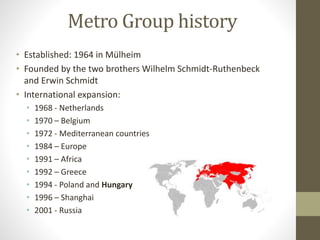
Metro Group history
• Established: 1964 in Mülheim
• Founded by the two brothers Wilhelm Schmidt-Ruthenbeck
and Erwin Schmidt
• International expansion:
• 1968 - Netherlands
• 1970 – Belgium
• 1972 - Mediterranean countries
• 1984 – Europe
• 1991 – Africa
• 1992 – Greece
• 1994 - Poland and Hungary
• 1996 – Shanghai
• 2001 - Russia
Metro Group overview
• Parts of Metro Group:
• Metro/Makro (Cash and Carry)
• Media Markt (The German and European market leader in consumer electronics retailing)
• Saturn (A huge selection of brand-name products at permanently low prices combined with
competent customer advice and tailor-made service)
• Redcoon.com (One of the largest specialist online discounters in Germany for consumer
electronics)
• Real (Real stands for a multifaceted range of food products offering a great price-performance
ratio with a large share of fresh produce complemented by an attractive non-food
assortment)
• Galeria Kaufhof (Galeria Kaufhof GmbH is the management company of the department
stores operated by METRO GROUP. These department stores are mostly located in city
centres)
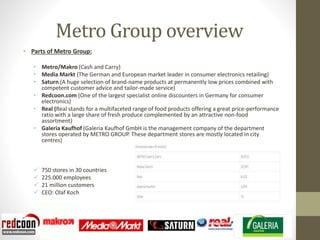
 750 stores in 30 countries
 225.000 employees
 21 million customers
 CEO: Olaf Koch
Strategy
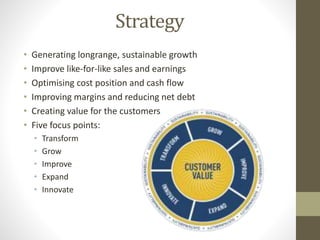
• Generating longrange, sustainable growth
• Improve like-for-like sales and earnings
• Optimising cost position and cash flow
• Improving margins and reducing net debt
• Creating value for the customers
• Five focus points:
• Transform
• Grow
• Improve
• Expand
• Innovate
SWOT Analysis
Strength
1. One of the top five largest retail chain in the
world and largest in its home market, Germany
2. Multi-store formats-convenience store,
department stores, supermarkets, discount stores
etc.
3. Retail operations offered to commercial
customers too in the format of cash and carry
stores
4. Huge brand equity and successful customer
loyalty programmes
Weakness
1.Need of localisation of its stores across different
cities and countries puts an additional pressure on
operation costs
2.Lower investments made by the retail chain in
modernising its IT technology and systems for
better automation of business
Opportunity
1.Seek growth through expansion into newer
markets
2.Emphaiss on private label growth
3.Widescale advertising, promotions and customer
loyalty programmes to increase business and loyal
customers
Threats
1.Rising labour costs worldwide
2.Threat from unionization of workforce in
Germany
3.Precarious economic condition in Euro zone and
Americas
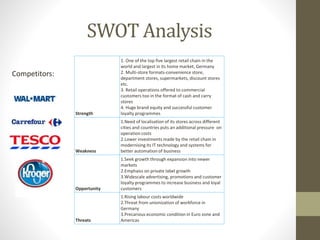
Competitors:
Concept
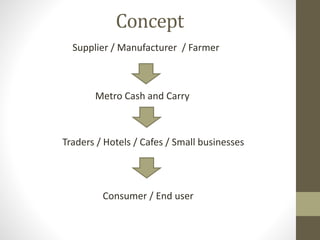
Supplier / Manufacturer / Farmer
Metro Cash and Carry
Traders / Hotels / Cafes / Small businesses
Consumer / End user
Metro in hungary
• 13 stores
• Online shopping available
• Club Cards
• Service Points
• Gastro academy
• Corporate trainings
• Bakery services
• Catering

Metro cash & carry

  • 1.
    Metro Cash &Carry Presented by: Áron Balázs Yiche Zhao
  • 2.
    Metro Group history •Established: 1964 in Mülheim • Founded by the two brothers Wilhelm Schmidt-Ruthenbeck and Erwin Schmidt • International expansion: • 1968 - Netherlands • 1970 – Belgium • 1972 - Mediterranean countries • 1984 – Europe • 1991 – Africa • 1992 – Greece • 1994 - Poland and Hungary • 1996 – Shanghai • 2001 - Russia
  • 3.
    Metro Group overview •Parts of Metro Group: • Metro/Makro (Cash and Carry) • Media Markt (The German and European market leader in consumer electronics retailing) • Saturn (A huge selection of brand-name products at permanently low prices combined with competent customer advice and tailor-made service) • Redcoon.com (One of the largest specialist online discounters in Germany for consumer electronics) • Real (Real stands for a multifaceted range of food products offering a great price-performance ratio with a large share of fresh produce complemented by an attractive non-food assortment) • Galeria Kaufhof (Galeria Kaufhof GmbH is the management company of the department stores operated by METRO GROUP. These department stores are mostly located in city centres)  750 stores in 30 countries  225.000 employees  21 million customers  CEO: Olaf Koch
  • 4.
    Strategy • Generating longrange,sustainable growth • Improve like-for-like sales and earnings • Optimising cost position and cash flow • Improving margins and reducing net debt • Creating value for the customers • Five focus points: • Transform • Grow • Improve • Expand • Innovate
  • 5.
    SWOT Analysis Strength 1. Oneof the top five largest retail chain in the world and largest in its home market, Germany 2. Multi-store formats-convenience store, department stores, supermarkets, discount stores etc. 3. Retail operations offered to commercial customers too in the format of cash and carry stores 4. Huge brand equity and successful customer loyalty programmes Weakness 1.Need of localisation of its stores across different cities and countries puts an additional pressure on operation costs 2.Lower investments made by the retail chain in modernising its IT technology and systems for better automation of business Opportunity 1.Seek growth through expansion into newer markets 2.Emphaiss on private label growth 3.Widescale advertising, promotions and customer loyalty programmes to increase business and loyal customers Threats 1.Rising labour costs worldwide 2.Threat from unionization of workforce in Germany 3.Precarious economic condition in Euro zone and Americas Competitors:
  • 6.
    Concept Supplier / Manufacturer/ Farmer Metro Cash and Carry Traders / Hotels / Cafes / Small businesses Consumer / End user
  • 7.
    Metro in hungary •13 stores • Online shopping available • Club Cards • Service Points • Gastro academy • Corporate trainings • Bakery services • Catering