Methods of studying bone
growth
INDIAN DENTAL ACADEMY
Leader in continuing dental education
www.indiandentalacademy.com

www.indiandentalacademy.com
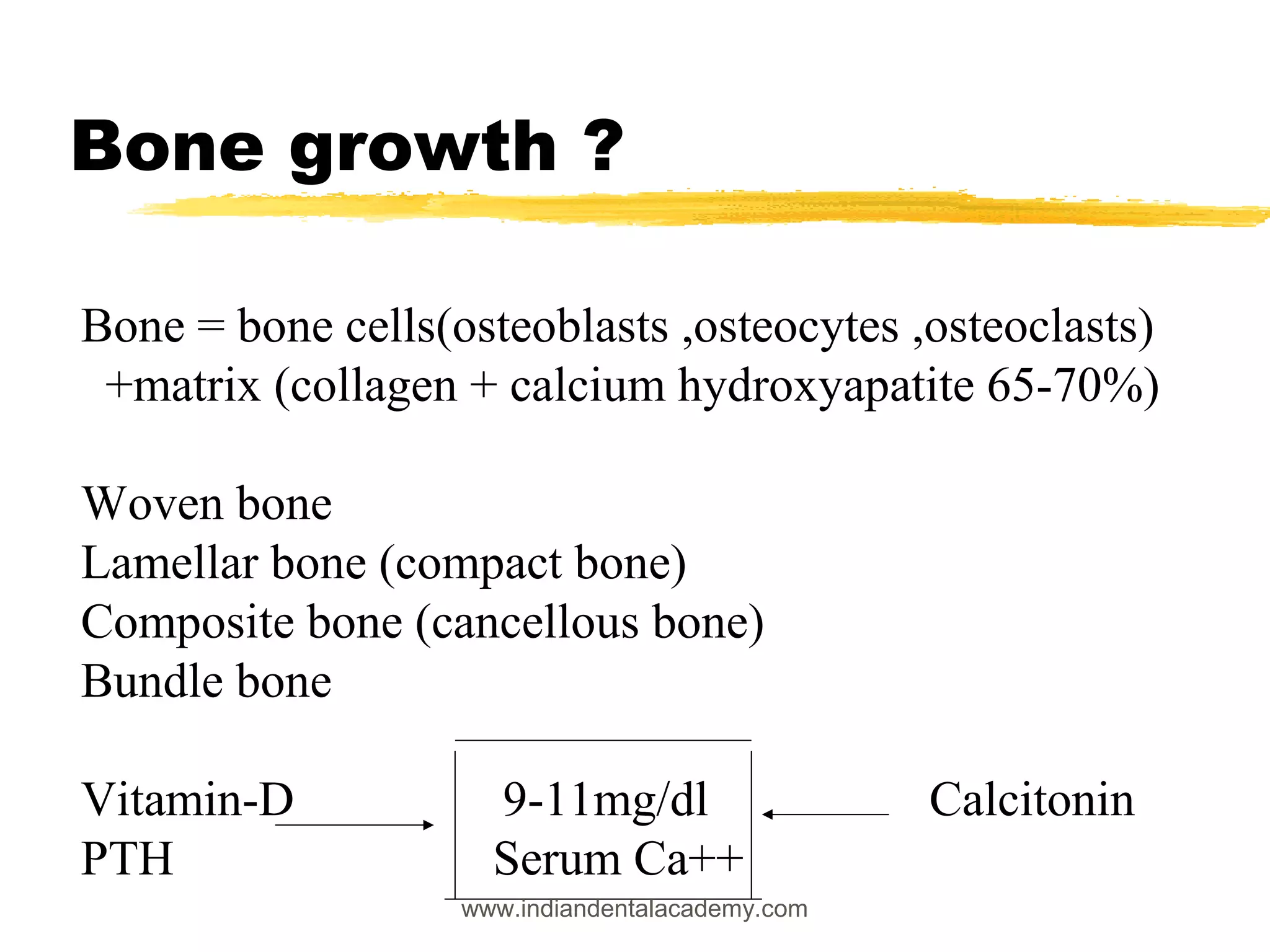
Bone growth ?
Bone = bone cells(osteoblasts ,osteocytes ,osteoclasts)
+matrix (collagen + calcium hydroxyapatite 65-70%)
Woven bone
Lamellar bone (compact bone)
Composite bone (cancellous bone)
Bundle bone
Vitamin-D
PTH

9-11mg/dl
Serum Ca++
www.indiandentalacademy.com

Calcitonin
Passion & controversy may have a place in discussion &
interpretation but certainly not in study of rigorously
collected biomedical &clinical data
A. G. Petrovic

Study
Acquisition of knowledge by investigation.

Collection
of data

Explanation

Analysis of
this data

Presentation
of data

www.indiandentalacademy.com
Source of data
Census
Registration of vital events
Hospital records & other health records
Survey of population
Health interview survey (opinion)
Health examination survey
Health record survey
mailed question survey
www.indiandentalacademy.com
Types of data
Opinion :it is a clever guess .
Observation :Done to see presence or
absence of certain
phenomena
Rating & ranking.
Measurements :Most scientific approch
direct data
indirect data
derived data

www.indiandentalacademy.com
Methods of collecting data
Cross sectional method :based on single

examination of a cross-section of population at
one point in time .

Longitudinal method :observations period
are repeated in the same population over a
prolonged of time by means of follow up
examination.

Semi-longitudinal method :
www.indiandentalacademy.com
Cross-sectional method
ADVANTAGES
easy & quick
less expensive
no attrition of sample
various factors acting
at that time can be
analyzed
can be repeated

DISADVANTAGES
variability with in
the sample
larger size of
sample
factors acting at
various time period
cannot be analyzed

www.indiandentalacademy.com
Longitudinal method
ADVANTAGES
more specific
factors acting at
different time can be
analyzed
less no of subjects
individual variations

DISADVANTAGES
more expensive
difficulty in maintaining
lab & data
more time
attrition of samples
cannot be repeated

Eg Bolton Brush study ,Michigan study ,Iova child welfare study
www.indiandentalacademy.com
Semi-longitudinal method
ADVANTAGES
Tries to combine advantages of both
longitudinal & cross-sectional method.
Data of 15 yrs of study obtained in 3 yrs
DISADVANTAGES
Not as authentic as longitudinal study

www.indiandentalacademy.com
Approach for analysis of
obtained data.
MEASUREMENT
APPROACH
Here animals & humans
are measured without
inducing any change in
them.
Dead/alive
Longitudinal/crosssectional

EXPERIMENTAL
APPROACH
Here growth is
manipulated and
observations are
made.
More detailed study.
Mainly animal study.
Longitudinal/crosssectional
www.indiandentalacademy.com
Methods of presenting data
Simple tables
Graphs (special
curves)
Charts
Bar charts
Histograms
Pie charts
Pictograms
www.indiandentalacademy.com
Diagrams (pictures)
Explanation concerning craniofacial
growth in current literature
Deductive:logically explained consequence of certain
premises.

Deductivoprobabilistic: tries to relate various items
explained by the deductive explanation with
certain assumptions.Forms basis of D/D
&prognosis.

Functional: Based on single assumption.Generally

Noncolinear relations are seen here .

Phylogenetic:Growth trends explained based on
www.indiandentalacademy.com
evolutionary trends.
Methods of studying bone
growth.
Mineralized sections
Polarized light birefringence
Craniometry
Fluorescent labels
Comparative
Micro radiography
anatomy
Auto radiography
Anthropometry
nuclear volume morphometry
Cell kinetics
Radiology/Imaging
Micro electrodes
Finite element modeling
EXPERIMENTAL
Vital staining
Metallic implants
www.indiandentalacademy.com

MEASUREMENT
Craniometry
Measurement of skull of human skeleton.
Broca (1875) defined landmarks &
instruments used for measurements.
Congress of German anthropological
society held at Frankfurt in 1882.

Comparative anatomy
www.indiandentalacademy.com
Anthropometry
Measurement of skeletal dimensions on
living individuals
Physical anthropology :Study of mans
biologic behavior in time and space
Special instruments are used
ADV :Longitudinal study
No harm to subjects
DISADV :Soft tissue error
www.indiandentalacademy.com
Operator error
Radiology /Imaging
Conventional radiographs
Nature and production of x-rays
How does it detect bone growth ?
Films :composition
size: 22*35 24*40 32*41 57*76 mm 8*10” :Image
formation ,developing & fixing

Intensifying screens (calcium tungstate & rare earth)
Grids (parallel ,focused &Potter Bucky grids.80-100lines/Inch)
www.indiandentalacademy.com
Techniques of
conventional radiography
Intra oral
IOPA

Extra oral

paralleling technique
Bisecting angle

Bite wing
occlusal projection

Posterio-anterior
Walters occipitofrontal
Riverse-Towne
sub mento vertex
Lateral oblique mand
Lateral skull
Pt position
Cephalostat
Cephalometry

www.indiandentalacademy.com
Broadbent-Bolton cephalometer

www.indiandentalacademy.com
Cephalometry
ADVANTAGES
Combines advantages of anthropometry
and craniometry that is direct bony
measurement & study of same individual
DISADVANTAGES
2-dimensional
Head position critical
Direction of growth not clear
Panoramic

www.indiandentalacademy.com
Specialized radiographic
technique
Digital imaging (CCD -voltage-bits 0-255)
Direct digital radiography (R V G )
Indirect digital radiography
Digital subtraction radiography
Digitized image interpretation

Computed tomography
Magnetic resonance
Radionuclide imaging
Ultrasound
www.indiandentalacademy.com
Electronic thermography
3-D Imaging
3-D analysis would be the ideal way of
analyzing soft/hard tissue profile
Source of data
Multiple video imaging
Sonic digitizing
Laser scanning

Disadv: Pt movement during digitizing
Primitive soft ware not very accurate
Norms & data not extensive
www.indiandentalacademy.com
Specific experimental
method
Mineralized sections
Finite element modeling
Polarized light
Vital staining
Fluorescent labels
Metallic implants
Micro radiography
Auto radiography
nuclear volume morphometry
Cell kinetics
Micro electrodes
www.indiandentalacademy.com
Histopathological technique
Preparation of tissues for microscopy
Soft tissue embedded in paraffin
Fixation
processing

colloidal embedding - hard tissues(decalcified)
Acid treatment
chelation
Hydrolysis

Ground sections- hard tissues(undecalcified)
Frozen sections for immediate examination
www.indiandentalacademy.com
Mineralized sections
Critical analysis of tissues as there is less
distortion during processing
Both inorganic mineral & organic matrix can
be studied
100um -tissue level details
25um-Enhanced cellular details
Bone labels quench rapidly
Tissue density inadequate for microradiography
www.indiandentalacademy.com
Polarized light birefringence
Fringe pattern indicate collagen
orientation within bone
Loading conditions during bone formation
dictates orientation of collagen
Longitudinal alignment -Tension
Transverse alignment -compression

www.indiandentalacademy.com
Fluorescent labels
In vivo administration of Cl binders act as
time markers of bone formation
Six fluorescent bone labels are used
Tetracycline -bright yellow
Calcein - green
Xylenol- orange
Alizarin- complexone red
Demeclocyclin- gold
Oxytetracycline- greenish yellow
www.indiandentalacademy.com
Microradiography
Higher resolution images of polished 100um
mineralized sections obtained
1 week primary mineralization
8 months secondary mineralization
Experimental animals analyzed by both
microradiography & using fluoroscentlabels
midfacial sutures PDL
Alveolar process Mandibular condyle
www.indiandentalacademy.com
temporal fossa
Autoradiography
Specific radioactive labels for proteins
carbohydrates ,& nucleic acids are injected at
known intervals before sampling
Detected by coating histologic sections with
nuclear track emulsion
3H thymidine labels DNA synthesis
3H Proline for bone matrix
www.indiandentalacademy.com
Nuclear volume
morphometry
Cytomorphometric procedure for accessing the
size of osteoblastic precursor cells
Mechanism of osteogenesis in orthodontically
activated PDL
Preosteoblasts have larger nucleus than
committed osteoprogenitor cells and their
precursors

www.indiandentalacademy.com
Cell kinetics
By noting the -increase in nuclear volume
or labeling S-phase cells in vivo using
Bromodeoxyuridine (BDU) cell movement
& differentiation is noted
Generally done in PDL
under normal conditions
under metabolic stimuli
mechanical stimuli
www.indiandentalacademy.com
Microelectrodes
Tungsten or glass electrodes are inserted
atraumatically into PDL in live animals via
gingival sulcus
changes in electric potential are noted
Widened areas have a negative charge
Compressed areas have positive charge
This coincides with the age old principle,
that bone forms near cathode & resorbs at
www.indiandentalacademy.com
anode
Finite element modeling
Finite element modeling is a branch of
mechanical engineering where in the stress &
strain of mechanically loaded structures are
analyzed.
Initial stress for periodontium are derived by
assuming linear elastic properties
For complex tissues like periodontium with
viscoelastic properties both solid & fluid
mechanics mustwww.indiandentalacademy.com
be considered
Vital staining
Reported initially by Belchier (1796) &
John Hunter where in they attributed
staining to alizarin
This method reveals the site ,manner,
amount , direction ,timing & duration of
bone growth
Tetracycline stains in humans
www.indiandentalacademy.com
Metallic implants
Method of study used extensively by Prof
Bjork & coworkers R D C Copenhagen
They gave new dimension to study of
dentofacial growth.
Remodeling changes in the contours of
jaws was better understood
Rotational pattern of jaw growth
www.indiandentalacademy.com
Conclusion
Tooth movement has been
possible because bone
behaves dynamically
Better understanding of
physiology of bone PDL
interface is necessary
All these methods have
given us the tool for further
study it is up to us to use it
www.indiandentalacademy.com
References
Enlow;Hand book of facial growth, W B Saunders
Company,1982
Orbans:Oral histology &embryology,Delhi, C B S
publishers,1990
Rakosi ,Jones & Graber:Colour atlas of orthodontic
diagnosis,New York,Thieme medical publishers,1993
Farkas L G:Anthropometry of head &face, New York,
Raven press,1994
Jacobson :Radiographic cephalometry,quintessence
www.indiandentalacademy.com
books,1995
References ctd
Goaz & White:Oral radiology, St Louis,C V Mosby,
1994
K Park : Preventive &social medicine, Jabalpur , M/S
Banarsidas Bhanot,1997
Profitt W R:Contemporary orthodontics,St Louis,C V
Mosby,1997
Graber,Rakosi,Petrovic:Dentofacial orthopedics with
functional appliances, 1997
Graber Vanarsdall:Orthodontics current principles
&technique, St Louis,C V Mosby,2000.

X

www.indiandentalacademy.com
Thank you
For more details please visit
www.indiandentalacademy.com

www.indiandentalacademy.com

Methods of study bone growth /certified fixed orthodontic courses by Indian dental academy

  • 1.
    Methods of studyingbone growth INDIAN DENTAL ACADEMY Leader in continuing dental education www.indiandentalacademy.com www.indiandentalacademy.com
  • 2.
    Bone growth ? Bone= bone cells(osteoblasts ,osteocytes ,osteoclasts) +matrix (collagen + calcium hydroxyapatite 65-70%) Woven bone Lamellar bone (compact bone) Composite bone (cancellous bone) Bundle bone Vitamin-D PTH 9-11mg/dl Serum Ca++ www.indiandentalacademy.com Calcitonin
  • 3.
    Passion & controversymay have a place in discussion & interpretation but certainly not in study of rigorously collected biomedical &clinical data A. G. Petrovic Study Acquisition of knowledge by investigation. Collection of data Explanation Analysis of this data Presentation of data www.indiandentalacademy.com
  • 4.
    Source of data Census Registrationof vital events Hospital records & other health records Survey of population Health interview survey (opinion) Health examination survey Health record survey mailed question survey www.indiandentalacademy.com
  • 5.
    Types of data Opinion:it is a clever guess . Observation :Done to see presence or absence of certain phenomena Rating & ranking. Measurements :Most scientific approch direct data indirect data derived data www.indiandentalacademy.com
  • 6.
    Methods of collectingdata Cross sectional method :based on single examination of a cross-section of population at one point in time . Longitudinal method :observations period are repeated in the same population over a prolonged of time by means of follow up examination. Semi-longitudinal method : www.indiandentalacademy.com
  • 7.
    Cross-sectional method ADVANTAGES easy &quick less expensive no attrition of sample various factors acting at that time can be analyzed can be repeated DISADVANTAGES variability with in the sample larger size of sample factors acting at various time period cannot be analyzed www.indiandentalacademy.com
  • 8.
    Longitudinal method ADVANTAGES more specific factorsacting at different time can be analyzed less no of subjects individual variations DISADVANTAGES more expensive difficulty in maintaining lab & data more time attrition of samples cannot be repeated Eg Bolton Brush study ,Michigan study ,Iova child welfare study www.indiandentalacademy.com
  • 9.
    Semi-longitudinal method ADVANTAGES Tries tocombine advantages of both longitudinal & cross-sectional method. Data of 15 yrs of study obtained in 3 yrs DISADVANTAGES Not as authentic as longitudinal study www.indiandentalacademy.com
  • 10.
    Approach for analysisof obtained data. MEASUREMENT APPROACH Here animals & humans are measured without inducing any change in them. Dead/alive Longitudinal/crosssectional EXPERIMENTAL APPROACH Here growth is manipulated and observations are made. More detailed study. Mainly animal study. Longitudinal/crosssectional www.indiandentalacademy.com
  • 11.
    Methods of presentingdata Simple tables Graphs (special curves) Charts Bar charts Histograms Pie charts Pictograms www.indiandentalacademy.com Diagrams (pictures)
  • 12.
    Explanation concerning craniofacial growthin current literature Deductive:logically explained consequence of certain premises. Deductivoprobabilistic: tries to relate various items explained by the deductive explanation with certain assumptions.Forms basis of D/D &prognosis. Functional: Based on single assumption.Generally Noncolinear relations are seen here . Phylogenetic:Growth trends explained based on www.indiandentalacademy.com evolutionary trends.
  • 13.
    Methods of studyingbone growth. Mineralized sections Polarized light birefringence Craniometry Fluorescent labels Comparative Micro radiography anatomy Auto radiography Anthropometry nuclear volume morphometry Cell kinetics Radiology/Imaging Micro electrodes Finite element modeling EXPERIMENTAL Vital staining Metallic implants www.indiandentalacademy.com MEASUREMENT
  • 14.
    Craniometry Measurement of skullof human skeleton. Broca (1875) defined landmarks & instruments used for measurements. Congress of German anthropological society held at Frankfurt in 1882. Comparative anatomy www.indiandentalacademy.com
  • 15.
    Anthropometry Measurement of skeletaldimensions on living individuals Physical anthropology :Study of mans biologic behavior in time and space Special instruments are used ADV :Longitudinal study No harm to subjects DISADV :Soft tissue error www.indiandentalacademy.com Operator error
  • 16.
    Radiology /Imaging Conventional radiographs Natureand production of x-rays How does it detect bone growth ? Films :composition size: 22*35 24*40 32*41 57*76 mm 8*10” :Image formation ,developing & fixing Intensifying screens (calcium tungstate & rare earth) Grids (parallel ,focused &Potter Bucky grids.80-100lines/Inch) www.indiandentalacademy.com
  • 17.
    Techniques of conventional radiography Intraoral IOPA Extra oral paralleling technique Bisecting angle Bite wing occlusal projection Posterio-anterior Walters occipitofrontal Riverse-Towne sub mento vertex Lateral oblique mand Lateral skull Pt position Cephalostat Cephalometry www.indiandentalacademy.com
  • 18.
  • 19.
    Cephalometry ADVANTAGES Combines advantages ofanthropometry and craniometry that is direct bony measurement & study of same individual DISADVANTAGES 2-dimensional Head position critical Direction of growth not clear Panoramic www.indiandentalacademy.com
  • 20.
    Specialized radiographic technique Digital imaging(CCD -voltage-bits 0-255) Direct digital radiography (R V G ) Indirect digital radiography Digital subtraction radiography Digitized image interpretation Computed tomography Magnetic resonance Radionuclide imaging Ultrasound www.indiandentalacademy.com Electronic thermography
  • 21.
    3-D Imaging 3-D analysiswould be the ideal way of analyzing soft/hard tissue profile Source of data Multiple video imaging Sonic digitizing Laser scanning Disadv: Pt movement during digitizing Primitive soft ware not very accurate Norms & data not extensive www.indiandentalacademy.com
  • 22.
    Specific experimental method Mineralized sections Finiteelement modeling Polarized light Vital staining Fluorescent labels Metallic implants Micro radiography Auto radiography nuclear volume morphometry Cell kinetics Micro electrodes www.indiandentalacademy.com
  • 23.
    Histopathological technique Preparation oftissues for microscopy Soft tissue embedded in paraffin Fixation processing colloidal embedding - hard tissues(decalcified) Acid treatment chelation Hydrolysis Ground sections- hard tissues(undecalcified) Frozen sections for immediate examination www.indiandentalacademy.com
  • 24.
    Mineralized sections Critical analysisof tissues as there is less distortion during processing Both inorganic mineral & organic matrix can be studied 100um -tissue level details 25um-Enhanced cellular details Bone labels quench rapidly Tissue density inadequate for microradiography www.indiandentalacademy.com
  • 25.
    Polarized light birefringence Fringepattern indicate collagen orientation within bone Loading conditions during bone formation dictates orientation of collagen Longitudinal alignment -Tension Transverse alignment -compression www.indiandentalacademy.com
  • 26.
    Fluorescent labels In vivoadministration of Cl binders act as time markers of bone formation Six fluorescent bone labels are used Tetracycline -bright yellow Calcein - green Xylenol- orange Alizarin- complexone red Demeclocyclin- gold Oxytetracycline- greenish yellow www.indiandentalacademy.com
  • 27.
    Microradiography Higher resolution imagesof polished 100um mineralized sections obtained 1 week primary mineralization 8 months secondary mineralization Experimental animals analyzed by both microradiography & using fluoroscentlabels midfacial sutures PDL Alveolar process Mandibular condyle www.indiandentalacademy.com temporal fossa
  • 28.
    Autoradiography Specific radioactive labelsfor proteins carbohydrates ,& nucleic acids are injected at known intervals before sampling Detected by coating histologic sections with nuclear track emulsion 3H thymidine labels DNA synthesis 3H Proline for bone matrix www.indiandentalacademy.com
  • 29.
    Nuclear volume morphometry Cytomorphometric procedurefor accessing the size of osteoblastic precursor cells Mechanism of osteogenesis in orthodontically activated PDL Preosteoblasts have larger nucleus than committed osteoprogenitor cells and their precursors www.indiandentalacademy.com
  • 30.
    Cell kinetics By notingthe -increase in nuclear volume or labeling S-phase cells in vivo using Bromodeoxyuridine (BDU) cell movement & differentiation is noted Generally done in PDL under normal conditions under metabolic stimuli mechanical stimuli www.indiandentalacademy.com
  • 31.
    Microelectrodes Tungsten or glasselectrodes are inserted atraumatically into PDL in live animals via gingival sulcus changes in electric potential are noted Widened areas have a negative charge Compressed areas have positive charge This coincides with the age old principle, that bone forms near cathode & resorbs at www.indiandentalacademy.com anode
  • 32.
    Finite element modeling Finiteelement modeling is a branch of mechanical engineering where in the stress & strain of mechanically loaded structures are analyzed. Initial stress for periodontium are derived by assuming linear elastic properties For complex tissues like periodontium with viscoelastic properties both solid & fluid mechanics mustwww.indiandentalacademy.com be considered
  • 33.
    Vital staining Reported initiallyby Belchier (1796) & John Hunter where in they attributed staining to alizarin This method reveals the site ,manner, amount , direction ,timing & duration of bone growth Tetracycline stains in humans www.indiandentalacademy.com
  • 34.
    Metallic implants Method ofstudy used extensively by Prof Bjork & coworkers R D C Copenhagen They gave new dimension to study of dentofacial growth. Remodeling changes in the contours of jaws was better understood Rotational pattern of jaw growth www.indiandentalacademy.com
  • 35.
    Conclusion Tooth movement hasbeen possible because bone behaves dynamically Better understanding of physiology of bone PDL interface is necessary All these methods have given us the tool for further study it is up to us to use it www.indiandentalacademy.com
  • 36.
    References Enlow;Hand book offacial growth, W B Saunders Company,1982 Orbans:Oral histology &embryology,Delhi, C B S publishers,1990 Rakosi ,Jones & Graber:Colour atlas of orthodontic diagnosis,New York,Thieme medical publishers,1993 Farkas L G:Anthropometry of head &face, New York, Raven press,1994 Jacobson :Radiographic cephalometry,quintessence www.indiandentalacademy.com books,1995
  • 37.
    References ctd Goaz &White:Oral radiology, St Louis,C V Mosby, 1994 K Park : Preventive &social medicine, Jabalpur , M/S Banarsidas Bhanot,1997 Profitt W R:Contemporary orthodontics,St Louis,C V Mosby,1997 Graber,Rakosi,Petrovic:Dentofacial orthopedics with functional appliances, 1997 Graber Vanarsdall:Orthodontics current principles &technique, St Louis,C V Mosby,2000. X www.indiandentalacademy.com
  • 38.
    Thank you For moredetails please visit www.indiandentalacademy.com www.indiandentalacademy.com

Editor's Notes