PBG-606: Concept of Science and Scientific Methods
SCIENCE:
• The term science is applied to systematized knowledge and the
procedure to acquire it.
– Systematized knowledge
– procedure to acquire it
• Empirical science is the classification of
– observed events,
– recognition of their sequences
– evaluation of their relative significance
Methods of scientific inquiry: Early Experimentation
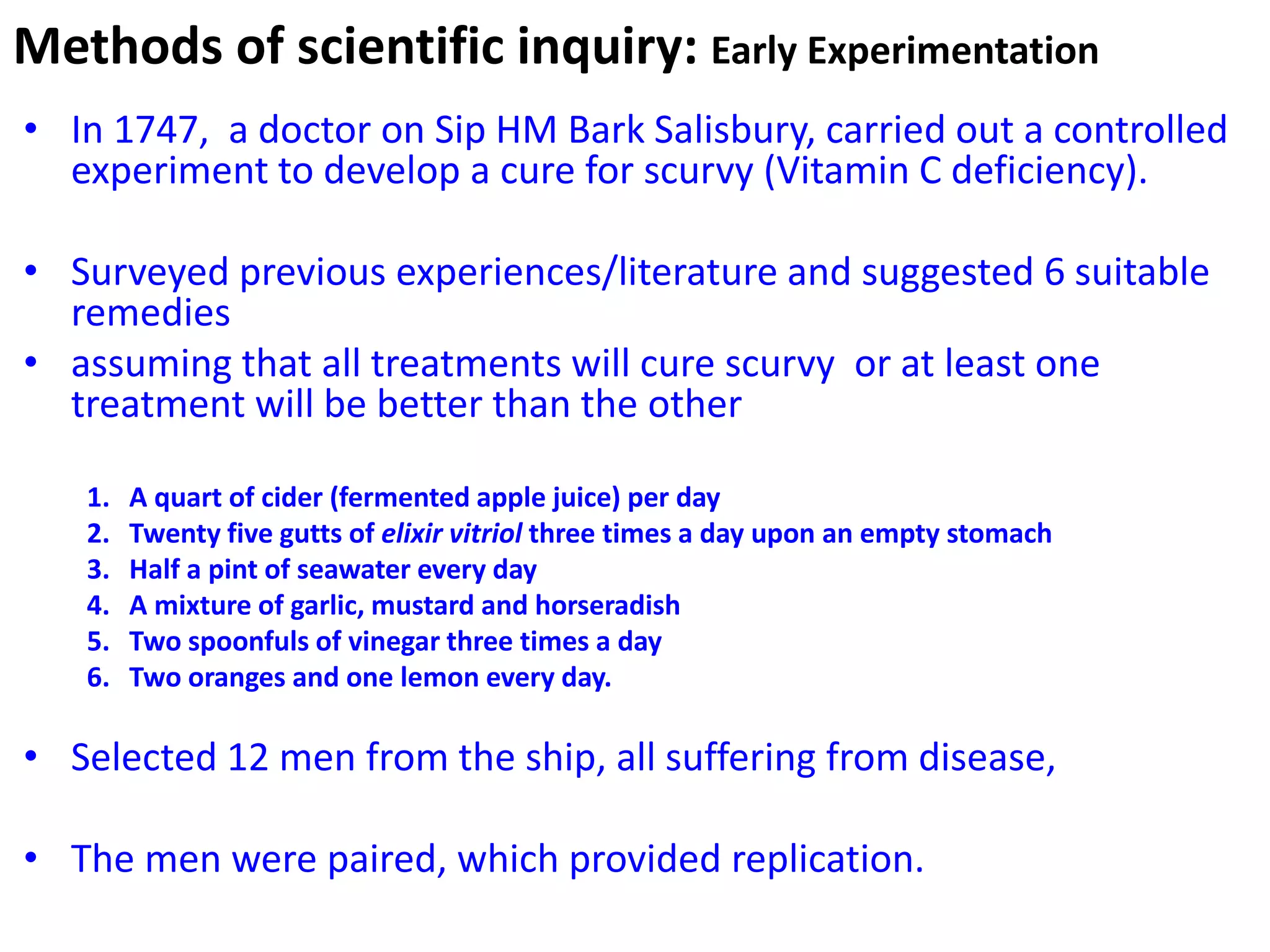
• In 1747, a doctor on Sip HM Bark Salisbury, carried out a controlled
experiment to develop a cure for scurvy (Vitamin C deficiency).
• Surveyed previous experiences/literature and suggested 6 suitable
remedies
• assuming that all treatments will cure scurvy or at least one
treatment will be better than the other
1. A quart of cider (fermented apple juice) per day
2. Twenty five gutts of elixir vitriol three times a day upon an empty stomach
3. Half a pint of seawater every day
4. A mixture of garlic, mustard and horseradish
5. Two spoonfuls of vinegar three times a day
6. Two oranges and one lemon every day.
• Selected 12 men from the ship, all suffering from disease,
• The men were paired, which provided replication.
Two weeks later
• The men who had been given citrus fruits recovered dramatically
within a week.
– One of them returned to duty after 6 days
– and the other became nurse to the rest.
• The others experienced some improvement, but nothing was
comparable to the citrus fruits,
• Citrus fruit proved to be substantially superior to the other
treatments.
• This query started from a PROBLEM
• Survey of the information regarding the problem and its solution
• Made a planned query with a certain HYPOTHESIS
• Took observations
• Compared the results
• And Concluded the query with a SOLUTION
• Science is applied to systematized knowledge and the
procedure to acquire it.
– Systematized knowledge SOLUTION
– procedure to acquire it PLANNED EXPERIMENT
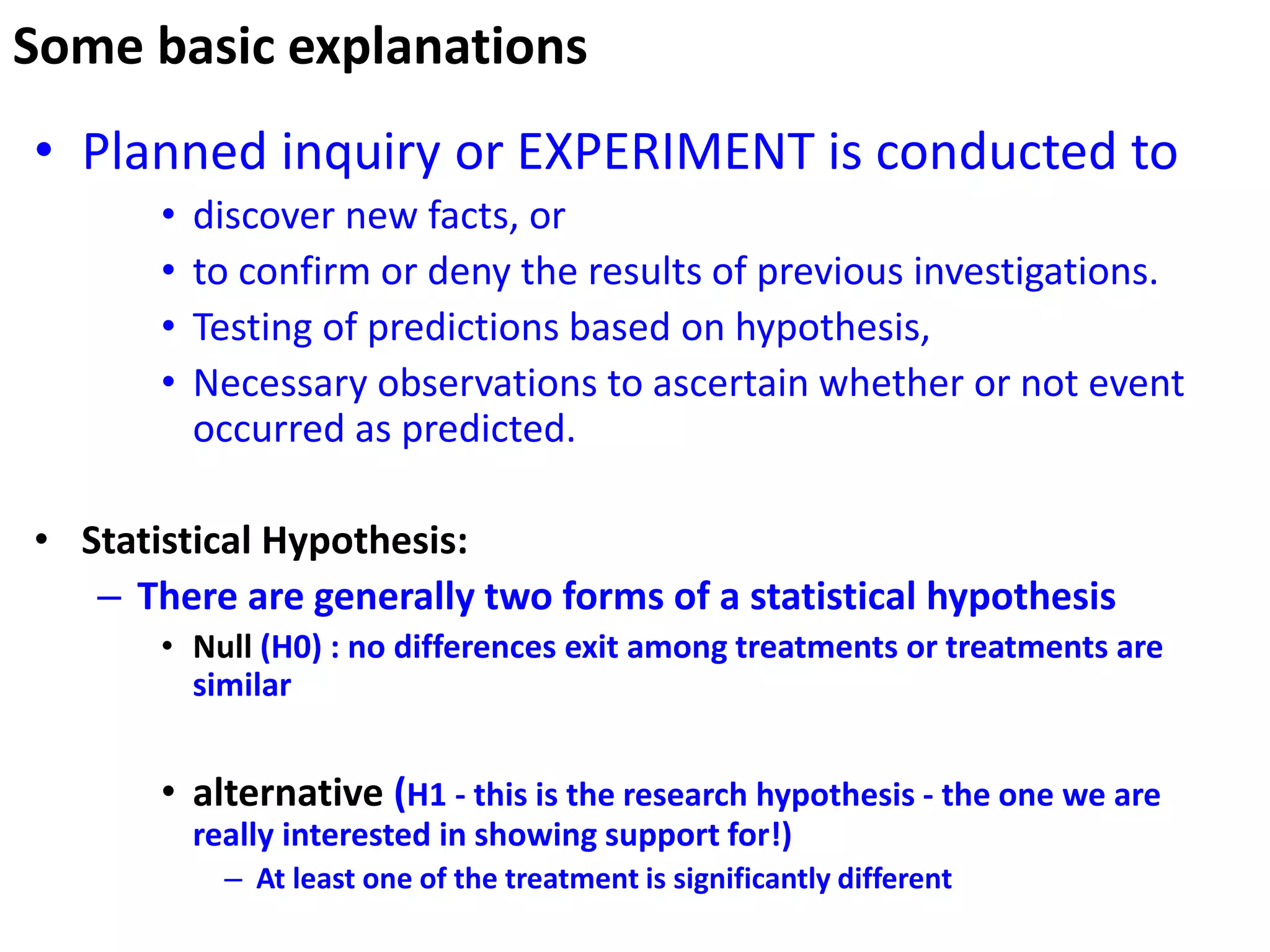
Some basic explanations
• Planned inquiry or EXPERIMENT is conducted to
• discover new facts, or
• to confirm or deny the results of previous investigations.
• Testing of predictions based on hypothesis,
• Necessary observations to ascertain whether or not event
occurred as predicted.
• Statistical Hypothesis:
– There are generally two forms of a statistical hypothesis
• Null (H0) : no differences exit among treatments or treatments are
similar
• alternative (H1 - this is the research hypothesis - the one we are
really interested in showing support for!)
– At least one of the treatment is significantly different
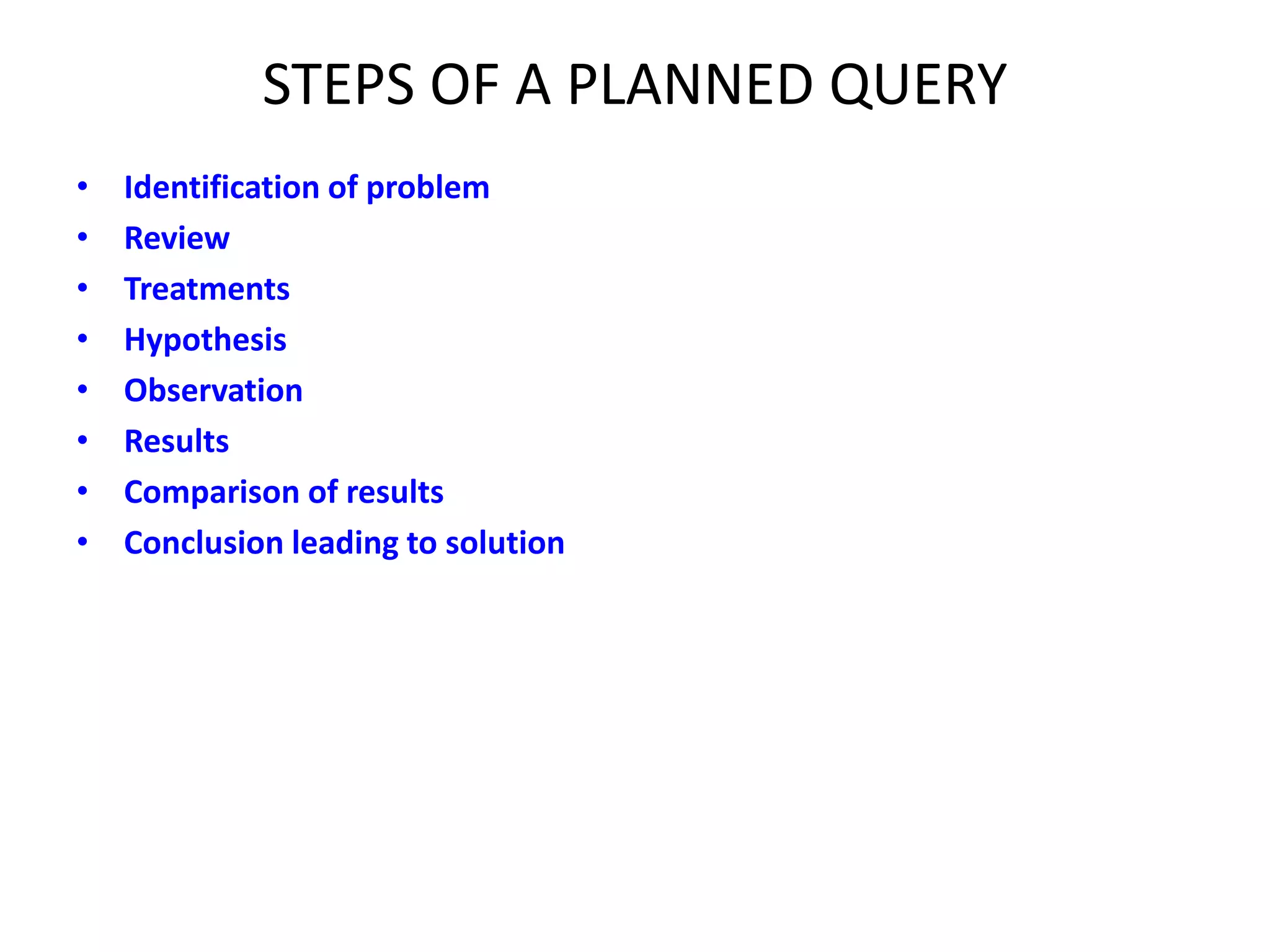
STEPS OF A PLANNED QUERY
• Identification of problem
• Review
• Treatments
• Hypothesis
• Observation
• Results
• Comparison of results
• Conclusion leading to solution
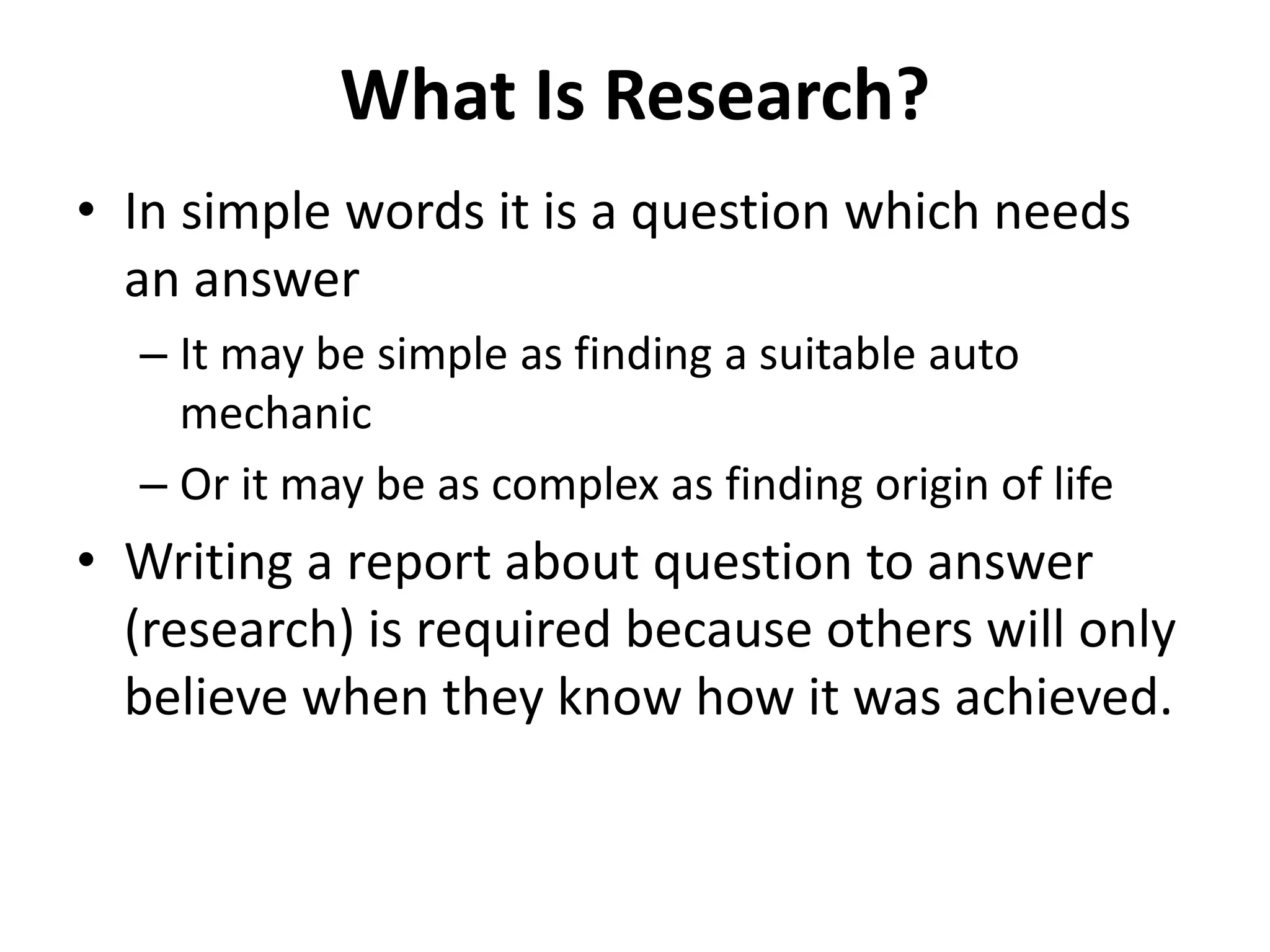
What Is Research?
• In simple words it is a question which needs
an answer
– It may be simple as finding a suitable auto
mechanic
– Or it may be as complex as finding origin of life
• Writing a report about question to answer
(research) is required because others will only
believe when they know how it was achieved.
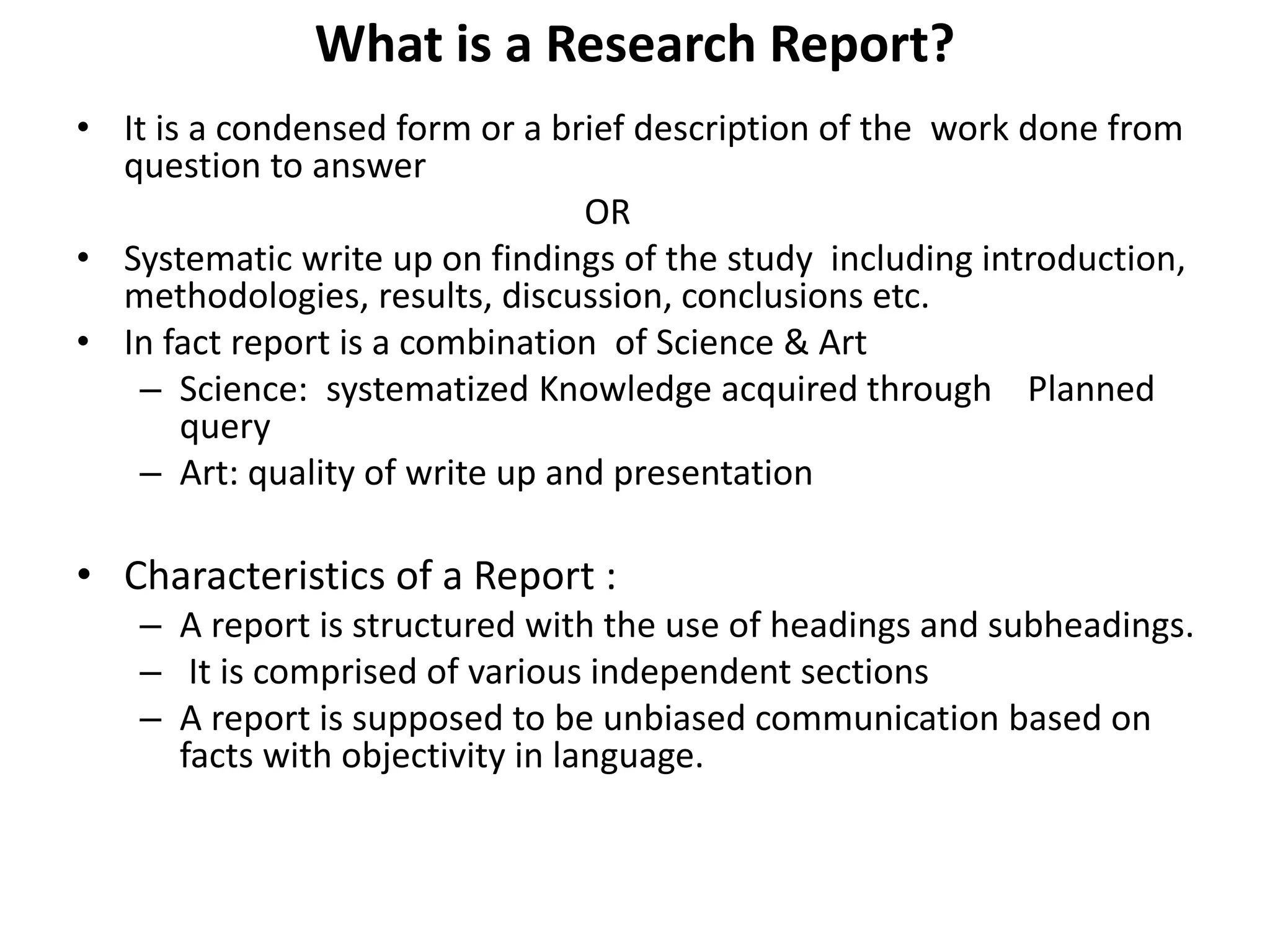
What is a Research Report?
• It is a condensed form or a brief description of the work done from
question to answer
OR
• Systematic write up on findings of the study including introduction,
methodologies, results, discussion, conclusions etc.
• In fact report is a combination of Science & Art
– Science: systematized Knowledge acquired through Planned
query
– Art: quality of write up and presentation
• Characteristics of a Report :
– A report is structured with the use of headings and subheadings.
– It is comprised of various independent sections
– A report is supposed to be unbiased communication based on
facts with objectivity in language.
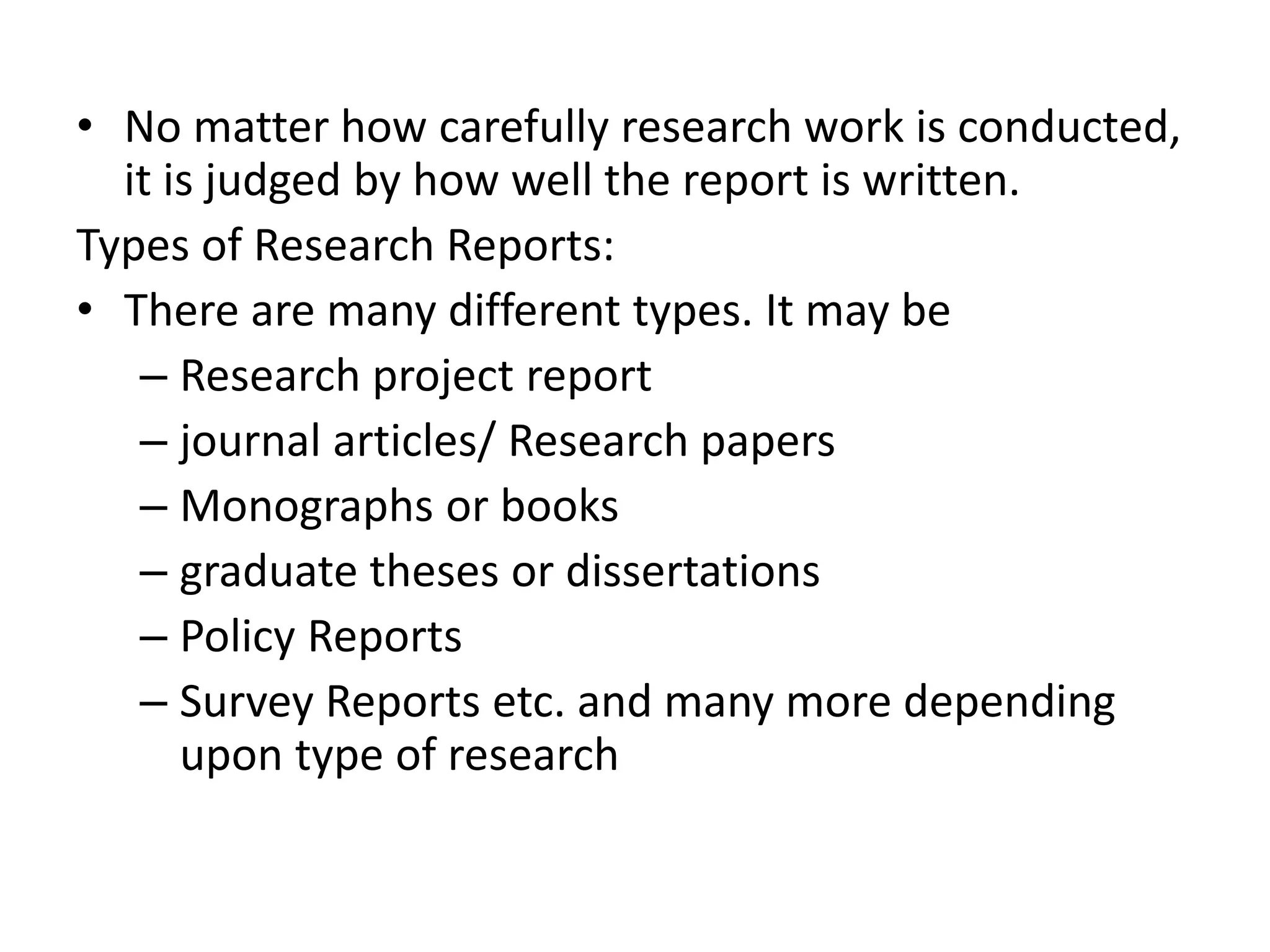
• No matter how carefully research work is conducted,
it is judged by how well the report is written.
Types of Research Reports:
• There are many different types. It may be
– Research project report
– journal articles/ Research papers
– Monographs or books
– graduate theses or dissertations
– Policy Reports
– Survey Reports etc. and many more depending
upon type of research
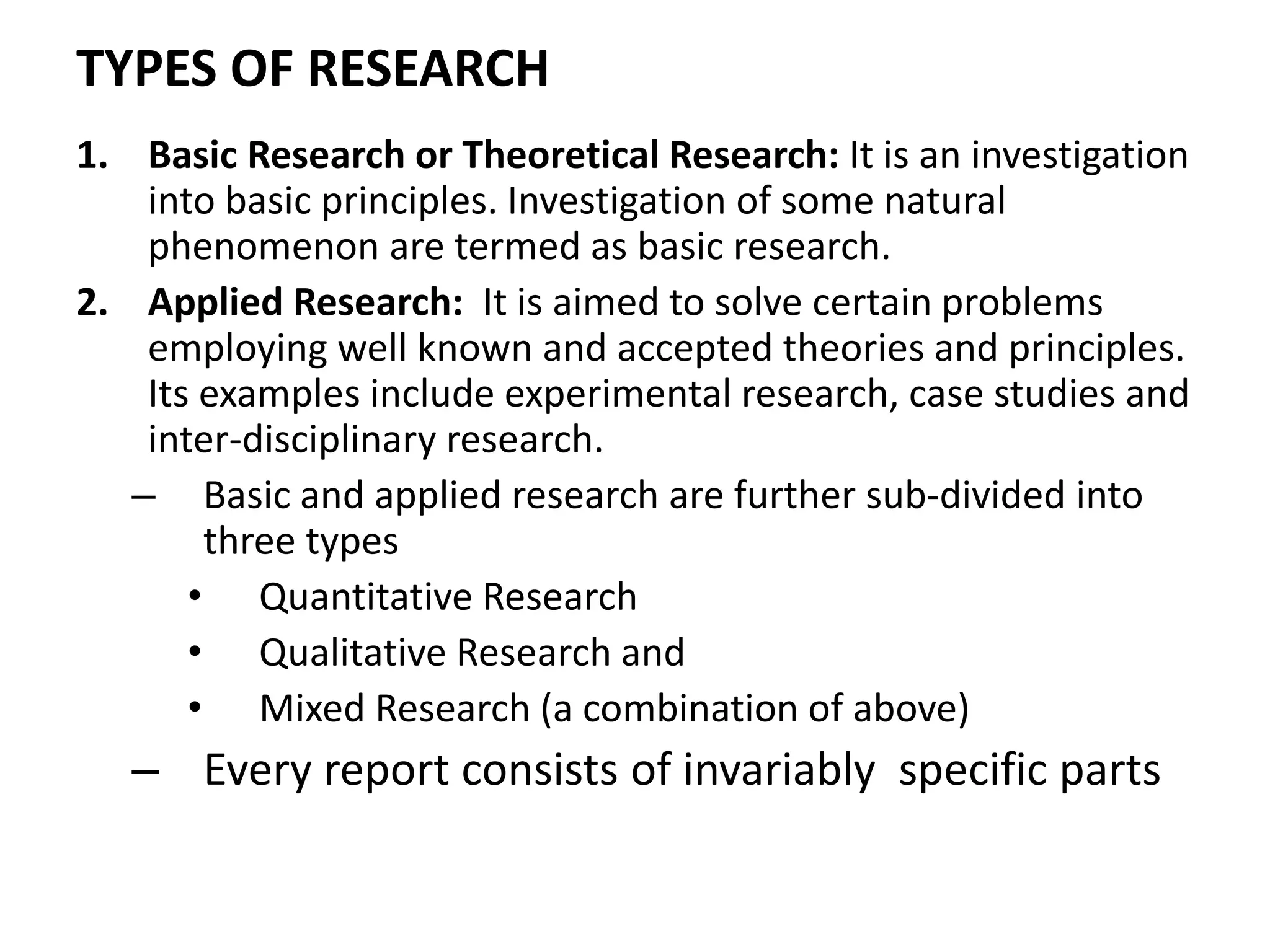
TYPES OF RESEARCH
1. Basic Research or Theoretical Research: It is an investigation
into basic principles. Investigation of some natural
phenomenon are termed as basic research.
2. Applied Research: It is aimed to solve certain problems
employing well known and accepted theories and principles.
Its examples include experimental research, case studies and
inter-disciplinary research.
– Basic and applied research are further sub-divided into
three types
• Quantitative Research
• Qualitative Research and
• Mixed Research (a combination of above)
– Every report consists of invariably specific parts

Methods of scientific inquiry

  • 1.
    PBG-606: Concept ofScience and Scientific Methods SCIENCE: • The term science is applied to systematized knowledge and the procedure to acquire it. – Systematized knowledge – procedure to acquire it • Empirical science is the classification of – observed events, – recognition of their sequences – evaluation of their relative significance
  • 2.
    Methods of scientificinquiry: Early Experimentation • In 1747, a doctor on Sip HM Bark Salisbury, carried out a controlled experiment to develop a cure for scurvy (Vitamin C deficiency). • Surveyed previous experiences/literature and suggested 6 suitable remedies • assuming that all treatments will cure scurvy or at least one treatment will be better than the other 1. A quart of cider (fermented apple juice) per day 2. Twenty five gutts of elixir vitriol three times a day upon an empty stomach 3. Half a pint of seawater every day 4. A mixture of garlic, mustard and horseradish 5. Two spoonfuls of vinegar three times a day 6. Two oranges and one lemon every day. • Selected 12 men from the ship, all suffering from disease, • The men were paired, which provided replication.
  • 3.
    Two weeks later •The men who had been given citrus fruits recovered dramatically within a week. – One of them returned to duty after 6 days – and the other became nurse to the rest. • The others experienced some improvement, but nothing was comparable to the citrus fruits, • Citrus fruit proved to be substantially superior to the other treatments.
  • 4.
    • This querystarted from a PROBLEM • Survey of the information regarding the problem and its solution • Made a planned query with a certain HYPOTHESIS • Took observations • Compared the results • And Concluded the query with a SOLUTION • Science is applied to systematized knowledge and the procedure to acquire it. – Systematized knowledge SOLUTION – procedure to acquire it PLANNED EXPERIMENT
  • 5.
    Some basic explanations •Planned inquiry or EXPERIMENT is conducted to • discover new facts, or • to confirm or deny the results of previous investigations. • Testing of predictions based on hypothesis, • Necessary observations to ascertain whether or not event occurred as predicted. • Statistical Hypothesis: – There are generally two forms of a statistical hypothesis • Null (H0) : no differences exit among treatments or treatments are similar • alternative (H1 - this is the research hypothesis - the one we are really interested in showing support for!) – At least one of the treatment is significantly different
  • 6.
    STEPS OF APLANNED QUERY • Identification of problem • Review • Treatments • Hypothesis • Observation • Results • Comparison of results • Conclusion leading to solution
  • 7.
    What Is Research? •In simple words it is a question which needs an answer – It may be simple as finding a suitable auto mechanic – Or it may be as complex as finding origin of life • Writing a report about question to answer (research) is required because others will only believe when they know how it was achieved.
  • 8.
    What is aResearch Report? • It is a condensed form or a brief description of the work done from question to answer OR • Systematic write up on findings of the study including introduction, methodologies, results, discussion, conclusions etc. • In fact report is a combination of Science & Art – Science: systematized Knowledge acquired through Planned query – Art: quality of write up and presentation • Characteristics of a Report : – A report is structured with the use of headings and subheadings. – It is comprised of various independent sections – A report is supposed to be unbiased communication based on facts with objectivity in language.
  • 9.
    • No matterhow carefully research work is conducted, it is judged by how well the report is written. Types of Research Reports: • There are many different types. It may be – Research project report – journal articles/ Research papers – Monographs or books – graduate theses or dissertations – Policy Reports – Survey Reports etc. and many more depending upon type of research
  • 10.
    TYPES OF RESEARCH 1.Basic Research or Theoretical Research: It is an investigation into basic principles. Investigation of some natural phenomenon are termed as basic research. 2. Applied Research: It is aimed to solve certain problems employing well known and accepted theories and principles. Its examples include experimental research, case studies and inter-disciplinary research. – Basic and applied research are further sub-divided into three types • Quantitative Research • Qualitative Research and • Mixed Research (a combination of above) – Every report consists of invariably specific parts