LO Introduction to Philosophy of the
Human Person
GOOD DAY!!
Review of the past lesson
Philosophical Reflection
 is the act of giving time to think about meaning and purpose of life
 an important human activity in which people recapture their
experiences, think about it, mull over and evaluate it
 it is a form of experience
• You have been saving your allowance in order to buy a new pair of
fashion shoes, but your mother is asking you to give your savings
for your brother to buy materials for his project.
Possible Question
Is a new pair of shoes worth it?
How do you apply broad perspective to the situation?
Think what is more worth it and important. The fashion shoes are
always there and you can save again to buy a new pair of shoes.
Objective:
• Define opinion and truth;
• Discover the nature of truth in terms of beliefs and statements;
• Value the importance of knowing opinion from truth in daily life
situation.
How do we know if something is true?
Philosophers emphasize the importance of belief as a basis
for determining truth. Something is true if it can be justified or
proven through the use of one’s senses; it is based on facts; it is a
product of agreement and consensus; and it can be applied in real
life (tested and verified).
Domains of Truth
Philosophy has been aware that the truth remains to be
question for thousand years now. To narrowly confine truth
aside of scientific way of thinking, there are domains in life in
which we understand truth differently.
1. Objective Domain
These are the scientific truths of life. This pertains to the
natural world that maintains a relative independence from the
perspective and attitude of human beings that perceive them. Truth
understood to the description of “state of affairs” which remain true
regardless of who is viewing it.
Example:
Water boiling point remains 100 degree Celsius, regardless of
who you are, you will be agreed to this kind of truth unless it is
contradicted of another empirical evidence.
2. Social Domain
- in this domain truth is analogous with (not the exact
equivalent) of a general agreement or consensus of what is right a
opposed to what is wrong. Mostly a product of agreement in the society
that has been established overtime. These truths are created and
constructed by the people so it can be changed through a critical
examination and deliberation among members of a community.
Example:
Muslim traditions of having more wives. For Christian
community it is a taboo to have more than one wife, but not in Muslim
Custom. A male Muslim is allowed to marry two or more as long as he
sustain the needs of his growing families.
3. Personal Domain
- truth in this domain is analogous with sincerity. The truth
that claim in this domain need corresponding actions that will
established trust. A person who proves to be consistent with what
he declares about himself is regarded as authentic and therefore
can be trusted.
Example:
When someone says, “I love you”, to his girlfriend. How
would one know that this is true? Dating and giving gift is not
enough. True love, as the adage goes, is tested by time and efforts.
What is an opinion?
Generally, an opinion is a judgement, viewpoint, or a
statement that is considered to be subjective. It could refer to
thoughts, beliefs, feelings and estimates with no evidence or
reasoned judgement to support it. For Dr. Rhonda Dubec (2019),
an opinion is what a person believe or think about something or
any subject.
It is a view that represents the outlook of an individual,
which may or may not be based on fact. Opinions are comprised of
statements which not only give facts but also provide conclusion or
perspectives regarding certain situations. Opinions are also the
bases for making arguments and convincing people that a certain is
fact. Opinions can’t be proven as that it is true or false. Because
everyone has their own viewpoint and opinions based on their
mindset.
Distinguishing TRUTH from OPINION
What are the differences?
It is very essential to distinguish truth from opinion because
apart from the fact the latter has no objective grounds, opinions could
also mislead us. They have the potential to influence public view just
to conform to a specific agenda. Their main goal is to achieve a
desired outcome rather than to promote what is the truth.
Whether the statement is a fact or an opinion depends on its
validity. The following are some differences between truth and
opinion:
1. Truth is a statement that can be verified or proved with the help of
evidence or empirical data while an opinion is an expression of
judgement or belief on any particular subject.
2. Truth heavily relies on fact, while opinion depends on assumption
and perception.
3. Generally, truth is an objective reality and has universality in
nature, while opinion is purely subjective reality.
4. Truth are useful to make information or make an argument, while
opinions are used for persuasion.
Application
Activity 1. Make your own analysis of the following statements.
1. It takes one day to recognize if a man loves a woman.
2. Living near the school is better because we do not have to
spend much money for transportation.
3. The color of the snow is white.
4. My sister is a selfish person because she ate the last piece of
pizza and didn’t share it with me.
5. The aggressive manner by which the police arrested the
suspect is an example of brutality that characterizes our police
force.
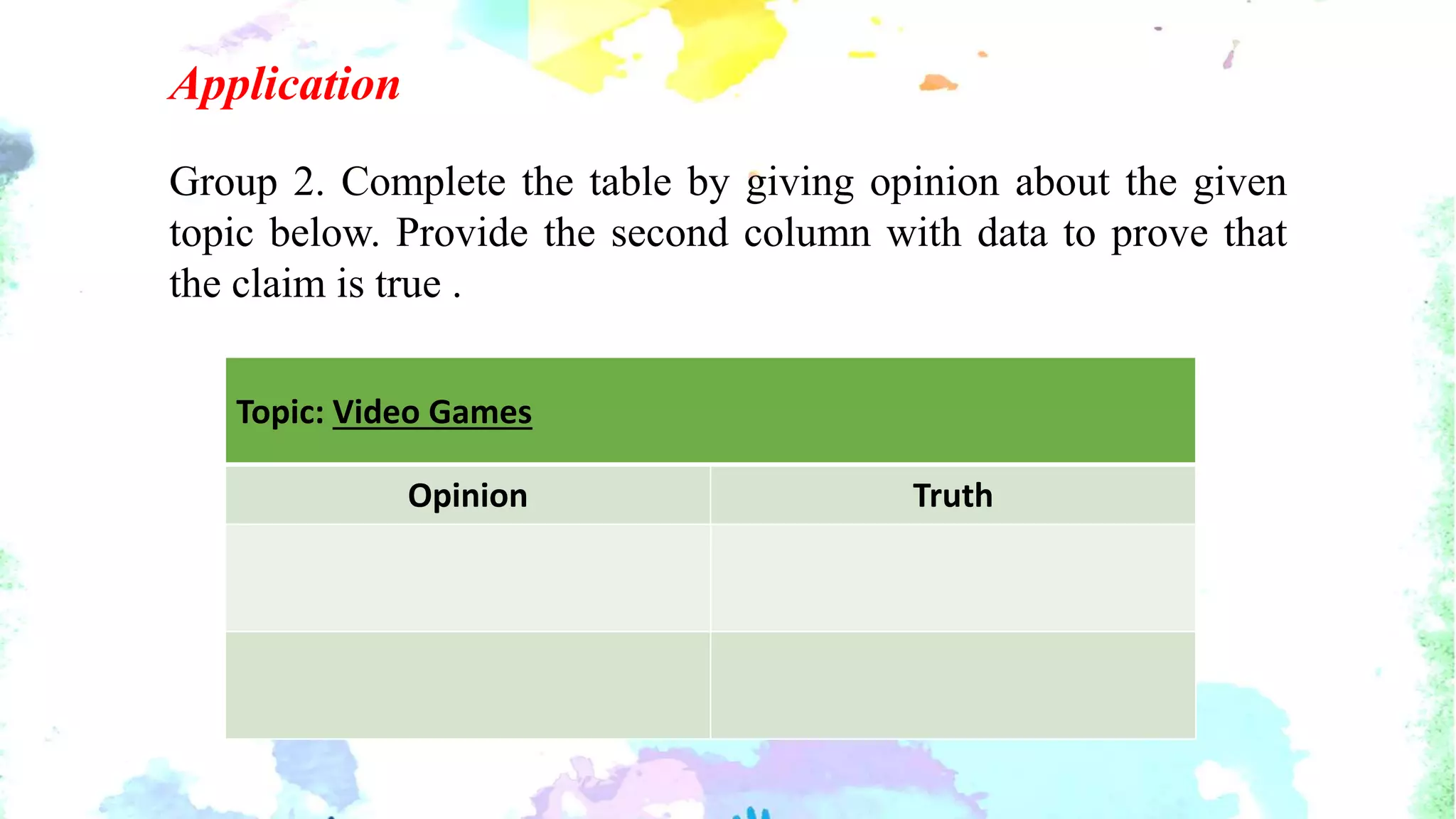
Application
Group 2. Complete the table by giving opinion about the given
topic below. Provide the second column with data to prove that
the claim is true .
Topic: Video Games
Opinion Truth
Opinion
• An opinion is a statement that cannot be proved or checked
• It tells what someone thinks, feels, or believes
• Clue words for opinion statements are:
- think, feel , believe, seem
- always, never, all, none, most, least, best, greatest,
worst
Truth/Fact
• Facts are statements that can be proved or checked
• We can check facts by conducting some sort of experiment,
observation, or by verifying (checking) the fact with source
document
• Facts often contain numbers, dates, or ages
• Facts might include specific information about a person,
place or thing
Quiz:
Which of these statements is a fact and which is an opinion.
1. There is no hope in the Philippine government.
2. President Duterte is currently the president of the Republic of the
Philippines.
3. Mr. Benito Esperitu is a mathematics teacher .
4. The most beautiful country in the Southeast Asia is the Philippines
next to Singapore and Japan.
5. Drinking orange juice after brushing tastes bad.
Assignment
o Research in advance about the most common fallacies
enumerated in Logic.

Philo-Week-4-Truth-or-Opinion.pptx

  • 1.
    LO Introduction toPhilosophy of the Human Person GOOD DAY!!
  • 2.
    Review of thepast lesson Philosophical Reflection  is the act of giving time to think about meaning and purpose of life  an important human activity in which people recapture their experiences, think about it, mull over and evaluate it  it is a form of experience
  • 3.
    • You havebeen saving your allowance in order to buy a new pair of fashion shoes, but your mother is asking you to give your savings for your brother to buy materials for his project. Possible Question Is a new pair of shoes worth it? How do you apply broad perspective to the situation? Think what is more worth it and important. The fashion shoes are always there and you can save again to buy a new pair of shoes.
  • 4.
    Objective: • Define opinionand truth; • Discover the nature of truth in terms of beliefs and statements; • Value the importance of knowing opinion from truth in daily life situation.
  • 5.
    How do weknow if something is true? Philosophers emphasize the importance of belief as a basis for determining truth. Something is true if it can be justified or proven through the use of one’s senses; it is based on facts; it is a product of agreement and consensus; and it can be applied in real life (tested and verified).
  • 6.
    Domains of Truth Philosophyhas been aware that the truth remains to be question for thousand years now. To narrowly confine truth aside of scientific way of thinking, there are domains in life in which we understand truth differently.
  • 7.
    1. Objective Domain Theseare the scientific truths of life. This pertains to the natural world that maintains a relative independence from the perspective and attitude of human beings that perceive them. Truth understood to the description of “state of affairs” which remain true regardless of who is viewing it. Example: Water boiling point remains 100 degree Celsius, regardless of who you are, you will be agreed to this kind of truth unless it is contradicted of another empirical evidence.
  • 8.
    2. Social Domain -in this domain truth is analogous with (not the exact equivalent) of a general agreement or consensus of what is right a opposed to what is wrong. Mostly a product of agreement in the society that has been established overtime. These truths are created and constructed by the people so it can be changed through a critical examination and deliberation among members of a community. Example: Muslim traditions of having more wives. For Christian community it is a taboo to have more than one wife, but not in Muslim Custom. A male Muslim is allowed to marry two or more as long as he sustain the needs of his growing families.
  • 9.
    3. Personal Domain -truth in this domain is analogous with sincerity. The truth that claim in this domain need corresponding actions that will established trust. A person who proves to be consistent with what he declares about himself is regarded as authentic and therefore can be trusted. Example: When someone says, “I love you”, to his girlfriend. How would one know that this is true? Dating and giving gift is not enough. True love, as the adage goes, is tested by time and efforts.
  • 10.
    What is anopinion? Generally, an opinion is a judgement, viewpoint, or a statement that is considered to be subjective. It could refer to thoughts, beliefs, feelings and estimates with no evidence or reasoned judgement to support it. For Dr. Rhonda Dubec (2019), an opinion is what a person believe or think about something or any subject. It is a view that represents the outlook of an individual, which may or may not be based on fact. Opinions are comprised of statements which not only give facts but also provide conclusion or perspectives regarding certain situations. Opinions are also the bases for making arguments and convincing people that a certain is fact. Opinions can’t be proven as that it is true or false. Because everyone has their own viewpoint and opinions based on their mindset.
  • 11.
    Distinguishing TRUTH fromOPINION What are the differences?
  • 12.
    It is veryessential to distinguish truth from opinion because apart from the fact the latter has no objective grounds, opinions could also mislead us. They have the potential to influence public view just to conform to a specific agenda. Their main goal is to achieve a desired outcome rather than to promote what is the truth. Whether the statement is a fact or an opinion depends on its validity. The following are some differences between truth and opinion: 1. Truth is a statement that can be verified or proved with the help of evidence or empirical data while an opinion is an expression of judgement or belief on any particular subject.
  • 13.
    2. Truth heavilyrelies on fact, while opinion depends on assumption and perception. 3. Generally, truth is an objective reality and has universality in nature, while opinion is purely subjective reality. 4. Truth are useful to make information or make an argument, while opinions are used for persuasion.
  • 14.
    Application Activity 1. Makeyour own analysis of the following statements. 1. It takes one day to recognize if a man loves a woman. 2. Living near the school is better because we do not have to spend much money for transportation. 3. The color of the snow is white. 4. My sister is a selfish person because she ate the last piece of pizza and didn’t share it with me. 5. The aggressive manner by which the police arrested the suspect is an example of brutality that characterizes our police force.
  • 15.
    Application Group 2. Completethe table by giving opinion about the given topic below. Provide the second column with data to prove that the claim is true . Topic: Video Games Opinion Truth
  • 16.
    Opinion • An opinionis a statement that cannot be proved or checked • It tells what someone thinks, feels, or believes • Clue words for opinion statements are: - think, feel , believe, seem - always, never, all, none, most, least, best, greatest, worst Truth/Fact • Facts are statements that can be proved or checked • We can check facts by conducting some sort of experiment, observation, or by verifying (checking) the fact with source document • Facts often contain numbers, dates, or ages • Facts might include specific information about a person, place or thing
  • 17.
    Quiz: Which of thesestatements is a fact and which is an opinion. 1. There is no hope in the Philippine government. 2. President Duterte is currently the president of the Republic of the Philippines. 3. Mr. Benito Esperitu is a mathematics teacher . 4. The most beautiful country in the Southeast Asia is the Philippines next to Singapore and Japan. 5. Drinking orange juice after brushing tastes bad.
  • 18.
    Assignment o Research inadvance about the most common fallacies enumerated in Logic.

Editor's Notes

  • #2 Let us all stand for a Prayer, checking of attendance
  • #4 With regards to your responses you are applying holistic perspective. Why? Because this is a genuine thinking and your mind was able to look beyond what you see with your senses.The connectedness of parts to see a meaningful whole
  • #10 .
  • #16 Ok time is up. You may post your work on the board and select one member of each group to report about your output. Ok lets give everybody a wow clap. Can you now define what is truth and what is an opinion?
  • #17 How do you feel when you heard an opinion about you? Why do we have to avoid giving unsolicited opinions to people who are not too familiar to us?