Process of
Management
Development
What is Management Development
2
◈ “An Organization’s conscious effort to provide
its managers (and potential managers) with
opportunities to learn, grow, and change, in
hopes of producing over the long term cadre of
managers with the skills necessary to function
effectively in that organization”
Methods of
Management
Development
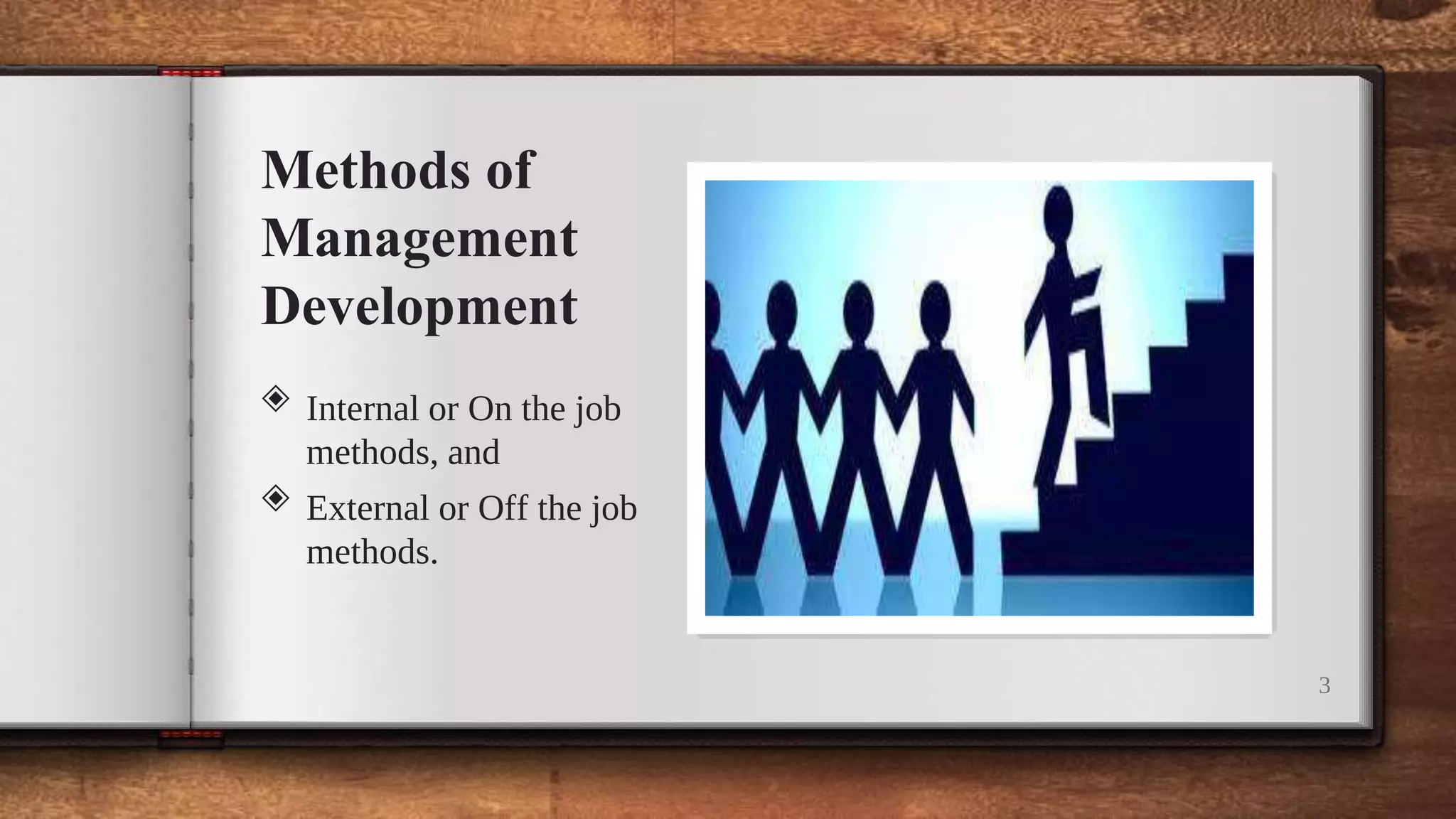
◈ Internal or On the job
methods, and
◈ External or Off the job
methods.
3
Internal Methods of Management Development:
1. Membership of Committees:
 Inter-departmental committees are created to bring
coordination in activities of different department.
 Managers from different departments are taken as
membership so as to get exposure to viewpoints of
other departmental heads.
 When there arise a problem, the management of the
membership committee studies the problem in depth
and makes recommendations.
4
2. Project Assignment
◈ A trainee manager is given a specific problem as
a project related to the work of his department.
◈ The executive have to study the problem and
give recommendations so as to develop their
problem-solving attitude, which is essential
requirement of an executive.
5
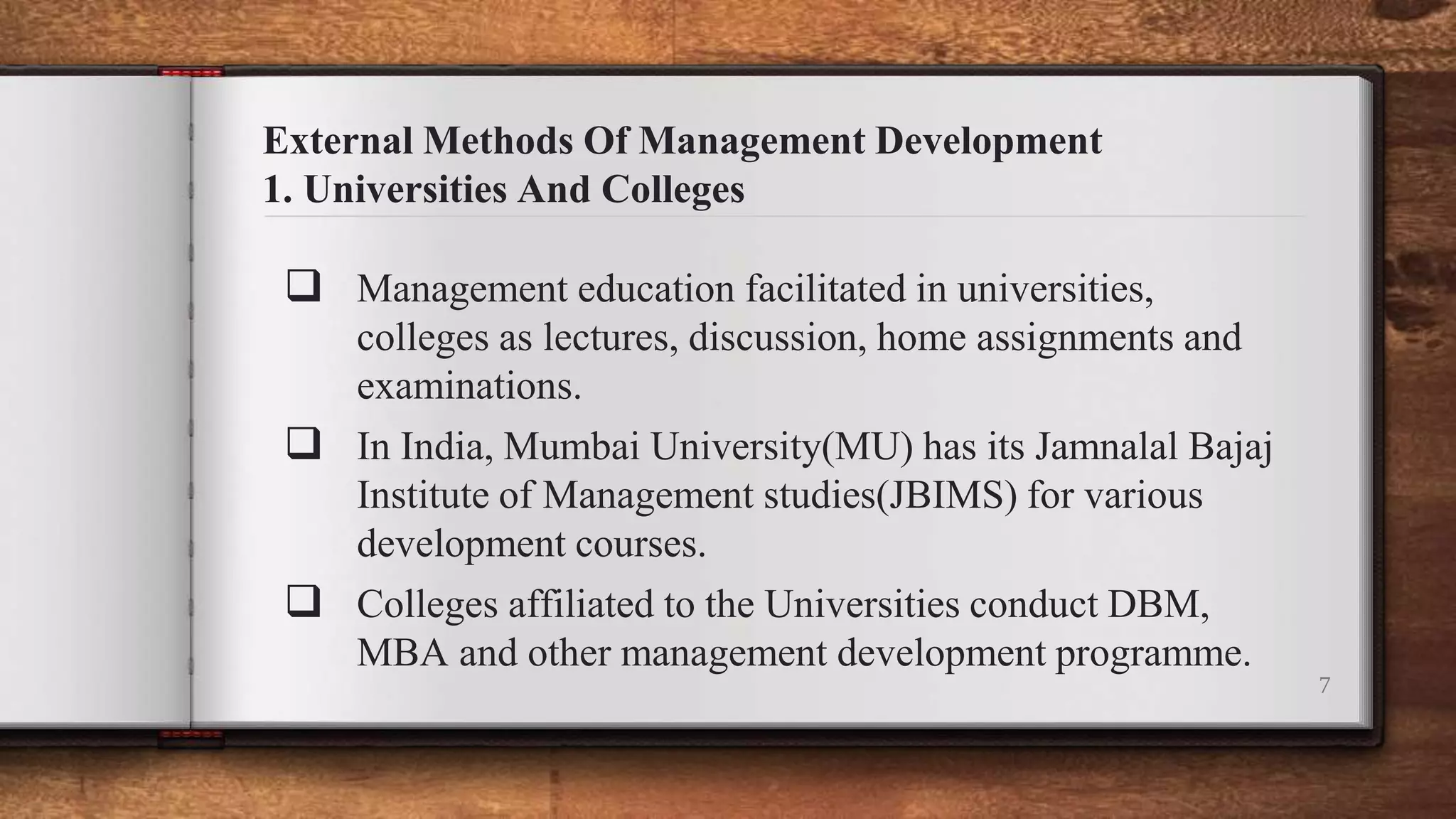
3. Promotion and Transfer
Promotion gives an opportunity to a
manager to acquire new skill required
for the job at the higher level.
Transfer facilitates the broadening of
viewpoint required for higher positions.
It gives an opportunity to work at
different positions and develop.
6
External Methods Of Management Development
1. Universities And Colleges
 Management education facilitated in universities,
colleges as lectures, discussion, home assignments and
examinations.
 In India, Mumbai University(MU) has its Jamnalal Bajaj
Institute of Management studies(JBIMS) for various
development courses.
 Colleges affiliated to the Universities conduct DBM,
MBA and other management development programme.
7
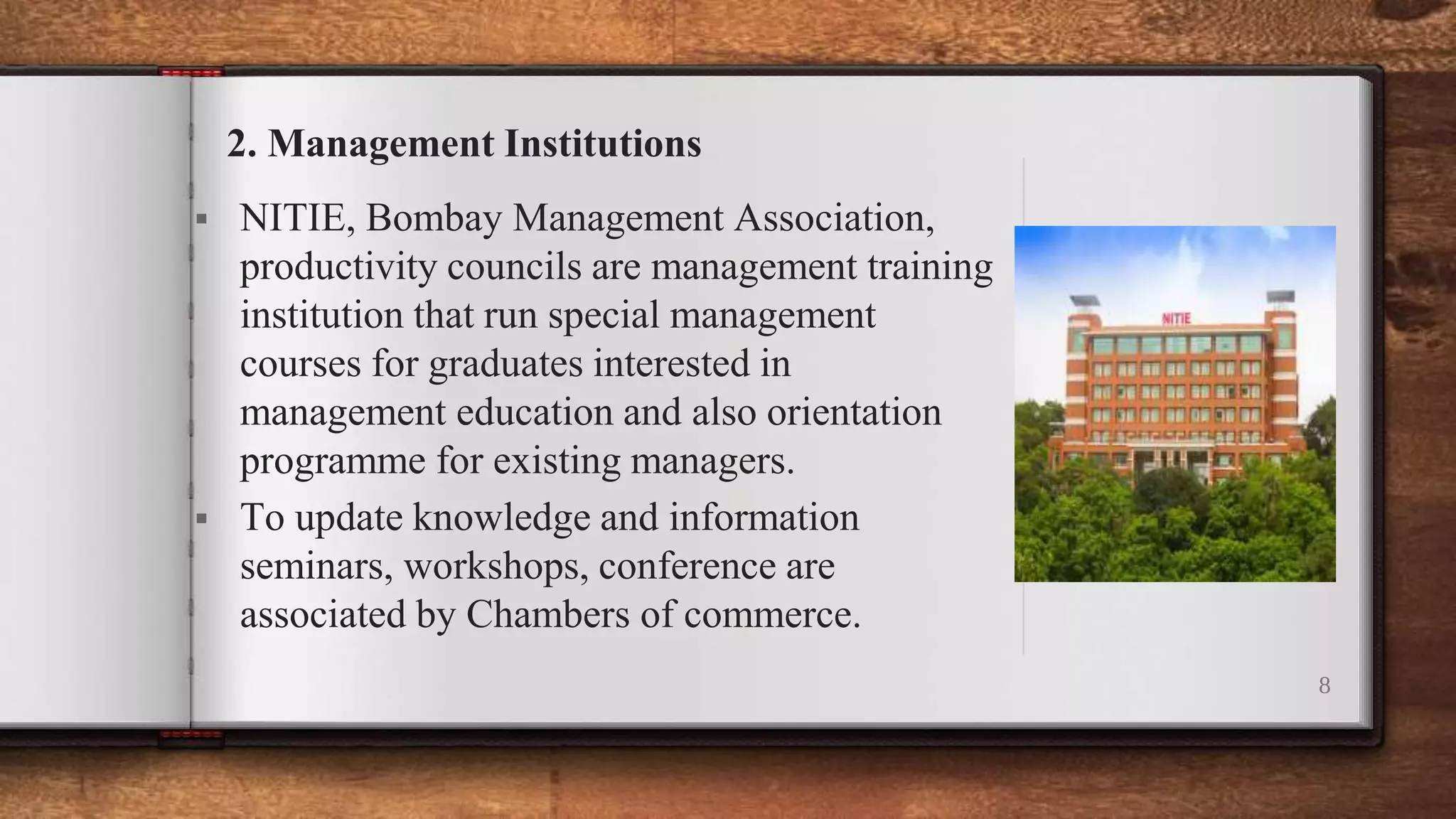
 NITIE, Bombay Management Association,
productivity councils are management training
institution that run special management
courses for graduates interested in
management education and also orientation
programme for existing managers.
 To update knowledge and information
seminars, workshops, conference are
associated by Chambers of commerce.
8
2. Management Institutions
3. Role Playing- A method of human interaction, which involves
reaisti behaviour in the imaginary situations.
 Useful for learning human relations and leadership training.
 To raise the ability of trainee manager while dealing with
others.
 In this, a conflict situation is artificially created and two or
more trainees are assigned different roles to play.
 This finally gives better understanding among individuals.
 It helps to promote interpersonal relations and attitude change.
9
4. Case Study
◈ First developed by Christopher Langdell at Harvard Law
School.
◈ “Written account giving details of the situation” relating to
aspect of management such as production, marketing,
personnel, finance.
◈ The case presented are always incomplete where the
participants are supposed to identify best available
solution.
◈ It promotes in-depth thinking about the matter, more
perception in thinking and great respect to others opinion. 10
5. Conferences and Seminars
◈ Various matters are discussed systematically which
provides new information and knowledge to the
Managers.
◈ The participants here are limited since everyone gets
opportunity to participate for self-development.
◈ This is held for directing, guiding or for consultation
and finally for problem solving.
11
6. Simulation
◈ A trainee is given practical training by creating situation
predicting real life aspects in work place.
◈ In that situation, the trainee is asked to take a decision
with supporting activities. The results of those decisions
are noted.
◈ The report illustrates what would have happened if that
decision was taken.
◈ The trainee learns from feedback and improves.
12
7. Management or Business Games
◈ A type of classroom method training in which the game is
designed predicting real life situation.
◈ Employees in managerial positions are put in an exercise
of actual decision making.
◈ A problem is provided to them along with all information
and constraints. The employee is asked to make decision
and the quality of this decision is judged.
◈ Finally, it develops capacity to take rational decisions.
13
8. TV and Video Instructions
◈ Programmes on Management problems are arranged on
TV network regularly.
◈ Videotapes are available on management training.
◈ Books and periodicals are published regularly on
management.
◈ Audio-visual aids now used for training of managers.
14
THANKS!
Efforts By.,
R Elizabeth (19012107)
MBA

Methods of Management Development

  • 1.
  • 2.
    What is ManagementDevelopment 2 ◈ “An Organization’s conscious effort to provide its managers (and potential managers) with opportunities to learn, grow, and change, in hopes of producing over the long term cadre of managers with the skills necessary to function effectively in that organization”
  • 3.
    Methods of Management Development ◈ Internalor On the job methods, and ◈ External or Off the job methods. 3
  • 4.
    Internal Methods ofManagement Development: 1. Membership of Committees:  Inter-departmental committees are created to bring coordination in activities of different department.  Managers from different departments are taken as membership so as to get exposure to viewpoints of other departmental heads.  When there arise a problem, the management of the membership committee studies the problem in depth and makes recommendations. 4
  • 5.
    2. Project Assignment ◈A trainee manager is given a specific problem as a project related to the work of his department. ◈ The executive have to study the problem and give recommendations so as to develop their problem-solving attitude, which is essential requirement of an executive. 5
  • 6.
    3. Promotion andTransfer Promotion gives an opportunity to a manager to acquire new skill required for the job at the higher level. Transfer facilitates the broadening of viewpoint required for higher positions. It gives an opportunity to work at different positions and develop. 6
  • 7.
    External Methods OfManagement Development 1. Universities And Colleges  Management education facilitated in universities, colleges as lectures, discussion, home assignments and examinations.  In India, Mumbai University(MU) has its Jamnalal Bajaj Institute of Management studies(JBIMS) for various development courses.  Colleges affiliated to the Universities conduct DBM, MBA and other management development programme. 7
  • 8.
     NITIE, BombayManagement Association, productivity councils are management training institution that run special management courses for graduates interested in management education and also orientation programme for existing managers.  To update knowledge and information seminars, workshops, conference are associated by Chambers of commerce. 8 2. Management Institutions
  • 9.
    3. Role Playing-A method of human interaction, which involves reaisti behaviour in the imaginary situations.  Useful for learning human relations and leadership training.  To raise the ability of trainee manager while dealing with others.  In this, a conflict situation is artificially created and two or more trainees are assigned different roles to play.  This finally gives better understanding among individuals.  It helps to promote interpersonal relations and attitude change. 9
  • 10.
    4. Case Study ◈First developed by Christopher Langdell at Harvard Law School. ◈ “Written account giving details of the situation” relating to aspect of management such as production, marketing, personnel, finance. ◈ The case presented are always incomplete where the participants are supposed to identify best available solution. ◈ It promotes in-depth thinking about the matter, more perception in thinking and great respect to others opinion. 10
  • 11.
    5. Conferences andSeminars ◈ Various matters are discussed systematically which provides new information and knowledge to the Managers. ◈ The participants here are limited since everyone gets opportunity to participate for self-development. ◈ This is held for directing, guiding or for consultation and finally for problem solving. 11
  • 12.
    6. Simulation ◈ Atrainee is given practical training by creating situation predicting real life aspects in work place. ◈ In that situation, the trainee is asked to take a decision with supporting activities. The results of those decisions are noted. ◈ The report illustrates what would have happened if that decision was taken. ◈ The trainee learns from feedback and improves. 12
  • 13.
    7. Management orBusiness Games ◈ A type of classroom method training in which the game is designed predicting real life situation. ◈ Employees in managerial positions are put in an exercise of actual decision making. ◈ A problem is provided to them along with all information and constraints. The employee is asked to make decision and the quality of this decision is judged. ◈ Finally, it develops capacity to take rational decisions. 13
  • 14.
    8. TV andVideo Instructions ◈ Programmes on Management problems are arranged on TV network regularly. ◈ Videotapes are available on management training. ◈ Books and periodicals are published regularly on management. ◈ Audio-visual aids now used for training of managers. 14
  • 15.