METHODS OF
KNOWLEDGE
MANAGEMENT
Presented by
T. Nivya
21BDP24
Sec - A
KNOWLEDGE MANAGEMENT
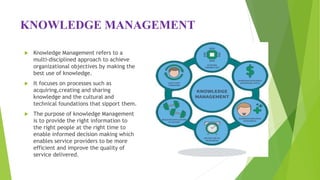
 Knowledge Management refers to a
multi-disciplined approach to achieve
organizational objectives by making the
best use of knowledge.
 It focuses on processes such as
acquiring,creating and sharing
knowledge and the cultural and
technical foundations that sipport them.
 The purpose of knowledge Management
is to provide the right information to
the right people at the right time to
enable informed decision making which
enables service providers to be more
efficient and improve the quality of
service delivered.
KNOWLEDGE MANAGEMENT PROCESS
 The process of knowledge management is
universal for any enterprise. Sometimes, the
resources used, such as tools and techniques, can
be unique to the organizational environment.
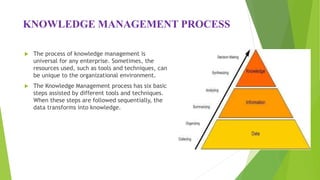
 The Knowledge Management process has six basic
steps assisted by different tools and techniques.
When these steps are followed sequentially, the
data transforms into knowledge.
METHOD 1: Collecting
 This is the most important step of the knowledge
management process. If you collect the incorrect or
irrelevant data, the resulting knowledge may not be
the most accurate. Therefore, the decisions made
based on such knowledge could be inaccurate as well.
 There are many methods and tools used for data
collection. First of all, data collection should be a
procedure in knowledge management process. These
procedures should be properly documented and
followed by people involved in data collection process.
METHOD 2: Organizing
 The data collected need to be organized. This
organization usually happens based on certain
rules. These rules are defined by the
organization.
 As an example, all sales-related data can be
filed together and all staff-related data could
be stored in the same database table. This
type of organization helps to maintain data
accurately within a database.
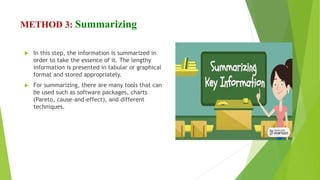
METHOD 3: Summarizing
 In this step, the information is summarized in
order to take the essence of it. The lengthy
information is presented in tabular or graphical
format and stored appropriately.
 For summarizing, there are many tools that can
be used such as software packages, charts
(Pareto, cause-and-effect), and different
techniques.
METHOD 4: Analysing
 At this method, the information is analyzed in
order to find the relationships, redundancies and
patterns.
 An expert or an expert team should be assigned
for this purpose as the experience of the
person/team plays a vital role. Usually, there are
reports created after analysis of information.
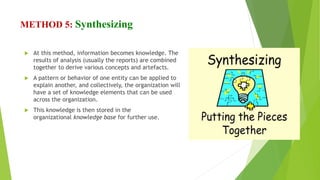
METHOD 5: Synthesizing
 At this method, information becomes knowledge. The
results of analysis (usually the reports) are combined
together to derive various concepts and artefacts.
 A pattern or behavior of one entity can be applied to
explain another, and collectively, the organization will
have a set of knowledge elements that can be used
across the organization.
 This knowledge is then stored in the
organizational knowledge base for further use.
METHOD 6: Decision Making
 At this method, the knowledge is used for decision
making. As an example, when estimating a specific
type of a project or a task, the knowledge related to
previous estimates can be used.
 This accelerates the estimation process and adds high
accuracy. This is how the organizational knowledge
management adds value and saves money in the long
run.
CONCLUSION
 Knowledge management is an essential practice for
enterprise organizations. Organizational knowledge
adds long-term benefits to the organization in terms of
finances, culture and people.
 Therefore, all mature organizations should take
necessary steps for knowledge management in order to
enhance the business operations and organization's
overall capability.
REFERENCES
 Knowledge Management concept
 www.valamis.com/hub/knowledge-management
 https://lucidea.com/blog/6-proven-knowledge-management-methodologies.
METHODS OF KNOWLEDGE MANAGEMENT.pptx

METHODS OF KNOWLEDGE MANAGEMENT.pptx

  • 1.
  • 2.
    KNOWLEDGE MANAGEMENT  KnowledgeManagement refers to a multi-disciplined approach to achieve organizational objectives by making the best use of knowledge.  It focuses on processes such as acquiring,creating and sharing knowledge and the cultural and technical foundations that sipport them.  The purpose of knowledge Management is to provide the right information to the right people at the right time to enable informed decision making which enables service providers to be more efficient and improve the quality of service delivered.
  • 3.
    KNOWLEDGE MANAGEMENT PROCESS The process of knowledge management is universal for any enterprise. Sometimes, the resources used, such as tools and techniques, can be unique to the organizational environment.  The Knowledge Management process has six basic steps assisted by different tools and techniques. When these steps are followed sequentially, the data transforms into knowledge.
  • 4.
    METHOD 1: Collecting This is the most important step of the knowledge management process. If you collect the incorrect or irrelevant data, the resulting knowledge may not be the most accurate. Therefore, the decisions made based on such knowledge could be inaccurate as well.  There are many methods and tools used for data collection. First of all, data collection should be a procedure in knowledge management process. These procedures should be properly documented and followed by people involved in data collection process.
  • 5.
    METHOD 2: Organizing The data collected need to be organized. This organization usually happens based on certain rules. These rules are defined by the organization.  As an example, all sales-related data can be filed together and all staff-related data could be stored in the same database table. This type of organization helps to maintain data accurately within a database.
  • 6.
    METHOD 3: Summarizing In this step, the information is summarized in order to take the essence of it. The lengthy information is presented in tabular or graphical format and stored appropriately.  For summarizing, there are many tools that can be used such as software packages, charts (Pareto, cause-and-effect), and different techniques.
  • 7.
    METHOD 4: Analysing At this method, the information is analyzed in order to find the relationships, redundancies and patterns.  An expert or an expert team should be assigned for this purpose as the experience of the person/team plays a vital role. Usually, there are reports created after analysis of information.
  • 8.
    METHOD 5: Synthesizing At this method, information becomes knowledge. The results of analysis (usually the reports) are combined together to derive various concepts and artefacts.  A pattern or behavior of one entity can be applied to explain another, and collectively, the organization will have a set of knowledge elements that can be used across the organization.  This knowledge is then stored in the organizational knowledge base for further use.
  • 9.
    METHOD 6: DecisionMaking  At this method, the knowledge is used for decision making. As an example, when estimating a specific type of a project or a task, the knowledge related to previous estimates can be used.  This accelerates the estimation process and adds high accuracy. This is how the organizational knowledge management adds value and saves money in the long run.
  • 10.
    CONCLUSION  Knowledge managementis an essential practice for enterprise organizations. Organizational knowledge adds long-term benefits to the organization in terms of finances, culture and people.  Therefore, all mature organizations should take necessary steps for knowledge management in order to enhance the business operations and organization's overall capability.
  • 11.
    REFERENCES  Knowledge Managementconcept  www.valamis.com/hub/knowledge-management  https://lucidea.com/blog/6-proven-knowledge-management-methodologies.