SUBJECT:
KNOWLEDGE MANAGEMENT
ASSIGNMENT ON:
PERFORMANCE OF KNOWLEDGE BASED ORGANIZATION
& THEIR AUDITING METHODS
SUBMITTED TO:
MAM SHABINA
SUBMITTED BY:
VARDA SHAIKH 1310-BBA027
KNOWLEDGE BASED ORGANIZATION:
 PERFORM WELL IN TERMS OF INNOVATION
The basic purpose of knowledge management is to bring innovation and the innovation
brings value for the business. The link between km and innovation is necessary
because Km basically helps to fill the knowledge gap which ultimately brings the
innovation into the organization.
ACCORDING TO A RESEARCH:
75% CEO’s of fastest growing organizations claim that their strongest weapon to
compete in market is their innovative products and processes that can be possible only
when they successfully implement the km system in their organizations.
The basic types of km are:
1. Explicit knowledge
2. tacit knowledge
Through knowledge management, organization can identify their tacit knowledge which
they usually do not know before. Knowledge management also helps the organization to
articulate tacit knowledge in the form of explicit knowledge and this is a strong base to
bring innovation.
Furthermore, through knowledge management activities, organizations can find out the
distance of knowledge from inside and outside the organizations and KM is the only tool
through which we can reduce the neglected distance.
Knowledge management focuses on this neglected area because in this competitive era
organizations compete not only on the basis of efficiency and effectiveness but its
success also depends upon how particular organizations identify, gather, manage,
integrate, share and disseminate relevant knowledge to their human capital to bring
innovation.
.
 PERFORM LESS IN TERMS OF EFFICIENCY:
Knowledge sharing is a crucial part of making knowledge management system work,
but most organizations fails to share the proper knowledge with employees and
managers, and it in turn costs the company.
ACCORDING TO FORBES MAGAZINE:
Fortune 500 companies are losing tens of billions of dollars per year just because of
neglecting in sharing the knowledge.
Extracting information from workers who possess valuable company knowledge can be
a difficult and lengthy process.
Knowledge management systems are complex and hard to understand for the average
worker and training workers to use knowledge management systems. When employees
fail to collect and input data into knowledge management systems properly, the
organization cannot take full advantage of the system's major benefits, ultimately reduce
the efficiency.
METHODS TO AUDIT KNOWLEDGE IN ORGANIZATIONS:
The knowledge audit is an assessment of an organization’s knowledge capabilities. It
identifies the gap between available knowledge and what’s needed based on the
organization’s strategic objectives.
A knowledge audit should start with strategic planning to identify current and future
priorities, as well as a SWOT analysis to examine the organization’s Strengths,
Weaknesses, Opportunities, and Threats.
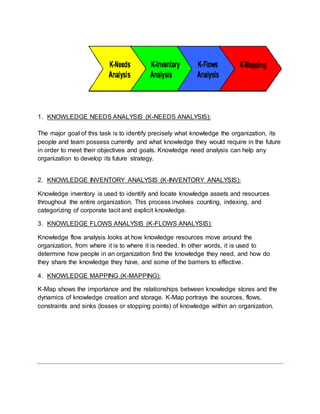
The following methods are consistent with the generalized knowledge life-cycle
suggested by Birken Shaw and Sheehan (2002), these are:
1. Knowledge Needs analysis
2. Knowledge Inventory analysis
3. Knowledge Flow analysis
4. Knowledge Mapping
1. KNOWLEDGE NEEDS ANALYSIS (K-NEEDS ANALYSIS):
The major goal of this task is to identify precisely what knowledge the organization, its
people and team possess currently and what knowledge they would require in the future
in order to meet their objectives and goals. Knowledge need analysis can help any
organization to develop its future strategy.
2. KNOWLEDGE INVENTORY ANALYSIS (K-INVENTORY ANALYSIS):
Knowledge inventory is used to identify and locate knowledge assets and resources
throughout the entire organization. This process involves counting, indexing, and
categorizing of corporate tacit and explicit knowledge.
3. KNOWLEDGE FLOWS ANALYSIS (K-FLOWS ANALYSIS):
Knowledge flow analysis looks at how knowledge resources move around the
organization, from where it is to where it is needed. In other words, it is used to
determine how people in an organization find the knowledge they need, and how do
they share the knowledge they have, and some of the barriers to effective.
4. KNOWLEDGE MAPPING (K-MAPPING):
K-Map shows the importance and the relationships between knowledge stores and the
dynamics of knowledge creation and storage. K-Map portrays the sources, flows,
constraints and sinks (losses or stopping points) of knowledge within an organization.
THE END

PERFORMANCE OF KNOWLEDGE BASED ORGANIZATION & THEIR AUDITING METHODS

  • 1.
    SUBJECT: KNOWLEDGE MANAGEMENT ASSIGNMENT ON: PERFORMANCEOF KNOWLEDGE BASED ORGANIZATION & THEIR AUDITING METHODS SUBMITTED TO: MAM SHABINA SUBMITTED BY: VARDA SHAIKH 1310-BBA027
  • 2.
    KNOWLEDGE BASED ORGANIZATION: PERFORM WELL IN TERMS OF INNOVATION The basic purpose of knowledge management is to bring innovation and the innovation brings value for the business. The link between km and innovation is necessary because Km basically helps to fill the knowledge gap which ultimately brings the innovation into the organization. ACCORDING TO A RESEARCH: 75% CEO’s of fastest growing organizations claim that their strongest weapon to compete in market is their innovative products and processes that can be possible only when they successfully implement the km system in their organizations. The basic types of km are: 1. Explicit knowledge 2. tacit knowledge Through knowledge management, organization can identify their tacit knowledge which they usually do not know before. Knowledge management also helps the organization to articulate tacit knowledge in the form of explicit knowledge and this is a strong base to bring innovation. Furthermore, through knowledge management activities, organizations can find out the distance of knowledge from inside and outside the organizations and KM is the only tool through which we can reduce the neglected distance. Knowledge management focuses on this neglected area because in this competitive era organizations compete not only on the basis of efficiency and effectiveness but its success also depends upon how particular organizations identify, gather, manage, integrate, share and disseminate relevant knowledge to their human capital to bring innovation. .  PERFORM LESS IN TERMS OF EFFICIENCY: Knowledge sharing is a crucial part of making knowledge management system work, but most organizations fails to share the proper knowledge with employees and managers, and it in turn costs the company.
  • 3.
    ACCORDING TO FORBESMAGAZINE: Fortune 500 companies are losing tens of billions of dollars per year just because of neglecting in sharing the knowledge. Extracting information from workers who possess valuable company knowledge can be a difficult and lengthy process. Knowledge management systems are complex and hard to understand for the average worker and training workers to use knowledge management systems. When employees fail to collect and input data into knowledge management systems properly, the organization cannot take full advantage of the system's major benefits, ultimately reduce the efficiency. METHODS TO AUDIT KNOWLEDGE IN ORGANIZATIONS: The knowledge audit is an assessment of an organization’s knowledge capabilities. It identifies the gap between available knowledge and what’s needed based on the organization’s strategic objectives. A knowledge audit should start with strategic planning to identify current and future priorities, as well as a SWOT analysis to examine the organization’s Strengths, Weaknesses, Opportunities, and Threats. The following methods are consistent with the generalized knowledge life-cycle suggested by Birken Shaw and Sheehan (2002), these are: 1. Knowledge Needs analysis 2. Knowledge Inventory analysis 3. Knowledge Flow analysis 4. Knowledge Mapping
  • 4.
    1. KNOWLEDGE NEEDSANALYSIS (K-NEEDS ANALYSIS): The major goal of this task is to identify precisely what knowledge the organization, its people and team possess currently and what knowledge they would require in the future in order to meet their objectives and goals. Knowledge need analysis can help any organization to develop its future strategy. 2. KNOWLEDGE INVENTORY ANALYSIS (K-INVENTORY ANALYSIS): Knowledge inventory is used to identify and locate knowledge assets and resources throughout the entire organization. This process involves counting, indexing, and categorizing of corporate tacit and explicit knowledge. 3. KNOWLEDGE FLOWS ANALYSIS (K-FLOWS ANALYSIS): Knowledge flow analysis looks at how knowledge resources move around the organization, from where it is to where it is needed. In other words, it is used to determine how people in an organization find the knowledge they need, and how do they share the knowledge they have, and some of the barriers to effective. 4. KNOWLEDGE MAPPING (K-MAPPING): K-Map shows the importance and the relationships between knowledge stores and the dynamics of knowledge creation and storage. K-Map portrays the sources, flows, constraints and sinks (losses or stopping points) of knowledge within an organization.
  • 5.