•
•
•
•
•
•
•
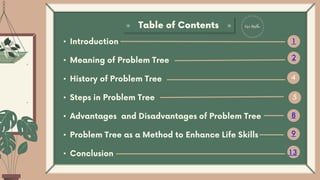
1
2
4
8
13
9
5
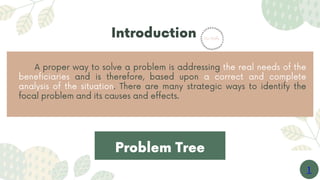
1
2
3
Problem Tree first appeared in October 2005 in
the ODI Toolkit, Successful Communication, A Toolkit for
Researchers and Civil Society Organisations.
Development agencies such as DFID’s Tools for Development and CERTI’s
crisis and transition toolkit referenced to Problem Tree Analysis in their
toolkit.
4
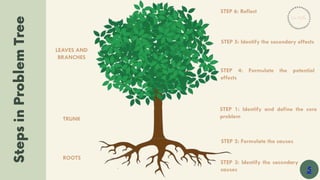
STEP 1: Identify and define the core
problem
STEP 2: Formulate the causes
STEP 4: Formulate the potential
effects
STEP 5: Identify the secondary effects
STEP 3: Identify the secondary
causes
STEP 6: Reflect
TRUNK
LEAVES AND
BRANCHES
ROOTS
5
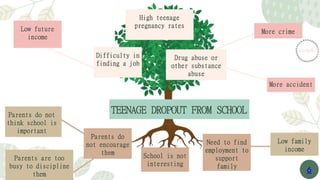
TEENAGE DROPOUT FROM SCHOOL
School is not
interesting
Parents do
not encourage
them
Need to find
employment to
support
family
Low future
income
More crime
Difficulty in
finding a job
High teenage
pregnancy rates
Drug abuse or
other substance
abuse
Parents do not
think school is
important
Parents are too
busy to discipline
them
Low family
income
More accident
6
7
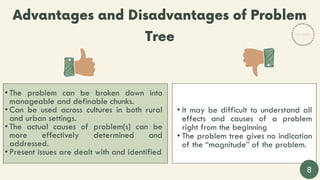
• The problem can be broken down into
manageable and definable chunks.
• Can be used across cultures in both rural
and urban settings.
• The actual causes of problem(s) can be
more effectively determined and
addressed.
• Present issues are dealt with and identified
• It may be difficult to understand all
effects and causes of a problem
right from the beginning
• The problem tree gives no indication
of the “magnitude” of the problem.
8
9
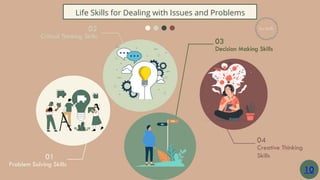
Life Skills for Dealing with Issues and Problems
01
Problem Solving Skills
02
Critical Thinking Skills
04
Creative Thinking
Skills
03
Decision Making Skills
10
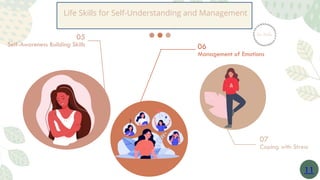
Life Skills for Self-Understanding and Management
06
Management of Emotions
05
Self-Awareness Building Skills
07
Coping with Stress
11
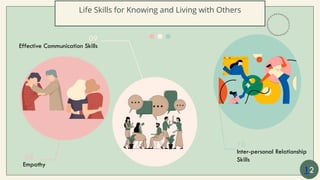
Life Skills for Knowing and Living with Others
08
Empathy
09
Effective Communication Skills
10
Inter-personal Relationship
Skills
12
13
Method for Life Skills Enhancement: Problem Tree

Method for Life Skills Enhancement: Problem Tree

  • 2.
  • 3.
  • 4.
  • 5.
  • 6.
    Problem Tree firstappeared in October 2005 in the ODI Toolkit, Successful Communication, A Toolkit for Researchers and Civil Society Organisations. Development agencies such as DFID’s Tools for Development and CERTI’s crisis and transition toolkit referenced to Problem Tree Analysis in their toolkit. 4
  • 7.
    STEP 1: Identifyand define the core problem STEP 2: Formulate the causes STEP 4: Formulate the potential effects STEP 5: Identify the secondary effects STEP 3: Identify the secondary causes STEP 6: Reflect TRUNK LEAVES AND BRANCHES ROOTS 5
  • 8.
    TEENAGE DROPOUT FROMSCHOOL School is not interesting Parents do not encourage them Need to find employment to support family Low future income More crime Difficulty in finding a job High teenage pregnancy rates Drug abuse or other substance abuse Parents do not think school is important Parents are too busy to discipline them Low family income More accident 6
  • 9.
  • 10.
    • The problemcan be broken down into manageable and definable chunks. • Can be used across cultures in both rural and urban settings. • The actual causes of problem(s) can be more effectively determined and addressed. • Present issues are dealt with and identified • It may be difficult to understand all effects and causes of a problem right from the beginning • The problem tree gives no indication of the “magnitude” of the problem. 8
  • 11.
  • 12.
    Life Skills forDealing with Issues and Problems 01 Problem Solving Skills 02 Critical Thinking Skills 04 Creative Thinking Skills 03 Decision Making Skills 10
  • 13.
    Life Skills forSelf-Understanding and Management 06 Management of Emotions 05 Self-Awareness Building Skills 07 Coping with Stress 11
  • 14.
    Life Skills forKnowing and Living with Others 08 Empathy 09 Effective Communication Skills 10 Inter-personal Relationship Skills 12
  • 15.