XXXV CONVEGNO NAZIONALE DI IDRAULICA
E COSTRUZIONI IDRAULICHE
Bologna, 14-16 Settembre 2016
The Metastatistical Extreme Value
Distribution
Metodi Statistici per le Applicazioni Idrologiche
Enrico Zorzetto1, Gianluca Botter2,
Marco Marani1,2,*
1Earth and Ocean Science Division, Duke University
2 DICEA, Universita’ di Padova
* marco.marani@unipd.it
Classical Extreme Value Theory (EVT)
[Fischer-Tippett-Gnedenko, 1928-1943]
Block Maxima:
Three-Type Theorem:
- As n  ∞
-After renormalization, 3 possible
asymptotic distributions,
summarized by GEV (e.g. Von Mises, 1936):
= Maxima n-event blocks
h[mm]
𝑥 𝑛
1937 19381936 1939 194019411942
𝑥 𝑛 = max
𝑛
(𝑥𝑖)
for i.i.d 𝑥𝑖 ∶ 𝐻 𝑛 𝑥 = 𝐹 𝑥 𝑛
𝐻 𝑥 = exp − 1 +
𝜉
𝜓
𝑥 − 𝜇
+
−
1
𝜉
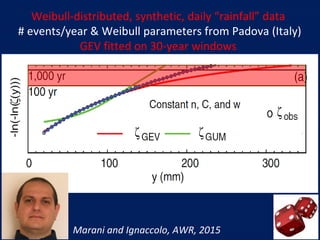
Marani and Ignaccolo, AWR, 2015
Weibull-distributed, synthetic, daily “rainfall” data
# events/year & Weibull parameters from Padova (Italy)
GEV fitted on 30-year windows
Considerations on the validity of the classical EVT
- Incomplete convergence to limiting distribution: n <<  !!!
(e.g. Koutsoyiannis, 2013; Serinaldi and Kilsby, 2014).
- When number of events is small yearly maxima also come from bulk of
distribution, not just the tail (we are far from a limiting form)
- GEV - Maximum Likelihood only uses yearly maxima and neglects most
of the data.
- Peak Over Threshold uses more data, but still a fraction of available
information.
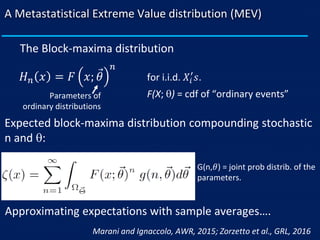
A Metastatistical Extreme Value distribution (MEV)
𝐻 𝑛 𝑥 = 𝐹 𝑥; Ԧ𝜃
𝑛
for i.i.d. 𝑋𝑖
′
𝑠.
F(X; ) = cdf of “ordinary events”
The Block-maxima distribution
Expected block-maxima distribution compounding stochastic
n and :
Marani and Ignaccolo, AWR, 2015; Zorzetto et al., GRL, 2016
G(n,𝜃) = joint prob distrib. of the
parameters.
Approximating expectations with sample averages….
Parameters of
ordinary distributions
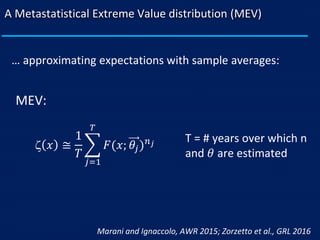
A Metastatistical Extreme Value distribution (MEV)
Marani and Ignaccolo, AWR 2015; Zorzetto et al., GRL 2016
 𝑥 ≅
1
𝑇
෍
𝑗=1
𝑇
𝐹(𝑥; 𝜃𝑗) 𝑛 𝑗
T = # years over which n
and 𝜃 are estimated
… approximating expectations with sample averages:
MEV:
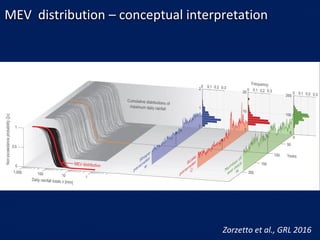
MEV distribution – conceptual interpretation
Zorzetto et al., GRL 2016
A choice for F(x) - the pdf of daily «ordinary» rainfall
𝑅 𝑎𝑐𝑐 = ത𝑘ത𝑞𝑚
𝐹 𝑥 = 1 − 𝑒
𝑥
𝐶
𝑤 Weibull Parent
distribution
ത𝑘=precipitation efficiency
ത𝑞=specific humidity
m=advection mass
[Wilson e Tuomi, 2005]
-Simple two-layers atmospheric model
-Temporal average
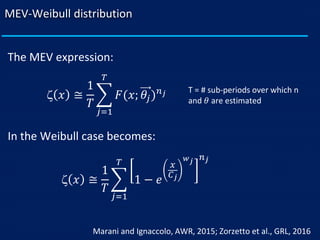
MEV-Weibull distribution
Marani and Ignaccolo, AWR, 2015; Zorzetto et al., GRL, 2016
The MEV expression:
 𝑥 ≅
1
𝑇
෍
𝑗=1
𝑇
𝐹(𝑥; 𝜃𝑗) 𝑛 𝑗 T = # sub-periods over which n
and 𝜃 are estimated
In the Weibull case becomes:
 𝑥 ≅
1
𝑇
෍
𝑗=1
𝑇
1 − 𝑒
𝑥
𝐶 𝑗
𝑤 𝑗 𝑛 𝑗
Marani and Ignaccolo, AWR, 2015
Weibull-distributed synthetic data
GEV and MEV fitted on 30-year windows
n random, c and w constant
n, C, and w are constant
n constant, C and w random
How about reality?
36 daily rainfall timeseries, 106 -275 years of daily observations,
( <L> =135 yrs) Less than 5% of missing data
OXFORD
SHEFFIELD
HOOFDOORP
PUTTEN
ZURICH
HEERDE
S. BERNARD
MELBOURNE
MILANO
PADOVA
BOLOGNA
CAPE TOWN
SAN FRANCISCO
ROOSVELT
ASHEVILLE
PHILADEPHIA
KINGSTON
ALBANY
DUBLIN
ZAGREB
WORCESTER
DUBLIN
SYDNEY
Method of analysis
• To eliminate correlation and non-stationarity
• Preserving the true (unknown) distribution of the
parameters and numbers of wet days.
• Fit on a sample of size s
• Test on remaining data. Non dimensional Root
Mean Square Error:
Which is studied as a function of sample size s.
Bootstrap - Reshuffling of daily data preserving
(1) yearly number of events, and
(2) observed values (i.e. Pdf’s)
ORIGINAL TIME SERIES
𝜖 =
1
𝑁
෍ (
ො𝑥 − 𝑥 𝑜𝑏𝑠
𝑥 𝑜𝑏𝑠
)2
RANDOMLY RESHUFFLED TIME SERIES
T Years
h [mm]
h [mm]
t [days]
t [days]
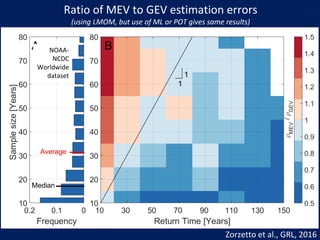
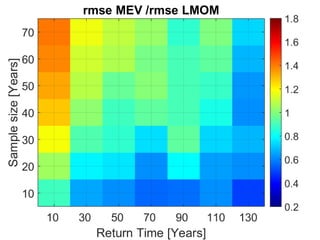
Ratio of MEV to GEV estimation errors
(using LMOM, but use of ML or POT gives same results)
NOAA-
NCDC
Worldwide
dataset
Zorzetto et al., GRL, 2016
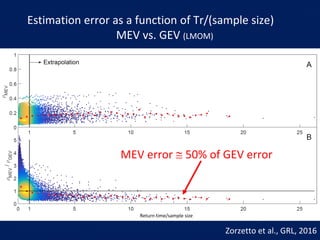
Estimation error as a function of Tr/(sample size)
MEV vs. GEV (LMOM)
Zorzetto et al., GRL, 2016
Return time/sample size
MEV error  50% of GEV error
Conclusions
MEV ouperforms classical EV distributions:
- Reliable assessment of high quantiles and small
samples (50% improvement over GEV)
- Better use of the available daily data
- Removal of the asymptotic hypothesis
Future:
1.MEV is general approach (floods, wind, storm sur
ges ...)
2. MEV is arguably suited to tackle non-stationarity
Grazie per l’attenzione
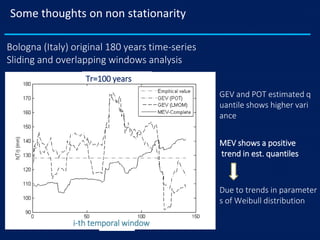
Some thoughts on non stationarity
Bologna (Italy) original 180 years time-series
Sliding and overlapping windows analysis
GEV and POT estimated q
uantile shows higher vari
ance
MEV shows a positive
trend in est. quantiles
Due to trends in parameter
s of Weibull distribution
Tr=100 years
i-th temporal window
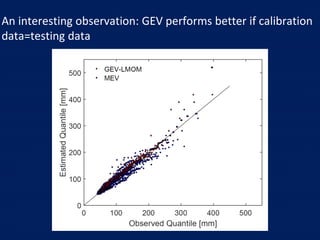
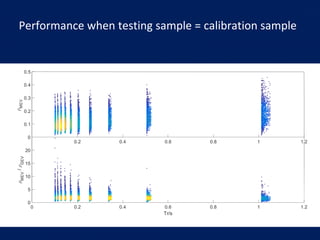
An interesting observation: GEV performs better if calibration
data=testing data
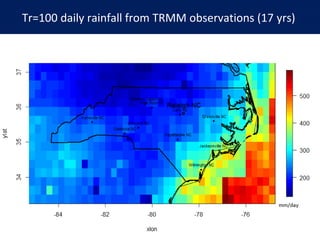
Tr=100 daily rainfall from TRMM observations (17 yrs)
Estimation error as a function of Tr/(sample size)
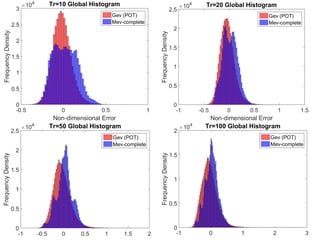
Distribution of the error computed over 1000 random reshuffling, for
all the analyzed datasets.
Quantiles (Tr=100 yrs) estimated by GEV, POT, MEV
calibrated over 30-years samples
Error distribution
𝜖 =
ො𝑥 − 𝑥 𝑜𝑏𝑠
𝑥 𝑜𝑏𝑠
ො𝑥 = 𝐹−1
1 −
1
𝑇𝑟𝑖
𝑥 𝑜𝑏𝑠 from the observational
(independent) sample
Distribution of the error computed over 1000 random generation
s, for all the analyzed datasets.
Theoretical quantiles (Tr=100 yrs) estimated by GEV, POT, MEV c
alibrated over 30-years samples
Error distribution
𝜖 =
ො𝑥 − 𝑥 𝑜𝑏𝑠
𝑥 𝑜𝑏𝑠
ො𝑥 = 𝐹−1
1 −
1
𝑇𝑟𝑖
𝑥 𝑜𝑏𝑠 from the observational
(independent) sample
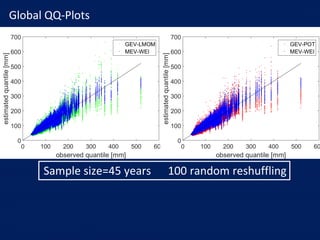
Global QQ-Plots
Sample size=45 years 100 random reshuffling
Global QQ plots
GEV/ POT are a good fit for the calibration sa
mple but they fail in describing the stochasti
c process from which the sample has been g
enerated
MEV allows a better description of the under
lying process; less variance in high quantile e
stimation
ൗ𝑃. 𝑡𝑖
𝑚𝑚2
The MEV domain
N
1982 1986198519841983
t
h [mm]
𝑛1 = 97 𝑛2 = 105 𝑛3 = 89 𝑛4 = 94 𝑛5 = 114
𝐶1, 𝑤1 𝐶2, 𝑤2 𝐶3, 𝑤3 𝐶4, 𝑤4 𝐶5, 𝑤5
2. Fit Weibull to the singl𝑒 𝑦𝑒𝑎𝑟𝑠 𝐶𝑖, 𝑤𝑖
1. Sampling n from the distribution p(n|C,w)
The MEV distribution
𝐹 𝑥 = 1 − 𝑒
𝑥
𝐶
𝑤
• Assuming Weibull as a pdf for daily rainfall
• Fit performed using Probability Weighted Moments (Greenwood et al, 1979)
Number of
events/ year
𝜁 𝑥 = ෍
𝑛=1
∞
ඵ
𝐶 𝑤
𝑔 𝑛, 𝐶, 𝑤 1 − 𝑒
𝑥
𝐶
𝑤 𝑛
𝑑𝐶𝑑𝑤
• Weibull parameters 𝜃 = 𝐶, 𝑤 and 𝑁 are random variables themselves
• The CDF of annual maximum is the mean on all their possible realizations
The Metastatistical Extreme Value Distribution
n
𝑓(𝑛)
𝑓(𝑤)
𝑓(𝐶)
Density frequencies
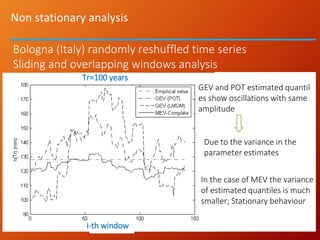
Non stationary analysis
GEV and POT estimated quantil
es show oscillations with same
amplitude
Due to the variance in the
parameter estimates
In the case of MEV the variance
of estimated quantiles is much
smaller; Stationary behaviour
Tr=100 years
i-th window
Bologna (Italy) randomly reshuffled time series
Sliding and overlapping windows analysis
Daily rainfall observations in Padova 1725-2015
The Padova observatory
(Marani and Zanetti, 2015)
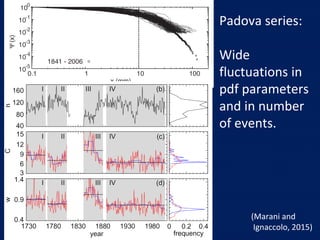
The Padova daily precipitation time series 1725-2006
(Marani and
Ignaccolo, 2015)
Padova series:
Wide
fluctuations in
pdf parameters
and in number
of events.
Peak Over Threshold Method (POT)
[Balkema, De Haan & Pickand, 1975; Davison and Smith, 1990]
• Exceedances arrivals Poisson
• Distribution of excesses Generalized Pareto
Advantages:
1. Better description of the ‘tail’
2. Consistent with GEV
𝑃 𝑌 𝑚𝑎𝑥 < x = ෍
𝑛=1
∞
𝑝 𝑛 ⋅ 𝐹 𝑥 𝑛
= ෍
𝑛=1
∞
𝜆 𝑛
𝑒−𝑛
𝑛!
∙ 1 − 1 +
𝜉
𝜓
∙ 𝑥 − 𝑞
−1/𝜉
𝑛
For a fixed threshold q → Exceedances 𝑌𝑖 = 𝐻𝑖 − 𝑞 𝑖. 𝑖. 𝑑. 𝑟. 𝑣.
𝑦𝑖 = ℎ𝑖 − 𝑞
Performance when testing sample = calibration sample
Ratio of MEV estimation error to GEV-POT error

Metastatistical Extreme Value distributions

  • 1.
    XXXV CONVEGNO NAZIONALEDI IDRAULICA E COSTRUZIONI IDRAULICHE Bologna, 14-16 Settembre 2016 The Metastatistical Extreme Value Distribution Metodi Statistici per le Applicazioni Idrologiche Enrico Zorzetto1, Gianluca Botter2, Marco Marani1,2,* 1Earth and Ocean Science Division, Duke University 2 DICEA, Universita’ di Padova * marco.marani@unipd.it
  • 2.
    Classical Extreme ValueTheory (EVT) [Fischer-Tippett-Gnedenko, 1928-1943] Block Maxima: Three-Type Theorem: - As n  ∞ -After renormalization, 3 possible asymptotic distributions, summarized by GEV (e.g. Von Mises, 1936): = Maxima n-event blocks h[mm] 𝑥 𝑛 1937 19381936 1939 194019411942 𝑥 𝑛 = max 𝑛 (𝑥𝑖) for i.i.d 𝑥𝑖 ∶ 𝐻 𝑛 𝑥 = 𝐹 𝑥 𝑛 𝐻 𝑥 = exp − 1 + 𝜉 𝜓 𝑥 − 𝜇 + − 1 𝜉
  • 3.
    Marani and Ignaccolo,AWR, 2015 Weibull-distributed, synthetic, daily “rainfall” data # events/year & Weibull parameters from Padova (Italy) GEV fitted on 30-year windows
  • 4.
    Considerations on thevalidity of the classical EVT - Incomplete convergence to limiting distribution: n <<  !!! (e.g. Koutsoyiannis, 2013; Serinaldi and Kilsby, 2014). - When number of events is small yearly maxima also come from bulk of distribution, not just the tail (we are far from a limiting form) - GEV - Maximum Likelihood only uses yearly maxima and neglects most of the data. - Peak Over Threshold uses more data, but still a fraction of available information.
  • 5.
    A Metastatistical ExtremeValue distribution (MEV) 𝐻 𝑛 𝑥 = 𝐹 𝑥; Ԧ𝜃 𝑛 for i.i.d. 𝑋𝑖 ′ 𝑠. F(X; ) = cdf of “ordinary events” The Block-maxima distribution Expected block-maxima distribution compounding stochastic n and : Marani and Ignaccolo, AWR, 2015; Zorzetto et al., GRL, 2016 G(n,𝜃) = joint prob distrib. of the parameters. Approximating expectations with sample averages…. Parameters of ordinary distributions
  • 6.
    A Metastatistical ExtremeValue distribution (MEV) Marani and Ignaccolo, AWR 2015; Zorzetto et al., GRL 2016  𝑥 ≅ 1 𝑇 ෍ 𝑗=1 𝑇 𝐹(𝑥; 𝜃𝑗) 𝑛 𝑗 T = # years over which n and 𝜃 are estimated … approximating expectations with sample averages: MEV:
  • 7.
    MEV distribution –conceptual interpretation Zorzetto et al., GRL 2016
  • 8.
    A choice forF(x) - the pdf of daily «ordinary» rainfall 𝑅 𝑎𝑐𝑐 = ത𝑘ത𝑞𝑚 𝐹 𝑥 = 1 − 𝑒 𝑥 𝐶 𝑤 Weibull Parent distribution ത𝑘=precipitation efficiency ത𝑞=specific humidity m=advection mass [Wilson e Tuomi, 2005] -Simple two-layers atmospheric model -Temporal average
  • 9.
    MEV-Weibull distribution Marani andIgnaccolo, AWR, 2015; Zorzetto et al., GRL, 2016 The MEV expression:  𝑥 ≅ 1 𝑇 ෍ 𝑗=1 𝑇 𝐹(𝑥; 𝜃𝑗) 𝑛 𝑗 T = # sub-periods over which n and 𝜃 are estimated In the Weibull case becomes:  𝑥 ≅ 1 𝑇 ෍ 𝑗=1 𝑇 1 − 𝑒 𝑥 𝐶 𝑗 𝑤 𝑗 𝑛 𝑗
  • 10.
    Marani and Ignaccolo,AWR, 2015 Weibull-distributed synthetic data GEV and MEV fitted on 30-year windows n random, c and w constant n, C, and w are constant n constant, C and w random
  • 11.
    How about reality? 36daily rainfall timeseries, 106 -275 years of daily observations, ( <L> =135 yrs) Less than 5% of missing data OXFORD SHEFFIELD HOOFDOORP PUTTEN ZURICH HEERDE S. BERNARD MELBOURNE MILANO PADOVA BOLOGNA CAPE TOWN SAN FRANCISCO ROOSVELT ASHEVILLE PHILADEPHIA KINGSTON ALBANY DUBLIN ZAGREB WORCESTER DUBLIN SYDNEY
  • 12.
    Method of analysis •To eliminate correlation and non-stationarity • Preserving the true (unknown) distribution of the parameters and numbers of wet days. • Fit on a sample of size s • Test on remaining data. Non dimensional Root Mean Square Error: Which is studied as a function of sample size s. Bootstrap - Reshuffling of daily data preserving (1) yearly number of events, and (2) observed values (i.e. Pdf’s) ORIGINAL TIME SERIES 𝜖 = 1 𝑁 ෍ ( ො𝑥 − 𝑥 𝑜𝑏𝑠 𝑥 𝑜𝑏𝑠 )2 RANDOMLY RESHUFFLED TIME SERIES T Years h [mm] h [mm] t [days] t [days]
  • 13.
    Ratio of MEVto GEV estimation errors (using LMOM, but use of ML or POT gives same results) NOAA- NCDC Worldwide dataset Zorzetto et al., GRL, 2016
  • 14.
    Estimation error asa function of Tr/(sample size) MEV vs. GEV (LMOM) Zorzetto et al., GRL, 2016 Return time/sample size MEV error  50% of GEV error
  • 15.
    Conclusions MEV ouperforms classicalEV distributions: - Reliable assessment of high quantiles and small samples (50% improvement over GEV) - Better use of the available daily data - Removal of the asymptotic hypothesis Future: 1.MEV is general approach (floods, wind, storm sur ges ...) 2. MEV is arguably suited to tackle non-stationarity
  • 16.
  • 17.
    Some thoughts onnon stationarity Bologna (Italy) original 180 years time-series Sliding and overlapping windows analysis GEV and POT estimated q uantile shows higher vari ance MEV shows a positive trend in est. quantiles Due to trends in parameter s of Weibull distribution Tr=100 years i-th temporal window
  • 18.
    An interesting observation:GEV performs better if calibration data=testing data
  • 19.
    Tr=100 daily rainfallfrom TRMM observations (17 yrs)
  • 20.
    Estimation error asa function of Tr/(sample size)
  • 21.
    Distribution of theerror computed over 1000 random reshuffling, for all the analyzed datasets. Quantiles (Tr=100 yrs) estimated by GEV, POT, MEV calibrated over 30-years samples Error distribution 𝜖 = ො𝑥 − 𝑥 𝑜𝑏𝑠 𝑥 𝑜𝑏𝑠 ො𝑥 = 𝐹−1 1 − 1 𝑇𝑟𝑖 𝑥 𝑜𝑏𝑠 from the observational (independent) sample
  • 22.
    Distribution of theerror computed over 1000 random generation s, for all the analyzed datasets. Theoretical quantiles (Tr=100 yrs) estimated by GEV, POT, MEV c alibrated over 30-years samples Error distribution 𝜖 = ො𝑥 − 𝑥 𝑜𝑏𝑠 𝑥 𝑜𝑏𝑠 ො𝑥 = 𝐹−1 1 − 1 𝑇𝑟𝑖 𝑥 𝑜𝑏𝑠 from the observational (independent) sample
  • 23.
    Global QQ-Plots Sample size=45years 100 random reshuffling
  • 24.
    Global QQ plots GEV/POT are a good fit for the calibration sa mple but they fail in describing the stochasti c process from which the sample has been g enerated MEV allows a better description of the under lying process; less variance in high quantile e stimation ൗ𝑃. 𝑡𝑖 𝑚𝑚2
  • 25.
  • 26.
    N 1982 1986198519841983 t h [mm] 𝑛1= 97 𝑛2 = 105 𝑛3 = 89 𝑛4 = 94 𝑛5 = 114 𝐶1, 𝑤1 𝐶2, 𝑤2 𝐶3, 𝑤3 𝐶4, 𝑤4 𝐶5, 𝑤5 2. Fit Weibull to the singl𝑒 𝑦𝑒𝑎𝑟𝑠 𝐶𝑖, 𝑤𝑖 1. Sampling n from the distribution p(n|C,w) The MEV distribution 𝐹 𝑥 = 1 − 𝑒 𝑥 𝐶 𝑤 • Assuming Weibull as a pdf for daily rainfall • Fit performed using Probability Weighted Moments (Greenwood et al, 1979) Number of events/ year
  • 27.
    𝜁 𝑥 =෍ 𝑛=1 ∞ ඵ 𝐶 𝑤 𝑔 𝑛, 𝐶, 𝑤 1 − 𝑒 𝑥 𝐶 𝑤 𝑛 𝑑𝐶𝑑𝑤 • Weibull parameters 𝜃 = 𝐶, 𝑤 and 𝑁 are random variables themselves • The CDF of annual maximum is the mean on all their possible realizations The Metastatistical Extreme Value Distribution n 𝑓(𝑛) 𝑓(𝑤) 𝑓(𝐶) Density frequencies
  • 28.
    Non stationary analysis GEVand POT estimated quantil es show oscillations with same amplitude Due to the variance in the parameter estimates In the case of MEV the variance of estimated quantiles is much smaller; Stationary behaviour Tr=100 years i-th window Bologna (Italy) randomly reshuffled time series Sliding and overlapping windows analysis
  • 29.
    Daily rainfall observationsin Padova 1725-2015 The Padova observatory
  • 30.
    (Marani and Zanetti,2015) The Padova daily precipitation time series 1725-2006
  • 31.
    (Marani and Ignaccolo, 2015) Padovaseries: Wide fluctuations in pdf parameters and in number of events.
  • 32.
    Peak Over ThresholdMethod (POT) [Balkema, De Haan & Pickand, 1975; Davison and Smith, 1990] • Exceedances arrivals Poisson • Distribution of excesses Generalized Pareto Advantages: 1. Better description of the ‘tail’ 2. Consistent with GEV 𝑃 𝑌 𝑚𝑎𝑥 < x = ෍ 𝑛=1 ∞ 𝑝 𝑛 ⋅ 𝐹 𝑥 𝑛 = ෍ 𝑛=1 ∞ 𝜆 𝑛 𝑒−𝑛 𝑛! ∙ 1 − 1 + 𝜉 𝜓 ∙ 𝑥 − 𝑞 −1/𝜉 𝑛 For a fixed threshold q → Exceedances 𝑌𝑖 = 𝐻𝑖 − 𝑞 𝑖. 𝑖. 𝑑. 𝑟. 𝑣. 𝑦𝑖 = ℎ𝑖 − 𝑞
  • 33.
    Performance when testingsample = calibration sample
  • 34.
    Ratio of MEVestimation error to GEV-POT error