METAMORPHOSIS
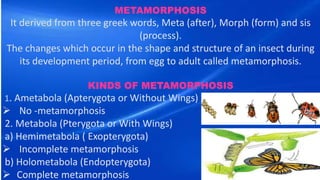
It derived from three greek words, Meta (after), Morph (form) and sis
(process).
The changes which occur in the shape and structure of an insect during
its development period, from egg to adult called metamorphosis.
KINDS OF METAMORPHOSIS
1. Ametabola (Apterygota or Without Wings)
 No -metamorphosis
2. Metabola (Pterygota or With Wings)
a) Hemimetabola ( Exopterygota)
 Incomplete metamorphosis
b) Holometabola (Endopterygota)
 Complete metamorphosis
AMETABOLA / (Apterygota)
 In this group of insects the development occurs without
metamorphosis.
 The young ones pass through no any changes to become adults.
 These insects have no any wings that’s why they are called
apterygota.
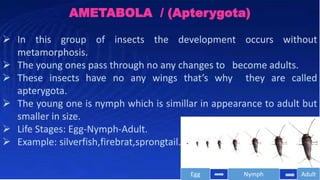
 The young one is nymph which is simillar in appearance to adult but
smaller in size.
 Life Stages: Egg-Nymph-Adult.
 Example: silverfish,firebrat,sprongtail.
Egg Nymph Adult
METABOLA / (Pterygota)
 In this group of insects the development occurs through
metamorphosis (either incomplete or complete
metamorphosis).
 The newly hatched immature stage (either nymph or larva)
are different from adults in their external characters and
smaller in size.
 These insects have wings that’s why they are called
pterygota.
 Further divided into two groups.
a. Hemimetabola (Exopterygota)
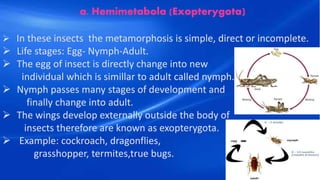
 In these insects the metamorphosis is simple, direct or incomplete.
 Life stages: Egg- Nymph-Adult.
 The egg of insect is directly change into new
individual which is simillar to adult called nymph.
 Nymph passes many stages of development and
finally change into adult.
 The wings develop externally outside the body of
insects therefore are known as exopterygota.
 Example: cockroach, dragonflies,
grasshopper, termites,true bugs.
b. Holometabola (Endopterygota)
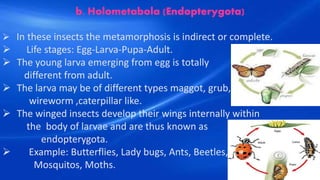
 In these insects the metamorphosis is indirect or complete.
 Life stages: Egg-Larva-Pupa-Adult.
 The young larva emerging from egg is totally
different from adult.
 The larva may be of different types maggot, grub,
wireworm ,caterpillar like.
 The winged insects develop their wings internally within
the body of larvae and are thus known as
endopterygota.
 Example: Butterflies, Lady bugs, Ants, Beetles,
Mosquitos, Moths.
Metamorphosis

Metamorphosis

  • 2.
    METAMORPHOSIS It derived fromthree greek words, Meta (after), Morph (form) and sis (process). The changes which occur in the shape and structure of an insect during its development period, from egg to adult called metamorphosis. KINDS OF METAMORPHOSIS 1. Ametabola (Apterygota or Without Wings)  No -metamorphosis 2. Metabola (Pterygota or With Wings) a) Hemimetabola ( Exopterygota)  Incomplete metamorphosis b) Holometabola (Endopterygota)  Complete metamorphosis
  • 3.
    AMETABOLA / (Apterygota) In this group of insects the development occurs without metamorphosis.  The young ones pass through no any changes to become adults.  These insects have no any wings that’s why they are called apterygota.  The young one is nymph which is simillar in appearance to adult but smaller in size.  Life Stages: Egg-Nymph-Adult.  Example: silverfish,firebrat,sprongtail. Egg Nymph Adult
  • 4.
    METABOLA / (Pterygota) In this group of insects the development occurs through metamorphosis (either incomplete or complete metamorphosis).  The newly hatched immature stage (either nymph or larva) are different from adults in their external characters and smaller in size.  These insects have wings that’s why they are called pterygota.  Further divided into two groups.
  • 5.
    a. Hemimetabola (Exopterygota) In these insects the metamorphosis is simple, direct or incomplete.  Life stages: Egg- Nymph-Adult.  The egg of insect is directly change into new individual which is simillar to adult called nymph.  Nymph passes many stages of development and finally change into adult.  The wings develop externally outside the body of insects therefore are known as exopterygota.  Example: cockroach, dragonflies, grasshopper, termites,true bugs.
  • 6.
    b. Holometabola (Endopterygota) In these insects the metamorphosis is indirect or complete.  Life stages: Egg-Larva-Pupa-Adult.  The young larva emerging from egg is totally different from adult.  The larva may be of different types maggot, grub, wireworm ,caterpillar like.  The winged insects develop their wings internally within the body of larvae and are thus known as endopterygota.  Example: Butterflies, Lady bugs, Ants, Beetles, Mosquitos, Moths.