


The Therapeutic Relationship
Crucial Importance

“The maintenance of a realistic, friendly
 relationship with the psychotherapist is
 thus of crucial importance in the treatment
 of the psychoses and borderline
 states, and the current emphasis on the
 significance of the so-called therapeutic
 alliance or working alliance is justified with
 regard to these cases.”
- Kohut: The Analysis of the Self
Feeling Safe Within Ourselves

    • How/why we can feel unsafe
     • Personal issues get activated
     • Personal history of trauma
     • Degree of exposure to trauma issues
    • Developing safety
     • Knowing yourself/feeling comfortable in your body
     • Feeling safe in your work environment
     • Relationships with supervisor/coworkers
     • Social support - support from family and friends
                           Karl D. LaRowe
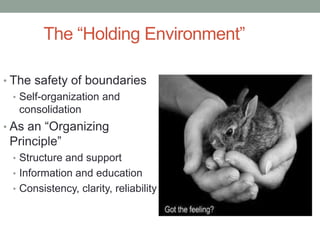
The “Holding Environment”

• The safety of boundaries
  • Self-organization and
    consolidation
• As an “Organizing
 Principle”
 • Structure and support
 • Information and education
 • Consistency, clarity, reliability
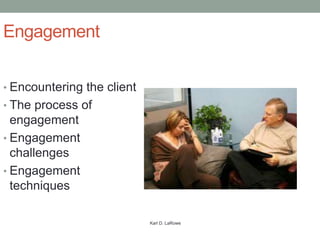
Engagement


• Encountering the client
• The process of
  engagement
• Engagement
  challenges
• Engagement
  techniques

                            Karl D. LaRowe
Encountering The Client

      • How does your mood and stress level impact your
       perception of your client?
        • Emotion is Energy in MOTION
        • Stress is contagious

      • Before every contact with clients
        • Checking in with your own body
        • Clearing energy residue


                                 Karl D. LaRowe
The Process of Engagement

     • Every session requires (re)engagement
      • Both client and therapist have changed
     • Participant/observer perspective
      • Suspending attention
      • Being present
      • “Attuning” yourself to your client
     • Mirroring (verbal and non-verbal)
      • Breath, motion, rhythm, eyes, voice, body tension
       and movement, flow, verbal tone and intensity, use
       of language
                          Karl D. LaRowe
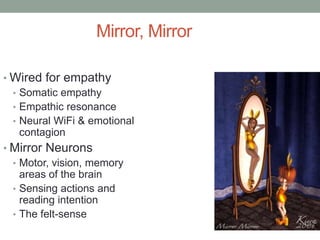
Mirror, Mirror

• Wired for empathy
  • Somatic empathy
  • Empathic resonance
  • Neural WiFi & emotional
    contagion
• Mirror Neurons
  • Motor, vision, memory
    areas of the brain
  • Sensing actions and
    reading intention
  • The felt-sense
Felt-Sense Mirroring Exercise

 • Utilizing your feelings/sensations/intuition in a
  flow of energy/communication
  • 2 person non-verbal communication-relationship
      exercise
  •   Be curious, open your heart and mind
  •   Sense, feel, follow and flow with another person’s
      energy
  •   Experience synergy and synchrony
  •   Allow your natural self to come out and play
What Was Your Experience?
• Your overall sense-feel
• Your connection to your body/mind
• Your connection with your partner
• Your feeling of synchronization
• Your sense of energy
• Your experience of “flow”
Engagement Challenges

    • The experience of being a client
    • Client is brought/mandated to counseling
    • Client does not trust you/mental health
    • Client is internally distracted and unable to
     process information very well
    • Client does not believe you can help them
     or does not believe they need your help
                      Karl D. LaRowe
Engagement Techniques
 “Engagement, or the development of a helpful, working or therapeutic
    alliance, has a strong impact on treatment outcome in clients with
                                       psychosis” (Frank et al., 1989).
• Recognize that the client may be nervous, wary or
  not want to see you
• Be aware that the client’s psychosis may distort their
  mode of interaction and their ability to process
  information
• Acknowledge and respect the client’s viewpoint
  identify common ground
• Listen carefully to the client and take their views
  seriously
Engagement Techniques
• Consider what is appropriate body language when
 interviewing a client who may be extremely
 paranoid, aroused or manic
  – sit side by side with the client (not too close) rather than face
   to face
  – avoid too much eye-to-eye contact
  – allow personal space, for example walk around while talking
• Be helpful, active and flexible
• Carefully explain the procedures involved in the
  assessment
• Gather information gradually, at the same time
  fostering a good relationship
Role Play

• Partner A: Role play a new client, first visit, recently discharged
  from Woodbridge, diagnosis of schizophrenia, first break, living
  with family, now stabilized on medication, not convinced s/he has
  a mental illness, is ambivalent about treatment and medications,
  was convinced by family to come to the agency. S/he is
  unemployed, is in recovery for alcohol/drugs, is not suicidal. Not
  actively psychotic but is anxious, suspicious, slightly paranoid.
• Partner B: Utilize the process just discussed to engage the client
  in an initial assessment
   • Feedback
   • Reverse roles
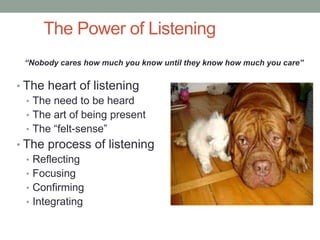
The Power of Listening
 “Nobody cares how much you know until they know how much you care”


• The heart of listening
  • The need to be heard
  • The art of being present
  • The “felt-sense”
• The process of listening
  • Reflecting
  • Focusing
  • Confirming
  • Integrating
Reflecting (Mirroring)

   • Attuning yourself to the overall “tone”
     • Listening to the music and not just words
     • Suspending attention/judgment
     • From the client’s perspective
     • Sensing underlying emotional currents
   • Responding/acknowledging/connecting
     • Verbal and non-verbal
     • Expressing acceptance/non-judgment
Focusing
   It is only with the heart that one can see rightly; what is essential is
                                                     invisible to the eye."
                                                           - The Little Prince

• Utilizing the “felt sense”
  • “Connecting” with your client through connecting with
    your own body
  • Sensations/feelings/intuition
  • Sensing the message of the feeling
  • Expressing the feeling verbally
  • “I sense a reluctance to talk. Your not feeling very
    understood right now”
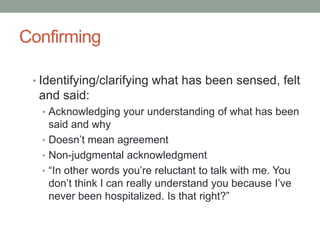
Confirming

 • Identifying/clarifying what has been sensed, felt
  and said:
  • Acknowledging your understanding of what has been
    said and why
  • Doesn’t mean agreement
  • Non-judgmental acknowledgment
  • “In other words you’re reluctant to talk with me. You
    don’t think I can really understand you because I’ve
    never been hospitalized. Is that right?”
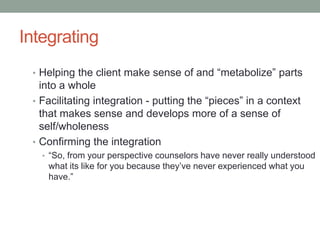
Integrating
 • Helping the client make sense of and “metabolize” parts
   into a whole
 • Facilitating integration - putting the “pieces” in a context
   that makes sense and develops more of a sense of
   self/wholeness
 • Confirming the integration
   • “So, from your perspective counselors have never really understood
    what its like for you because they’ve never experienced what you
    have.”
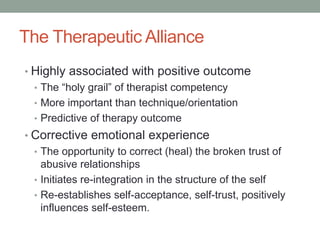
The Therapeutic Alliance
• Highly associated with positive outcome
  • The “holy grail” of therapist competency
  • More important than technique/orientation
  • Predictive of therapy outcome
• Corrective emotional experience
  • The opportunity to correct (heal) the broken trust of
    abusive relationships
  • Initiates re-integration in the structure of the self
  • Re-establishes self-acceptance, self-trust, positively
    influences self-esteem.
Development of the Therapeutic Alliance
  • The therapeutic alliance develops over time
   • Based on an agreement to work together to achieve
    specific goals
  • Development of therapeutic alliance can be
   influenced by:
   • Residual symptoms
   • Personality Disorders
   • Depression
   • Substance abuse
   • Pre-morbid deficits
   • Developmental issues
The “Vehicle of Psychotherapy”
       “…a mutual construction between patient and therapist that
     includes shared goals, accepted recognition of the tasks each
 person is to perform in the relationship, and an attachment bond.”

• Mutual construction
  • A “collaborative relationship”
• Shared goals
  • Gives direction and motivation to counseling
• Accepted recognition of tasks
  • Client and therapist recognize their part in counseling
• Attachment bond
  • A “genuine liking”
  • Transference and counter-transference
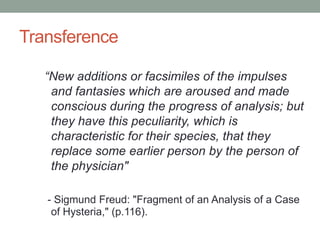
Transference

   “New additions or facsimiles of the impulses
    and fantasies which are aroused and made
    conscious during the progress of analysis; but
    they have this peculiarity, which is
    characteristic for their species, that they
    replace some earlier person by the person of
    the physician"

   - Sigmund Freud: "Fragment of an Analysis of a Case
    of Hysteria," (p.116).
Types of Transference
• Transference Neurosis and Transference
  Reactions
• Positive transference reactions
 • Basis of the therapeutic alliance
 • Can develop into “inappropriate” idealization
 • Expectations of entitlement, wish to merge
• Negative transference reactions
  • Avoidance/dis-engagement
  • Misdirected anger
  • Increased disorganization
Development of Transference Reactions

   • Transference reactions can develop
    immediately or over time
    • Immediate, intense transference reactions may be
     the result of:
      • “Unfinished business” with former therapist, provider or
        institution
      • Identification with a (past/current) abuser
      • Instability within the sense of self
    • The more intense/immediate development usually
     indicates self-weakness/instability
Qualities of Transference Reactions

   • Inappropriateness
      • Reactions out of context to the situation
   • Intensity
      • Usually overly intense
   • Tenacity
      • Resistant to change
   • Ambivalence
     • Idealization/devaluation
Counter-transference:
A Tool for Understanding
   “Counter-transference provides therapist with invaluable
     information to inform and shape their clinical interventions.”
   - Trauma and the Therapist
   • As a tool for understanding
     • Counter-transference is a reality of working with
       SMPI and trauma clients;
     • Counter-transference is not a sign of personal
       weakness or something the therapist is doing wrong
     • Paying attention to counter-transference can give
       the therapist crucial information
Factors Contributing to Counter-
Transference
 • The therapist’s response to the reality of trauma
   and psychosis;
 • The therapist’s responses to the client’s
   transference;
 • The therapist’s defenses against his/her own
   affects or intrapsychic conflicts aroused by the
   client and his/her material in the session
 • The therapist’s history, personality, coping
   style, and transference to the client
 • The therapist’s response to his/her own vicarious
   traumatization
Utilizing Counter-Transference
   “We do not see what we look at, we see what we look for”

• Self-honesty
 • Transparency and “in-sight”

• Personal responsibility
 • Taking ownership

• Self-expression
 • Addressing counter-transference
 • Clinical supervision
The “Real” Relationship

 • A realistic relationship based on a more
  stable, cohesive, resilient sense of self
  • It is more reality oriented.
  • There is a greater capacity for introspection.
  • There is a greater capacity for objectivity.
  • There is greater tolerance and ability to accept and
    forgive the shortcomings of self and others.
  • There is a greater ability to empathize with others.
  • There is greater resilience

The therapeutic relationship

  • 1.
  • 2.
    Crucial Importance “The maintenanceof a realistic, friendly relationship with the psychotherapist is thus of crucial importance in the treatment of the psychoses and borderline states, and the current emphasis on the significance of the so-called therapeutic alliance or working alliance is justified with regard to these cases.” - Kohut: The Analysis of the Self
  • 3.
    Feeling Safe WithinOurselves • How/why we can feel unsafe • Personal issues get activated • Personal history of trauma • Degree of exposure to trauma issues • Developing safety • Knowing yourself/feeling comfortable in your body • Feeling safe in your work environment • Relationships with supervisor/coworkers • Social support - support from family and friends Karl D. LaRowe
  • 4.
    The “Holding Environment” •The safety of boundaries • Self-organization and consolidation • As an “Organizing Principle” • Structure and support • Information and education • Consistency, clarity, reliability
  • 5.
    Engagement • Encountering theclient • The process of engagement • Engagement challenges • Engagement techniques Karl D. LaRowe
  • 6.
    Encountering The Client • How does your mood and stress level impact your perception of your client? • Emotion is Energy in MOTION • Stress is contagious • Before every contact with clients • Checking in with your own body • Clearing energy residue Karl D. LaRowe
  • 7.
    The Process ofEngagement • Every session requires (re)engagement • Both client and therapist have changed • Participant/observer perspective • Suspending attention • Being present • “Attuning” yourself to your client • Mirroring (verbal and non-verbal) • Breath, motion, rhythm, eyes, voice, body tension and movement, flow, verbal tone and intensity, use of language Karl D. LaRowe
  • 8.
    Mirror, Mirror • Wiredfor empathy • Somatic empathy • Empathic resonance • Neural WiFi & emotional contagion • Mirror Neurons • Motor, vision, memory areas of the brain • Sensing actions and reading intention • The felt-sense
  • 9.
    Felt-Sense Mirroring Exercise • Utilizing your feelings/sensations/intuition in a flow of energy/communication • 2 person non-verbal communication-relationship exercise • Be curious, open your heart and mind • Sense, feel, follow and flow with another person’s energy • Experience synergy and synchrony • Allow your natural self to come out and play
  • 10.
    What Was YourExperience? • Your overall sense-feel • Your connection to your body/mind • Your connection with your partner • Your feeling of synchronization • Your sense of energy • Your experience of “flow”
  • 11.
    Engagement Challenges • The experience of being a client • Client is brought/mandated to counseling • Client does not trust you/mental health • Client is internally distracted and unable to process information very well • Client does not believe you can help them or does not believe they need your help Karl D. LaRowe
  • 12.
    Engagement Techniques “Engagement,or the development of a helpful, working or therapeutic alliance, has a strong impact on treatment outcome in clients with psychosis” (Frank et al., 1989). • Recognize that the client may be nervous, wary or not want to see you • Be aware that the client’s psychosis may distort their mode of interaction and their ability to process information • Acknowledge and respect the client’s viewpoint identify common ground • Listen carefully to the client and take their views seriously
  • 13.
    Engagement Techniques • Considerwhat is appropriate body language when interviewing a client who may be extremely paranoid, aroused or manic – sit side by side with the client (not too close) rather than face to face – avoid too much eye-to-eye contact – allow personal space, for example walk around while talking • Be helpful, active and flexible • Carefully explain the procedures involved in the assessment • Gather information gradually, at the same time fostering a good relationship
  • 14.
    Role Play • PartnerA: Role play a new client, first visit, recently discharged from Woodbridge, diagnosis of schizophrenia, first break, living with family, now stabilized on medication, not convinced s/he has a mental illness, is ambivalent about treatment and medications, was convinced by family to come to the agency. S/he is unemployed, is in recovery for alcohol/drugs, is not suicidal. Not actively psychotic but is anxious, suspicious, slightly paranoid. • Partner B: Utilize the process just discussed to engage the client in an initial assessment • Feedback • Reverse roles
  • 15.
    The Power ofListening “Nobody cares how much you know until they know how much you care” • The heart of listening • The need to be heard • The art of being present • The “felt-sense” • The process of listening • Reflecting • Focusing • Confirming • Integrating
  • 16.
    Reflecting (Mirroring) • Attuning yourself to the overall “tone” • Listening to the music and not just words • Suspending attention/judgment • From the client’s perspective • Sensing underlying emotional currents • Responding/acknowledging/connecting • Verbal and non-verbal • Expressing acceptance/non-judgment
  • 17.
    Focusing It is only with the heart that one can see rightly; what is essential is invisible to the eye." - The Little Prince • Utilizing the “felt sense” • “Connecting” with your client through connecting with your own body • Sensations/feelings/intuition • Sensing the message of the feeling • Expressing the feeling verbally • “I sense a reluctance to talk. Your not feeling very understood right now”
  • 18.
    Confirming • Identifying/clarifyingwhat has been sensed, felt and said: • Acknowledging your understanding of what has been said and why • Doesn’t mean agreement • Non-judgmental acknowledgment • “In other words you’re reluctant to talk with me. You don’t think I can really understand you because I’ve never been hospitalized. Is that right?”
  • 19.
    Integrating • Helpingthe client make sense of and “metabolize” parts into a whole • Facilitating integration - putting the “pieces” in a context that makes sense and develops more of a sense of self/wholeness • Confirming the integration • “So, from your perspective counselors have never really understood what its like for you because they’ve never experienced what you have.”
  • 20.
    The Therapeutic Alliance •Highly associated with positive outcome • The “holy grail” of therapist competency • More important than technique/orientation • Predictive of therapy outcome • Corrective emotional experience • The opportunity to correct (heal) the broken trust of abusive relationships • Initiates re-integration in the structure of the self • Re-establishes self-acceptance, self-trust, positively influences self-esteem.
  • 21.
    Development of theTherapeutic Alliance • The therapeutic alliance develops over time • Based on an agreement to work together to achieve specific goals • Development of therapeutic alliance can be influenced by: • Residual symptoms • Personality Disorders • Depression • Substance abuse • Pre-morbid deficits • Developmental issues
  • 22.
    The “Vehicle ofPsychotherapy” “…a mutual construction between patient and therapist that includes shared goals, accepted recognition of the tasks each person is to perform in the relationship, and an attachment bond.” • Mutual construction • A “collaborative relationship” • Shared goals • Gives direction and motivation to counseling • Accepted recognition of tasks • Client and therapist recognize their part in counseling • Attachment bond • A “genuine liking” • Transference and counter-transference
  • 23.
    Transference “New additions or facsimiles of the impulses and fantasies which are aroused and made conscious during the progress of analysis; but they have this peculiarity, which is characteristic for their species, that they replace some earlier person by the person of the physician" - Sigmund Freud: "Fragment of an Analysis of a Case of Hysteria," (p.116).
  • 24.
    Types of Transference •Transference Neurosis and Transference Reactions • Positive transference reactions • Basis of the therapeutic alliance • Can develop into “inappropriate” idealization • Expectations of entitlement, wish to merge • Negative transference reactions • Avoidance/dis-engagement • Misdirected anger • Increased disorganization
  • 25.
    Development of TransferenceReactions • Transference reactions can develop immediately or over time • Immediate, intense transference reactions may be the result of: • “Unfinished business” with former therapist, provider or institution • Identification with a (past/current) abuser • Instability within the sense of self • The more intense/immediate development usually indicates self-weakness/instability
  • 26.
    Qualities of TransferenceReactions • Inappropriateness • Reactions out of context to the situation • Intensity • Usually overly intense • Tenacity • Resistant to change • Ambivalence • Idealization/devaluation
  • 27.
    Counter-transference: A Tool forUnderstanding “Counter-transference provides therapist with invaluable information to inform and shape their clinical interventions.” - Trauma and the Therapist • As a tool for understanding • Counter-transference is a reality of working with SMPI and trauma clients; • Counter-transference is not a sign of personal weakness or something the therapist is doing wrong • Paying attention to counter-transference can give the therapist crucial information
  • 28.
    Factors Contributing toCounter- Transference • The therapist’s response to the reality of trauma and psychosis; • The therapist’s responses to the client’s transference; • The therapist’s defenses against his/her own affects or intrapsychic conflicts aroused by the client and his/her material in the session • The therapist’s history, personality, coping style, and transference to the client • The therapist’s response to his/her own vicarious traumatization
  • 29.
    Utilizing Counter-Transference “We do not see what we look at, we see what we look for” • Self-honesty • Transparency and “in-sight” • Personal responsibility • Taking ownership • Self-expression • Addressing counter-transference • Clinical supervision
  • 30.
    The “Real” Relationship • A realistic relationship based on a more stable, cohesive, resilient sense of self • It is more reality oriented. • There is a greater capacity for introspection. • There is a greater capacity for objectivity. • There is greater tolerance and ability to accept and forgive the shortcomings of self and others. • There is a greater ability to empathize with others. • There is greater resilience

Editor's Notes

  • #3 WHY IS THE RELATIONSHIP OF CRUCIAL IMPORTANCE IN TREATMENT?First and foremost is the sense of personal safetyBoth trauma and spmi suffer from devastating experiences of not being safeSafety both externally and internallyEquilibrium is finding a sense of stabilityBoth trauma and spmi clients suffer from BOTH external and internal instabilitySuccess of treatment depends on client’s ability to tolerate intimacy:Intimacy with others is also intimacy with selfEVEN IF CLIENTS ARE NOT ABLE TO MAKE A FULL RECOVERY FROM PSYCHOSIS – AND MANY WILL NOT, THEY DO NOT HAVE TO SUFFER FROM A DAMAGED SENSE OF SELF AND SELF ESTEEM.HELPING CLIENTS ACCEPT AND ADJUST TO THEIR MENTAL ILLNESS CAN ONLY BE DONE IN THE SAFE HARBOR OF THE THERAPEUTIC RELATIONSHIP
  • #10 UTILIZE THE FELT-SENSE, INTUITION IN A NON-VERBAL EXERCISEConnect you to your felt-sense intuitionOpen heart and mindHelp you connect what you already doSTEP 1:Partner A lead, B follow.The object is to sense, feel, follow another person’s movement, intention, energySense how comfortable you feel leading/followingSTEP 2 REVERSE ROLESB Leads, A follows: Re-connectSense the transition from leading to followingSTEP 3, BOTH/NEITHER LEAD/FOLLOWSense the energy/synergy, allow yourself to flow with it
  • #15 ROLE PLAY:Role play makes us nervous and we are not always at our bestRole play is done to try out and internalize new skills – not to prove how good we arePay attention to what happens in your body as you do the role play – exercise of self-awarenessObject is to emotionally engage your partner – join, mirror without being intrusive Both partners have a role to play in role play:Partner A: Do not play a terribly difficult client – Take on their voice but not to the extreme – you are also a part in helping your partnerPartner B: Relax, be natural, you have nothing to prove. Have fun!SCENARIOIntake interview – initial assessment Partner A tell B something about
  • #23 THE THERAPEUTIC ALLIANCE REALLY IS THE “VEHICLE OF ALL PSYCHOTHERAPY” SUPPORTIVE, EDUCATIONAL OR INSIGHTMutual construction A “collaborative relationship”This is a 2-way relationship in which each partner has an equal voiceEven in our role as guiding/educating, we value, preserve the clients sense of self and self-esteem in how we relate to each personSometimes easy to fall into a “care-taking” role Shared goalsGives direction and motivation to counselingEstablishing SHARED, AGREED UPON, CLEAR goals is vital to why are we meeting?Accepted recognition of tasksClient and therapist recognize their part in counseling – both know their roles and what is expected of themAttachment bondA “genuine liking” NOT ALWAYS EASY TO ACCOMPLISHEMERGENCY ROOM EXPERIENCETransference and counter-transference
  • #24 THE ORIGINAL DEFINITION OF TRANSFERENCE BY FREUDHOW MANY PEOPLE HERE HAVE EXPERIENCED YOUR CLIENT HAVING IDEAS ABOUT YOU, OR ATTRIBUTING YOU WITH QUALITIES THAT WERE JUST NOT TRUE? WHAT IS THE MECHANISM OF TRANSFERENCE? IS IT POSSIBLE THAT WE ALL HAVE SOME DEGREE OF TRANSFERENCE IN OUR RELATIONSHIPS WITH OTHERS?
  • #25 TRANSFERENCE NEUROSIS IS SPECIFIC TO PSYCHOANALYSISMY EXPERIENCE WITH ANALYSIS AND FEELINGS ABOUT THE ANALYSTThe relationship itself becomes a focus for treatment.The advantage is, all your stuff gets focused and played out in the here/now TRANSFERENCE REACTIONSUniversal in numerous contexts:The professor we had in university/our doctor/the postman?WE CAN’T HELP BUT PROJECT SOME PART OF OURSELVES ONTO OTHERSPositive transference reactionsBasis of the therapeutic allianceCan develop into “inappropriate” idealizationExpectations of entitlement, wish to mergeNegative transference reactionsAvoidance/dis-engagementMisdirected angerIncreased disorganization
  • #27 There are four major qualities to transference reactions, both positive and negative:Inappropriateness. Transference reactions are emotional responses, which are out of context. They are not warranted to the person of the counselor or the context of the counseling.Intensity. Transference reactions are generally intense emotional responses, positive or negative. While the intensity may not be openly expressed, it usually reveals itself in some aspect of the client's behavior towards the counselor and/or counseling.Tenacity. Transference reactions are tenacious. They are resistant to change. Even when they are pointed out to the client they may continue to persist. The counselor many times may have to "ride them out," allowing them to transform during the course of counseling.Ambivalence. Just as there is no up without down, hot without cold, so it is with transference reactions. The counselor can be sure, that just as the client may be idealizing him for what a good counselor he is, at some point the client may become disappointed and angry when the counselor must be firm, or draw limits.
  • #30 Self-honestyThe Psychology of Self-Deception99.9% of cognition is unconsciousGood me, bad me, not me Forgetting and forgetting we have forgottenFacilitating self-honestyA courageous willingnessHonesty and transparency: The development of “in-sight”Self-acceptance: The body doesn’t lieLooking and listeningPersonal responsibilityOwnership and empowermentResponsibility VS blameThe need-desire to be rightThe art of being “good enough”Facilitating personal responsibilityCreating a place of safetyA willingness to acceptSurrendering pride (the need to be right)Self-expressionThe magic of transformationHonest, responsible self-expressionTrust and spontaneityThe power of playDiscovering the “Natural Self”Facilitating self-expressionCreative playfulnessBody/mind talkGuided journaling
  • #31 The “real relationship is genuine and reality oriented or undistorted as contrasted to the term ‘transference’ which connotes unrealistic, distorted, and inappropriate”It is reality oriented. This means a portion of the self is focused and able to operate in the external world relatively independent from active psychotic process. There is some capacity for introspection. The real relationship is an extension of that part of the client, which both desires and is able to participate in self-examination.There is some capacity for objectivity. A part of the self, the "observing ego," is free enough from the distortions of transference reactions to objectively assess and participate in relating realistically with himself and others.There is some tolerance and ability to accept and forgive the shortcomings of self and others. There is also some frustration tolerance, or the ability to delay the need for immediate gratification.There is some ability to empathize with others even though there may not be agreement with their point of view.