PRESENTED BY: CHRISTIAN B.GABUYA
• Who are the men behind computer?
• What are there contribution?
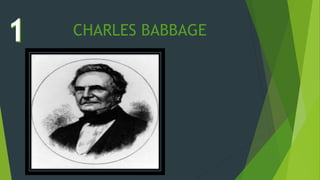
CHARLES BABBAGE
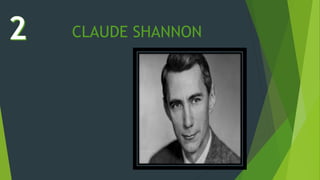
CLAUDE SHANNON
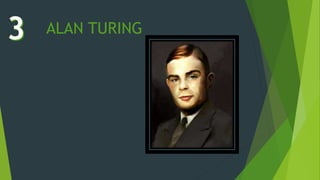
ALAN TURING
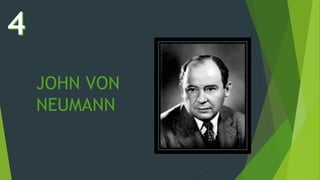
JOHN VON
NEUMANN
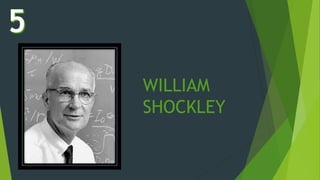
WILLIAM
SHOCKLEY
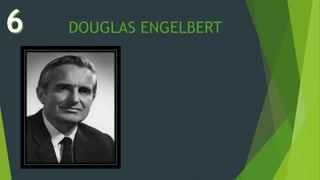
DOUGLAS ENGELBERT
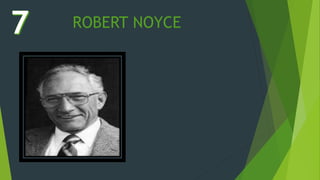
ROBERT NOYCE
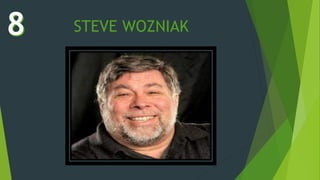
STEVE WOZNIAK
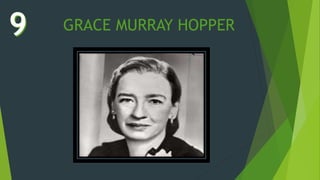
GRACE MURRAY HOPPER
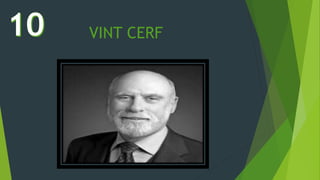
VINT CERF
Charles Babbage
He invented computers but failed to build them.
The first complete Babbage Engine was completed
in London in 2002, 153 years after it was designed.
Claude Shannon
Shannon is noted for having
founded information theory with
a land mark paper, A
Mathematical Theory of
Communication, that he
published in 1948.
Alan Turing
who made major contributions
to mathematics, cryptanalysis, logic, philosophy,
and mathematical biology and also to the new
areas later named computer science, cognitive
science, artificial intelligence, and artificial life.
John Von Neumann
He made important contributions to
mathematics, physics, computer
science, and the area of artificial life.
He was born in Budapest, Hungary, on
28 December 1903. His mother was
Margit von Neumann and his father was
Max von Neumann.
William Shockley
A Nobel Prize for his development of
point-contact transistors, work that
provided the basis for one of the
sweeping technological revolutions of
the twentieth century. His junction
and field-effect transistors became
workhorses of the electronics industry.
Douglas Engelbert
is most celebrated for his role in
inventing the mouse (along with his
lead engineer at the Stanford
Research Institute, Bill English, who
fashioned the first mouse prototype).
Robert Noyce
was an American physicist who co-
founded Fairchild Semiconductor in 1957
and Intel Corporation in 1968. He is also
credited (along with Jack Kilby) with the
realization of the first integrated circuit or
microchip that fueled the personal computer
revolution and gave Silicon Valley its name
Steve Wozniak
invented the Apple I computer. The
pair founded Apple Computers in
1976 with Ronald Wayne, releasing
some of the first personal computers
on the market.
Grace Murry Hopper
was a computer pioneer and naval officer.
She received a master's degree (1930) and
a Ph.D. (1934) in mathematics from Yale.
One of the first three modern
“programmers,” Hopper is best known for
her trailblazing contributions to the
development of computer languages.
Vint Cerf
Widely known as a “Father of the Internet,”
Cerf is the co-designer of the TCP/IP
protocols and the architecture of the
Internet. In December 1997, President Bill
Clinton presented the U.S. National Medal of
Technology to Cerf and his colleague, Robert
E. Kahn, for founding and developing the
Internet.
MEN BEHIND COMPUTER

MEN BEHIND COMPUTER

  • 1.
  • 2.
    • Who arethe men behind computer? • What are there contribution?
  • 3.
  • 4.
  • 5.
  • 6.
  • 7.
  • 8.
  • 9.
  • 10.
  • 11.
  • 12.
  • 14.
    Charles Babbage He inventedcomputers but failed to build them. The first complete Babbage Engine was completed in London in 2002, 153 years after it was designed.
  • 15.
    Claude Shannon Shannon isnoted for having founded information theory with a land mark paper, A Mathematical Theory of Communication, that he published in 1948.
  • 16.
    Alan Turing who mademajor contributions to mathematics, cryptanalysis, logic, philosophy, and mathematical biology and also to the new areas later named computer science, cognitive science, artificial intelligence, and artificial life.
  • 17.
    John Von Neumann Hemade important contributions to mathematics, physics, computer science, and the area of artificial life. He was born in Budapest, Hungary, on 28 December 1903. His mother was Margit von Neumann and his father was Max von Neumann.
  • 18.
    William Shockley A NobelPrize for his development of point-contact transistors, work that provided the basis for one of the sweeping technological revolutions of the twentieth century. His junction and field-effect transistors became workhorses of the electronics industry.
  • 19.
    Douglas Engelbert is mostcelebrated for his role in inventing the mouse (along with his lead engineer at the Stanford Research Institute, Bill English, who fashioned the first mouse prototype).
  • 20.
    Robert Noyce was anAmerican physicist who co- founded Fairchild Semiconductor in 1957 and Intel Corporation in 1968. He is also credited (along with Jack Kilby) with the realization of the first integrated circuit or microchip that fueled the personal computer revolution and gave Silicon Valley its name
  • 21.
    Steve Wozniak invented theApple I computer. The pair founded Apple Computers in 1976 with Ronald Wayne, releasing some of the first personal computers on the market.
  • 22.
    Grace Murry Hopper wasa computer pioneer and naval officer. She received a master's degree (1930) and a Ph.D. (1934) in mathematics from Yale. One of the first three modern “programmers,” Hopper is best known for her trailblazing contributions to the development of computer languages.
  • 23.
    Vint Cerf Widely knownas a “Father of the Internet,” Cerf is the co-designer of the TCP/IP protocols and the architecture of the Internet. In December 1997, President Bill Clinton presented the U.S. National Medal of Technology to Cerf and his colleague, Robert E. Kahn, for founding and developing the Internet.