Detail facts on computer 
development
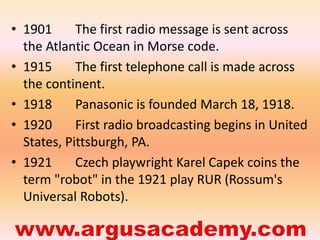
• 1901 The first radio message is sent across 
the Atlantic Ocean in Morse code. 
• 1915 The first telephone call is made across 
the continent. 
• 1918 Panasonic is founded March 18, 1918. 
• 1920 First radio broadcasting begins in United 
States, Pittsburgh, PA. 
• 1921 Czech playwright Karel Capek coins the 
term "robot" in the 1921 play RUR (Rossum's 
Universal Robots).
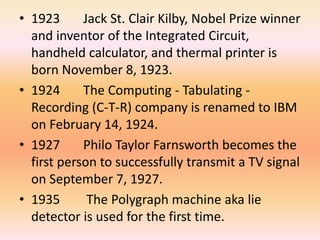
• 1923 Jack St. Clair Kilby, Nobel Prize winner 
and inventor of the Integrated Circuit, 
handheld calculator, and thermal printer is 
born November 8, 1923. 
• 1924 The Computing - Tabulating - 
Recording (C-T-R) company is renamed to IBM 
on February 14, 1924. 
• 1927 Philo Taylor Farnsworth becomes the 
first person to successfully transmit a TV signal 
on September 7, 1927. 
• 1935 The Polygraph machine aka lie 
detector is used for the first time.
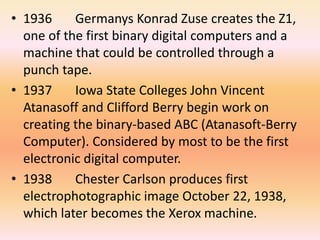
• 1936 Germanys Konrad Zuse creates the Z1, 
one of the first binary digital computers and a 
machine that could be controlled through a 
punch tape. 
• 1937 Iowa State Colleges John Vincent 
Atanasoff and Clifford Berry begin work on 
creating the binary-based ABC (Atanasoft-Berry 
Computer). Considered by most to be the first 
electronic digital computer. 
• 1938 Chester Carlson produces first 
electrophotographic image October 22, 1938, 
which later becomes the Xerox machine.
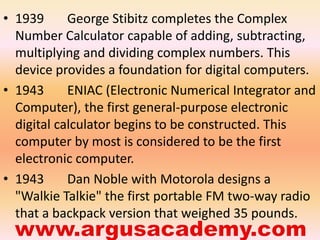
• 1939 George Stibitz completes the Complex 
Number Calculator capable of adding, subtracting, 
multiplying and dividing complex numbers. This 
device provides a foundation for digital computers. 
• 1943 ENIAC (Electronic Numerical Integrator and 
Computer), the first general-purpose electronic 
digital calculator begins to be constructed. This 
computer by most is considered to be the first 
electronic computer. 
• 1943 Dan Noble with Motorola designs a 
"Walkie Talkie" the first portable FM two-way radio 
that a backpack version that weighed 35 pounds.
• 1944 The first binary, and partially 
programmable computer, Colossus, was created at 
Bletchley Park. 
• 1945 The term bug as computer bug was 
termed by Grace Hopper when programming the 
MARK II. 
• 1946 Freddie Williams applies for a patent on 
his cathode-ray tube (CRT) storing device in 
December. The device that later became known as 
the Williams tube is capable of storing between 
512 and 1024 bits of data. 
• 1946 ENIAC computer completed. 
• 1947 ISO is founded.
• 1947 John Bardeen, Walter Brattain and William 
Shockley invent the first transistor at the Bell 
Laboratories on December 23, 1947. 
• 1948 Andrew Donald Booth creates magnetic 
drum memory, which is two inches long and two 
inches wide and capable of holding 10 bits per inch. 
• 1949 The first computer company, Electronic 
Controls Company is founded by J. Presper Eckert 
and John Mauchly, the same individuals who helped 
create the ENIAC computer. 
• 1951 UNIVAC I was introduced.
• 1952 Alexander Sandy Douglas created the 
first graphical computer game of Tic-Tac-Toe 
on an EDSAC known as "OXO." 
• 1953 IBM introduces the 701 to the public 
April 7, 1953. The 701 is IBM's first electric 
computer and first mass produced computer. 
• 1954 IBM becomes the first company to 
translate Russian into English using a 
computer. 
• 1955 Dartmouth Colleges John McCarthy 
coins the term "artificial intelligence."
• 1955 Bell Labs introduces its first transistor 
computer. Transistors are faster, smaller and 
create less heat than traditional vacuum tubs, 
making these computers more reliable and 
efficient. 
• 1955 The ENIAC is turned off for the last 
time. Its estimated to have done more 
arithmetic than the entire human race had 
done prior to 1945. 
• 1956 The programming language FORTRAN 
is introduced to the public October 15, 1956.
• 1958 The first integrated circuit is first 
developed by Robert Noyce of Fairchild 
Semiconductor and Jack Kilby of Texas Instruments. 
The first IC was demonstrated on September 12, 
1958. 
• 1960 The Common Business-Oriented Language 
(COBOL) programming language is invented. 
• 1962 Steve Russell creates "SpaceWar!" and 
releases it in February 1962. This game is 
considered the first game intended for computers. 
• 1962 Philips invents the compact audio cassette 
tape.
• 1963 The American Standard Code for 
Information Interchange (ASCII) is developed 
to standardize data exchange among 
computers. 
• 1963 Bell Telephone introduces the push 
button telephone November 18, 1963. 
• 1964 Dartmouth Universitys John Kemeny 
and Thomas Kurtz develop Beginners All-purpose 
Symbolic Instruction Language 
(BASIC) and run it for the first time May 1, 
1964.
• 1966 Robert Taylor joins ARPA and brings Larry 
Roberts there to develop ARPANET. 
• 1967 IBM creates the first floppy disk. 
• 1967 The LOGO programming language is 
developed and is later known as "turtle graphics," a 
simplified interface useful for teaching children 
computers. 
• 1967 Nokia is formed. 
• 1968 Intel Corporation is founded by Robert 
Noyce and Gordon Moore. 
• 1969 AT&T Bell Laboratories develop Unix.
• 1969 Gary Starkweather, while working with 
Xerox invents the laser printer. 
• 1969 UCLA puts out a press release introducing 
the public to the Internet on July 3, 1969. 
• 1969 The first U.S. bank ATM went into service 
at 9:00am on September 2, 1969. 
• 1969 Charley Kline a UCLA student tries to send 
"login", the first message over ARPANET at 10:30 
p.m on October 29, 1969. The system transmitted 
"l" and then "o" but then crashed making the first 
day a message was sent over the Internet and the 
first network crash.
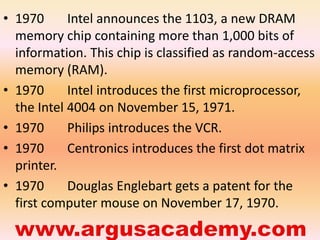
• 1970 Intel announces the 1103, a new DRAM 
memory chip containing more than 1,000 bits of 
information. This chip is classified as random-access 
memory (RAM). 
• 1970 Intel introduces the first microprocessor, 
the Intel 4004 on November 15, 1971. 
• 1970 Philips introduces the VCR. 
• 1970 Centronics introduces the first dot matrix 
printer. 
• 1970 Douglas Englebart gets a patent for the 
first computer mouse on November 17, 1970.
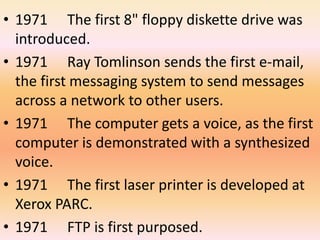
• 1971 The first 8" floppy diskette drive was 
introduced. 
• 1971 Ray Tomlinson sends the first e-mail, 
the first messaging system to send messages 
across a network to other users. 
• 1971 The computer gets a voice, as the first 
computer is demonstrated with a synthesized 
voice. 
• 1971 The first laser printer is developed at 
Xerox PARC. 
• 1971 FTP is first purposed.
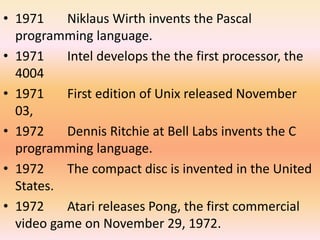
• 1971 Niklaus Wirth invents the Pascal 
programming language. 
• 1971 Intel develops the the first processor, the 
4004 
• 1971 First edition of Unix released November 
03, 
• 1972 Dennis Ritchie at Bell Labs invents the C 
programming language. 
• 1972 The compact disc is invented in the United 
States. 
• 1972 Atari releases Pong, the first commercial 
video game on November 29, 1972.
• 1972 First public demo of ARPANET. 
• 1973 IBM introduces its 3660 Supermarket 
System, which uses a laser to read grocery 
prices and UPC bar codes. 
• 1974 IBM develops SEQUEL, which today 
is known as SQL today. 
• 1975 Bill Gates and Paul Allen Establish 
Microsoft April 4, 1975. 
• 1976 Intel introduces the 8085 processor 
on March 1976.
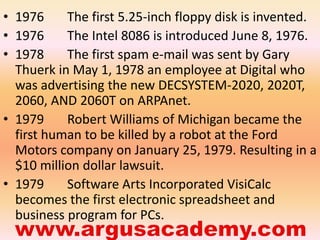
• 1976 The first 5.25-inch floppy disk is invented. 
• 1976 The Intel 8086 is introduced June 8, 1976. 
• 1978 The first spam e-mail was sent by Gary 
Thuerk in May 1, 1978 an employee at Digital who 
was advertising the new DECSYSTEM-2020, 2020T, 
2060, AND 2060T on ARPAnet. 
• 1979 Robert Williams of Michigan became the 
first human to be killed by a robot at the Ford 
Motors company on January 25, 1979. Resulting in a 
$10 million dollar lawsuit. 
• 1979 Software Arts Incorporated VisiCalc 
becomes the first electronic spreadsheet and 
business program for PCs.
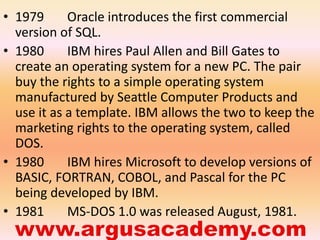
• 1979 Oracle introduces the first commercial 
version of SQL. 
• 1980 IBM hires Paul Allen and Bill Gates to 
create an operating system for a new PC. The pair 
buy the rights to a simple operating system 
manufactured by Seattle Computer Products and 
use it as a template. IBM allows the two to keep the 
marketing rights to the operating system, called 
DOS. 
• 1980 IBM hires Microsoft to develop versions of 
BASIC, FORTRAN, COBOL, and Pascal for the PC 
being developed by IBM. 
• 1981 MS-DOS 1.0 was released August, 1981.
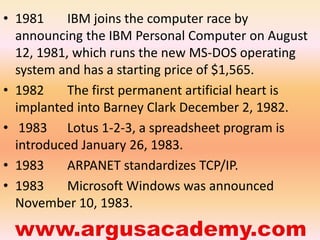
• 1981 IBM joins the computer race by 
announcing the IBM Personal Computer on August 
12, 1981, which runs the new MS-DOS operating 
system and has a starting price of $1,565. 
• 1982 The first permanent artificial heart is 
implanted into Barney Clark December 2, 1982. 
• 1983 Lotus 1-2-3, a spreadsheet program is 
introduced January 26, 1983. 
• 1983 ARPANET standardizes TCP/IP. 
• 1983 Microsoft Windows was announced 
November 10, 1983.
• 1985 The first Internet domain 
name symbolics.com is registered by 
Symbolics, a Massachusetts 
computer company on March 15, 
1985. 
• 1985 Microtek introduces the 
world's first 300-dpi black-and-white 
sheetfed scanner.

Detailed facts on computer development

  • 1.
    Detail facts oncomputer development
  • 2.
    • 1901 Thefirst radio message is sent across the Atlantic Ocean in Morse code. • 1915 The first telephone call is made across the continent. • 1918 Panasonic is founded March 18, 1918. • 1920 First radio broadcasting begins in United States, Pittsburgh, PA. • 1921 Czech playwright Karel Capek coins the term "robot" in the 1921 play RUR (Rossum's Universal Robots).
  • 3.
    • 1923 JackSt. Clair Kilby, Nobel Prize winner and inventor of the Integrated Circuit, handheld calculator, and thermal printer is born November 8, 1923. • 1924 The Computing - Tabulating - Recording (C-T-R) company is renamed to IBM on February 14, 1924. • 1927 Philo Taylor Farnsworth becomes the first person to successfully transmit a TV signal on September 7, 1927. • 1935 The Polygraph machine aka lie detector is used for the first time.
  • 4.
    • 1936 GermanysKonrad Zuse creates the Z1, one of the first binary digital computers and a machine that could be controlled through a punch tape. • 1937 Iowa State Colleges John Vincent Atanasoff and Clifford Berry begin work on creating the binary-based ABC (Atanasoft-Berry Computer). Considered by most to be the first electronic digital computer. • 1938 Chester Carlson produces first electrophotographic image October 22, 1938, which later becomes the Xerox machine.
  • 5.
    • 1939 GeorgeStibitz completes the Complex Number Calculator capable of adding, subtracting, multiplying and dividing complex numbers. This device provides a foundation for digital computers. • 1943 ENIAC (Electronic Numerical Integrator and Computer), the first general-purpose electronic digital calculator begins to be constructed. This computer by most is considered to be the first electronic computer. • 1943 Dan Noble with Motorola designs a "Walkie Talkie" the first portable FM two-way radio that a backpack version that weighed 35 pounds.
  • 6.
    • 1944 Thefirst binary, and partially programmable computer, Colossus, was created at Bletchley Park. • 1945 The term bug as computer bug was termed by Grace Hopper when programming the MARK II. • 1946 Freddie Williams applies for a patent on his cathode-ray tube (CRT) storing device in December. The device that later became known as the Williams tube is capable of storing between 512 and 1024 bits of data. • 1946 ENIAC computer completed. • 1947 ISO is founded.
  • 7.
    • 1947 JohnBardeen, Walter Brattain and William Shockley invent the first transistor at the Bell Laboratories on December 23, 1947. • 1948 Andrew Donald Booth creates magnetic drum memory, which is two inches long and two inches wide and capable of holding 10 bits per inch. • 1949 The first computer company, Electronic Controls Company is founded by J. Presper Eckert and John Mauchly, the same individuals who helped create the ENIAC computer. • 1951 UNIVAC I was introduced.
  • 8.
    • 1952 AlexanderSandy Douglas created the first graphical computer game of Tic-Tac-Toe on an EDSAC known as "OXO." • 1953 IBM introduces the 701 to the public April 7, 1953. The 701 is IBM's first electric computer and first mass produced computer. • 1954 IBM becomes the first company to translate Russian into English using a computer. • 1955 Dartmouth Colleges John McCarthy coins the term "artificial intelligence."
  • 9.
    • 1955 BellLabs introduces its first transistor computer. Transistors are faster, smaller and create less heat than traditional vacuum tubs, making these computers more reliable and efficient. • 1955 The ENIAC is turned off for the last time. Its estimated to have done more arithmetic than the entire human race had done prior to 1945. • 1956 The programming language FORTRAN is introduced to the public October 15, 1956.
  • 10.
    • 1958 Thefirst integrated circuit is first developed by Robert Noyce of Fairchild Semiconductor and Jack Kilby of Texas Instruments. The first IC was demonstrated on September 12, 1958. • 1960 The Common Business-Oriented Language (COBOL) programming language is invented. • 1962 Steve Russell creates "SpaceWar!" and releases it in February 1962. This game is considered the first game intended for computers. • 1962 Philips invents the compact audio cassette tape.
  • 11.
    • 1963 TheAmerican Standard Code for Information Interchange (ASCII) is developed to standardize data exchange among computers. • 1963 Bell Telephone introduces the push button telephone November 18, 1963. • 1964 Dartmouth Universitys John Kemeny and Thomas Kurtz develop Beginners All-purpose Symbolic Instruction Language (BASIC) and run it for the first time May 1, 1964.
  • 12.
    • 1966 RobertTaylor joins ARPA and brings Larry Roberts there to develop ARPANET. • 1967 IBM creates the first floppy disk. • 1967 The LOGO programming language is developed and is later known as "turtle graphics," a simplified interface useful for teaching children computers. • 1967 Nokia is formed. • 1968 Intel Corporation is founded by Robert Noyce and Gordon Moore. • 1969 AT&T Bell Laboratories develop Unix.
  • 13.
    • 1969 GaryStarkweather, while working with Xerox invents the laser printer. • 1969 UCLA puts out a press release introducing the public to the Internet on July 3, 1969. • 1969 The first U.S. bank ATM went into service at 9:00am on September 2, 1969. • 1969 Charley Kline a UCLA student tries to send "login", the first message over ARPANET at 10:30 p.m on October 29, 1969. The system transmitted "l" and then "o" but then crashed making the first day a message was sent over the Internet and the first network crash.
  • 14.
    • 1970 Intelannounces the 1103, a new DRAM memory chip containing more than 1,000 bits of information. This chip is classified as random-access memory (RAM). • 1970 Intel introduces the first microprocessor, the Intel 4004 on November 15, 1971. • 1970 Philips introduces the VCR. • 1970 Centronics introduces the first dot matrix printer. • 1970 Douglas Englebart gets a patent for the first computer mouse on November 17, 1970.
  • 15.
    • 1971 Thefirst 8" floppy diskette drive was introduced. • 1971 Ray Tomlinson sends the first e-mail, the first messaging system to send messages across a network to other users. • 1971 The computer gets a voice, as the first computer is demonstrated with a synthesized voice. • 1971 The first laser printer is developed at Xerox PARC. • 1971 FTP is first purposed.
  • 16.
    • 1971 NiklausWirth invents the Pascal programming language. • 1971 Intel develops the the first processor, the 4004 • 1971 First edition of Unix released November 03, • 1972 Dennis Ritchie at Bell Labs invents the C programming language. • 1972 The compact disc is invented in the United States. • 1972 Atari releases Pong, the first commercial video game on November 29, 1972.
  • 17.
    • 1972 Firstpublic demo of ARPANET. • 1973 IBM introduces its 3660 Supermarket System, which uses a laser to read grocery prices and UPC bar codes. • 1974 IBM develops SEQUEL, which today is known as SQL today. • 1975 Bill Gates and Paul Allen Establish Microsoft April 4, 1975. • 1976 Intel introduces the 8085 processor on March 1976.
  • 18.
    • 1976 Thefirst 5.25-inch floppy disk is invented. • 1976 The Intel 8086 is introduced June 8, 1976. • 1978 The first spam e-mail was sent by Gary Thuerk in May 1, 1978 an employee at Digital who was advertising the new DECSYSTEM-2020, 2020T, 2060, AND 2060T on ARPAnet. • 1979 Robert Williams of Michigan became the first human to be killed by a robot at the Ford Motors company on January 25, 1979. Resulting in a $10 million dollar lawsuit. • 1979 Software Arts Incorporated VisiCalc becomes the first electronic spreadsheet and business program for PCs.
  • 19.
    • 1979 Oracleintroduces the first commercial version of SQL. • 1980 IBM hires Paul Allen and Bill Gates to create an operating system for a new PC. The pair buy the rights to a simple operating system manufactured by Seattle Computer Products and use it as a template. IBM allows the two to keep the marketing rights to the operating system, called DOS. • 1980 IBM hires Microsoft to develop versions of BASIC, FORTRAN, COBOL, and Pascal for the PC being developed by IBM. • 1981 MS-DOS 1.0 was released August, 1981.
  • 20.
    • 1981 IBMjoins the computer race by announcing the IBM Personal Computer on August 12, 1981, which runs the new MS-DOS operating system and has a starting price of $1,565. • 1982 The first permanent artificial heart is implanted into Barney Clark December 2, 1982. • 1983 Lotus 1-2-3, a spreadsheet program is introduced January 26, 1983. • 1983 ARPANET standardizes TCP/IP. • 1983 Microsoft Windows was announced November 10, 1983.
  • 21.
    • 1985 Thefirst Internet domain name symbolics.com is registered by Symbolics, a Massachusetts computer company on March 15, 1985. • 1985 Microtek introduces the world's first 300-dpi black-and-white sheetfed scanner.