Mind Experiences and
Models Experimenter
Framework
MEME
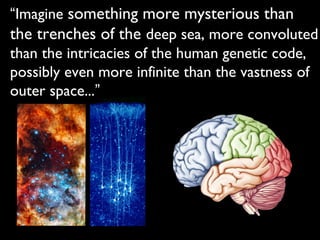
“Imagine something more mysterious than
the trenches of the deep sea, more convoluted
than the intricacies of the human genetic code,
possibly even more infinite than the vastness of
outer space...”
Question: What I think?
Brain: “...an
apparatus with wich
we think we think”;
the physical and
chemical platform
for the mind;
energy, signals,
thoughts... Phrenology Chart (1833)
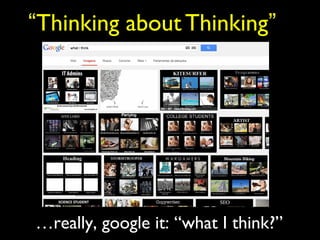
“Thinking about Thinking”
…really, google it: “what I think?”
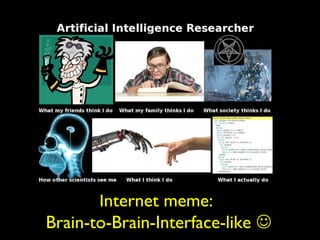
Internet meme:
Brain-to-Brain-Interface-like 
Limits of science
http://en.wikipedia.org/wiki/Meme
• The word meme is a shortening (modeled on gene)
of mimeme and it was coined by the British
evolutionary biologist Richard Dawkins in The
Selfish Gene (1976) as a concept for discussion of
evolutionary principles.
• The meme, analogous to a gene, was conceived as a
"unit of culture" (an idea, belief, pattern of
behaviour, etc.) which is "hosted" in one or more
individual minds, and which can reproduce itself,
thereby jumping from mind to mind.
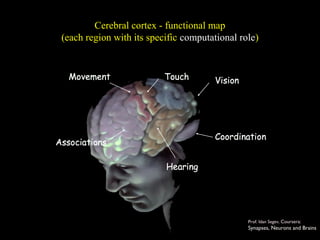
Cerebral cortex - functional map
(each region with its specific computational role)
Prof. Idan Segev, Coursera:
Synapses, Neurons and Brains
Computing image correlation and binding different parts of the image (figure
– ground separation) is essential for the organism
Prof. Idan Segev, Coursera:
Synapses, Neurons and Brains
“Is intelligence the goal of a biological evolution?”
How to create mind, Ray Kurzweill
• Cognitive
• Reason (make judgment under uncertainly)
• Consciousness
• Represent knowledge (also commonsense)
• Plan
• Learn (critical to human intelligence)
• Communicate (natural language)
• Self-awareness, Sentience, Sapience...
Hypothesis: How I think?
http://en.wikipedia.org/wiki/Cognitive_science
• Affective
• Emotions
• Conative
• Natural
tendency?,
impulse…
mind loop:
Sensation >
Perception >
Action >
Emotion >
• The transformation of external events
into neural activity;
•Processing of sensory information; we
believe that the end result is a useful
representation in terms of the external
objects that produced the sensations;
•Organisms use the representation of
the world in order to act on it,
optimizing rewards and minimizing
punishments;
•Emotion is often the driving force
behind motivation, positive or negative.
Our Neuronal Processing
Mechanism
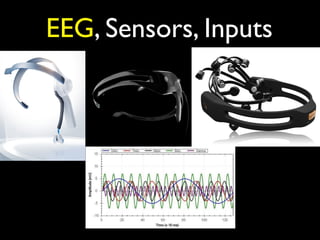
EEG, Sensors, Inputs
Dataset scales (hbp)
http://www.humanbrainproject.eu/
MEME dataset scales
• Spatial = S (Structure)
• S = Brain Region Area (cm) = # Sensors EEG selected
• Energy = E (Efficiency)
• E = reflects the summation of the synchronous activity of
thousands or millions of neurons that have similar spatial
orientation = microVolts (mV) [2..100mV]
• Time = T (Function)
• T = seconds (sec);
• Analysis type: continuous || steady-state
• S+E+T = inputs variables to build, run and validate regression
and classification models (machine learning)
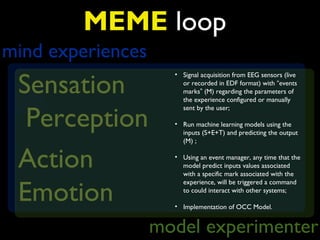
MEME loop
Sensation
Perception
Action
Emotion
mind experiences
model experimenter
• Signal acquisition from EEG sensors (live
or recorded in EDF format) with “events
marks” (M) regarding the parameters of
the experience configured or manually
sent by the user;
• Run machine learning models using the
inputs (S+E+T) and predicting the output
(M) ;
• Using an event manager, any time that the
model predict inputs values associated
with a specific mark associated with the
experience, will be triggered a command
to could interact with other systems;
• Implementation of OCC Model.
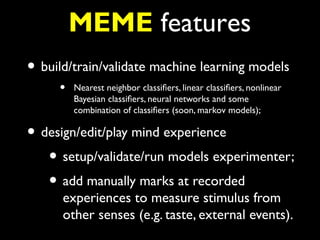
• build/train/validate machine learning models
• Nearest neighbor classifiers, linear classifiers, nonlinear
Bayesian classifiers, neural networks and some
combination of classifiers (soon, markov models);
• design/edit/play mind experience
• setup/validate/run models experimenter;
• add manually marks at recorded
experiences to measure stimulus from
other senses (e.g. taste, external events).
MEME features
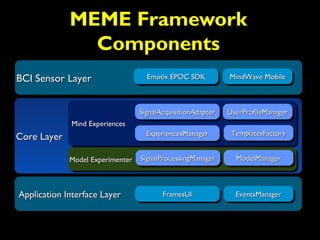
MEME Framework
Components
BCI Sensor LayerBCI Sensor LayerBCI Sensor LayerBCI Sensor Layer Emotiv EPOC SDKEmotiv EPOC SDKEmotiv EPOC SDKEmotiv EPOC SDK
Core LayerCore LayerCore LayerCore Layer
Model ExperimenterModel ExperimenterModel ExperimenterModel Experimenter
Mind ExperiencesMind ExperiencesMind ExperiencesMind Experiences
SignalAcquisitionAdapterSignalAcquisitionAdapterSignalAcquisitionAdapterSignalAcquisitionAdapter
SignalProcessingManagerSignalProcessingManagerSignalProcessingManagerSignalProcessingManager
Application Interface LayerApplication Interface LayerApplication Interface LayerApplication Interface Layer FramesUIFramesUIFramesUIFramesUI
UserProfileManagerUserProfileManagerUserProfileManagerUserProfileManager
ExperiencesManagerExperiencesManagerExperiencesManagerExperiencesManager
EventsManagerEventsManagerEventsManagerEventsManager
ModelManagerModelManagerModelManagerModelManager
MindWave MobileMindWave MobileMindWave MobileMindWave Mobile
TemplatesFactoryTemplatesFactoryTemplatesFactoryTemplatesFactory
Next steps...
•“When gamified, crowdsourced
science is more than expediting
data collection and analysis–it
helps communicate science with
the world”
(e.g. www.eyewire.org)
Questions???

Meme Framework

  • 1.
    Mind Experiences and ModelsExperimenter Framework MEME
  • 2.
    “Imagine something moremysterious than the trenches of the deep sea, more convoluted than the intricacies of the human genetic code, possibly even more infinite than the vastness of outer space...”
  • 3.
    Question: What Ithink? Brain: “...an apparatus with wich we think we think”; the physical and chemical platform for the mind; energy, signals, thoughts... Phrenology Chart (1833)
  • 4.
    “Thinking about Thinking” …really,google it: “what I think?”
  • 5.
  • 6.
    Limits of science http://en.wikipedia.org/wiki/Meme •The word meme is a shortening (modeled on gene) of mimeme and it was coined by the British evolutionary biologist Richard Dawkins in The Selfish Gene (1976) as a concept for discussion of evolutionary principles. • The meme, analogous to a gene, was conceived as a "unit of culture" (an idea, belief, pattern of behaviour, etc.) which is "hosted" in one or more individual minds, and which can reproduce itself, thereby jumping from mind to mind.
  • 7.
    Cerebral cortex -functional map (each region with its specific computational role) Prof. Idan Segev, Coursera: Synapses, Neurons and Brains
  • 8.
    Computing image correlationand binding different parts of the image (figure – ground separation) is essential for the organism Prof. Idan Segev, Coursera: Synapses, Neurons and Brains “Is intelligence the goal of a biological evolution?” How to create mind, Ray Kurzweill
  • 9.
    • Cognitive • Reason(make judgment under uncertainly) • Consciousness • Represent knowledge (also commonsense) • Plan • Learn (critical to human intelligence) • Communicate (natural language) • Self-awareness, Sentience, Sapience... Hypothesis: How I think? http://en.wikipedia.org/wiki/Cognitive_science • Affective • Emotions • Conative • Natural tendency?, impulse…
  • 10.
    mind loop: Sensation > Perception> Action > Emotion > • The transformation of external events into neural activity; •Processing of sensory information; we believe that the end result is a useful representation in terms of the external objects that produced the sensations; •Organisms use the representation of the world in order to act on it, optimizing rewards and minimizing punishments; •Emotion is often the driving force behind motivation, positive or negative. Our Neuronal Processing Mechanism
  • 11.
  • 12.
  • 13.
    MEME dataset scales •Spatial = S (Structure) • S = Brain Region Area (cm) = # Sensors EEG selected • Energy = E (Efficiency) • E = reflects the summation of the synchronous activity of thousands or millions of neurons that have similar spatial orientation = microVolts (mV) [2..100mV] • Time = T (Function) • T = seconds (sec); • Analysis type: continuous || steady-state • S+E+T = inputs variables to build, run and validate regression and classification models (machine learning)
  • 14.
    MEME loop Sensation Perception Action Emotion mind experiences modelexperimenter • Signal acquisition from EEG sensors (live or recorded in EDF format) with “events marks” (M) regarding the parameters of the experience configured or manually sent by the user; • Run machine learning models using the inputs (S+E+T) and predicting the output (M) ; • Using an event manager, any time that the model predict inputs values associated with a specific mark associated with the experience, will be triggered a command to could interact with other systems; • Implementation of OCC Model.
  • 15.
    • build/train/validate machinelearning models • Nearest neighbor classifiers, linear classifiers, nonlinear Bayesian classifiers, neural networks and some combination of classifiers (soon, markov models); • design/edit/play mind experience • setup/validate/run models experimenter; • add manually marks at recorded experiences to measure stimulus from other senses (e.g. taste, external events). MEME features
  • 16.
    MEME Framework Components BCI SensorLayerBCI Sensor LayerBCI Sensor LayerBCI Sensor Layer Emotiv EPOC SDKEmotiv EPOC SDKEmotiv EPOC SDKEmotiv EPOC SDK Core LayerCore LayerCore LayerCore Layer Model ExperimenterModel ExperimenterModel ExperimenterModel Experimenter Mind ExperiencesMind ExperiencesMind ExperiencesMind Experiences SignalAcquisitionAdapterSignalAcquisitionAdapterSignalAcquisitionAdapterSignalAcquisitionAdapter SignalProcessingManagerSignalProcessingManagerSignalProcessingManagerSignalProcessingManager Application Interface LayerApplication Interface LayerApplication Interface LayerApplication Interface Layer FramesUIFramesUIFramesUIFramesUI UserProfileManagerUserProfileManagerUserProfileManagerUserProfileManager ExperiencesManagerExperiencesManagerExperiencesManagerExperiencesManager EventsManagerEventsManagerEventsManagerEventsManager ModelManagerModelManagerModelManagerModelManager MindWave MobileMindWave MobileMindWave MobileMindWave Mobile TemplatesFactoryTemplatesFactoryTemplatesFactoryTemplatesFactory
  • 17.
    Next steps... •“When gamified,crowdsourced science is more than expediting data collection and analysis–it helps communicate science with the world” (e.g. www.eyewire.org)
  • 18.