Our
Introduction
Lesson Quiz
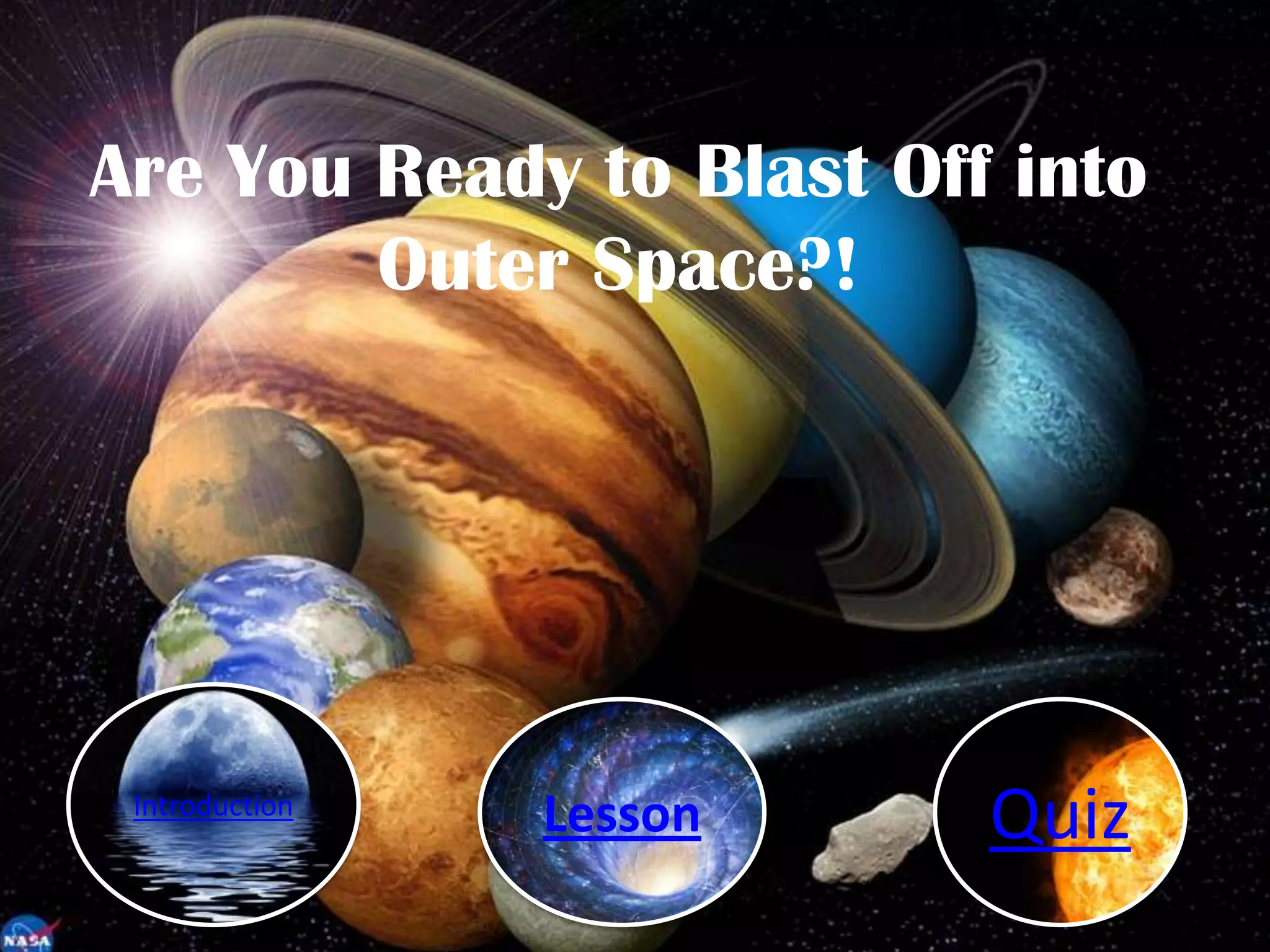
Are You Ready to Blast Off into
Outer Space?!
• The best part of your 5th grade science class is traveling
through our Solar System!
• After this lesson you will be able to recognize the eight
planets that orbit our sun
• Know which order the planets evolve
• Know how to distinguish between each planet
Best of all you’ll be able to impress anyone after learning
about our unique world 
Previous Page Next Page
The Standards for this lesson are in reference
to the Ohio Department of Education’s Grade
k-8 Science Standards and Model Curriculum:
Grade 5 Earth and Space Science
Before We Sky Rocket Lets know the
Basics…
• Your ultimate goal is to be able to complete the quiz at the
end of this lesson. In order to do well on it you must go
through the lessons and absorb the knowledge presented
before you and demonstrate it on the quiz.
• In order to operate through the slides, each slide will contain
a sun bottom left which will take you to the previous page
and a moon bottom right which will take you to the next
slide. A lighting bolt will take you back to the very first page
You Are Now Ready to
Venture through our
Astonishing Solar
System! Buckle Up
Students!
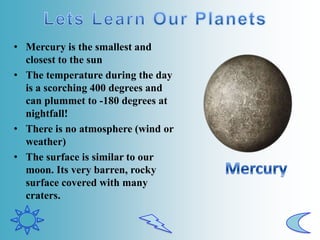
• Mercury is the smallest and
closest to the sun
• The temperature during the day
is a scorching 400 degrees and
can plummet to -180 degrees at
nightfall!
• There is no atmosphere (wind or
weather)
• The surface is similar to our
moon. Its very barren, rocky
surface covered with many
craters.
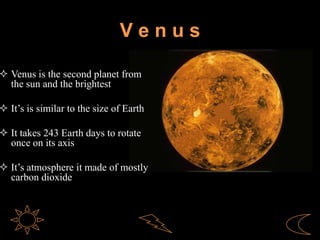
V e n u s
 Venus is the second planet from
the sun and the brightest
 It’s is similar to the size of Earth
 It takes 243 Earth days to rotate
once on its axis
 It’s atmosphere it made of mostly
carbon dioxide
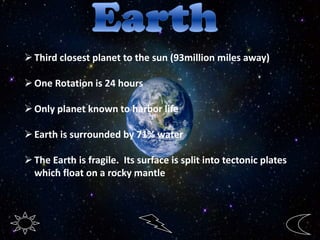
Third closest planet to the sun (93million miles away)
One Rotation is 24 hours
Only planet known to harbor life
Earth is surrounded by 71% water
The Earth is fragile. Its surface is split into tectonic plates
which float on a rocky mantle
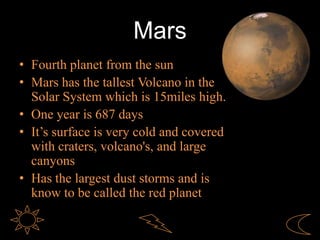
Mars
• Fourth planet from the sun
• Mars has the tallest Volcano in the
Solar System which is 15miles high.
• One year is 687 days
• It’s surface is very cold and covered
with craters, volcano's, and large
canyons
• Has the largest dust storms and is
know to be called the red planet
 Jupiter is the 5th closest to the sun
and largest planet in our solar system
 Days are only 10hours long do to the
rapid rotation!
 The “Giant Red Spot” is a storm that
has been occurring for hundred of
years
 A year is 12 Earth years
 Jupiter contain two rings around it
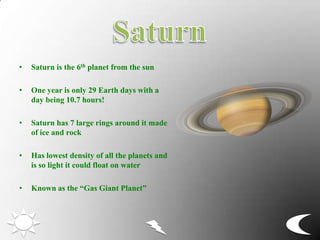
• Saturn is the 6th planet from the sun
• One year is only 29 Earth days with a
day being 10.7 hours!
• Saturn has 7 large rings around it made
of ice and rock
• Has lowest density of all the planets and
is so light it could float on water
• Known as the “Gas Giant Planet”
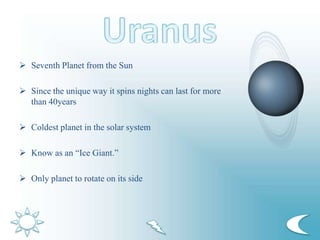
 Seventh Planet from the Sun
 Since the unique way it spins nights can last for more
than 40years
 Coldest planet in the solar system
 Know as an “Ice Giant.”
 Only planet to rotate on its side
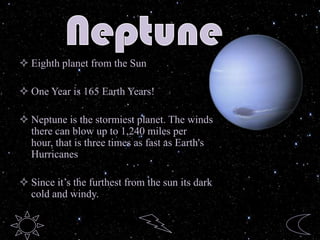
 Eighth planet from the Sun
 One Year is 165 Earth Years!
 Neptune is the stormiest planet. The winds
there can blow up to 1,240 miles per
hour, that is three times as fast as Earth's
Hurricanes
 Since it’s the furthest from the sun its dark
cold and windy.
• We have learned lot of information pertaining to the
planets. If you would like to find out more details please visit
this website
• http://msnucleus.org/membership/html/k-
6/uc/solar_system/k/ucssk_1a.html
• http://space-facts.com/planets/
You may now proceed to the quiz by clicking on the moon.
If you prefer to look through the lesson again, click the sun
to see the planets (in the order of farthest from the sun to
closest to the sun), or click the lighting bolt to start from the
beginning by then clicking the “lesson.”
Good Luck!!
Which Planet is the furthest from
the sun?
 A. Earth
 B. Mercury
 C. Neptune
 D. Uranus
Correct!
Next Question
Sorry
Try
Again…
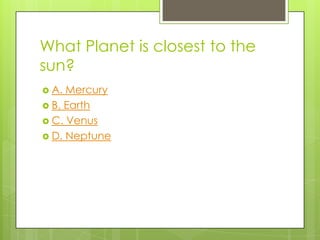
What Planet is closest to the
sun?
 A. Mercury
 B. Earth
 C. Venus
 D. Neptune
Correct!
Next Question
Sorry
Try
Again…
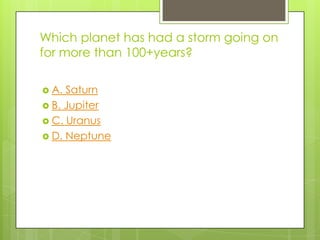
Which planet has had a storm going on
for more than 100+years?
 A. Saturn
 B. Jupiter
 C. Uranus
 D. Neptune
Correct!
Next Question
Sorry
Try
Again…
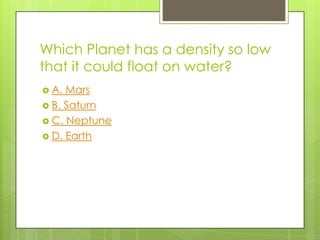
Which Planet has a density so low
that it could float on water?
 A. Mars
 B. Saturn
 C. Neptune
 D. Earth
Correct!
Next question
Sorry
Try
Again…
Earth is surrounded by 85%water?
 True
 False
Correct!
Sorry
Try
Again…
You Were Remarkable!
• Congratulations! You have successfully
completed your outer space journey by
learning all about the planets in the solar
system, and passing the final quiz! You
should be very proud of yourself!
• You can go home or check out my citation
page! Thanks for learning all about the
science of our galaxy!
Thanks for your help
• Google Images
• Coldplay “Clocks’ Song
• http://msnucleus.org/membership/html/k-
6/uc/solar_system/k/ucssk_1a.html
• http://space-facts.com/planets/

Meg chapinfinal

  • 1.
    Our Introduction Lesson Quiz Are YouReady to Blast Off into Outer Space?!
  • 2.
    • The bestpart of your 5th grade science class is traveling through our Solar System! • After this lesson you will be able to recognize the eight planets that orbit our sun • Know which order the planets evolve • Know how to distinguish between each planet Best of all you’ll be able to impress anyone after learning about our unique world  Previous Page Next Page The Standards for this lesson are in reference to the Ohio Department of Education’s Grade k-8 Science Standards and Model Curriculum: Grade 5 Earth and Space Science
  • 3.
    Before We SkyRocket Lets know the Basics… • Your ultimate goal is to be able to complete the quiz at the end of this lesson. In order to do well on it you must go through the lessons and absorb the knowledge presented before you and demonstrate it on the quiz. • In order to operate through the slides, each slide will contain a sun bottom left which will take you to the previous page and a moon bottom right which will take you to the next slide. A lighting bolt will take you back to the very first page
  • 4.
    You Are NowReady to Venture through our Astonishing Solar System! Buckle Up Students!
  • 5.
    • Mercury isthe smallest and closest to the sun • The temperature during the day is a scorching 400 degrees and can plummet to -180 degrees at nightfall! • There is no atmosphere (wind or weather) • The surface is similar to our moon. Its very barren, rocky surface covered with many craters.
  • 6.
    V e nu s  Venus is the second planet from the sun and the brightest  It’s is similar to the size of Earth  It takes 243 Earth days to rotate once on its axis  It’s atmosphere it made of mostly carbon dioxide
  • 7.
    Third closest planetto the sun (93million miles away) One Rotation is 24 hours Only planet known to harbor life Earth is surrounded by 71% water The Earth is fragile. Its surface is split into tectonic plates which float on a rocky mantle
  • 8.
    Mars • Fourth planetfrom the sun • Mars has the tallest Volcano in the Solar System which is 15miles high. • One year is 687 days • It’s surface is very cold and covered with craters, volcano's, and large canyons • Has the largest dust storms and is know to be called the red planet
  • 9.
     Jupiter isthe 5th closest to the sun and largest planet in our solar system  Days are only 10hours long do to the rapid rotation!  The “Giant Red Spot” is a storm that has been occurring for hundred of years  A year is 12 Earth years  Jupiter contain two rings around it
  • 10.
    • Saturn isthe 6th planet from the sun • One year is only 29 Earth days with a day being 10.7 hours! • Saturn has 7 large rings around it made of ice and rock • Has lowest density of all the planets and is so light it could float on water • Known as the “Gas Giant Planet”
  • 11.
     Seventh Planetfrom the Sun  Since the unique way it spins nights can last for more than 40years  Coldest planet in the solar system  Know as an “Ice Giant.”  Only planet to rotate on its side
  • 12.
     Eighth planetfrom the Sun  One Year is 165 Earth Years!  Neptune is the stormiest planet. The winds there can blow up to 1,240 miles per hour, that is three times as fast as Earth's Hurricanes  Since it’s the furthest from the sun its dark cold and windy.
  • 13.
    • We havelearned lot of information pertaining to the planets. If you would like to find out more details please visit this website • http://msnucleus.org/membership/html/k- 6/uc/solar_system/k/ucssk_1a.html • http://space-facts.com/planets/
  • 14.
    You may nowproceed to the quiz by clicking on the moon. If you prefer to look through the lesson again, click the sun to see the planets (in the order of farthest from the sun to closest to the sun), or click the lighting bolt to start from the beginning by then clicking the “lesson.” Good Luck!!
  • 15.
    Which Planet isthe furthest from the sun?  A. Earth  B. Mercury  C. Neptune  D. Uranus
  • 16.
  • 17.
  • 18.
    What Planet isclosest to the sun?  A. Mercury  B. Earth  C. Venus  D. Neptune
  • 19.
  • 20.
  • 21.
    Which planet hashad a storm going on for more than 100+years?  A. Saturn  B. Jupiter  C. Uranus  D. Neptune
  • 22.
  • 23.
  • 24.
    Which Planet hasa density so low that it could float on water?  A. Mars  B. Saturn  C. Neptune  D. Earth
  • 25.
  • 26.
  • 27.
    Earth is surroundedby 85%water?  True  False
  • 28.
  • 29.
  • 30.
    You Were Remarkable! •Congratulations! You have successfully completed your outer space journey by learning all about the planets in the solar system, and passing the final quiz! You should be very proud of yourself! • You can go home or check out my citation page! Thanks for learning all about the science of our galaxy!
  • 31.
    Thanks for yourhelp • Google Images • Coldplay “Clocks’ Song • http://msnucleus.org/membership/html/k- 6/uc/solar_system/k/ucssk_1a.html • http://space-facts.com/planets/