Ms. Miller
 http://www.google.com/earth/ , type in the
school’s address and take a little trip from
outer space to Braxton County Middle School.
 There is so much more beyond where we live.
Let’s investigate what’s out there.
 First we will look at what is being effected by
the Earth’s gravitational pull.
 Gravity has an effect on many things outside of
our atmosphere.
 Comets
 Asteroids
 Meteoroids
 Let’s learn how the Earth’s gravity pulls them
in and the difference between them.
 Comets – Overview
 A comet is an object in space that is made up of dust and
rock particles mixed with frozen water, methane, and
ammonia that forms a bright coma as it approaches the sun.
 Comets orbit the sun. Some comets inhabit in an area
known as the Oort Cloud which is far beyond the orbit of
Pluto.
 Occasionally a comet streaks through the inner solar system;
some do so regularly, some only once every few centuries.
Many people have never seen a comet, but those who have
won't easily forget the celestial show.

 Famous Comets
 Let’s explore.
 http://amazing-
space.stsci.edu/resources/explorations/comet
myth/lesson/facts/Fact6/index_nf.html
 The main difference between an asteroid and a comet is
what they are made of.
 Asteroids are made up of metals and rocky material.
 Comets are made up of ice, dust and rocky material.
 Both of these space objects were formed during the earliest
times of the solar system, around 4.5 billion years ago.
 Asteroids formed much closer to the Sun, where it was too
warm for ices to remain solid.
 Comets have tails and asteroids do not.
 Why do comets have tails? Comets formed farther from the
sun where ices would not melt. Comets, which approach the
Sun, lose material with each orbit because some of their ice
melts and vaporizes to form a tail.
 Let’s watch a video of asteroids. . . .
 http://www.space.com/51-asteroids-
formation-discovery-and-exploration.html
 A meteoroid is matter revolving around the
sun or any object in space that is too small to be
called an asteroid or a comet.
 A meteor is a meteoroid that buns up in Earth’s
atmosphere.
 A meteorite is a meteoroid that strikes the
surface of the moon or planet.
 We can study meteorites that have landed on
Earth. . . .
 http://www.solarviews.com/eng/meteor.htm
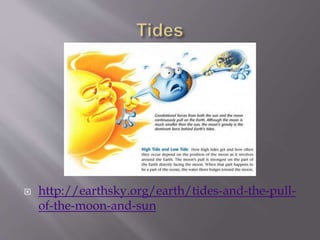
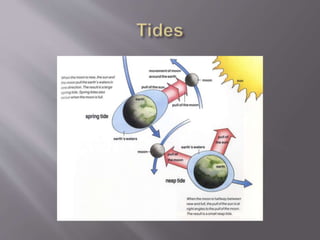
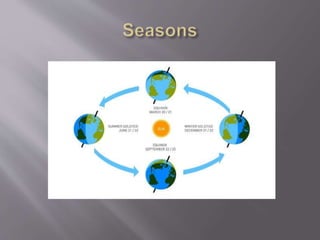
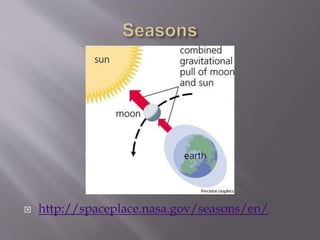
 Gravity effects the motions in sun-earth moon
systems
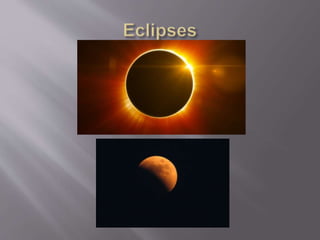
 Eclipses, tides, seasons
 http://www.solarviews.com/eng/solarsys.ht
m
 http://www.visuallearningsys.com/digital-
science/preview
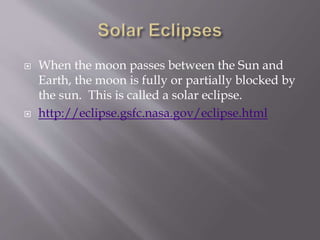
 When the moon passes between the Sun and
Earth, the moon is fully or partially blocked by
the sun. This is called a solar eclipse.
 http://eclipse.gsfc.nasa.gov/eclipse.html
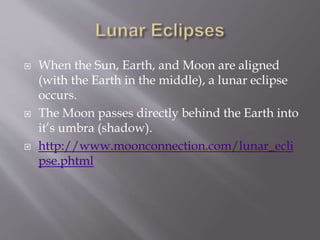
 When the Sun, Earth, and Moon are aligned
(with the Earth in the middle), a lunar eclipse
occurs.
 The Moon passes directly behind the Earth into
it’s umbra (shadow).
 http://www.moonconnection.com/lunar_ecli
pse.phtml
 http://earthsky.org/earth/tides-and-the-pull-
of-the-moon-and-sun
 http://spaceplace.nasa.gov/seasons/en/
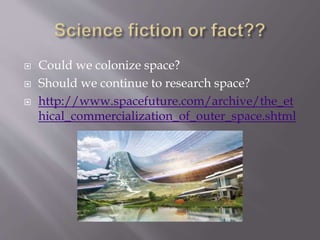
 Could we colonize space?
 Should we continue to research space?
 http://www.spacefuture.com/archive/the_et
hical_commercialization_of_outer_space.shtml
 http://www.spacedaily.com/
 http://www.spaceref.com/news/viewsr.html
?pid=30009
 http://www.universetoday.com/37079/benefi
ts-of-space-exploration/
 Let’s discuss the pros and cons of space
colonization.
 http://settlement.arc.nasa.gov/Basics/wwww
h.html
 http://www.debate.org/opinions/should-
humans-attempt-to-colonize-space

Science 8 rev

  • 1.
  • 3.
     http://www.google.com/earth/ ,type in the school’s address and take a little trip from outer space to Braxton County Middle School.  There is so much more beyond where we live. Let’s investigate what’s out there.
  • 4.
     First wewill look at what is being effected by the Earth’s gravitational pull.
  • 5.
     Gravity hasan effect on many things outside of our atmosphere.  Comets  Asteroids  Meteoroids  Let’s learn how the Earth’s gravity pulls them in and the difference between them.
  • 6.
     Comets –Overview  A comet is an object in space that is made up of dust and rock particles mixed with frozen water, methane, and ammonia that forms a bright coma as it approaches the sun.  Comets orbit the sun. Some comets inhabit in an area known as the Oort Cloud which is far beyond the orbit of Pluto.  Occasionally a comet streaks through the inner solar system; some do so regularly, some only once every few centuries. Many people have never seen a comet, but those who have won't easily forget the celestial show. 
  • 7.
     Famous Comets Let’s explore.  http://amazing- space.stsci.edu/resources/explorations/comet myth/lesson/facts/Fact6/index_nf.html
  • 8.
     The maindifference between an asteroid and a comet is what they are made of.  Asteroids are made up of metals and rocky material.  Comets are made up of ice, dust and rocky material.  Both of these space objects were formed during the earliest times of the solar system, around 4.5 billion years ago.  Asteroids formed much closer to the Sun, where it was too warm for ices to remain solid.  Comets have tails and asteroids do not.  Why do comets have tails? Comets formed farther from the sun where ices would not melt. Comets, which approach the Sun, lose material with each orbit because some of their ice melts and vaporizes to form a tail.
  • 9.
     Let’s watcha video of asteroids. . . .  http://www.space.com/51-asteroids- formation-discovery-and-exploration.html
  • 10.
     A meteoroidis matter revolving around the sun or any object in space that is too small to be called an asteroid or a comet.  A meteor is a meteoroid that buns up in Earth’s atmosphere.  A meteorite is a meteoroid that strikes the surface of the moon or planet.
  • 11.
     We canstudy meteorites that have landed on Earth. . . .  http://www.solarviews.com/eng/meteor.htm
  • 12.
     Gravity effectsthe motions in sun-earth moon systems  Eclipses, tides, seasons  http://www.solarviews.com/eng/solarsys.ht m  http://www.visuallearningsys.com/digital- science/preview
  • 14.
     When themoon passes between the Sun and Earth, the moon is fully or partially blocked by the sun. This is called a solar eclipse.  http://eclipse.gsfc.nasa.gov/eclipse.html
  • 15.
     When theSun, Earth, and Moon are aligned (with the Earth in the middle), a lunar eclipse occurs.  The Moon passes directly behind the Earth into it’s umbra (shadow).  http://www.moonconnection.com/lunar_ecli pse.phtml
  • 16.
  • 19.
  • 20.
     Could wecolonize space?  Should we continue to research space?  http://www.spacefuture.com/archive/the_et hical_commercialization_of_outer_space.shtml
  • 21.
     http://www.spacedaily.com/  http://www.spaceref.com/news/viewsr.html ?pid=30009 http://www.universetoday.com/37079/benefi ts-of-space-exploration/
  • 22.
     Let’s discussthe pros and cons of space colonization.  http://settlement.arc.nasa.gov/Basics/wwww h.html  http://www.debate.org/opinions/should- humans-attempt-to-colonize-space

Editor's Notes

  • #4 200 Carter Braxton Drive, Sutton, WV 26601