Science 6
Week 6
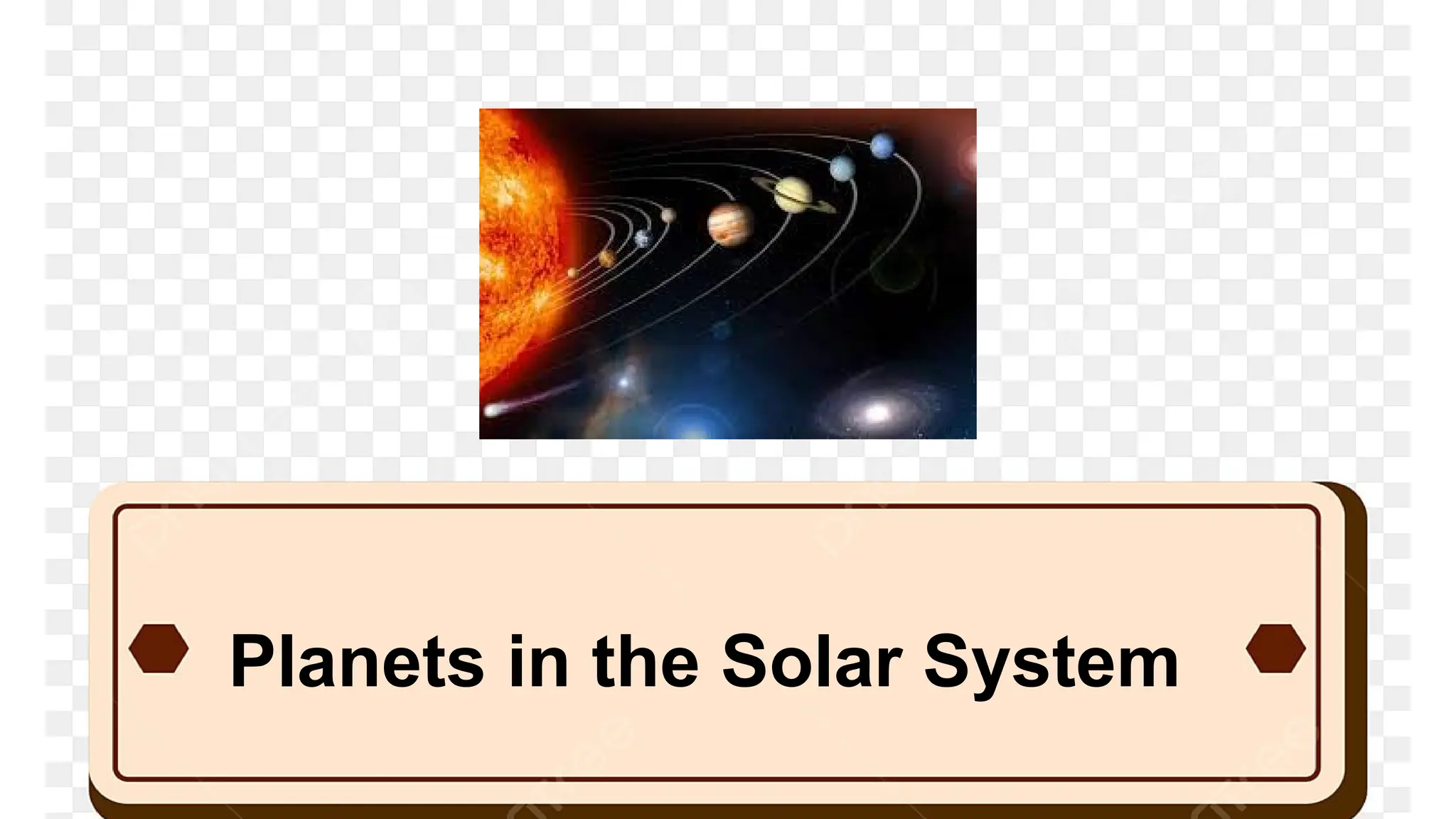
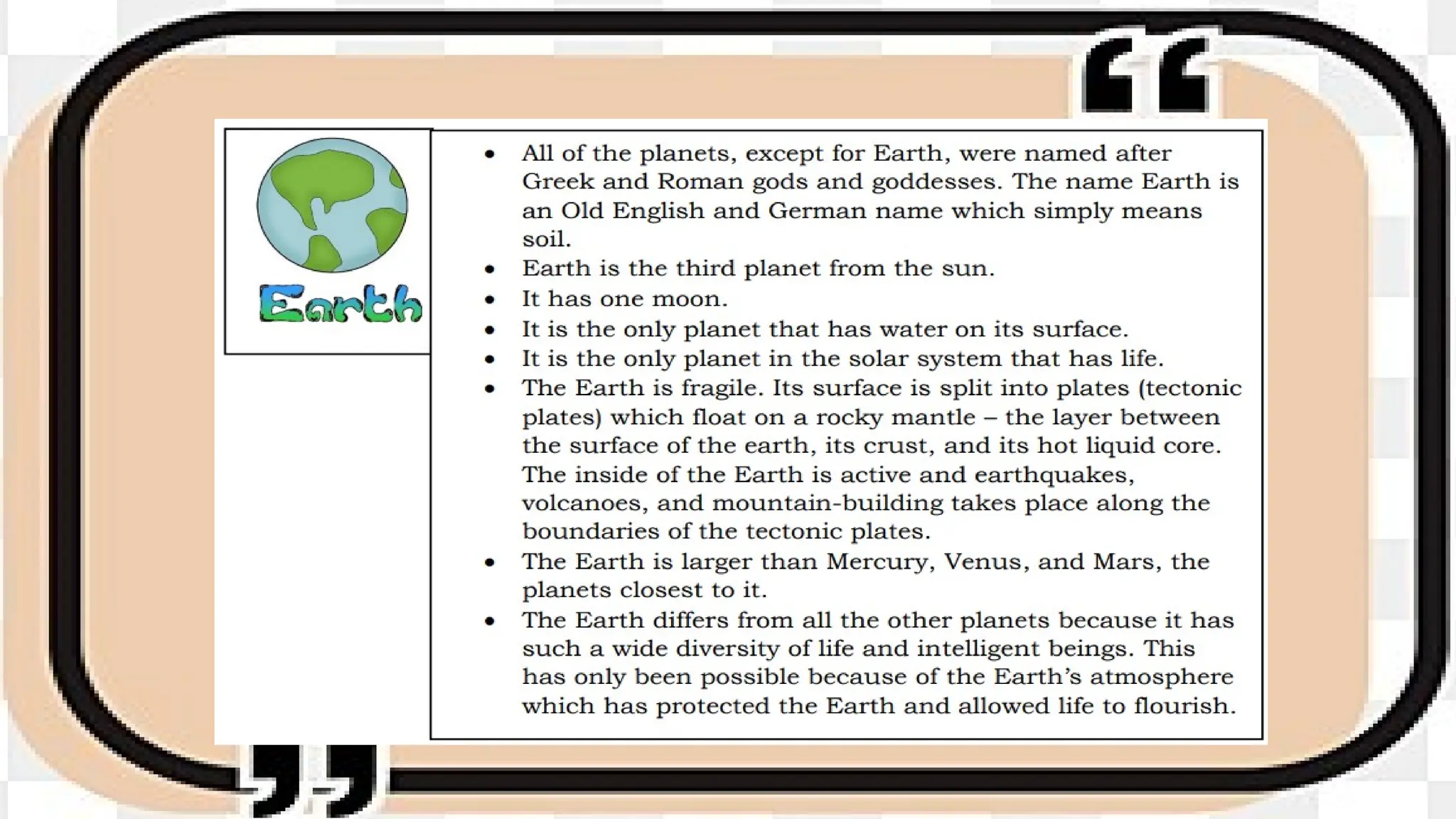
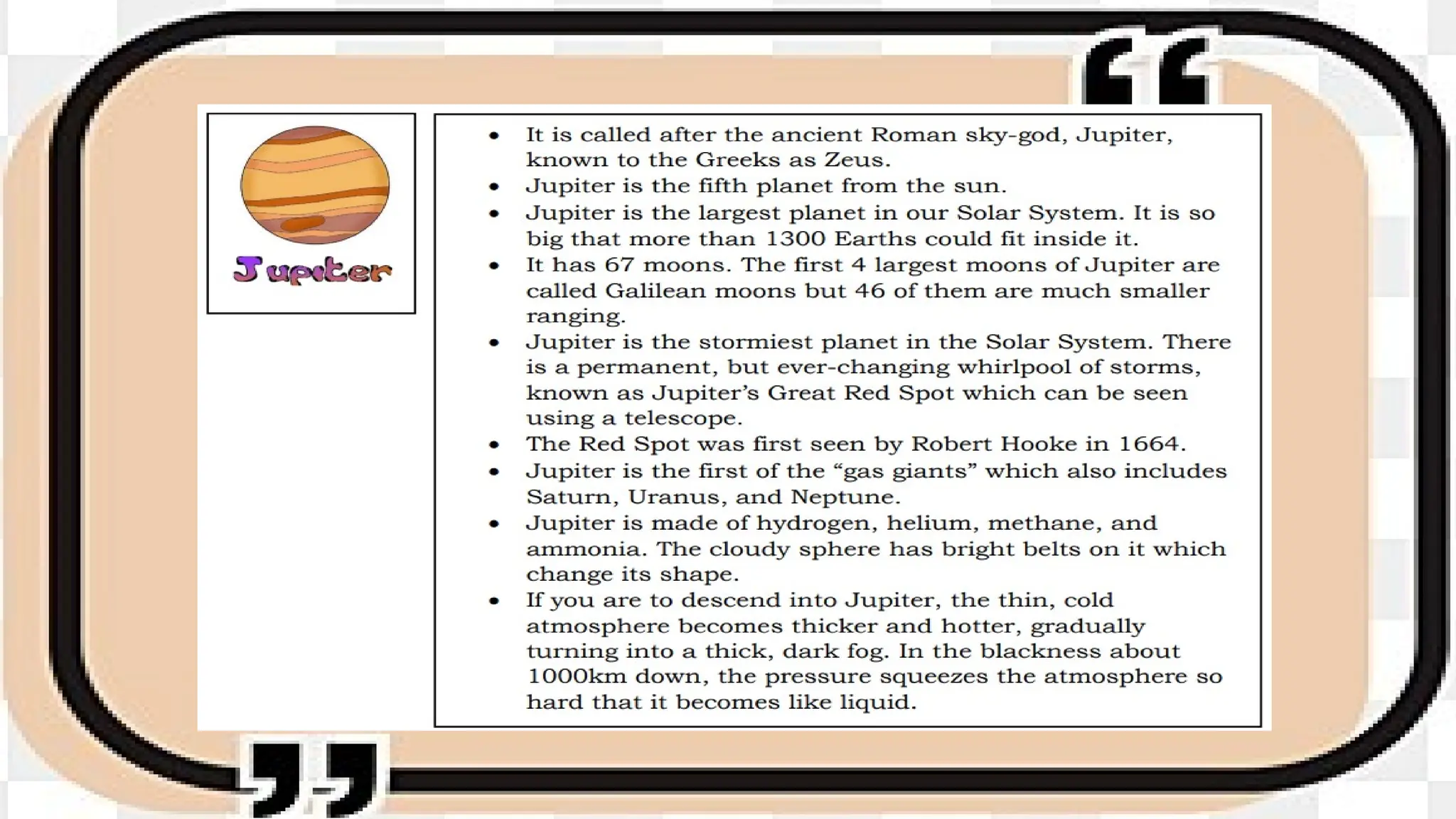
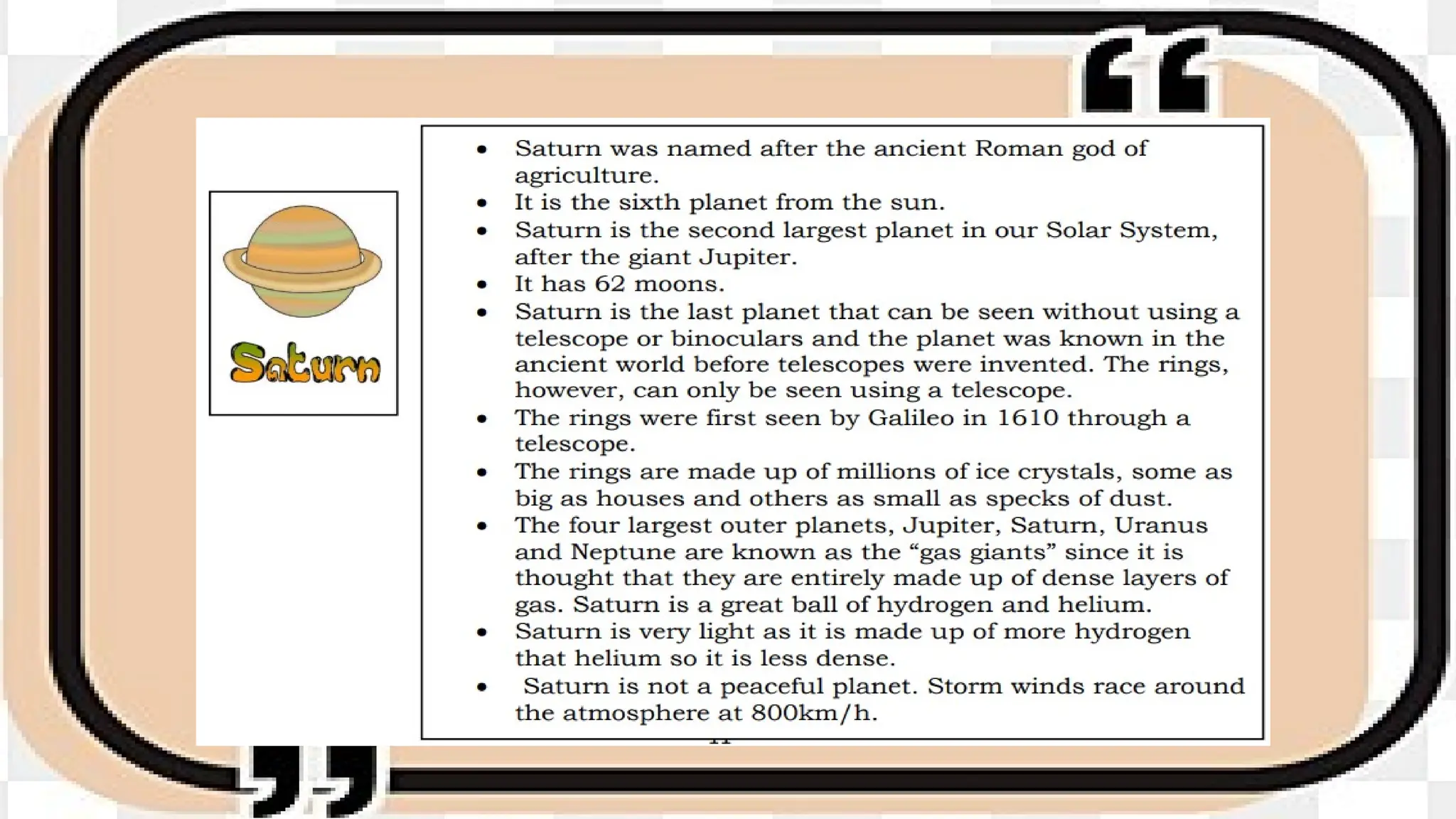
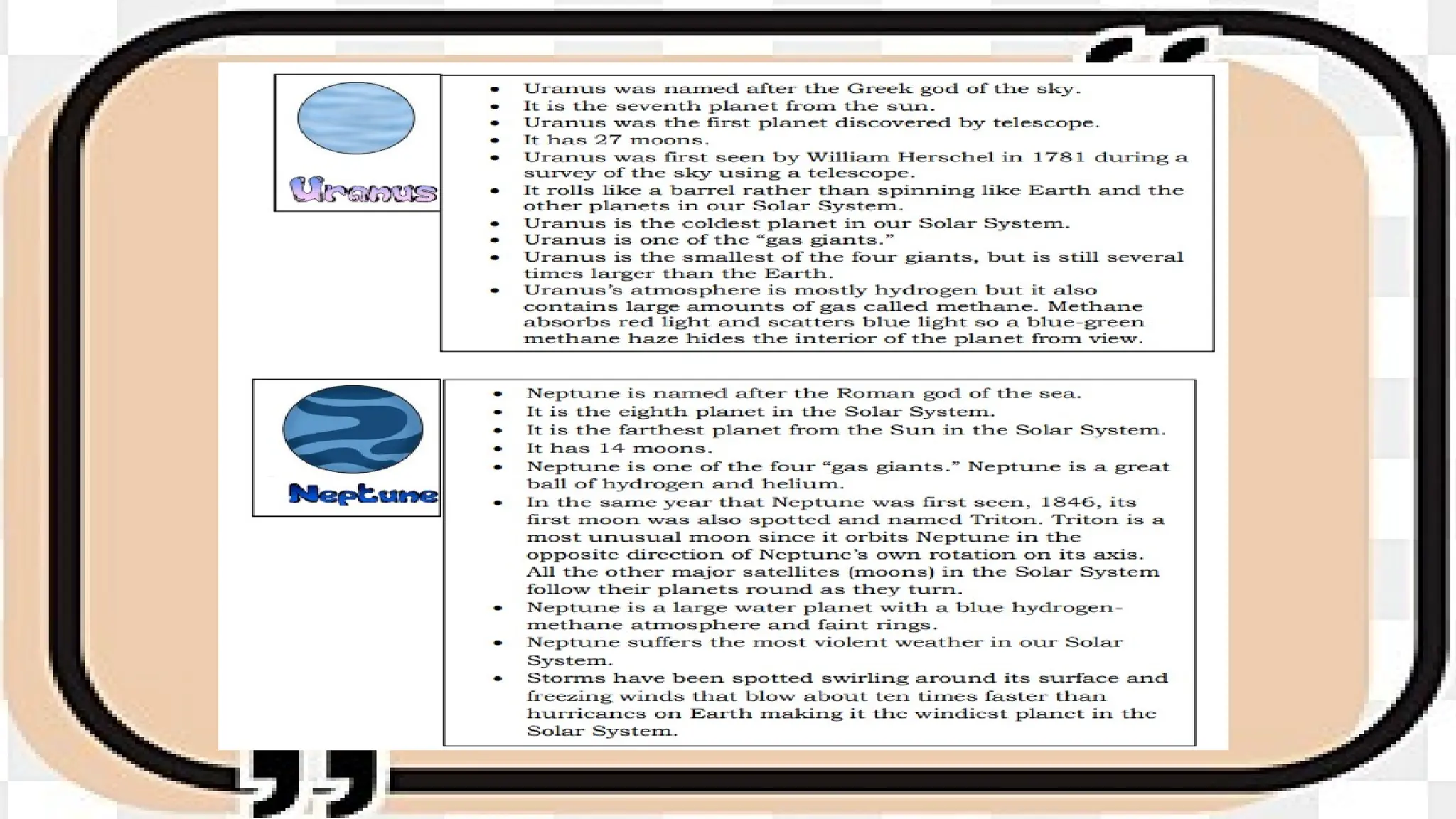
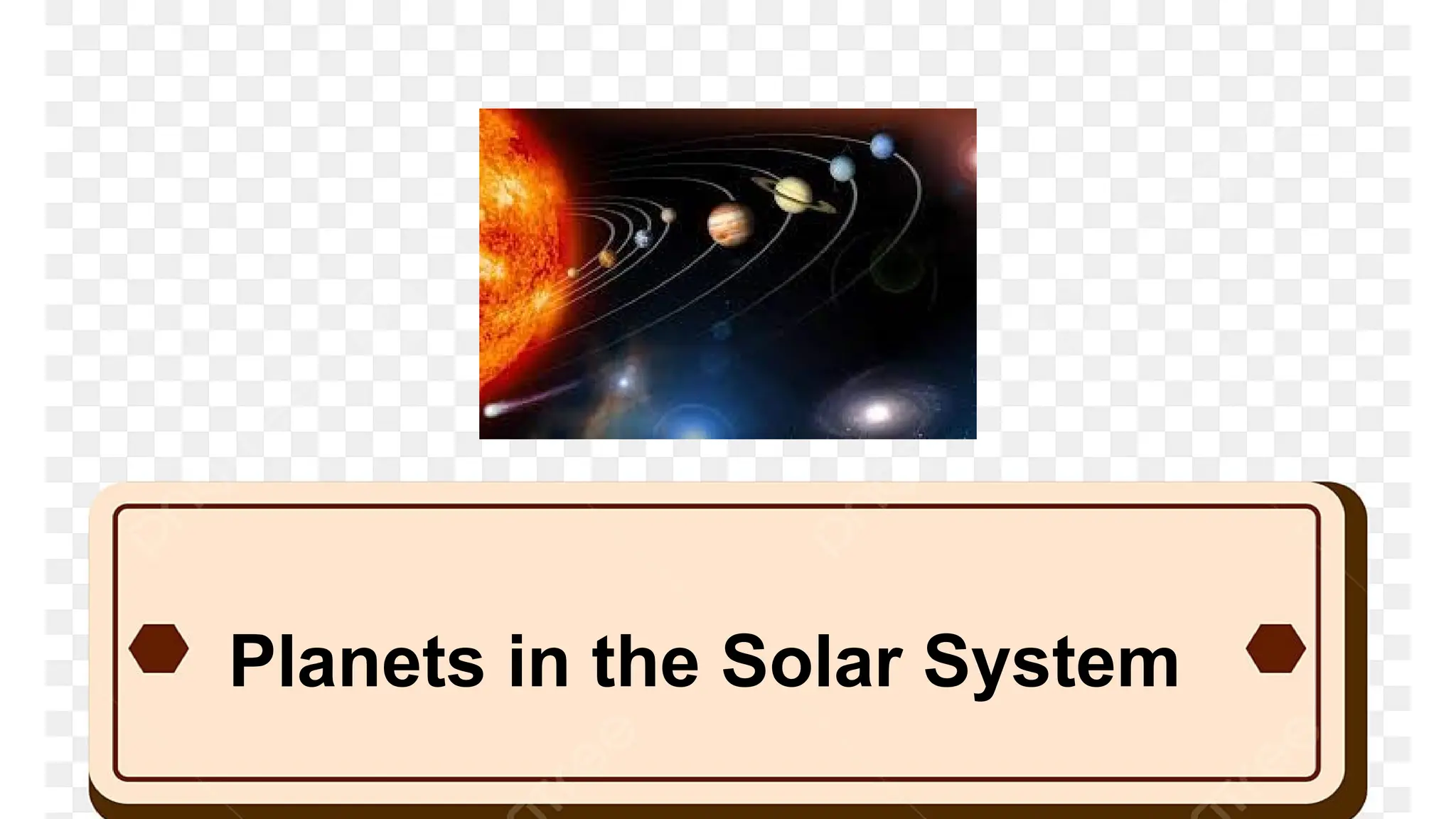
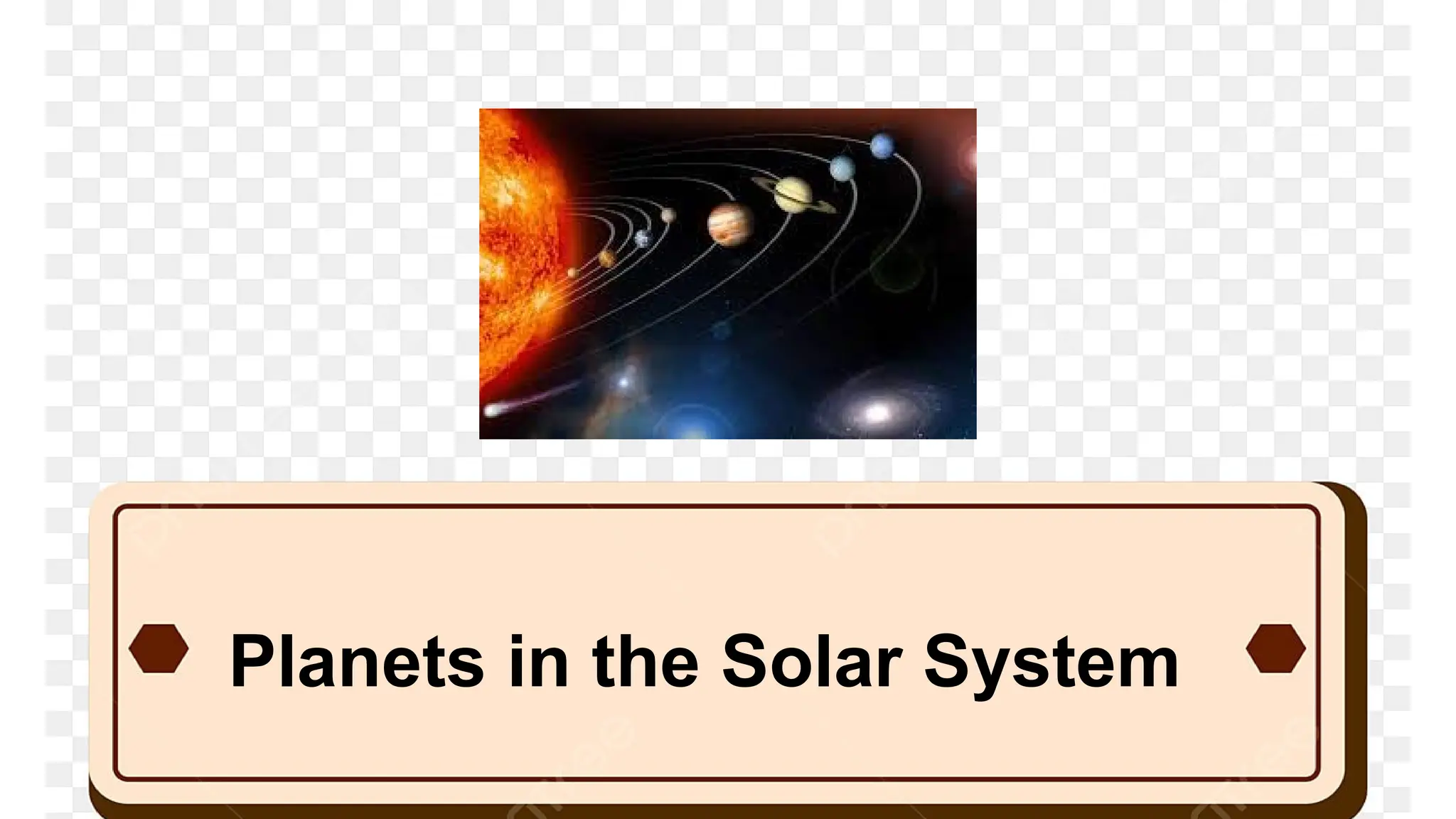
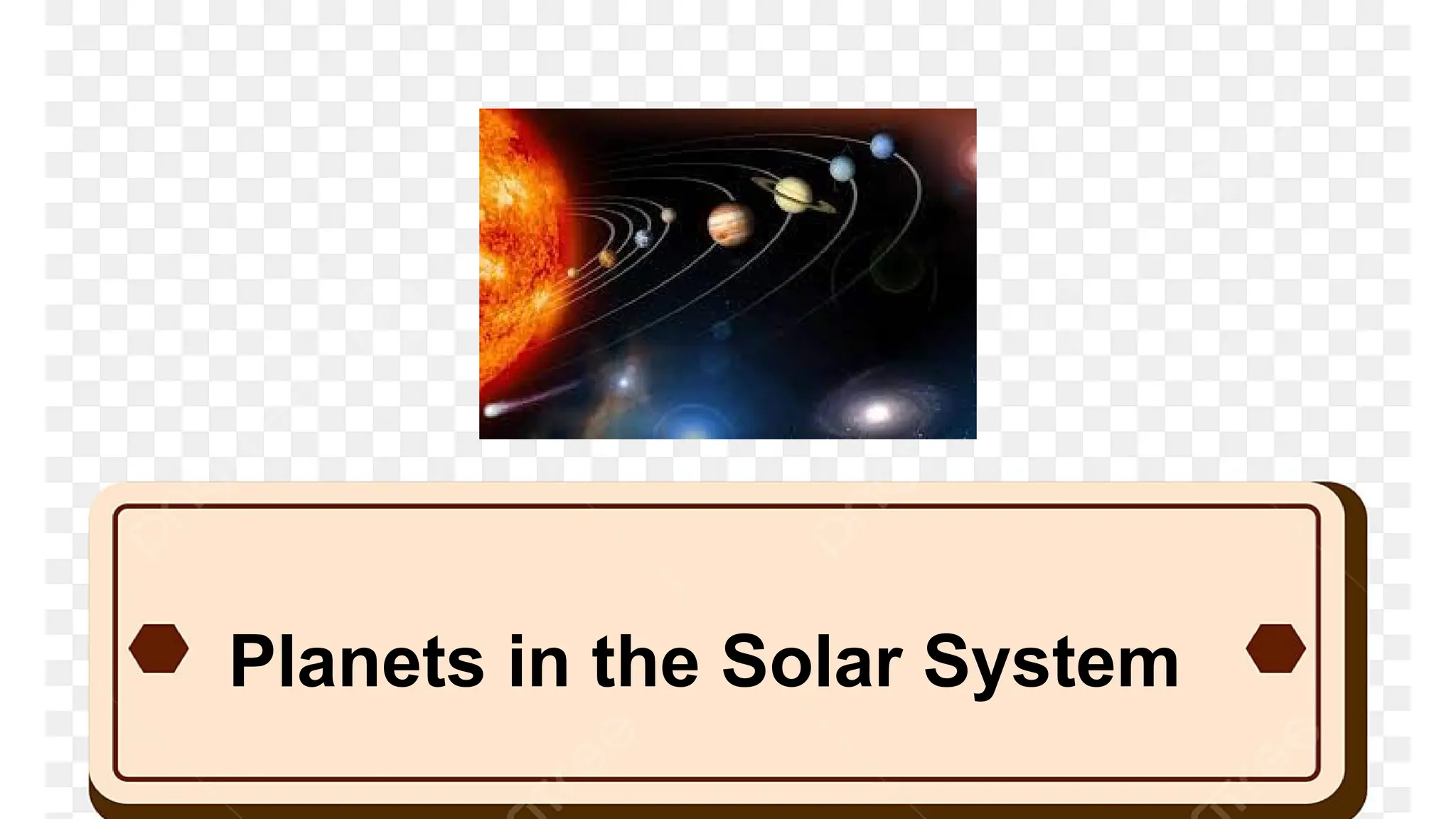
Planets in the Solar System
Day 1
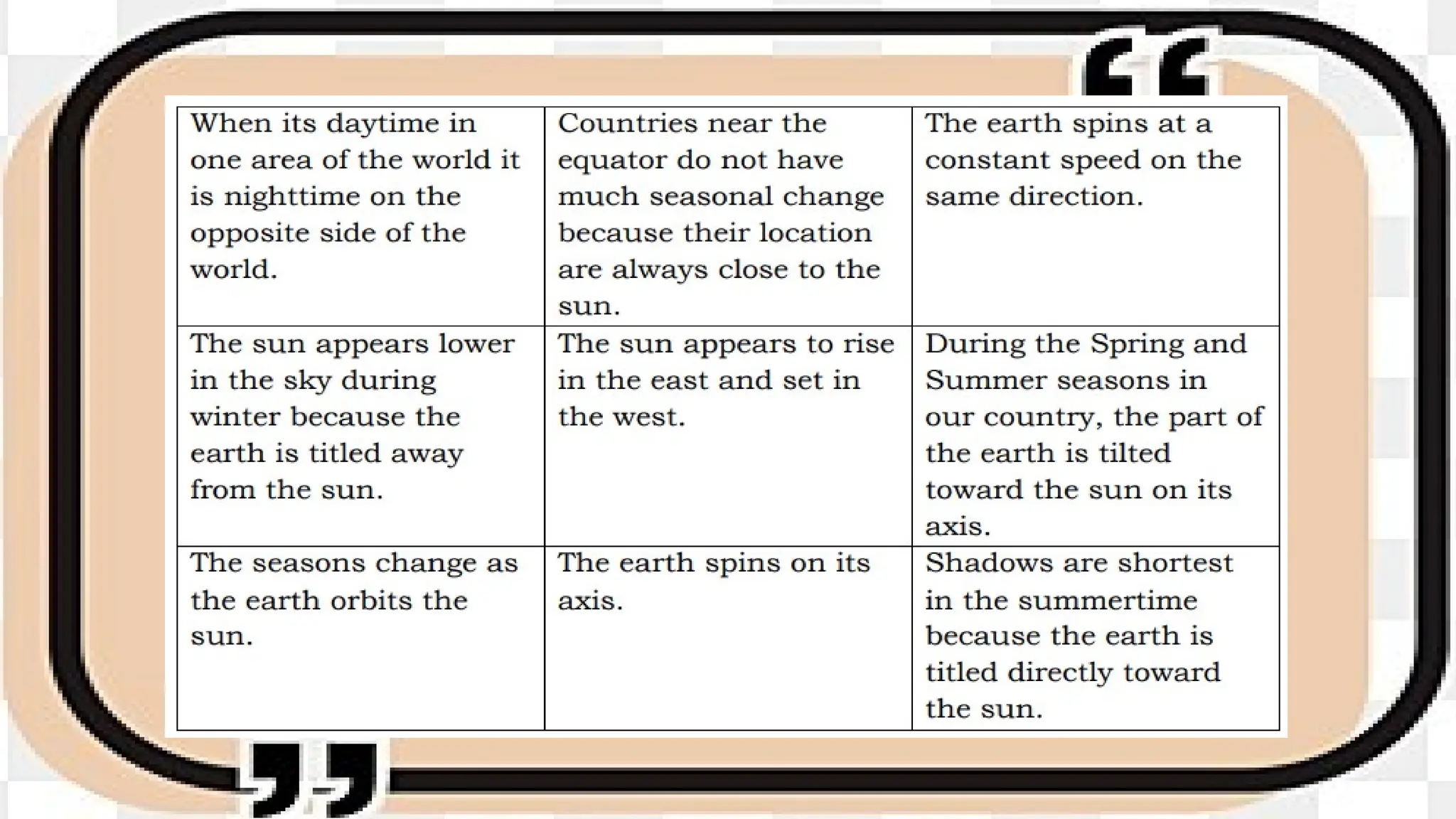
Directions: Decide whether each of
the statements below is describing
revolution or rotation. Color the box
red if the statement describes
revolution, yellow if the statement
describes rotation.
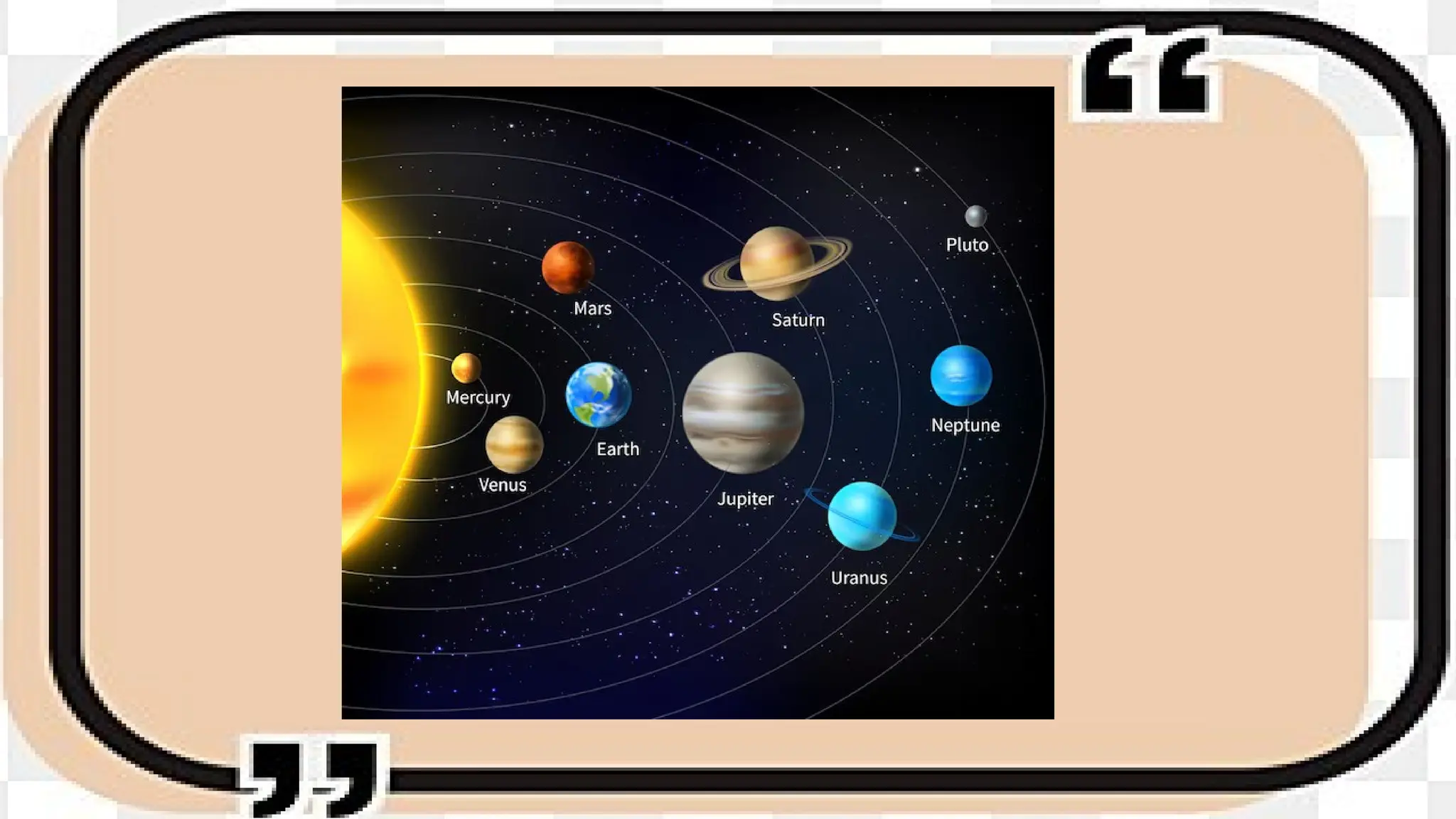
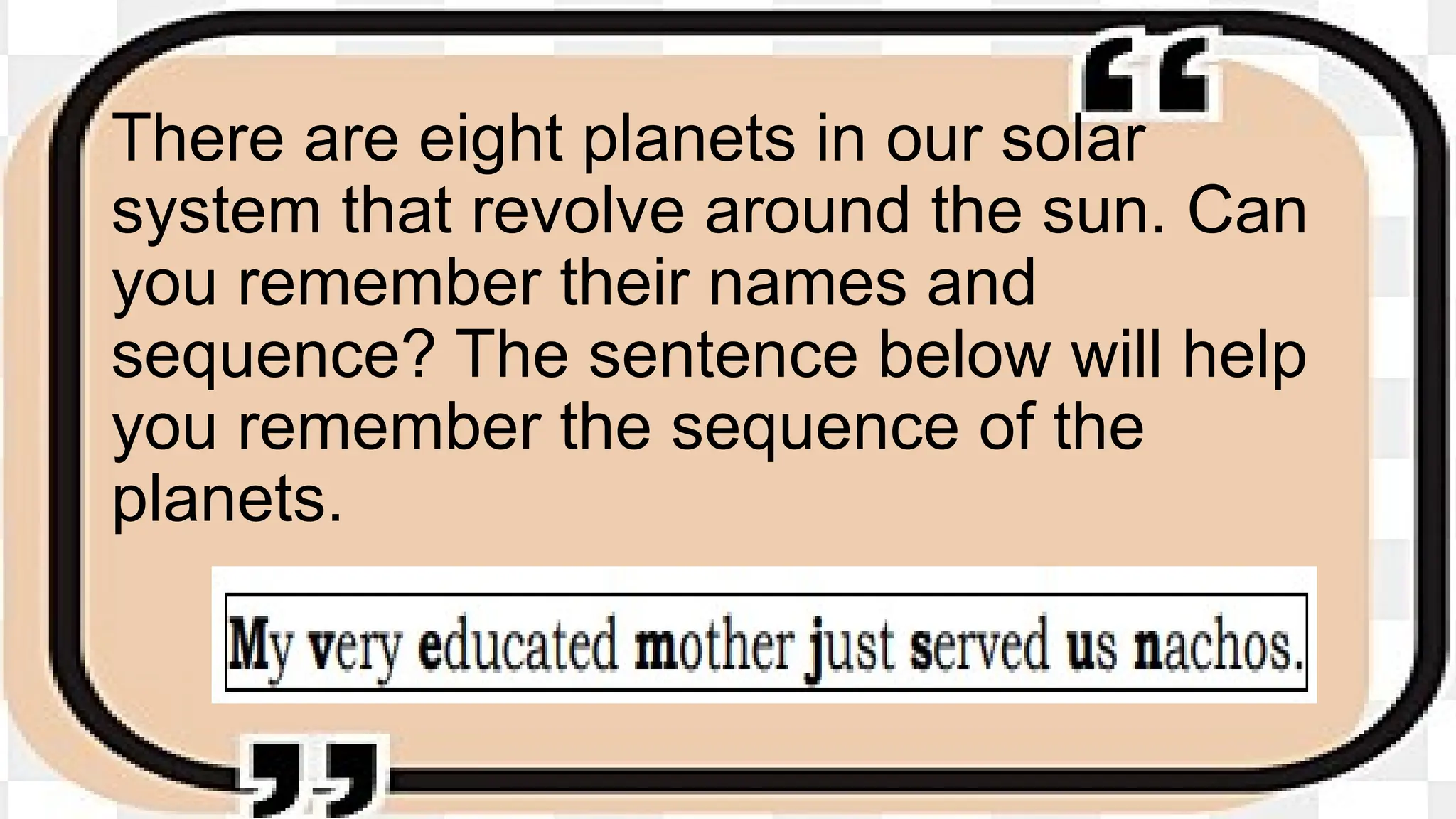
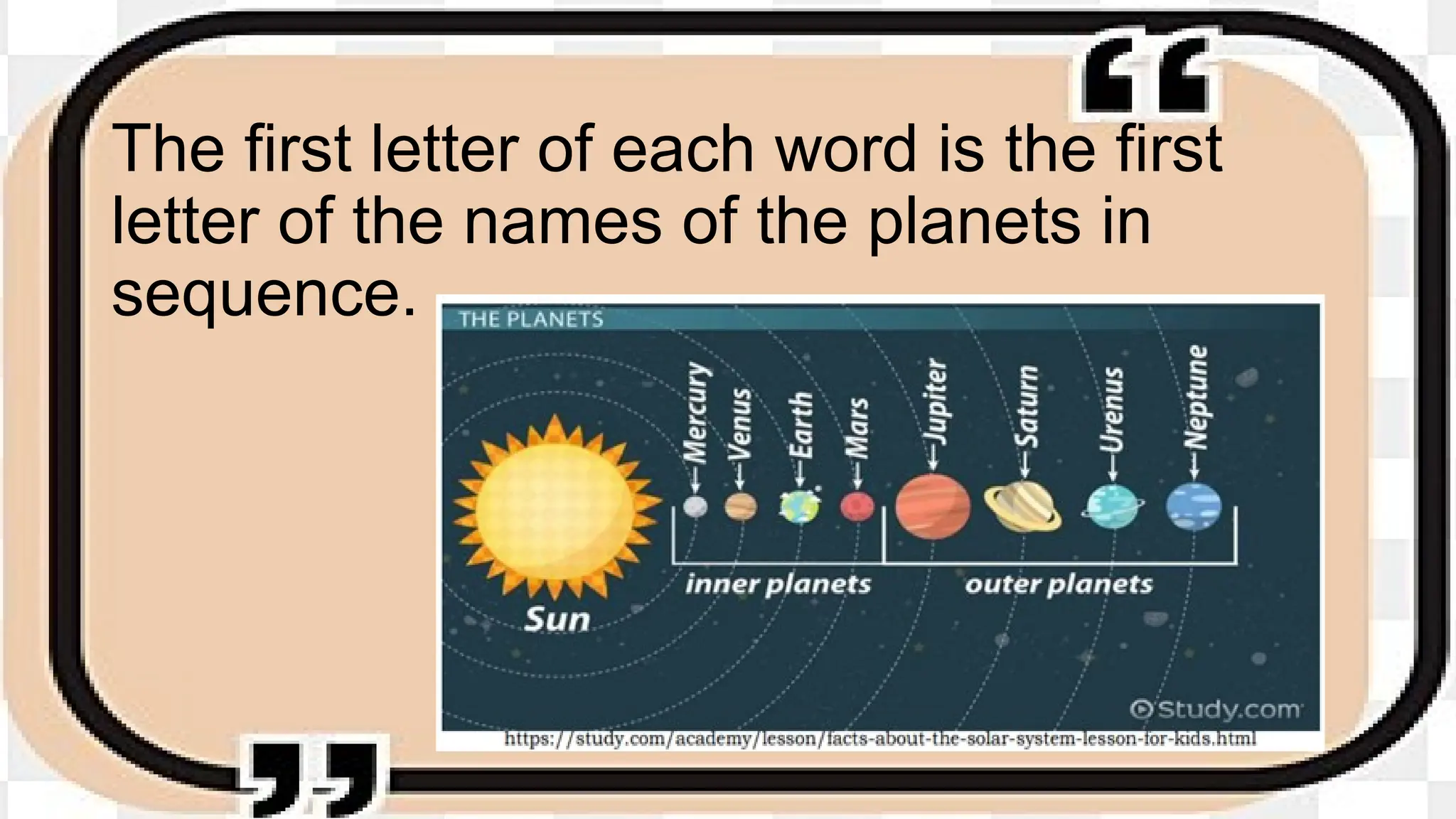
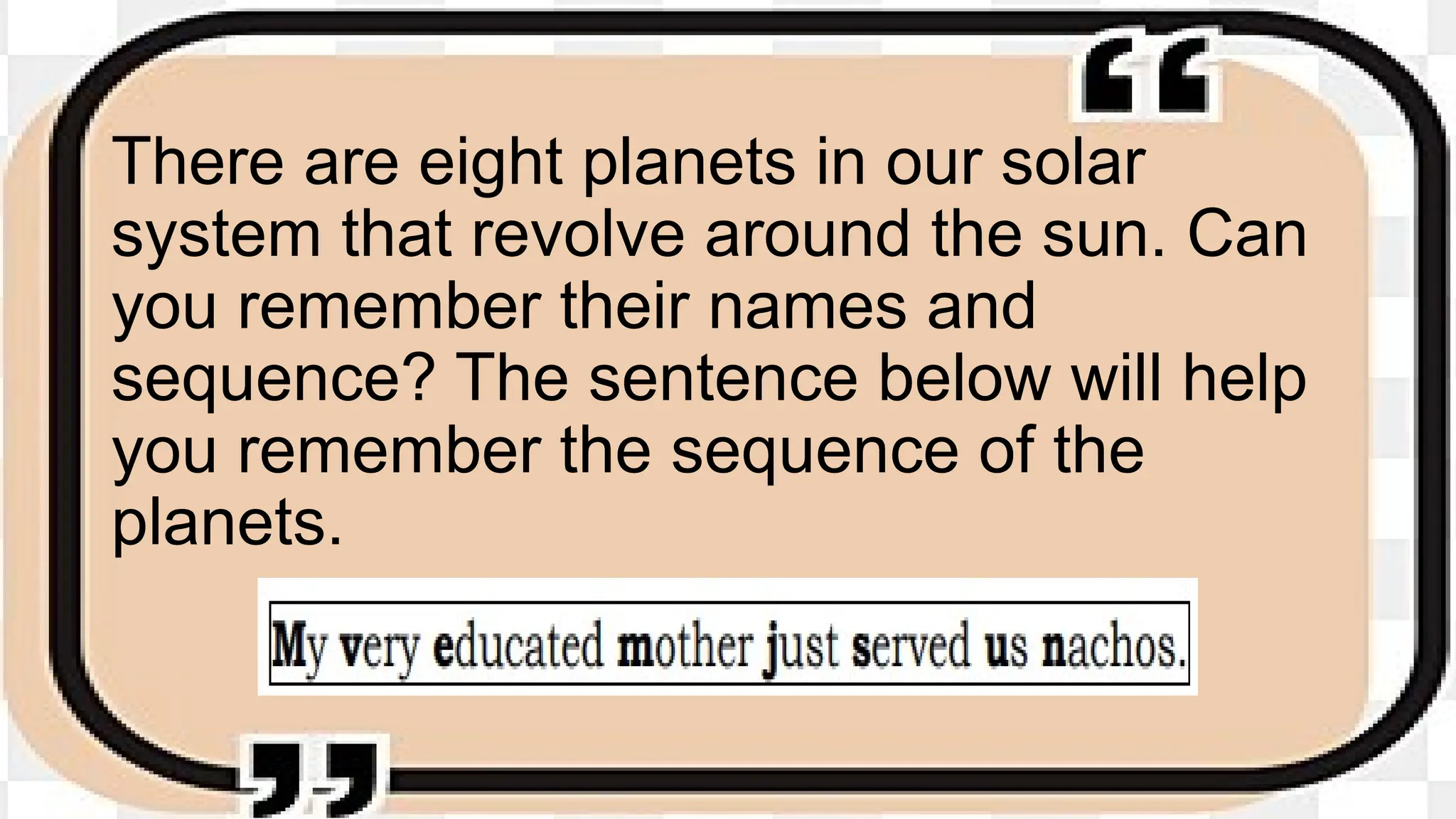
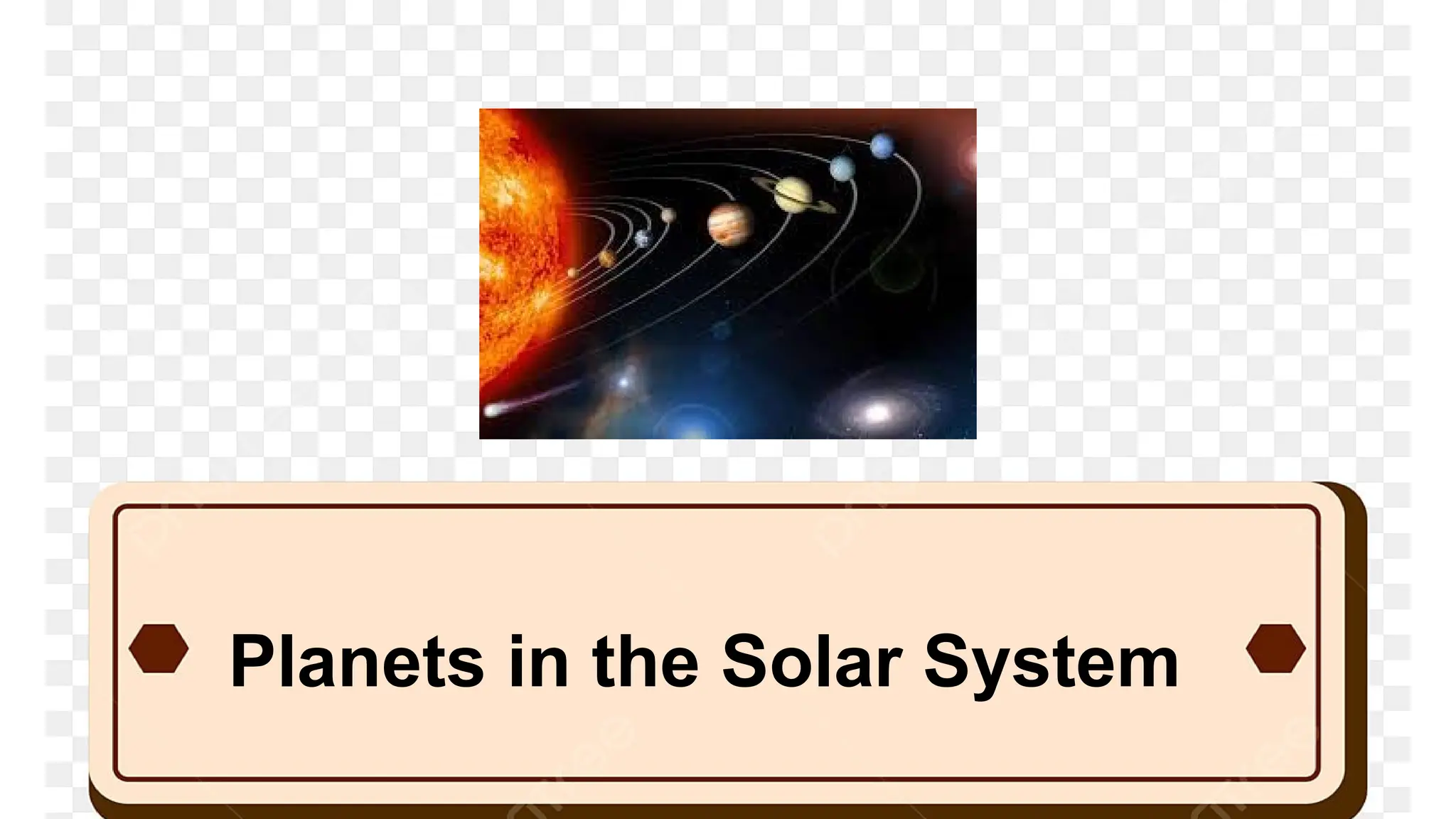
There are eight planets in our solar
system that revolve around the sun. Can
you remember their names and
sequence? The sentence below will help
you remember the sequence of the
planets.
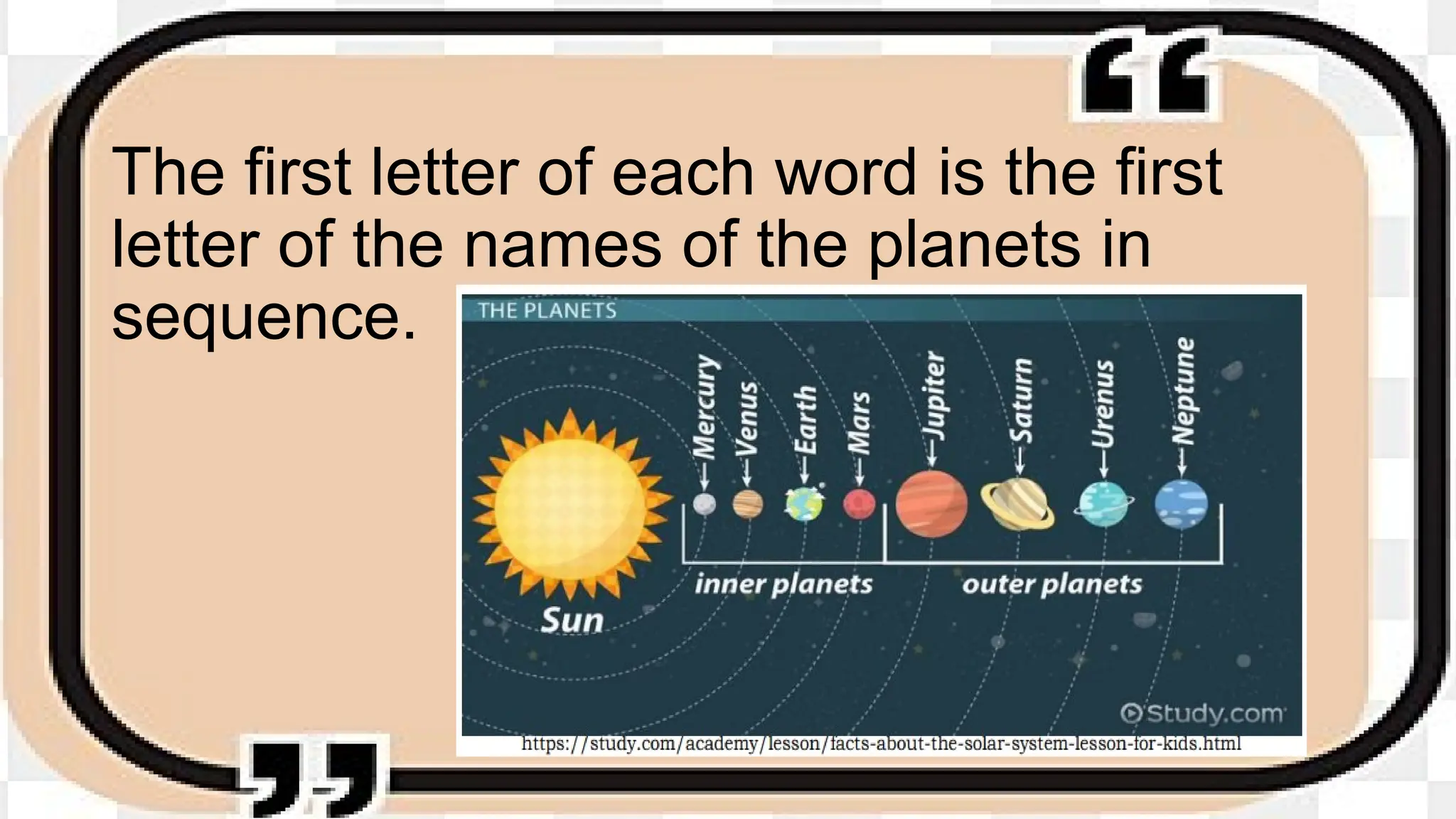
The first letter of each word is the first
letter of the names of the planets in
sequence.
The planets can be divided into
two groups, namely: the inner planets and
the outer planets. Generally, the inner
planets are smaller and are composed of
rocks. They have few or no natural
satellites or rings circling them. The outer
planets, on the contrary, often have dozens
of natural satellites and rings. They are
composed mostly of gases. Planets do not
produce their own light and heat.
They shine because they reflect the
sunlight that falls on them. They moved
around the sun in an elliptical pathway
called an orbit. As they revolve around
the sun, they also spin and rotate. Each
planet has an orbit of different length
around the sun. The further the planet
from the sun, the longer its orbit.
Optional Activity: Watch the video for
additional information. Link:
https://www.youtube.com/watch?v=IDhap
t7nw4A
Directions: Choose the letter of the
correct answer. Write your answer on a
separate sheet of paper.
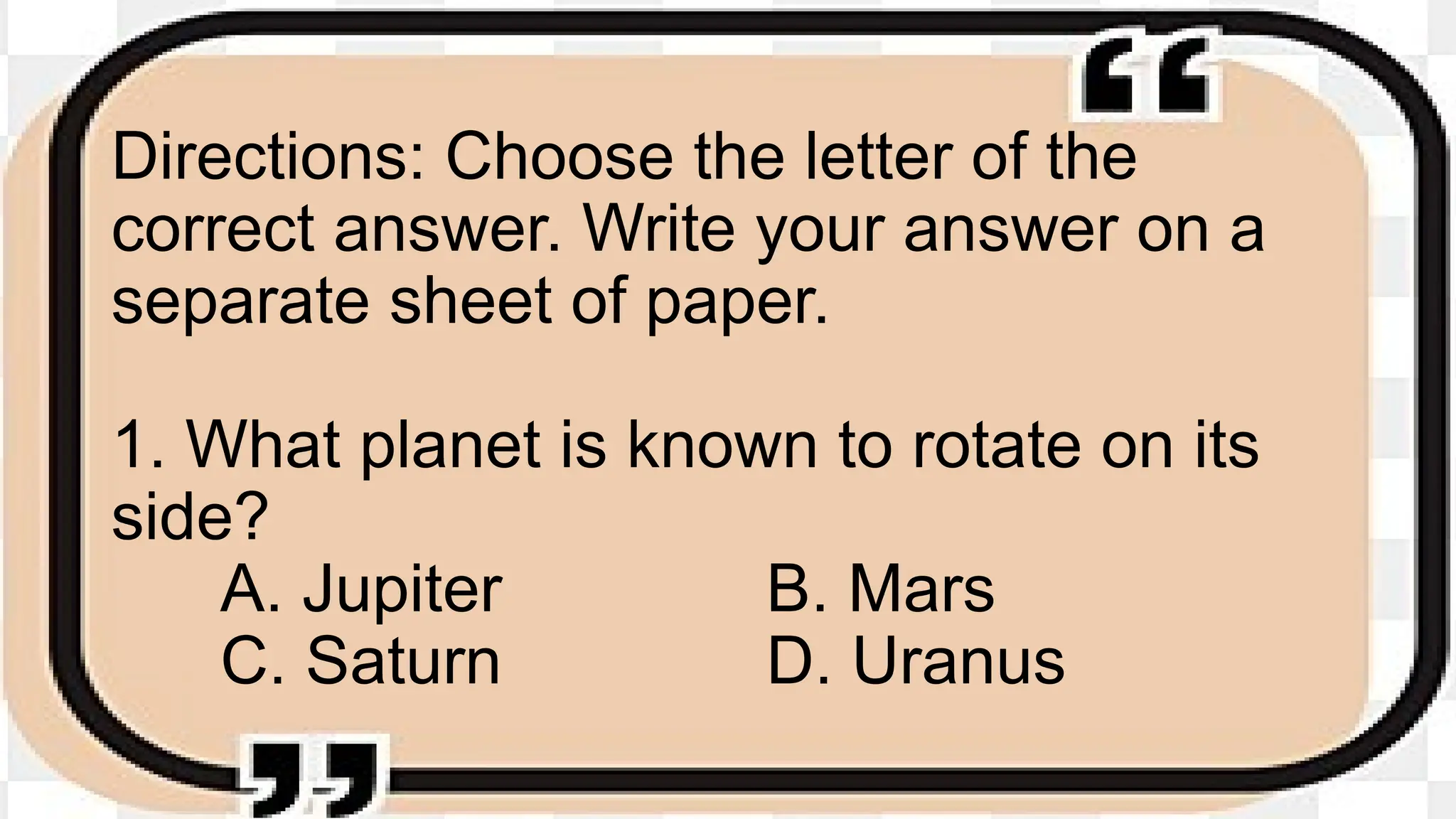
1. What planet is known to rotate on its
side?
A. Jupiter B. Mars
C. Saturn D. Uranus
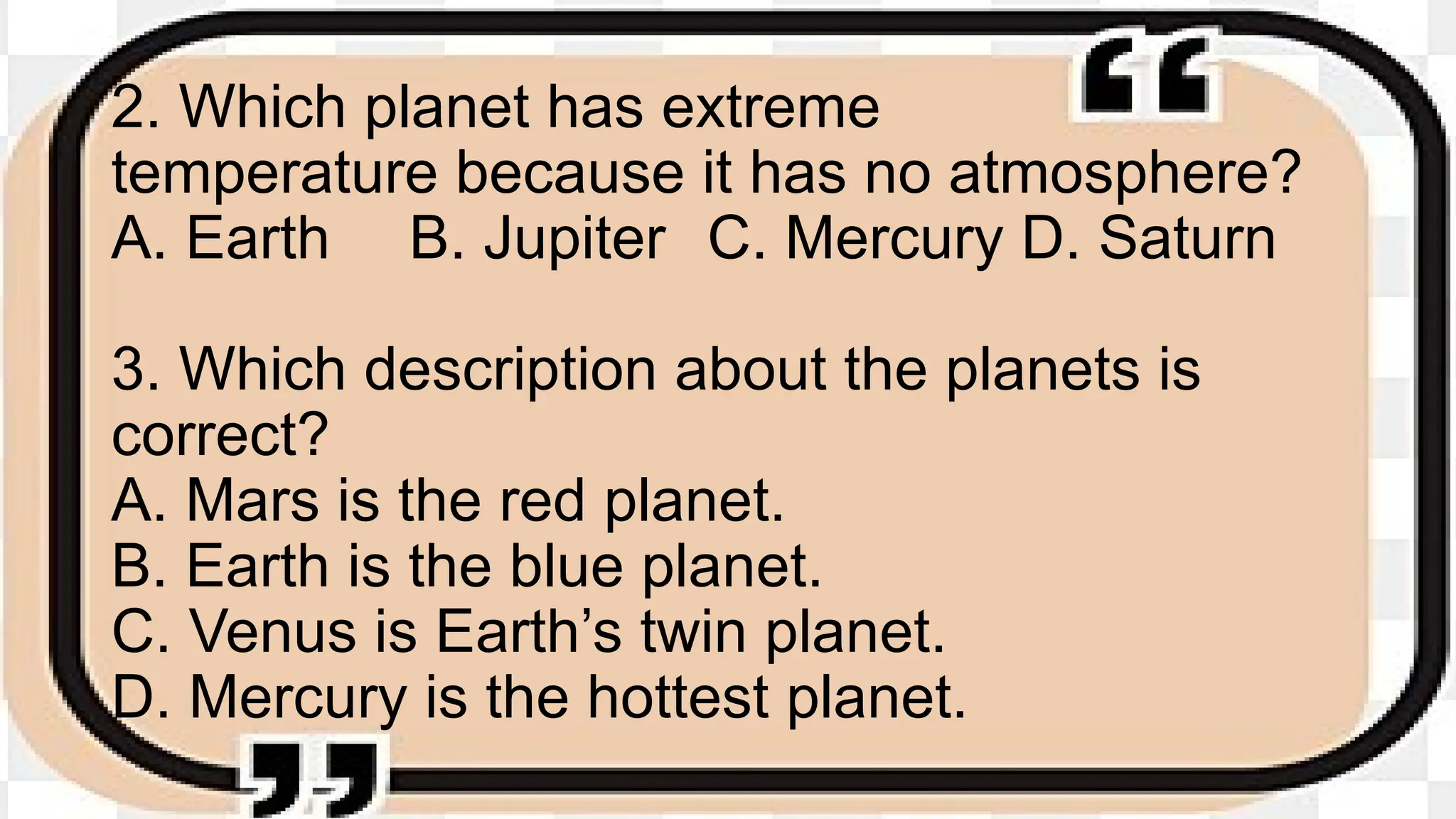
2. Which planet has extreme
temperature because it has no atmosphere?
A. Earth B. Jupiter C. Mercury D. Saturn
3. Which description about the planets is
correct?
A. Mars is the red planet.
B. Earth is the blue planet.
C. Venus is Earth’s twin planet.
D. Mercury is the hottest planet.
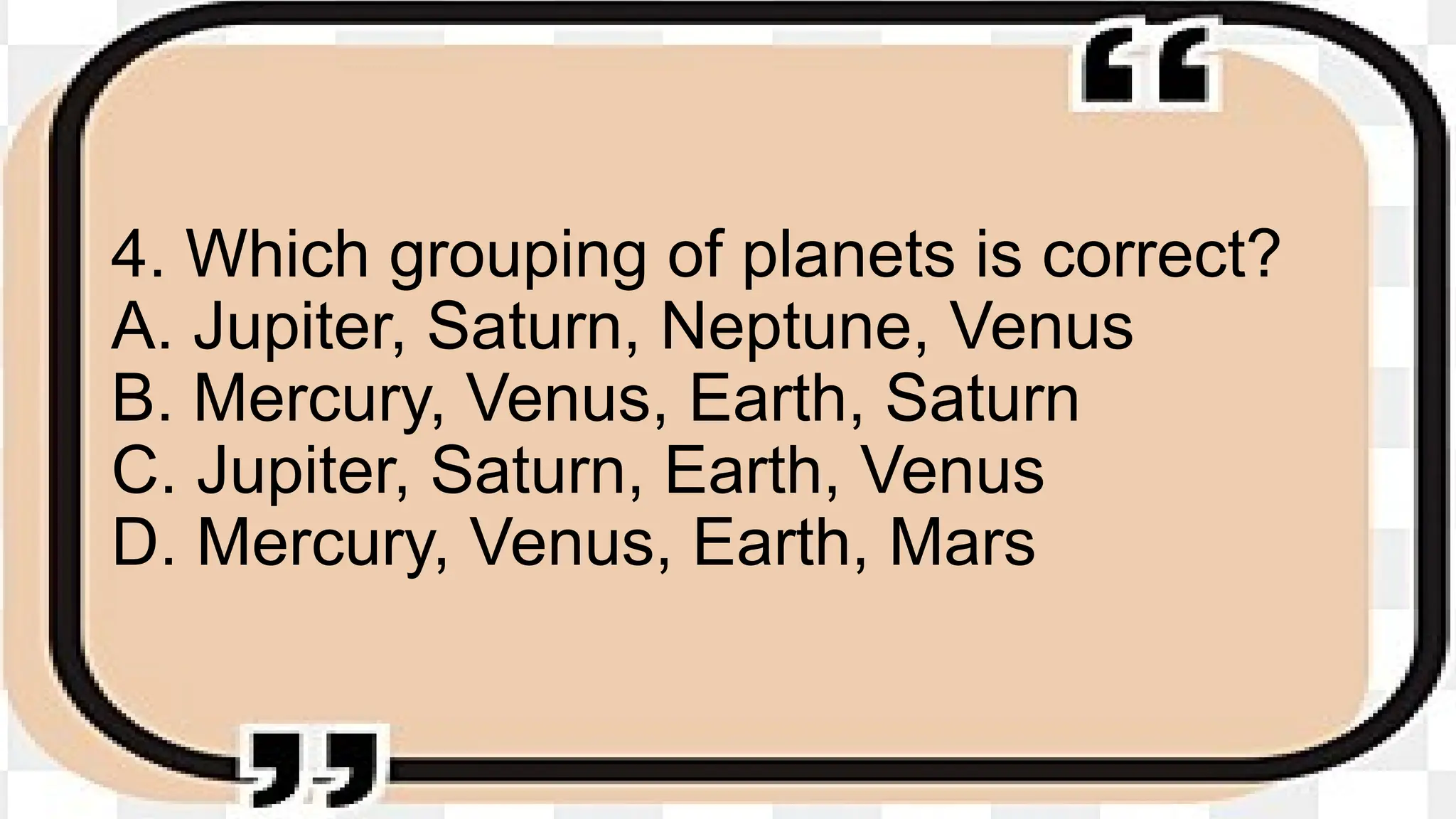
4. Which grouping of planets is correct?
A. Jupiter, Saturn, Neptune, Venus
B. Mercury, Venus, Earth, Saturn
C. Jupiter, Saturn, Earth, Venus
D. Mercury, Venus, Earth, Mars
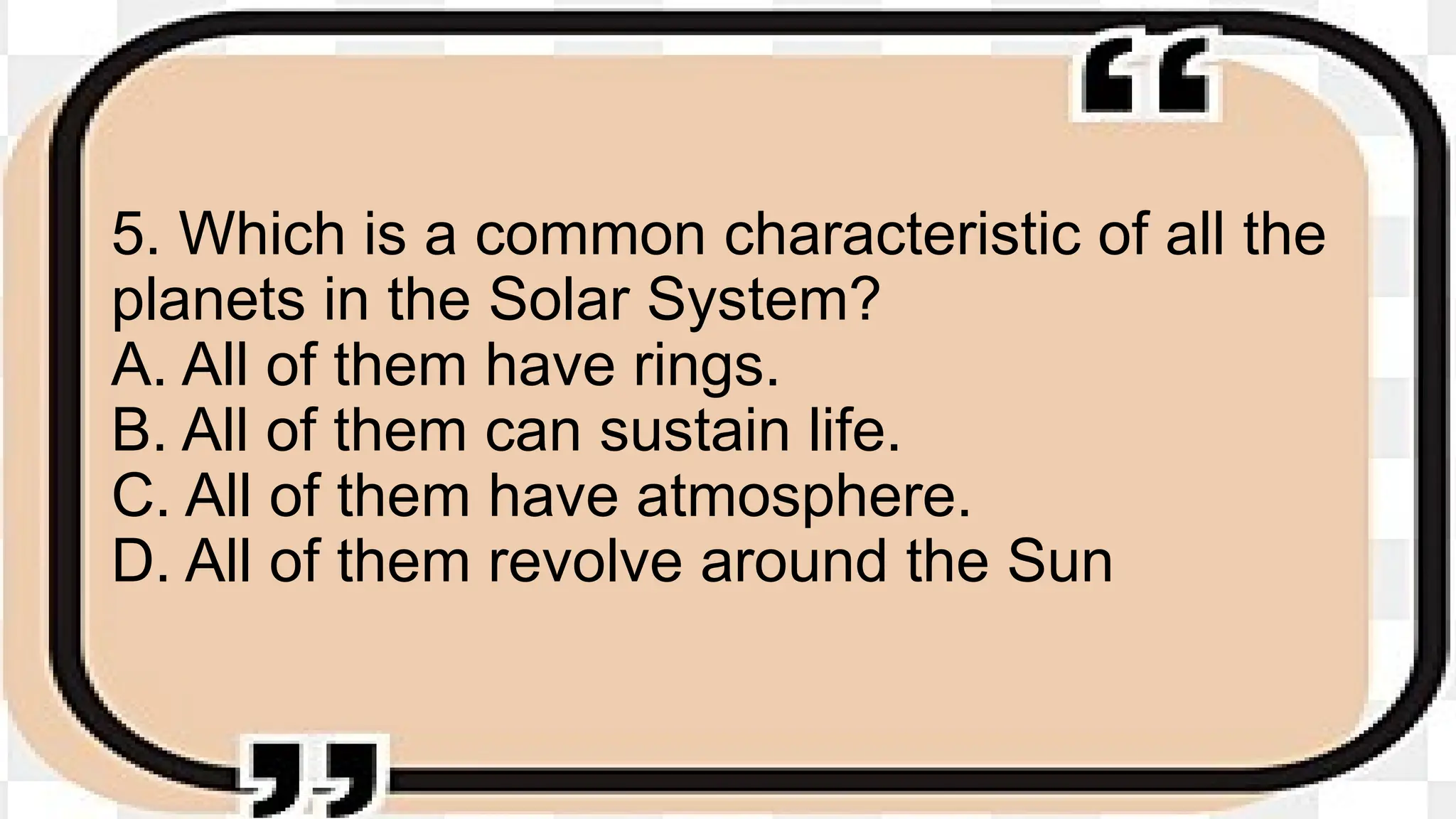
5. Which is a common characteristic of all the
planets in the Solar System?
A. All of them have rings.
B. All of them can sustain life.
C. All of them have atmosphere.
D. All of them revolve around the Sun
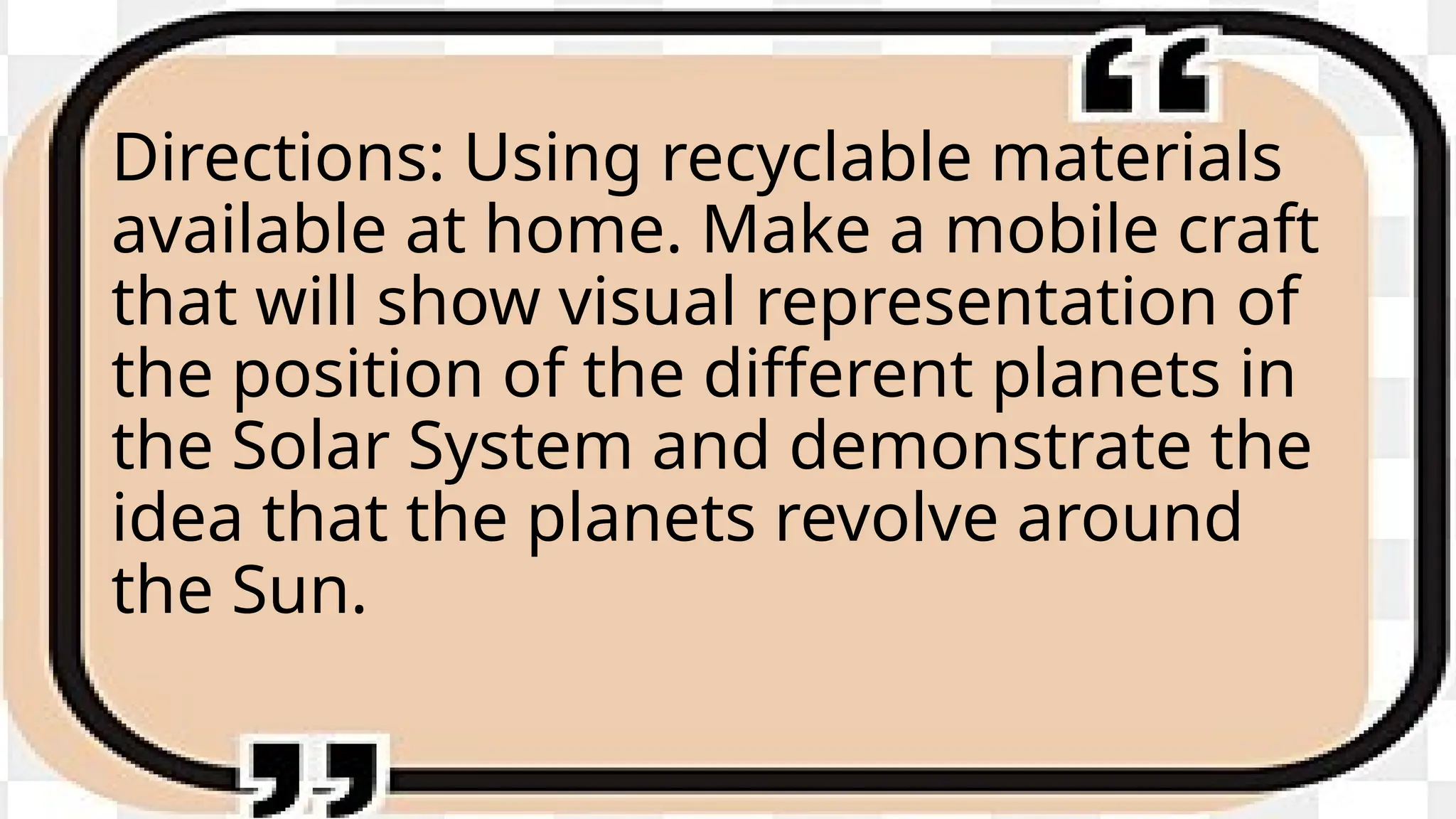
Directions: Using recyclable materials
available at home. Make a mobile craft
that will show visual representation of
the position of the different planets in
the Solar System and demonstrate the
idea that the planets revolve around
the Sun.
Based on the insights gained in
the lesson, how is understanding
the Solar System and learning
about space benefits Earth?
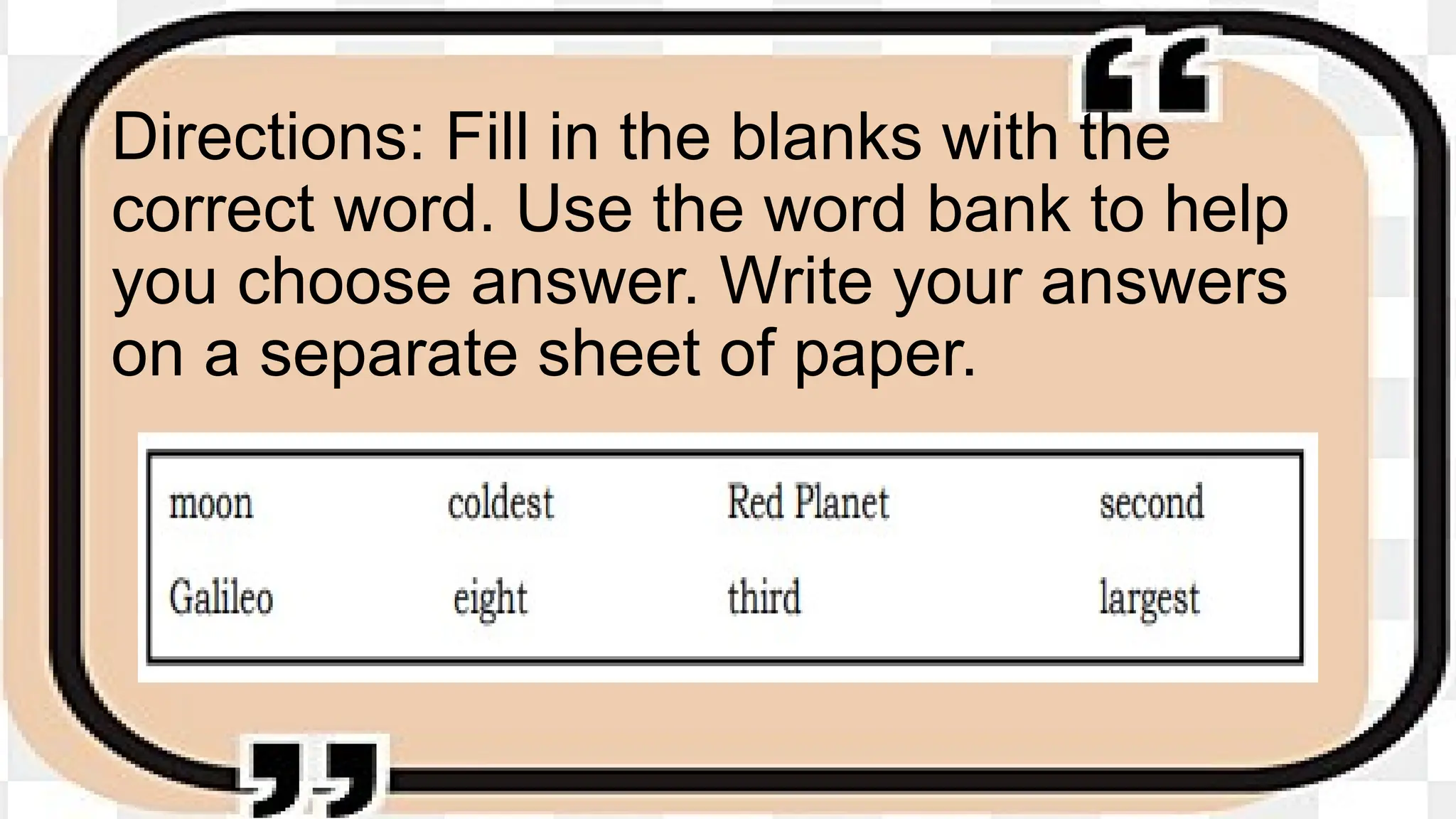
Directions: Fill in the blanks with the
correct word. Use the word bank to help
you choose answer. Write your answers
on a separate sheet of paper.
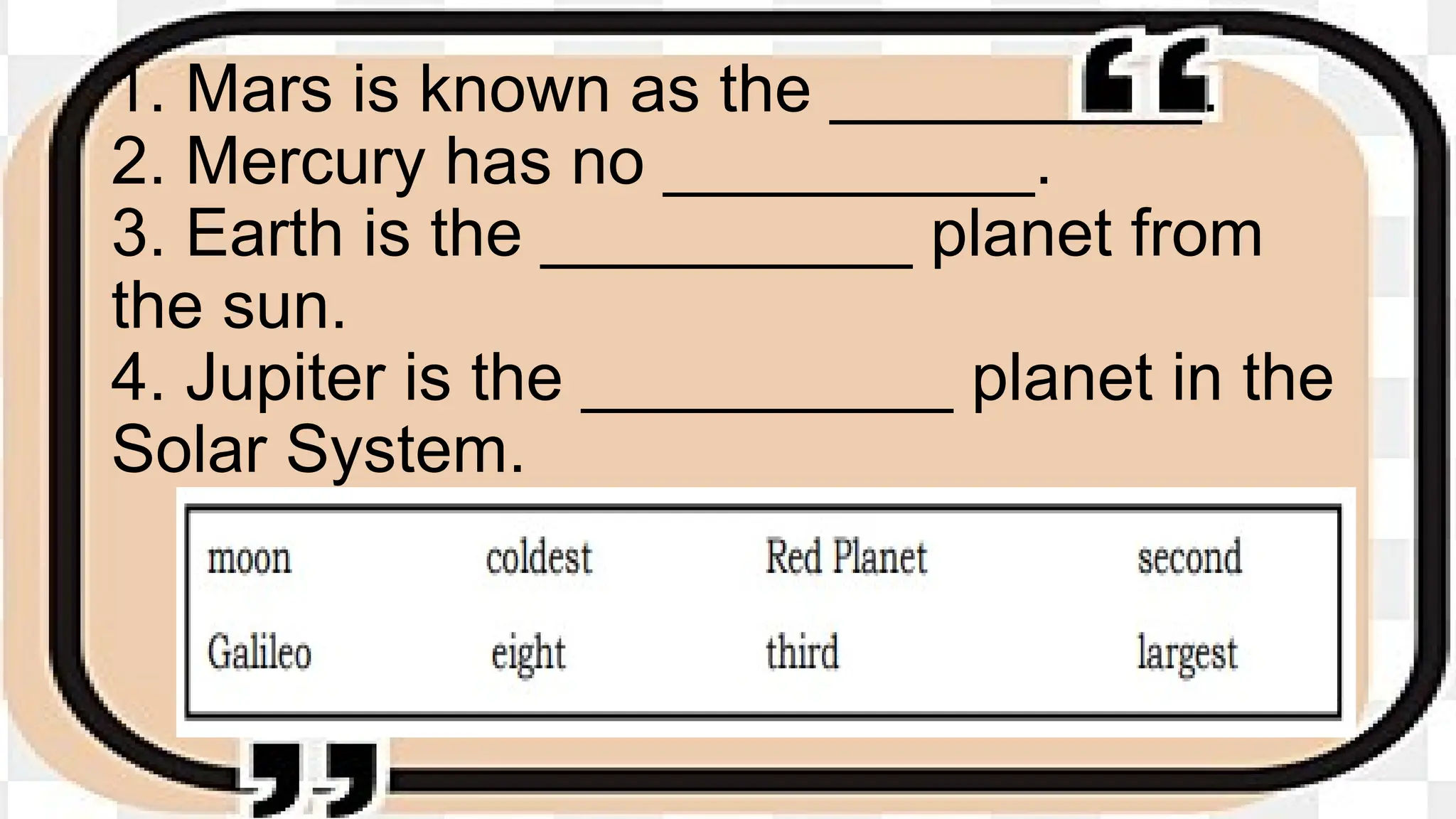
1. Mars is known as the __________.
2. Mercury has no __________.
3. Earth is the __________ planet from
the sun.
4. Jupiter is the __________ planet in the
Solar System.
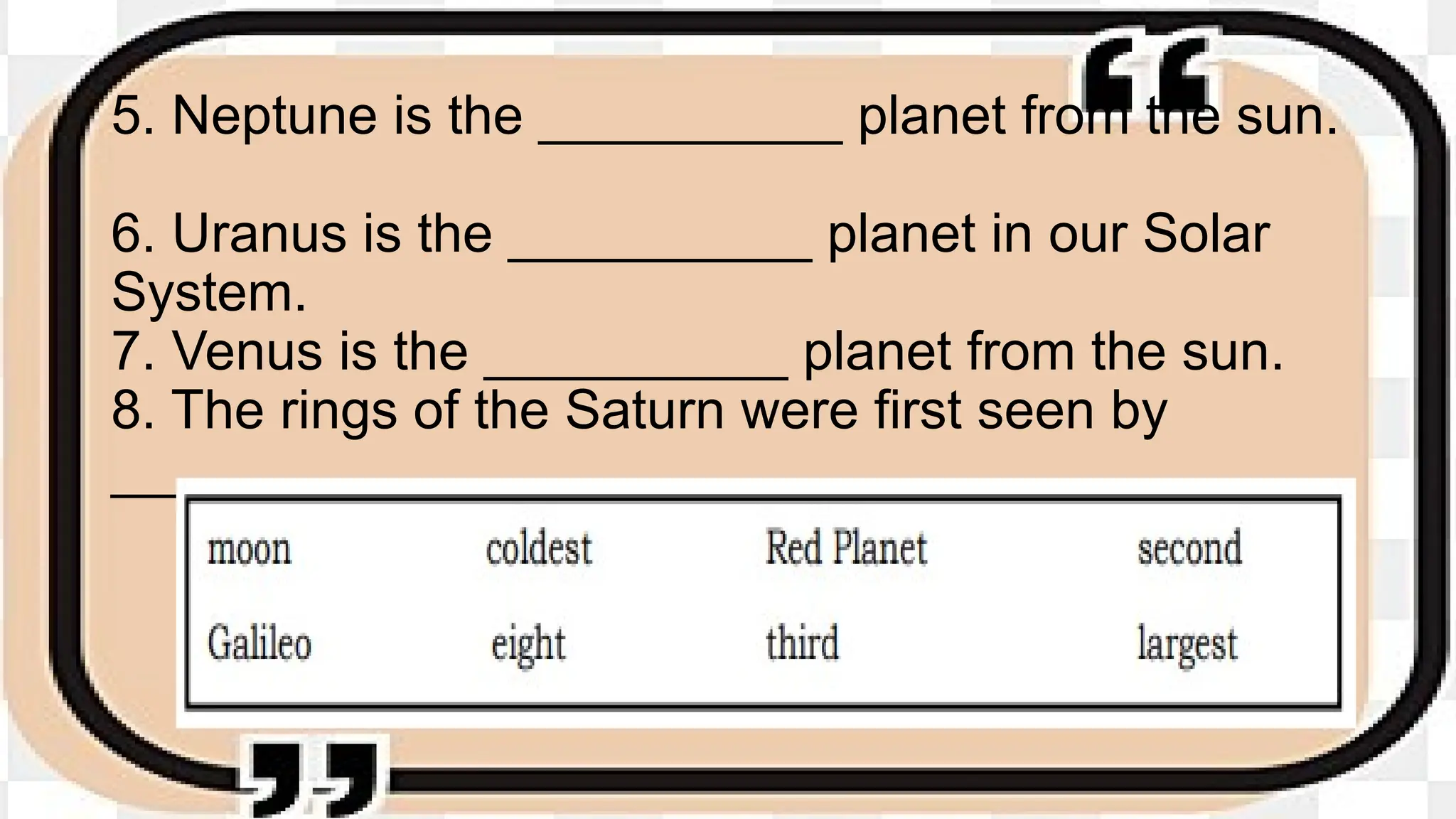
5. Neptune is the __________ planet from the sun.
6. Uranus is the __________ planet in our Solar
System.
7. Venus is the __________ planet from the sun.
8. The rings of the Saturn were first seen by
__________.
Day 2
Planets in the Solar System
Draw the 8 planets
according to their size.
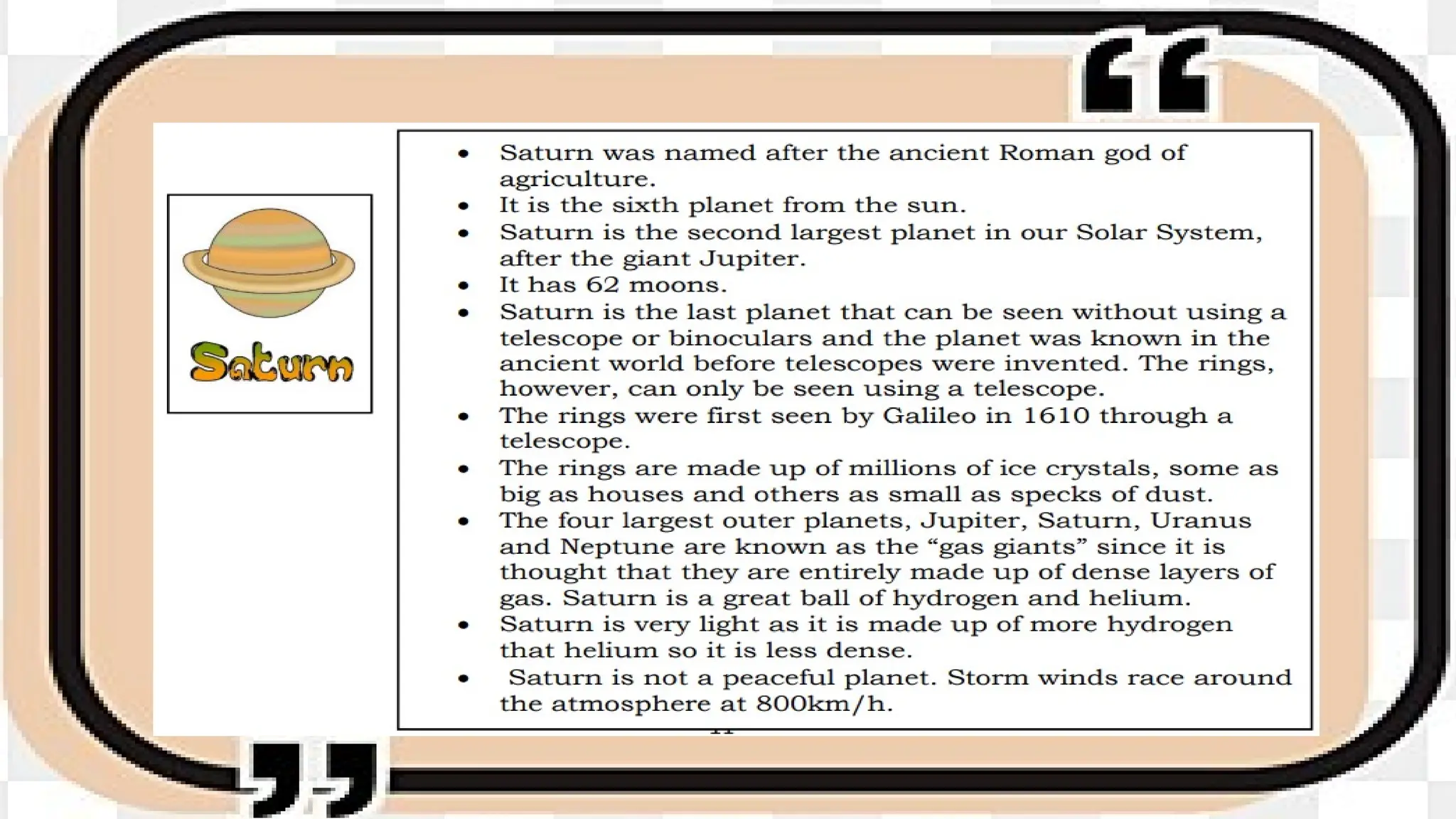
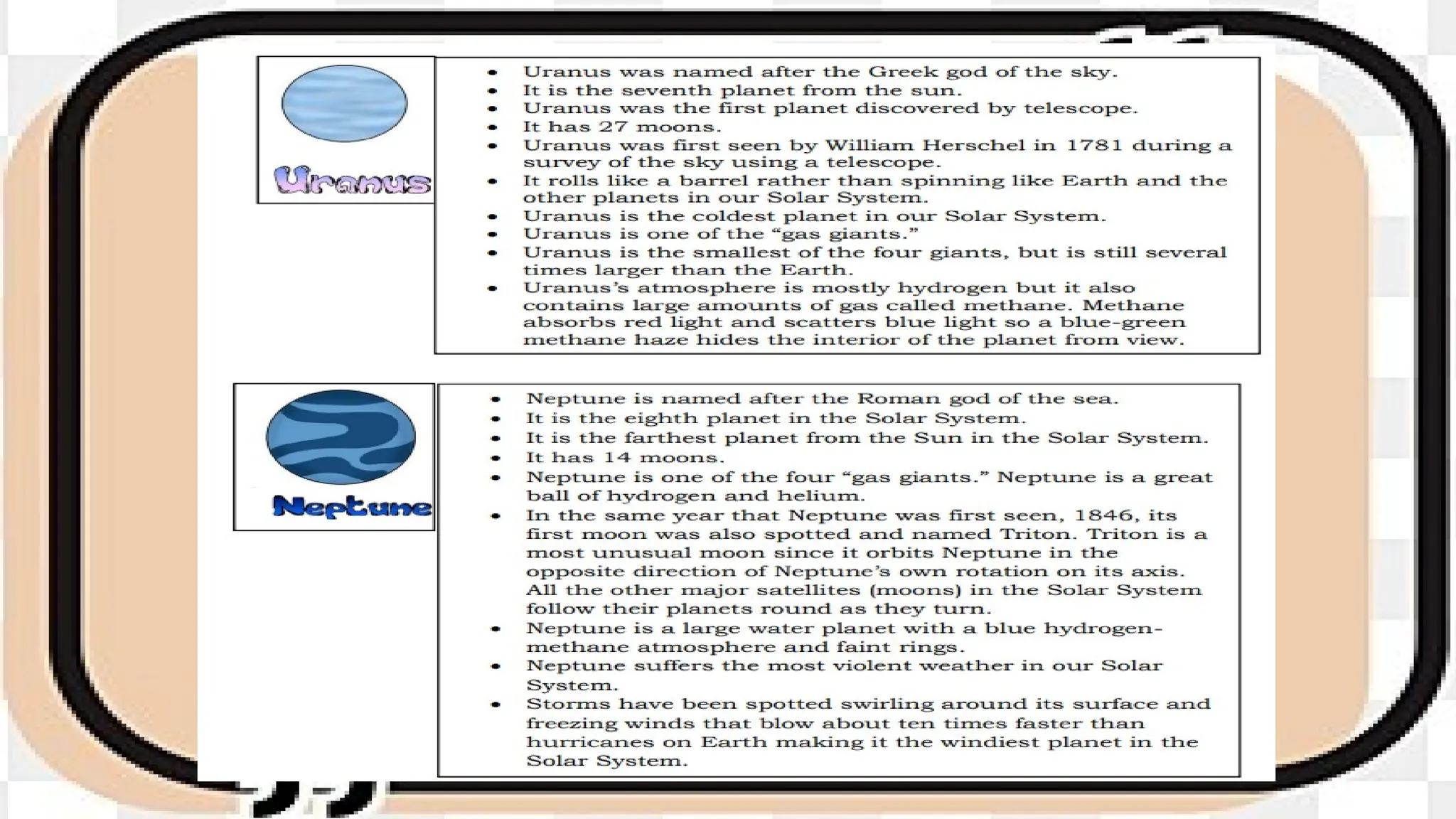
There are eight planets in our solar
system that revolve around the sun. Can
you remember their names and
sequence? The sentence below will help
you remember the sequence of the
planets.
The first letter of each word is the first
letter of the names of the planets in
sequence.
The planets can be divided into two
groups, namely: the inner planets and the
outer planets. Generally, the inner planets
are smaller and are composed of rocks.
They have few or no natural satellites or
rings circling them. The outer planets, on
the contrary, often have dozens of natural
satellites and rings. They are composed
mostly of gases. Planets do not produce
their own light and heat.
They shine because they reflect the
sunlight that falls on them. They moved
around the sun in an elliptical pathway
called an orbit. As they revolve around
the sun, they also spin and rotate. Each
planet has an orbit of different length
around the sun. The further the planet
from the sun, the longer its orbit.
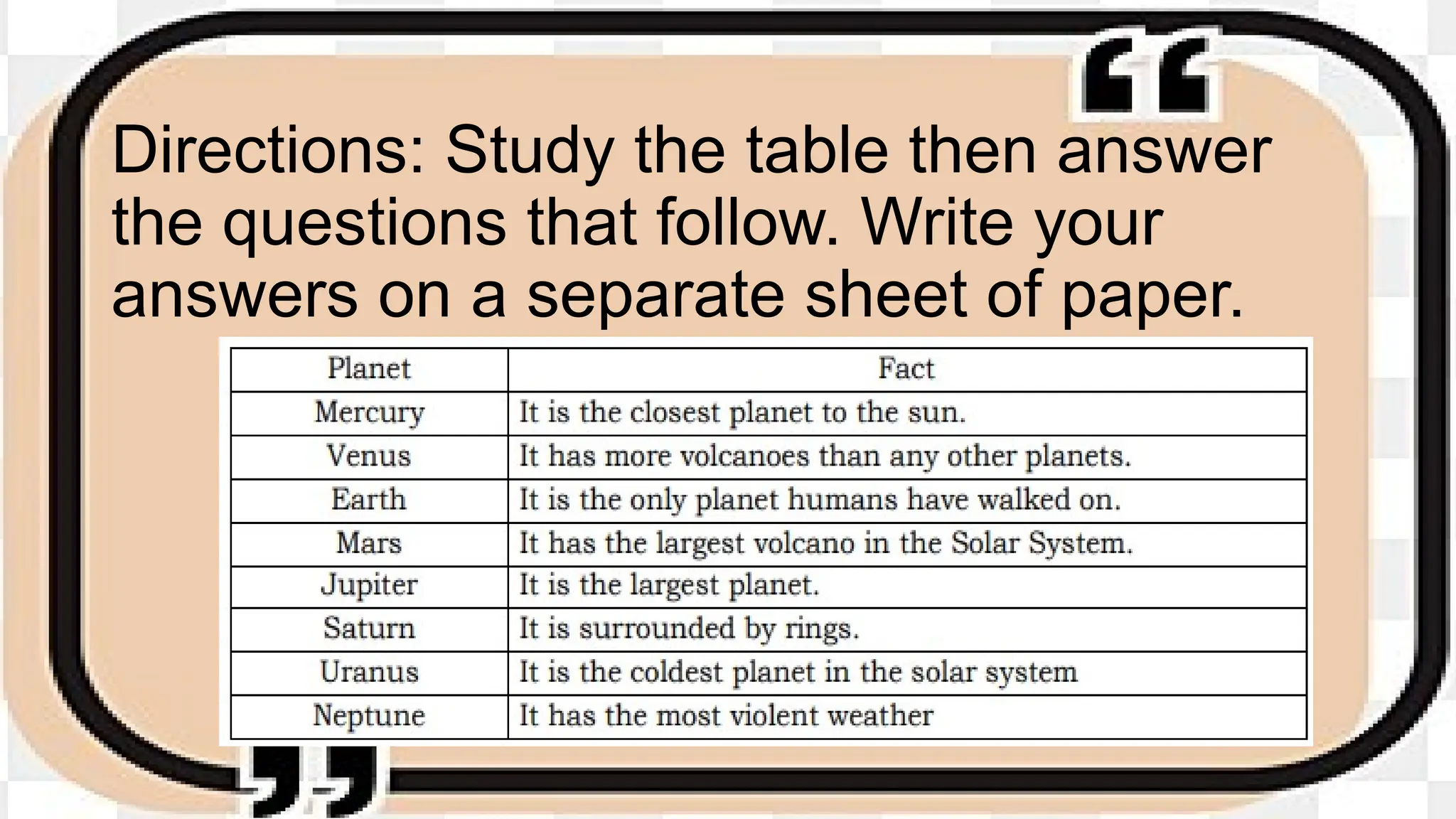
Directions: Study the table then answer
the questions that follow. Write your
answers on a separate sheet of paper.
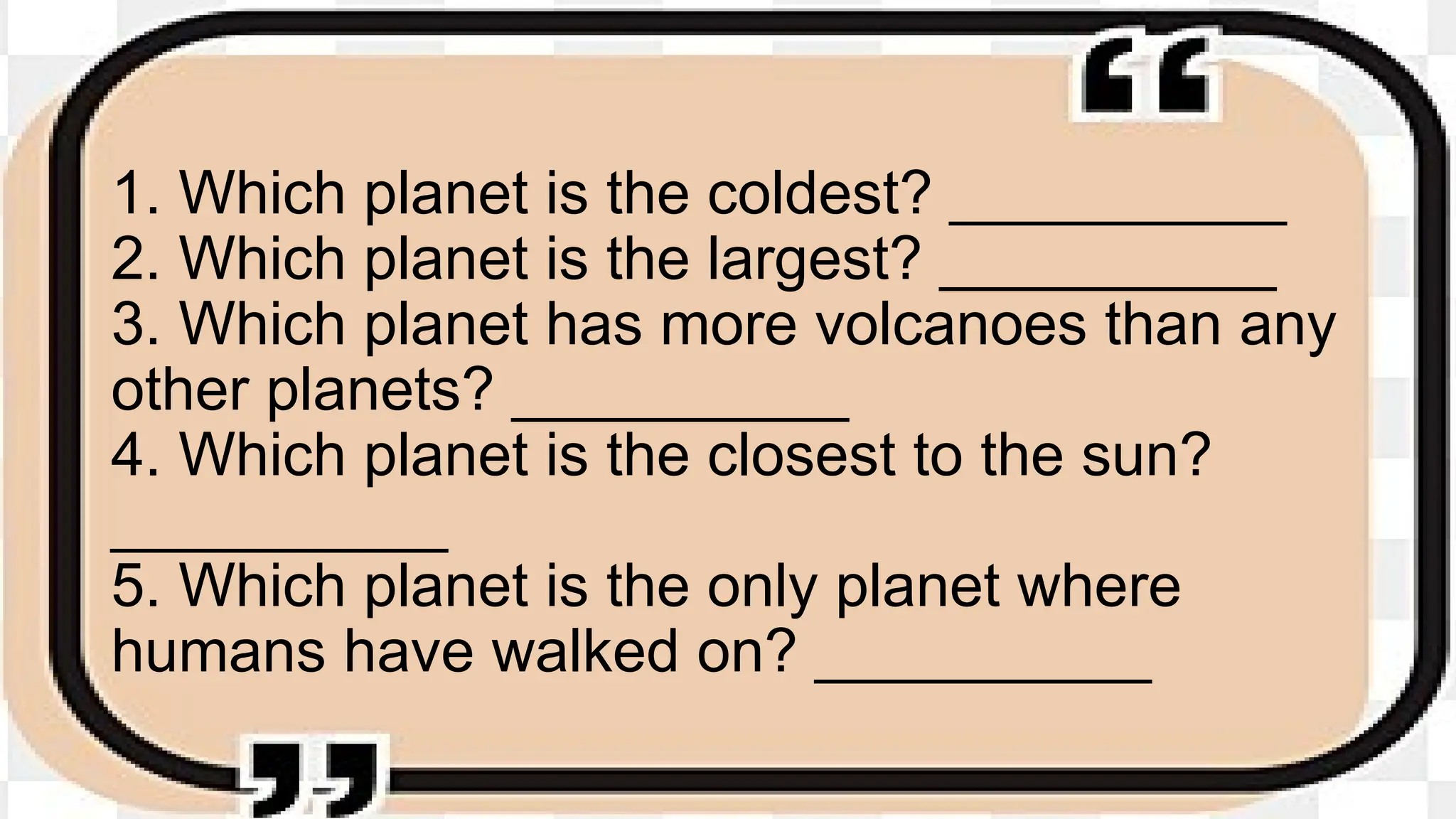
1. Which planet is the coldest? __________
2. Which planet is the largest? __________
3. Which planet has more volcanoes than any
other planets? __________
4. Which planet is the closest to the sun?
__________
5. Which planet is the only planet where
humans have walked on? __________
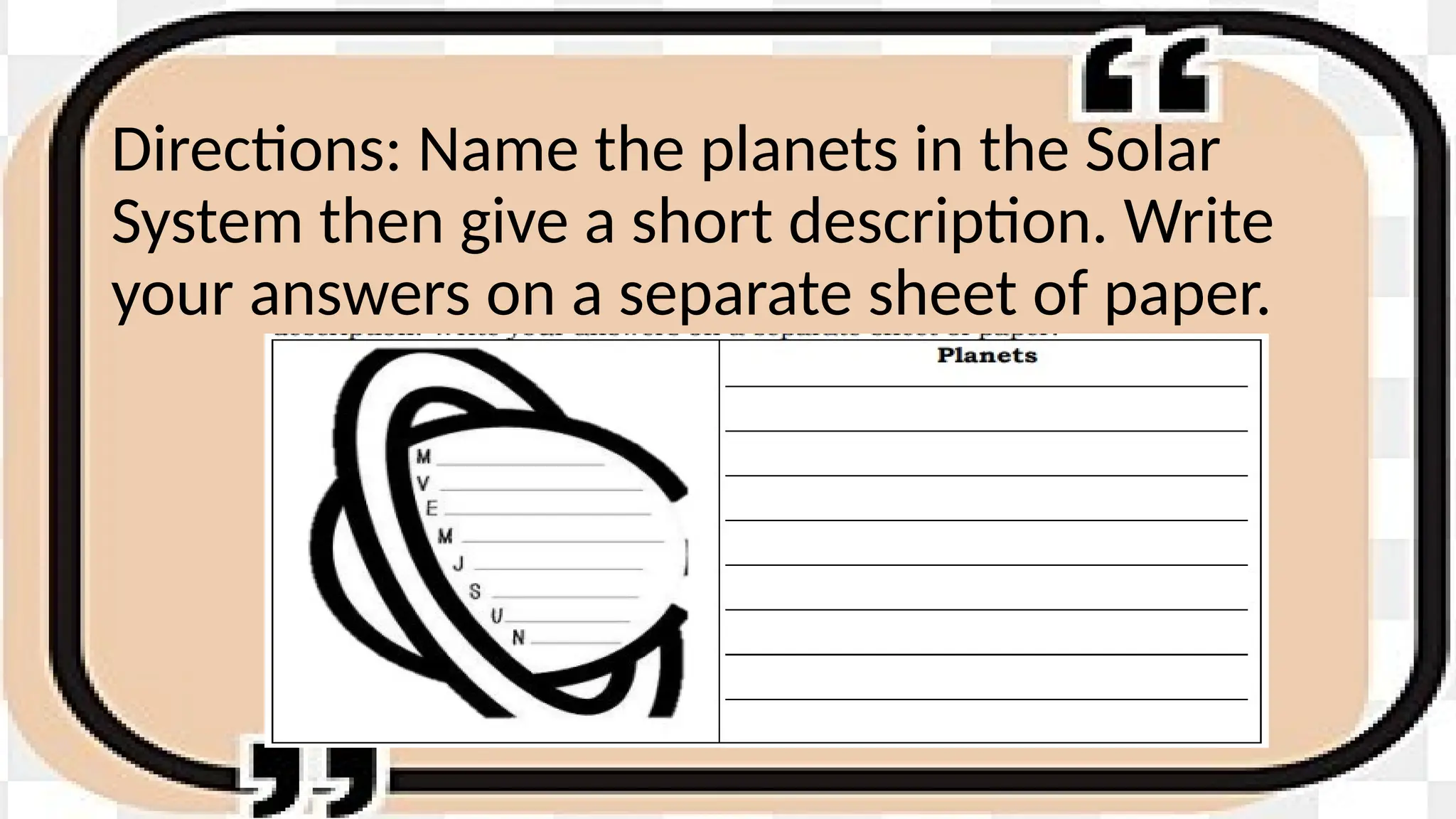
Directions: Name the planets in the Solar
System then give a short description. Write
your answers on a separate sheet of paper.
Based on the insights gained in
the lesson, how is understanding
the Solar System and learning
about space benefits Earth?
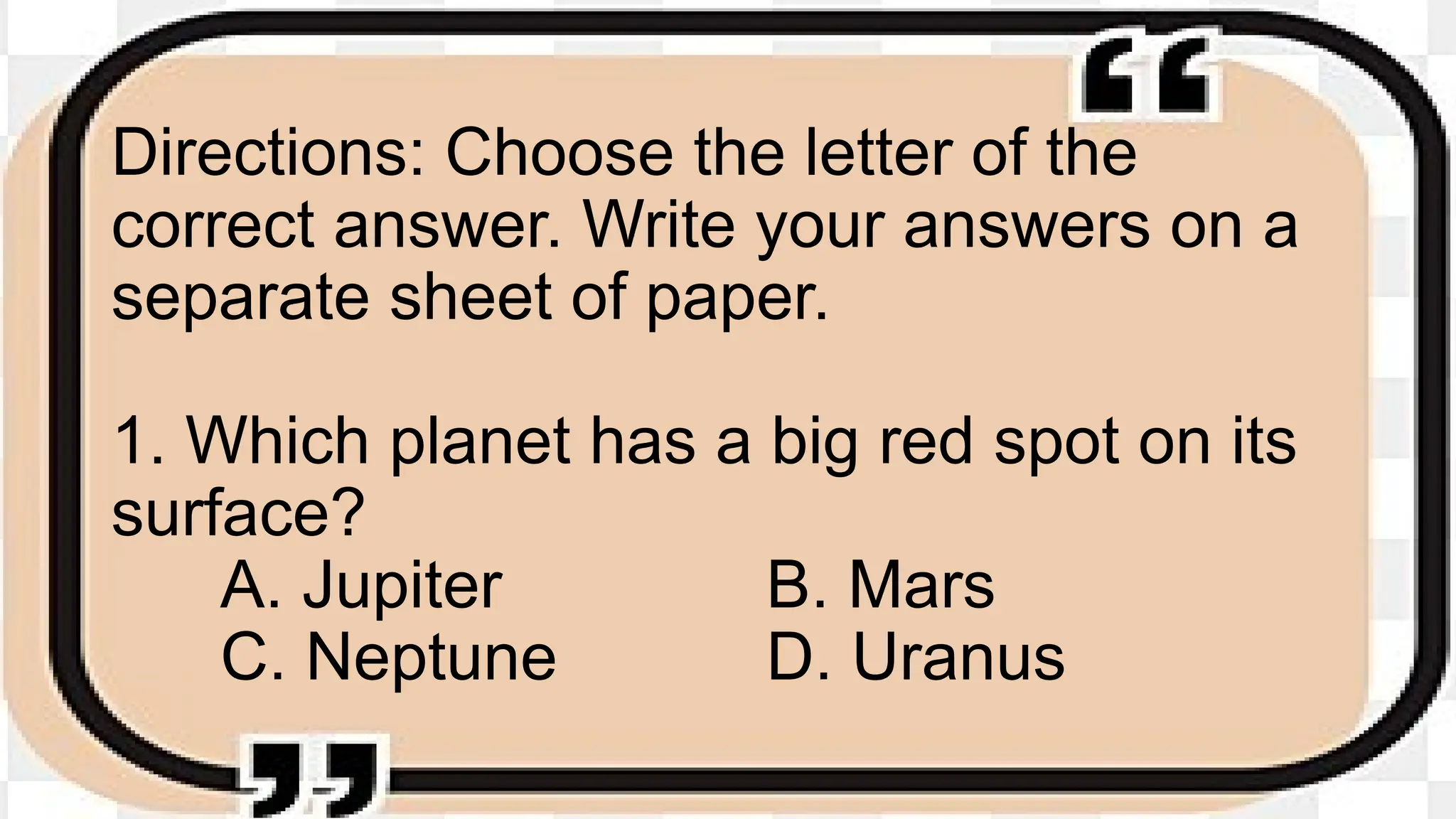
Directions: Choose the letter of the
correct answer. Write your answers on a
separate sheet of paper.
1. Which planet has a big red spot on its
surface?
A. Jupiter B. Mars
C. Neptune D. Uranus
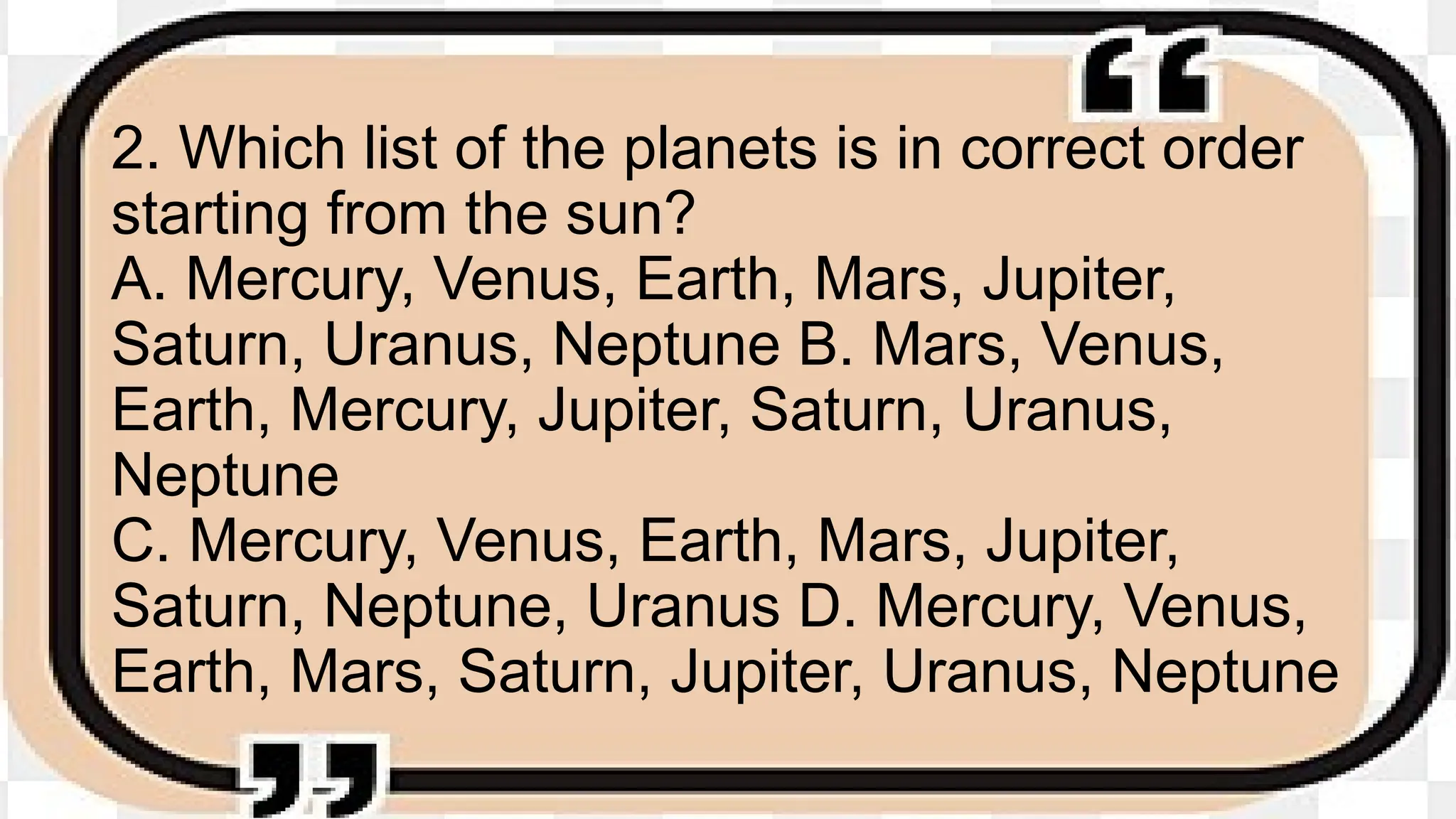
2. Which list of the planets is in correct order
starting from the sun?
A. Mercury, Venus, Earth, Mars, Jupiter,
Saturn, Uranus, Neptune B. Mars, Venus,
Earth, Mercury, Jupiter, Saturn, Uranus,
Neptune
C. Mercury, Venus, Earth, Mars, Jupiter,
Saturn, Neptune, Uranus D. Mercury, Venus,
Earth, Mars, Saturn, Jupiter, Uranus, Neptune
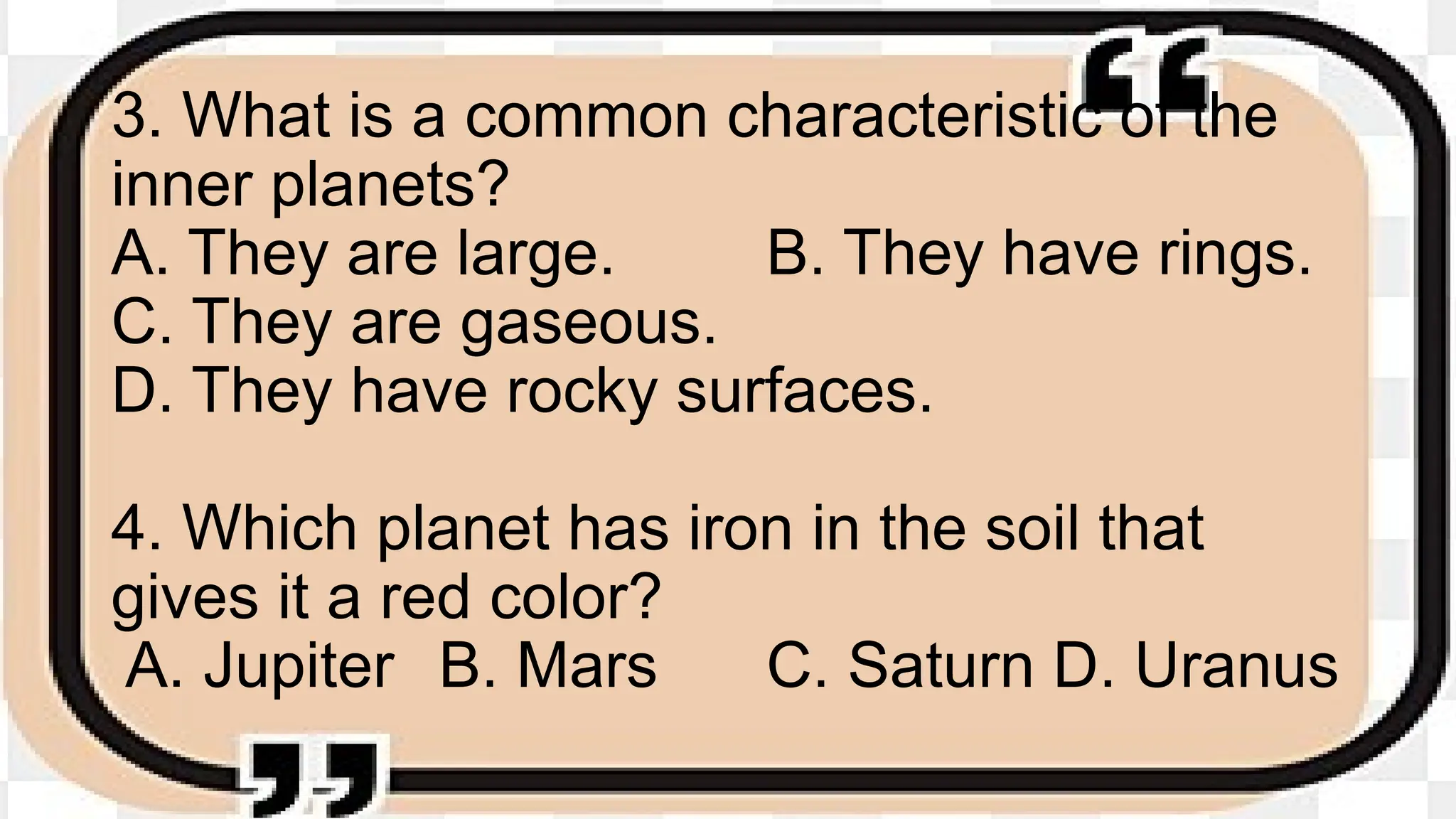
3. What is a common characteristic of the
inner planets?
A. They are large. B. They have rings.
C. They are gaseous.
D. They have rocky surfaces.
4. Which planet has iron in the soil that
gives it a red color?
A. Jupiter B. Mars C. Saturn D. Uranus
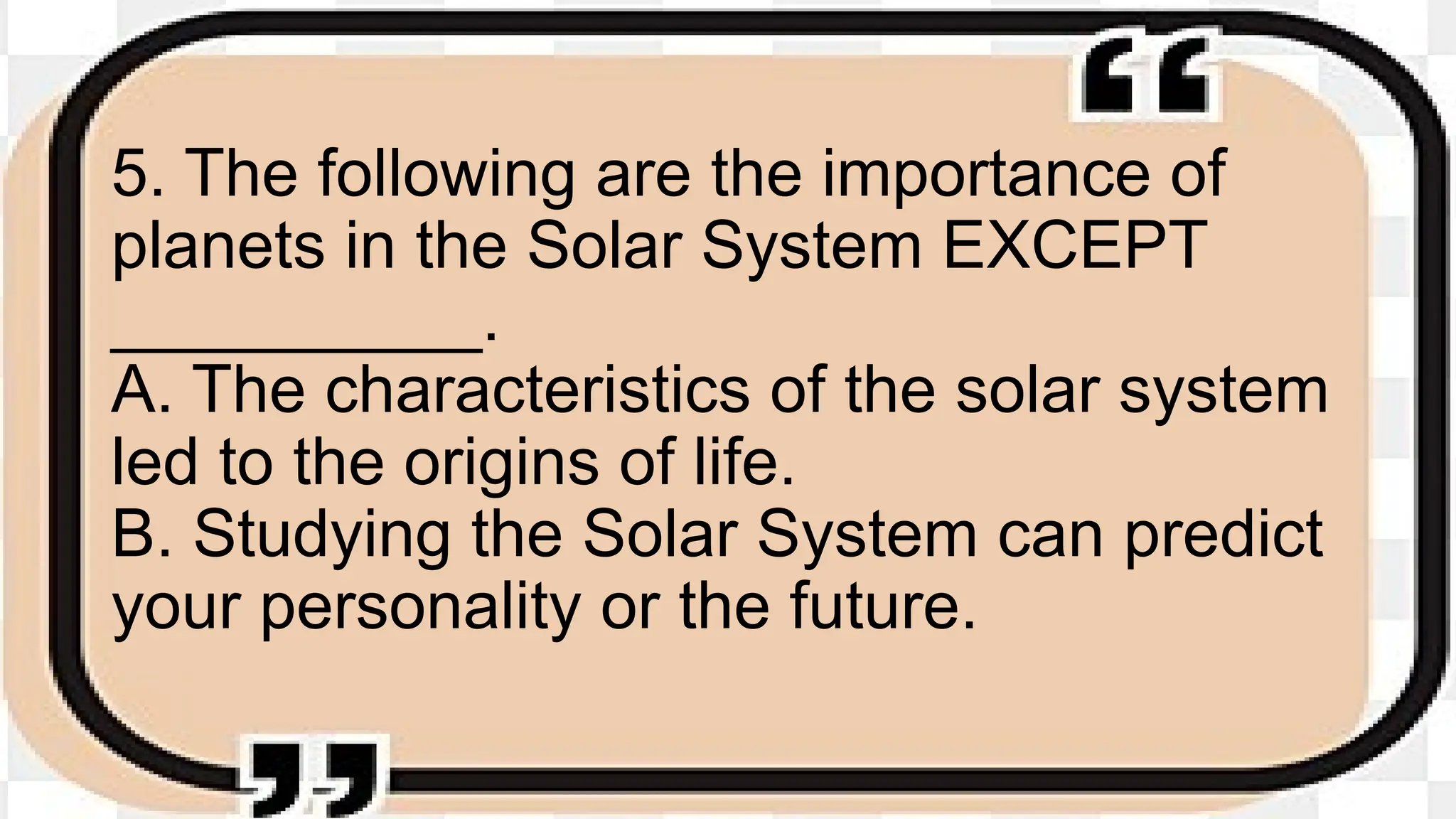
5. The following are the importance of
planets in the Solar System EXCEPT
__________.
A. The characteristics of the solar system
led to the origins of life.
B. Studying the Solar System can predict
your personality or the future.
C. They give details on how life evolved on
Earth and possibly elsewhere in the Solar
System.
D. Understanding the planets and small
bodies that inhabit our Solar System helps
the scientists answer questions about its
formation.
Day 3
Planets in the Solar System
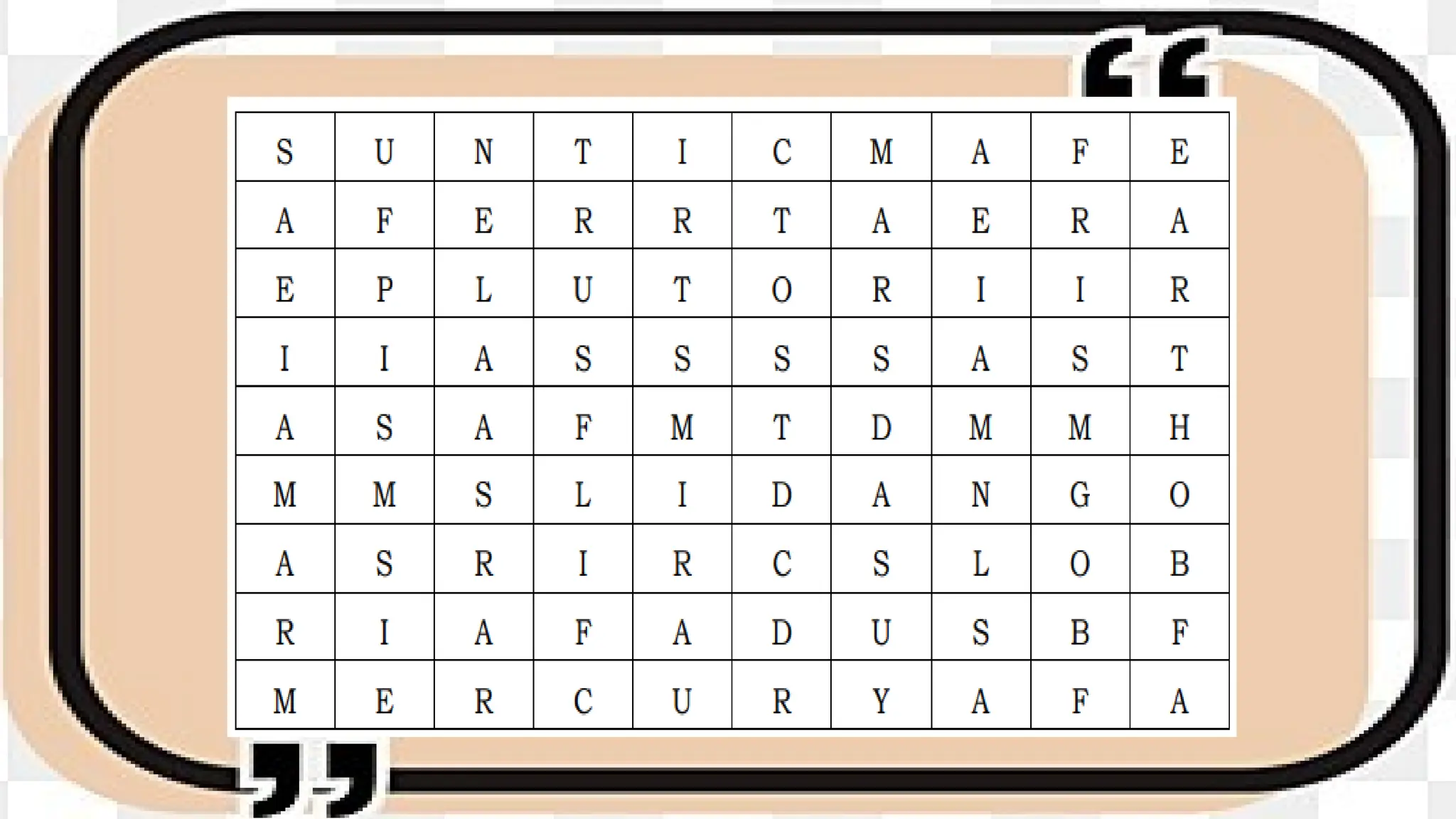
Search for the words that are
related to Solar System. Write
your answers on a separate
sheet of paper.
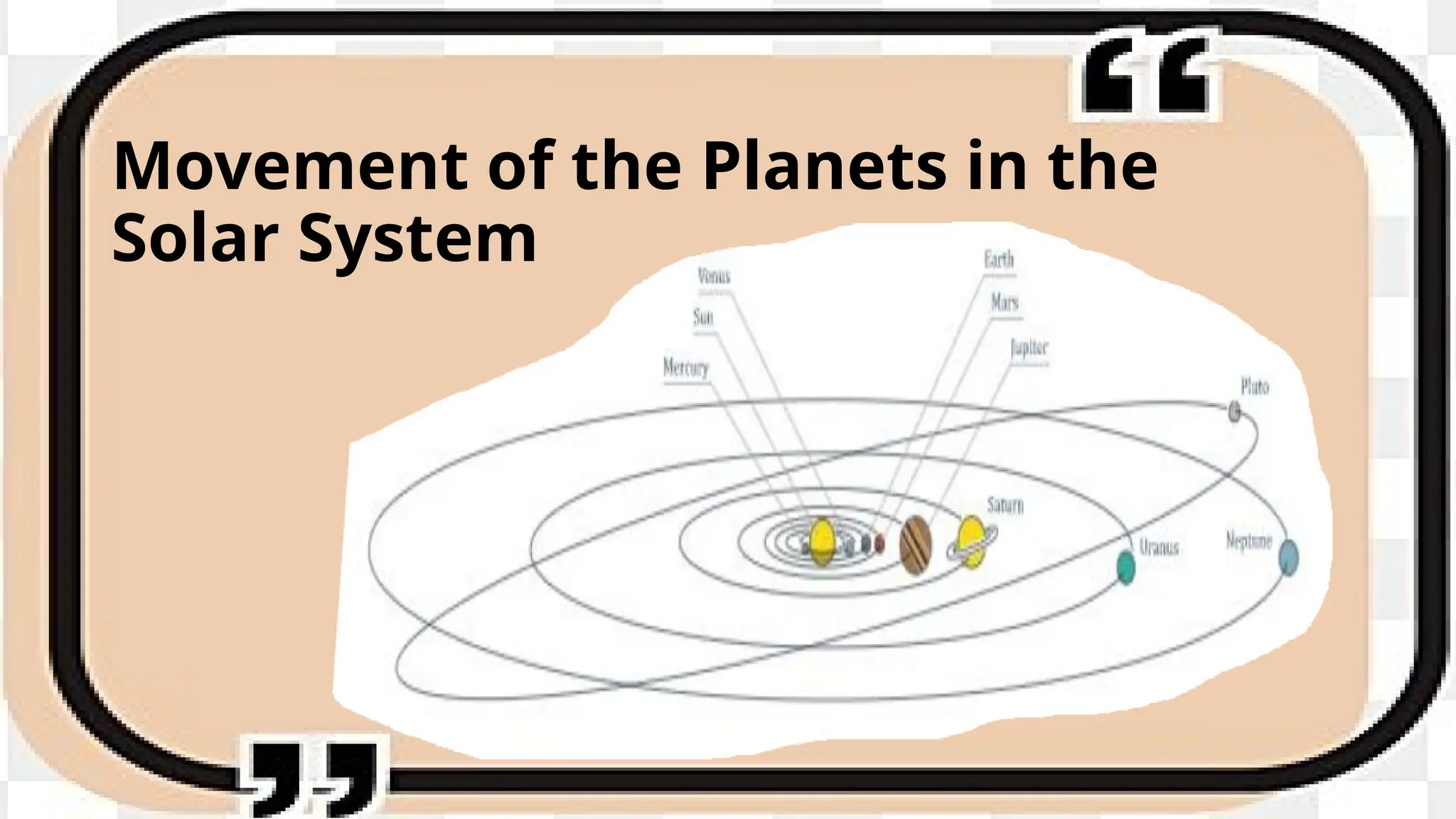
Movement of the Planets in the
Solar System
We live on a planet called Earth that
orbits the Sun once every 365 ¼ days.
Earth is one of the eight known planets
in the Solar System while the Sun is a
very ordinary star about half-way
through its lifetime with another 5,000
million years to go. The only reason
the Sun does not look like the other
stars is because it is much nearer to us.
Even so, at 147 million kilometers (93
million miles) away, it still takes about
8 minutes for light from the Sun to
reach us. All the planets orbit the Sun
in more or less the same plane. This is
called the plane of the ecliptic. The
planets are not evenly spaced but are
in three groups: the inner planets, the
gas giants, and the outer planets.
The inner planets are Mercury, Venus,
Earth and Mars. The gas giants are
Jupiter and Saturn. And the outer
planets are Uranus and Neptune. Pluto
lost its status as a planet in 2006 and
analysis of the orbits of comets has
suggested that there may be another
planet, between 1 and 10 times the
size of Jupiter.
This planet, if it exists, is about three
trillion miles out from the Sun and is
invisible to telescopes. Much of the
information about the planets in the
Solar System has been determined by
observation. The planets Venus, Mars,
Jupiter, and Saturn can all be seen with
the naked eye. However, much better
information can be gathered with a
telescope and, better still, by satellite
and space probes.
The name planets come from the Greek
word planetos which means wanderer.
This is because, unlike the stars whose
position relative to each other is fixed, the
planets appear to wander across the sky,
first going ahead of the fixed stars and
then appearing to stop and fall behind.
As you can imagine, trying to devise
theories to explain why this happened
was a major preoccupation for many
astronomers for much of history. As seen
from the Earth, the Sun, the Moon, and
the planets all appear to move along the
ecliptic. More precisely, the ecliptic is the
Sun's apparent path among the stars
over the course of a year.
It is actually the Earth that moves about
the Sun, and not the other way around,
but because of our orbital motion, the
Sun seems to move across the backdrop
of distant stars. The planets do not
remain exactly on the ecliptic, but they
always stay fairly close to it.
Unlike the Sun, however, the planets
do not always make steady progress
along the ecliptic. They usually move in
the same direction as the Sun, but from
time to time they seem to slow down,
stop, and reverse direction. This
retrograde motion was a great puzzle to
ancient astronomers. Copernicus gave
the correct explanation.
He said all planets, including the Earth,
move around the Sun in the same
direction. Retrograde motion is an illusion
created when we observe other planets
from the moving planet Earth. It is easiest
to understand the retrograde motion of
the inner planets, Mercury and Venus.
These planets are closer to the Sun than
Earth, and they orbit the Sun faster. From
our point of view, the Sun trundles along
the ecliptic due to our orbital motion while
Mercury and Venus run rings around the
Sun. So, at some time we see these
planets moving in the same direction as
the Sun while at other times we see them
moving in the opposite direction.
Directions: Write FACT if the statement is
correct and BLUFF if the statement is
incorrect.
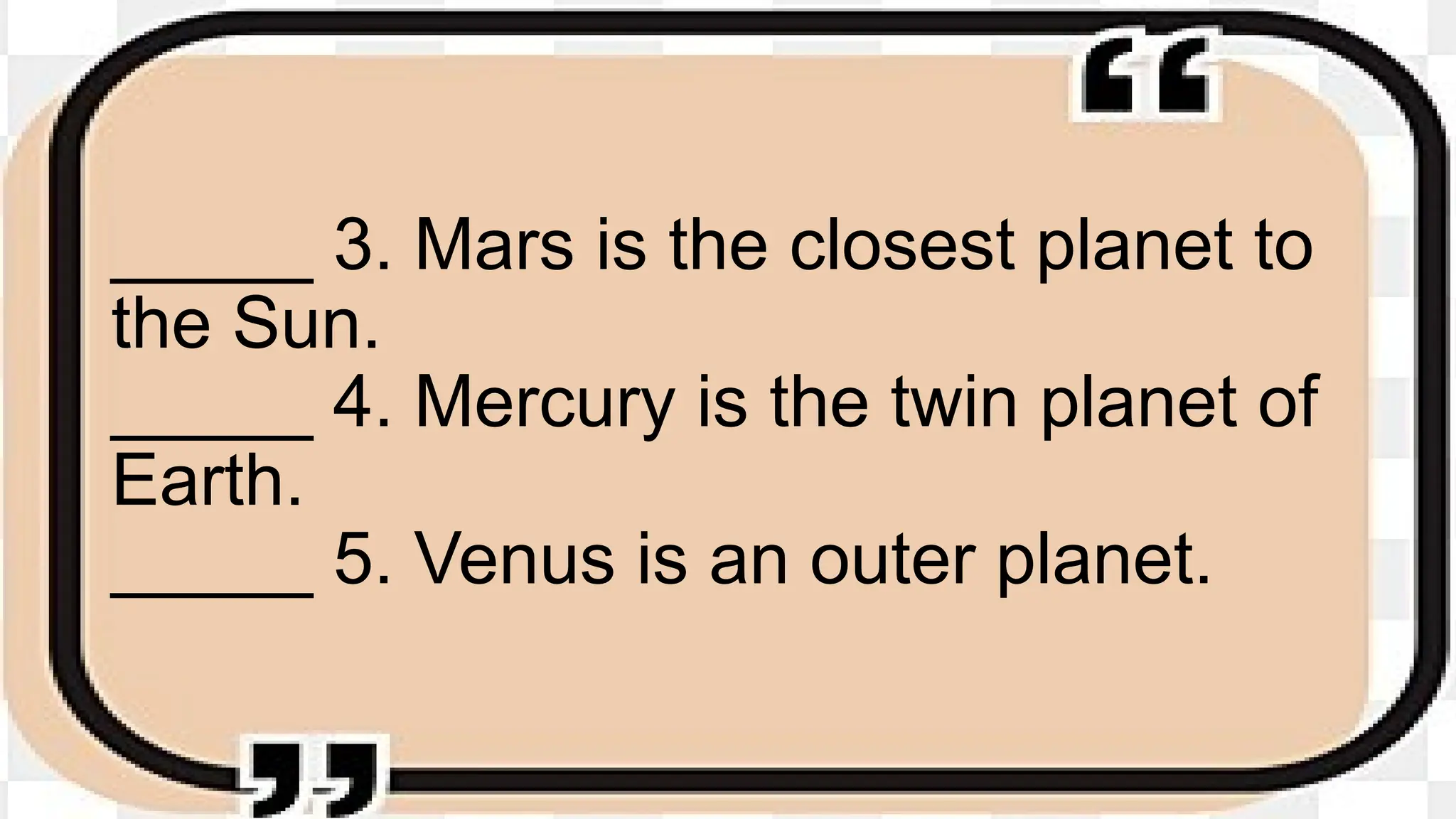
_____ 1. The inner planets are the
largest group of planets.
_____ 2. Earth is the largest of the inner
planets.
_____ 3. Mars is the closest planet to
the Sun.
_____ 4. Mercury is the twin planet of
Earth.
_____ 5. Venus is an outer planet.
Directions: The planets are not evenly spaced
and they are grouped in three. Draw the
three groups.
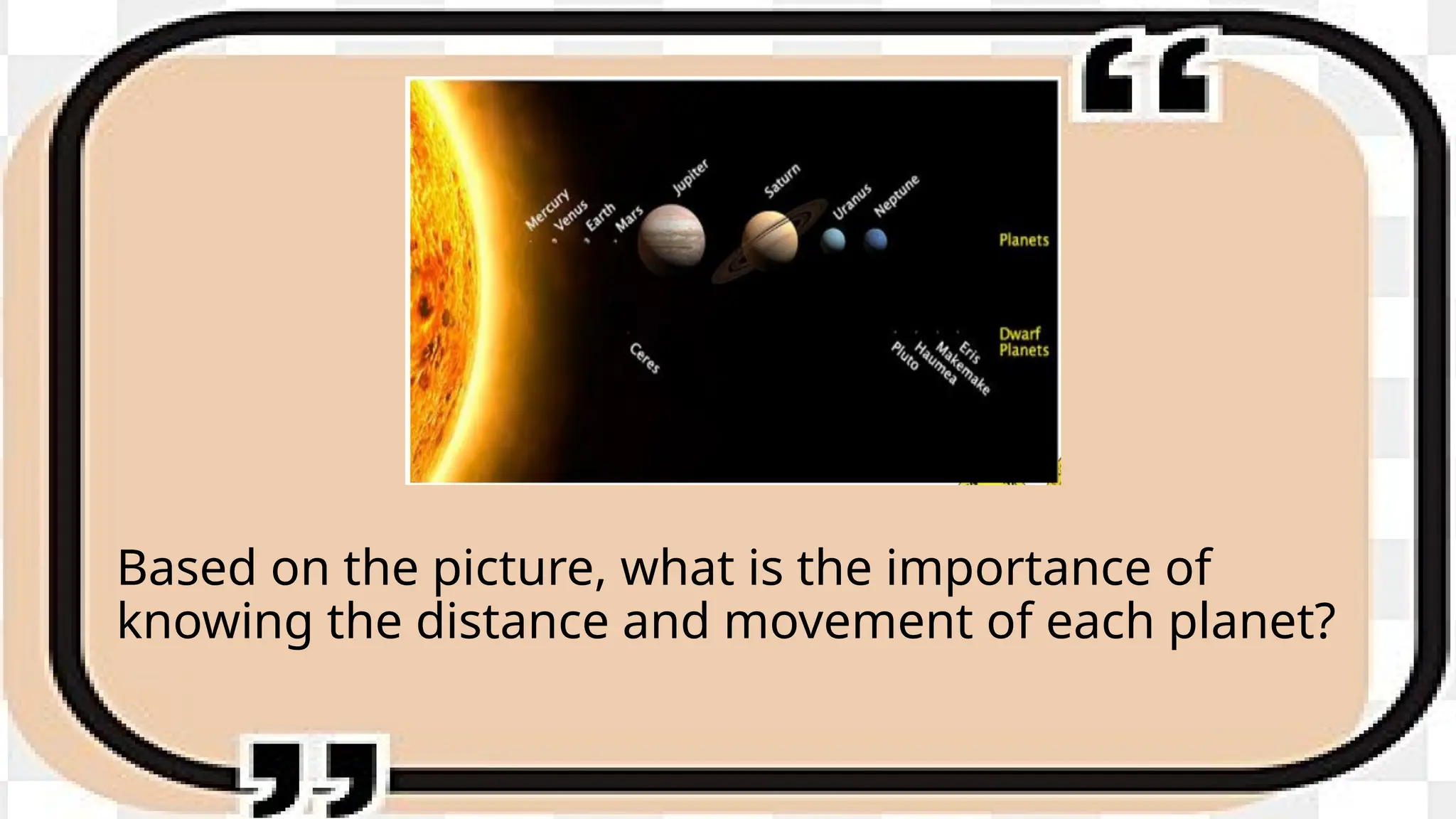
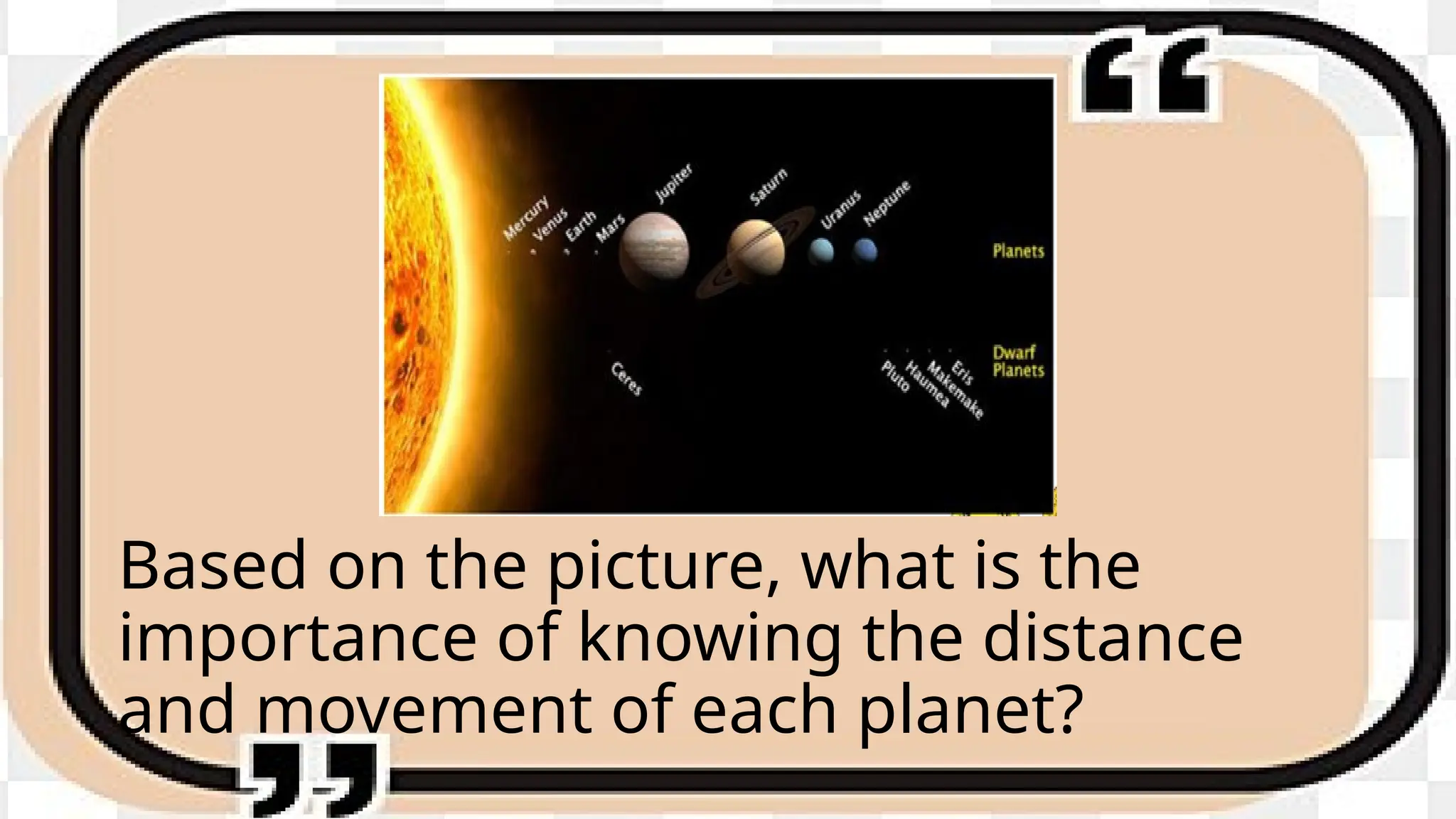
Based on the picture, what is the importance of
knowing the distance and movement of each planet?
Directions: Choose the letter of the best
answer. Write the letter of your answer on
a separate sheet of paper.
1. Which planet is considered Earth’s
twin?
A. Mars B. Moon
C. Sun D. Venus
2. What planet is closest to the Sun?
A. Mars
B. Mercury
C. Sun
D. Venus
3. Which is the correct order of the
planets from the Sun?
A. Mercury, Venus, Earth, Mars, Jupiter,
Saturn, Uranus, Neptune
B. Mercury, Venus, Earth, Mars, Jupiter,
Uranus, Saturn, Neptune
C. Mercury, Saturn, Earth, Mars, Jupiter,
Venus, Uranus, Neptune
D. Mercury, Venus, Earth, Mars, Jupiter,
Saturn, Uranus, Pluto
4. What is the common characteristic of
the inner planets?
A. The distance between them is shorter.
B. The distance between them is longer.
C. They are gaseous
D. They have rings
5. One complete rotation composes
one day and one night. Which of the following
statements shows the value of time?
A. Play mobile games day and night with friends.
B. Browse the social media and post latest
events in life.
C. Watch free movies and television series with
friends online.
D. Communicate with friends to get
performance tasks and written works done.
Day 4
Planets in the Solar System
For the outer planets, Mars, Jupiter,
Saturn, and so on, the explanation is a
bit subtler. These planets are farther
from the Sun than Earth, and they orbit
the Sun more slowly. From time to time
we pass one of these planets, and
when that happens, the planet seems
to be moving backwards because we
are moving faster than it does.
At such times we naturally see the
Sun and the planet in opposite parts of
the sky; the planet is said to be in
opposition to the Sun. Opposition is a
good time to observe an outer planet;
it is above the horizon all night, and
relatively close to the Earth.
An outer planet's apparent motion
is always retrograde for a month or
more before and after opposition. The
duration of retrograde motion
depends on the planet; it's shortest for
Mars, and generally longest for
Neptune. The moment when a planet's
apparent motion changes direction is
called a stationary point, because at
that instant the planet
appears to be more or less stationary
with respect to the stars. An outer
planet always has one stationary point
before opposition, and another
stationary point after opposition.
Venus and Mars are the two planets
that come nearest to the Earth. As all
three planets orbit the Sun, the view of
our neighbors will constantly change in
various ways.
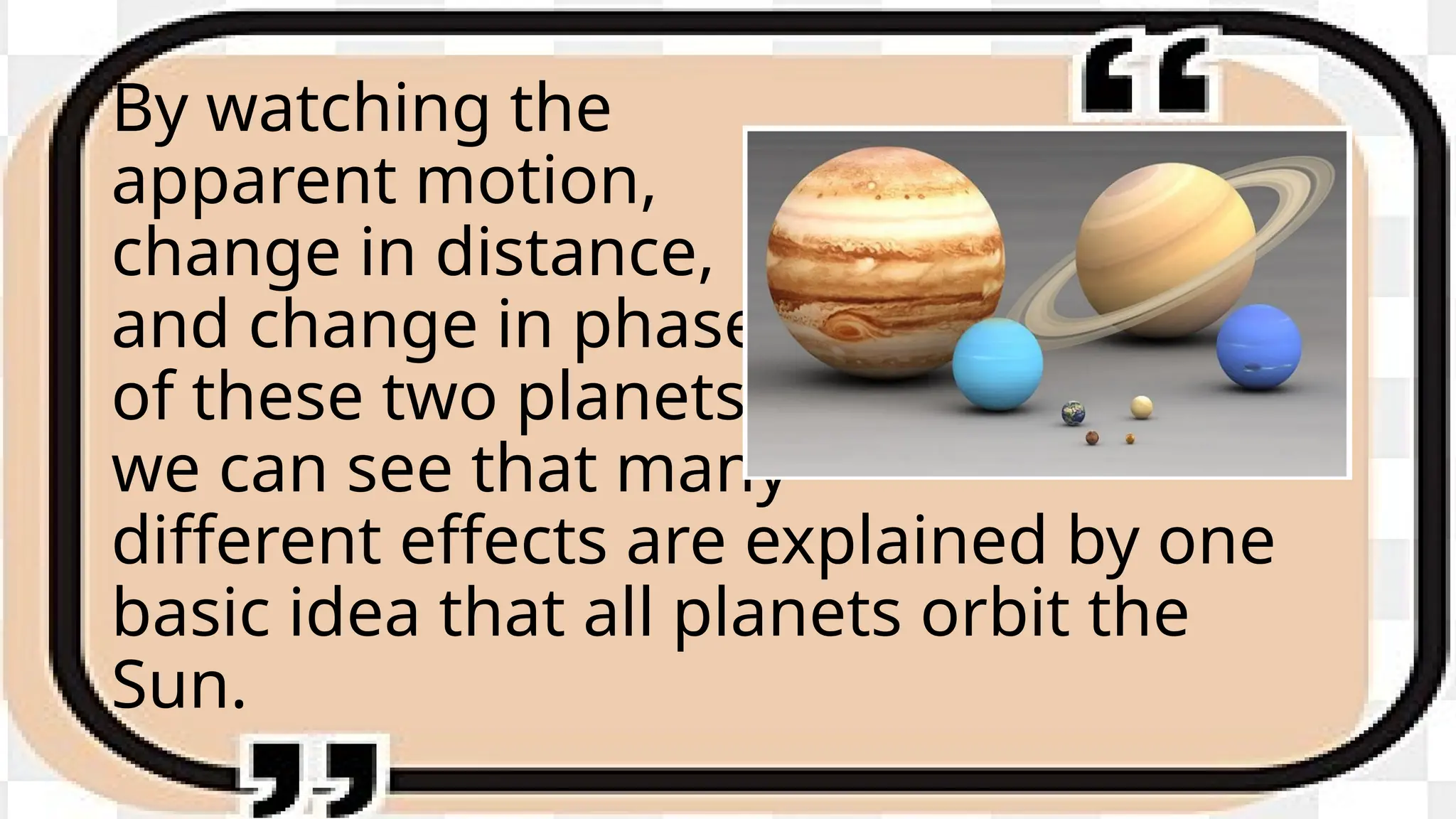
By watching the
apparent motion,
change in distance,
and change in phase
of these two planets,
we can see that many
different effects are explained by one
basic idea that all planets orbit the
Sun.
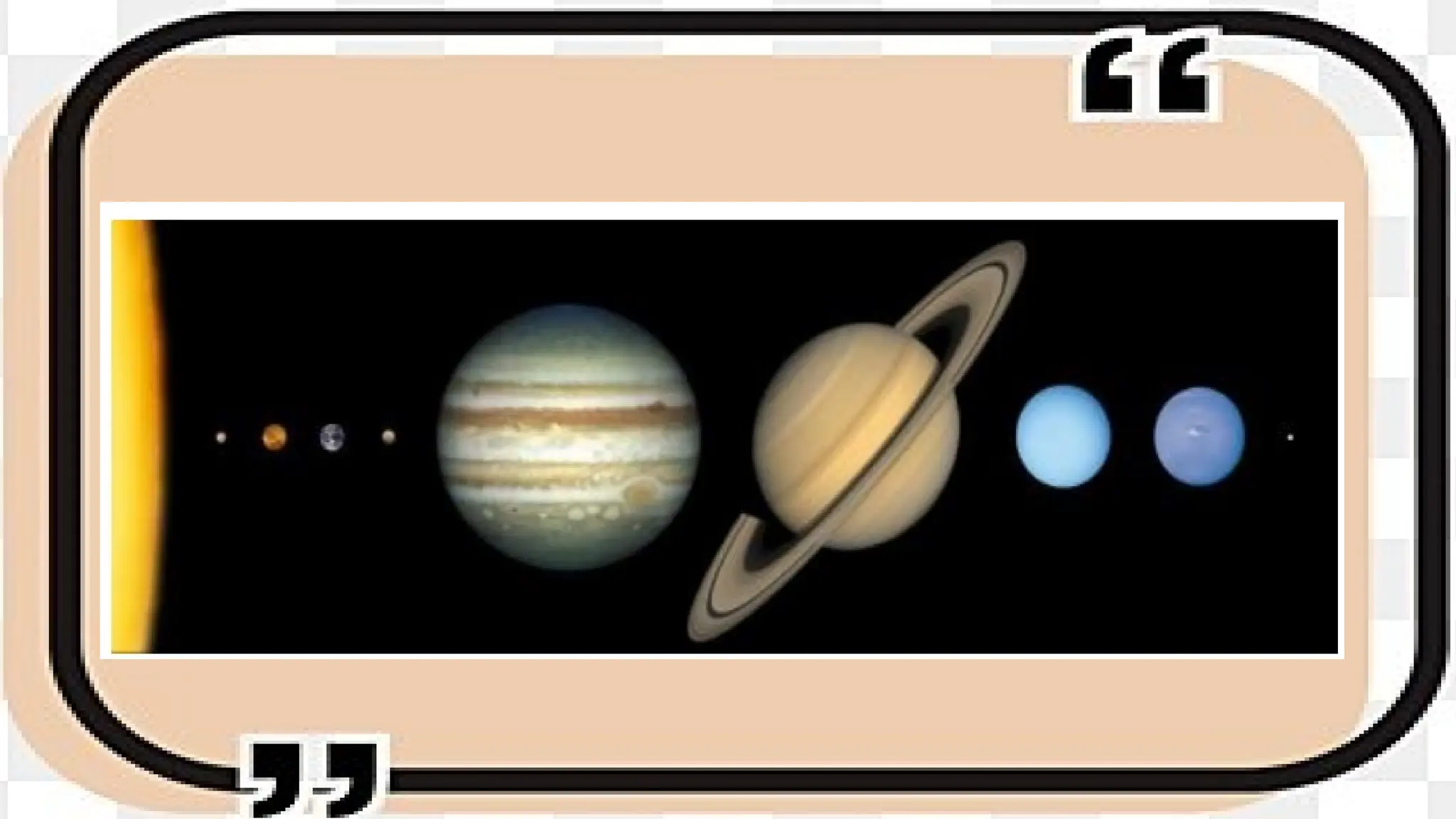
The Planets in the Solar System in
Order of Size
If you are interested in planets, the good
news is there is a variety to choose from
in our own Solar System. From the ringed
beauty of Saturn, to the massive hulk of
Jupiter, to the lead-melting temperatures
of Venus, each planet is unique
— with its own environment and own
story to tell about the history of the Solar
System. What is also amazing is the
sheer size difference of planets. While
humans think of Earth as a large planet,
in reality it is dwarfed by the massive gas
giants lurking at the outer edges of our
Solar System.
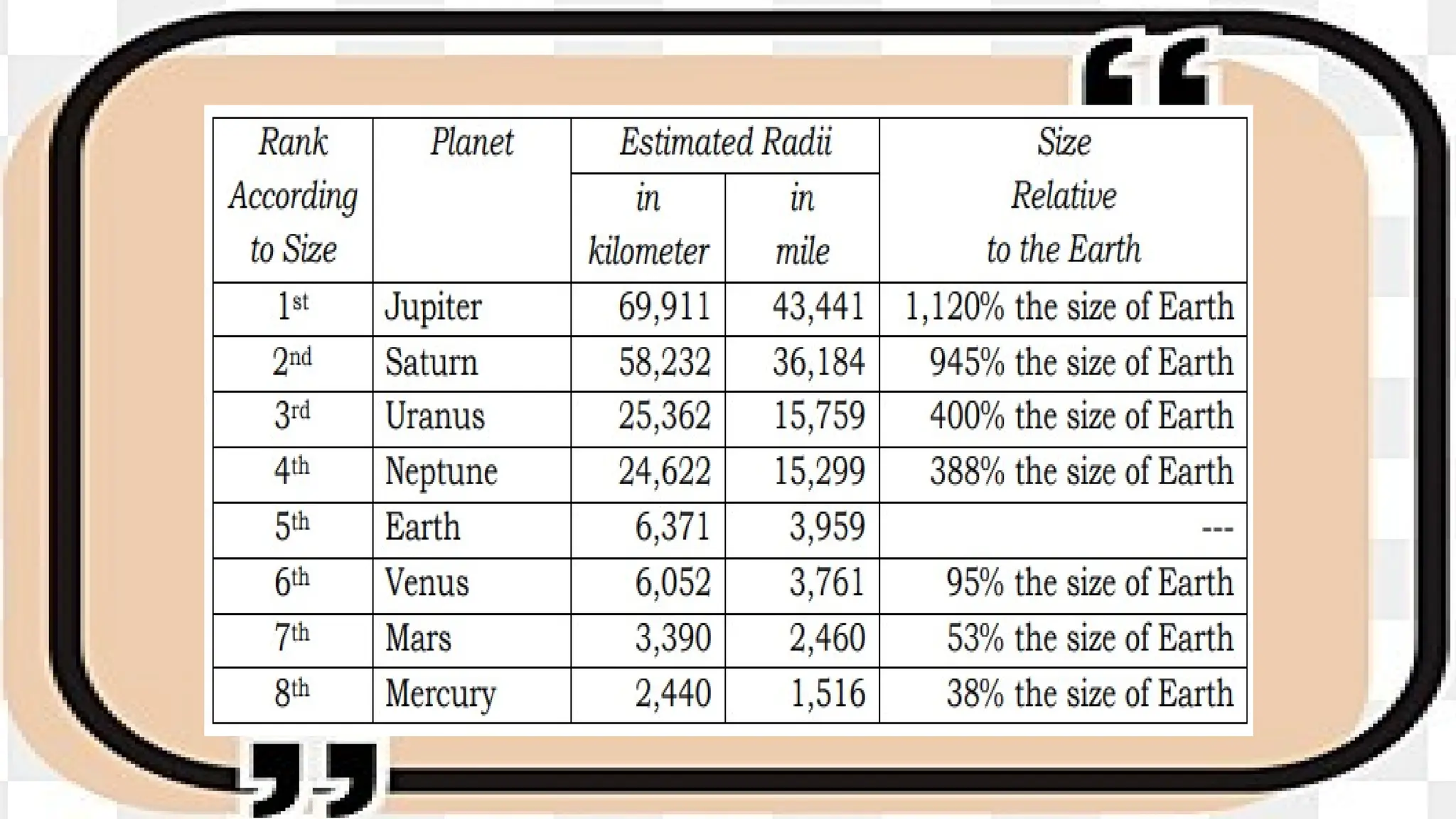
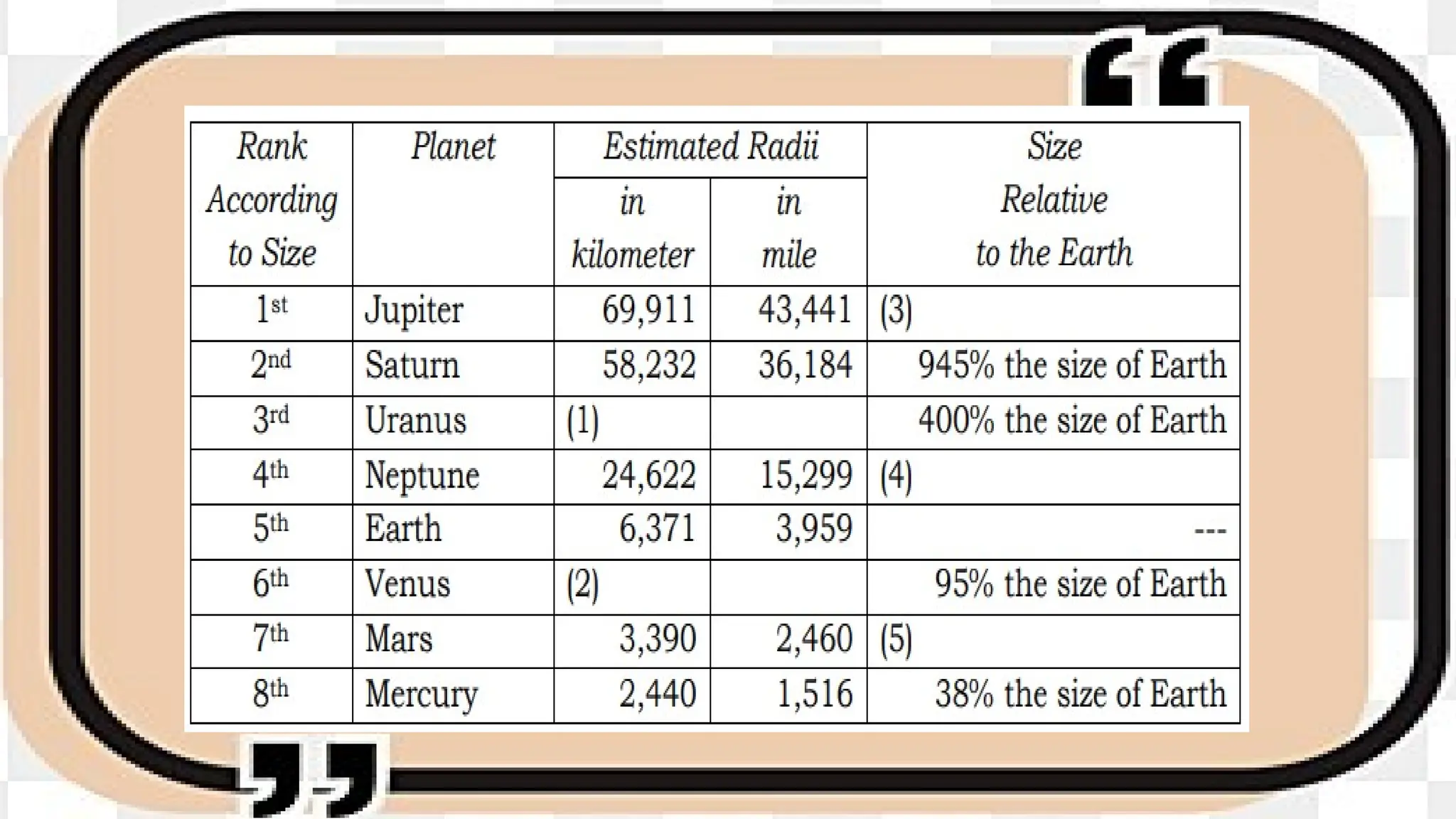
Sizes of the Eight Planets
According to NASA, this is the
estimated radii of the eight planets in the
Solar System, in order of size. We also
have included the radii sizes relative to
Earth to help you picture them better.
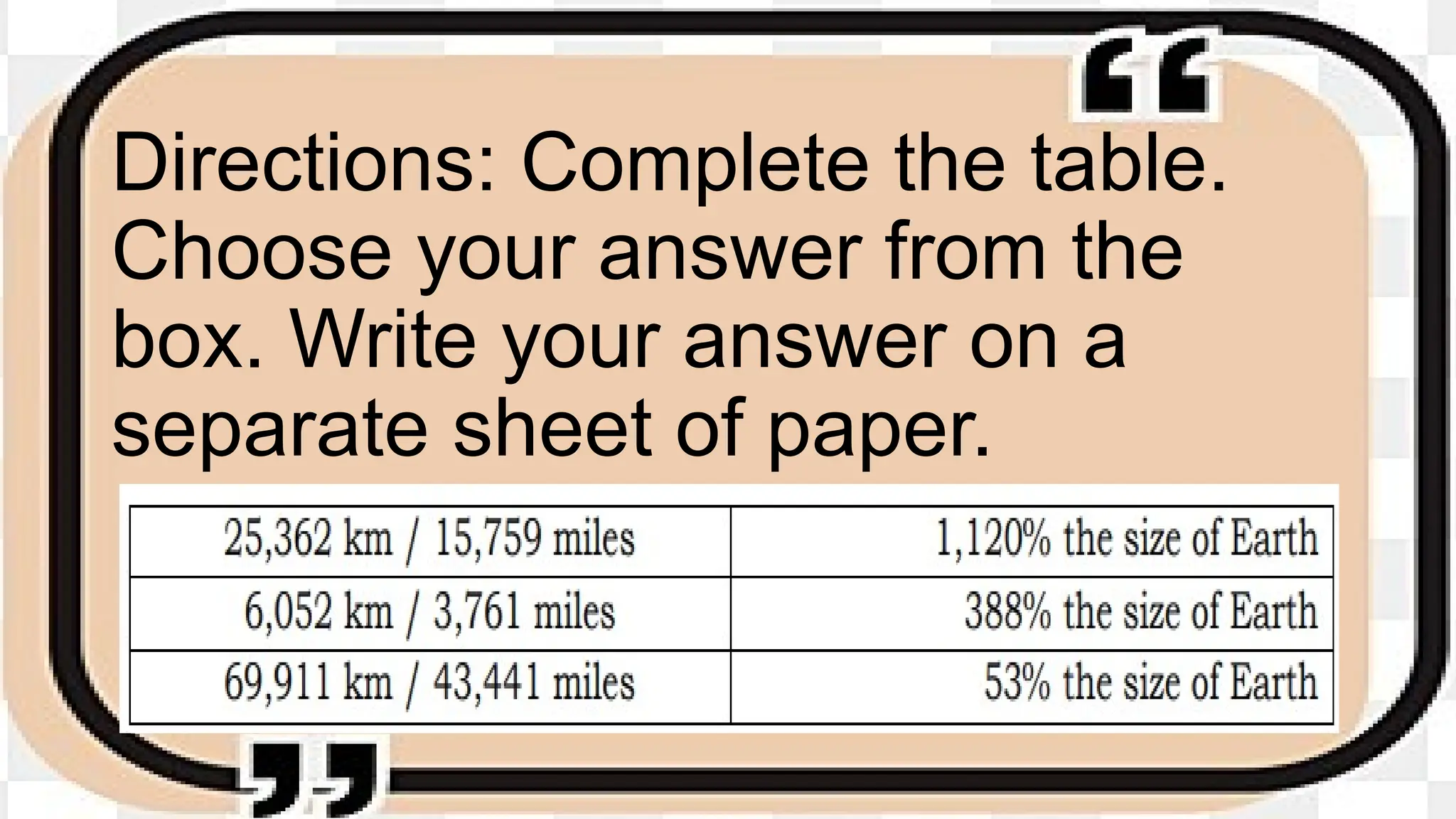
Directions: Complete the table.
Choose your answer from the
box. Write your answer on a
separate sheet of paper.
To wrap up everything that we have
discussed about the movement and
comparison of planets in the Solar System.
Draw the eight planet and write their
movement in the Solar System.
Based on the picture, what is the
importance of knowing the distance
and movement of each planet?
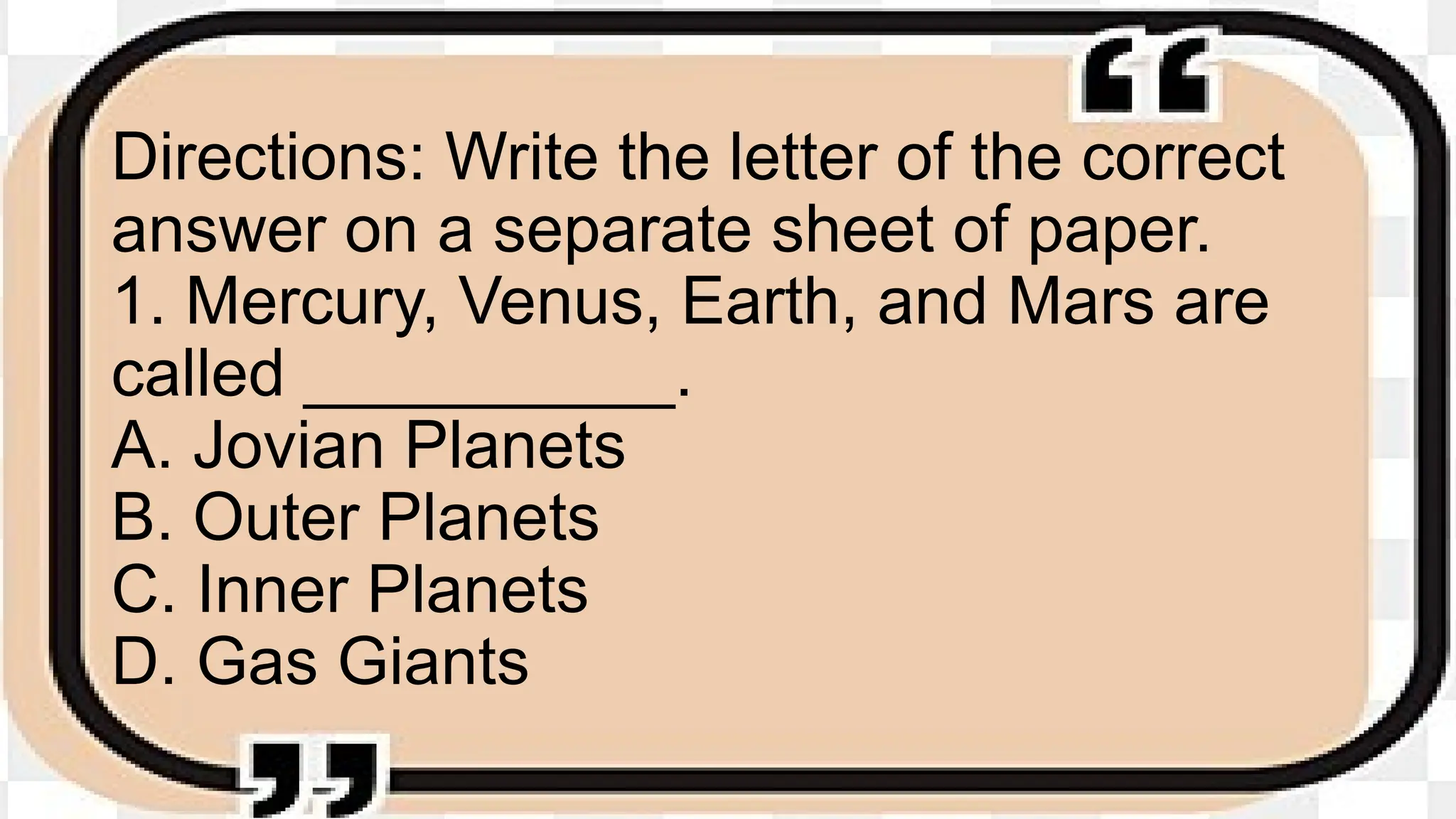
Directions: Write the letter of the correct
answer on a separate sheet of paper.
1. Mercury, Venus, Earth, and Mars are
called __________.
A. Jovian Planets
B. Outer Planets
C. Inner Planets
D. Gas Giants
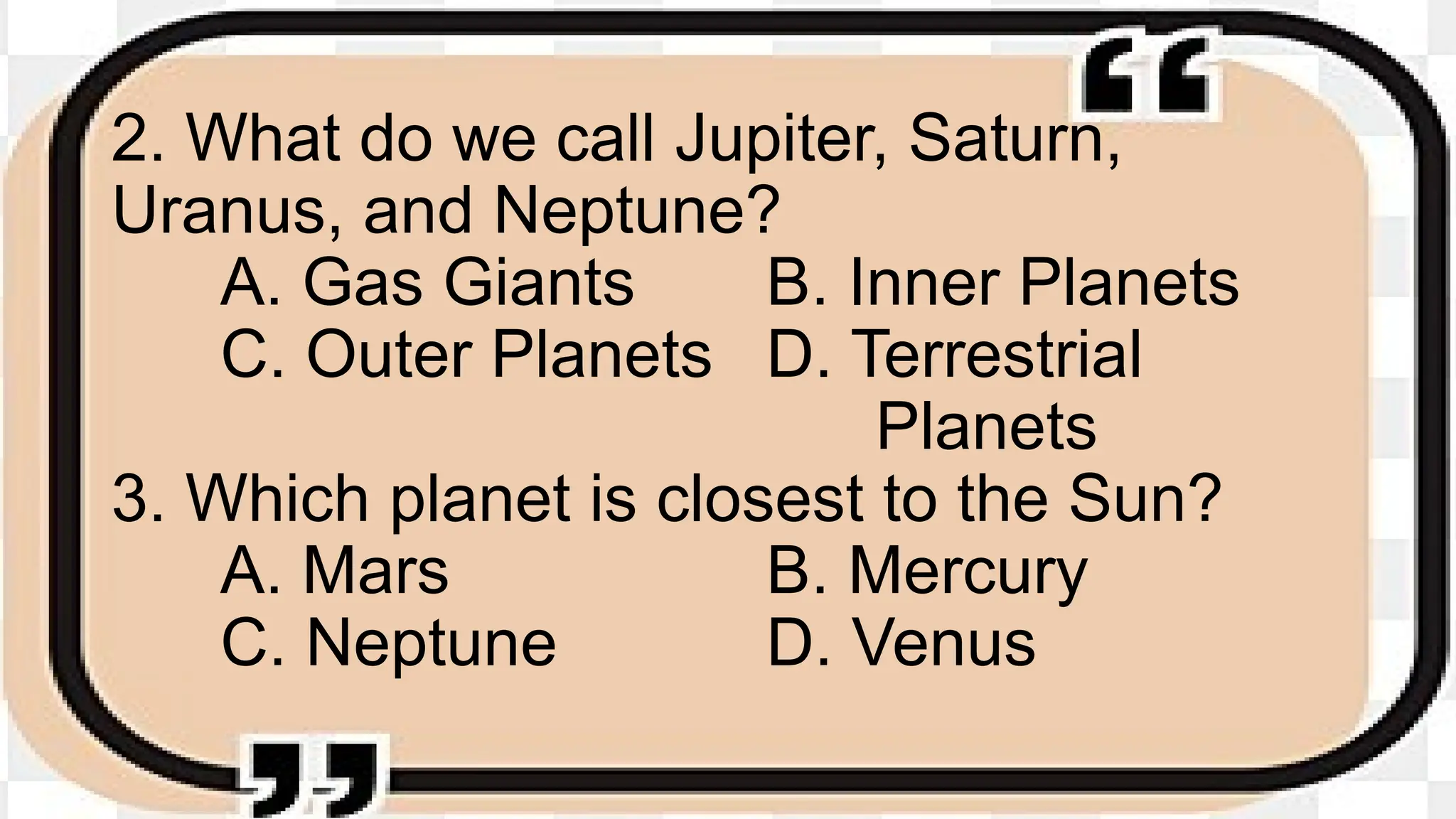
2. What do we call Jupiter, Saturn,
Uranus, and Neptune?
A. Gas Giants B. Inner Planets
C. Outer Planets D. Terrestrial
Planets
3. Which planet is closest to the Sun?
A. Mars B. Mercury
C. Neptune D. Venus
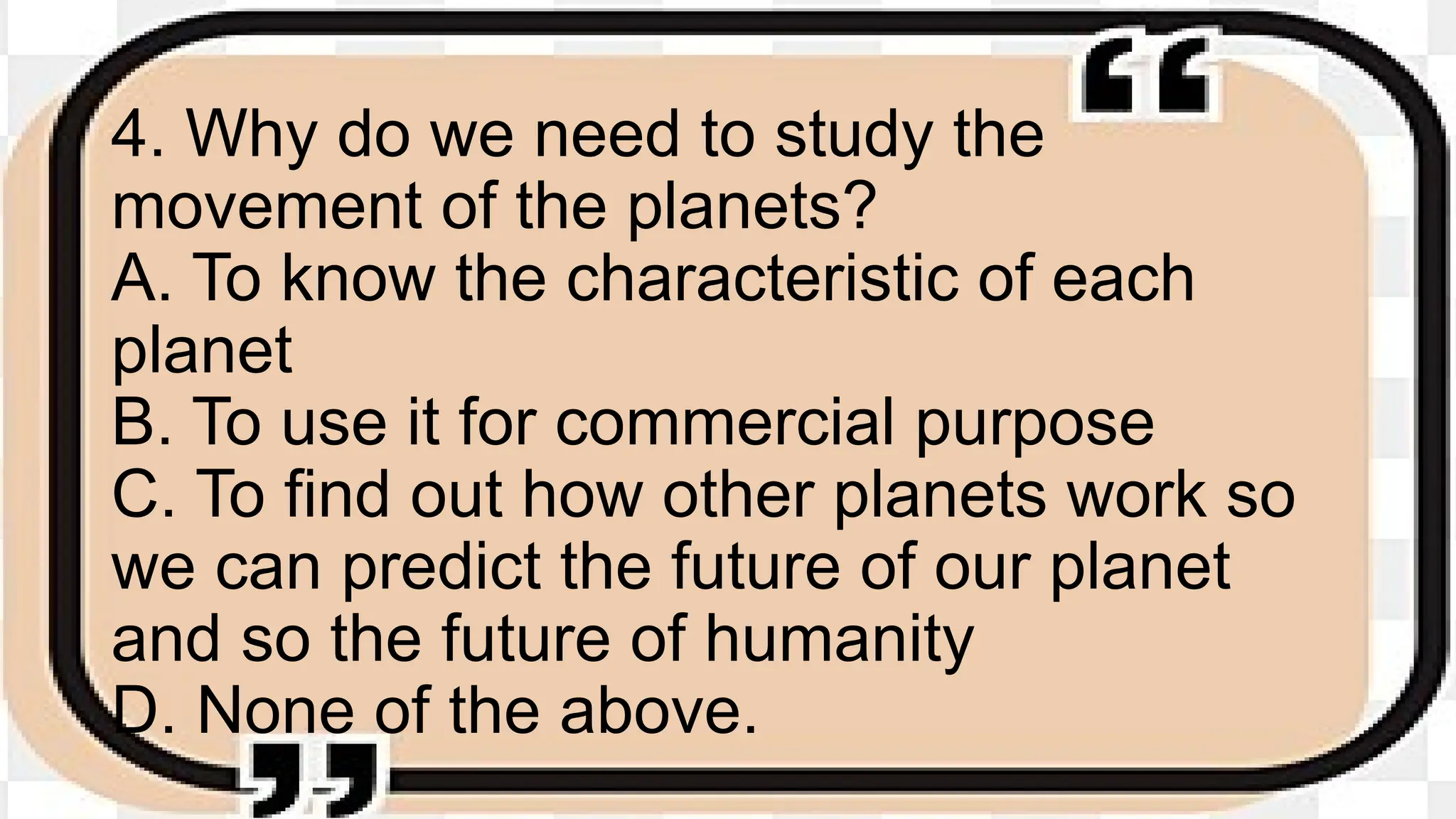
4. Why do we need to study the
movement of the planets?
A. To know the characteristic of each
planet
B. To use it for commercial purpose
C. To find out how other planets work so
we can predict the future of our planet
and so the future of humanity
D. None of the above.
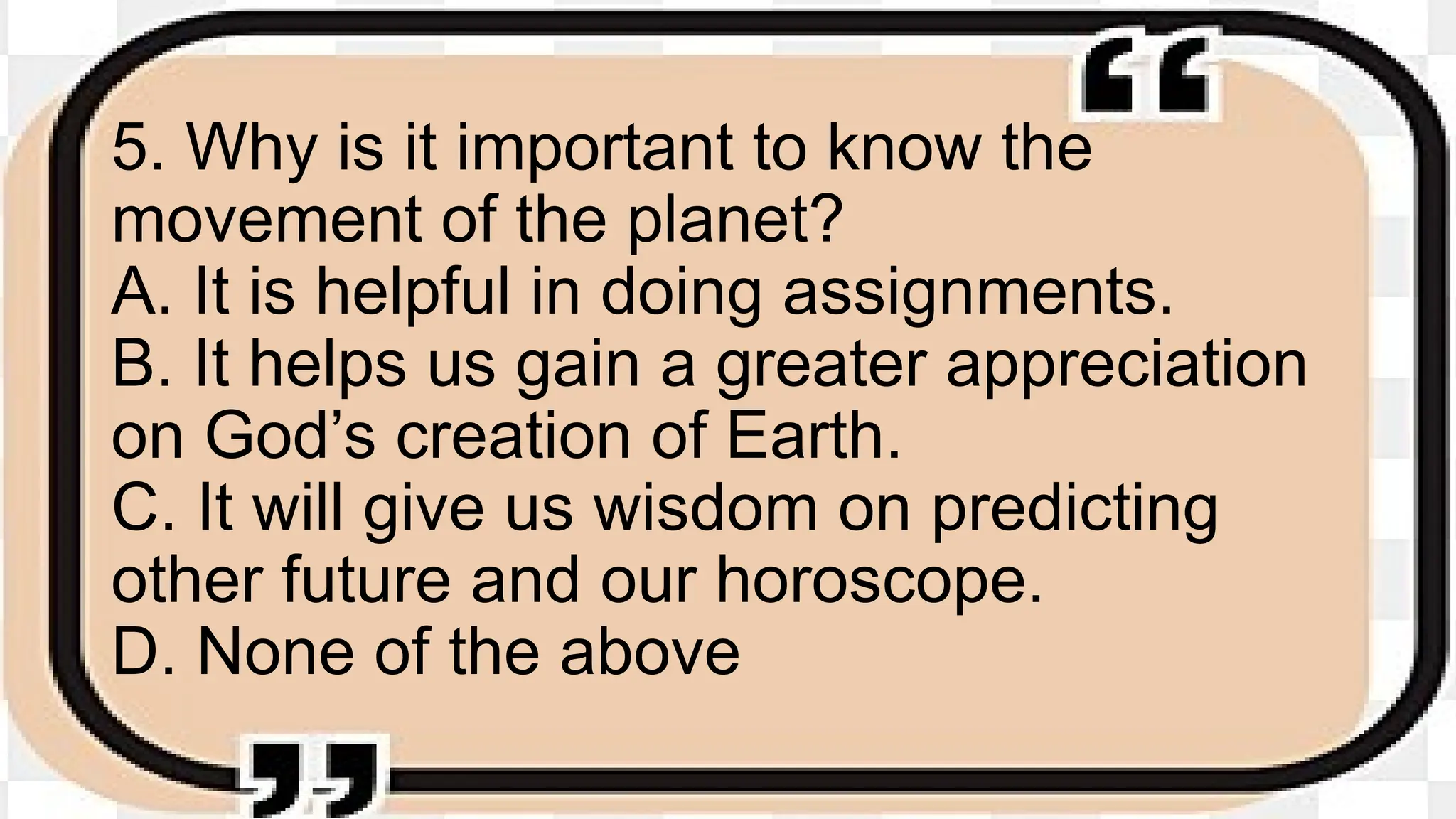
5. Why is it important to know the
movement of the planet?
A. It is helpful in doing assignments.
B. It helps us gain a greater appreciation
on God’s creation of Earth.
C. It will give us wisdom on predicting
other future and our horoscope.
D. None of the above
Day 5
Planets in the Solar System
SUMMATIVE TEST

SCI 6_PPT_WEEK 6_Q4.pptx rotation and revolution

  • 1.
  • 2.
    Planets in theSolar System
  • 3.
  • 4.
    Directions: Decide whethereach of the statements below is describing revolution or rotation. Color the box red if the statement describes revolution, yellow if the statement describes rotation.
  • 7.
    There are eightplanets in our solar system that revolve around the sun. Can you remember their names and sequence? The sentence below will help you remember the sequence of the planets.
  • 8.
    The first letterof each word is the first letter of the names of the planets in sequence.
  • 9.
    The planets canbe divided into two groups, namely: the inner planets and the outer planets. Generally, the inner planets are smaller and are composed of rocks. They have few or no natural satellites or rings circling them. The outer planets, on the contrary, often have dozens of natural satellites and rings. They are composed mostly of gases. Planets do not produce their own light and heat.
  • 10.
    They shine becausethey reflect the sunlight that falls on them. They moved around the sun in an elliptical pathway called an orbit. As they revolve around the sun, they also spin and rotate. Each planet has an orbit of different length around the sun. The further the planet from the sun, the longer its orbit.
  • 11.
    Optional Activity: Watchthe video for additional information. Link: https://www.youtube.com/watch?v=IDhap t7nw4A
  • 19.
    Directions: Choose theletter of the correct answer. Write your answer on a separate sheet of paper. 1. What planet is known to rotate on its side? A. Jupiter B. Mars C. Saturn D. Uranus
  • 20.
    2. Which planethas extreme temperature because it has no atmosphere? A. Earth B. Jupiter C. Mercury D. Saturn 3. Which description about the planets is correct? A. Mars is the red planet. B. Earth is the blue planet. C. Venus is Earth’s twin planet. D. Mercury is the hottest planet.
  • 21.
    4. Which groupingof planets is correct? A. Jupiter, Saturn, Neptune, Venus B. Mercury, Venus, Earth, Saturn C. Jupiter, Saturn, Earth, Venus D. Mercury, Venus, Earth, Mars
  • 22.
    5. Which isa common characteristic of all the planets in the Solar System? A. All of them have rings. B. All of them can sustain life. C. All of them have atmosphere. D. All of them revolve around the Sun
  • 23.
    Directions: Using recyclablematerials available at home. Make a mobile craft that will show visual representation of the position of the different planets in the Solar System and demonstrate the idea that the planets revolve around the Sun.
  • 25.
    Based on theinsights gained in the lesson, how is understanding the Solar System and learning about space benefits Earth?
  • 26.
    Directions: Fill inthe blanks with the correct word. Use the word bank to help you choose answer. Write your answers on a separate sheet of paper.
  • 27.
    1. Mars isknown as the __________. 2. Mercury has no __________. 3. Earth is the __________ planet from the sun. 4. Jupiter is the __________ planet in the Solar System.
  • 28.
    5. Neptune isthe __________ planet from the sun. 6. Uranus is the __________ planet in our Solar System. 7. Venus is the __________ planet from the sun. 8. The rings of the Saturn were first seen by __________.
  • 29.
  • 30.
    Planets in theSolar System
  • 31.
    Draw the 8planets according to their size.
  • 32.
    There are eightplanets in our solar system that revolve around the sun. Can you remember their names and sequence? The sentence below will help you remember the sequence of the planets.
  • 33.
    The first letterof each word is the first letter of the names of the planets in sequence.
  • 34.
    The planets canbe divided into two groups, namely: the inner planets and the outer planets. Generally, the inner planets are smaller and are composed of rocks. They have few or no natural satellites or rings circling them. The outer planets, on the contrary, often have dozens of natural satellites and rings. They are composed mostly of gases. Planets do not produce their own light and heat.
  • 35.
    They shine becausethey reflect the sunlight that falls on them. They moved around the sun in an elliptical pathway called an orbit. As they revolve around the sun, they also spin and rotate. Each planet has an orbit of different length around the sun. The further the planet from the sun, the longer its orbit.
  • 43.
    Directions: Study thetable then answer the questions that follow. Write your answers on a separate sheet of paper.
  • 44.
    1. Which planetis the coldest? __________ 2. Which planet is the largest? __________ 3. Which planet has more volcanoes than any other planets? __________ 4. Which planet is the closest to the sun? __________ 5. Which planet is the only planet where humans have walked on? __________
  • 45.
    Directions: Name theplanets in the Solar System then give a short description. Write your answers on a separate sheet of paper.
  • 46.
    Based on theinsights gained in the lesson, how is understanding the Solar System and learning about space benefits Earth?
  • 47.
    Directions: Choose theletter of the correct answer. Write your answers on a separate sheet of paper. 1. Which planet has a big red spot on its surface? A. Jupiter B. Mars C. Neptune D. Uranus
  • 48.
    2. Which listof the planets is in correct order starting from the sun? A. Mercury, Venus, Earth, Mars, Jupiter, Saturn, Uranus, Neptune B. Mars, Venus, Earth, Mercury, Jupiter, Saturn, Uranus, Neptune C. Mercury, Venus, Earth, Mars, Jupiter, Saturn, Neptune, Uranus D. Mercury, Venus, Earth, Mars, Saturn, Jupiter, Uranus, Neptune
  • 49.
    3. What isa common characteristic of the inner planets? A. They are large. B. They have rings. C. They are gaseous. D. They have rocky surfaces. 4. Which planet has iron in the soil that gives it a red color? A. Jupiter B. Mars C. Saturn D. Uranus
  • 50.
    5. The followingare the importance of planets in the Solar System EXCEPT __________. A. The characteristics of the solar system led to the origins of life. B. Studying the Solar System can predict your personality or the future.
  • 51.
    C. They givedetails on how life evolved on Earth and possibly elsewhere in the Solar System. D. Understanding the planets and small bodies that inhabit our Solar System helps the scientists answer questions about its formation.
  • 52.
  • 53.
    Planets in theSolar System
  • 54.
    Search for thewords that are related to Solar System. Write your answers on a separate sheet of paper.
  • 56.
    Movement of thePlanets in the Solar System
  • 57.
    We live ona planet called Earth that orbits the Sun once every 365 ¼ days. Earth is one of the eight known planets in the Solar System while the Sun is a very ordinary star about half-way through its lifetime with another 5,000 million years to go. The only reason the Sun does not look like the other stars is because it is much nearer to us.
  • 58.
    Even so, at147 million kilometers (93 million miles) away, it still takes about 8 minutes for light from the Sun to reach us. All the planets orbit the Sun in more or less the same plane. This is called the plane of the ecliptic. The planets are not evenly spaced but are in three groups: the inner planets, the gas giants, and the outer planets.
  • 59.
    The inner planetsare Mercury, Venus, Earth and Mars. The gas giants are Jupiter and Saturn. And the outer planets are Uranus and Neptune. Pluto lost its status as a planet in 2006 and analysis of the orbits of comets has suggested that there may be another planet, between 1 and 10 times the size of Jupiter.
  • 60.
    This planet, ifit exists, is about three trillion miles out from the Sun and is invisible to telescopes. Much of the information about the planets in the Solar System has been determined by observation. The planets Venus, Mars, Jupiter, and Saturn can all be seen with the naked eye. However, much better information can be gathered with a telescope and, better still, by satellite and space probes.
  • 61.
    The name planetscome from the Greek word planetos which means wanderer. This is because, unlike the stars whose position relative to each other is fixed, the planets appear to wander across the sky, first going ahead of the fixed stars and then appearing to stop and fall behind.
  • 62.
    As you canimagine, trying to devise theories to explain why this happened was a major preoccupation for many astronomers for much of history. As seen from the Earth, the Sun, the Moon, and the planets all appear to move along the ecliptic. More precisely, the ecliptic is the Sun's apparent path among the stars over the course of a year.
  • 63.
    It is actuallythe Earth that moves about the Sun, and not the other way around, but because of our orbital motion, the Sun seems to move across the backdrop of distant stars. The planets do not remain exactly on the ecliptic, but they always stay fairly close to it.
  • 64.
    Unlike the Sun,however, the planets do not always make steady progress along the ecliptic. They usually move in the same direction as the Sun, but from time to time they seem to slow down, stop, and reverse direction. This retrograde motion was a great puzzle to ancient astronomers. Copernicus gave the correct explanation.
  • 65.
    He said allplanets, including the Earth, move around the Sun in the same direction. Retrograde motion is an illusion created when we observe other planets from the moving planet Earth. It is easiest to understand the retrograde motion of the inner planets, Mercury and Venus.
  • 66.
    These planets arecloser to the Sun than Earth, and they orbit the Sun faster. From our point of view, the Sun trundles along the ecliptic due to our orbital motion while Mercury and Venus run rings around the Sun. So, at some time we see these planets moving in the same direction as the Sun while at other times we see them moving in the opposite direction.
  • 67.
    Directions: Write FACTif the statement is correct and BLUFF if the statement is incorrect. _____ 1. The inner planets are the largest group of planets. _____ 2. Earth is the largest of the inner planets.
  • 68.
    _____ 3. Marsis the closest planet to the Sun. _____ 4. Mercury is the twin planet of Earth. _____ 5. Venus is an outer planet.
  • 69.
    Directions: The planetsare not evenly spaced and they are grouped in three. Draw the three groups.
  • 70.
    Based on thepicture, what is the importance of knowing the distance and movement of each planet?
  • 71.
    Directions: Choose theletter of the best answer. Write the letter of your answer on a separate sheet of paper. 1. Which planet is considered Earth’s twin? A. Mars B. Moon C. Sun D. Venus
  • 72.
    2. What planetis closest to the Sun? A. Mars B. Mercury C. Sun D. Venus
  • 73.
    3. Which isthe correct order of the planets from the Sun? A. Mercury, Venus, Earth, Mars, Jupiter, Saturn, Uranus, Neptune B. Mercury, Venus, Earth, Mars, Jupiter, Uranus, Saturn, Neptune C. Mercury, Saturn, Earth, Mars, Jupiter, Venus, Uranus, Neptune D. Mercury, Venus, Earth, Mars, Jupiter, Saturn, Uranus, Pluto
  • 74.
    4. What isthe common characteristic of the inner planets? A. The distance between them is shorter. B. The distance between them is longer. C. They are gaseous D. They have rings
  • 75.
    5. One completerotation composes one day and one night. Which of the following statements shows the value of time? A. Play mobile games day and night with friends. B. Browse the social media and post latest events in life. C. Watch free movies and television series with friends online. D. Communicate with friends to get performance tasks and written works done.
  • 76.
  • 77.
    Planets in theSolar System
  • 78.
    For the outerplanets, Mars, Jupiter, Saturn, and so on, the explanation is a bit subtler. These planets are farther from the Sun than Earth, and they orbit the Sun more slowly. From time to time we pass one of these planets, and when that happens, the planet seems to be moving backwards because we are moving faster than it does.
  • 79.
    At such timeswe naturally see the Sun and the planet in opposite parts of the sky; the planet is said to be in opposition to the Sun. Opposition is a good time to observe an outer planet; it is above the horizon all night, and relatively close to the Earth.
  • 80.
    An outer planet'sapparent motion is always retrograde for a month or more before and after opposition. The duration of retrograde motion depends on the planet; it's shortest for Mars, and generally longest for Neptune. The moment when a planet's apparent motion changes direction is called a stationary point, because at that instant the planet
  • 81.
    appears to bemore or less stationary with respect to the stars. An outer planet always has one stationary point before opposition, and another stationary point after opposition. Venus and Mars are the two planets that come nearest to the Earth. As all three planets orbit the Sun, the view of our neighbors will constantly change in various ways.
  • 82.
    By watching the apparentmotion, change in distance, and change in phase of these two planets, we can see that many different effects are explained by one basic idea that all planets orbit the Sun.
  • 83.
    The Planets inthe Solar System in Order of Size If you are interested in planets, the good news is there is a variety to choose from in our own Solar System. From the ringed beauty of Saturn, to the massive hulk of Jupiter, to the lead-melting temperatures of Venus, each planet is unique
  • 84.
    — with itsown environment and own story to tell about the history of the Solar System. What is also amazing is the sheer size difference of planets. While humans think of Earth as a large planet, in reality it is dwarfed by the massive gas giants lurking at the outer edges of our Solar System.
  • 85.
    Sizes of theEight Planets According to NASA, this is the estimated radii of the eight planets in the Solar System, in order of size. We also have included the radii sizes relative to Earth to help you picture them better.
  • 88.
    Directions: Complete thetable. Choose your answer from the box. Write your answer on a separate sheet of paper.
  • 90.
    To wrap upeverything that we have discussed about the movement and comparison of planets in the Solar System. Draw the eight planet and write their movement in the Solar System.
  • 91.
    Based on thepicture, what is the importance of knowing the distance and movement of each planet?
  • 92.
    Directions: Write theletter of the correct answer on a separate sheet of paper. 1. Mercury, Venus, Earth, and Mars are called __________. A. Jovian Planets B. Outer Planets C. Inner Planets D. Gas Giants
  • 93.
    2. What dowe call Jupiter, Saturn, Uranus, and Neptune? A. Gas Giants B. Inner Planets C. Outer Planets D. Terrestrial Planets 3. Which planet is closest to the Sun? A. Mars B. Mercury C. Neptune D. Venus
  • 94.
    4. Why dowe need to study the movement of the planets? A. To know the characteristic of each planet B. To use it for commercial purpose C. To find out how other planets work so we can predict the future of our planet and so the future of humanity D. None of the above.
  • 95.
    5. Why isit important to know the movement of the planet? A. It is helpful in doing assignments. B. It helps us gain a greater appreciation on God’s creation of Earth. C. It will give us wisdom on predicting other future and our horoscope. D. None of the above
  • 96.
  • 97.
    Planets in theSolar System
  • 98.

Editor's Notes

  • #6 Show a solar system tarp and introduce it to the class.
  • #29 Recall previous lesson.
  • #55 Continuation of the topic.
  • #76 Recall previous lesson.
  • #77 Continuation of the topic.