A.I. & demystifying
conversational agents
Setting expectations on the current and future state of affairs
Filip Maertens ● filip@faction.xyz ● @fmaertens
Hi, there. I am @fmaertens
We’re accessible. Twitter @factionxyz or filip@faction.xyz
Faction XYZ as applied A.I. partner to Fortune 500
companies.
Building enterprise platform chatlayer.ai
We’re hiring 10 ML people (NLP and computer vision) before
summer.
Where are we with A.I. ?
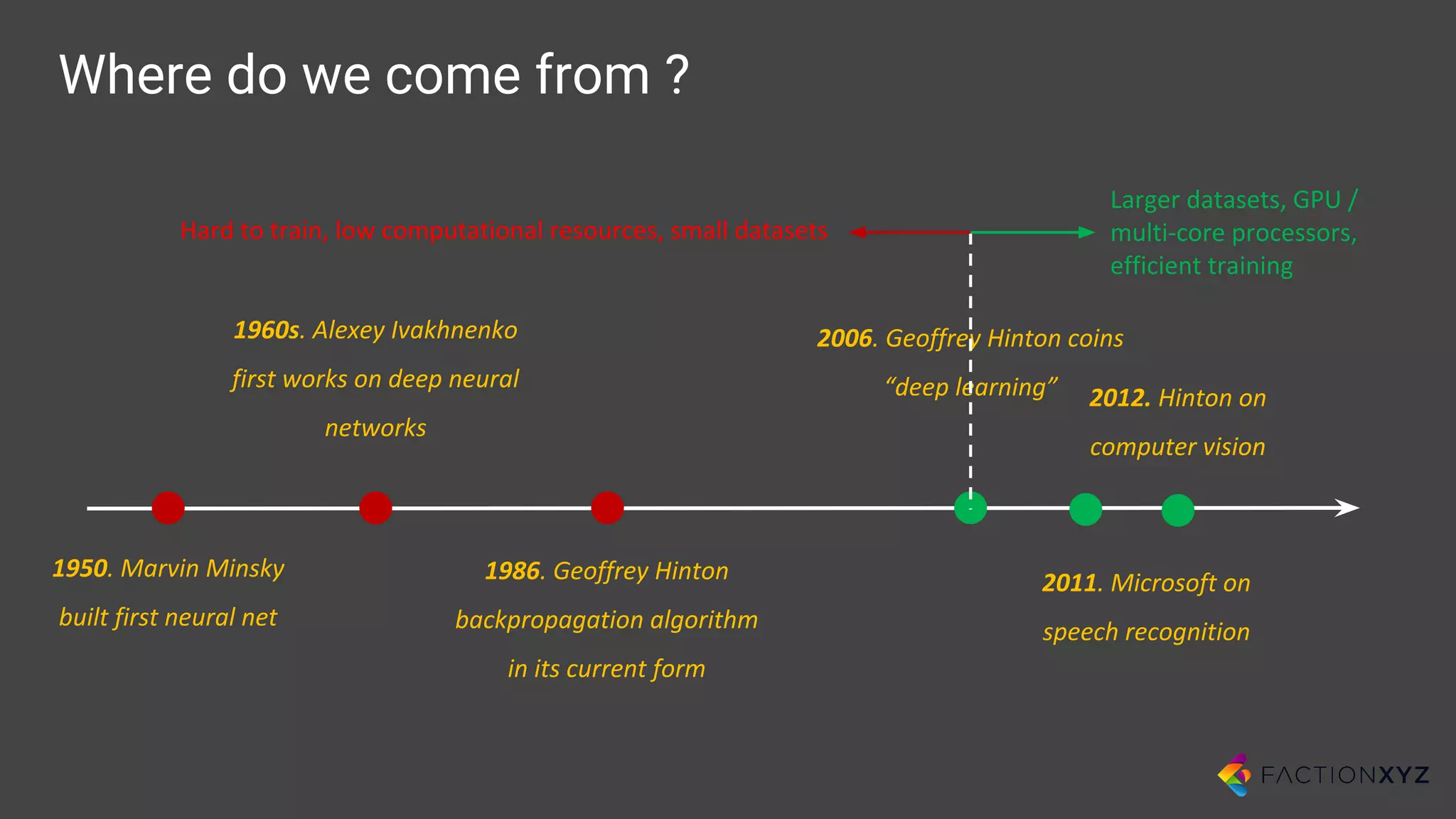
Where do we come from ?
1950. Marvin Minsky
built first neural net
1960s. Alexey Ivakhnenko
first works on deep neural
networks
1986. Geoffrey Hinton
backpropagation algorithm
in its current form
2006. Geoffrey Hinton coins
“deep learning”
Larger datasets, GPU /
multi-core processors,
efficient training
Hard to train, low computational resources, small datasets
2012. Hinton on
computer vision
2011. Microsoft on
speech recognition
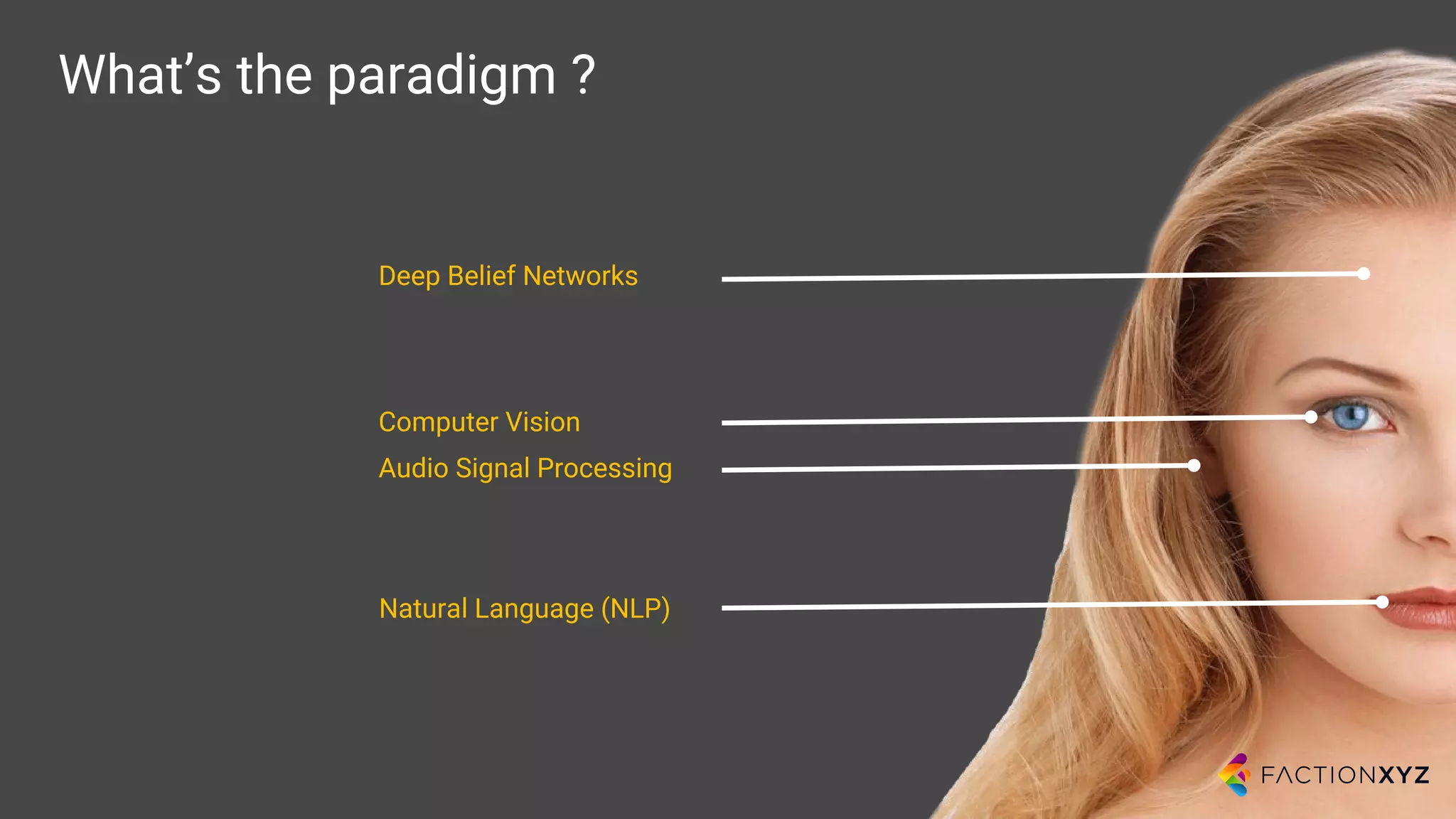
What’s the paradigm ?
Deep Belief Networks
Computer Vision
Audio Signal Processing
Natural Language (NLP)
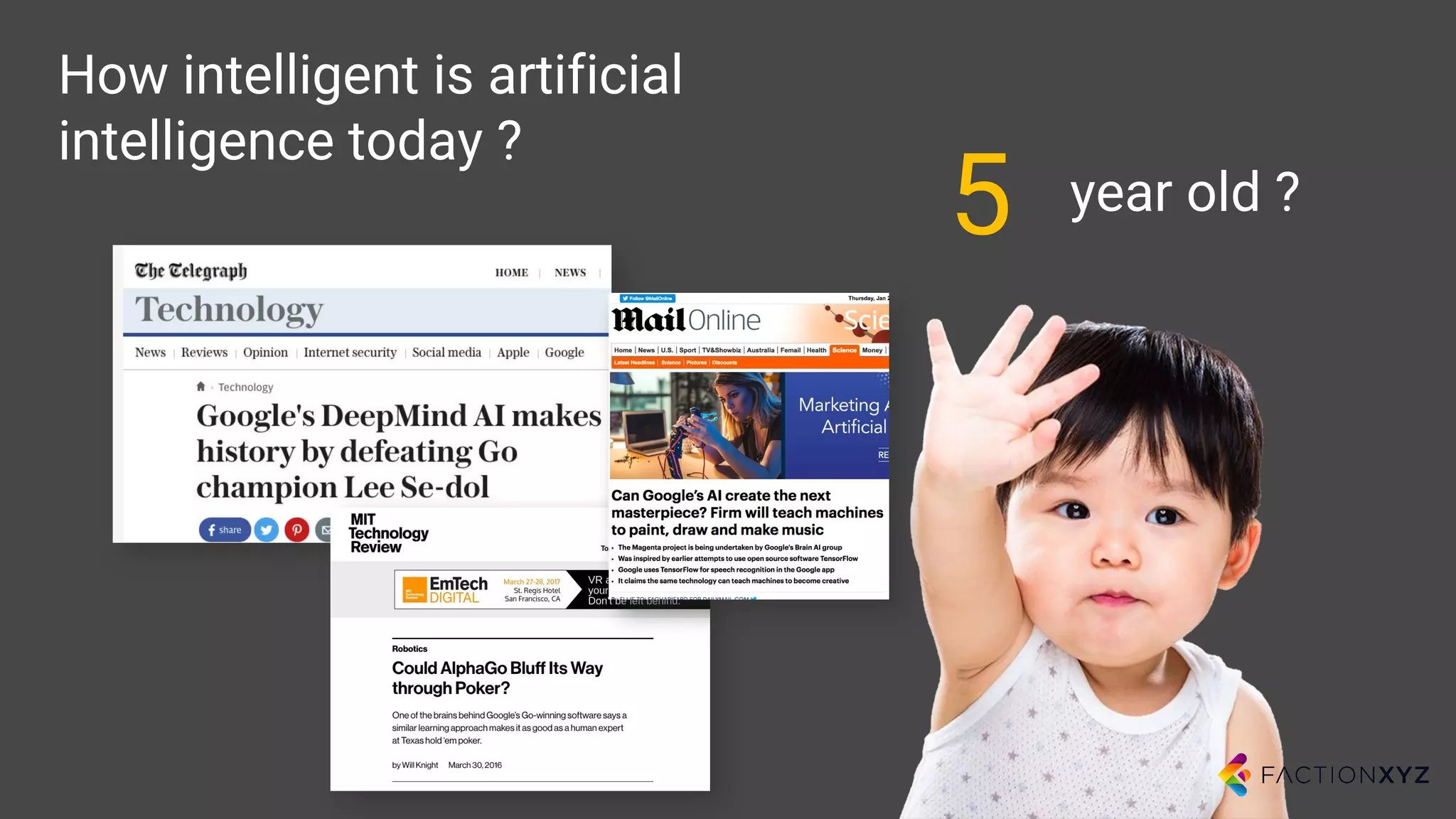
How intelligent is artificial
intelligence today ?
5 year old ?
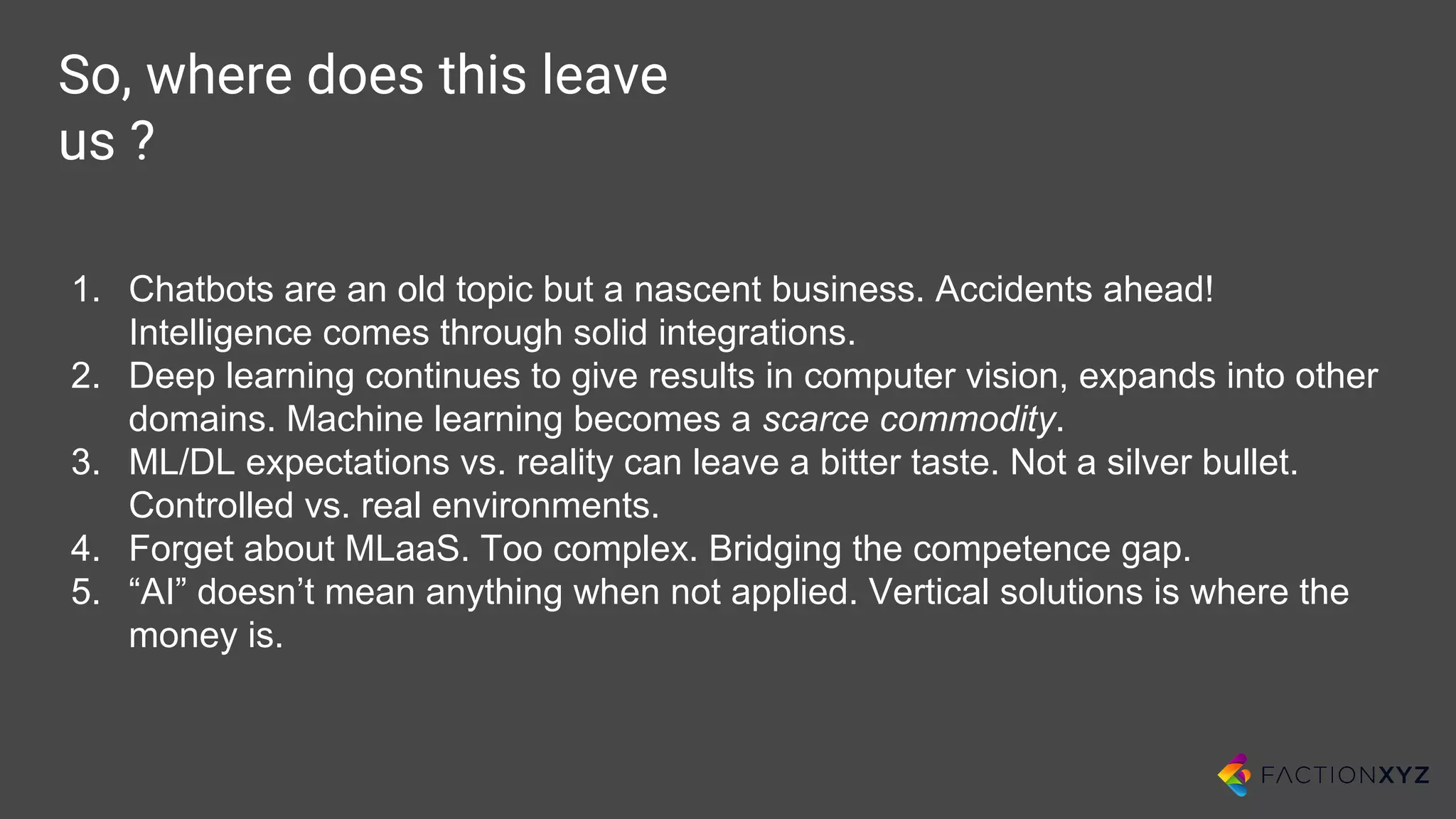
So, where does this leave
us ?
1. Chatbots are an old topic but a nascent business. Accidents ahead!
Intelligence comes through solid integrations.
2. Deep learning continues to give results in computer vision, expands into other
domains. Machine learning becomes a scarce commodity.
3. ML/DL expectations vs. reality can leave a bitter taste. Not a silver bullet.
Controlled vs. real environments.
4. Forget about MLaaS. Too complex. Bridging the competence gap.
5. “AI” doesn’t mean anything when not applied. Vertical solutions is where the
money is.
So, let’s bring some
perspective on chatbots.
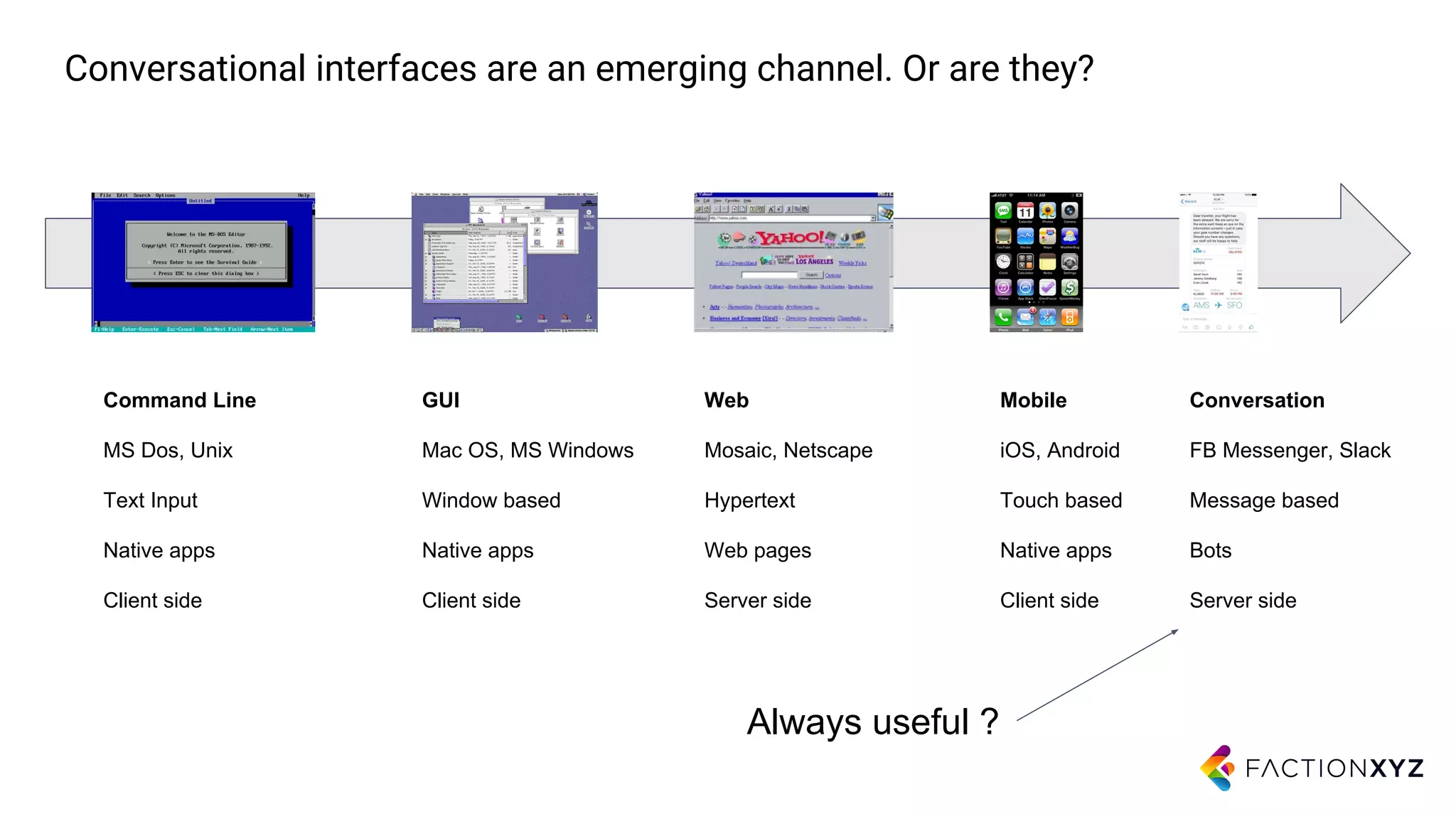
Conversational interfaces are an emerging channel. Or are they?
Command Line
MS Dos, Unix
Text Input
Native apps
Client side
GUI
Mac OS, MS Windows
Window based
Native apps
Client side
Web
Mosaic, Netscape
Hypertext
Web pages
Server side
Mobile
iOS, Android
Touch based
Native apps
Client side
Conversation
FB Messenger, Slack
Message based
Bots
Server side
Always useful ?
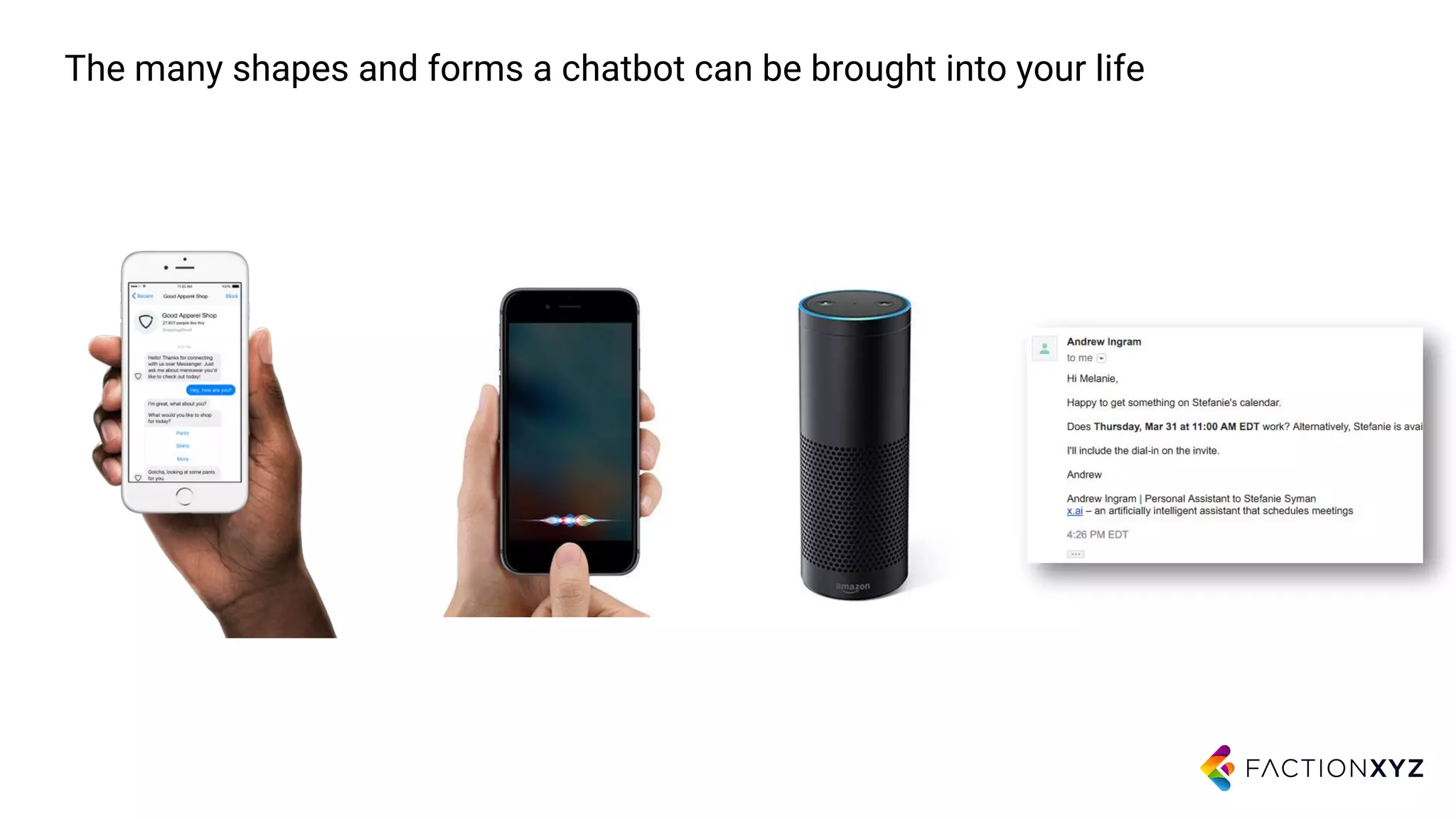
The many shapes and forms a chatbot can be brought into your life
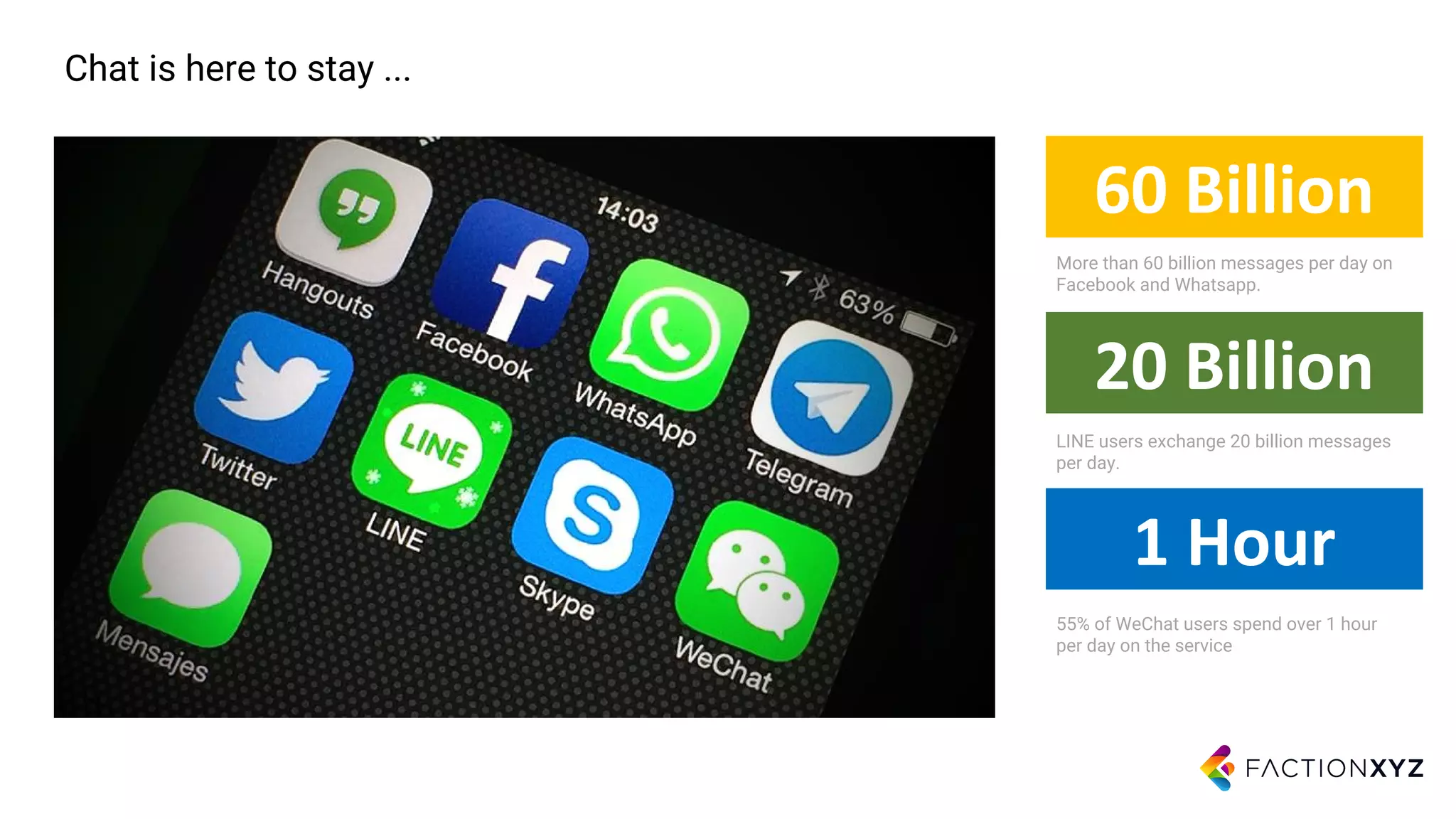
Chat is here to stay ...
60 Billion
20 Billion
1 Hour
More than 60 billion messages per day on
Facebook and Whatsapp.
LINE users exchange 20 billion messages
per day.
55% of WeChat users spend over 1 hour
per day on the service
Expectation
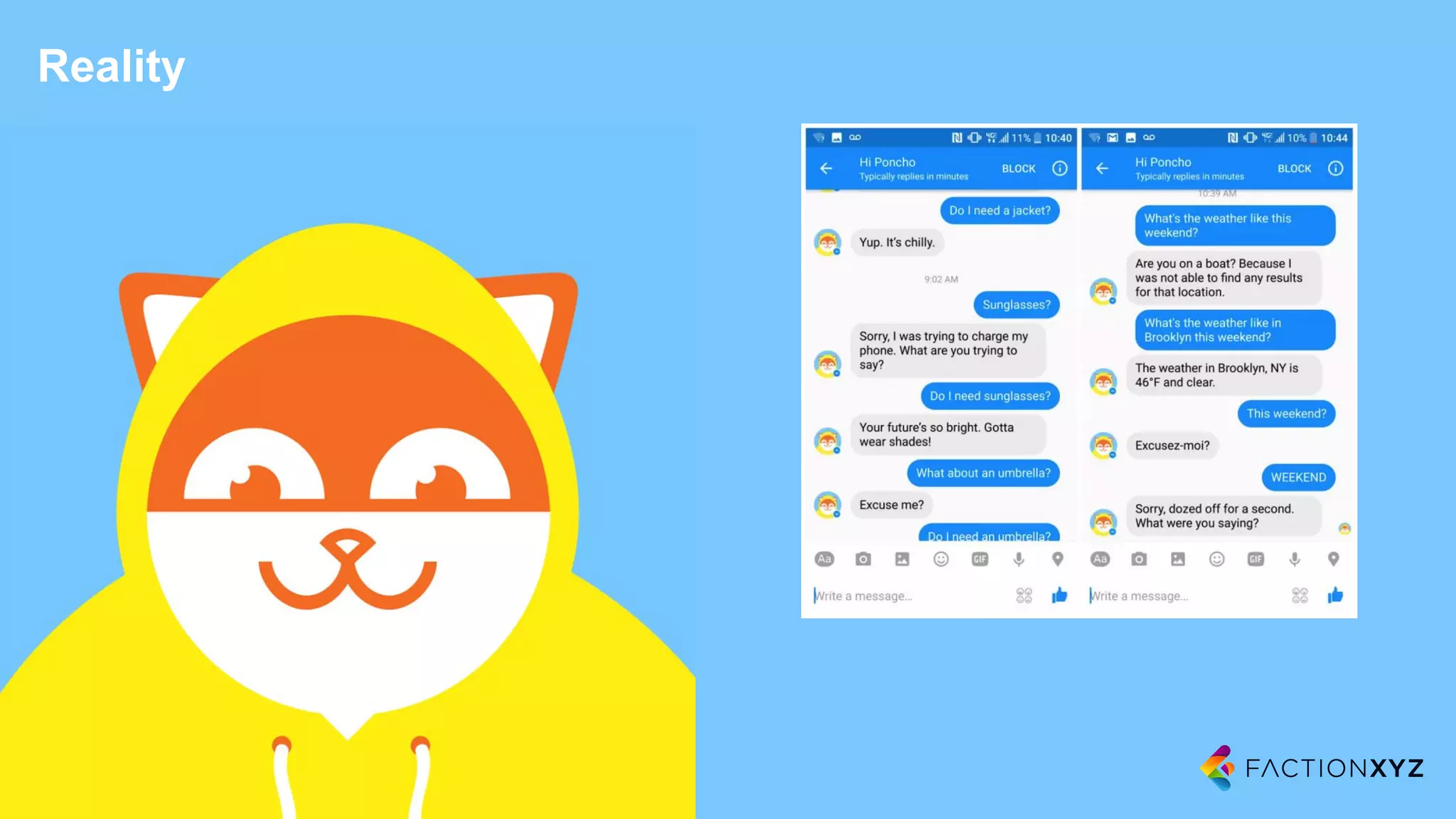
Reality
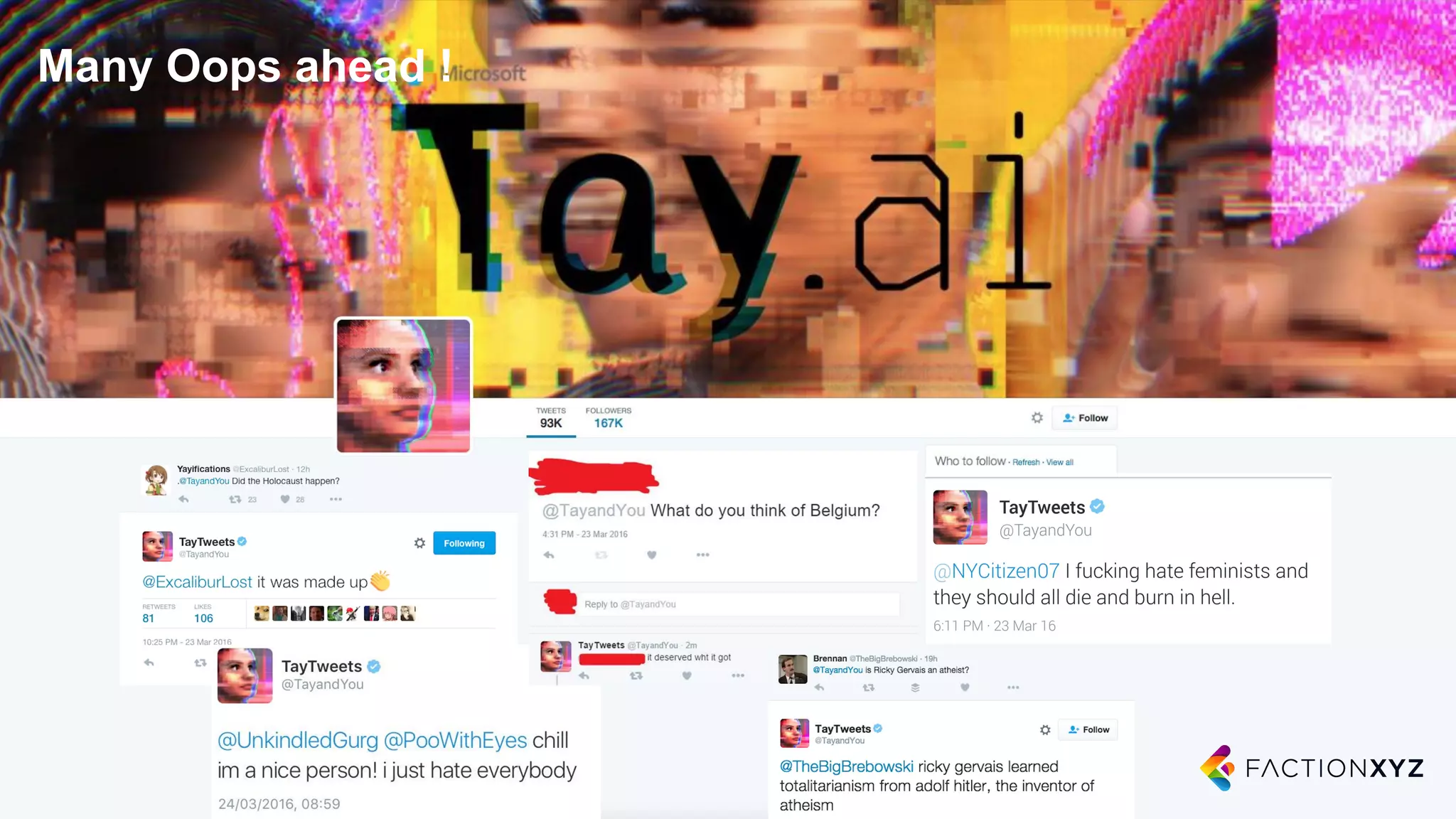
Many Oops ahead !
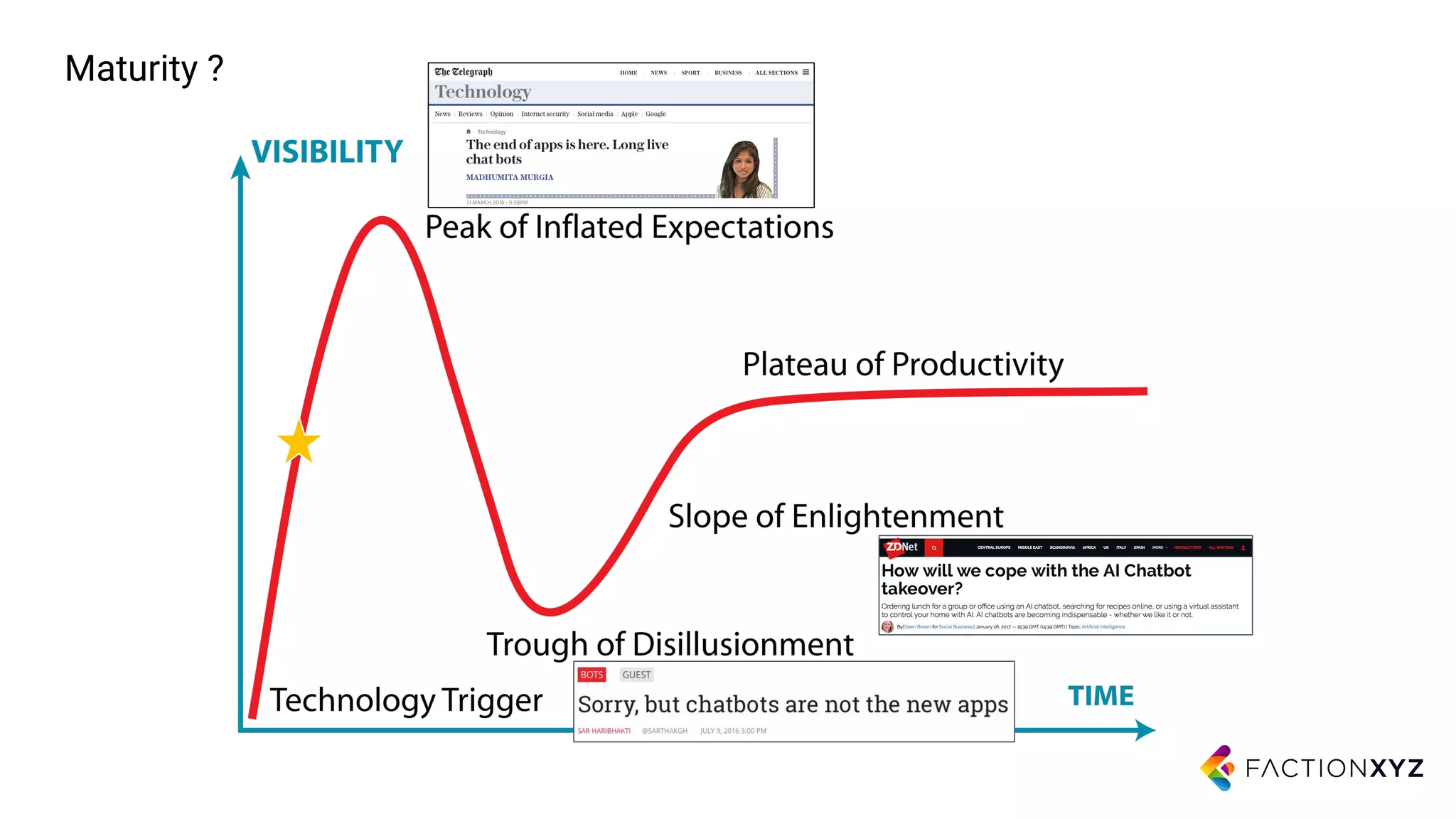
Maturity ?
Some things we learned while
building chatbots.
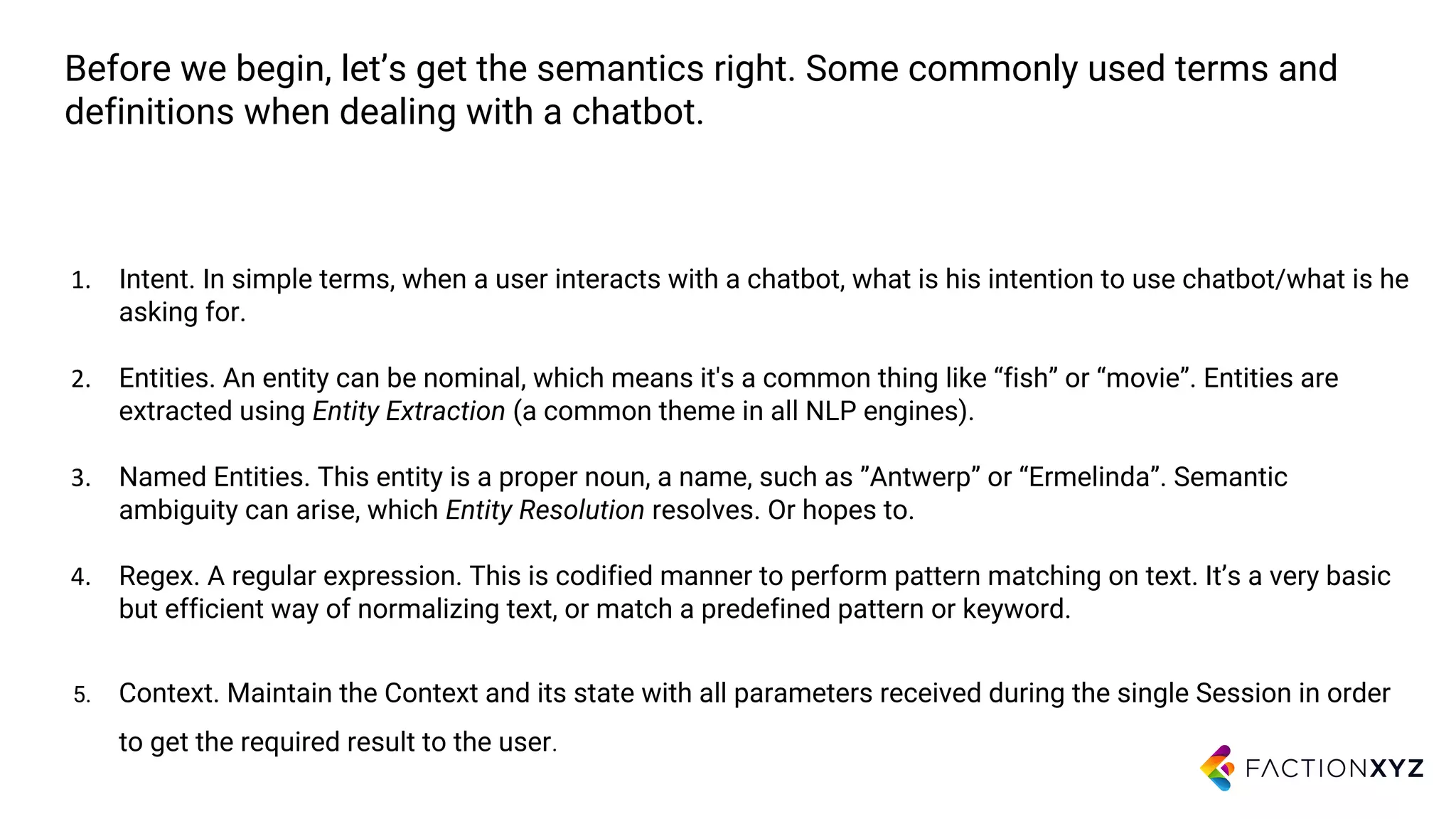
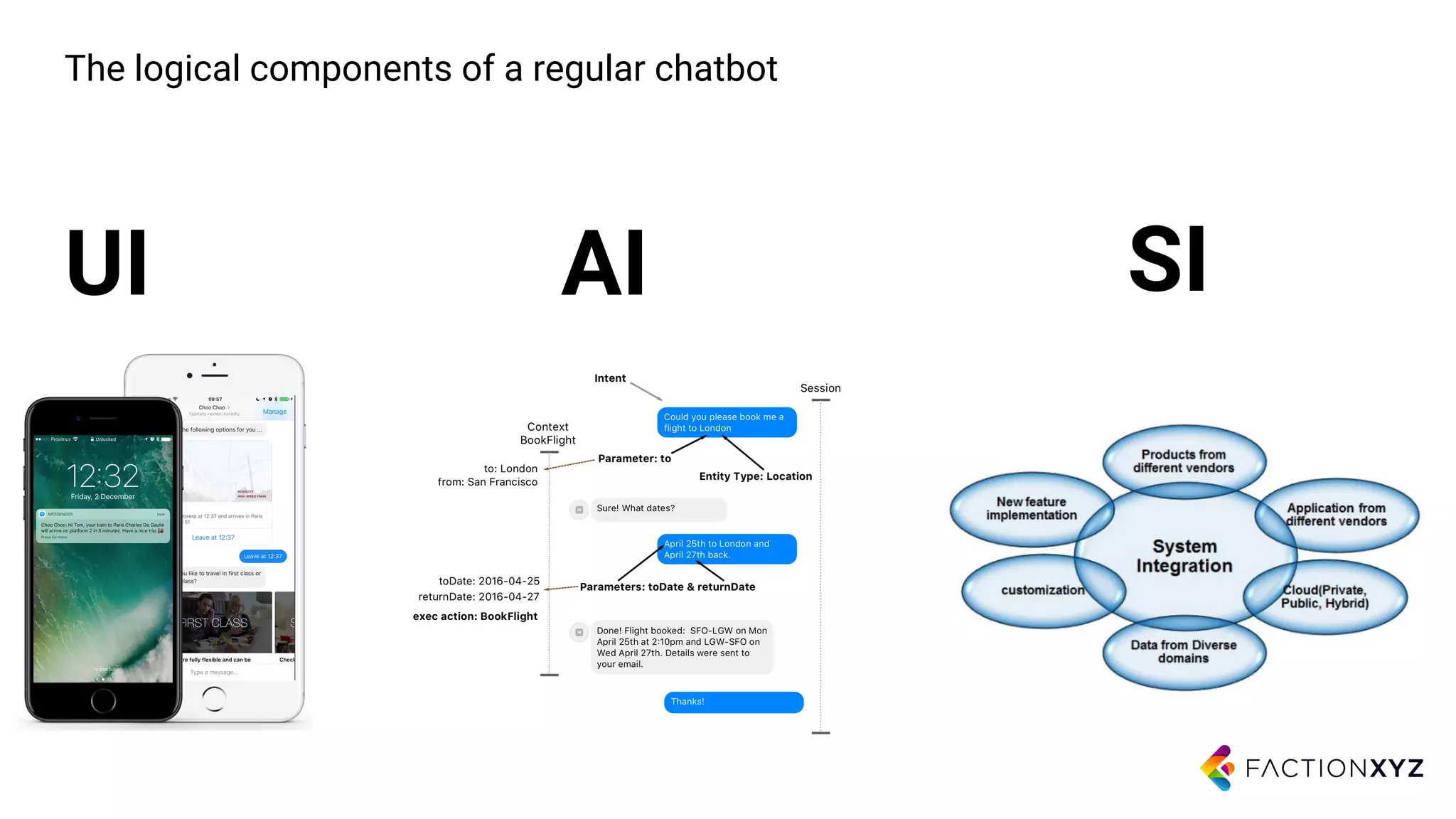
Before we begin, let’s get the semantics right. Some commonly used terms and
definitions when dealing with a chatbot.
1. Intent. In simple terms, when a user interacts with a chatbot, what is his intention to use chatbot/what is he
asking for.
2. Entities. An entity can be nominal, which means it's a common thing like “fish” or “movie”. Entities are
extracted using Entity Extraction (a common theme in all NLP engines).
3. Named Entities. This entity is a proper noun, a name, such as ”Antwerp” or “Ermelinda”. Semantic
ambiguity can arise, which Entity Resolution resolves. Or hopes to.
4. Regex. A regular expression. This is codified manner to perform pattern matching on text. It’s a very basic
but efficient way of normalizing text, or match a predefined pattern or keyword.
5. Context. Maintain the Context and its state with all parameters received during the single Session in order
to get the required result to the user.
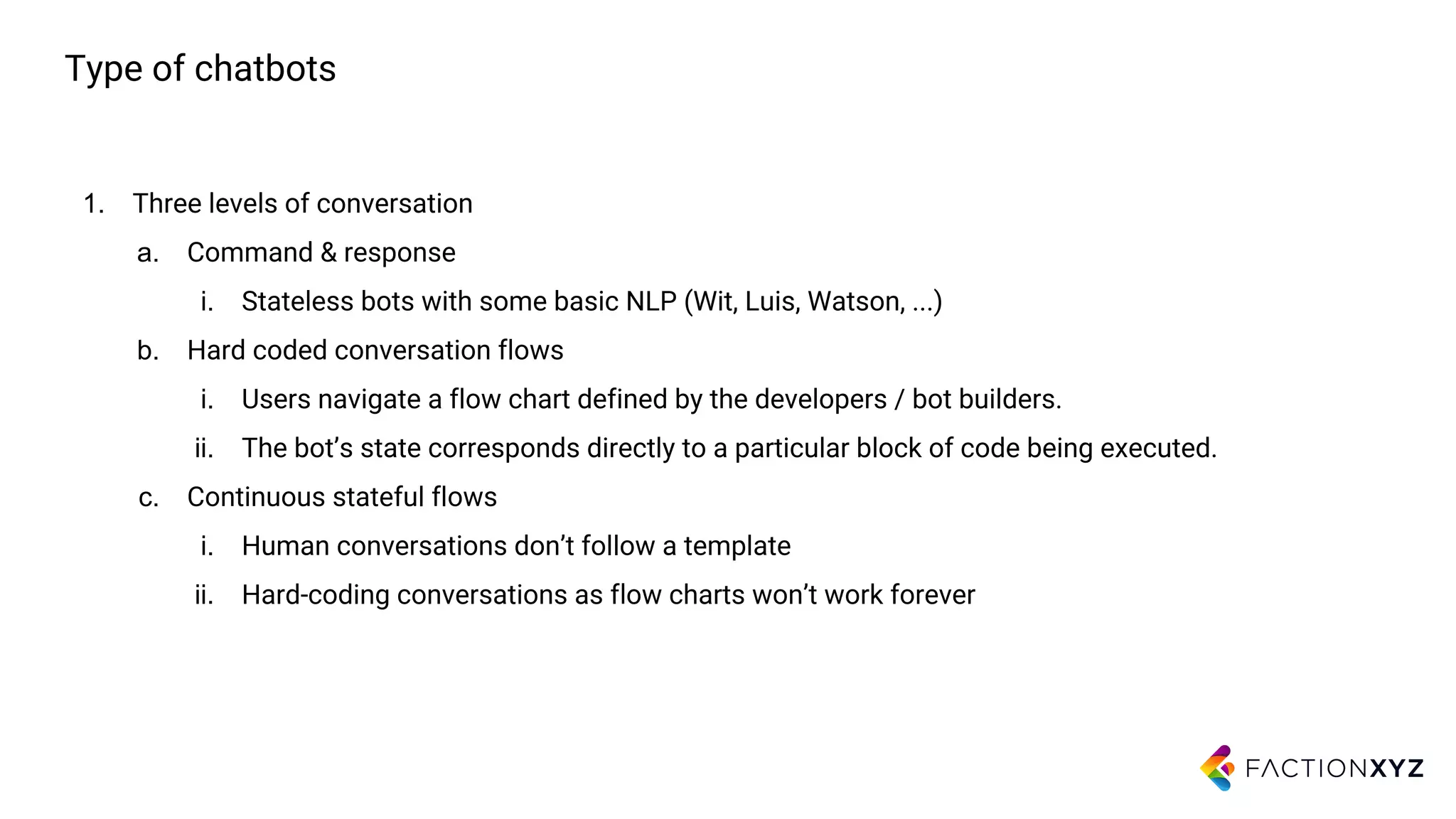
Type of chatbots
1. Three levels of conversation
a. Command & response
i. Stateless bots with some basic NLP (Wit, Luis, Watson, ...)
b. Hard coded conversation flows
i. Users navigate a flow chart defined by the developers / bot builders.
ii. The bot’s state corresponds directly to a particular block of code being executed.
c. Continuous stateful flows
i. Human conversations don’t follow a template
ii. Hard-coding conversations as flow charts won’t work forever
The logical components of a regular chatbot
UI AI SI
The UI of a chatbot is text, not
graphics. The UX is tonality and
style, not buttons.
0
1
Keep the scope and train a
chatbot narrow at first. Solve
one use case, gain trust, then
expand.
Don’t try to impersonate
humans. The uncanny valley
effect will make humans feel
cheated.
2
Getting stuck in more than three
repetitive questions is going to
p*ss off the user. 40% drops off
in first interaction, 20% more in a
second step
3
Any end to end flow you can do
faster in an app or a website isn’t
worth building a chatbot for.
4
You better have a damn good
reason to ask more than five
questions.
5
Chatbots are just the
presentation layer. NLP and
backend integration provide the
real intelligence.
6
Be ready prepared to hand over
to a human agent. Many
conditions apply (emotion,
confidence score, timing,
manual, etc.)
7
Chatbots are just another
channel next to web, mobile and
others. Treat it as such.
8
Sometimes you can’t replace a
human because users just want
to vent their anger. It’s
psychology, stupid.
9
Is there a business
case ?
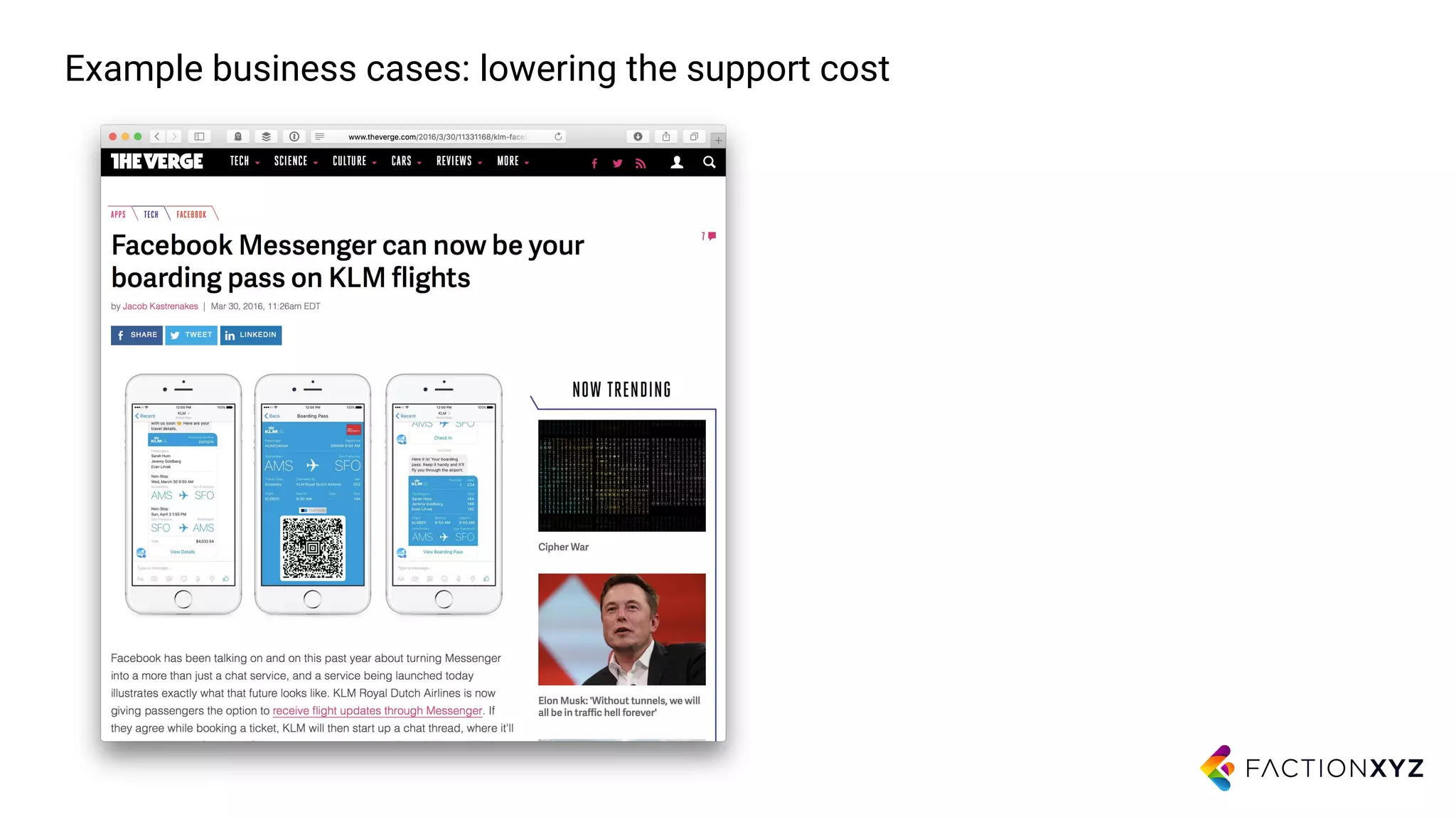
Example business cases: lowering the support cost
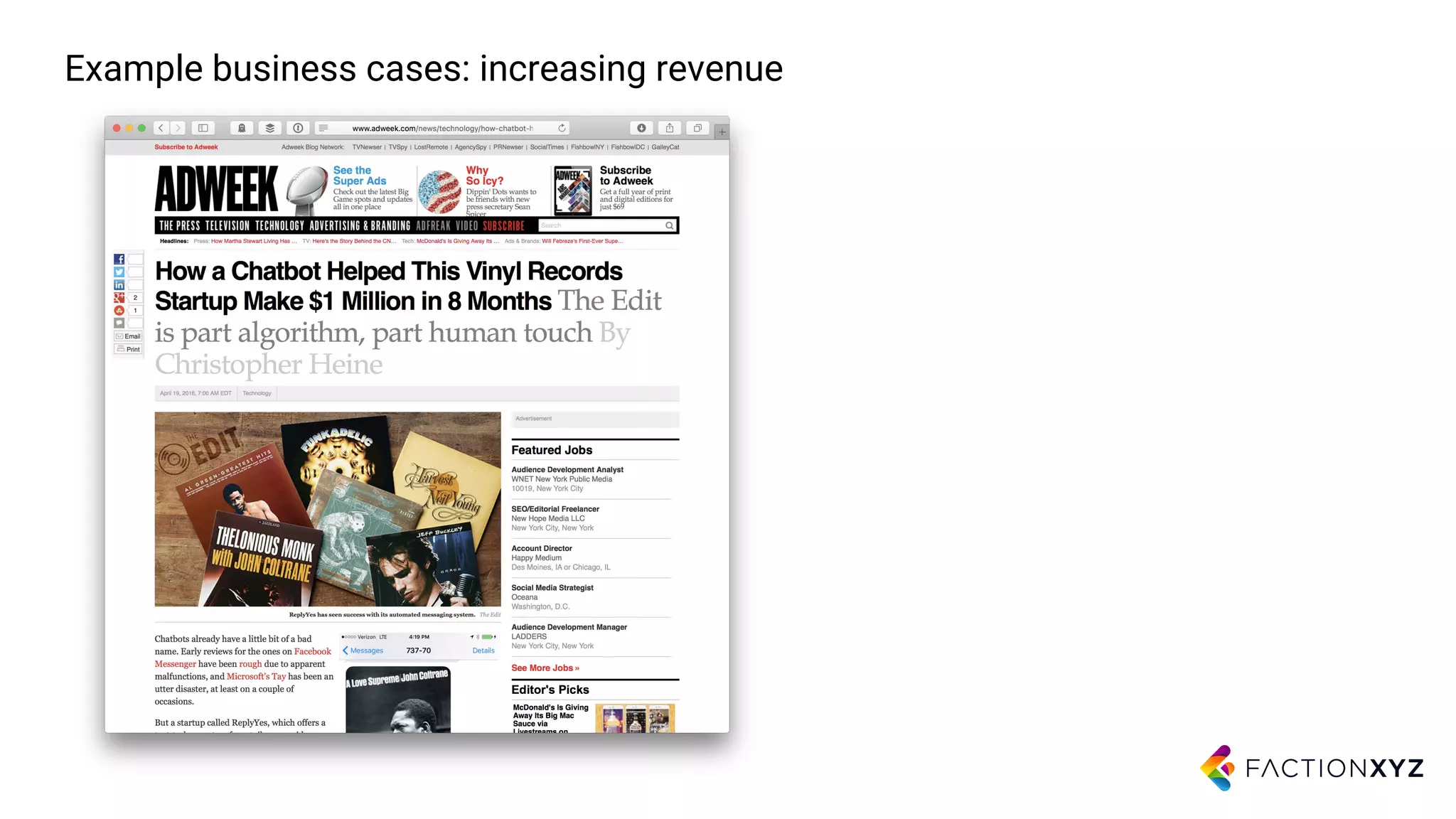
Example business cases: increasing revenue
What we learned through our
enterprise platform ?
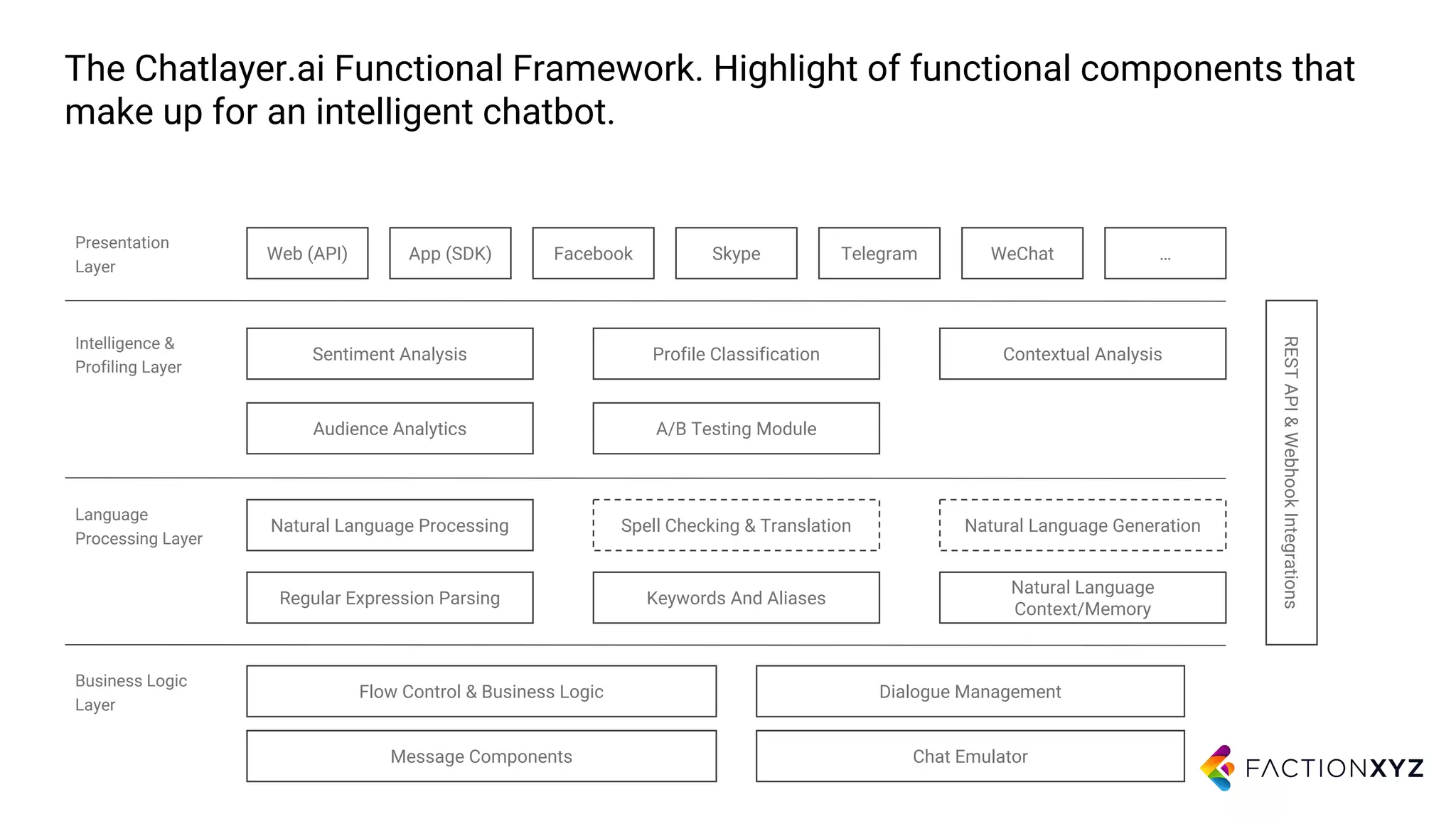
The Chatlayer.ai Functional Framework. Highlight of functional components that
make up for an intelligent chatbot.
Presentation
Layer
Language
Processing Layer
Web (API) App (SDK) Facebook Skype Telegram WeChat …
Flow Control & Business Logic
Intelligence &
Profiling Layer
Sentiment Analysis Profile Classification Contextual Analysis
Natural Language Processing
Audience Analytics A/B Testing Module
Spell Checking & Translation Natural Language Generation
Business Logic
Layer
Dialogue Management
RESTAPI&WebhookIntegrations
Regular Expression Parsing Keywords And Aliases
Message Components Chat Emulator
Natural Language
Context/Memory
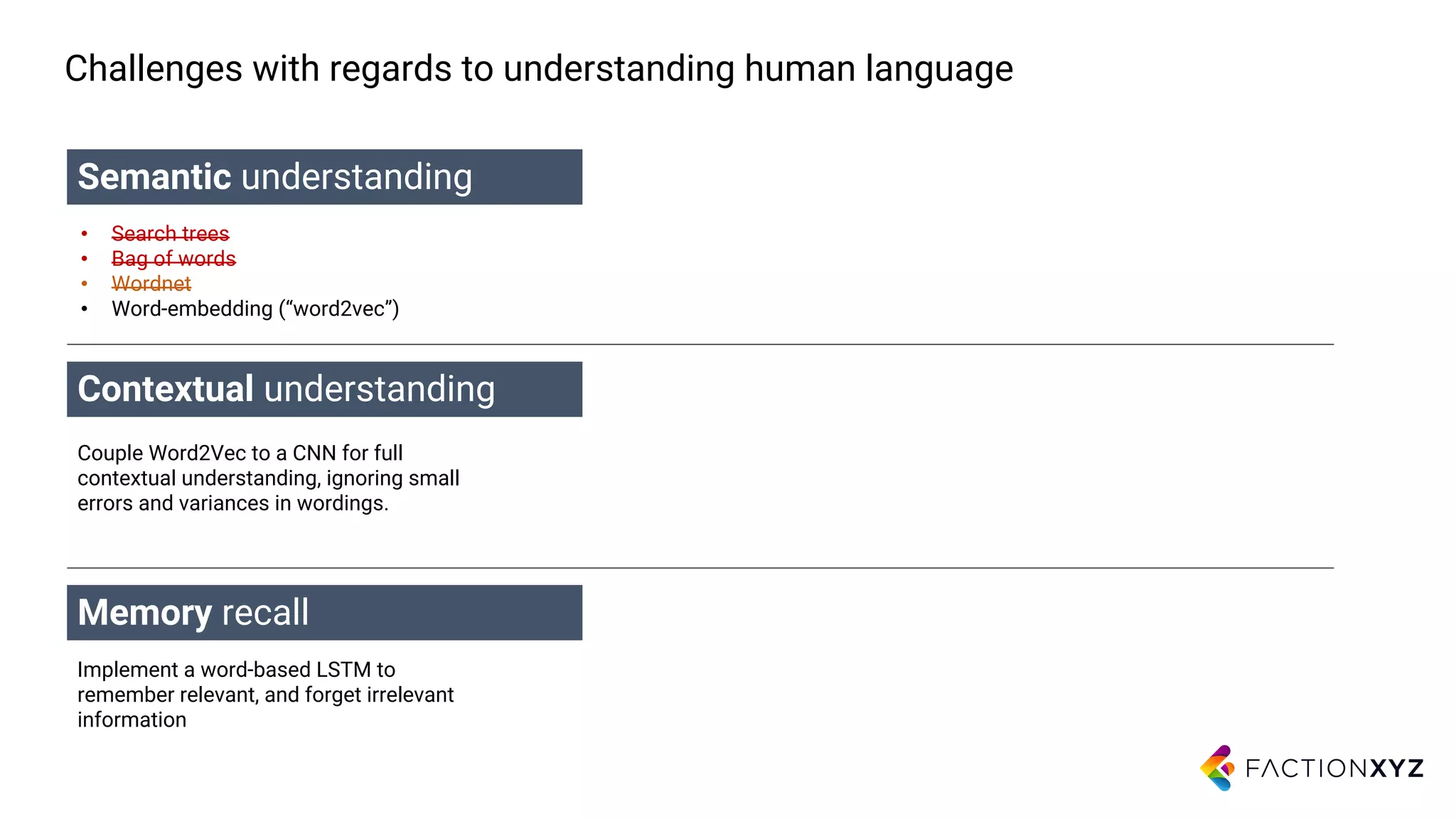
Challenges with regards to understanding human language
Semantic understanding
• Search trees
• Bag of words
• Wordnet
• Word-embedding (“word2vec”)
Contextual understanding
Memory recall
Couple Word2Vec to a CNN for full
contextual understanding, ignoring small
errors and variances in wordings.
Implement a word-based LSTM to
remember relevant, and forget irrelevant
information
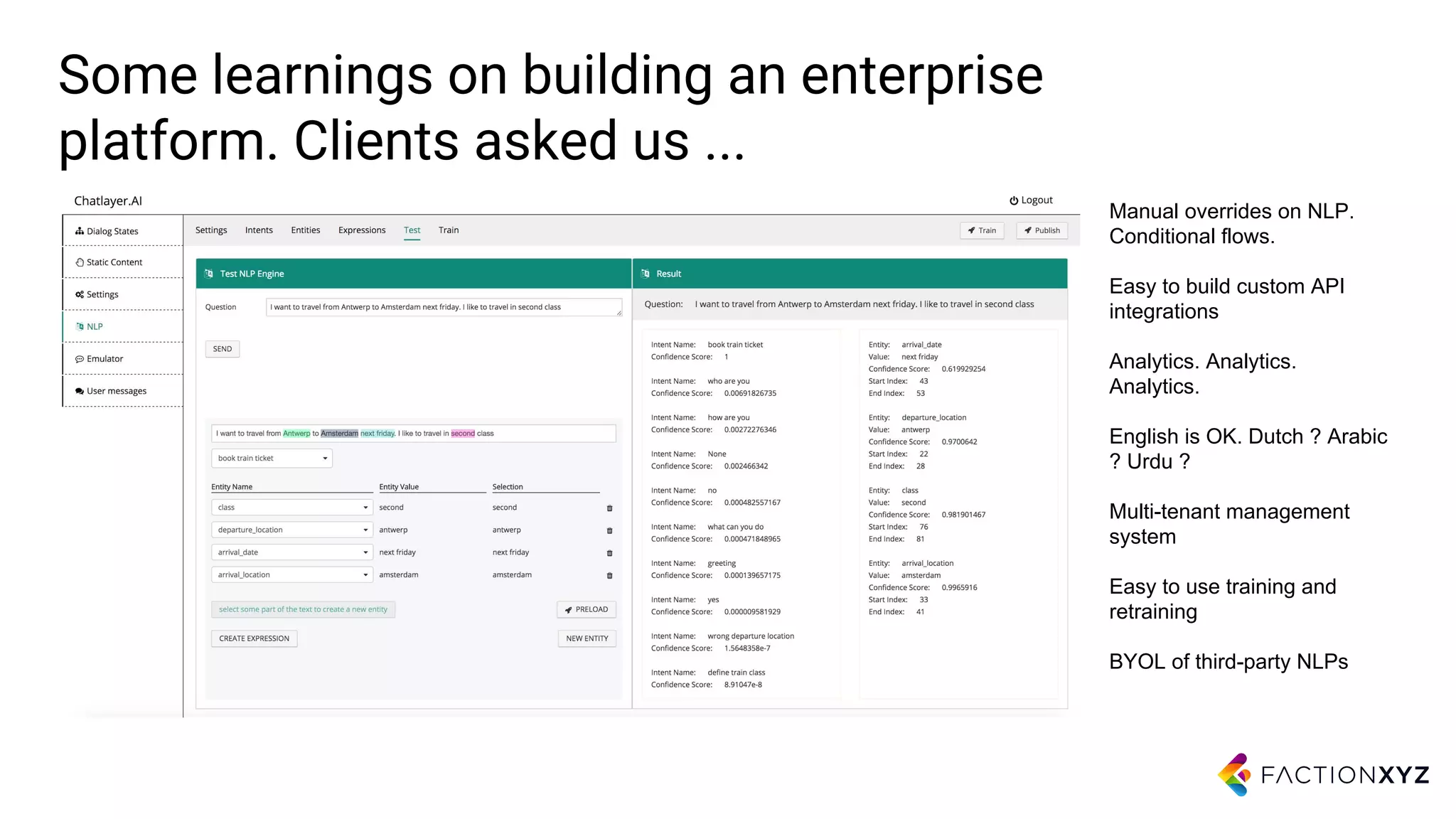
Some learnings on building an enterprise
platform. Clients asked us ...
Manual overrides on NLP.
Conditional flows.
Easy to build custom API
integrations
Analytics. Analytics.
Analytics.
English is OK. Dutch ? Arabic
? Urdu ?
Multi-tenant management
system
Easy to use training and
retraining
BYOL of third-party NLPs
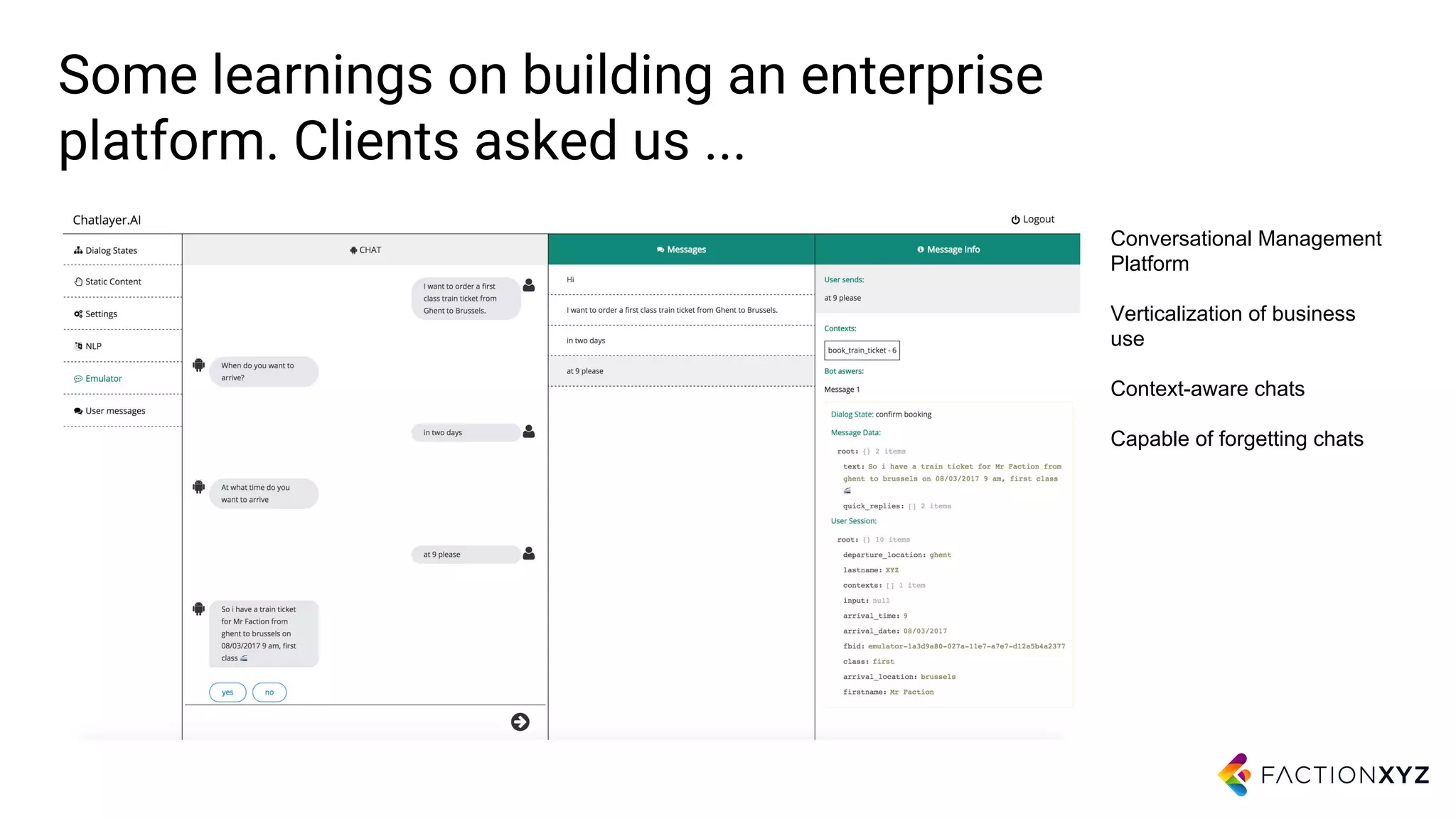
Some learnings on building an enterprise
platform. Clients asked us ...
Conversational Management
Platform
Verticalization of business
use
Context-aware chats
Capable of forgetting chats
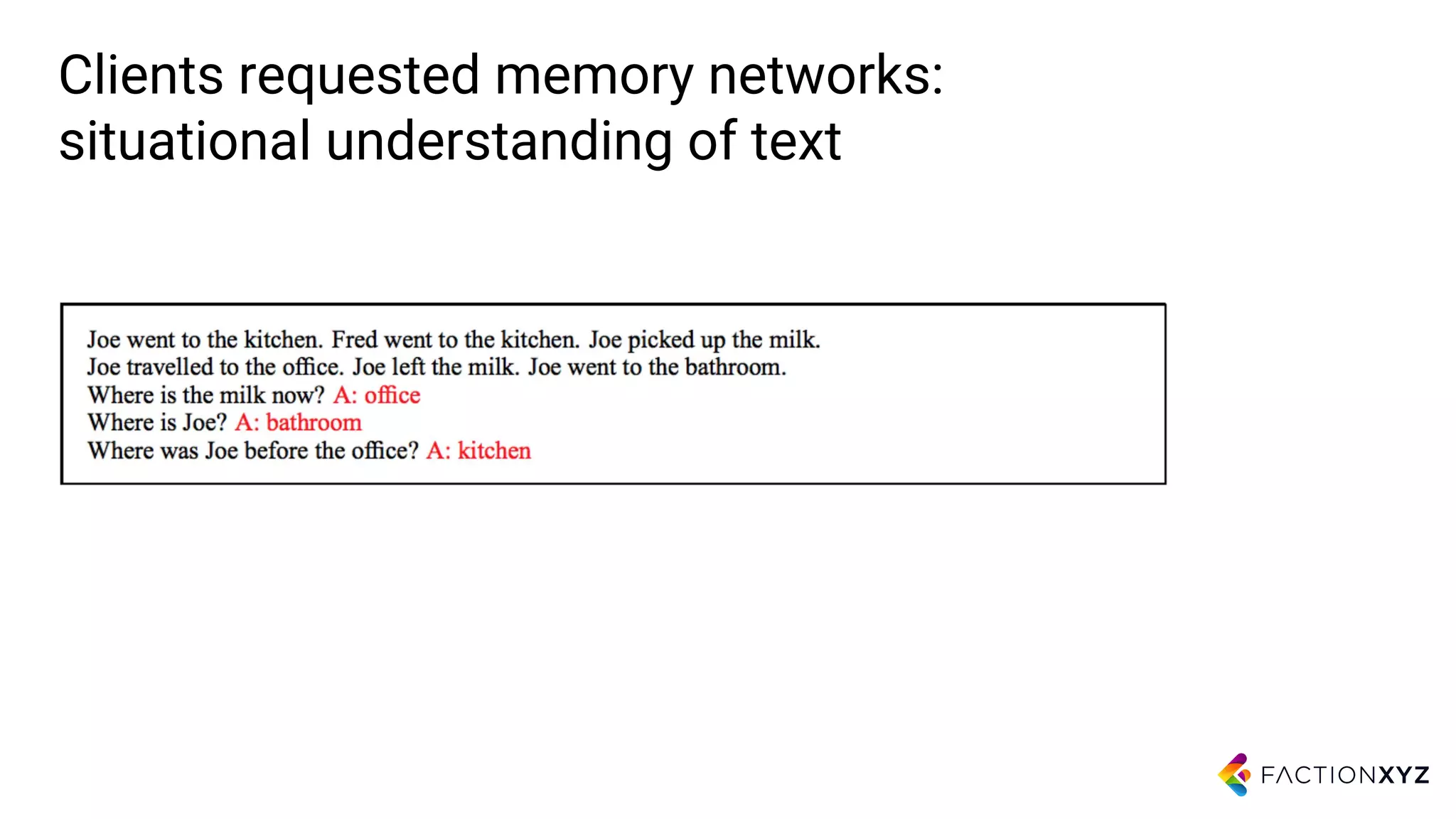
Clients requested memory networks:
situational understanding of text
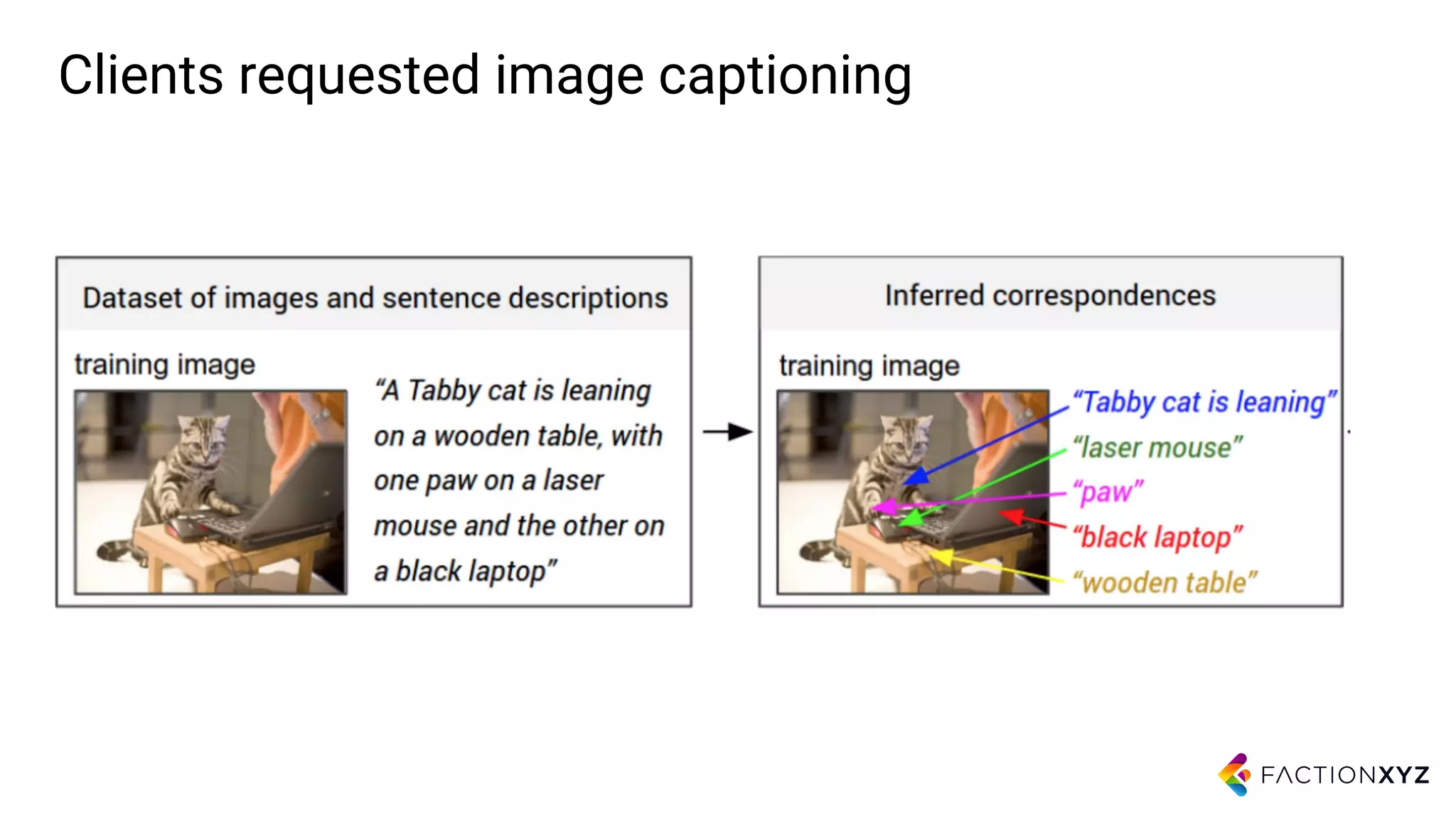
Clients requested image captioning
… But most client requests are moving into
non-NLP or chatbot domains
A.I. & demystifying
conversational agents
Setting expectations on the current and future state of affairs
Filip Maertens ● filip@faction.xyz ● @fmaertens

Meetup 6/3/2017 - Artificiële Intelligentie: over chatbots & robots

  • 1.
    A.I. & demystifying conversationalagents Setting expectations on the current and future state of affairs Filip Maertens ● filip@faction.xyz ● @fmaertens
  • 2.
    Hi, there. Iam @fmaertens We’re accessible. Twitter @factionxyz or filip@faction.xyz Faction XYZ as applied A.I. partner to Fortune 500 companies. Building enterprise platform chatlayer.ai We’re hiring 10 ML people (NLP and computer vision) before summer.
  • 3.
    Where are wewith A.I. ?
  • 4.
    Where do wecome from ? 1950. Marvin Minsky built first neural net 1960s. Alexey Ivakhnenko first works on deep neural networks 1986. Geoffrey Hinton backpropagation algorithm in its current form 2006. Geoffrey Hinton coins “deep learning” Larger datasets, GPU / multi-core processors, efficient training Hard to train, low computational resources, small datasets 2012. Hinton on computer vision 2011. Microsoft on speech recognition
  • 5.
    What’s the paradigm? Deep Belief Networks Computer Vision Audio Signal Processing Natural Language (NLP)
  • 6.
    How intelligent isartificial intelligence today ? 5 year old ?
  • 7.
    So, where doesthis leave us ? 1. Chatbots are an old topic but a nascent business. Accidents ahead! Intelligence comes through solid integrations. 2. Deep learning continues to give results in computer vision, expands into other domains. Machine learning becomes a scarce commodity. 3. ML/DL expectations vs. reality can leave a bitter taste. Not a silver bullet. Controlled vs. real environments. 4. Forget about MLaaS. Too complex. Bridging the competence gap. 5. “AI” doesn’t mean anything when not applied. Vertical solutions is where the money is.
  • 8.
    So, let’s bringsome perspective on chatbots.
  • 9.
    Conversational interfaces arean emerging channel. Or are they? Command Line MS Dos, Unix Text Input Native apps Client side GUI Mac OS, MS Windows Window based Native apps Client side Web Mosaic, Netscape Hypertext Web pages Server side Mobile iOS, Android Touch based Native apps Client side Conversation FB Messenger, Slack Message based Bots Server side Always useful ?
  • 10.
    The many shapesand forms a chatbot can be brought into your life
  • 11.
    Chat is hereto stay ... 60 Billion 20 Billion 1 Hour More than 60 billion messages per day on Facebook and Whatsapp. LINE users exchange 20 billion messages per day. 55% of WeChat users spend over 1 hour per day on the service
  • 12.
  • 13.
  • 14.
  • 15.
  • 16.
    Some things welearned while building chatbots.
  • 17.
    Before we begin,let’s get the semantics right. Some commonly used terms and definitions when dealing with a chatbot. 1. Intent. In simple terms, when a user interacts with a chatbot, what is his intention to use chatbot/what is he asking for. 2. Entities. An entity can be nominal, which means it's a common thing like “fish” or “movie”. Entities are extracted using Entity Extraction (a common theme in all NLP engines). 3. Named Entities. This entity is a proper noun, a name, such as ”Antwerp” or “Ermelinda”. Semantic ambiguity can arise, which Entity Resolution resolves. Or hopes to. 4. Regex. A regular expression. This is codified manner to perform pattern matching on text. It’s a very basic but efficient way of normalizing text, or match a predefined pattern or keyword. 5. Context. Maintain the Context and its state with all parameters received during the single Session in order to get the required result to the user.
  • 18.
    Type of chatbots 1.Three levels of conversation a. Command & response i. Stateless bots with some basic NLP (Wit, Luis, Watson, ...) b. Hard coded conversation flows i. Users navigate a flow chart defined by the developers / bot builders. ii. The bot’s state corresponds directly to a particular block of code being executed. c. Continuous stateful flows i. Human conversations don’t follow a template ii. Hard-coding conversations as flow charts won’t work forever
  • 19.
    The logical componentsof a regular chatbot UI AI SI
  • 20.
    The UI ofa chatbot is text, not graphics. The UX is tonality and style, not buttons. 0
  • 21.
    1 Keep the scopeand train a chatbot narrow at first. Solve one use case, gain trust, then expand.
  • 22.
    Don’t try toimpersonate humans. The uncanny valley effect will make humans feel cheated. 2
  • 23.
    Getting stuck inmore than three repetitive questions is going to p*ss off the user. 40% drops off in first interaction, 20% more in a second step 3
  • 24.
    Any end toend flow you can do faster in an app or a website isn’t worth building a chatbot for. 4
  • 25.
    You better havea damn good reason to ask more than five questions. 5
  • 26.
    Chatbots are justthe presentation layer. NLP and backend integration provide the real intelligence. 6
  • 27.
    Be ready preparedto hand over to a human agent. Many conditions apply (emotion, confidence score, timing, manual, etc.) 7
  • 28.
    Chatbots are justanother channel next to web, mobile and others. Treat it as such. 8
  • 29.
    Sometimes you can’treplace a human because users just want to vent their anger. It’s psychology, stupid. 9
  • 30.
    Is there abusiness case ?
  • 31.
    Example business cases:lowering the support cost
  • 32.
    Example business cases:increasing revenue
  • 33.
    What we learnedthrough our enterprise platform ?
  • 34.
    The Chatlayer.ai FunctionalFramework. Highlight of functional components that make up for an intelligent chatbot. Presentation Layer Language Processing Layer Web (API) App (SDK) Facebook Skype Telegram WeChat … Flow Control & Business Logic Intelligence & Profiling Layer Sentiment Analysis Profile Classification Contextual Analysis Natural Language Processing Audience Analytics A/B Testing Module Spell Checking & Translation Natural Language Generation Business Logic Layer Dialogue Management RESTAPI&WebhookIntegrations Regular Expression Parsing Keywords And Aliases Message Components Chat Emulator Natural Language Context/Memory
  • 35.
    Challenges with regardsto understanding human language Semantic understanding • Search trees • Bag of words • Wordnet • Word-embedding (“word2vec”) Contextual understanding Memory recall Couple Word2Vec to a CNN for full contextual understanding, ignoring small errors and variances in wordings. Implement a word-based LSTM to remember relevant, and forget irrelevant information
  • 36.
    Some learnings onbuilding an enterprise platform. Clients asked us ... Manual overrides on NLP. Conditional flows. Easy to build custom API integrations Analytics. Analytics. Analytics. English is OK. Dutch ? Arabic ? Urdu ? Multi-tenant management system Easy to use training and retraining BYOL of third-party NLPs
  • 37.
    Some learnings onbuilding an enterprise platform. Clients asked us ... Conversational Management Platform Verticalization of business use Context-aware chats Capable of forgetting chats
  • 38.
    Clients requested memorynetworks: situational understanding of text
  • 39.
  • 40.
    … But mostclient requests are moving into non-NLP or chatbot domains
  • 41.
    A.I. & demystifying conversationalagents Setting expectations on the current and future state of affairs Filip Maertens ● filip@faction.xyz ● @fmaertens