Sponsor:
2
PALCO
Meeting
Service Sandbox
Jane Vita,
Digitalist Group
#servicesandbox
#servicedesign
#digitalist
@janevita
Meeting
Service
Sandbox
co.
creation
Why Sandbox?
Why Sandbox?
Encourages user to
explore and have
autonomy to select their
next steps and immerse in
specific interactions points.
It is aligned with
System and Design
thinking approach
They will decide what happens,
how they will play with your
service building blocks, that
were being assigned with a
contextual meaning.
Rather than paths,
sandboxes are not shaping
behaviour, instead creates
engagement and keeps
user in control.
Personal
devices
Home
appliances
Sensors &
Detectors
Personas
Value
creation
themes
Interface
Devices
Interactions
Environmental
encounters
Social & Cultural
and legal &
Ethical
Encounters
Experience
Hierarchy
Connectivity
devices
1 2 3
9
87
4
10 11
36
12
5
Spatial
Context
Place
Description Persona
Value
Creation Encounters
Evaluation
Experience
Hierarchy
Story
Canvas
Elevator
Pitch
Layers Templates and canvases
Spatial
context
Description
of the place
and place tiles
Each room is essential to your service creation. The
room purpose can give you insights about what kinds
of activities people perform there, i.e., kitchen -
cooking, eating, family time, among others.
Living spaces
Smart Cities
Modular
Dashboards
…
semi-detatched
frequently with kids
surrounding facilities
Describe
your home
home
Single Person
Detached
Attached
Semi-detached
Row House
Terrace
Cottage
Villa
Flat/Apartment
Other:
Couple
Frequently with kids
Number of kids:
Other:
Neighborhood:
Location:
Surrounding Facilities:
Describe
your
Personas
Templates
and
tokens
The Service Sandbox includes a template that helps
you to describe people that are experiencing your
service. You will represent each persona with a token
in the board.
Name:
Short bio:Short bio: Cultural encounters:
Family Composition:
Ethics:
Mood:
Motivation:
Personal Devices:
Social encounters:
Permanent disabilities:
Temporary disabilities:
Routine:
Age:
Archetype:
Occupation:
Material Status:
Family Member:
Familiarity with technology:
Persona
Low Med High
Personal
devices
Gathering
personal
information
BikeSmart Jewelry
Bio/Health DeviceVirtual Reality
Personal devices are devices owned by an individual.
These devices are used in different contexts and they
serve multiple purposes that can enhance the service
experience.
Appliances
For home, office,
hospital etc.
Our first set includes home appliances, but the whole
layer could be substituted by other appliances related to
other places, such as office and hospitals. They represent
specific use, associated with the daily activities happening
on that particular ambient. They are not necessarily smart,
but they can become one. WasherA/C
Coffee MakerFanA
Value
creation
themes
Purpose of the
place and the
values created
Places have a purpose, and we visit them with an
intention. We expect that those places can deliver
the moments that we are looking. We go home for
example to have a pleasurable moment with our
families, to rest to sleep and to eat. We go to
hospitals to get the doctor advice, to be treated, to
seek a cure for an illness. Our values are created
around those moments. The themes help us to
understand what are the values we need to create
concerning a specific place and service proposed.
comfort learning
What’s Happening
Value Creation
Place Post-It
Drawing Here
Template
1
What’s Happening
Value Creation
Place Post-It
Drawing Here
Template
2
What’s Happening
Value Creation
Place Post-It
Drawing Here
3
Template TemplateTemplate
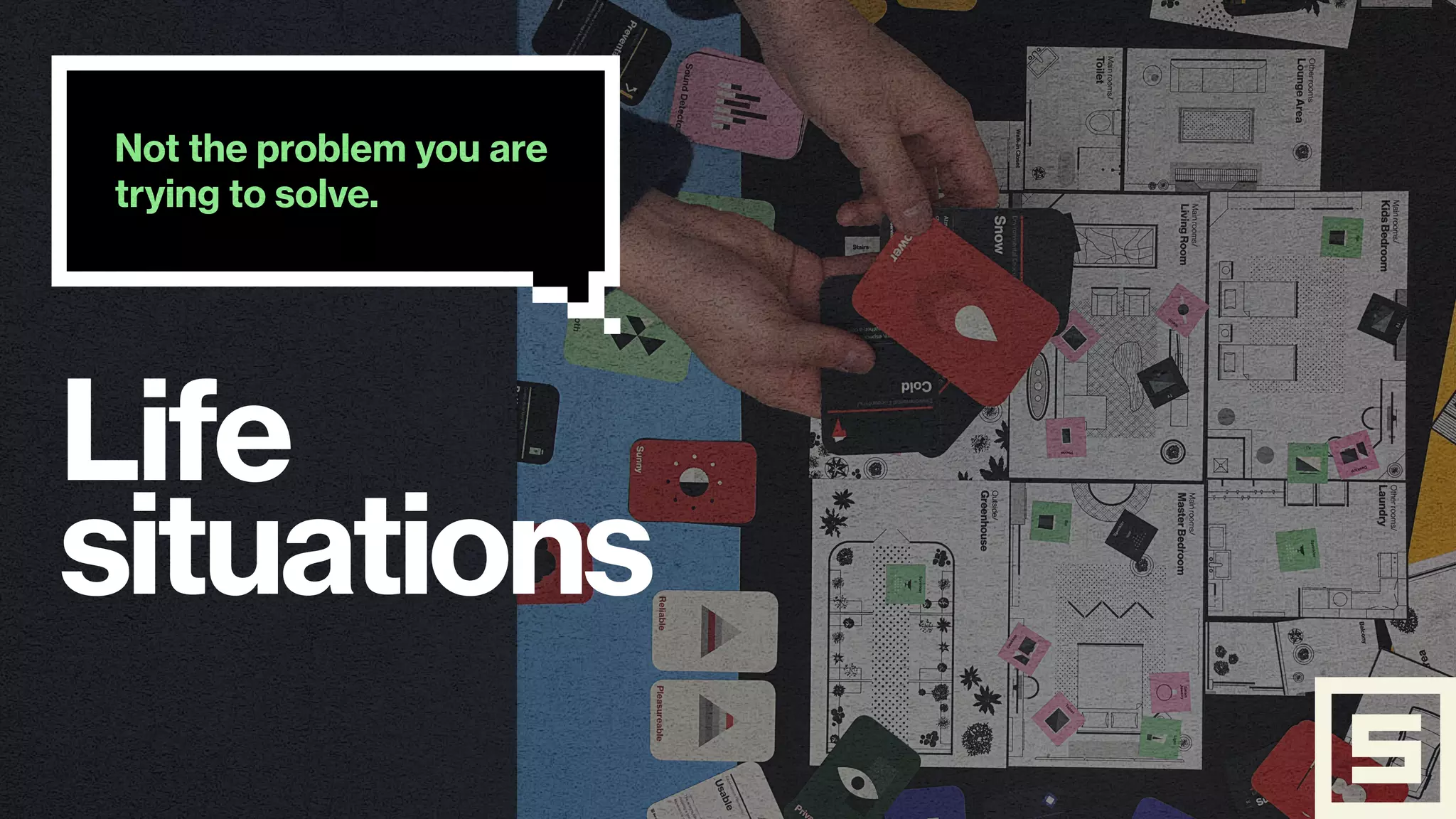
Life
situations
Not the problem you are
trying to solve.
Create a situation for
each of the value
themes.
Think of a situation
when we can deliver
the promised value.
Ideate and pick up the
best. Use the post-its.
Values &
Situations:
Use the post-its.
1 2 3
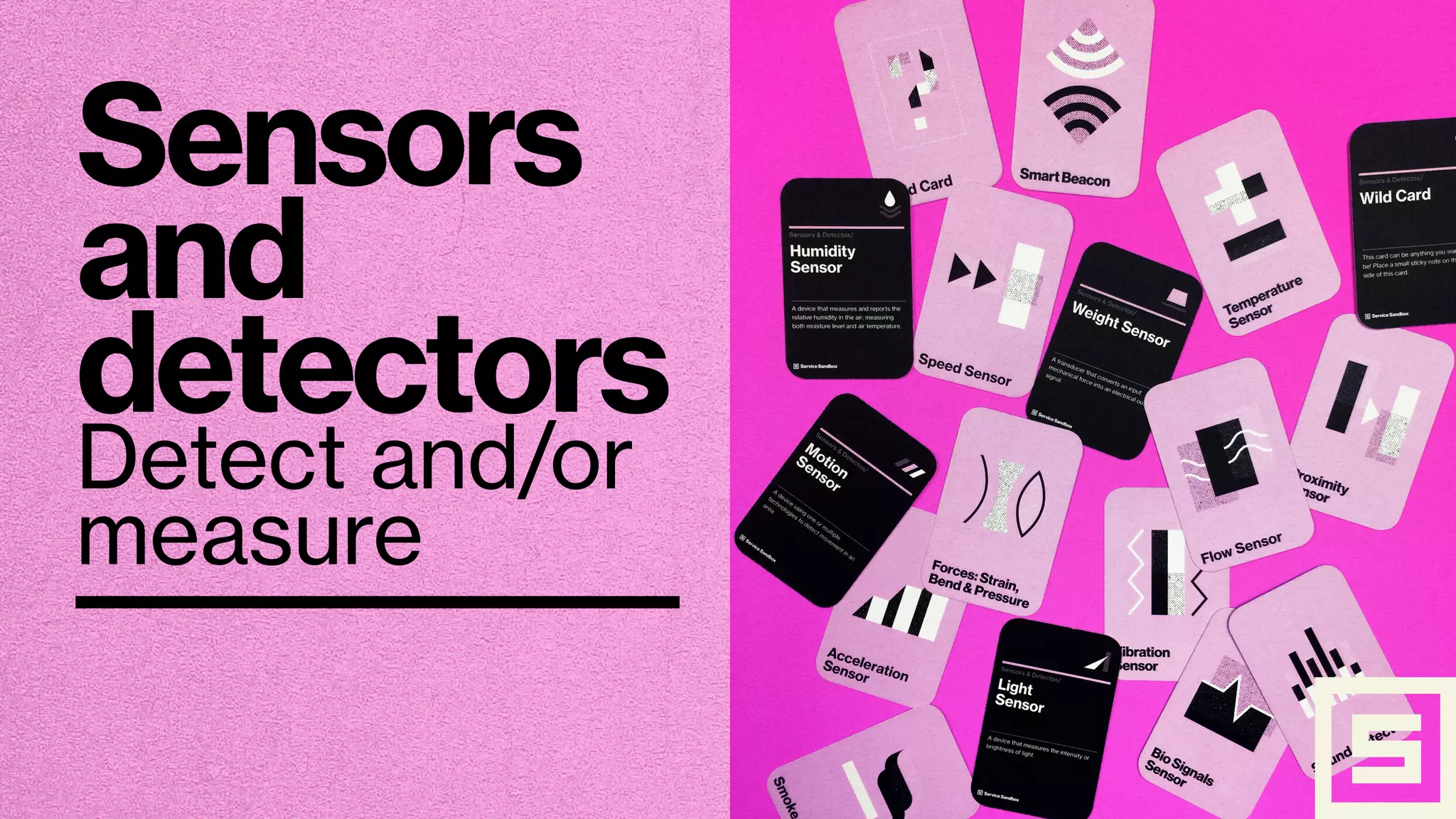
Detect and/or
measure
Sensors
and
detectors
Sensors
and
detectors
Sensors and detectors are devices which detect or
measure a physical property and record, indicate, or
respond to it. There is a great variety of sensors and
detectors and they will help you to capture the
necessary data to make your service meaningful.
Detect and/or
measure
Vibration SensorMotion Sensor
Humidity SensorFlow sensor
Interface
devices
Interacting with
machines
Interface
devices
Interacting with
machines
Air Quality MeterCamera
Intelligent Personal AssistantRadiator Control Valve
An interface device is a hardware component or
system of components that allows an individual to
interact with a machine. Personal devices are interface
devices, but we do not include them in this set since
they are represented in the other another deck.
Connectivity
devices
Connecting
machines and
data
The connectivity devices are responsible for the
communication and network, i.e., between machines,
between machine and personal devices and data
generated by the machines and individuals to the cloud.
Hyperlocal ConnectionCloud-based Connection
BluetoothBattery
Maximizing the role
of technology and
the experience
Deep in time context
and interactions
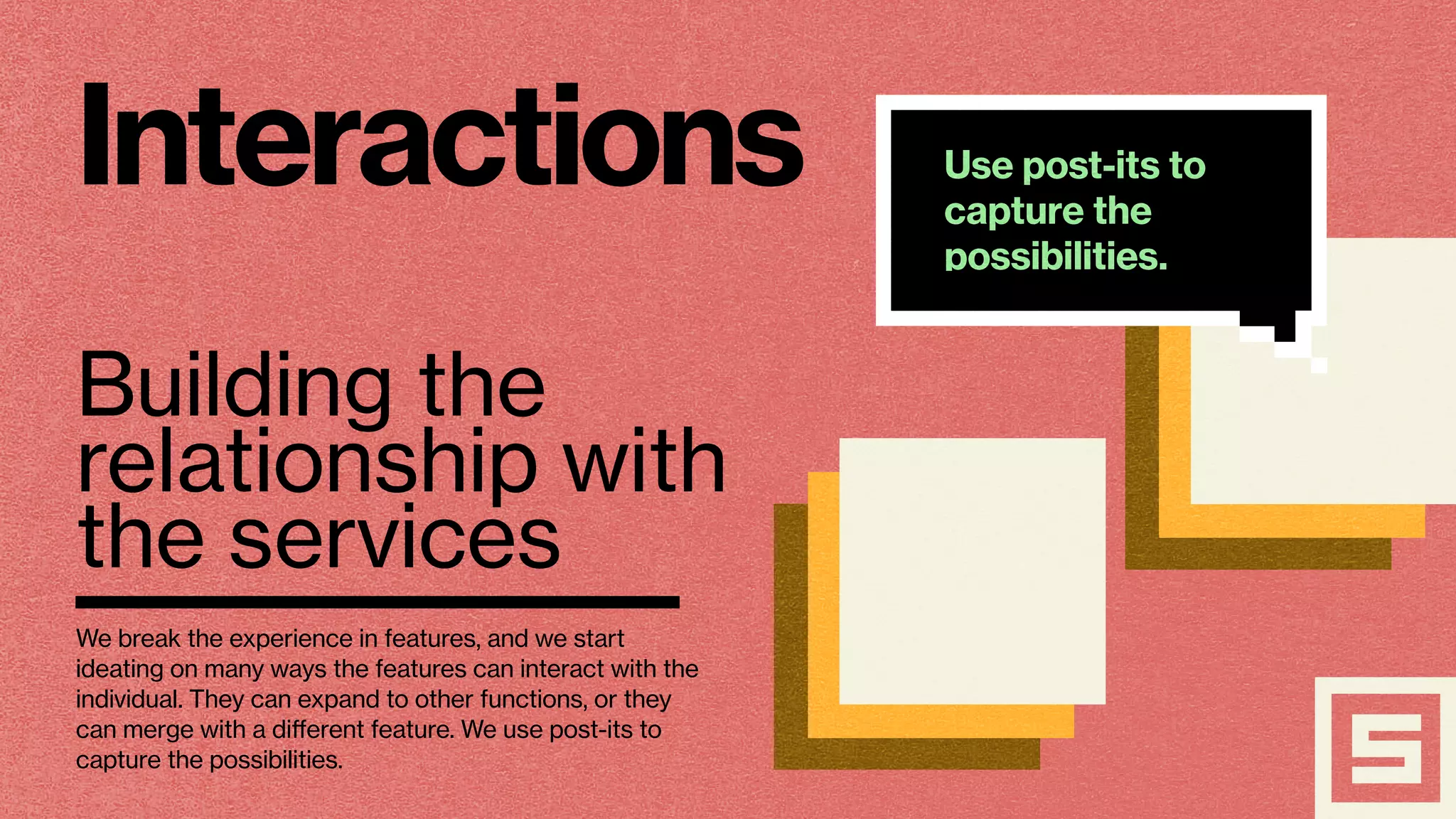
Interactions
Building the
relationship with
the services
Interactions
Building the
relationship with
the services
Use post-its to
capture the
possibilities.
We break the experience in features, and we start
ideating on many ways the features can interact with the
individual. They can expand to other functions, or they
can merge with a different feature. We use post-its to
capture the possibilities.
Environmental
encounters
Because
external factors
matter
coldblizzard
What happens if rains? It it is night? If is hot? If is
winter? Is our service still the same or are we creating
additional elements that will help our service to
perform better?
Social & Cultural
and legal and ethical
encounters
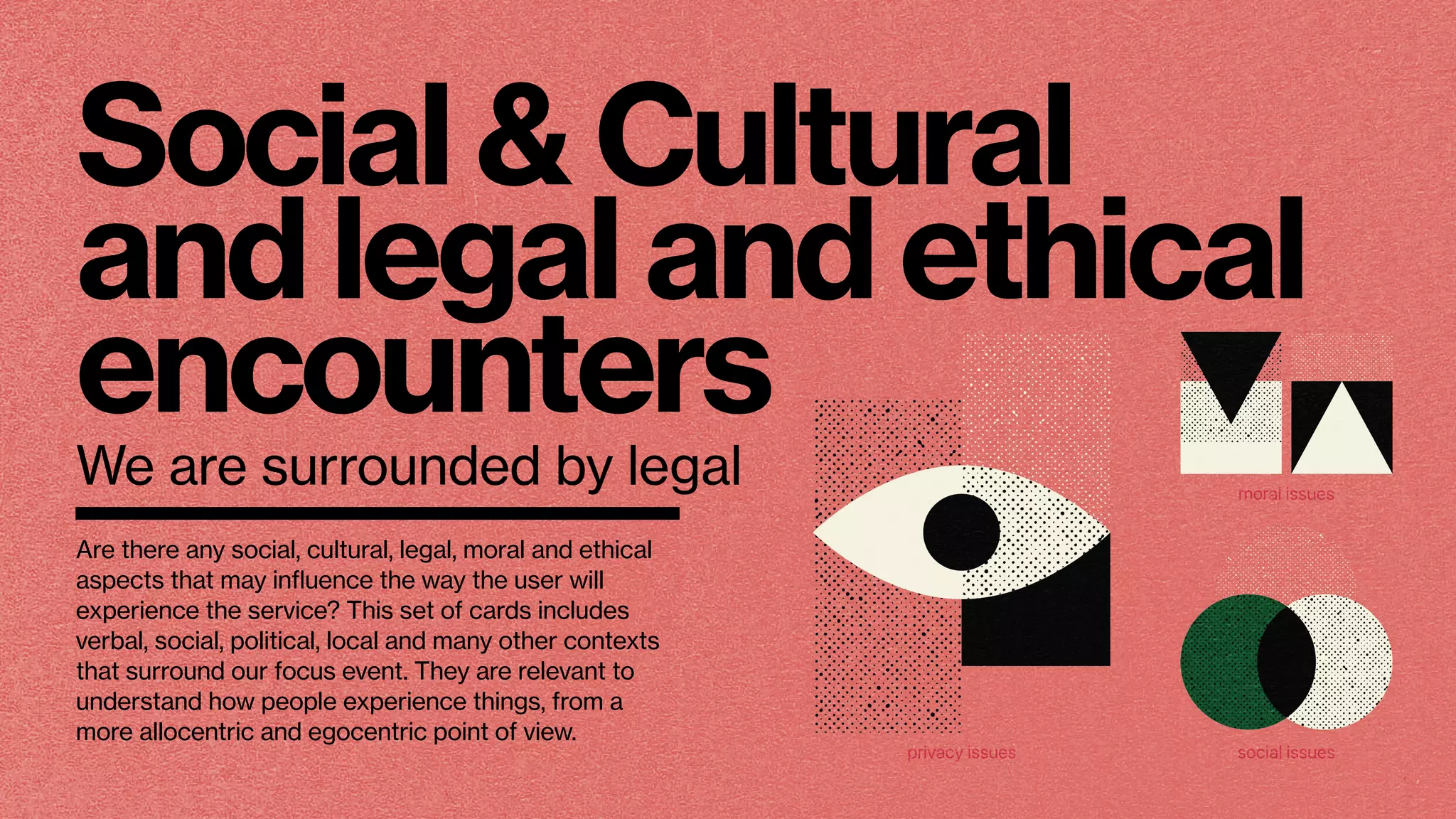
We are surrounded by legal
privacy issues
moral issues
social issues
Are there any social, cultural, legal, moral and ethical
aspects that may influence the way the user will
experience the service? This set of cards includes
verbal, social, political, local and many other contexts
that surround our focus event. They are relevant to
understand how people experience things, from a
more allocentric and egocentric point of view.
Environmental
encounters
Legal and
ethical
encounters
Environmental encounters Template
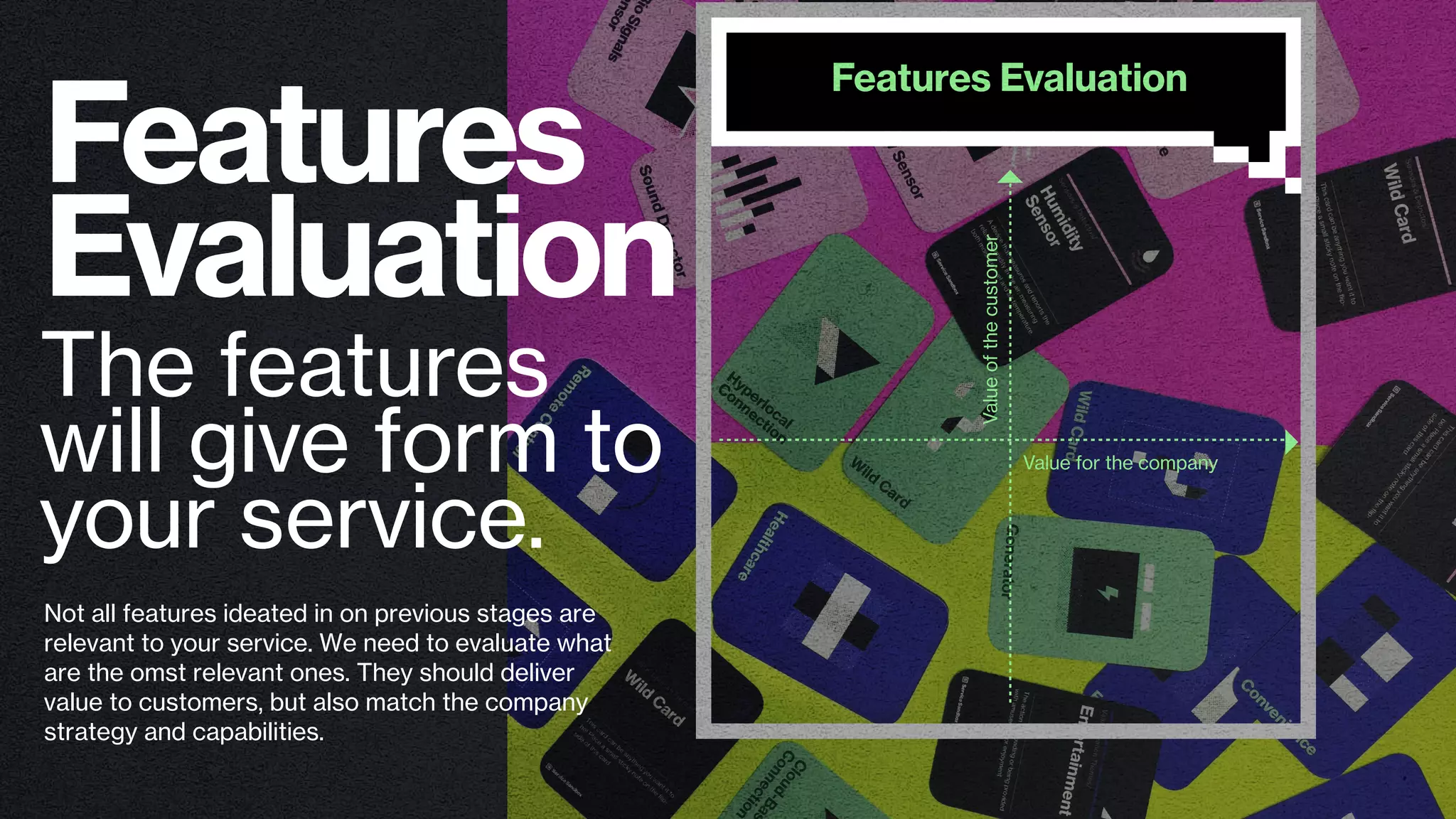
Features
Evaluation
The features
will give form to
your service.
Valueofthecustomer
Value for the company
Features Evaluation
Not all features ideated in on previous stages are
relevant to your service. We need to evaluate what
are the omst relevant ones. They should deliver
value to customers, but also match the company
strategy and capabilities.
Features Evaluation TemplateFeatures EvaluationFeatures Evaluation
Valueofthecustomer
Value for the company
Getting from tasks
to experiences
User Experience
Hierarchy of Needs by
Stephen P. Anderson
Focus on experiences driven by what your users want
to do rather than business objectives or the mechanics
of delivering your service.
Subjective/Qualitative
Meaningful
(Has personal significance)
Pleasurable
(Memorable experience
worth sharing)
Convenient
(Super easy to use,
works like I think)
Usable
(Can be used without difficulty)
Reliable
(Is availble and accurate)
Functional (useful)
(Works as programmed)
This is the “chasm that
is difficult for
organizations to cross
Focused on Experiences
(People, Activities, Context)
Objective/Quantifiable
Focused on Tasks
(Products/Features)
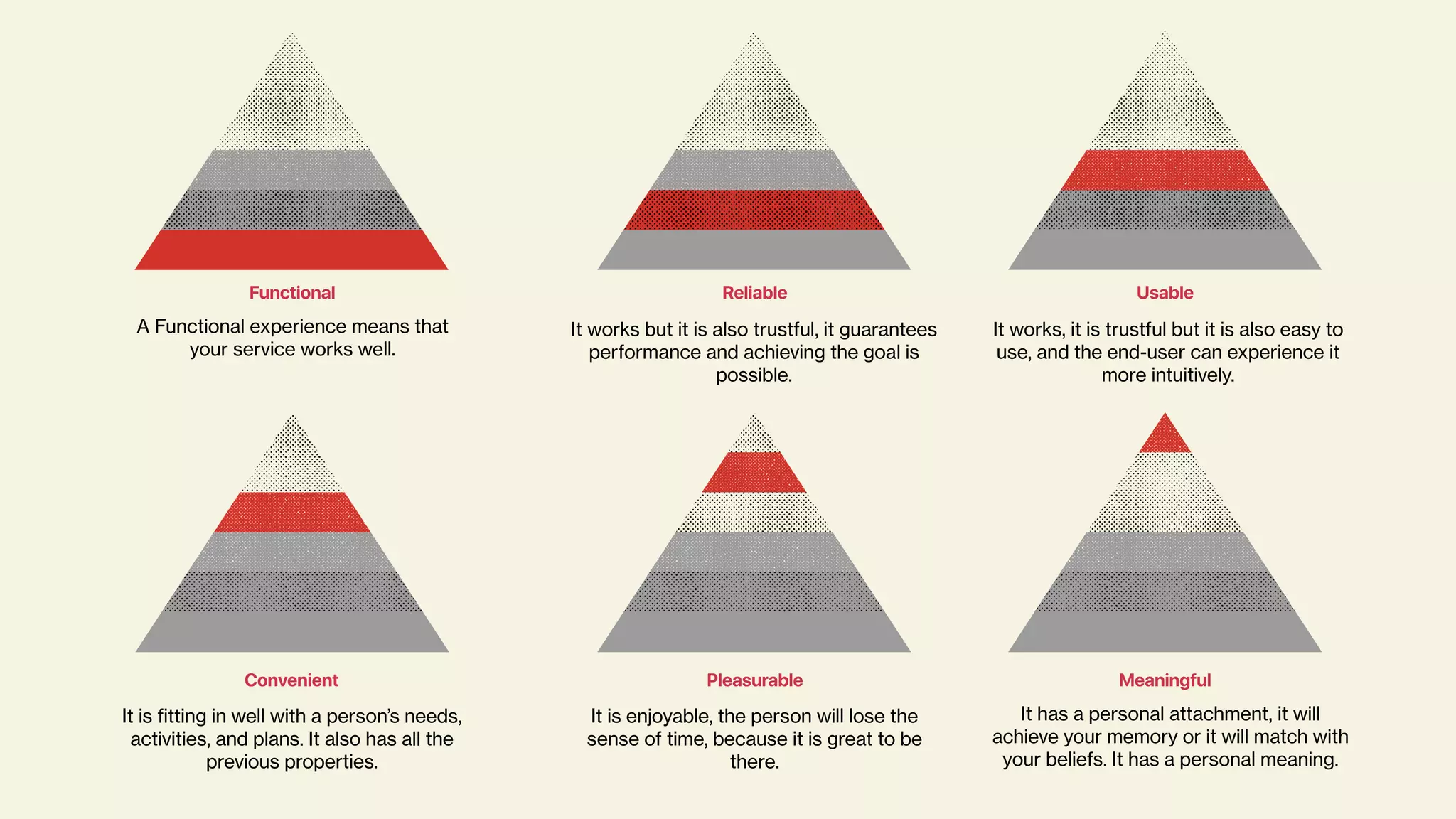
Functional
A Functional experience means that
your service works well.
Convenient
It is fitting in well with a person’s needs,
activities, and plans. It also has all the
previous properties.
Reliable
It works but it is also trustful, it guarantees
performance and achieving the goal is
possible.
Pleasurable
It is enjoyable, the person will lose the
sense of time, because it is great to be
there.
Usable
It works, it is trustful but it is also easy to
use, and the end-user can experience it
more intuitively.
Meaningful
It has a personal attachment, it will
achieve your memory or it will match with
your beliefs. It has a personal meaning.
Experience
Hierarchy
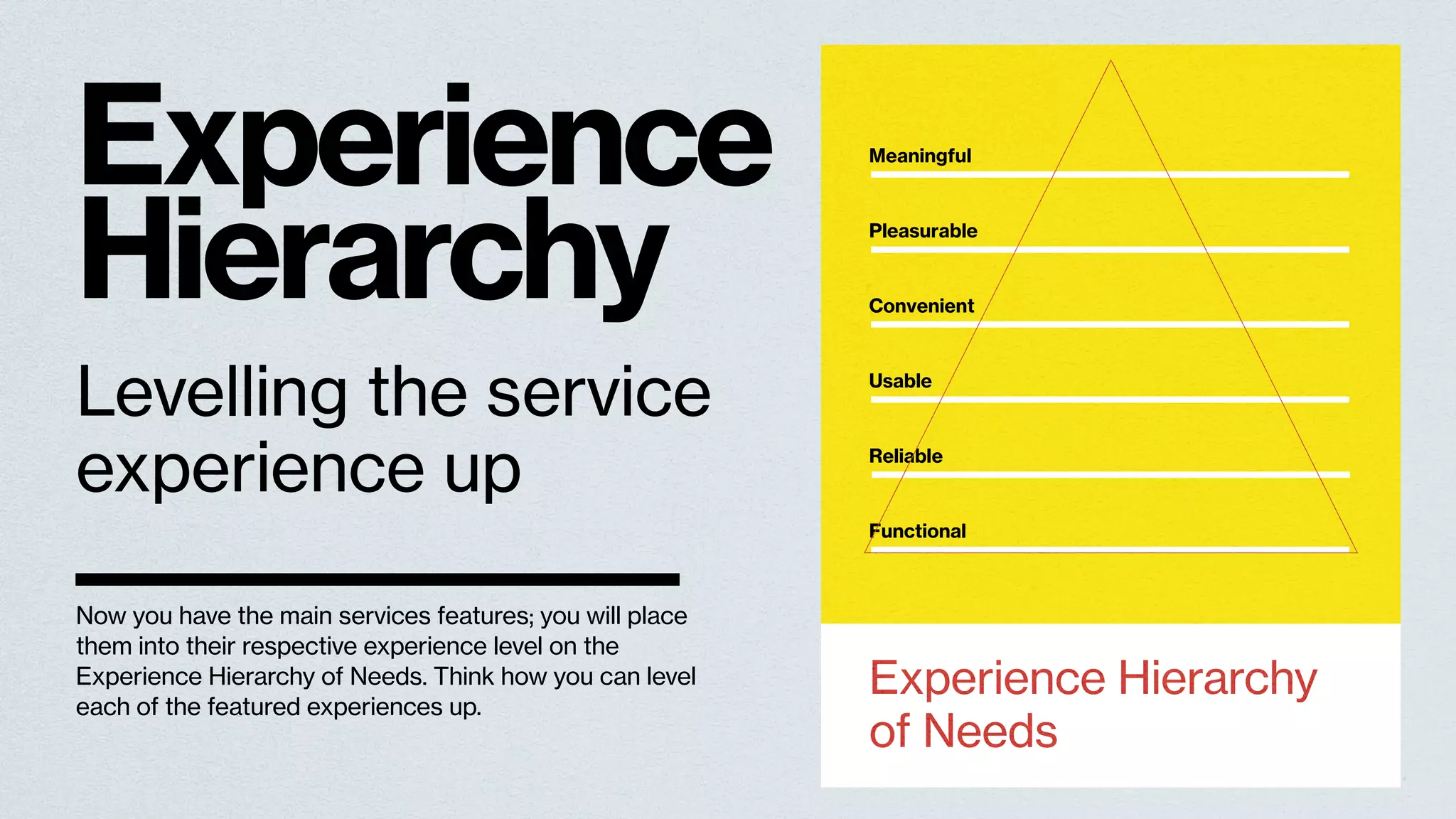
Levelling the service
experience up
Now you have the main services features; you will place
them into their respective experience level on the
Experience Hierarchy of Needs. Think how you can level
each of the featured experiences up.
Meaningful
Pleasurable
Usable
Reliable
Functional
Experience Hierarchy
of Needs
Convenient
Presenting
The Concept
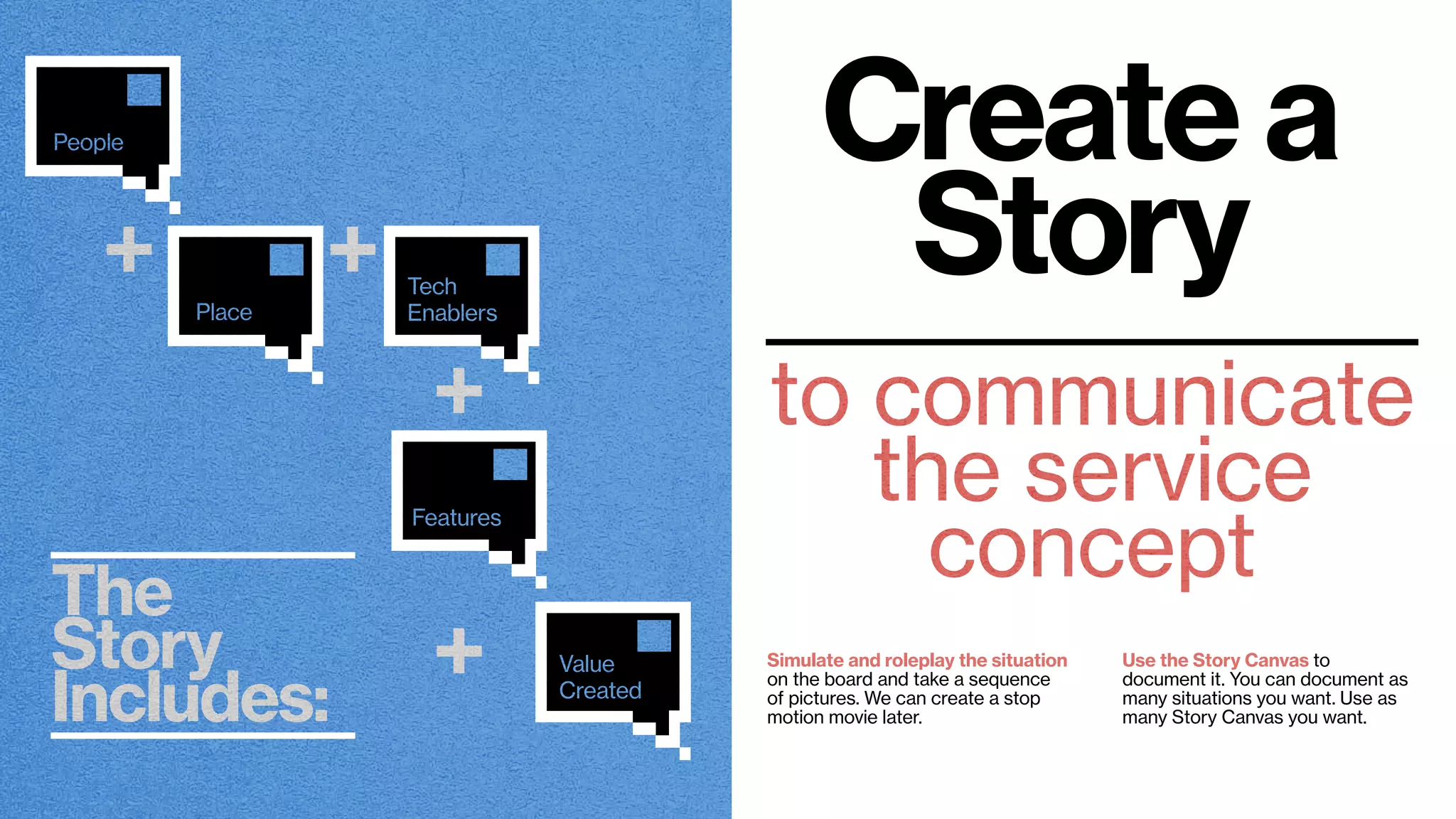
Create a
Story
The
Story
Includes:
to communicate
the service
concept
People
Place
Tech
Enablers
Features
Value
Created
Simulate and roleplay the situation
on the board and take a sequence
of pictures. We can create a stop
motion movie later.
Use the Story Canvas to
document it. You can document as
many situations you want. Use as
many Story Canvas you want.
Experience Story: How the service Works
Main features: Tech includes:
Create a story
Creating a story template
Situation (Iillustration)
Concept
wrap-up:
5 minutes5 minutes
Fill in the Elevator
Pitch Canvas!
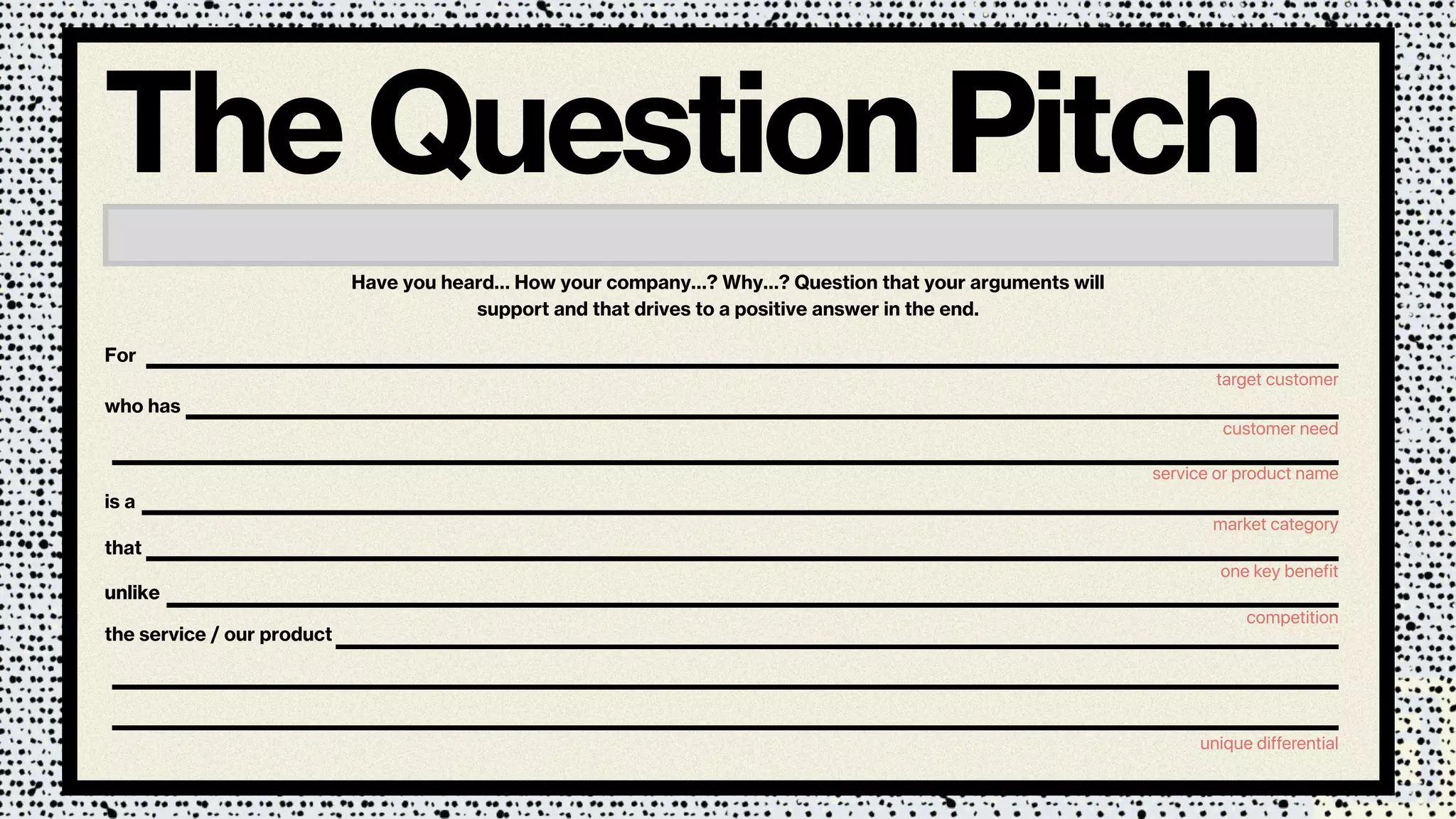
For
Have you heard… How your company…? Why…? Question that your arguments will
support and that drives to a positive answer in the end.
The Question Pitch
target customer
who has
customer need
is a
market category
that
one key benefit
unlikeunlike
the service / our product
competition
unique differential
service or product name
Envision
Operational
Applied
Accepted
Vital
Invisible
Natural
The idea stage (e.g. the time machine - still not invented or even a prototype)The idea stage (e.g. the time machine - still not invented or even a prototype)
Experimental stage - things that work in labs.
Transitional stage between invention and acceptance (e.g. Google Glass anno 2013/14)
Technologies that have become as natural as nature itself (agriculture, cooking)
Technologies that are no longer considered technologies (the alphabet, the clock)
Technologies that reach a significant level of familiarity within society
(cars, phones, microwave ovens)
Hard to live without
(sewage systems, electric lighting, the internet)
Source: Dutch artist,
philosopher and scientist
Koert van Mensvoort of
Next Nature book
Naturalized
Invisible
Vital
Accepted
Operational
Envisioned
Thank you!
http://www.servicesandbox.net
Jane Vita @janevita
Studio Design Director
at Digitalist Vancouver
jane.vita@digitalistgroup.com
http://www.janevita.com

Meeting the Service Sandbox

  • 1.
  • 2.
  • 3.
  • 4.
  • 5.
    Why Sandbox? Encourages userto explore and have autonomy to select their next steps and immerse in specific interactions points. It is aligned with System and Design thinking approach They will decide what happens, how they will play with your service building blocks, that were being assigned with a contextual meaning. Rather than paths, sandboxes are not shaping behaviour, instead creates engagement and keeps user in control.
  • 6.
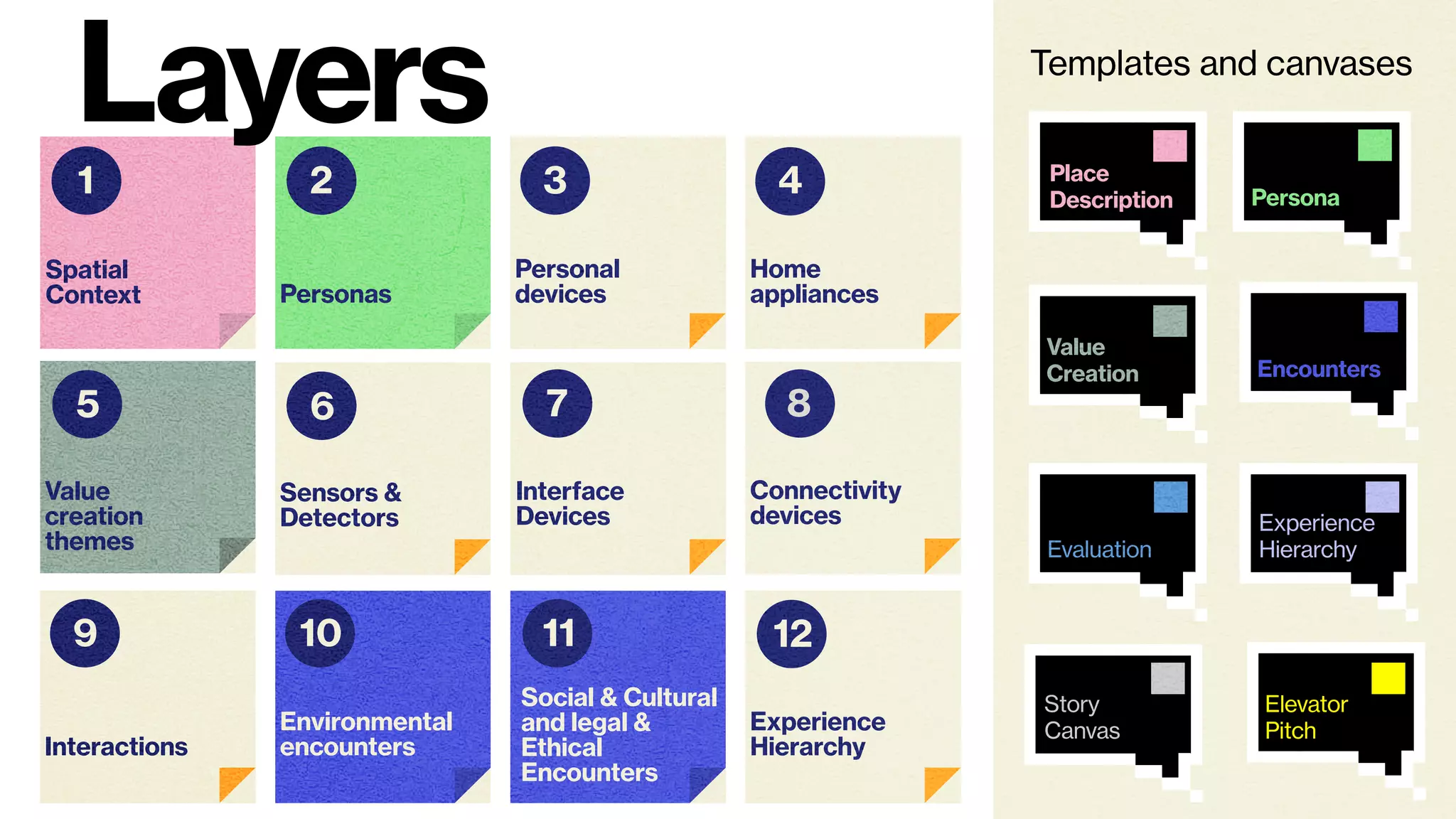
    Personal devices Home appliances Sensors & Detectors Personas Value creation themes Interface Devices Interactions Environmental encounters Social &Cultural and legal & Ethical Encounters Experience Hierarchy Connectivity devices 1 2 3 9 87 4 10 11 36 12 5 Spatial Context Place Description Persona Value Creation Encounters Evaluation Experience Hierarchy Story Canvas Elevator Pitch Layers Templates and canvases
  • 7.
    Spatial context Description of the place andplace tiles Each room is essential to your service creation. The room purpose can give you insights about what kinds of activities people perform there, i.e., kitchen - cooking, eating, family time, among others. Living spaces Smart Cities Modular Dashboards …
  • 8.
  • 9.
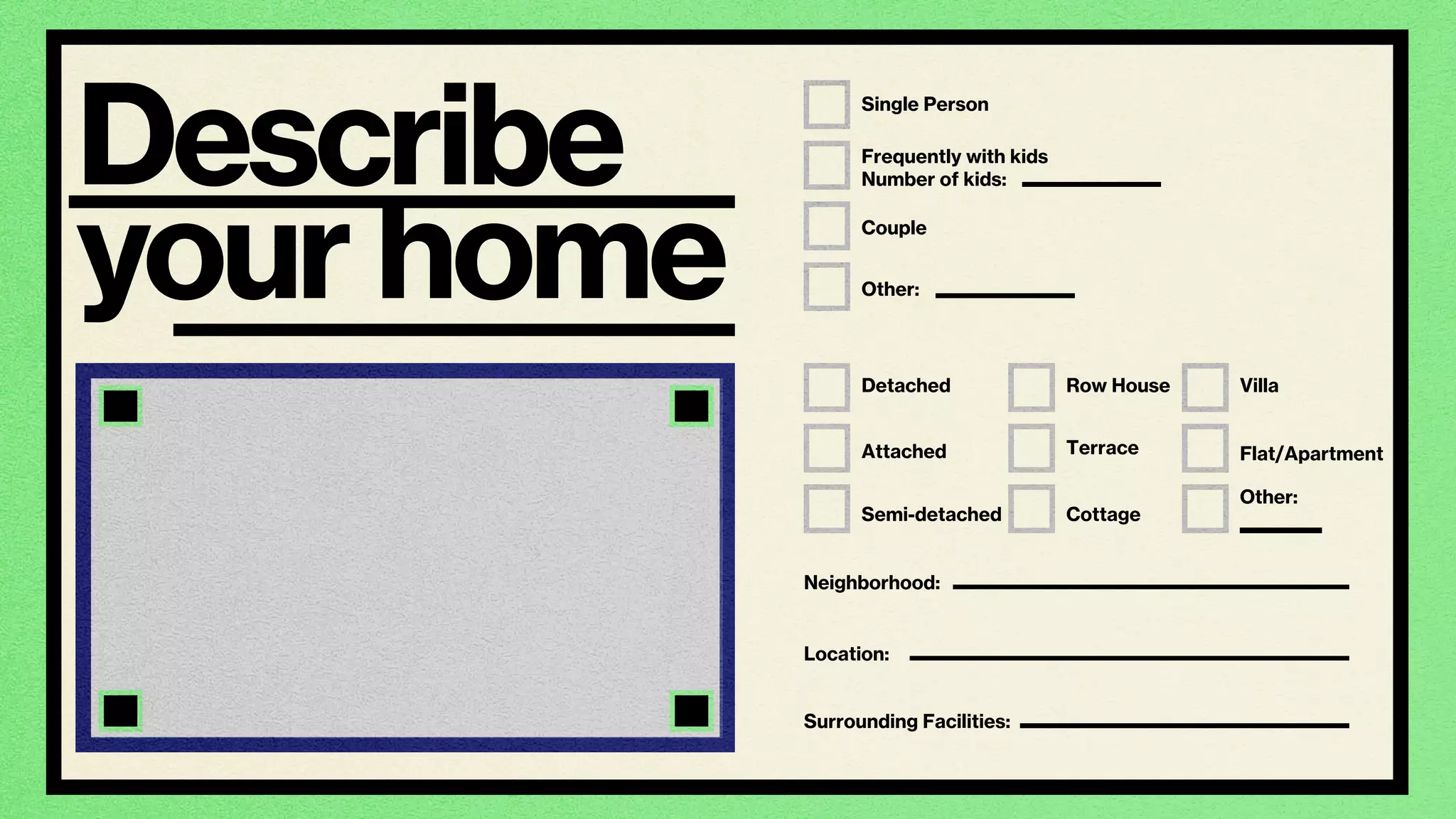
    home Single Person Detached Attached Semi-detached Row House Terrace Cottage Villa Flat/Apartment Other: Couple Frequentlywith kids Number of kids: Other: Neighborhood: Location: Surrounding Facilities: Describe your
  • 10.
    Personas Templates and tokens The Service Sandboxincludes a template that helps you to describe people that are experiencing your service. You will represent each persona with a token in the board.
  • 11.
    Name: Short bio:Short bio:Cultural encounters: Family Composition: Ethics: Mood: Motivation: Personal Devices: Social encounters: Permanent disabilities: Temporary disabilities: Routine: Age: Archetype: Occupation: Material Status: Family Member: Familiarity with technology: Persona Low Med High
  • 12.
    Personal devices Gathering personal information BikeSmart Jewelry Bio/Health DeviceVirtualReality Personal devices are devices owned by an individual. These devices are used in different contexts and they serve multiple purposes that can enhance the service experience.
  • 13.
    Appliances For home, office, hospitaletc. Our first set includes home appliances, but the whole layer could be substituted by other appliances related to other places, such as office and hospitals. They represent specific use, associated with the daily activities happening on that particular ambient. They are not necessarily smart, but they can become one. WasherA/C Coffee MakerFanA
  • 14.
    Value creation themes Purpose of the placeand the values created Places have a purpose, and we visit them with an intention. We expect that those places can deliver the moments that we are looking. We go home for example to have a pleasurable moment with our families, to rest to sleep and to eat. We go to hospitals to get the doctor advice, to be treated, to seek a cure for an illness. Our values are created around those moments. The themes help us to understand what are the values we need to create concerning a specific place and service proposed. comfort learning
  • 15.
    What’s Happening Value Creation PlacePost-It Drawing Here Template 1 What’s Happening Value Creation Place Post-It Drawing Here Template 2 What’s Happening Value Creation Place Post-It Drawing Here 3 Template TemplateTemplate
  • 16.
    Life situations Not the problemyou are trying to solve.
  • 17.
    Create a situationfor each of the value themes. Think of a situation when we can deliver the promised value. Ideate and pick up the best. Use the post-its. Values & Situations: Use the post-its. 1 2 3
  • 18.
  • 19.
    Sensors and detectors Sensors and detectorsare devices which detect or measure a physical property and record, indicate, or respond to it. There is a great variety of sensors and detectors and they will help you to capture the necessary data to make your service meaningful. Detect and/or measure Vibration SensorMotion Sensor Humidity SensorFlow sensor
  • 20.
  • 21.
    Interface devices Interacting with machines Air QualityMeterCamera Intelligent Personal AssistantRadiator Control Valve An interface device is a hardware component or system of components that allows an individual to interact with a machine. Personal devices are interface devices, but we do not include them in this set since they are represented in the other another deck.
  • 22.
    Connectivity devices Connecting machines and data The connectivitydevices are responsible for the communication and network, i.e., between machines, between machine and personal devices and data generated by the machines and individuals to the cloud. Hyperlocal ConnectionCloud-based Connection BluetoothBattery
  • 23.
    Maximizing the role oftechnology and the experience Deep in time context and interactions
  • 24.
  • 25.
    Interactions Building the relationship with theservices Use post-its to capture the possibilities. We break the experience in features, and we start ideating on many ways the features can interact with the individual. They can expand to other functions, or they can merge with a different feature. We use post-its to capture the possibilities.
  • 26.
    Environmental encounters Because external factors matter coldblizzard What happensif rains? It it is night? If is hot? If is winter? Is our service still the same or are we creating additional elements that will help our service to perform better?
  • 27.
    Social & Cultural andlegal and ethical encounters We are surrounded by legal privacy issues moral issues social issues Are there any social, cultural, legal, moral and ethical aspects that may influence the way the user will experience the service? This set of cards includes verbal, social, political, local and many other contexts that surround our focus event. They are relevant to understand how people experience things, from a more allocentric and egocentric point of view.
  • 28.
  • 29.
    Features Evaluation The features will giveform to your service. Valueofthecustomer Value for the company Features Evaluation Not all features ideated in on previous stages are relevant to your service. We need to evaluate what are the omst relevant ones. They should deliver value to customers, but also match the company strategy and capabilities.
  • 30.
    Features Evaluation TemplateFeaturesEvaluationFeatures Evaluation Valueofthecustomer Value for the company
  • 31.
    Getting from tasks toexperiences User Experience Hierarchy of Needs by Stephen P. Anderson Focus on experiences driven by what your users want to do rather than business objectives or the mechanics of delivering your service. Subjective/Qualitative Meaningful (Has personal significance) Pleasurable (Memorable experience worth sharing) Convenient (Super easy to use, works like I think) Usable (Can be used without difficulty) Reliable (Is availble and accurate) Functional (useful) (Works as programmed) This is the “chasm that is difficult for organizations to cross Focused on Experiences (People, Activities, Context) Objective/Quantifiable Focused on Tasks (Products/Features)
  • 32.
    Functional A Functional experiencemeans that your service works well. Convenient It is fitting in well with a person’s needs, activities, and plans. It also has all the previous properties. Reliable It works but it is also trustful, it guarantees performance and achieving the goal is possible. Pleasurable It is enjoyable, the person will lose the sense of time, because it is great to be there. Usable It works, it is trustful but it is also easy to use, and the end-user can experience it more intuitively. Meaningful It has a personal attachment, it will achieve your memory or it will match with your beliefs. It has a personal meaning.
  • 33.
    Experience Hierarchy Levelling the service experienceup Now you have the main services features; you will place them into their respective experience level on the Experience Hierarchy of Needs. Think how you can level each of the featured experiences up. Meaningful Pleasurable Usable Reliable Functional Experience Hierarchy of Needs Convenient
  • 34.
  • 35.
    Create a Story The Story Includes: to communicate theservice concept People Place Tech Enablers Features Value Created Simulate and roleplay the situation on the board and take a sequence of pictures. We can create a stop motion movie later. Use the Story Canvas to document it. You can document as many situations you want. Use as many Story Canvas you want.
  • 36.
    Experience Story: Howthe service Works Main features: Tech includes: Create a story Creating a story template Situation (Iillustration)
  • 37.
    Concept wrap-up: 5 minutes5 minutes Fillin the Elevator Pitch Canvas!
  • 38.
    For Have you heard…How your company…? Why…? Question that your arguments will support and that drives to a positive answer in the end. The Question Pitch target customer who has customer need is a market category that one key benefit unlikeunlike the service / our product competition unique differential service or product name
  • 39.
    Envision Operational Applied Accepted Vital Invisible Natural The idea stage(e.g. the time machine - still not invented or even a prototype)The idea stage (e.g. the time machine - still not invented or even a prototype) Experimental stage - things that work in labs. Transitional stage between invention and acceptance (e.g. Google Glass anno 2013/14) Technologies that have become as natural as nature itself (agriculture, cooking) Technologies that are no longer considered technologies (the alphabet, the clock) Technologies that reach a significant level of familiarity within society (cars, phones, microwave ovens) Hard to live without (sewage systems, electric lighting, the internet) Source: Dutch artist, philosopher and scientist Koert van Mensvoort of Next Nature book Naturalized Invisible Vital Accepted Operational Envisioned
  • 41.
    Thank you! http://www.servicesandbox.net Jane Vita@janevita Studio Design Director at Digitalist Vancouver jane.vita@digitalistgroup.com http://www.janevita.com